Livre Rare Book
Livre Rare Book
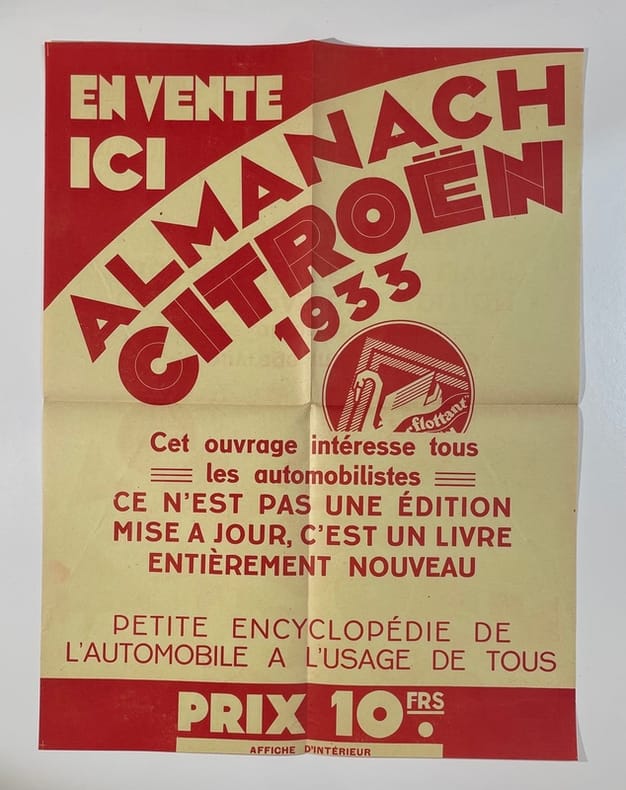
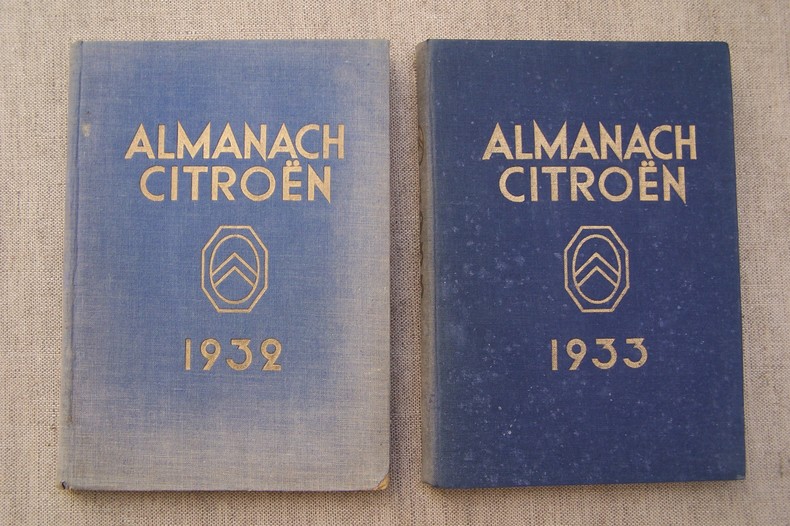
ALMANACH CITROEN 1932 1933
AUTO480Ensemble de deux volumes in-8, 352 et 251 pages.
Librairie Le Carrérès · Paris, France90,00 €
652 résultats
013660Musée des années 30 - Somogy 0 In-4 carré Broché couverture illustrée
29400Paris, Société Anonyme André Citroën, 1932. , In 8°relié pleine toile bleue d' éditeur, titre doré sur le premier plat, 351 pages,
AUTO480Ensemble de deux volumes in-8, 352 et 251 pages.
1238In-8, toile éditeur bleue. Belle affiche jointe, pliée.On joint l'Almanach Citroën 1935 (toile éditeur orange et or, salie ; incomplet des 20 premières pages).On joint 2 brochures : - Traction avant Citroën, 7, 11, 11 légère. 1938. In-12, 14 pp., agrafé, illustrations photographiques. Dos fendu, petits frottements et marge du second plat abîmée.- Les 11 cv Traction avant Citroën. 1952. In-12, 27 pp., agrafé, dessin. Salissures.
1975378732-UA13Amsterdam : Noord-Hollandsche Uitgeversmaatschappij 1975. Hardcover. Good. Originele zwarte linnen band met zilveropdruk stofomslag veel illustraties in z/w klein 4to.; Enkele lichte krassen op voor- en achterzijde stofomslag klein scheurtje in stofomslag gerepareerd met tape pagina 118 en 119 licht gevlekt. Amsterdam : Noord-Hollandsche Uitgeversmaatschappij hardcover
1975384758-UF4Amsterdam : Noord-Hollandsche Uitgeversmaatschappij 1975. Hardcover. Good. Originele zwarte linnen band met zilveropdruk stofomslag veel illustraties in z/w klein 4to.; Klein scheurtje stofomslag geplakt. Amsterdam : Noord-Hollandsche Uitgeversmaatschappij hardcover
199887055Arthaud 1998 In-4 cartonnage éditeur sous jaquette 30,1 cm sur 24,7. 200 pages. Jaquette en assez bon état. Très bon état d’occasion.
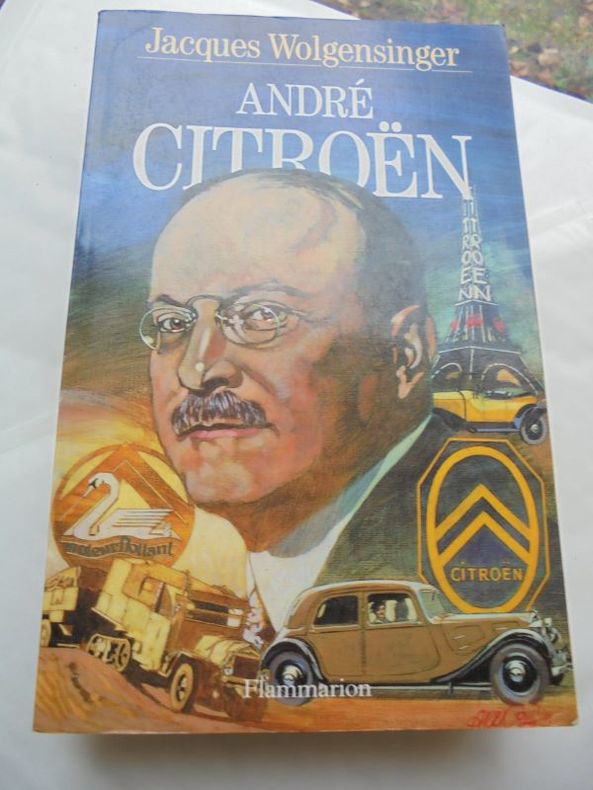
17570Broché - 15 x 24 - 310 pp - année 1991 - Editions Flammarion - illustrations -
in-8°, 310 pages, ill. hors texte N&B, broche, couverture illustree plast. Bel exemplaire [CA26/2]
4152Broché, 24X15 cm, 1991, 311 pages, photos en noir, éditions Flammarion. Bon état.
46348E.P.A.1980.In-8 avec jaquette en couleurs.317 p.Iconographie importante. TBE avec jaquette un peu frottée.
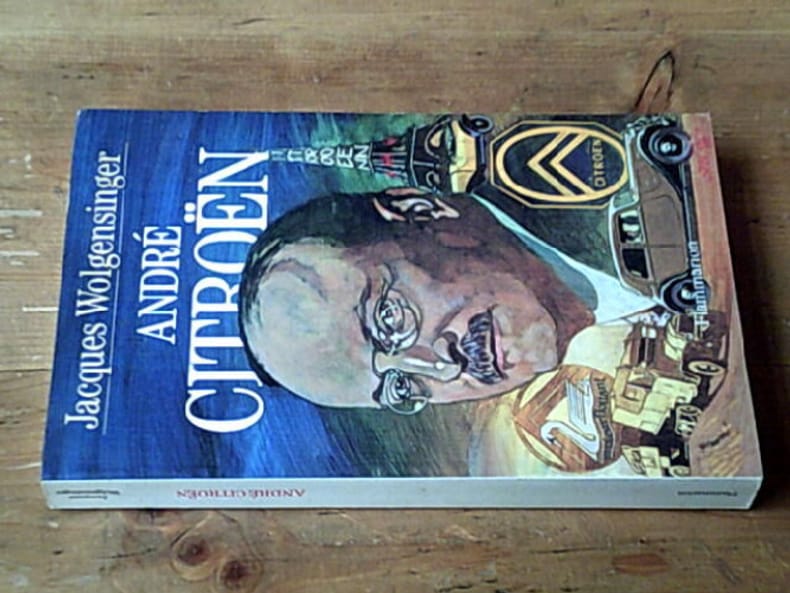
199325541Flammarion 1993 310 pages in-8. 1993. Broché. 310 pages. Avec des illustrations en noir hors-texte - Ce livre retrace la vie d'André Citroën fondateur de la marque automobile Citroën à travers ses réalisations emblématiques comme la Croisière noire et la Traction avant. L'auteur Jacques Wolgensinger explore le parcours exceptionnel de cet industriel visionnaire
15315Paris, E.P.A., 1980. In-8 broché, 1957. In-4 cartonné, jaquette ill. (chevrons et portrait), 223 p. Très nombreuses illustrations en noir. Avec un disque 45 tours in fine : Bande sonore originale du livre. Bon état.
AUTO171Les Hommes du Jour, 1933. In-4, 16 pp (1 pages consacrée à Citroën), couverture illustrée par Cabrol, br.
198079767Paris, E.P.A 1980 In-4 27 x 20,5 cm. Cartonnage éditeur gris, jaquette noire illustrée, 317 pp., nombreux documents d’époque, bibliographie, sommaire. Jaquette légèrement effrangée, sinon exemplaire en bon état.
19801107691980 Editions E.P.A. - 1980 - In-4, cartonnage toilé gris sous jaquette illustrée - 313 pages - Nombreuses reproductions photographiques en N&B in et hors-texte - Avec son vinyle en bon état
69842S.l., éd. E.P.A., mars 1980, EDITION ORIGINALE, pt. in-4, cartonnage toilé gris clair éd., jaquette ill. coul. avec 1 photo en noir de André Citroën, 320 pp., papier glacé, très nb. photos en noir, sommaire, bibliographie, complet du disque 45 tours en fin de volume, Un très "grand" livre sur l'histoire et l'activité d'André Citroën. De nombreuses photographies et documents anciens inédits. Bien complet du disque 45 tours du discours d'André Citroën. Pas courant. Très bon état de la reliure et du papier; petites déchirures à la jaquette
201190612E.T.A.I 2011 In-4. Cartonnage éditeur illustré en couleurs, Jaquette illustré en couleurs, 159 pp., illustrations, plans, documents en noir & blanc et en couleurs.
77190Paris Citroën 1915-1916. In two volumes. Oblong folio 31.5 x 43.7 cm. 71 original photographs 22.0 x 28.5-35.5 cm mounted on grey cardboard with printed captions 60; 11. Uniform full mottled calf. Boards with double gilt-rolled ornamental borders and gilt title. = A very rare set both volumes dealing with the Parisian factory founded by André-Gustave Citroën 1878-1935 renowned for its technologically advanced cars but also for its contributions to the French war industry during WWI and in particular the contributions women made as factory workers in the mass production of artillery shells. The first volume is entirely devoted to this subject showing the female munitions-workers at work. André Citroën played an essential part in French women's emancipation: once the women had left their traditional singular role as homemakers replacing the men who fought in the trenches there was no looking back and after the war their participation in the country's workforce became permanent. "World War I radically changed women's role in society as they stepped into the boots of men gone to fight for their countries. In cities across Europe women took on traditionally 'male' jobs - waiting on tables delivering the mail teaching in boys' schools or handling cash as bank clerks. 'Women rapidly became indispensable not only in the nursing and welfare services but in offices and factories and agriculture changing the whole balance of society in the process' says historian Michael Howard. As soon as war broke out in 1914 France's prime minister Rene Viviani called on women to 'replace in the workplace those who are on the battlefield'. . From 1915 onwards Europe's industry - devoted to the war effort - relied massively on the female workforce as did that of the United States from 1917. 'Without women victory will tarry' warned Britain's soon-to-be prime minister David Lloyd George in 1915. Some 400000 women were toiling in France's war factories by 1918 - a quarter of the workforce - handling some 2500 shells per exhausting 11-hour shifts" AFP. The second volume records the building and operational start of the factory itself. It shows the evolution of the works starting with a photo of the still-vacant lot save for gardens and sheds followed chronologically by views of all building developments including one with the famous Eiffel Tower in the distance. Groundwork started in March 1915 and by the 28 September the largely female workforce had already become fully active. The final photo shows the official ceremonial opening of the factory on 24 June 1916 revealing decorations given by General Gilinski on behalf of the Russian emperor. "As soon as war was declared in August 1914 André Citroën was mobilized as a lieutenant then as captain in the 2nd Grenoble Artillery Regiment. On the eastern front he was able to witness France's lack of artillery and ammunition to counter the German forces. Following the death of his brother Bernard on the front André Citroën was determined not only to do his duty but also to repel the enemy as far as possible. In January 1915 he proposed to General Louis Baquet director of artillery at the Ministry of War which was sorely lacking in ammunition to apply Fordism in a factory built in three months and capable of producing 5000 to 10000 artillery shells of Type 75 per day. Thanks to his savings those of his right-hand man Georges-Marie Haardt and especially financing from a rich diamond dealer of Armenian origin Atanik Eknayan who had already saved his fragile Mors 12 car business Citroën erected a huge ultramodern factory on 15 hectares of vacant land and vegetable gardens on the Quai de Javel. With some 13000 workers the factory produced 23 million shells at a rate of 10000 per day an unprecedented rate at the time. 'You have to produce quickly well and economically to put the products manufactured within the reach of the greatest possible number of consumers he said. The pace the factories imposed on workers was tiring and as a result André Citroën was sometimes considered a despot. Nevertheless he was one of the first manufacturers concerned about the well-being of his workers and avoided imposing repetitive tasks. André Citroën's ammunition business quickly gained a reputation and became a model of organization efficiency and social responsibility. Major personalities both civil and military visited the factory. Between 1917 and 1918 the government also charged Citroën with reorganizing supplies for the armaments industry the military postal services and with the distribution of bread ration tickets in the Paris region. When the war was over André Citroën decided to convert his factory on the Quai de Javel into a car manufacturing plan" taken from French Wikipedia. Boards a bit rubbed; a skilful repair to one joint one photograph with a brown spot in the top left corner; otherwise in an excellent state. hardcover
Hardcover in-4° 217 pp., abdt illustre en noir, cartonnage sous jaquette illustree de l'editeur. Bel exemplaire. [P-35]
51235N° 13 - mars-avril 1973 - Tavard Editeur - revue illustrée - in-4 broché
201299008Post Editions. New. 2012. Paperback. 9460830501 . FREE UPGRADE to Courier/Priority Shipping Upon Request - IN STOCK AND IMMEDIATELY AVAILABLE FOR SHIPMENT - Flawless copy brand new pristine never opened -- 416 pp. ; 373 illus. 231 in color. -- with a bonus offer-- . Post Editions paperback
231803977Rotterdam post editions. 2011 414 pp. paperback original Dutch edition in fine condition Rotterdam, post editions paperback
1993LFA-126737129Une publication de 34 pages, format 210 x 295 mm, illustrée, brochée couverture couleurs, publiée en 1993, SNEP, bon état
1993LFA-126737132Une publication de 34 pages, format 210 x 295 mm, illustrée, brochée couverture couleurs, publiée en 1993, SNEP, bon état