[ABRAHAM LINCOLN]. [RACISM]Biblio.com

9 915 résultats
186425614<p>The second in a series of four racist political cartoons published in 1864 by Bromley & Company which was closely affiliated with the Copperhead New York <i>World</i> newspaper. These prints sought to undermine Abraham Lincoln's chances for reelection by branding him as a "miscegenationist" and playing on white fears of "race-mixing." The cartoon scene pictures several interracial couples enjoying a day at the park eating ice cream discussing wedding plans and a woman's upcoming lecture. Two African American families have white employees a carriage driver and footmen and a babysitter.</p><p>The only other example traced at auction brought $7800 in 2010.</p> <b>ABRAHAM LINCOLN. RACISM.</b>Print. "Miscegenation or the Millennium of Abolitionism." Political Cartoon. New York: Bromley & Co. 1864. 1 p. 20¾ x 13â… in.<p><br /></p><p>American politics had long played on fears of sexual relationships between races. A powerful new word for "race-mixing" was coined in an anonymous December 1863 pamphlet entitled <i>Miscegenation: The Theory of the Blending of the Races Applied to the American White Man and Negro</i> published in New York. Purporting to advocate the virtues of the "blending of the white and black races on this continent" it was a literary forgery prepared by <i>The World</i> managing editor David Goodman Croly and reporter George Wakeman. The authors were unsuccessful in their attempt to trick President Lincoln into endorsing the work.</p><p>At the far left of the image Abraham Lincoln declares "<i>I shall be proud to number among my intimate friends any member of the Squash family especially the little Squashes.</i>" The African American woman to whom he is speaking replies "<i>I'se 'quainted wid Missus Linkum I is washed far her 'fore de hebenly Miscegenation times was cum. Dont do nuffin now but gallevant 'round wid de white gem'men! he-ah! he-ah! he-ah!</i>"</p><p>Senator Charles Sumner says "<i>Mr. President! Allow me the honor of introducing my very dear friend Miss Dinah Arabella Aramintha Squash.</i>" A white carriage driver complains in the background "<i>Gla-a-ang there 240t! White driver white footmen niggers inside my heys! I wanted a situation when I took this one</i>" while a black man in the carriage tells his companion "<i>Phillis de_ah dars Sumner. We must not cut him if he is walking.</i>" A black woman at a table tells a white man with her "<i>Ah! Horace its-its-its-bully 'specially de cream</i>" and he replies "<i>Ah! my dear Miss Snowball we have at last reached our political and social Paradise. Isn't it extatic</i>"</p><p>To the right are two couples embracing each a white woman and an African American man. The first white women tells her partner "<i>Oh! You dear creature. I am so agitated! Go and ask Pa</i>" to which he replies "<i>Lubly Julia Anna name de day when Brodder Beecher shall make us one!</i>" The second white woman says "<i>Adolphus now you'll be sure to come to my lecture to morrow night won't you</i>" to which he answers "<i>I'll be there Honey on de front seat sure!</i>" In the background are various immigrant minorities viewing the scene. One exclaims "<i>Most hextwadinary! Aw neva witnessed the like in all me life if I did dem me!</i>" and another adds "<i>Mine Got vat a guntry vat a beebles!</i>" An Irish girl complains "<i>And is it to drag nagur babies that I left old Ireland Bad luck to me.</i>"</p><p>Manton Marble the editor of <i>The World</i> collaborated with printmaker Bromley & Company to issue a series of four anti-Lincoln "Political Caricatures." The present example was the No. 2 in that series. No. 1 was "The Grave of the Union or Major Jack Downing's Dream"; No. 3 "The Abolition Catastrophe Or the November Smash-up"; and No. 4 "The Miscegenation Ball."</p><p>Republicans responded by trying to turn the "miscegenation" charge against the Democrats. A Republican print "The Political "Siamese" Twins: The Offspring of Chicago Miscegenation" pictures McClellan and Pendleton joined together despite their very different ideas on ending the war.</p><p>Although Abraham Lincoln won New York states' electoral votes in 1860 Stephen Douglas had carried New York City and its environs. Financial elites fearing that civil war would ruin business and recent immigrants fearing competition with free black labor supported Douglas. Lincoln's unpopularity in New York City during the Civil War was a factor in the deadly 1863 Draft Riots.</p><p>In 1864 Lincoln again won the states' electoral votes while New York City favored his Democratic opponent McClellan. In fact Lincoln's majority dropped from 50136 votes in 1860 to only 7373 votes in 1864 with approximately 50000 more total votes cast than in 1860.</p><p>Bromley and Company continued to sell the caricatures after the election as this January 1865 advertisement from an Ohio newspaper makes clear. Another advertisement assured purchasers that the set of four prints available for $1 were "sent on wooden rollers to insure safe carriage."</p><p><b><i>The World</i></b> 1860-1931 a daily independent newspaper was published in New York City. Alexander Cummings founded it as a religious Republican outlet in 1860. August Belmont and others purchased it in 1862 changing the editorial focus. With editor Manton Marble 1834-1917 <i>The World</i> soon became the country's leading Democratic newspaper. In 1864 Union authorities shut down <i>The World</i>and another paper for three days after they published forged documents purportedly written by Lincoln that were really part of a hoax to manipulate the price of gold. The paper actively supported George B. McClellan against Lincoln in 1864.</p><p><b>Condition</b></p><p>Fine for exhibit despite flaws. Cropped with loss of "Political Caricature No. 2" from top edge and part of printed pricing information from bottom edge publisher's name rubbed out from the copyright statement lacking ½" from lower left corners a few short tape repairs by the edges a 2" closed tear through the second dialogue bubble along the top edge and a 3" closed tear parallel to the right edge. Mount remnants on verso.</p>
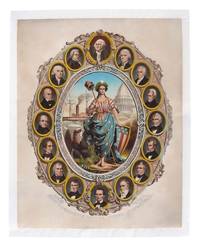
186131279Philadelphia: F. Bouclet 1861. Very Good. Philadelphia: F. Bouclet 1861. Original color lithograph 68x54cm. Mounted to matte backing; marginal tears and soiling; rubbing and a few scrapes around title; colors remain bright; a Very Good copy. <br /> <br /> This large vibrant lithograph was issued to commemorate Lincoln's first inauguration depicting the first sixteen Presidents with George Washington at top a beardless Abraham Lincoln at the bottom. The female personification of Columbia stands in the center before the Capitol holding a shield and staff with a liberty cap. The Capitol Dome sits in the background and is depicted as the artist anticipated it would look--the structure was not completed until late 1863. A handsome and uncommon print scarce in retail and auction records with only two holdings found in OCLC at the Library of Congress and the Mankato Area Public School District in Minnesota. . F. Bouclet unknown
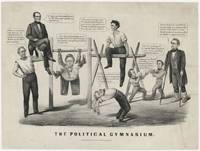
186060001<p><strong>Scarce iconic & fantastic lithograph Abraham Lincoln cartoon <em>The Political Gymnasium</em></strong></p><p>Abraham Lincoln Louis Mauer <strong><em>The Political Gymnasium</em></strong>. New York: Currier & Ives 1860. Lithograph broadside 18 x 13-1/2 inches.</p><p>This scarce and iconic lithograph is a detailed humorous "parody on the field of presidential candidates and their supporters in the 1860 campaign." Bell and Everett for the Constitutional Union Party are there: Bell a muscle man holds Everett aloft on a barbell. Horace Greeley struggles to do a pull-up in his effort to gain the New York governorship while Lincoln is easily astride his own bar wooden rails offering helpful advice: "You must do as I did Greely get somebody to give you a boost. I'm sure I never could have got up here by my own efforts." The New York Courier's James Watson Webb does a backward somersault in the foreground.</p><p>The broadside evidently issued after the parties' nominating Conventions because Seward is depicted as a cripple "on crutches and with bandaged feet." Breckinridge and Douglas "the two sectional Democratic candidates compete in a boxing match."</p><p>Auction records for the last couple of years show a colored example with trimmed right margin selling for $8125 and a nice but sooty uncolored example for $5250. Both sold by Heritage. Measures 18 x 13-1/2 in. and is an ideal candidate for framing. Overall Near Fine. Professionally cleaned & mended. Closed tear crosses most of Seward's midsection.</p> Currier & Ives
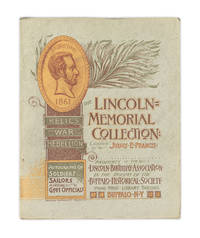
3733314<p>Buffalo: Art-Printing Works of Matthews Northrup & Co. Office of the Buffalo Morning Express 1887. 55 1 pages. Small quarto. Pictorial wraps. A near fine copy.</p> <p>An exceptional copy. “Description of three cases of material comprising the “Lincoln Memorial Collection†in the Grosvenor Library in Buffalo and programs and addresses of dedication. Also programs of the Lincoln Birthday Association from 1874 to 1881.†—Monaghan</p> <p>Monaghan 1031.</p> unknown
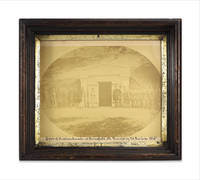
3733424<p>Springfield Illinois 1865. Photographic image: 7½ x 9 inches on mount with handwritten caption. Period deep-set walnut and gilt frame glazed 9¾ x 11¼ inches overall. Evenly-lightened with the image likely taken on a bright sunlit day.</p> <p>Unpublished and previously unknown. A rare photographic print created from a large format albumen photograph taken in 1865. The image captures Lincoln’s tomb being guarded by the Veteran Reserve Corps. The Reserve Corps were active from May to November 1865 helping to date when this image was first taken.</p> <p>As President Lincoln’s funeral train wended its way from Washington D.C. to Springfield “non-commissioned officers of the Veteran Reserve Corps were detailed to act as a body-guard and major generals of the army were directed to attend the train and keep watch so that at all times during the journey the coffin should be under their special guardianship.†Isaac N. Arnold</p> <p>The majority of photographs of Lincoln’s tomb taken in Springfield in 1865 were captured by two local photographers Ingmire and Tresize. They had a thriving business photographing various delegations in front of the Lincoln home and at the receiving tomb. Jonathan H. Mann</p> <p>Over the past two decades new examples of these tomb photographs have emerged suggesting that many individuals involved in the procession including honor guards made a pilgrimage and posed for the camera. Most of these images are found in carte-de-visite format. Larger formats like the present print hold greater significance and desirability. While the members of the Reserve Corps in this image may remain anonymous there are four individuals of higher rank depicted on the opposite side of the vault door who might be identifiable with closer examination. ibid</p> unknown
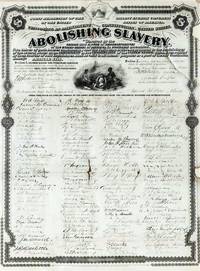
1868019219Chicago: Western Bank Note & Engraving Co. 1868. First Edition. Document. Recently backed with thin paper with several professional repairs of chips and tears. Very Good . Large folio 16-1/4" x 21-3/4" finely engraved and printed on good quality paper with elaborate decorative borders with a "US" monogram to upper corners a bold calligraphic heading with "ABOLISHING SLAVERY" in prominent decorated letters; at top center is a small vignette of the pyramid and all-seeing eye above an oval vignette of a slave family with child mourning over a cameo portrait of Lincoln. This is followed by the engraved signatures of President Lincoln Vice President Hamlin Schuyler Colfax and J. W. Forney Speaker and Secretary of the Senate and 164 Senators and Congressmen. An exceedingly rare and beautiful printing of the Thirteenth Amendment abolishing slavery: "Neither slavery nor involuntary servitude . Shall exist within the United States." This elaborately engraved Reconstruction-era broadside is based on the special "souvenir" copies on parchment signed by Lincoln and the others of which only a handful are known to have been made. The Thirteenth Amendment represents the first substantive change to how America interpreted those liberties guaranteed by the Bill of Rights since its ratification in 1791. The Emancipation Proclamation only freed the slaves in the openly rebellious states. The Amendment effectively put an end to slavery once and for all upon its passage on 1 February 1865. <br/><br/> Western Bank Note & Engraving Co. unknown
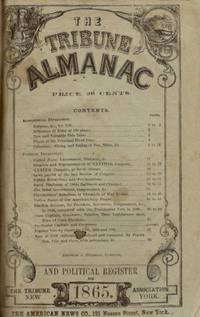
186431724New York: The American News Co 1864. First Edition. Hardcover. Good. Octavo. 11; 72 pages; 5. Original wraps with covers rebound in Gray paper covered boards with blue cloth spine. Gilt title "Almanac" on the upper spine. "J E Boos" in gilt letters stamped on lower spine. Light scattered foxing and toning to the contents. <br /> <br /> Bound with the Almanac preceding the front wrap is an essay titled: "An Old House Near An Old Dead Canal" by J. E. Boos Albany New York 1931. Following the last page of the Almanac are 5 bound in additional leaves of which 3 are blank. A receipt dated July 27th 1879 is pasted down on one of the pages for Adam Van Vraken donation of $66 to the poor. Another page has a pasted down blank Justice of the Peace form printed by "Websters & Skinners at their bookstore in the White House corner of State & Pearl Streets Albany". <br /> <br /> The essay in front contains 6 typed one-sided pages 3 photograph plates and one pasted down photograph of an old house Vranken's house. Page 1 of the narrative has a small circle photograph in the body of the text. Photograph plates include a floral arrangement frontispiece; The First Bridge between Schenectady and Scotia; and Some Horace Greeley 1872 Campaign Pins. <br /> <br /> In his short narrative Boos recounts a visit to the abandoned house that once belonged to Adam Van Vranken. He writes about the condition of dilapidated house describing plaster on the floors the roof falling in scattered toys and pieces of clothing a torn Courier and Ives print wreck of a Boston Rocker a paper box holding locks of children's hair papers scattered about and much more. He takes the Almanac as a souvenir: "I picked from under a pile an old Almanac that had been printed by the White Coated Philosopher Horace Greeley. I decided to carry it away before wet and mold caught up with it because it was sold when Abraham Lincoln was President in the year of his second inaugural and at the time of the ending of the Civil War." <br /> <br /> "J. E. Boos October 1931" inscription is located bottom of the last narrative page before the front wrap of the Almanac. The American News Co hardcover
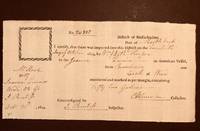
18044777Marblehead: Port of Marblehead 1804. Single loose leaf. Very Good. Import certificate manuscript and printed dated Oct. 20 1804 signed by Benjamin Lincoln as "B. Lincoln" in the blank titled "Collector." Measures 9.75" x 5". Blindstamped seal within printed decorated border. In addition the document is countersigned by Joshua Prentiss as "J. Prentiss" the blank titled "Inspector." Slight age-toning to edges else Fine. The certificate identifies a cask containing 52 gallons of wine was imported by Captain "Wm. J. Nath. Hooper" in the American vessel Joanna. Inspector Joshua Prentiss 1744-1837 served in the Revolutionary Army in Captain John Merritt’s company which was part of Col. John Glover’s regiment. The history of Benjamin Lincoln 1733-1810 in the War of Independence is well documented. After Yorktown "he assumed the office of Secretary of War under the new national government and held that position with distinction until October 1783" DNB. In 1789 after serving as Lieutenant Governor of Massachusetts his friend George Washington appointed him Collector of the Port of Boston. During that tenure he produced the document at hand. Now enclosed in a removable clear archival sleeve with an acid-free backing. Port of Marblehead unknown
195862427Detroit MI: Lincoln Ford Motor Co. 1958. 4to. 24 pp unpaginated. Colour-photo illustrated throughout a few text colour illustrations. Self-printed softcovers cover art interior view of 1959 Lincoln badging very minor shelfwear slight creasing lower fore-edge front cover still a VG copy. First edition of this nicely illustrated dealer’s brochure for the 1959 Lincoln Continental Mark IV which had undergone extensive styling changes in 1958 in order to lower its’ base price and boost production bringing it in line with the Lincoln Premiere. As shown in the photographs shot by Richard Avedon who was the commercial photographer for much of the 1959 Ford line-up the Mark IV featured reverse-slant roofline retractable “breezeway†rear window and division-specific grille. All of this was powered with the 430 cubic-inch MEL V-8 engine and 3-speed Turbo-Drive automatic with an AutoLube lubrication system. Worldcat locates 4 copies Hagley Lib. of MI Sloan NY Met; See: Stork & Dolle Glamour Road: Colour Fashion Style and the Midcentury Automobile p.182-184. Lincoln, Ford Motor Co., paperback
191564092New York: Brentano’s 1915. 8vo. ix 1 11-216 pp. Photo frontisp. numerous photo plates 1 large folding route map. Pictorial gray publisher’s cloth cover art map and decorative border touting the Lincoln Highway minor sunning to spine minor shelfwear slight rubbing uniform interior toning as usual still VG- copy. First edition of this well-illustrated and excellent memoir documenting amenities and sights along the Lincoln Highway considered one of the first full length travel accounts on transcontinental motoring of their 1914 trip. The Lincoln Highway was newly inaugurated as one of the first transcontinental highways and the association ramrodded by Carl Fisher and then Henry Joy had launched the coast-to-coast rock highway for visitors to the Panama-Pacific International Exposition in 1915 later to be enjoyed by automobile travelers during the Roaring 20’s. Effie Price Gladding 1865-1947 details their arrival from a three-year round the World Tour via Asia and Hawaii into San Francisco Bay and subsequent drives along 600 miles of the El Camino Real and then continuing Eastward through Nevada Utah Wyoming Colorado Nebraska Iowa Illinois Ohio Pennsylvania and eventually to New York. She has included many tips to women travelers at the rear of this account and would later write the foreword to the Lincoln Highway association’s first road guide directed to women motorists. Brentano’s, hardcover
195762426Detroit MI: Lincoln Ford Motor Co. Oct. 1957. Oblong Folio. 14.75 x 10 in. 12 pp unpaginated. Colour-photo illustrated throughout a few text colour illustrations. Self-printed colour-illustrated softcovers cover art exterior view of the new Lincoln Continental Mark III slight shelfwear NF copy. First edition of this dealers premier showroom brochure for the 1958 Lincoln line-up which featured the the largest unit-bodied cars and longest six-passenger vehicles ever mass-produced any where. Designed by John Majjar alongside David Ash Bud Kaufman Art Miller and others these were influenced by Alex Tremulis’ concept car La Tosca. The models included the Capri Premiere and the Continental Mark III whose Landau priced out at $ 6072. No copies in Worldcat similar titles for smaller & variant brochures are located at Hagley & SMU. Lincoln, Ford Motor Co., paperback
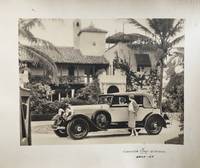
192957874Detroit MI & Cleveland OH: Lincoln Motor Car Division of Ford Motor Co. 1929. Oblong Folio. 14.5 x 10.25 in. With 21 silver gelatin photographs on thick photo stock sized 9.75 x 11.5 in. text w/in negative at lower blank margin a few w/ pen annotations all mounted on white linen hinges at gutter margin minor curving and bowing to fore-edge. Factory limp padded calf post-binder gray silk moire pastedowns brass screw-posts at gutter margin black enamel & nickel badge mounted on front cover rounded corners some chipping edgewear minor chipping to spine fraying to pastedowns still a VG exemplar from the library of Donald Garrett Small 1889-1973 who served in World War I and then was very successful auto salesman and sales manager with Oakland Lincoln and Ford Motor Companies until after World War II w/ discrete embossed stamp at upper corners handwritten manuscript note on verso of last photo. First edition of this extraordinary dealership showroom album for the iconic 1929 Lincoln L Motor Cars considered to be one of the most elegant of the automobiles of the 1920’s. The Lincoln Motor marque was the flagship badge of the Ford Motor Car Co. and largely overseen by Edsel Ford whose talent for design replaced the original Leland models with modern & elegant coach builder designs featuring dark glass version interiors twin windshield wipers laminated windshields a 384.8 cubic-inch engine rubber engine mounts and four wheel braking. The 1929 Lincoln featured 24 different catalogued bodies with twelve from Lincoln including those such as deluxe Sport touring models to closed sedans as well as specialized models from such custom coachbuilders as Dietrich Judkins LeBarton Locke Brunn Willoughby and Waterhouse. The models depicted in these photos include the Sport Touring Type 177 Sport Phaeton Type 176B Club Roadster Type 165 the 5-Passenger Coupe Type 170 Judkins Berline Three Window Type 1720 All Weather Brougham by Brunn All Weather Cabriolet by LeBaron and the stunning Convertible Coupe by Dietrich Type 181 parked in front of a stately Southern California Spanish-style home. Very subtle changes were introduced between years until the 1930 model year and in 1931 Ford Model K with a refined V8 and 120 horsepower replaced the Model L. No copies in Worldcat; See: Frank Rose Lincoln Model L Production Information 1921-1939 Lincoln Owners Club 2012. Lincoln Motor Car, Division of Ford Motor Co., unknown
195762425Detroit MI: Lincoln Ford Motor Co. 1957. Oblong Folio. 14 x 11 in. 12 pp unpaginated. Colour-photo illustrated throughout a few text colour illustrations. Self-printed colour-illustrated softcovers cover art exterior view of the new Lincoln Priemiere 2-door coupe hardtop and white-walls slight shelfwear NF copy. First edition of this well-illustrated dealers premier showroom brochure for the 1957 Lincoln line-up which featured the Lincoln Premiere Landau 2-door coupe 4-door hardtop Premiere Convertible and 4-door sedan. The 1957 styling was overseen by John Najjar who’d inherited Bill Schmidt’s designs featuring gargantuan fins from the Futura concept car and managed to trim it down and also shorten the wrap-around chrome but the quad headlights were not popular and in some states not yet legal so sales dropped to less than 42000 Lincoln’s sold. No copies in Worldcat similar titles for smaller & variant brochures are located at Hagley & Lib. of MI; See: Stork & Dolle Glamour Road: Colour Fashion Style and the Midcentury Automobile pp. 70-71. Lincoln, Ford Motor Co., paperback
195961257Detroit MI: Lincoln Ford Motor Co. Sept. 1959. Oblong folio. 14 x 11 in. 20 pp. Colour illustrations and photos throughout a few text colour illustrations. Self-printed textured softcovers cover art of 1960 Lincoln badging minor shelfwear slight age toning at fore-edges still a VG copy w/ ownership makings of Bill Mohr 1913-1973 longtime Portland area Ford dealership sales manager. First edition of this splendid dealer’s premium brochure for the 1960 Lincoln series sedans Landaus and Lincoln Continental Mark IV. The 1960 Lincoln models was nothing short of majestic with long clean lines imposing grille elegant tailfins stunning rich leather upholstery fine wood accents and power-operated features. Richard Avedon was the commercial photographer for much of the 1959-1960 Ford line-up and the photos here feature many of his elegant touches. All of this was powered with the 430 cubic-inch MEL V-8 engine was capable of driving the Lincoln Continental to 120 mph. Worldcat locates 2 copies Lib. of MI SMU; See: Stork & Dolle Glamour Road: Colour Fashion Style and the Midcentury Automobile pp.182-184. Lincoln, Ford Motor Co., paperback
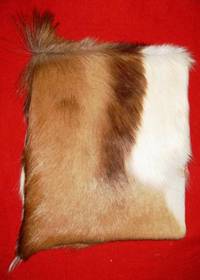
1679579London: Printed by T. Newcomb 1679. Exotic. Near Fine. 8 x 9 1/2 inches; 4 unnumbered 108 numbered pages. Pages generally bright and clean with light soiling at margins. Bound by John Field with binder's ticket in modern full African Springbock with hair and new endpapers. Provenance: Library of Henry and Virginia Walton. ESTCR228432. Harry and Virginia Walton were lifelong residents of Covington Virginia a small town in the Allegheny Mountains. Harry was a graduate of Lynchburg College and Virginia was a graduate of the Lynchburg General School of Nursing. Although largely unknown to the general public the Waltons' reputation as collectors was widely respected in bibliophile and academic circles and items from their collection were exhibited at numerous colleges universities and art centers. After their deaths the original Walton collection was the subject of a series of very successful auctions in New York and London. John Field was an expert leather bookbinder associated with W.J. Barrow Restoration Shop Richmond VA. Printed by T. Newcomb unknown
1902D20861Trenton: Albert Brandt 1902. First Edition. Hardcover. Very Good. 8vo. pp. 198 ad. leaf. Bound by Bayntun in tan calf with pictorial tan cloth covers bound in at rear. a.e.g. Spine title label chipped else a nice copy. Internally bright and clean; illustrated with drawings by Edward W. Kemble. <br/><br/> Albert Brandt hardcover
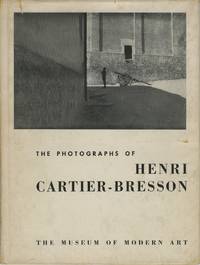
194752679NY: The Museum of Modern Art 1947. First edition. Cartier-Bresson Henri. Small 4to. 56 pp. 42 b&w photos. Tan paper over boards titled in red ink. A fine copy in the lightly soiled illustrated dust jacket that is lacking few small chips and has a few short tears at the edges and a large but closed separation along the spine. Cartier-Bresson's first monograph present in conjunction with his major exhibition at the Museum of Modern Art. Contains a detailed chronology and bibliography. The Museum of Modern Art unknown
186358199Camp near Brooks Station Saturday April 11 1863. Fine original condition. 15-1/2 x 9-3/4 inches. ".Yesterday I witnessed one of the grandest sights that I ever beheld. Our whole corps was reviewed by the President Generals Hooker McLain Howard Steinway Secretary Seward and an innumerable host of Brigadier Generals and it was a sight that has paid me for coming to war." The spectacle is described in great detail. Private Penfield was soon to be captured at Chancellorsville spending 12 days as a prisoner of war before being exchanged. He survived the war to carry on his father's carriage making business in Monroe Connecticut and later founded a small private academy. unknown
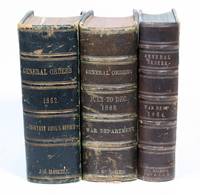
18622923Washington D.C.: War Department 1862. Calf marbled boards. Very Good. FIRST OBTAINABLE PRINTING OF THE PRELIMINARY EMANCIPATION PROCLAMATION setting a date for the freedom of more than three million enslaved in the United States and reframing the Civil War as a fight against slavery. Issued by the War Department to regimental commanders in the field during the Civil War in the week after the completion of President Lincoln’s official manuscript version. Contained is a set of three volumes of General Orders covering the full year 1862 July-Dec 1863 and the full year 1864. History of the Emancipation Proclamation:<br /> <br /> “The proclamation has been called by responsible persons one of the three great<br /> documents of world history ranking with Magna Carta and the Declaration of<br /> Independence†– Eberstadt<br /> <br /> “From the first days of the Civil War slaves had acted to secure their own liberty. The Emancipation Proclamation confirmed their insistence that the war for the Union must become a war for freedom. It added moral force to the Union cause and strengthened the Union both militarily and politically. As a milestone along the road to slavery’s final destruction the Emancipation Proclamation has assumed a place among the great documents of human freedom†– National Archives<br /> <br /> Following the Seven Days Battle and General McClellan’s retreat from the Peninsula at the end of June 1862 President Lincoln realized that there would be no early end to the war and found himself “as inconsolable as it was possible for a human to be and yet live.†Anxious for news from the army and needing to escape the constant interruptions at the White House he frequently visited the telegraph office in the War Department building to await dispatches. It was during one such visit early in July that he asked the chief of the telegraph staff Major Thomas Thompson Eckert for some paper to “write something special†and began the first draft of the Emancipation Proclamation completing it in a few weeks. Lincoln had long hoped to resolve the slavery issue through a congressional act of emancipation compensating slave owners for their loss of “property†but that approach was roundly rejected by representatives from the border states leaving the President who had decided upon the necessity of emancipation with a presidential proclamation as the only option. The extraordinary document he conceived would announce the liberation on January 1 1863 of all slaves in those states still in rebellion against the Union and promised compensation to slave owners in those states that returned to the fold before that time if they adopted “immediate or gradual abolishment of slavery.†This proclamation would be followed by a final proclamation issued on the 1st of January identifying those states still in rebellion and confirming the liberation of all slaves therein.<br /> <br /> On Tuesday July 22 Lincoln presented his draft to the Cabinet telling them that he had resolved firmly upon the course of action it specified and asking them not for advice but suggestions. The only observation he had not anticipated came from Secretary of State Seward who proposed that it might be best to wait for a military victory before issuing the Proclamation as it could otherwise seem like “the last measure of an exhausted government.†Immediately recognizing the wisdom of the suggestion Lincoln held back. On September 17 after an anxious wait of nearly two months he received the victory he needed at the bloody Battle of Antietam. Completing his final draft Lincoln presented it to his cabinet for refinement on September 22. Following the meeting Seward took the amended draft with him to the State Department where a formal manuscript copy was made then signed by Lincoln and Seward. The formal official “Emancipation Proclamation†was of course issued on January 1 1863 the day it became the law of the land.<br /> <br /> Printing History:<br /> <br /> This printing in the War Department’s official “General Orders†is the fourth printing overall but realistically the first obtainable printing. It is preceded by:<br /> <br /> -The first printing Eberstadt #1 a small three-page circular intended for distribution within the government and to the local press likely printed on September 22. At the time that Charles Eberstadt published his study of the Proclamation 1950 he was able to locate only one copy which he himself owned and as nearly as we have been able to determine no other copies have come to light since then.<br /> <br /> -The second printing Eberstadt #2 may be a phantom printing. Charles Eberstadt was not able to locate a copy but he inferred its existence from the standard State Department practice of printing a folio edition consisting solely of the text of the proclamation followed by another printing consisting of the text of a letter of transmittal from the Secretary of State as well as the text of the proclamation. While there may be a copy of Eberstadt #2 in the National Archives as he speculated it is not recorded in their online catalogue nor have we been able to find a copy in any other online catalogue including OCLC the Library of Congress and the Abraham Lincoln Library.<br /> <br /> -Eberstadt’s third printing is of legendary rarity. It consists of Secretary of State Seward’s one-page letter of transmittal addressed “To the Diplomatic and Consular Officers of the United States in foreign countries†and the text of the proclamation. Eberstadt located a total of only five copies in institutions at the Library of Congress the National Archives Yale the Clements Library and Brown. OCLC does not record any additional copies nor is it recorded in Monaghan. There has been one copy at auction $400000 in 2021 and that was described as the only copy in private hands. <br /> <br /> -The present copy General Orders No. 139 is Eberstadt’s fourth printing of the Preliminary Emancipation Proclamation dated in print on September 24. Eberstadt surmises that this field order printing could have been accomplished as late as September 29 or 30. Although it may have been printed in as many as 15000 copies it is very rare in commerce likely due to the ephemeral nature of the printing and distribution.<br /> <br /> Additional General Orders and Provenance:
<br /> <br /> The three volumes once belonged to John G. Haskell A.Q.M. Chief Quartermaster and contain the General Orders for the year 1862 July-December only for the year 1863 and for the full year 1864. John Gideon Haskell 1832-1907 was a resident of Kansas and joined the Union Army when the war broke out. He enlisted with the 14th Kansas Volunteer Cavalry Regiment and later served as Assistant Quartermaster General of Kansas as quartermaster of the Third Kansas and the Tenth Kansas Volunteers as Captain and Assistant Quartermaster on the staff of General James G. Blunt and as Chief Quartermaster of the Army of the Frontier. After the war Haskell was named official state architect and worked on the state house the capitol the State University and more.<br /> <br /> In addition to the preliminary Emancipation Proclamation the three volumes also contain the Acts of Congress on many other subjects including pay discharge recruitment handling of troops etc.<br /> <br /> Washington D.C.: War Department Adjutant General’s Office 1862-64. Three volumes. Small octavo contemporary three-quarter brown morocco two volumes with cloth boards one with marbled boards. Some rubbing and wear to bindings pencil notations on endpapers with collation and highlighting certain orders and some internal pages. Dampstaining to general title of 1862 volume; internal text and Emancipation Proclamation generally fine. RARE AND IMPORTANT.<br /> <br /> References:<br /> <br /> Charles Eberstadt. “Lincoln’s Emancipation Proclamation.†New York: 1950. War Department unknown
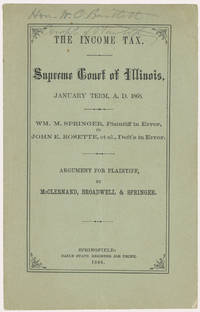
186837668Springfield: Daily State Register Job Print 1868. First edition. Stitched paper wrappers. A very good copy; mail fold some minor wear and soiling to wrappers. 25 pp. 8vo. Presentation copy. Inscribed on front wrapper "Compl. of plaintiff." <br /> <br /> President Lincoln signed into law a temporary income tax to help finance the Civil War. William Springer an Illinois lawyer refused to pay on earnings from his law practice. Eventually his real property was seized and sold to the government to satisfy the arrearage. Springer and his law firm argued that the War income tax was an impermissible direct tax on his estate by the federal government not apportioned among the states in violation of the Constitution. The case would eventually go to the Supreme Court in 1881.<br /> <br /> Two of the members of the firm McClernand Broadwell & Springer were well known to Lincoln: Norman M. Broadwell studied law in the office of Lincoln and Herndon in Springfield Illinois and John McClernand was a disastrous Civil War General once relieved his his command then restored by Lincoln. <br /> <br /> John E. Rosette for the government had "at the invitation of Abraham Lincoln. moved to Springfield Illinois where he practiced law for about thirty years. Rosette came to Sangamon County as a Democrat in politics but from 1856 on he identified himself with the Republican party. He edited the Springfield Republican and supported Lincoln’s presidential nomination" lawpracticeofabrahamlincoln.org.<br /> <br /> Provenance: William O. Bartlett prominent New York lawyer.<br /> <br /> Not in Sabin who lists only the corresponding argument of John E. Rosette Defendants 89841. OCLC locates three copies: Abraham Lincoln Pres. Lib. Wisc. Hist. Soc. So. Illinois Univ. Law. Daily State Register Job Print unknown
201660047Norwalk CT: The Easton Press 2016. Tall 8vo. 12 304 pp. Numerous photo plates. Full black leather gilt decorated covers raised bands & gilt decorated spine silk moire endpapers a.e.g. NF copy w/ Easton Press Collector’s Notes laid-in from the library of Robert A. Taylor w/ bookplate on front pastedown. First Easton Press Collector’s Edition of this work examining the efforts of Meig’s monumental effort to guarantee supplies for the Northern Armies during the Civil War and judged by Lincoln and Seward both to be the indispensable architect of the eventual victory. Issued as part of Easton’s “Military History†series. The Easton Press, hardcover
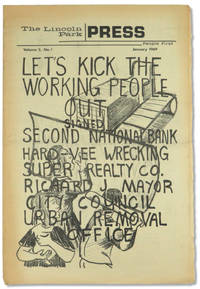
196954576Chicago: Concerned Citizens for Lincoln Park 1969. Hardcover. Very good. Hardcover. 28pp. Newsprint paper in tabloid format. Pages tanned as usual with horizontal fold to the middle else very good. English and Spanish language versions bound dos-a-dos. Hyper local chicago newspaper published for both English and Spanish speaking residents of the neighborhood. <br/><br/> Concerned Citizens for Lincoln Park hardcover
1991132279New York: Lincoln Center 1991. Original half sheet poster for the opening of the Walter Reade Theater at Lincoln Center in New York in 1991. Designed by Stephen Talasnik. <br /> <br /> 21 x 31 inches rolled. A few faint creases else Near Fine. Lincoln Center unknown
197580001Np:: Reed Wallcoverings 1975. Publisher's lettered portfolio with snap closure and handle. Fine. 26 x 26 x 3:. Illustrated with large actual samples of reproduction wallpaper including that in the Presidential Box at Ford's Theatre reproduced from a 3 x 5" souvenir sample. There are 3 bifold samples 3 folded samples and 19 full-page samples; each with descriptive text and color photographs. This is a huge and very heavy volume. Additional postage will apply and international shipping will be prohibitive. Reed Wallcoverings, unknown
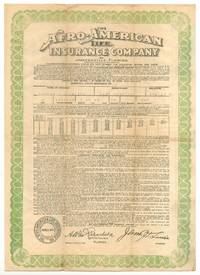
1949518371Jacksonville Florida: The Afro-American Life Insurance Company 1949. Softcover. Near Fine. Original printed life insurance policy certificate issued March 21 1949. Large single sheet measuring 11" x 15" printed on both sides text in black within decorative border printed in green. Prints details about premiums and benefits "Conditions Privileges and Limitations" details about the policy holder General A Burkette and beneficiary Mary Burkette etc. Signed in holograph facsimile by James H. Lewis son of one of the company founders and former President of the company Abraham Lincoln Lewis. Verso prints charts of extended term insurance and premiums.<br /> <br /> Small tears at old folds a near fine example of a fragile ephemeral item. Abraham Lincoln Lewis 1865-1947 African-American businessman was one of the founders of the Afro-American Industrial and Benefit Association which became the Afro-American Life Insurance Company in Jacksonville Florida in 1901. It was the first insurance company in Florida and one of the largest black-owned businesses in Florida. "As the oldest life insurance company in Florida and one of the most successful black businesses in the state it helped thousands of blacks over the years. The importance of that insurance company… cannot be underestimated. According to the 'Encyclopedia of Southern Culture' the insurance companies established by African-Americans and catering to them 'formed the heart of black financial networks the cultural beginnings of which can be traced to mutual benefit societies and the church'" McCarthy African-American Sites in Florida' p. 52; c.f. Low Encyclopedia of Black America p. 207. Lewis helped found the National Negro Insurance Association and the exclusive African-American vacation spot American Beach on Amelia Island and was Florida's first black millionaire. "By 1902 the Afro-American Life Insurance Company was the cornerstone of Black economic development in the city… and grew into one of the most successful minority owned insurance companies in the country. He was a close friend of Booker T. Washington and helped Washington establish the Negro Business League…" Bartley Keeping the Faith p. 10. The company closed in 1990. The Afro-American Life Insurance Company unknown