ABRAHAM LINCOLNBiblio.com
9 915 résultats
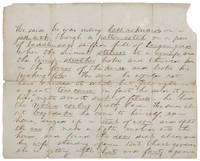
184528226<p>A master storyteller and talented mimic Lincoln's humor was the product of his upbringing in the frontiers of Kentucky Indiana and Illinois where tall tales and exaggeration were key ingredients to good jokes and effective tools in the courtrooms and legislative halls. For some it made him more appealing and approachable to the common man. For others his coarse backwoods humor was undignified reinforcing their belief that he was unfit to be president.</p><p>This manuscript utilizes a series of "spoonerisms" in which the storyteller transposes the first few letters of two adjacent or nearby words for humorous effect. Its namesake Rev. William Archibald Spooner of New College Oxford University was allegedly prone to unintentionally making such mistakes in speaking</p><p><strong>Complete Transcript</strong><br /><em>He said he was riding <u>bass-ackwards</u> on a <u>jass-ack</u> through a <u>patton-cotch</u> on a pair of <u>baddle-sags</u> stuffed full of <u>binger-gred</u> when the animal <u>steered</u> at a <u>scump</u> and the <u>lirrup-steather</u> broke and throwed him in the <u>forner</u> of the <u>kence</u> and broke his <u>pishing-fole</u>. He said he would not have minded it much but </em><em>he</em><em>fell right in a great <u>tow-curd</u>; in fact he said it give him </em><em>a</em><em>right smart <u>sick</u> of <u>fitness</u>he had the <u>molera-corbus</u> pretty bad. He said about <u>bray</u> <u>dake</u> he come to himself ran home seized up a <u>stick</u> of <u>wood</u> and split the <u>axe</u> to make a light rushed into the house and found the <u>door</u> sick abed and his <u>wife</u> standing open. But thank goodness she is getting right <u>hat</u> and <u>farty</u> again.</em></p><p><strong>ABRAHAM LINCOLN.</strong> Autograph Manuscript "Bass-Ackwards" story ca. 1845-1850 Springfield IL. 1 p. 7 x 8.5 in.</p><p><strong>Historical Background</strong><br />C. F. Gunther of Chicago told Jesse W. Weik that Lincoln penned this for a bailiff in the Springfield courts. It was first published by Emanuel Hertz in <em>The Hidden Lincoln</em> in 1938. It once belonged to the Illinois State Historical Library in Springfield which traded it for a first edition of the <em>Book of Mormon</em>. According to auctioneer Charles Hamilton one collector considered it so unworthy of Lincoln's sacred memory he bid intending to burn it! Fortunately he lost.</p><p><strong>Provenance</strong><br />Abraham Lincoln to a bailiff of a Springfield court reportedly Arnold R. Robinson > The Illinois State Historical Library gift of a descendant > Charles Hamilton Galleries May 16 1963. See account in Hamilton <em>Auction Madness</em> 119: "This unsigned bit of Lincolniana was knocked down for $4000 at one of my earliest auctions nearly twenty years ago. What would it fetch today!" > Lindley and Charles Eberstadt > Parke-Bernet Galleries Eberstadt sale October 13 1964 lot 124 described as being "the most intimate and unusual Lincoln document known to survive" and "perhaps the greatest Presidential character piece extant" > Christie's a Western Collector December 9 1994 lot 84 > Louise Taper Beverly Hills California > The Abraham Lincoln Presidential Foundation 2007 > Freeman's/Hindman May 21 2025 lot 21.</p><p><strong>Exhibitions</strong><br /><em>The Last Best Hope of Earth: Abraham Lincoln and the Promise of America</em> at the Huntington Library October 1993-August 1994<br /><em>Abraham Lincoln: A Personal Journey</em> at the Gerald Ford Presidential Museum October 12 2001February 18 2002</p><p><strong>Condition:</strong> Silked; creasing from folds; small losses along folds affecting a few letters; small marginal loss in upper right corner not affecting text; scattered spotting.</p>
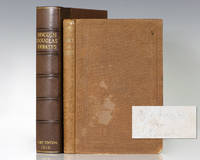
1860138634Columbus: Follett Foster and Company 1860. First edition first issue of the most famous debates in American history which cemented Lincoln as a national presidential candidate; inscribed by Lincoln in pencil to close friend Martin S. Morris and accompanied by the table from the Morris household that Lincoln signed the book on. Octavo original cloth stamped in blind. First issue with no advertisements no rule above the publisher’s imprint on the copyright page and with numeral 2 at the bottom of page 17. Association copy inscribed by Abraham Lincoln in pencil on the front free endpaper "M. S. Morris Esq A. Lincoln." The recipient Martin S. Morris was was a long-time political supporter and friend of Abraham Lincoln from Menard County Illinois. In March 1843 Lincoln wrote to Morris “It is truly gratifying to me to learn that while the people of Sangamon have cast me off my friends of Menard who have known me longest and best of any still retain their confidence in me.†Morris was selected as one of the delegates from Menard County to attend the Whig convention in Pekin in May 1843 but was detained by an illness and Francis Regnier attended in his place. The convention selected John J. Hardin rather than Lincoln as the Whig candidate for Congress from that district. In June 1852 Morris's close friend Whig Congressman and later Illinois governor Richard Yates wrote to him from Washington regarding the 1852 presidential election. The Democratic National Convention was then underway in Baltimore and after 32 ballots by the convention Yates believed the chances of receiving the nomination were against U.S. Senator Stephen A. Douglas of Illinois unless “his almost never failing good luck may avail him.†Ultimately on the 49th ballot the Convention nominated Franklin Pierce who had received no votes until the 35th ballot. Laid in is Yates' letter to Morris which reads in part “Washington June 4 1852 Dear Morris I thank you kindly. The Democratic Convention is now in session in Baltimore. The 32nd ballot has been had and no nomination. Douglass does not appear to have as much strength as anticipated and if we were to judge from present indications the chances are against him. How far his almost never failing good luck may avail him remains to be seen. The contest between Fillmore & Scott it is now believed will be very close. Some of the knowing ones who have not much to do but make calculations say that the vote of Illinois will decide the question. We do not know how the Illinois delegation stands but we suppose nearly equal for Scott and for Fillmore. Fillmore and his friends will if necessary to defeat Gen'l Scott cast their vote for Mr. Webster. My opinion and it is only an opinion is that Gen'l Scott will receive the nomination. Of one thing I feel pretty sure that either Scott or Fillmore will be supported most cheerfully by the Whigs and what is better the Whigs here and throughout the Union have an abiding confidence that they will again gloriously triumph in November. Such was not the case at the beginning of the session. There was more or less of despondency then but the skies are bright ahead now and be the result what it may the Whigs will march up to the work with unfaltering purpose and in the confident hope of victory. Your friend Richard Yates." The Whig National Convention met a few weeks later also in Baltimore and the contest remained close between Winfield Scott and incumbent president Millard Fillmore with Daniel Webster running a distant third until Scott finally received the nomination on the 53rd ballot. In his letter to Morris Yates was confident of a Whig victory in November but Pierce went on to defeat Scott with 51 percent of the vote to Scott’s 44 percent and an overwhelming 254-to-42 victory in the Electoral College. In May 1858 Morris wrote to Lincoln that he and other Republicans in Menard County “are up and doing†and “though we are in a minority we nevertheless intend to give them the Democrats the best fight we can.†Four months later he again wrote to “Friend Lincolnâ€: "If there is any reliance to be placed on the papers which I read you are certainly making a very successful electioneering tour through the state and whether you are elected to the senate or not you certainly have reason to congratulate yourself and feel proud of the manifestations of confidence every where shown you by the people I have said and believed ever since Douglass repealed the MO. Com. That you would be his successor the first chance the people had to vote in matter that was a most rascally thing and I believe would and know it ought to politically damn him and all who had anything to do with it at least in the north. But my object is not to write a dissertation on politicks knowing well that I could say nothing But which you already know But merely to inform you by way of adding to the encouragement which I believe you are every where receiving the good news that you may calculate with a very great degree of certainty on a vote from Menard & Cass. We are glad that you have made an appointment to speak here and will endeavor to get you a large crowd." Contrary to Morris’s assurances in the race for state representative from Cass and Menard Democrat William Engle defeated Republican James W. Judy for a seat in the legislature where he dutifully voted for Stephen A. Douglas for the U.S. Senate. In September 1859 Morris was a delegate from Menard County to the Republican Congressional Convention for the Sixth Congressional District in Springfield. At the Convention Morris was elected to the District Central Committee which consisted of one delegate from each county. Among the resolutions passed by the Convention were “Resolved That the Territories of the United States are the common property of all the free white citizens of the whole Union but that the institution of Slavery has no right or heritage therein.but at the same time we strenuously oppose every attempt to interfere with slavery in the States where it now exists.†and “Resolved That Freedom is universal and Slavery sectional and cannot exist where it is not authorized by virtue of special local legislation; and that the Government of the United States in the exercise of its powers whether executive legislative or judicial is bound to adhere in substance and in form to the generous and noble spirit of these important maxims.†6 Less than a month later John Brown did “interfere with slavery in the States where it now exists†by seizing the federal arsenal in Harpers Ferry Virginia. In 1862 Morris wrote to President Lincoln on behalf of his friend Henry Clay Denison who was serving as a commissary clerk in the 14th Illinois Infantry regiment. Denison wanted a position as assistant quartermaster or assistant commissary in the army. Morris stressed that Denison was “a descendant of a good Whig family of the good old Whig state of Vermont his native place being Woodstock. He is also as good a Republican as lives and if he didn’t do as much he tried as hard as any one else to bring about your nomination &election.†President Lincoln dutifully forwarded the letter to the War Department. With Yates' June 1852 letter to Morris laid in and with the ownership inscription of Morris' great granddaughter beneath Lincoln's inscription “Property of Pauline Madgett Welton Lincoln’s signature above." Provenance: kept in the Morris family for over six generations Martin S. Morris 1816-1884 husband of Elizabeth Waggoner Morris 1820-1901; Their daughter Jane Eliza Morris Nance 1857-1927 wife of Benjamin Franklin Nance 1853-1914; Their daughter Pauline E. Nance Madgett 1879-1971 wife of William P. Madgett 1875-1951; Their daughter Pauline Helen Madgett Welton 1908-1978 wife of Claude R. Welton 1908-1978; Their son William R. Welton 1939-2014; Welton family. Ownership inscription of Pauline Helen Madgett Welton. In very good condition. Housed in a custom half morocco clamshell box. Exceptionally rare signed by Lincoln with no other signed copies traced at auction. Accompanied by the original pedestal table from the Morris household that according to generations of family lore Lincoln sat at with Morris signed the book and ate apples as well as an oil portrait of Martin S. Morris which hung by the table. With a letter of provenance signed by a descendant of Pauline Helen Madgett Welton attesting to the provenance of the book table and a portrait. According to Rae Katherine Eighmey Abraham Lincoln in the Kitchen: A Culinary View 2014 fellow lawyer Charles S. Zane recalled Lincoln at a circuit town inn: "There was a 'large basket of apples in the sitting room and we were invited to help ourselves. Mr. Lincoln was a great eater of apples. He said to me once that a man should eat and drink only that which is conducive to his own health. "Apples" he said "agree with me."'" p. 131 citing Zane's article in the Journal of the Illinois State Historical Society in 1921. According to Eighmey Herndon wrote of Lincoln: "He loved best the vegetable world generally.and especially did he love apples. Running as a little-known candidate for the Illinois senatorship in 1858 Lincoln challenged incumbent and Democratic leader Stephen Douglas to a series of debates. The result was a memorable chain of lively arguments in front of cheering crowds. Though Lincoln lost the senatorial race “he began collecting a scrapbook of his best speeches particularly those from the just-concluded campaign against Douglas for possible inclusion in a book. Assiduously pasting newspaper accounts of the debates into the scrapbook Lincoln cast about for a publisher. Initial efforts failed mainly because Lincoln wanted the book printed in Springfield which had no local publishing or printing facilities. Eventually however the Columbus Ohio firm of Follett Foster & Company showed interest and he began preparing the first edition… Somewhat surprisingly for an attorney Lincoln did not seek Douglas’ permission to publish a book of their combined speeches although Douglas was later given the last-minute opportunity—he declined—to make corrections to his own remarks†Morris 121. Follett, Foster and Company hardcover
183624346.99<p>1836. No binding. Fine. Autograph Letter Signed to Mary S. Owens December 13 1836 2 pp. 9 3/4 x 7 3/4 in. ""Write back as soon as you get this and if possible say something that will please me for really I have not been pleased since I left you.""Here Lincoln perfectly demonstrates what Owens later described as deficiencies ""in those little links which make up the chain of a woman's happiness."" Rather than expressing his feelings for Owens Lincoln complains about his health and discusses political issues swirling in the Illinois General Assembly. Although inept at love the letter offers rare insight into the young representative's thoughts on a variety of political issues. In this highly important letter to Mary Owens a self-absorbed Lincoln complains to his potential spouse of his health both physical and mental and discusses political issues to the point that he describes his own letter as ""dry and stupid."" Perhaps more revealing than he realized it illustrates the tension in Lincoln's early life between matters of the head with which he was comfortable and matters of the heart with which he clearly was not. Complete Transcript Vandalia Decr 13. 1836Mary I have been sick ever since my arrival here or I should have written sooner. It is but little difference however as I have verry little even yet to write. And more the longer I can avoid the mortification of looking in the Post Office for your letter and not finding it the better. You see I am mad about that old letter yet. I dont like verry well to risk you again. I'll try you once more anyhow. The new State House is not yet finished and consequently the legislature is doing little or nothing. The Governor delivered an inflamitory political message and it is expected there will be some sparring between the parties about it as soon as the two Houses get to business. Taylor delivered up his petitions for the New County to one of our members this morning. I am told that he despairs of its success on account of all the members from Morgan County opposing it. There are names enough on the petitions I think to justify the members from our county in going for it; but if the members from Morgan oppose it which they say they will the chance will be bad. Our chance to take the seat of Government to Springfield is better than I expected. An Internal Improvement Convention was held here since we met which recommended a loan of several millions of dollars on the faith of the state to construct Rail Roads. Some of the legislature are for it and some against it; which has the majority I can <2> not tell. There is great strife and struggling for the office of U.S. Senator here at this time. It is probable we shall ease their pains in a few days. The opposition men have no candidate of their own and consequently they smile as complacently at the angry snarls of the contending Van Buren candidates and their respective friends as the Christian does at Satan's rage. You recollect I mentioned in the outset of this letter that I had been unwell. That is the fact though I belive I am about well now; but that with other things I can not account for have conspired and have gotten my spirits so low that I feel that I would rather be any place in the world than here. I really can not endure the thought of staying here ten weeks. Write back as soon as you get this and if possible say something that will please me for really I have not been pleased since I left you. This letter is so dry and stupid that I am ashamed to send it but with my present feelings I can not do any better. Give my respects to Mr & Mrs Abell and family. Your friend LincolnMiss Mary S. OwensHistoric BackgroundThis is one of the ten oldest Lincoln letters known to have survived. Although 11 leaves 9 of which are in institutions from Lincoln's educational sum book a few documents written or signed by Abraham Lincoln in 1832 relating to his service in the Black Hawk War again mos. See website for full description</p>
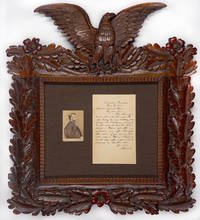
186132820663<br />One page. Beautifully presented in a spectacular 19th-century carved wood frame with surmounted eagle. <br />Abraham Lincoln writing at the outset of the Civil War recommends that the Army admit three volunteers from the highly divided city of Baltimore. He advises Adjutant General Lorenzo Thomas "I hate to reject any volunteers offered from what is called a Southern State."<br />Maryland's Southern sympathies were of paramount concern to Lincoln. On February 23 1861 learning of a rumored assassination plot president-elect Lincoln passed through Baltimore in secrecy to reach Washington. On April 19 1861 just a week after the surrender of Fort Sumter a mob killed four soldiers and wounded thirty-six more when the 6th Massachusetts Infantry passed through Baltimore en route to Washington. A week later Lincoln suspended the writ of habeas corpus to maintain control in the state. Maryland's governor had ordered the militia to burn railroad bridges north of the city to prevent more federal troops from coming through the city. Finally on May 13 federal troops occupied the city quelling pro-Confederate unrest.<br /> In this fine letter written just days later Lincoln asks Adjutant General Lorenzo Thomas "The three gentlemen who will hand you this note belong to an Artillery Company at Baltimore who wish to get into the United States service. Please give them an interview; and after they explain their case if you advise it I will receive them. I hate to reject any offered from what is called a Southern State."<br />This outstanding letter from the earliest days of the Civil War reflects Lincoln's intense desire to keep the people of Baltimore Maryland and the neighboring border states in the Union and to bring in new recruits wherever he could find them.<br />Important Lincoln letters relating to his concern about Baltimore and Maryland in the early days of his presidency are of great rarity.<br />OFFERED WITH:<br />Silk U.S. Flag Bunting from the Presidential Box at Ford's Theatre the Night of the Assassination. Ford's Theatre April 14 1865.<br />Section of an American flag in two pieces upper half 6 1â„2 x 8 1â„4 in. lower half 6 1â„4 x 7 1â„2 in. Horizontal separations light loss and fraying some stains. Oriented vertically. Handsomely framed.<br />This is a section of the bunting from the presidential box at Ford's Theatre where Abraham Lincoln was shot by John Wilkes Booth on April 14 1865. Harry C. Ford manager of stage shows at Ford's Theatre preserved the bunting and a few weeks later gave this section to John A. Ellinger see Provenance.<br />The bunting has an impeccable provenance. It came into the possession of Oliver R. Barrett perhaps the greatest of all Lincoln collectors and it was sold at his Parke Bernet auction in 1952. Elsie O. and Philip D. Sang the leading Lincoln and Civil War collectors of the second half of the century then acquired it. The bunting was sold in 1981 at the fifth Sang sale and has since been owned by two other leading Lincoln collectors Dr. John K. Lattimer and Dr. Blaine Houmes.<br />"The term 'draped" used by Ellinger who received the bunting from Ford would seem to indicate that this piece was from one of the two flags draped on the presidential-box balustrades and not mounted on a pole. … Known Provenance: Oliver R. Barrett Lincoln Collection … It is not known where the item is today" "The Oliver R. Barrett artifact" in Smyth & Garrett The Lincoln Assassination: The Flags of Ford's Theatre p. 70.
This is an evocative relic from a sacred place in American memory and one of the most momentous events in American history.<br />Please inquire for more details.
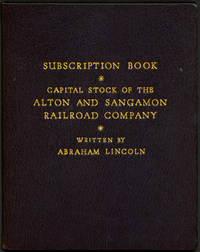
185127561<p>A list of stockholders entirely in Lincoln's hand filed as evidence in his first significant railroad case. Lincoln's own appearance in the shareholder list represents only the second known instance of a stock purchase by the future president. The Illinois Supreme Court's ultimate ruling in favor of Lincoln and the railroad set an important legal precedent upholding the binding nature of a stockholder's contractual and financial obligations. "The decision subsequently cited in twenty-five other cases throughout the United States helped establish the principle that corporation charters could be altered in the public interest and it established Lincoln as one of the most prominent and successful Illinois practitioners of railroad law" Donald p.155.</p><p><strong>ABRAHAM LINCOLN.</strong> Autograph Manuscript Signed by Lincoln in text constituting his official transcript of the "<em>Subscription Book of the Capital Stock of the Alton and Sangamon Rail Road Company</em>" incorporated February 27 1847 transcribed in early 1851. Comprising a cover sheet titled in Lincoln's hand the joint stock subscription statement and list of 91 shareholders with the number of shares subscribed and leaf with Lincoln's legal docket: "<em>Alton and Sangamon Railroad Company vs. James A. Barret. Copy of contents of subscription book</em>." 8 pp. 6 x 8¼ x ¼ in. With Lincoln's original stock certificate for the six shares noted in his manuscript. One of only two instances of his owning a stock and the only certificate of his known to survive.</p><p><strong>Historical Background</strong></p><p>The Alton and Sangamon Rail Road Company was chartered in 1847 to construct a line from Alton via New Berlin to Springfield. In 1850 however the Illinois General Assembly approved a more direct route bypassing the landholdings of some investors. Claiming breach of contract James A. Barret refused to make further installment payments for his 30 shares of stock as did several others who no longer stood to benefit from the new line. In 1851 Lincoln was hired to compel the defaulting shareholders to pay the balance of their promised investment.</p><p>The tactical details are spelled out in a February 19 1851 letter from Lincoln to William Martin a commissioner for the sale of the company's stock. Four suits were to be brought against stockholders who had subscribed to the initial offering but had then failed to make the additional installment payments. In preparation Lincoln listed the essential documents he would need in order to win a judgment. "We must prove" he advised Martin "that the defendant is a Stockholder" "that the calls have been made" and "that due notice of the calls has been given." To show that the defendants were in fact stockholders Lincoln explained he needed to produce "the subscription book with the defendant's name and proof of the genuineness of the signature together with any competent parole or evidence that he made the advance payment" Basler 2:99.</p><p>Lincoln's meticulous transcript of the subscription book was a key piece of the evidence filed in Sangamon Circuit Court on February 22 1851. The book includes Barret's name and the subscription statement transcribed by Lincoln on page two is explicit about the shareholders' obligations.</p><p><em>We the subscribers to the Capital Stock of the Alton and Sangamon Rail Road Company.do hereby agree.to pay the balance of the installments due on said stock by us subscribed when the same may be called for by the board of Directors of said Company when duly organized in conformity with the Charter approved February 27th 1847.</em></p><p>"<em>A. Lincoln</em>" with six shares for $600 is prominent among the 91 subscriber names. The only other known record of a Lincoln stock purchase dates from 1836 when he bought one share in the Beardstown and Sangamon Canal.</p><p>In June of 1847 as head of a committee to promote subscriptions for the projected railroad Lincoln wrote an open letter to the "People of Sangamon County" appealing for their support. Railroad construction was booming and Lincoln anticipated that a line between Springfield and Alton would prove a lucrative investment for himself and his state. "The whole is a matter of pecuniary interest" he argued. "The proper question for us is whether with reference to the present and the future and to direct and indirect results it is our interest to subscribe. If it can be shown that it is we hope few will refuse" Basler 1:396-398.</p><p>The list of subscribers is itself of considerable interest. It includes John Hay 1775-1865 the grandfather of Lincoln's later secretary John Hay 2 shares Ninian W. Edwards 1809-1889 husband of Mary Todd Lincoln's sister 20 shares John T. Stuart 1807-1885 Lincoln's law partner 5 shares Henry Yates 1786-1865 father of Illinois governor Richard Yates 10 shares Noah W. Matheny 1815-1877 clerk of Sangamon County and others. In the subscription book Henry Yates hedging his bets has added a condition beneath his name: "<em>if the Road intersects the M. & S R R at New Berlin.</em>"</p><p>Lincoln was mindful of the critical issues raised by the Alton and Sangamon lawsuits and "took extraordinary pains to construct an airtight case for his client" Donald p.155. To Martin he pointed out the legal issues adding "I have labored hard to find the law" in preparation for the trials. In the end two of the defaulting stockholders paid their delinquent calls. The suits against James A. Barret and Joseph Klein came to trial in the Sangamon Circuit Court in August of 1851 with Lincoln handling both the trials and the appeals for the railroad.</p><p>Lincoln's preparation proved its worth the rulings were in favor of the railroad. "Illinois Supreme Court Justice Samuel H. Treat ruled that public utility superseded private profit. If Barret had won the case other stockholders would balk at fulfilling their obligations. The rule of caveat emptor protected corporate management from stockholder's personal interests and encouraged subsequent investment" <em>Lincoln Legal Briefs</em> Oct-Dec 1990 no. 16 online.</p><p>At the time he transcribed this document Lincoln was an attorney on the 8th Judicial Circuit and also managed a thriving appellate and federal court practice. He handled a number of railroad-related cases representing both private individuals as well as the railroads themselves. He was not as some have argued a hired gun for corporate interests. Rather as his law partner William Herndon described him Lincoln was "purely and entirely a case lawyer."</p><p>The fact that Lincoln despite his commitment to railroading often handled suits against the carriers casts light on his understanding of the lawyer's role in societyHe simply could not afford to take only one side in legal disputes. Nor did Lincoln pursue some political or philosophical agenda through litigation. He was not concerned with developing a consistent legal ideology. His business as Donald reminds us "was law not morality." James W. Ely "Lincoln as Railroad Attorney" Indiana Historical Society Symposium April 15-16 2005</p><p>Though a prominent lawyer Lincoln was still smarting over recent political defeats. Elected to the U.S. Congress in 1846 he had served out his term but his outspoken opposition to the Mexican-American War had cost him any chance at a second term. He subsequently failed in his attempt to become commissioner of the General Land Office. Lincoln declined an appointment as governor of the Oregon Territory instead returning to his law practice with William H. Herndon in Springfield Illinois. He would not attempt a political comeback until 1854.</p><p>The rail line was ultimately highly profitable. Lincoln's overriding belief in the broader benefits of internal improvements is best expressed in a speech he delivered before Congress in 1848.</p><p>Let the nation take hold of the larger works and the states the smaller ones; and thus working in a meeting direction discreetly but steadily and firmly what is made unequal in one place may be equalized in another extravagance avoided and the whole country put on that career of prosperity which shall correspond with it's extent of territory it's natural resources and the intelligence and enterprize of it's people.</p><p><strong>Reference</strong></p><p>"<em>Barret v. Alton & Sangamon Railroad</em>" in Daniel W. Stowell et al. eds. <em>The Papers of Abraham Lincoln: Legal Documents and Cases</em> 4 vols. Charlottesville: University of Virginia Press 2008 2:172-210.</p>
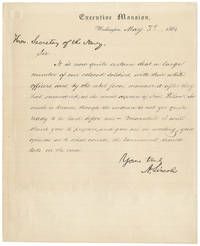
186424088<p>President Abraham Lincoln seeks counsel from his cabinet on the appropriate response to the massacre at Fort Pillow Tennessee three weeks earlier. More than 400 African-American Union troops and their white officers were slain many of them after surrendering.</p><p><strong>ABRAHAM LINCOLN.</strong> Letter Signed to Gideon Welles May 3 1864 Washington D.C. 1 p. 8 x 10 in. With: <strong>FORT PILLOW MASSACRE LYMAN TRUMBULL.</strong> Signed Presentation Copy. <em>Reports of the Committee on the Conduct of the War: Fort Pillow Massacre. Returned Prisoners.</em> 8vo. Illustrated with 8 portraits on 4 pages of woodcut engravings after photographic portraits of Belle Island POWs. Contemporary green cloth gilt with morocco spine label gilt-lettered. First Edition. Washington D.C. 1864. Inscribed on front fly leaf: <em>"Lyman Trumbull to D.J. Ely"</em>. The cover title of sammelband that contains two Senate Reports related to Confederate atrocities: 1. U.S. Congress. May 5 1864. - Ordered to be printed.Joint Resolution directing the Committee on the Conduct of the War to examine into the recent attack on Fort Pillow. Senate Report 38th Congress 1st Session. Senate Rep. Com. No. 63. Nevins I: 204. 2. U.S. Congress. May 9 1864 - Ordered That the report.be printed in connexion with the report of the committee in relation to the Fort Pillow massacre.Joint Resolution directing the Committee on the Conduct and Expenditures of the War. Senate Report 38th Congress 1st Session. Senate Rep. Com. No. 68.</p><p>On April 12 1864 1500 Confederate troops under Nathan Bedford Forrest attacked a Union outpost at Fort Pillow Tennessee. After four hours of intense fighting Forrest demanded the garrison surrender. Although outnumbered almost three to one the Union troops inside the fort at first refused. Confederate forces eventually captured the position. According to survivors Confederate troops motivated by racial hatred proceeded to kill Union prisoners as they pleaded for their lives. It is unclear how many were killed after the surrender but first-hand accounts suggest that the numbers were high. Of 262 black soldiers at Fort Pillow only 58 survived to be taken prisoner; of 395 white soldiers 168 survived as prisoners.</p><p>On May 3 President Lincoln sent a letter like this one to each of the members of his cabinet. Three days later Lincoln held a cabinet meeting at which each cabinet member read his opinion on the appropriate response. All agreed that the U.S. government should demand "an explanation" from the Confederacy. Seward Chase Stanton and Welles advised holding Confederate prisoners equal in numbers to the Union troops massacred as hostages; if the Confederate government avowed the massacre those prisoners would be executed. Usher Bates and Blair strongly disagreed with Blair pointing out that such a response "would not be justified by the rules of civilized warfare." Bates concurred noting that "retaliation is not mere justice. It is avowedly revenge; and it is wholly unjustifiable in law and conscience."</p><p>Little formal action beyond a Congressional investigation took place. Perhaps the greatest impact that Fort Pillow had was on the morale of black troops. Knowing what their fate would be if captured on the field by Confederate soldiers black Union soldiers charged into battle with the war cry "Remember Fort Pillow!"</p><p><strong>Complete Transcript</strong></p><p><em>Executive Mansion<br />Washington May 3d 1864</em></p><p><em>Hon. Secretary of the Navy.</em></p><p><em>Sir:</em></p><p><em>It is now quite certain that a large number of our colored soldiers with their white officers were by the rebel force massacred after they had surrendered at the recent capture of Fort-Pillow. So much is known though the evidence is not quite ready to be laid before me. Meanwhile I will thank you to prepare and give me in writing your opinion as to what course the Government should take in this case.</em></p><p><em>Yours truly<br />A. Lincoln</em></p><p>With abolitionist Senator Lyman Trumbull's signed presentation copy of Congressional reports.</p><p>Condition: very good.</p>
1865376410Montauk Montauk Navy Yard Wash D.C. 1865. 4 pp. 8vo. Slight soiling and minor tears along old folds otherwise in very good condition. 4 pp. 8vo. ".About 10:25 P.M. a man came in and walked slowly along the side." <br /> <br /> A remarkably clear and dramatic eyewitness account of the assassination of Abraham Lincoln from a naval surgeon who was close to the President's box at Ford's theater on that fateful night of April 14 1865. In this letter to his brother written the night after the assassination while the details were still fresh in his memory Dr. George B. Todd surgeon aboard the U.S. "Montauk" at anchor in the Navy Yard that day recounts the terrible event with a clarity of observation one might expect of his profession-a rarity among confused eyewitness accounts. The text of Todd's letter one of only 7 eyewitness accounts written within 24 hours of the assassination reads: <br /> <br /> "The few hours that have intervened since that most terrible tragedy of last night have served to give me a little clearer brain and I believe I am now able to give you a clear account up to this hour. Yesterday about 3 P.M. the President and wife drove down to the navy yard and paid our ship a visit going all over her accompanied by us all. Both seemed very happy and so expressed themselves - glad that this war was over or so near its end and then drove back to the White House. In the evening nearly all of us went to the Ford's Theatre. I was very early and got a seat near the President's private box as we heard he was to be there. About half past nine he came in with his wife a Miss Harris and Major Rathburn and was cheered by every one. As soon as there was a silence the play went on and I could see that the "pres." seemed to enjoy it very much. About 10:25 P.M. a man came in and walked slowly along the side on which the 'pres.' box was and I heard a man say "there's Booth" and I turned my head to look at him. He was still walking very slow and was near the box door when he stopped took a card from his pocket wrote something on it and gave it to the usher who took it to the box. In a minute the door was opened and he walked in. No sooner had the door closed then I heard the report of a pistol and on the instant Booth jumped out of the box onto the stage holding in his hand a large knife and shouted so as to be heard all over the house - 'Sic Semper Tyrannis' "so always with tyrants" and fled behind the scenes-I attempted to get to the box but I could not and in an instant the cry was raised 'The President is Assassinated.' <br /> "Such a scene I never saw before. The cry spread to the street only to be met by another 'So is Mr. Seward.' Soldiers had gone. Some General handed me a note and bid me go to the nearest telegraph office and arouse the nation. I ran with all my speed and in ten minutes the sad news was all over the country. Today all the city is in mourning nearly every house being in black and I have not seen a smile. No business and many a strong man I have seen in tears. <br /> "Some reports say Booth is a prisoner others that he has made his escape but from orders received here I believe he is taken as a mob once raised now would know no end. I will not seal this until morning and I may have some more news. <br /> <br /> "April 24th. <br /> "I have had no time to write until now as I have been a detective. We have now 7 that are implicated.<br /> Why don't you write Love to all George" <br /> <br /> Several important facts regarding the movements of both the President and John Wilkes Booth are recorded here: <br /> 1 This appears to be the only eyewitness account of the President's inspection of the "Montauk" earlier that afternoon. <br /> 2 Todd's account of Booth's interaction with the "usher" sitting outside the President's box "took a card from his pocket wrote something on it and gave it to the usher" is especially intriguing and reveals not only something of Todd's powers of observations but also his proximity to the assassin immediately before the shooting. Todd alone among eyewitnesses notes that the "usher" first took the card from Booth then went into the box and that a short time later the door opened and Booth went in. In fact Good finds only 7 other eye-witness accounts of the Lincoln assassination as early as April 15-most of these witnesses record little or nothing regarding the events before hearing the shot itself and none of them noticed Booth's interchange with the usher who was in fact Lincoln's valet Charles Forbes. There are three other accounts by eyewitnesses which partially corroborate Todd's observation of the Forbes and Booth interchange-but they were written much later than Todd's. <br /> 3 Todd's observation of the time he spotted Booth moving toward the box "about 10:25" corresponds to Good's own conclusion that Booth fired the fatal shot close to 10:30 PM. According to James Swanson MANHUNT p. 419 "the exact time of Booth's shot cannot be fixed . Booth may have shot Lincoln as early as 10:13 or as late as 10:30" Todd's account - again one of the freshest and most reliable weighs heavily in favor of Good. <br /> 4 Todd by his own account played a role in alerting the nation by telegraph. <br /> 5 Although he doesn't mention it as a surgeon of the ironclad Montauk Todd was also probably present at the autopsy of John Wilkes Booth on Thursday April 27 in the gun room of his ship. Indeed in an article in the February issue of the Baltimore and Ohio Magazine 1926 where the letter was first published and reproduced Todd is reported to have been "one of the surgeons who performed the autopsy." That as well as the fact that the other prisoners were being held on board the ironclad "Montauk" and "Saugus" may explain his cryptic remark near the end ". I have been a detective .". Todd actually mailed the letter on April 30 3 days after the autopsy and may very have participated in the actual investigation of the captives aboard the "Montauk." <br /> <br /> AN EXTRAORDINARY AND UNIQUE RECORD OF ONE THE NATION'S GREAT TRAGEDIES. Published from a copy in the State Historical Library of Wisconsin in Timothy S. Good WE SAW LINCOLN SHOT U. of Miss. 1995; with the mistaken date of April 30 1865 unknown
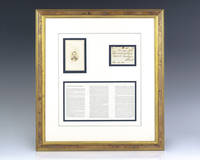
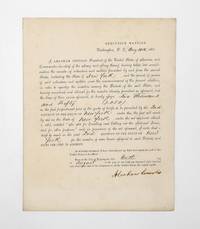
1864132045Washington D.C.: War Department Adjutant General's Office 1864-1869. Rare autograph Oath of December 8 endorsement signed and entirely in the hand of the 16th President of the United States Abraham Lincoln with an exceedingly rare contemporary printing of Lincoln's Amnesty Proclamation which includes the wording of the oath itself and a rare carte-de-visite of Lincoln Providence RI: Salisbury Bro. & Co. n.d. One page the endorsement is signed and inscribed by Lincoln “Let these men take the oath of Dec. 8 1863 & be discharged – A. Lincoln Dec. 30 1863.†One page disbound the contemporary printing of the Amnesty Proclamation consists of 6 pages printed by order of the Secretary of War: E.D. Townsend Washington D.C.: War Department Adjutant General's Office February 18 1864. Lincoln issued the Proclamation of Amnesty and Reconstruction in his annual message to Congress on December 8 1863. In the message Lincoln declared that he would offer a pardon to any man who would swear without coercion his allegiance to the Union. This provided then a general pardon to soldiers in the Rebellion and to those too who deserted the Union cause. All Southerners except for high-ranking Confederate army officers and government officials could be granted a full pardon by taking the oath and Lincoln guaranteed Southerners that he would protect their private property though not their slaves. The oath read in part “I do solemnly swear in presence of Almighty God that I will henceforth faithfully support protect and defend the Constitution of the United States and the Union of the States thereunder; and that I will in like manner abide by and faithfully support all acts of congress passed during the existing rebellion with reference to slaves so long and so far as not repealed modified or held void by Congress or by decision of the Supreme Court; and that I will in like manner abide by and faithfully support all proclamations of the President made during the existing rebellion having reference to slaves so long and so far as not modified or declared void by decision of the Supreme Court. So help me God.†Double matted and framed. The entire piece measures 17 inches by 19 inches. The autograph pardon is in very good condition. The carte-de-visite is in fine condition. The contemporary printing of the Amnesty Pardon is in fine condition and is exceedingly rare with only one other copy appearing at auction over the course of the past century. An exceptional grouping of Lincolnalia. Abraham Lincoln served as the 16th President of the United States from March 1861 until his assassination in April 1865. He led the United States through the American Civil War the country's greatest moral cultural constitutional and political crisis and in doing so preserved the Union of the United States of America abolished slavery and strengthened the federal government. Lincoln ran for President in 1860 sweeping the North in victory. The South was outraged by Lincoln's election and in response secessionists implemented plans to leave the Union before he took office in March 1861. War began in April 1861 when secessionist forces attacked Fort Sumter in South Carolina just over a month after Lincoln's inauguration and after years of deadly military conflict officially ended on April 9 1865 when Confederate General Robert E. Lee surrendered to Union General Ulysses S. Grant at the Battle of Appomattox Court House. On April 14 1865 just days after the war's end at Appomattox Lincoln was attending a play at Ford's Theatre with his wife Mary when he was assassinated by Confederate sympathizer John Wilkes Booth. Lincoln is remembered as the martyr hero of the United States and is consistently ranked as one of the greatest presidents in American history. War Department, Adjutant General's Office unknown
1890189727New York: The Century Co. 1890. A superb panorama of the age of Lincoln First edition abundantly extra-illustrated with over 650 letters photographs prints and ephemera crowned by an autograph letter signed by Lincoln as President: an extraordinary collection of signatures from the military and political leaders who shaped the nation in its greatest existential struggle. The authors Lincoln's private secretaries "shared a room at the White House and had an exceptionally close relationship with Lincoln though they stood somewhat in awe of the president. Lincoln and his two secretaries had a good deal of mutual affection. They served Lincoln for four years performing a wide variety of political and personal duties and remaining close friends throughout a working friendship that became the foundation for an important literary collaboration in later years" ANB. Their monumental History remains one of the grandest narratives of Lincoln's life presidency and legacy. The original 10 volumes have here been expanded to 20 and luxuriously bound by Whitman Bennett of New York in blue morocco emblazoned with the American eagle Lincoln's signature and patriotic insignia. The first item is an apparently unpublished autograph letter signed by Lincoln as President dated 2 August 1861 and written from the Executive Mansion to his Secretary of War: "My dear Sir Let Charles S. Hamilton of Wisconsin be a Brigadier General of volunteers". Hamilton 1822-1891 a West Point classmate of Ulysses S. Grant served in the Mexican-American War and commanded companies in Texas and Mississippi between 1848 and 1853. He later settled in Wisconsin and at the outbreak of the Civil War was commissioned colonel of the 3rd Wisconsin Infantry on 11 May 1861. The Lincoln letter here concerns his formal commissioning as brigadier general of volunteers that August. He served in Virginia Tennessee and Mississippi resigning in 1863 in protest at being denied higher command; he rebuffed Lincoln's request that he withdraw his resignation. Also included are four signed letters addressed to Lincoln during his presidency: from the acting governor of Utah Territory the Executive Council of New Hampshire the Pennsylvania congressional delegation and the citizens of Pottsville Pennsylvania. Together the signatures span the military and political leadership of the Civil War. They include former presidents Millard Fillmore and John Tyler and the future president Ulysses S. Grant. Also present are Lincoln's adversaries: Confederate president Jefferson Davis Confederate vice president Alexander Stephens his famous debating rival Stephen Douglas and Robert E. Lee. Lincoln's Cabinet is represented by Gideon Welles Edwin Stanton Salmon P. Chase and William H. Seward. Major Union commanders include Ulysses S. Grant George B. McClellan George G. Meade and Philip Sheridan. The ephemera includes currency and memorial ribbons. Several autograph letters signed by Nicolay and Hay are also bound in together with letters from Lincoln's wife Mary Todd Lincoln and his son Robert Todd Lincoln. Bound at the front is a notarized affidavit signed by the New York autograph dealer and expert Thomas F. Madigan dated 3 February 1925 certifying all the letters and documents as authentic. 10 vols extended to 20 224 x 152 mm. Extra-illustrated with 44 photographs 150 autograph letters and documents 13 ephemeral items and 450 plates. Circa 1925 blue morocco by Whitman Bennett of New York spines lettered in gilt gilt eagle and wreath devices to compartments gilt Lincoln facsimile signature to front covers red doublures red silk free endpapers top edges gilt. Joints and extremities neatly restored else a fine set. unknown
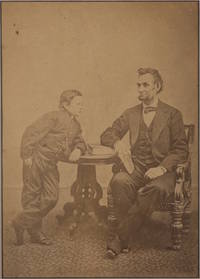
186632820664<br />Perhaps the most delightful of the Lincoln family photographs this portrait shows an impish Tad leaning on a table as his seemingly bemused father sits on Gardner's studio chair. Thomas "Tad" Lincoln was the youngest of the Lincoln boys.<p>Abraham Lincoln an indulgent father let his children run wild at his law offices and at the White House. His law partner William H. Herndon recounted "I have felt many and many a time that I wanted to wring their little necks and yet out of respect for Lincoln I kept my mouth shut. Lincoln did not note what his children were doing or had done."Lincoln sat for this portrait at Alexander Gardner's studio on February 5 1865. Just a month later he delivered the Second Inaugural Address and within weeks he was assassinated. It would be his final sitting for Gardner who made five poses that day. This fine portrait does not show the heavy retouching evident in later prints</p><p>By this date the end of the Civil War seemed to be drawing near. The war years had taken a heavy toll on Lincoln and on the nation. Horace Greeley observed "his face was haggard with care and seamed with thought and trouble. It looked care-ploughed tempest-tossed and weatherbeaten."</p><p>Albumen print 14 x 10 in. card mount. Minimal wear and fading two spots at the upper left. Good tones. An excellent photograph. Framed.</p><p>Ostendorf <i>Lincoln's Photographs</i> O-114.</p><p><b>This fine portrait is the largest example we have seen and a scarce survival showing Lincoln as a loving father.</b></p><br /> Gardner
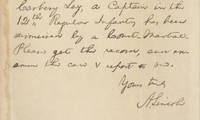
18632972001/09/1863. <blockquote><p>A powerful letter showing Lincoln's direct involvement with the chief judicial military officer showing the merciful Lincoln at work and showing his prioritizing retaining experienced veterans in the service</p></blockquote><p><img class=""alignnone size-post-window wp-image-29790"" src=""https://cdn.raabcollection.com/wp-content/uploads/20240123003955/Lincoln-Sept-1-1863-3-1600x295.jpg"" alt="""" width=""1600"" height=""295"" /></p><p>The Judge Advocate General of the United States Army is the senior officer of the Judge Advocate General's Corps of the United States Army. The position was abolished but then reinstated in 1849. In 1862 Lincoln appointed his first Judge Advocate General Joseph Holt only the second since 1783. He named Joseph Holt. Holt joined the Army as a colonel in 1862. As Judge Advocate General of the Army Holt oversaw the expansion of military law to include the military prosecutions of citizens who were not in the military service. By the time he joined the Army he believed that the only means to prevent treason from occurring again was to ensure that slavery was abolished for all time and eventually equal treatment under the law enforced in the South.</p><p>At the beginning of the Civil War Joseph Carbery Lay had an office in Washington D. C. as an agent for the transaction of all kinds of business including procuring patents pensions back pay purchase and sale of real estate writing of deeds releases and other instruments regarding settlement of accounts with and claims against the Government.</p><p>He quickly enlisted in the 12th Infantry Regiment of the Regular Army as a lieutenant. During the Peninsula Campaign in the spring of 1862 the 12th Infantry distinguished itself in its first combat action at the Battle of Gaines Mill in June 1862 while sustaining fifty percent casualties. Lay was a captain at that time.</p><p><img class=""alignnone size-post-window wp-image-29789"" src=""https://cdn.raabcollection.com/wp-content/uploads/20240123003932/Lincoln-Sept-1-1863-2-1600x746.jpg"" alt="""" width=""1600"" height=""746"" /></p><p>Captain Joseph Carbery Lay was cashiered - dismissed - from the Army on July 21 1862 for being drunk on duty and breach of arrest. Lay felt that an injustice had been done and wanted the dismissal revoked. In 1863 the matter came to the attention of President Lincoln who insisted on seeing the record of the case. He was always anxious to prevent injustice from being done and even a case in which alleged drunkenness was involved was not beneath his notice.</p><p><strong>Autograph letter signed</strong> as President on Executive Mansion letterhead Washington September 1 1863 to the Judge Advocate General insisting that he receive the records in Lay’s case. <em>“Sir: I am told that Carbery Lay a Captain in the 12th. Regular Infantry has been dismissed by a Court-Martial. Please get the record and examine the case & report to me. Yours truly A. Lincoln.â€</em></p><p><img class=""alignnone size-post-window wp-image-29791"" src=""https://cdn.raabcollection.com/wp-content/uploads/20240123004036/Lincoln-Sept-1-1863-4-1600x491.jpg"" alt="""" width=""1600"" height=""491"" /></p><p>Lincoln prioritized retaining experienced veterans in the service and sided with Lay as is indicated by the fact that Lay was reinstated by being appointed a lieutenant in the Seventeenth Infantry on October 30 1863 less than two months after this letter. While Lay was serving in that unit in 1863 it was present in engagements at Rappahannock Station and on Mine Run and marched with it until going into winter camp. In 1864 the regiment took part in the Wilderness Campaign and the operations before Petersburg inscribing on its colors Laurel Hill North Anna Bethesda Church Cold Harbor and Petersburg; while its records show in addition that it was also engaged at Spotsylvania Court House and the battle of the Wilderness.</p><p>Lay’s problems were not over however as in June 1864 he was accused of having returned to his home in Washington without leave. He came back to base soon after and made a statement that he had been ill and sent to hospital and then had a difficult time rejoining his regiment. Perhaps to avoid disciplinary action he resigned from the Army a few months later on September 12 1864.</p><p>Over the years we’ve had just a handful of letters showing the kindly merciful Lincoln at work and none to Holt.</p><p><img class=""alignnone size-post-window wp-image-25018"" src=""https://cdn.raabcollection.com/wp-content/uploads/20231204144051/Folder-site-11-1600x1327.jpg"" alt="""" width=""1600"" height=""1327"" /></p> unknown
1863373004Washington D.C. 1863. 1p. plus integral blank. 4to 9-3/4x7-3/4 inches. Minor smudging to signature. Housed in a blue full morocco box. 1p. plus integral blank. 4to 9-3/4x7-3/4 inches. The first military draft in U.S. history was passed by Congress in early 1863 and signed into law by President Abraham Lincoln in March of that year. The Enrollment Act or Civil War Military Draft Act required the enrollment of every male citizen between twenty and forty-five years of age as well as those immigrants who had filed for citizenship unless exempted by the Act. It set enlistment quotas for each state and required states to draft men if they did not meet their enlistment quotas through volunteers. It also included the policies of substitution furnishing a suitable substitute to take the draftee's place and commutation paying $300 to avoid the draft which led to substantial resentment among working-class citizens not wealthy enough to pay their way out of service.<br /> <br /> Only July 13 during the draft lottery in New York City a riot broke out leading to three days of violence and destruction. Although initially focused on the draft the protests subsequently devolved into vicious race riots. The rioters were largely white and in the wake of the Emancipation Proclamation claimed to fear that freed enslaved men would migrate to the city and take their jobs. Since Blacks were exempted from the draft the Draft Act only heightened fears of Black migration to the city. The violence against the Black community in New York as well as against abolitionists was substantial: the death toll reached upwards of 120 and numerous homes and churches were burned. Since most of the New York State Militia was fighting with Union troops at Gettysburg the New York Police Department was the only force on hand to deal with the rioters initially and they were badly outnumbered and underequipped. By day four of the riots five New York Militia units had reached the city along with the 26th Michigan Volunteers and the 27th Indiana Volunteers and were able to start restoring order. Eventually there were several thousand troops in the city and they brutally put down the remaining rioters.<br /> <br /> Almost immediately calls came to suspend the draft in New York most notably by Horatio Seymour the Governor of New York who wrote to Lincoln several times in the weeks which followed arguing against the constitutionality of the draft and the inequity in its application. <br /> <br /> Lincoln replied on August 7 refusing to acquiesce to Seymour's demands writing: "I shall direct the draft to proceed in all the Districts drawing however at first from each of the four Districts towit: the second fourth sixth and eighth . I do not object to abide a decision of the United States Supreme Court or of the judges thereof on the constitutionality of the draft law. In fact I should be willing to facilitate the obtaining of it; but I can not consent to lose the time while it is being obtained. We are contending with an enemy who as I understand drives every able bodied man he can reach into his ranks very much as a butcher drives bullocks into a slaughter-pen. No time is wasted no argument is used. This produces an army which will soon turn upon our now victorious soldiers already in the field if they shall not be sustained by recruits as they should be. It produces an army with a rapidity not to be matched on our side if we first waste time to re-experiment with the volunteer system already deemed by congress and palpably in fact so far exhausted as to be inadequate; and then more time to obtain a court decision as to whether a law is constitutional which requires a part of those not now in the service to go to the aid of those who are already in it; and still more time to determine with absolute certainty that we get those who are to go in the precisely legal proportion to those who are not to go. My purpose is to be in my action just and constitutional; and yet practical in performing the important duty with which I am charged of maintaining the unity and the free principles of our common country" Collected Works of Abraham Lincoln Vol. 6.<br /> <br /> Three days later on August 10 Lincoln signed the present order to resume the draft in the Second Congressional district of New York the western portion of Long Island primarily Nassau County and part of Queens County. This is the first draft order following his refusal to Governor Seymour to suspend the draft in the New York City area.<br /> <br /> In full manuscript accomplishments in brackets: "I Abraham Lincoln President of the United States of America and Commander-in-chief of the Army and Navy thereof having taken into consideration the number of volunteers and militia furnished by and from the several States including the State New York and the period of service of said volunteers and militia since the commencement of the present rebellion in order to equalize the numbers among the Districts of the said States and having considered and allowed for the number already furnished as aforesaid and the time of their service aforesaid do hereby assign Two Thousand and Fifty 2050 as the first proportional part of the quota of troops to be furnished by the 2ndDistrict of the State of New York under this the first call made by me on the State of New York under the act approved March 3 1863 entitled 'An Act for Enrolling and Calling our the National Forces and for other purposes' and in pursuance of the act aforesaid I order that a draft be made in the said 2nd District of the State of New York for the number of men herein assigned to said District."<br /> <br /> On the same day as this order Lincoln would meet with Frederick Douglass at the White House to discuss his traveling through the south to recruit former slaves to fight for the Union. An extraordinary Lincoln document at a turning point moment in the Civil War. unknown
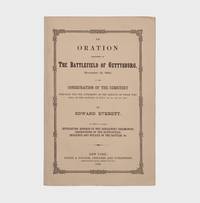
1863376857New York: Baker & Godwin 1863. First edition in book form. 48 pp. 1 vols. 8vo. Original printed wrappers expert restoration to the spine. Housed in a morocco backed box. First edition in book form. 48 pp. 1 vols. 8vo. A lovely copy of the rare first edition of Lincoln's Gettysburg Address delivered at the dedication of a cemetery on the Gettysburg battlefield four months after the bloody and pivotal battle that turned the tide of the Civil War in favor of the Union. Lincoln's speech delivered in only a few minutes stands as a supreme distillation of American values and of the sacrifices necessary for the survival of liberty and freedom.<br /> <br /> Much controversy surrounds the circumstances and content of the address as it was actually delivered at Gettysburg. The words spoken in the speech differ in the versions appearing in newspapers and the text which appeared in Washington several days later published as The Gettysburg Solemnities and known in only four copies which is now taken as the closest version to Lincoln's final intent because of its correspondence to the known manuscript versions. Interestingly and according to Carbonell the text of the first appearance of the speech in book form published a few days later as An Oration Delivered on the Battlefield of Gettysburg i.e. the present printing is taken largely from the New York Tribune printing. Lincoln's address appears on page 40 and parenthetical notes are added indicating "applause" and "long-continued applause." A diagram on page 32 gives the details of the Soldiers' National Cemetery at Gettysburg.<br /> <br /> "Lincoln's speech composed on the train on the way to Gettysburg and written down according to tradition on scratch-paper and the backs of envelopes comprised ten sentences and took only a few minutes to deliver. From the first words - 'Four score and seven years ago' - to the last - 'that government of the people by the people and for the people shall not perish from the earth' - it is immortal one of the supreme utterances of the principles of democratic freedom" PMM. PMM 351; Wills 191-204 261-263; Howes E233; Sabin 23263; Streeter sale 1747; Monaghan 193 Baker & Godwin unknown
18642292021/03/1864. <blockquote><p>“If there is on file a request of Gen. Meigs that William Alexander may be appointed an Assistant Quarter-Master with the rank of Captain let him be appointed.â€</p><p> </p><p>There is no record of the appointment having been made with speculation being that Lincoln possibly sent the appointment to Stanton to die there</p><p> </p><p><img class=""alignnone wp-image-22921 size-post-window"" src=""https://cdn.raabcollection.com/wp-content/uploads/20231204160847/branding-Lincoln-March-21-1864-C-e1640668975889-1600x692.jpg"" alt="""" width=""1600"" height=""692"" /></p></blockquote><p>Lincoln had the rare quality of not taking opposition personally. During the Civil War he was vilified more than any other public figure in American history yet saw the issues as so great that they transcended any personal aspect. He bore no resentments because as he said he “never thought it paid.†He appointed men to high office because he perceived that they would be useful to the war effort. When Gen. George B. McClellan was insufferably rude to him he was willing to suffer the personal indignity if only McClellan would win. His most important civilian appointment shows this management principal in operation. Edwin Stanton had met Lincoln before the war when they had served as co-counsel in a famous lawsuit involving the McCormick reaper. Stanton who had a reputation for being stern imperious hot-tempered and controlling had snubbed him and then ridiculed him publicly as a gorilla and an imbecile. Lincoln also saw him as honest dedicated and extremely competent. Carrying no grudges he appointed Stanton to be Secretary of War and it was a brilliant choice. The two men came to respect and even like each other as they worked together daily to achieve victory.</p><p>Lincoln even used Stanton to deflect criticism from himself. Lincoln was inundated with requests for military positions requests in which he had little if any interest. But these requests often came from members of his administration from Union generals or other notables and the President could not decline them without angering his friends colleagues or other supporters of the Union cause. He shoveled these requests to Stanton with his endorsement. But Stanton would only approve those requests he deemed meritorious.</p><p><img class=""alignnone wp-image-22923 size-post-window"" src=""https://cdn.raabcollection.com/wp-content/uploads/20231204160837/Lincoln-March-21-1864-B-e1640669110694-1600x636.jpg"" alt="""" width=""1600"" height=""636"" /></p><p>Montgomery C. Meigs was a career United States Army officer civil engineer and construction engineer. At the start of the Civil War Lincoln appointed Meigs quartermaster general a crucial post that was perfectly suited to his organizational and management talents. Before the war Meigs played a key role in the extension and dome of the U.S. Capitol. After the war he oversaw much of the design and monument construction at Arlington National Cemetery.</p><p>Meigs had requested that Lincoln make an appointment in his department and the President wrote this letter to accommodate him. <strong>Autograph letter signed</strong> on Executive Mansion letterhead Washington March 21 1864 to <em>“Hon. Secretary of War.â€</em> Lincoln writes <em>“My dear Sir If there is on file a request of Gen. Meigs that William Alexander may be appointed an Assistant Quarter-Master with the rank of Captain let him be appointed. Yours truly A. Lincoln.â€</em></p><p>There is no record of the appointment having been made with speculation being that Lincoln sent the appointment to Stanton to die there. An interesting letter associating the President Secretary of War and Quartermaster General and taking place just eleven days after Grant assumed the role that led to Union victory.</p><p><img class=""alignnone wp-image-22732 size-post-window"" src=""https://cdn.raabcollection.com/wp-content/uploads/20231204162353/Folder-site-1600x1327.jpg"" alt="""" width=""1600"" height=""1327"" /></p> unknown
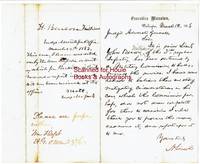
1863604602"A. Lincoln" in black ink on Executive Mansion Washington letterhead March 18 1863. 5" x 8" 1 page with integral leaf. Very good. Integral blank with an autograph endorsement signed by Holt and clerical endorsement from the Adjutant General's office. To Judge Advocate General Joseph Holt: Lincoln requests his Judge Advocate General to investigate the "Strong Mitigating Circumstances" surrounding the court-martial of a member of the West Point Class of 1861. "It is said Lieut. John Benson Williams of the 3rd regular infantry as been sentenced by a Military Commission to be dismissed the service. I have some reason to believe there are strong mitigating circumstances in his case which the Commission perhaps did not deem competent for them to consider I will thank you to procure the record examine it and report it to me. . ." Holt forwarded Lincoln's letter to the Adjutant General noting that "No record or report in regard to the Williams case has been received at this office." The letter was returned to Holt accompanied by the record of William's court-martial and docketed "Please see papers within." After studying the record Holt made a lengthy report to Secretary of War Stanton March 30 1863 which survives in the Abraham Lincoln Presidential Library. Holt dismissed the "mitigating circumstances" referenced by Lincoln - Williams's supposedly "severe sickness" - and concluded that "It is evident that Lieut. Williams left his command on the battlefield and returned to Washington without leave and in known violation of orders and of his duty. . . .He has shown himself disqualified for the profession of arms." On April 8th Stanton in turn forwarded Holt's deposition to the President "as requested by his note on the 18th Ulto" that is the present letter. Lincoln ended the matter with his own terse endorsement on April 11th: "I decline to interfere in Behalf of Lieut. Williams" Basler 4:169. Although referred to in Basler's note regarding Lincoln's endorsement the present letter does not appear in "The Collected Works of Abraham Lincoln".<br /><br />Extra shipping required.<br /><br />
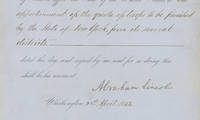
18642373223/04/1864. <blockquote><p>A search of public sale records going back 40 years fails to turn up even one other example of this document</p></blockquote><p>After the firing on Fort Sumter on April 12 1861 enthusiasm for enlisting in military service swept through both the North and South. In remarkable speed two large volunteer armies were created. Except for a tiny number of professional soldiers all expected to be in service for a brief term. Not just soldiers but the public and political leaders had fooled themselves about the war's likely duration. However the patriotic hope on each side that the war would be over in a matter of weeks or months was dashed in the first battle of Bull Run on July 21 1861. By late 1862 no sensible person believed that an early end to the bloody strife was possible and the knowledgeable expected peace to be far off in the future. Facing a protracted war maintaining a sufficiently sizable army became the greatest problem facing both Union leader Abraham Lincoln and Confederate leader Jefferson Davis.</p><p>In 1862 rather than institute a draft President Lincoln requested 300000 more men and assigned each state a quota. The states could meet their quota in any manner they saw fit. Most states offered cash incentives known as bounties to gain recruits. Depending on where one enlisted the combination of local state and federal bounties could exceed $1000. But the 1862 policy also did not recruit enough troops.</p><p><img class=""alignnone wp-image-24611 size-post-window"" src=""https://cdn.raabcollection.com/wp-content/uploads/20231204150003/Lincoln-April-23-1864-2-1600x602.jpg"" alt="""" width=""1600"" height=""602"" /></p><p>As the war dragged on with no end in sight the inflow of volunteers was drying up and the Union needed to keep the ranks filled. The U.S. Congress resorted to the first draft in the country’s history in March 1863. All able-bodied men between ages 20 and 45 were required to be enrolled and available for military service. Draftees were chosen by lottery. Once conscripted a man could avoid service for that particular round of the draft either by paying a $300 commutation fee or by hiring a substitute to take his place. As in the South this raised accusations that the war had become “a rich man’s war but a poor man’s fight.†Nevertheless in both North and South statistics indicate that wealthy men were represented in the service in at least the same proportion as they were in the general population.</p><p>A lot of blood was spilled in 1863 with the battles of Chancellorsville Gettysburg Vicksburg Chickamauga and Chattanooga among others. By year’s end President Lincoln and the Union leadership realized that more men were needed for the army and urgently. On February 1 1864 Lincoln called for 500000 men to serve for three years or for the duration of the war. Then on March 15 he supplemented this with a call for 250000 more. There would be another draft call in December 1864 but it was never completed due to the impending end of the war.</p><p>The March 1864 draft call stated: “Washington March 15 1864. In order to supply the force required to be drafted for the Navy and to provide an adequate reserve force for all contingencies in addition to the 500000 men called for Feb. 1 1864 the call is hereby made and a draft ordered for Two Hundred Thousand men for the military service – Army Navy and Marine corps of the United States. The proportional quotas for the different wards towns townships precincts or election districts or counties will be made known through the Provost Marshall General’s bureau and account will be taken of the credits and deficiencies of former quotas.</p><p>The 15th day of April 1864 is designated as the time up to which the numbers required from each ward of a city town etc. may be raised by voluntary enlistment; and drafts will be made in each ward of a city town etc. which shall not have filled the quota assigned to it within the time designated for the number required to fill said quota. The draft will be commenced as soon after the 15th of April as practicable…†It took little more than a week for everything to be in place.</p><p><img class=""alignnone wp-image-24623 size-full"" src=""https://cdn.raabcollection.com/wp-content/uploads/20231204145931/My-Movie-177ygbhbj.gif"" alt="""" width=""1920"" height=""1080"" /></p><p>The mechanics of the draft were that each state and district within a state were assigned quotas and the President would order that each state’s draft numbers and districts be implemented. This was the actual order for the draft. Then each individual district would receive from the President details of its requirements in a circular letter. One sees these individual district circular letters on the market every now and then. But what one never sees is the order to implement the draft for a state assigning the districts and number of troops being called forth. In fact a search of public sale records going back 40 years fails to turn up another example nor have we seen one before.</p><p><strong>Document signed</strong> as President Washington April 23 1864 being Lincoln’s implementation order for New York. <em>“I hereby authorize and direct the Secretary of State to affix the Seal of the United States to the apportionment of the quota of troops to be furnished by the State of New York from its several districts dated and this day signed by me and for so doing this shall be his warrant.â€</em></p><p>An extremely rare if not unique document showing Lincoln raising troops on the macro level of a state.</p><p><img class=""alignnone wp-image-23729 size-post-window"" src=""https://cdn.raabcollection.com/wp-content/uploads/20231204152429/Folder-site-7-1600x1327.jpg"" alt="""" width=""1600"" height=""1327"" /></p> unknown
1863423266New York: Baker & Godwin Printers and Publishers Printing-House Square opposite City Hall 1863. Softcover. Very Good. The earliest publication of Lincoln’s Gettysburg Address in book form preceded only by the exceptionally scarce 16-page pamphlet The Gettysburg Solemnities. Octavo. Stitched in the original printed wrapper with a publisher’s advertisement on the rear wrap. pp. 1-3 4-48. Modest overall toning and rubbing to the wrapper some fraying at the corners part of the paper along the spine back is perished one vertical stain at the front wrap and title page a very good copy with a few scattered contemporary brown ink markings. Very light contemporary ownership name in pencil at the top of the front wrap. Housed in a fine quarter blue morocco slipcase with gilt spine lettering and two raised bands and with an internal cloth chemise. “Collection of Foreman M. Lebold†stamped in gold on the front cover of the slipcase. Foreman M. Lebold was a noted collector of Lincoln material and the eldest brother of Nathan Leopold one of the infamous Leopold and Loeb teenage thrill killers convicted of the murder of Bobby Franks which captured the attention of the nation. Foreman like much of his family eventually changed his last name to Lebold because of the notoriety of the trial.<br /> <br /> Lincoln delivered his speech at the dedication ceremony of the Gettysburg National Cemetery on November 19 1863 about four months after the pivotal battle that turned the tide of the Civil War in favor of the Union. His speech was preceded by an Oration by Edward Everett the most famous orator of the day. Everett’s oration printed here in full took about two hours to deliver and is now largely forgotten. Lincoln’s address was delivered in only a few minutes and is now celebrated as the supreme distillation of American values and testament to the sacrifices necessary to achieve freedom for all Americans. It is printed on page 40 of this booklet under the title: “The dedicatory remarks were then delivered by the President as follows: / President Lincoln’s Speech. / Four score and seven years ago our fathers brought forth upon this continent a new nation …â€<br /> <br /> A well-preserved copy in the original wrappers.<br /> <br /> Sabin 23263; Printing and the Mind of Man 351. Baker & Godwin, Printers and Publishers, Printing-House Square, opposite City Hall unknown
18463117130/03/1846. <blockquote><p>At the time Lincoln wrote this he was running for Congress</p></blockquote><blockquote><p>It shows the relationship between perhaps the most famous senior and junior law partners</p><p> </p></blockquote><p>https://vimeo.com/943731365share=copy</p><p> </p><p>In his nearly 25 years as a lawyer in Springfield Illinois Abraham Lincoln had three partners. He joined John Todd Stuart as a junior partner then started a new practice as a junior partner with Stephen T. Logan. In 1844 Lincoln and Logan took on William H. Herndon. In the fall of 1844 Lincoln was tired of being a junior partner. He had worked for senior partners with political ambitions and Lincoln wanted a younger partner to whom he could relate. Logan and Lincoln dissolved their partnership in December 1844. Logan wanted to practice law with his son David and Lincoln wanted to start his own law firm. In October Lincoln invited his friend William Herndon to form a partnership with Herndon as junior partner. Thus was born Lincoln and Herndon. The firm would become a legend. In all three firms Lincoln functioned as a general practitioner taking a wide variety of civil and criminal cases. Herndon did not disappoint his friend. He contributed to the practice by performing research for his older and more experienced partner building the firm's law library and overseeing young men who came to study law read the law at their office.</p><p>Business began slowly for the new firm. Not until March 1845 was their first case heard in the Sangamon County Circuit Court. That first case was Hope v. Beebe et al and was action in debt with Lincoln and Herndon appearing for plaintiff and Logan for defendant. Here is a description of that case: A plaintiff Norwood had won a replevin suit against the Beebee also spelled Beebe Brothers in the U. S. Circuit Court Beebee Brothers v. Whitney & Norwood. Hope the marshal of the U. S. Circuit Court District of Illinois to help Norwood collect what he was owed retained Lincoln and Herndon and sued Beebee and others in an action of debt the intent being to collect money ordered paid by the court. Beebee and others named on the replevin bond in the federal suit failed to perform the obligation of bond - they did not or would not pay. Beebee claimed that he was unable to pay because of another suit that Norwood instituted against Beebee.</p><p>On March 18 1845 the case was continued and heard again in July when Lincoln filed documents allowing for concessions on both sides. It was again continued until March of 1846. Lincoln with the help of Herndon then drafted another document seemingly pointing to the another aspect of the suit and explaining why the plaintiff should not have to drop the suit.</p><p>In 1846 Lincoln was running for what would be his first elected position Congressman. In August he won that election and served one term. In March he was campaigning and seeking to gain support.</p><p><strong>Autograph document signed</strong> <em>""Lincoln & Herndon""</em> Springfield late March 1846 in the hand of both partners showing their collaboration. It begins in Lincoln's hand: <em>“And for further replication"" before switching to Herndons for the lines"" to the said plea of the said defendants by them above pleaded said plaintiff says that to be further precluded from maintaining his said action against said defendants because of the matters in said plea alleged he ought not because he says that since the pleading of the last plea by said defendants to wit on — day of February AD 1846 the said replevin suit by the said Norwood and Turner against the said Beebees in the Said plea mentioned was by the same court at which it was pending determined in favor of the said Beebees and against the said Norwood and Turner and by the judgment of said court a return of the bacon in the plea mentioned.â€</em></p><p>Lincoln hand wrote the balance: <em>“…Mentioned was awarded to the said Beebees and also adjudged that the said Beebees should recover of and from the said Norwood and Turner the sum of $650 damages and costs of suit and this he is ready to verify. Wherefore he prays judgment.â€</em> At that time Lincoln was preparing for his run for Congress his only national election until 1860.</p><p>The parties would later reach an agreement in March 1847 and the court dismissed the case. Lincoln and Herndon received fees of $25 for their legal services. A final version of this filed document is published by the Papers of Abraham Lincoln as is the judge's further March 1846 continuance. The present document is three pieces affixed either by Lincoln or at a later date.</p><p>This is the only paperwork from Lincoln and Herndon’s first case we have ever seen on the market.</p><p><img class=""alignnone size-post-window wp-image-25018"" src=""https://cdn.raabcollection.com/wp-content/uploads/20231204144051/Folder-site-11-1600x1327.jpg"" alt="""" width=""1600"" height=""1327"" /></p> unknown
186332820640<p>Mammoth albumen print 17 ½ x 22 in mounted oval gilt-rule mat. Retouched vignetted enlargement. A few spots some toning. Very good condition.</p><p>This famous "Gettysburg portrait" with Lincoln looking directly into the camera was made just days before he delivered the Gettysburg Address on November 19 1863.</p><p>A giant of American photography Alexander Gardner is credited with introducing the large-format Imperial portrait to the United States while working as a staff photographer for Mathew Brady. Gardner left Brady's employ in early 1863 and his studio quickly rivaled Brady's for the quality and extent of its war and portrait photography. Gardner first photographed Lincoln as president-elect while working for Brady and he went on to take Lincoln's portrait more than any other photographer.</p><p>Lincoln sat for Gardner on several occasions usually visiting his studio on Sunday to avoid crowds. Lincoln sat for this splendid portrait on Sunday November 8 1863. His private secretaries John Hay and John Nicolay joined him. Hay noted in his diary that "We had a great many pictures taken … some of the Prest. the best I have seen." This print emphasizes Lincoln's head and shoulders enlarging them to a size rarely seen.</p><p>The gilt-ruled paper mat is characteristic of the 1860s and 1870s with this style of mat being popular during this period. Moses Rice subsequently had access to Gardner's negatives and routinely signed his prints with his name suggesting that Gardner himself made this enlargement. He died in 1882.</p><p>The photography session of November 8 1863 also produced the mammoth portrait we offer for $95000. That photograph and the present are among the only early mammoth Lincoln portraits we have ever encountered.</p><p>This is the only mammoth example of the famous Gettysburg portrait that we have seen.</p><p>Ostendorf O-77</p>
185316994Springfield Ill: Handwritten Letter 1853. ALS. Cloth. Very good. A two-page handwritten letter from Abraham Lincoln to fellow attorney Thomas J. Turner of Freeport Illinois addressing their future legal strategy since ".the Judge has already decided." The letter is dated June 27 1853 and is self-addressed. Octavo 4pp. Previously folded glue remnant along top edge. Several folds of the letter are weakened some partially separated. Small paper loss at intersecting fold with archival tissue repair. The letter is addressed in Lincoln's hand with "Springfield" and "Paid 3" stamped on cover. Housed in custom folding folio quarter blue morocco blue cloth title in gilt on the spine illustration of Lincoln on the front pastedown. This letter concerns the case of Kemper v. Adams & Bovey a land dispute in Freeport Illinois. Lincoln was retained by Adams and Bovey who after a series of losses and appeals prevailed in March 1858 by appealing to U.S. Circuit Court of Northern Illinois. Full letter reads: "Springfield June 27. 1853. / Hon. T. J. Turner: / Dear Sir: Your letter of the 20th. reached me day-before yesterday. I had the day before written to Adams to be on hand with his witnesses- but at the request of Judge Logan who is Kemper's attorney I put in a Post-script saying to Adams if he was agreed the cause should be continued over the summer term. On subsequent reflection I rather wish Adams may not agree. I have the case fresh in my mind and therefore wish to keep it going till it is finished. I have already drafted a Bill of Exceptions and my plan is to put the common lawsuit through the forms of a second trial up to a verdict which must be against us under Judge D's view of the law except & save all the points and then before judgment file our Bill and get an injunction. I shall begin preparing a Bill this afternoon which I which I wish to file during the evening term; and I believe I will do this Mr Adams must come down to swear to the Bill. In no event can we be ready for proof in the chancery suit at this time so that we will need no other witness than the one that was here last summer. I wrote Mr Adams about a Register's certificate & if he can find one or two missing tax receipts let him bring them. I should be glad to see you & shake you by the hand; but as there is no contested jury question I scarcely think you need be at the trouble & expense of coming. All the law questions which can arise at this term the Judge has already decided. Very truly yours A. Lincoln." Provenance: Originally the property of Claribel Mitchell of Freeport Illinois a principal at the Lincoln School until 1916. The letter was sold at auction by the American Art Association on January 30 1923 to Mr. George A. Ball of Muncie Indiana the namesake of the Ball Mason Jar Company. This letter was published in The Collected Works of Abraham Lincoln by Roy Basler New Brunswick NJ: Rutgers University Press 1953 2:199-200. Handwritten Letter unknown
1863192290Springfield Illinois: 22 January 1863. Lincoln intercedes for two runaway boys On the verso of a letter to Stanton from Illinois Governor Richard Yates 1815-1873 the president writes "The families to which these boys belong are among my old acquaintances. A. Lincoln. Jan. 22 1863". Yates 1815-1873 was a longtime friend of Lincoln's. His letter dated 12 January 1863 states that "Thomas E. Clark and Jonathan C. Bergen of Petersburg in this state respectively 17 and 16 years of age left home some time during the last month without the consent of their parents and joined the 2nd Reg't U.S Cavalry stationed at Carlyle Barrack Pa". Yates requests to Stanton that "Messrs Clark & Bergen are both respectable & loyal citizens and you will oblige me by discharging these boys from the service of the United States". Petersburg Illinois is near New Salem where Lincoln lived from 1831 to 1837. Lincoln also received letters from the fathers George S. Bergen and David Clark which he referred to the Adjutant General of the Army Lorenzo Thomas on 21 January Collected Works of Abraham Lincoln Vol. 8 1953 p. 509. Although no one under 18 could legally enlist without the written consent of a parent or guardian many did so. By one recent estimate underage enlistees accounted for roughly a tenth of the Union forces Clarke & Plant. Parents filed thousands of petitions with Union authorities and state courts to secure their children's discharge. Here the families were sufficiently well-connected to appeal at the highest level; Lincoln's endorsement implies that the request was granted. Provenance: Elsie O. and Philip D. Sang their sale at Sotheby Parke Bernet 1978 lot 484; Louise Taper Beverly Hills California; acquired by the Abraham Lincoln Presidential Foundation as part of the Taper Collection 2007; sold by the Foundation at Freeman's Hindman in their Lincoln's Legacy sale 2025 lot 78. Single sheet on State of Illinois Executive Department letterhead 253 x 197 mm handwritten by Yates on recto endorsed by Lincoln on verso alongside a note it was forwarded to Stanton. Central folds repaired still in very good condition. The endorsement is published in Roy P. Basler The Collected Works of Abraham Lincoln First Supplement 1974 page 175. Frances M. Clarke & Rebecca Jo Plant Of Age: Boy Soldiers and Military Power in the Civil War Era 2022. unknown
1862376858Boston: J.M. Forbes 1862. 7 1 blankpp. Miniature 3-1/4x2-1/8 inches. Original wrappers unstitched. Small repair to tears at gutter. Housed in a blue morocco backed box. 7 1 blankpp. Miniature 3-1/4x2-1/8 inches. The first and only contemporary printing of Lincoln's historic preliminary Emancipation Proclamation in separate pamphlet form. <br /> <br /> This small pamphlet was printed by John Murray Forbes a Boston industrialist and abolitionist for distribution by Union soldiers to African Americans in the south. In 1899 the publisher's daughter recalled the genesis of this pocket-sized edition: "With the view of placing the Proclamation of Emancipation in the hands of the negroes themselves my father had printed 1000000 copies on small slips one and half inches square put into packages of fifty each and distributed among the Northern soldiers at the front who scattered them about among the blacks while on the march. Massachusetts Senator Charles Sumner approved the idea ." Sara Forbes Hughes Letters and Recollections of John Murray Forbes pp. 348-49. Indeed in a letter to Forbes on Christmas Day 1862 Sumner asked "Why not send to all the hospitals camps posts The more the better" However the diminutive printing's scarcity in institutions and in the market would seem to belie that notion as it is among the rarest of editions of the Proclamation no doubt in part because of its small size. <br /> <br /> The preliminary proclamation of the Emancipation Proclamation was issued on September 22 1862 shortly following the Battle of Antietam and declared the freedom of all slaves in any Confederate state that did not return to Union control by January 1 1863. The text of the final official proclamation was the result of Lincoln's consultation with his cabinet on the morning of Dec. 31 1862 in which many changes were suggested. Lincoln then retired to consider all the cabinet members' recommendations and compose the final proclamation which he completed late in the day just before it would take effect. <br /> <br /> A signal moment in American history and the ideological raison d'etre of America's bloodiest war. Eberstadt 7; Monaghan 147 J.M. Forbes unknown
195300524461Upton Sinclair 1953. First Edition. Unknown. Very Good/No Jacket. 4to - over 9¾" - 12" tall. Believed to be the last of Upton Sinclair's unpublished book-length manuscripts in private hands AMERICAN FABLES is a uniquely important piece of American literary history. Sinclair's body of work dealt with numerous issues and trends in American life society and politics during this era but often as part of a larger character-driven narrative. AMERICAN FABLES was his signal attempt to synthesize these key threads by combining sections of his work with that of other authors. The work takes the form of 30 'Fables' seventeen of which are Sinclair thirteen by others including such prominent American authors and friends Jack London Sinclair Lewis Lincoln Steffens and John Reed. Also included are contributions by Cornelius Vanderbilt Jr the noted anarchist Prince Kropotkin E. W. Scripps Harry Price Prynce Hopkins and others. Sinclair's own seventeen 'Fables' are taken from or based on previously published works authored 1923-48 with new unpublished material composed in 1952. The thirteen 'Fables' of the other authors Jack London Sinclair Lewis et al. are mostly from between the wars but range from 1899 Kropotkin - a bit of an outlier to 1951. This work has been much discussed for decades among Sinclair scholars. It has been described as Sinclair's attempt to create a politically-layered fictionalized history of America between the wars told through key stories taken from his own work and that of others. From what Sinclair told Ron Gottesman it was intended as a domestic 'prequel' of sorts to the Lanny Budd series. It was an outgrowth of several earlier drafts conceived of it is said as an American equivalent to the 'Arabian Nights' or 'One Thousand and One Nights'. Gottesman indicated that after Sinclair worked through a number of drafts for the better part of a decade under a different title see below finishing and sending this 'final' draft to Sinclair's literary agent Bertha Klausner right around the time of the publication of THE RETURN OF LANNY BUDD in 1953 which was the culmination of the enormous series of eleven volumes begun with WORLD'S END in 1940. Sinclair had expected Viking to publish the work or to easily find another publisher. But this was not to be as Senator Joseph McCarthy's incendiary attacks against the Left created such a hostile environment that it intimidated all potential publishers of this new work by the avowed Socialist and one-time Democratic nominee to be Governor of California. After that first flurry of submissions and what Sinclair described to Gottesman as somewhat panicked rejections the work sat forgotten for years in the files of Sinclair's literary agent Bertha Klausner until it was returned to Sinclair in the 1960's. FORMAT: The work is 400 pages typed on white watermarked paper 8.5 x 11 inches with 350 of the 400 leaves bearing holograph additions corrections and excisions mainly by Upton Sinclair but some in the hand of his wife author Mary Craig Sinclair 1 page entirely in holograph. The vast majority of typed leaves are ribbon copies. Pagination is almost entirely supplied by hand correcting the prior typed pagination. The COLLATION is 1-2 17-54 54a 55-189 190-1 192 193a-193b 194-215 261-17 218-263 263a 264-267 267a 268-284 285-99 300-425. PROVENANCE: The estate of Upton Sinclair; by inheritance to his son David by inheritance to David's wife Jean Sinclair. Ink stamp of Sinclair's literary agent Bertha Klausner on title/index leaf. Upton Beall Sinclair Jr. 1878-1968 pioneering muckraker American novelist winner of the Pulitzer Prize author of the influential novel THE JUNGLE which created such public controversy about the meat packing industry that it is in large part credited with the passing of the Pure Food and Drug Act and ultimately to the creation of the Food and Drug Administration FDA. Outside his literary work Sinclair was notable in many fields. He was in some ways a precursor to Bernie Sanders an avowed Socialist who was the Democratic nominee for Governor of California in 1934 running on the EPIC platform End Poverty in California. He and Mary Craig produced Sergei Eisenstein's landmark 'Que Viva Mexico' in 1930-32. He was a pioneer in such diverse fields as nutrition and health cooperative living investigative journalism self-publishing free speech and civil liberties etc. etc. Sinclair's relationships with the authors of the other work included here were often of long-standing. As examples: Jack London had been President of the Intercollegiate Socialist Society with Upton Sinclair as his Vice President and he and Sinclair were lifelong friends. In fact London's futuristic novel THE IRON HEEL 1908 was written in response to Sinclair's THE INDUSTRIAL REPUBLIC 1906 and provided the introduction to Sinclair's pioneering anthology of literature on social protest THE CRY FOR JUSTICE 1915. London also was one of the subjects of Sinclair's anti-alcohol book THE CUP OF FURY 1956. Sinclair Lewis served for two months as janitor of Upton Sinclair's abortive co-operative colony Helicon Hall in Englewood Cliffs NJ which Sinclair established win 1906 with profits from THE JUNGLE it burned down in 1907. BIBLIOGRAPHIC REFERENCES: For discussion of this item and its earlier unfinished incarnations from the prior decade see Gottesman and Silet 'The Literary Manuscripts of Upton Sinclair' #A26. See also G&S A26a-f describing six earlier drafts dating from the 1940's of what became this work under the working titles 'American Nights' Entertainments'. Upton Sinclair unknown
18643503129/10/1864. <blockquote><p>Journalist George D. Prentice's son was a Confederate officer captured by Union forces who would later be charged with murder</p></blockquote><p>George D. Prentice was born in Connecticut on December 18 1802 and graduated from Brown University in 1823. He came to Kentucky in 1830 to write a campaign biography entitled The Biography of Henry Clay and remained in this state until his death on January 22 1870 in Louisville. Prentice became the editor of the Louisville Journal the newspaper of the Whig Party. The main focus of this paper was the promotion of Henry Clay’s agenda and his multiple presidential campaigns. Prentice brought the Journal from upstart newspaper to the most widely read newspaper in the western United States because of his wit and command of the English language. Upon the failure of the Whig Party Prentice supported the Know-Nothing Party. Prentice then supported John Bell and his Unionist platform in the 1860 election calling for the Southern states to stay in the Union. Following the repeal of neutrality in Kentucky the pro-Union Prentice wrote in the Louisville Journal on September 19 1861: “Well thank God we at last have weighed anchor and set out for the haven of safety and of honor. Now let all possible sail be spread and the noble ship of state be driven into the lines of her insolent foe with the whole might of the valor and devotion of her true men.†Prentice became part of Lincoln’s core group of advisors for Kentucky affairs during the war. But despite Prentice’s Unionist satisfaction that Kentucky was no longer neutral his two sons fought in the Confederate army one dying in 1862 and the other being captured in 1863.</p><p>The son of Prentice Clarence J. Prentice was one of the most colorful Kentuckians in the Confederate Army. From 1863 to 1865 he commanded the 7th Confederate Cavalry Battalion. Based in southwestern Virginia the 7th was composed of mountaineers who resided along the Kentucky-Virginia border. The unit was difficult to discipline and was regarded as a ""black sheep"" battalion by other units in the department. While some members of the battalion accompanied Gen. John Hunt Morgan on his last Kentucky raid they were part of the dismounted brigade. Prentice and the balance of the 7th was left behind to guard Pound Gap. In his ""Kentucky Cavaliers in Dixie"" George Dallas Mosgrove left a lively pen portrait of the young officer. He described the 7th as wild and difficult to discipline but added that the men were afraid of Prentice who was a crack shot. Major Prentice was captured on March 31 1863.</p><p>George Prentice wrote to Lincoln to enlist his help in securing a parole for his son. In his letter to Lincoln dated Journal Office Louisville Ky. May 6 1863 Prentice stated: “I wrote to you last week in regard to my son Major Clarence Prentice now a rebel prisoner at Camp Chase. He would ere this have been forwarded for exchange but Gen. Burnside at my solicitation consented to have him detained until I could have time to hear from you. I think there has been time but I have received nothing from you either by mail or telegraph. I know that the pressure of the affairs of state upon you is very great. Perhaps you did not read my letter at all. Major Prentice is the only child left to me. My household is very desolate. My son is tired of the war but unfortunately he thinks the south right. I ask you to direct his release upon his taking the non combatants oath and giving bond and security for its scrupulous observance. If you cannot do this as I painfully fear you cannot I earnestly appeal to you to parole him to stay outside of both the United States and the Southern Confederacy until after the rebellion. I should scarcely venture Mr. President to make this appeal to you but that I think I have served the Union cause faithfully devotedly and successfully. I have suffered very much and sacrificed very much in its behalf—more I am sure than any other man in Kentucky; and I am likely even at the best to suffer and sacrifice much hereafter. I think there is not a candid and intelligent Union man in this state who would hesitate to say to you that I have saved it to the Union politically.</p><p>“And now dear sir pray grant me what I ask in behalf of my only son. His mother is half delirious and so am I. I am scarcely capable of performing my daily duties to the country but if my request were granted I feel I should be buoyant with new life. Please let me know your decision soon for if my son cannot be paroled upon either of the conditions I have mentioned I want him sent forward as soon as possible to City Point as he is extremely uncomfortable in his present situation.â€</p><p>Ten days later Lincoln issued an order written on the back of Prentice's letter instructing General Burnside to parole young Prentice ""to remain outside the limits of both the loyal and disloyal States or so-called 'Confederate States’…during the present rebellion and to abstain from in any wise aiding or abetting said rebellion."" He was released in May 1863. However Clarence Prentice immediately upon his release from Camp Chase violated his oath and re-entered the Confederate Army. He was promoted to lieutenant colonel. Only a few months after his parole he was back to robbing banks burning courthouses and spreading terror and destruction generally along the Kentucky-Virginia border.</p><p>In the fall of 1863 after being released from Union custody Prentice shot and killed a hotel proprietor named White in Abingdon Va. during a ""personal difficulty."" His trial was set for November 8 1864 in Abingdon and his father wanted to attend and assist him at his trial. George Prentice again wrote Lincoln asking for his assistance.</p><p>Lincoln complied with Prentice’s request. <strong>Autograph note signed</strong> Washington October 29 1864.<em> “Allow George D. Prentice of the Louisville Journal to pass our lines go to Abingdon Va. and return.â€</em></p><p>Prentice also wrote to Secretary of State William Seward on October 25 1864. A letter of Captain R. H. Baptist exists October 22 1864 to Prentice offering to give evidence in the forthcoming trial of his son saying “a conversation occurred between White & myself that ought to be made known in the trial of your son by all means.†Prentice sought Seward’s help in lining up Baptist up as a witness for his son: “Capt Baptist who formerly served under my son…and is now a prisoner…at Johnson's Island writes to me some facts which would be of vast importance to my erring child in his approaching trial…and which Capt. B. says he would state on oath…if he could be paroled to the Southern Confederacy or exchanged…I think that the exchange of Capt Baptist would subserve the cause of truth humanity and justice.’’ After being shown Baptist's letter Lincoln arranged for his parole so that he could testify on behalf of Clarence Prentice.</p><p>Thus did Lincoln intervene twice to aid his Kentucky advisor.</p><p>Clarence Prentice was acquitted of the murder charge. He continued to serve in the Confederate Army until the war ended.</p><p><img class=""alignnone wp-image-25018 size-post-window"" src=""https://cdn.raabcollection.com/wp-content/uploads/20231204144051/Folder-site-11-1600x1327.jpg"" alt="""" width=""1600"" height=""1327"" /></p> unknown
18613521508/08/1861. <blockquote><p>""It is said that the young man named within was in the Great Bethel affair. His mother calls on me to ask a Lieutenancy for him""</p><p> </p><p>We have never before a document on the market referencing Bethel by name or referring to the battle as great</p><p> </p><p>Part of a private collection assembled at Sesslers more than a half century ago</p></blockquote><p>The Civil War formally began with the bombardment of Fort Sumter on April 12–13 1861 but the first sustained clash between organized armies on land was the Battle of Big Bethel also called the Battle of Bethel Church fought on June 10 1861 near Hampton Virginia.</p><p>Virginia's decision to secede from the Union had been ratified by popular vote on May 23 and Confederate colonel later major general John B. Magruder was sent down to the peninsula to deter any advance on the state capital Richmond by Union troops based at the well-defended post of Fort Monroe.</p><p>Confederate forces under Magruder defeated a probing Union attack led by John Adams Dix and field commander Theodore Winthrop who was killed in the assault. The Union objective was to push back Confederate outposts guarding the Yorktown Road but poor coordination and a nighttime friendly-fire incident ruined surprise. When Union troops advanced at dawn they were repulsed by well-positioned Southern artillery and infantry around Big Bethel Church. The battle ended in a Confederate victory providing an early morale boost to the South while exposing the inexperience and disorganization of Union forces in the war’s opening weeks. It confirmed that the conflict would not be short or bloodless.</p><p>Abraham Lincoln was distressed by the Union defeat at Big Bethel. The battle underscored for him the Union's lack of military preparedness and the challenges in finding capable commanders reinforcing his determination to avoid future losses.</p><p>During his presidency Lincoln would regularly meet with members of the public who would wait to see him in the foyer of his office in the White House. This included soldiers and their family members.</p><p>Autograph letter signed Frank J. White as Captain of Company A 10th Regiment Fortress Monroe July 27 1861 seemingly given to the soldier himself or his sent to his family. ""Mr. Charles. J. Seymour has been a member of my company for three months and has gained my highest esteem for the excellent manner in which he has discharged his duties. He is well qualified to hold a much higher position than his present one.""</p><p><strong>Autograph document signed</strong> August 8 1861 on a detached leaf no recipient but likely Secretary of War Simon Cameron. <em>""It is said that the young man named within was in the Great Bethel affair. His mother calls on me to ask a Lieutenancy for him; and I ask a respectful consideration of his case.""</em></p><p>Seymour received the promotion Lincoln requested becoming a lieutenant just weeks later on August 27 1861. He served as Aide-de-Camp on the staff of Gen. Daniel E. Sickles and was later promoted to major. He also assisted in recruiting efforts in New York City.</p><p>This was acquired from Mabel Zahn at Sesslers in the 1970s.</p><p><img class=""alignnone wp-image-25018 size-post-window"" src=""https://cdn.raabcollection.com/wp-content/uploads/20231204144051/Folder-site-11-1600x1327.jpg"" alt="""" width=""1600"" height=""1327"" /></p> unknown