9 915 résultats
24428Springfield: Baker & Phillips April 26 1865 Vol. XVII No. 269. Large folio. 4pp. Black mourning borders. Very good. Minor soiling and minor wear along some original folds but no binding traces and remarkably few edge tears. Further news on the route of Lincoln's body en route to Springfield via a special funeral train plus more surrender details etc. An attractive copy. unknown
24427Springfield: Baker & Phillips April 25 1865 Vol. XVII No. 268. Large folio. 4pp. Black mourning borders. Very good. Minor soiling and minor wear along some original folds but no binding traces and remarkably few edge tears. Lincoln's body had just left Philadelphia en route to Springfield via a special funeral train when this issue appeared. Some other headlines: "Mosby Surrenders Conditionally on Johnston's Terms" "Lee's Paroled Soldiers Tearing up the Railroads" "Fall of Montgomery Confirmed" "Condition of Secretary Seward and Son." An attractive copy. unknown
24455New York: New-York Daily Tribune 21 April 1865 Vol. XXV No. 7501. Folio. 8pp. Very good. Quite mild age toning and bit of wear and light soiling along original folds; minor edge curling and very small edge tears. Black mourning borders. Lincoln assassination coverage dominates the front page news of this daily with the leftmost of the six columns featuring a bold for that day headline: "OUR LOSS. / A Day of Fasting and Prayer. / The president's Assassin. / Further Rewards Offered" and so on. Despite mild wear quite attractive and displayable. unknown
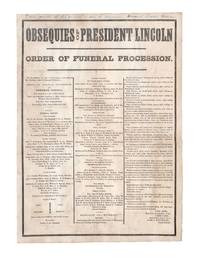
1865353589Springfield IL 1865. Broadside text in three columns mourning borders. Early manuscript note signed by Harriet Louise Greene in the upper margin "I was present at the funeral & saw the remains". 10-3/4 x 7-3/4 inches. Paper-backed at an early date with early newspaper clippings mounted on verso. Broadside text in three columns mourning borders. Early manuscript note signed by Harriet Louise Greene in the upper margin "I was present at the funeral & saw the remains". 10-3/4 x 7-3/4 inches. President Lincoln was assassinated on April 15 1865. His body lay in state in the White House on April 18 and a ceremonial funeral service took place in Washington D.C. around noon on April 19. Two days later President Lincoln's casket was loaded on a funeral train headed for Springfield Illinois stopping at Baltimore Harrisburg Philadelphia New York City Albany Buffalo Cleveland Columbus Indianapolis Michigan City and Chicago before arriving in Lincoln's adopted hometown early on the morning of May 3. <br /> <br /> Immediately upon arrival in Springfield Lincoln's coffin was transferred by hearse to Representatives' Hall inside the Illinois Old State Capitol. For the next twenty-four hours about 75000 mourners were allowed to pass by the open coffin of the slain president to pay last respects.<br /> <br /> According to the present broadside President Lincoln's funeral procession left the Old State Capitol "on Thursday the 4th Inst. at 10 o'clock a.m. precisely." The funeral party of over 10000 people then turned right on 7th Street to pass by the Lincoln family home and then right up Cook Street to proceed past the Governor's Mansion before heading north to Oak Ridge Cemetery.<br /> <br /> Surrounded by a heavy black band it lists all the persons and units involved their place in the procession and rules for the day. The entire procession was divided into eight divisions with Gen. Joseph Hooker acting as Marshal in Chief. The first three divisions were the military escort representing all the elements of the Army and Navy. After them came the attending clergy and Lincoln's attending physicians. Next was the casket itself the only wheeled vehicle in the procession with the pall bearers to each side followed by Lincoln's horse with reversed boots and then the immediate family. Next came government officials ambassadors and state officials followed by delegations from Springfield and other Illinois towns. Next were representatives of various organizations delegations from colleges lawyers doctors and the press. After this came Masons Odd Fellows and firemen. The final division was designated "Citizens at large. Colored Persons." Directions were given for the locations of each group forming up. Only marshals were allowed to be on horseback; all others walked. Bands were under the direction of the Committee on Music. Other particular directions complete the document.<br /> <br /> This broadside must have been widely distributed to assist the mourners but like all such ephemeral pieces few copies have survived. OCLC locates only six; at Indiana University the Abraham Lincoln Memorial Library the Boston Athenaeum the Chapin Library at Williams College the John Hay Library at Brown University and a copy formerly in the James S. Copley Library. There is also a copy at the Library of Congress. Two variants are recorded the other with a variant headline omitting "Order of" from title as well as a proof without the letters FUN of Funeral in the title. unknown
186524425New York: The New York Times 1865. Folio. 8pp. Black mourning borders. Very good. Slight age toning; inoffensive binding traces at left edge; small paper loss at bottom edge of last page. Lincoln had been dead one week when this issue Vol. XIV No. 4235 covering the search for the conspirators appeared. A handsome copy. The New York Times unknown
192474070Detroit: Lincoln Motor Company; A Division of Ford Motor Company 1924. First edition of this little swag book. It was not available for sale but when you bought a Lincoln you were given a copy. Small 12mo 6 x 4 inches. 29 1 pp. Publisher's decorative flexible blue fabricoid with gold title panel to front cover. Excellent.This particular copy was given out by the Walter H. Murphy Motors Company on Hope St. in Los Angeles so stamped on the title page; all copies should bear a similar stamp. An attractive little booklet. On each recto is a verse from the poem and each opposing verso has a different model of Lincoln shown and each car is surrounded by a lovely drawing of the Lincoln driving to various spots. Lincoln Motor Company; A Division of Ford Motor Company unknown
1868377927Jefferson City MO 1868. 2pp. printed recto and verso on a single quarto sheet. Old folds. 2pp. printed recto and verso on a single quarto sheet. Unrecorded handbill issued as a circular letter to the former Civil War officers of the 62nd U.S. Colored Infantry giving updates on each of their lives since the close of the war with some information on the founding of HBCU Lincoln University. Founded in 1866 the school had come about through the initiative of veterans of the 62nd and 65th United States Colored Infantries many of whom having learned to read and write while in the army recognized the importance of creating educational opportunities for newly emancipated African Americans after the war. Founding secretary of the Lincoln Institute Richard Baxter Foster 1826-1901 who has signed this circular in print was a White abolitionist and former first lieutenant in the 62nd Infantry who would go on to serve as the Institute's first principal as well as its only instructor for the first two years. <br /> <br /> Foster notes under his own update that he was teaching at the Lincoln Institute: "The school still flourishes as well as possible with its present poor accomodations. I think we chall build a school house next season. We have invested a part of our funds in 365 acres of land mostly timbered three miles south from Jefferson City . Sergeant Major Jefferys is still attending my school. He taught three months in the summer. Many other soldiers of different regiments are in the school."<br /> Formerly enslaved John O. Jefferys d. 1922 was the highest ranking non-commissioned African American in the 62nd U.S.C.I.<br /> <br /> One of approximately 35 copies printed assuming that copies were printed for the 35 named officers in the circular and not many more. unknown
1871334508New York 1871. Unbound. Near Fine. Two printed tickets each with a mounted albumen photograph in cabinet card format 4.25 x 6.25 inches. The back side of each ticket has a faint printed design on white glazed paper. Both tickets are neatly trimmed along the right edge near fine with a few tiny perimeter tears and light toning. The first ticket from 1870 has a mounted albumen photograph of a painting by A.H. Ritchie of Lincoln with his cabinet reading the Emancipation Proclamation. The second ticket from 1871 has a mounted albumen photograph of a statue of Lincoln reading a newspaper with Grant and whom we believe is Gideon Wells. The Lincoln Union Social Club a pro-Republican party function held its first ball in New York City in 1870. These two ephemeral items tickets for the first and second balls are not to be confused with the invitations that preceded them. Of the two the tickets may be a rarer survival. We know of only one other copy of the 1870 ticket at the Library of Congress. unknown
a61746Fort Wayne 1931-1947. 590 issues of this newsleter. 4to. 1 page per issue each with 3 holes at left margin for binder many with reinforcements. A few pencil notes on some issues. Good to VG. 590 issues. Pictures available on request. . unknown
193622171Chicago:Black Cat Press 1936. First Edition. hard cover. Very Good/No jacket. Chicago:The Black Cat Press. 1936. Limited edition of 140 copies. 98pp. In very good condition. Top pages edges are lightly soiled and the gilt on spine is faded with a touch of mottling to lower spine. Internally there are no previous owners marks or signatures. The pages are clean and bright. A very good copy. Chicago:Black Cat Press hardcover
1930SKU1016760Knickerbocker 1930-01-01. First Edition. Hardcover. Very Good. 0x0x0. The Knickerbocker Press; New York 1930. Hardcover. First Edition. Very Good green binding with gilt lettering to spine that shows rub marks bookplate to front pastedown binding a bit shaky and cocked light wear/rub marks to text block edges/fore-edge lightly sunned pages some handling wear rubbing to board corners/spine edges small abrasion to top front joint without Dust wrapper. A nice clean unmarked copy. 8vooctavo or approx. 6 x 9 inches 322pp. b&w illustrations errata and addenda attached to rear. We pack securely and ship daily with delivery confirmation on every book. The picture on the listing page is of the actual book for sale. Additional Scans are available for any item please inquire. Knickerbocker hardcover
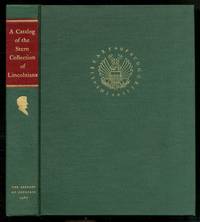
1960561636Washington: The Library of Congress 1960. Hardcover. Fine. First edition. Foreword by L. Quincy Mumford. Introduction by Arthur G. Burton. Quarto. xi 498pp. Gift inscription on front blank boards very slightly bowed with a tiny faint stain on the front cover and top corner of the textblock not affecting interior very near fine. The Library of Congress hardcover
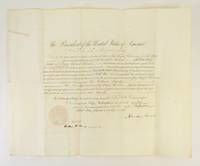
1718ST16605bWashington D.C.: U. S. Government 17 July 1862. 445 x 565 mm. 17 3/4 x 22 1/2". 17 lines of engraved text in copperplate script with names and dates completed in a fine secretarial hand. <br/> Loose as issued in an archival mylar sleeve. ◆Neatly mended two-and-three-quarters-inch tear to one edge well away from text half inch slit to end of one fold three very short separations along two folds only one touching text otherwise A FINE FRESH SPECIMEN clean and bright the signature dark and clear the wax-and-white-paper seal intact.<br/> <br/> This is an excellent example of a presidential document with Lincoln's full signature and with that of his Secretary of State William Henry Seward 1801-72 remembered for negotiating the purchase of Alaska from Russia. The consul appointed in this document Jay Haziel Sherman of Vermont served in Charlottetown Prince Edward Island from 1861 to 1865. It is likely this appointee was Jahaziel Blossom Sherman 1801-65 son of pioneering steamship captain Jahaziel Sherman 1770-1844 and that his unusual Old Testament name was misspelled by the scribe who filled in the appointment form. The younger Sherman died in Nova Scotia in 1865. U. S. Government unknown
1865236784Boston: Printed by Order of the City Council 1865. 1 vols. 8vo. Original pebbled bevelled cloth. Fine. 1 vols. 8vo. Includes speeches by Mayor of Boston Lincoln Senator Charles Sumner the eulogy Charles G. Loring A.H. Rice and Richard Henry Dana Jr pp. 56-61. BAL 4465 Printed by Order of the City Council unknown
192314412London: Savoy 1923. Hardcover. Small 4to. Grey paper over boards with gilt-edged paper label. 18pp 3pp. Tipped-in frontispiece. Near fine. First edition of this handsome production on fine paper. History of the famous Lincoln Room at the Savoy Hotel. G.D. Macdougald sculpted the magnificent Lincoln bust depicted on the frontispiece and unveiled when this room -- at which many historic events involving Herbert Hoover Winston Churchill and other notables took place -- was officially openedunveiled. MONAGHAN 2656. Savoy hardcover
1941320873New York: Newhouse Galleries 1941. Presentation manuscript accomplished by Paul Hessemer for Newhouse Galleries illustrated with a photographic portrait of the painting. With typed letters signed from E.J. Rousuck to Allan P. Kirby and a contemporary copy of a letter to John Hay Whitney offering the portrait. With the original label from an 1869 exhibition of the painting at the Pennsylvania Academy of Fine Arts. 4to. Bound in full blue morocco lettered in gilt silk endpapers. Presentation manuscript accomplished by Paul Hessemer for Newhouse Galleries illustrated with a photographic portrait of the painting. With typed letters signed from E.J. Rousuck to Allan P. Kirby and a contemporary copy of a letter to John Hay Whitney offering the portrait. With the original label from an 1869 exhibition of the painting at the Pennsylvania Academy of Fine Arts. 4to. An elaborate brochure for the sale of this important portrait offered to Allan Kirby and John "Jock" Hay Whitney just days before Pearl Harbor. Newhouse Galleries unknown
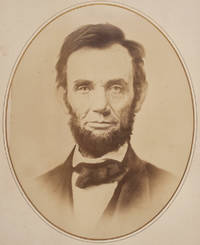
186332820640<p>Mammoth albumen print 17 ½ x 22 in mounted oval gilt-rule mat. Retouched vignetted enlargement. A few spots some toning. Very good condition.</p><p>This famous "Gettysburg portrait" with Lincoln looking directly into the camera was made just days before he delivered the Gettysburg Address on November 19 1863.</p><p>A giant of American photography Alexander Gardner is credited with introducing the large-format Imperial portrait to the United States while working as a staff photographer for Mathew Brady. Gardner left Brady's employ in early 1863 and his studio quickly rivaled Brady's for the quality and extent of its war and portrait photography. Gardner first photographed Lincoln as president-elect while working for Brady and he went on to take Lincoln's portrait more than any other photographer.</p><p>Lincoln sat for Gardner on several occasions usually visiting his studio on Sunday to avoid crowds. Lincoln sat for this splendid portrait on Sunday November 8 1863. His private secretaries John Hay and John Nicolay joined him. Hay noted in his diary that "We had a great many pictures taken … some of the Prest. the best I have seen." This print emphasizes Lincoln's head and shoulders enlarging them to a size rarely seen.</p><p>The gilt-ruled paper mat is characteristic of the 1860s and 1870s with this style of mat being popular during this period. Moses Rice subsequently had access to Gardner's negatives and routinely signed his prints with his name suggesting that Gardner himself made this enlargement. He died in 1882.</p><p>The photography session of November 8 1863 also produced the mammoth portrait we offer for $95000. That photograph and the present are among the only early mammoth Lincoln portraits we have ever encountered.</p><p>This is the only mammoth example of the famous Gettysburg portrait that we have seen.</p><p>Ostendorf O-77</p>
1918251096London: Sidgwick & Jackson Ltd 1918. First edition. 1 vols. 8vo. Red boards paper spine label. Spine chipped with loss else VG. Bookplate of T. Fytton Armstrong John Gawsworth. First edition. 1 vols. 8vo. This was the play that made Drinkwater famous and his success was followed by other historical plays such as Mary Stuart Robert E. Lee etc. Inscribed on title-page "With malice toward none with charity for all it is for us to resolve that this antion under God shall have a new birth of freedom.A.L. p. 71 written out for John Gawsworth John Drinkwater August 1932." John Gawsworth's Copy. <br/><br/> Sidgwick & Jackson, Ltd hardcover
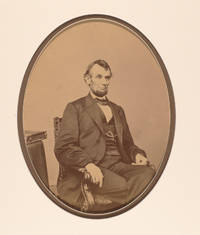
186442820809<p>Oval albumen print 8 x 6 in. original printed mount trimmed at bottom removing caption signed "BRADY & CO. PHOTOGRAPHERS." Browning and offsetting to mount light toning to image. Very good. Matted and framed.</p><p><strong>The classic Brady $5 bill photograph.</strong> This celebrated portrait the basis for the five-dollar bill engraving used for most of the 20th century is one of seven poses taken by Anthony Berger at Mathew Brady's Washington D. C. studio on February 9 1864. The most prolific photographer of Lincoln Brady himself did not actually operate his cameras during the war years instead training and employing men like Alexander Gardner and his successor Anthony Berger who took this picture to operate the camera.</p><p><strong>Lincoln's son Robert Todd Lincoln declared this famous portrait to be "the most satisfactory likeness" of Abraham Lincoln.</strong></p> Mathew Brady Gallery
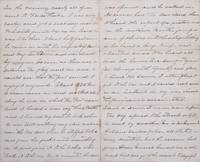
1865376410Montauk Montauk Navy Yard Wash D.C. 1865. 4 pp. 8vo. Slight soiling and minor tears along old folds otherwise in very good condition. 4 pp. 8vo. ".About 10:25 P.M. a man came in and walked slowly along the side." <br /> <br /> A remarkably clear and dramatic eyewitness account of the assassination of Abraham Lincoln from a naval surgeon who was close to the President's box at Ford's theater on that fateful night of April 14 1865. In this letter to his brother written the night after the assassination while the details were still fresh in his memory Dr. George B. Todd surgeon aboard the U.S. "Montauk" at anchor in the Navy Yard that day recounts the terrible event with a clarity of observation one might expect of his profession-a rarity among confused eyewitness accounts. The text of Todd's letter one of only 7 eyewitness accounts written within 24 hours of the assassination reads: <br /> <br /> "The few hours that have intervened since that most terrible tragedy of last night have served to give me a little clearer brain and I believe I am now able to give you a clear account up to this hour. Yesterday about 3 P.M. the President and wife drove down to the navy yard and paid our ship a visit going all over her accompanied by us all. Both seemed very happy and so expressed themselves - glad that this war was over or so near its end and then drove back to the White House. In the evening nearly all of us went to the Ford's Theatre. I was very early and got a seat near the President's private box as we heard he was to be there. About half past nine he came in with his wife a Miss Harris and Major Rathburn and was cheered by every one. As soon as there was a silence the play went on and I could see that the "pres." seemed to enjoy it very much. About 10:25 P.M. a man came in and walked slowly along the side on which the 'pres.' box was and I heard a man say "there's Booth" and I turned my head to look at him. He was still walking very slow and was near the box door when he stopped took a card from his pocket wrote something on it and gave it to the usher who took it to the box. In a minute the door was opened and he walked in. No sooner had the door closed then I heard the report of a pistol and on the instant Booth jumped out of the box onto the stage holding in his hand a large knife and shouted so as to be heard all over the house - 'Sic Semper Tyrannis' "so always with tyrants" and fled behind the scenes-I attempted to get to the box but I could not and in an instant the cry was raised 'The President is Assassinated.' <br /> "Such a scene I never saw before. The cry spread to the street only to be met by another 'So is Mr. Seward.' Soldiers had gone. Some General handed me a note and bid me go to the nearest telegraph office and arouse the nation. I ran with all my speed and in ten minutes the sad news was all over the country. Today all the city is in mourning nearly every house being in black and I have not seen a smile. No business and many a strong man I have seen in tears. <br /> "Some reports say Booth is a prisoner others that he has made his escape but from orders received here I believe he is taken as a mob once raised now would know no end. I will not seal this until morning and I may have some more news. <br /> <br /> "April 24th. <br /> "I have had no time to write until now as I have been a detective. We have now 7 that are implicated.<br /> Why don't you write Love to all George" <br /> <br /> Several important facts regarding the movements of both the President and John Wilkes Booth are recorded here: <br /> 1 This appears to be the only eyewitness account of the President's inspection of the "Montauk" earlier that afternoon. <br /> 2 Todd's account of Booth's interaction with the "usher" sitting outside the President's box "took a card from his pocket wrote something on it and gave it to the usher" is especially intriguing and reveals not only something of Todd's powers of observations but also his proximity to the assassin immediately before the shooting. Todd alone among eyewitnesses notes that the "usher" first took the card from Booth then went into the box and that a short time later the door opened and Booth went in. In fact Good finds only 7 other eye-witness accounts of the Lincoln assassination as early as April 15-most of these witnesses record little or nothing regarding the events before hearing the shot itself and none of them noticed Booth's interchange with the usher who was in fact Lincoln's valet Charles Forbes. There are three other accounts by eyewitnesses which partially corroborate Todd's observation of the Forbes and Booth interchange-but they were written much later than Todd's. <br /> 3 Todd's observation of the time he spotted Booth moving toward the box "about 10:25" corresponds to Good's own conclusion that Booth fired the fatal shot close to 10:30 PM. According to James Swanson MANHUNT p. 419 "the exact time of Booth's shot cannot be fixed . Booth may have shot Lincoln as early as 10:13 or as late as 10:30" Todd's account - again one of the freshest and most reliable weighs heavily in favor of Good. <br /> 4 Todd by his own account played a role in alerting the nation by telegraph. <br /> 5 Although he doesn't mention it as a surgeon of the ironclad Montauk Todd was also probably present at the autopsy of John Wilkes Booth on Thursday April 27 in the gun room of his ship. Indeed in an article in the February issue of the Baltimore and Ohio Magazine 1926 where the letter was first published and reproduced Todd is reported to have been "one of the surgeons who performed the autopsy." That as well as the fact that the other prisoners were being held on board the ironclad "Montauk" and "Saugus" may explain his cryptic remark near the end ". I have been a detective .". Todd actually mailed the letter on April 30 3 days after the autopsy and may very have participated in the actual investigation of the captives aboard the "Montauk." <br /> <br /> AN EXTRAORDINARY AND UNIQUE RECORD OF ONE THE NATION'S GREAT TRAGEDIES. Published from a copy in the State Historical Library of Wisconsin in Timothy S. Good WE SAW LINCOLN SHOT U. of Miss. 1995; with the mistaken date of April 30 1865 unknown
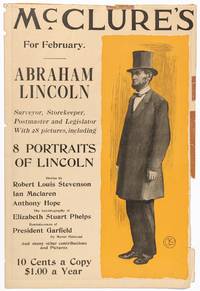
1896458433New York: McLure's 1896. Unbound. Good. 15" x 22". Illustration of Lincoln by Corwin Knapp Linson. Remnants of tape from old matting with a few small chips at the margins a good only example. also advertises stories by Robert Louis Stevenson Anthony Hope and others. McLure's unknown
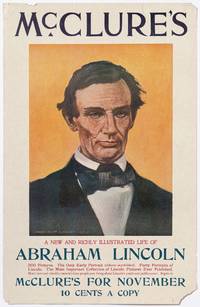
1895517161New York: McClure's 1895. Unbound. Very Good. Publisher's promotional broadside. Illustrated from a portrait of Lincoln by Corwin Knapp Linson. Measuring 12½" x 19½". Several small chips and edge tears one longer closed tear at the top edge affecting the title but stopping short of the image bright and very good. A handsome publisher's broadside announcing the publication of "A New and Richly Illustrated Life of Abraham Lincoln" in McClure's magazine. The serial will publish 300 pictures the only and previously unpublished early portrait of Lincoln and "much new and valuable material from people now living about Lincoln's youth and public career. McClure's unknown
553031 vols. 9 x 6 inches framed to 17 x 14-1/2. Two chips lightly scratched. Glued in wood frame. 1 vols. 9 x 6 inches framed to 17 x 14-1/2. unknown
1866375831Washington D.C.: John H. Littlefield; Wm. Terry Printer 1866. Photograph by John Goldin of Littlefield's painting on printed mount. Image 5 x 9 1/2 in.; mounted to 11 x 14 in. Faint toning to mount; fine. Photograph by John Goldin of Littlefield's painting on printed mount. Image 5 x 9 1/2 in.; mounted to 11 x 14 in. A published photograph of Littlefield's hyper-realistic Lincoln death-bed painting each figure meticulously rendered from photographs. <br /> Littlefield studied law under Lincoln in 1858 stumped for him in his Presidential bid and was rewarded with a position in the Treasury Department. After Lincoln's death Littlefield invented this tableau of twenty-five people ranged around the death-bed including Vice-President Johnson Surgeon Charles Leale and Mrs. Lincoln.<br /> "The artist used photographs as models for the twenty-five people gathered in the death room but his profile of the dying Lincoln shows a first-hand acquaintance" Ostendorf LINCOLN'S PHOTOGRAPHS p. 279. John H. Littlefield; Wm. Terry, Printer unknown
1866238120Washington D.C.: John H. Littlefield; Wm. Terry Printer 1866. Photograph by John Goldin of Littlefield's painting on printed mount. 1 vols. Image 11 1/2 x 18 3/4 in.; mounted to 19 x 24 in. Soiling to image vertical crease large chips to bottom of mount not affecting image or legend; good. Photograph by John Goldin of Littlefield's painting on printed mount. 1 vols. Image 11 1/2 x 18 3/4 in.; mounted to 19 x 24 in. A published photograph of Littlefield's hyper-realistic Lincoln death-bed painting each figure meticulously rendered from photographs. Littlefield studied law under Lincoln in 1858 stumped for him in his Presidential bid and was rewarded with a position in the Treasury Department. After Lincoln's death Littlefield invented this tableau of twenty-five people ranged around the death-bed including Vice-President Johnson Surgeon Chalres Leale and Mrs. Lincoln. "The artist used photographs as models for the twenty-five people gathered in the death room but his profile of the dying Lincoln shows a first-hand acquaintance" Ostendorf LINCOLN'S PHOTOGRAPHS p. 279. Provenance: Harper Family John H. Littlefield; Wm. Terry, Printer unknown