Lincoln, Abraham [Gerald R Ford]Biblio.com
9 915 résultats
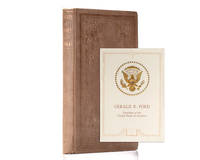
1860149362Columbus: Follett Foster and Company 1860. First edition early issue of the most famous debates in American history which cemented Lincoln as a national presidential candidate. Octavo original cloth stamped in blind. Ownership bookplate of President Gerald R. Ford to the front pastedown. President Gerald R. Ford and Abraham Lincoln occupy distinct yet symbolically linked places in American presidential history united by their encounters with political violence and national division. Abraham Lincoln the 16th president led the United States through the Civil War and became the first American president to be assassinated when he was shot by John Wilkes Booth at Ford’s Theatre in 1865—a moment that transformed him into a martyr for the Union and a symbol of democratic perseverance. Over a century later Gerald R. Ford the 38th president survived two assassination attempts within seventeen days in 1975 both carried out by women—Lynette “Squeaky†Fromme and Sara Jane Moore—amid the turbulence of the post-Watergate era. While Ford’s brush with assassination did not result in tragedy it echoed the lingering volatility of American political life that had claimed Lincoln’s. In near fine condition. An exceptional example with even better provenance. Running as a little-known candidate for the Illinois senatorship in 1858 Lincoln challenged incumbent and Democratic leader Stephen Douglas to a series of debates. The result was a memorable chain of lively arguments in front of cheering crowds. Though Lincoln lost the senatorial race “he began collecting a scrapbook of his best speeches particularly those from the just-concluded campaign against Douglas for possible inclusion in a book. Assiduously pasting newspaper accounts of the debates into the scrapbook Lincoln cast about for a publisher. Initial efforts failed mainly because Lincoln wanted the book printed in Springfield which had no local publishing or printing facilities. Eventually however the Columbus Ohio firm of Follett Foster & Company showed interest and he began preparing the first edition… Somewhat surprisingly for an attorney Lincoln did not seek Douglas’ permission to publish a book of their combined speeches although Douglas was later given the last-minute opportunity—he declined—to make corrections to his own remarks†Morris 121. Follett, Foster and Company hardcover
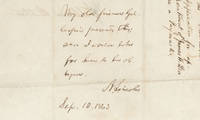
15093547615/09/1863. <blockquote><p>The letter itself was from Lamb a pallbearer after Lincoln's assassination</p></blockquote><p>Joseph Gillespie was a Whig member of the Illinois Assembly in 1840-41 and then served in the State Senate from 1847 to 1859. He joined the Republicans in 1856. Gillespie chaired the Illinois Republican State Convention in 1860 where presidential electors were selected who would vote for Abraham Lincoln and served as circuit court judge in Southern Illinois from 1861 to 1873.</p><p>From when they met in 1840 Gillespie was a key political ally lawyer and trusted and intimate friend to Abraham Lincoln. They consulted on legal cases and in political matters where they kept each other informed of political developments. Gillespie visited President-elect Lincoln at Springfield before he left for Washington. When Lincoln was president Gillespie occasionally went to Washington to see him and kept him informed about the political situation in the western states. Their correspondence shows a close personal bond.</p><p>James L. Lamb was a meatpacker industrialist and friend of Lincoln from Illinois known for his business dealings with the future President and his role as one of the pallbearers at Lincoln's funeral. In a letter addressed to President Lincoln Lamb wrote him from Springfield Ill. September 10 1863 to secure a position for a relative. “My friend and relative Mr. James H. Lea is an applicant for the position of paymaster in the army. His appointment I am sure would meet the approbation of all true friends of the Government who are acquainted with him. I have long known him as a reliable competent businessman and one whose integrity could be fully relied upon. His moral character is without blemish and the most satisfactory assurances can be given of his integrity and fitness for the position.†The docket states “Springfield Sep. 10/63 James L. Lamb to the President. Application for appointment of James H. Lea as a Paymaster.â€</p><p>This letter was not mailed by Lamb to Lincoln. Instead Lamb gave the letter to Gillespie to enlist his support and use his influence with Lincoln. Gillespie presented Lamb’s letter to Lincoln with his request that it be honored.</p><p><strong>Autograph endorsement signed</strong> Washington September 15 1863. <em>“My old friend Gillespie presents this; and I would like for him to be obliged.†</em>This is unpublished and not in Basler’s Collected Works of Abraham Lincoln. The wording of Lincoln’s endorsement saying that Gillespie presented this to Lincoln and the implication that Gillespie will need to be presenting this to the Secretary of War raises the possibility that Gillespie handed this to Lincoln in person and then took the endorsement to Stanton.</p><p>On October 10 Gillespie wrote Lincoln that the appointment had not yet been made and relating a communication with Stanton saying<em> “I would beg to call your attention to the subject of the appointment of my friend James H. Lea of Alton to the office of paymaster in the regular army. Secy. Stanton told me that he would retire one now on the list to make place for Mr Lea in a short time. I have heard nothing from him since. I would take it as a great favor if this thing could be done soon. I am aware how much you must be pressed with business of an engrossing character at this juncture but hope you may find leisure to jog the secretary’s memory.â€</em></p><p>According to papers in the Library of Congress James H. Lea was appointed an additional paymaster of volunteers to rank from February 23 1864. He signed his oath of office in April.</p><p>This is a fascinating endorsement showing how Lincoln sought to assist his old friends to the extent he appropriately could.</p><p><img class=""alignnone wp-image-25018 size-post-window"" src=""https://cdn.raabcollection.com/wp-content/uploads/20231204144051/Folder-site-11-1600x1327.jpg"" alt="""" width=""1600"" height=""1327"" /></p> unknown
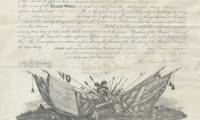
15073254115/07/1864. <blockquote><p>A real rarity the first Lincoln appointment to the Signal Corps for an officer active in Sherman’s Georgia Campaign we have seen</p></blockquote><p>On March 29 1860 the United States House of Representatives approved the Army appropriations bill for fiscal year 1861 which included the following amendment: ""For the manufacture or purchase of apparatus and equipment for field signals $2000; and that there be added to the staff of the Army one signal officer with the rank pay and allowance of a major of cavalry who shall have charge under the direction of the Secretary of War of all signal duty and all books papers and apparatus connected therewith."" The United States Senate eventually approved the appropriations bill over the objections of Jefferson Davis now Senator from Mississippi and President James Buchanan signed it into law on June 21 1860 the date now celebrated as the birthday of the modern U.S. Army Signal Corps.</p><p>Now armies on the go could report back to their civilian leadership in real time and those leaders could make decisions without waiting for a messenger on horse. This changed the face of warfare. President Lincoln himself spent significant time in the telegraph office sending and receiving war correspondence. He often walked alone from the White House to the office and chatted with the operators. As Bates later wrote “During the Civil War the President spent more of his waking hours in the War Department telegraph office than in any other place except the White House. While in the Telegraph Office he was comparatively free from official cares and therefore more apt to disclose his natural traits and disposition than elsewhere under other conditions.â€</p><p>John Quincy Adams first enlisted in 1862 with the 38th Ohio Volunteers. On October 15 of that year he was a quartermaster sergeant with the 10th Ohio Cavalry. After a stint as acting lieutenant on July 15 1864 he was appointed by the President Second Lieutenant to date from March 3 1863. Adams was actively involved in the Georgia campaign conducted by Gen. William T. Sherman. He was with left wing of the 16th Army Corps on the march to Chattanooga Tenn. In the Atlanta Campaign he participated in the battles of Resaca Dallas Kenesaw Mountain. and Jonesboro. He manned signal corps stations at Kenesaw Mt. and Allatoona.</p><p>Adams was in the engagements at Port McAllister and Rice Mill station in the campaign from Savannah through the Carolinas including battles at Columbia Bentonville and Raleigh; and at the surrender of Confederate Gen. Joseph E. Johnston to Sherman on April 26 1865. Adams was breveted 1st lieutenant for gallant and meritorious service in the Signal Corps at the battle of Allatoona; he was breveted captain for gallant and meritorious services in the Signal Corps at the capture of Fort McAllister and Savannah and throughout the war. Adams was mustered out August 22 1865. After the war he was in the 1st U. S. Cavalry and was in the Indian wars and finished his career as captain and aide to Gen. O.O. Howard in October 1884. He is listed on the roster of the U.S. Signal Corps in the Civil War.</p><p>Adams is also a protagonist in one of the most famous telegraph exchanges of the war during the battle near Allatoona. During this battle legend goes that Sherman signaled to General Corse and his men to ""hold the fort"" a phrase that inspired the later popular religious hymn entitled Hold the Fort by Chicago evangelist Philip P. Bliss which featured the chorus 'Hold the fort for I am coming’ which then became a common expression. We still use ""hold down the fort"" today. Adams was the signal officer who received that message or rather a variant as Sherman did not use that exact phrase though captured the sentiment.</p><p>This is President Lincoln’s appointment of Adams as Second Lieutenant. <strong>Document signed</strong> Washington July 15 1864 naming Adams <em>""Second Lieutenant in the Signal Corps""</em> dating from the third of March 1863.</p><p>This document is a real rarity as we have never before seen a Lincoln appointment to the Signal Corps for an officer active in Sherman’s March to the Sea. Moreover Lincoln Signal Corps appointments are themselves uncommon this being our first.</p><p>It was acquired from the Adams descendants and has never been offered for sale before.</p><p><img class=""alignnone wp-image-25018 size-post-window"" src=""https://cdn.raabcollection.com/wp-content/uploads/20231204144051/Folder-site-11-1600x1327.jpg"" alt="""" width=""1600"" height=""1327"" /></p> unknown
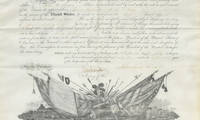
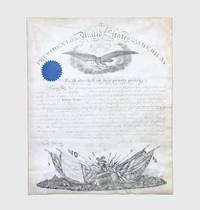
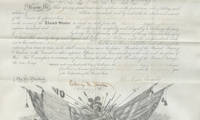
18623341204/03/1862. <p>As 1862 opened the war was not going well for the Union. In the east Bull Run had been a disaster and led to the shake-up of command with no results yet to show for it. In the west the loss at Wilson’s Creek gave the Confederates the upper hand. The Federal armies in the west then turned their attention to implementation of the Anaconda Plan – to cut the Confederacy in half by securing the Mississippi River from St. Louis all the way to the Gulf of Mexico and clearing a maritime invasion route into the heart of the Confederacy by taking the Tennessee and Cumberland Rivers which lay just to the east of the Mississippi. If successful these maneuvers would cut Texas Arkansas and Louisiana off from the main body of the South hold Kentucky and Missouri firmly in the Union and make it difficult for Tennessee to cooperate with her sister Confederate states. The first moves would be to take and hold commanding locations north on the Tennessee and Cumberland rivers and command of the operation was given to Brig. Gen. Ulysses S. Grant an obscure and largely unproven officer.</p><p>On February 6 1862 Fort Henry commanding the Tennessee River was captured by Grant’s forces. It had a poor defensive position and was reduced mainly by the bombardment of gunboats on the river. Nonetheless its fall opened the Tennessee River to Union gunboats and shipping past the Alabama border and provided a real victory for Union arms. Grant next focused his attention on Fort Donelson eleven miles away on the more strategically important Cumberland River. This fort had a much stronger physical position and the Confederates had placed some 20000 men and a number of senior commanders on site to engage in its defense. They were not about to concede the fort and they were ready and waiting for Grant. Grant arrived at Fort Donelson late on February 12 and on the 13th established his headquarters near the left side of the front of the line. That day was spent in battle preparation with a few small probing attacks being carried out against the Confederate defenses.</p><p>Grant's headquarters was at Cairo Ill where the head of Ordnance was Stephen Lyford. Grant arrived at Fort Donelson late on February 12 and on the 13th established his headquarters near the left side of the front of the line. That day was spent in battle preparation with a few small probing attacks being carried out against the Confederate defenses.</p><p>The battle was severe with nearly 1000 soldiers on both sides killed and about 3000 wounded. When Simon Buckner the Confederate commander asked for surrender terms Grant famously replied “No terms except unconditional and immediate surrender can be accepted“ adding “I propose to move immediately upon your works.†Buckner surrendered his command of about 15000 men; this was the first of three Confederate armies that Grant captured during the war.</p><p>The capture of Fort Donelson gave the North control of the Cumberland River which provided the road that opened the Deep South to Union invasion. It boosted morale in the North which now saw that the war could result in great victories and not just defeats. It gave President Lincoln the fighting general he was looking for and it made Grant’s career in the process; he was soon promoted to major general of volunteers.</p><p>Stephen C. Lyford had a long and distinguished career. He served from May to August 1861 in the defenses of Washington D. C. and in the Manassas Campaign participating in the Battle of Bull Run July 21 1861. He was Aide-de_Camp to Brig. General McDowell in the defenses of Washington D. C. August to October 1861 and Asst. Ordnance Officer at St. Louis Arsenal Mo. November 2 1861 to February 1 1862; in command of the Cairo Ordnance Depot Ill. February to May 1862 being detached to the Cumberland River and was present at the Surrender of Ft. Donelson. He was part of Gen. Halleck's Mississippi Campaign May to July 1862 being engaged in the Siege of Corinth May 1862 and was Chief of Ordnance for Department of the Tennessee July 11 1862 to September 6 1863 and fought in the Battle of Corinth. He would go on to teach at West Point and also serve as aide-de-camp for Gen. Halleck and as representative of the US to Japan to bring back information and technology relevant for American ordnance.</p><p><strong>Document signed</strong> with engravings of flags and weapons Washington March 4 1862 Naming Lyford a <em>“Second Lieutenant in the Ordnance Department.""</em></p><p><img class=""alignnone wp-image-25018 size-post-window"" src=""https://cdn.raabcollection.com/wp-content/uploads/20231204144051/Folder-site-11-1600x1327.jpg"" alt="""" width=""1600"" height=""1327"" /></p> unknown
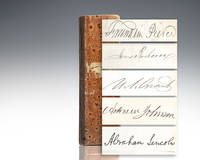
18771465621877-1880. Unique 19th-century autograph album containing the signatures of six American presidents fifteen senators several cabinet members and governors including Abraham Lincoln Ulysses S. Grant James Buchanan and Franklin Pierce. Narrow quarto bound in one quarter period dark brown cloth over stiff marbled wrappers the autograph album is a repurposed 19th-century caucus record dating from ca. 1870. The caucus book is alphabetically tab-indexed and filled out in ink voters are tracked by their name with caucus results appearing in the back. Although this is labeled “Ward 5†in the first page the term "Ward" was flexible in its usage. This could have been for a Ward election precinct caucus legislative congressional or state convention caucus. The autographs are mounted over the caucus records in their respective alphabetical tab. Also mounted at front are 6 printed pieces of 19th-century ephemera. The autograph album was assembled between 1877 and 1880 and can be dated by a contemporary pencil note that John Sherman had transitioned from the Senate to be Secretary of the Treasury. From the collection of a Mr. Boyd a 19th-century Ward politician in the upper Midwest Minnesota or Wisconsin. The Presidential autographs are primarily clipped from Presidential appointments and include: Abraham Lincoln James Buchanan Ulysses S. Grant Andrew Johnson Franklin Pierce and Rutherford B. Hayes. In very good condition. A very rare and unique collection. hardcover
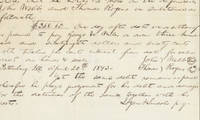
18433570010/1843. <blockquote><p>Miles who was also a prominent Whig politico and part of Lincoln’s political circle used Lincoln’s legal services a number of times</p></blockquote><p>Abraham Lincoln and Stephen T. Logan formed a prominent Illinois law partnership called Logan & Lincoln from 1841 to 1844 during which Logan an experienced attorney mentored Lincoln and introduced him to complex areas of the law. During his partnership with Logan Lincoln also increased his caseload before the Illinois Supreme Court and handled appeals from all areas of the state. Logan and Lincoln handled many cases together not merely at their Springfield office but around the state. This ls because Lincoln had a circuit law practice that involved riding the Eighth Judicial Circuit in Illinois covering 14-15 counties including Menard County on horseback or buggy. Logan remained in Springfield while Lincoln traveled the Circuit. As a general practitioner Lincoln handled diverse cases including property disputes debts torts. slander and criminal law. The Logan & Lincoln partnership ended amicably in 1844 after which Lincoln partnered with William H. Herndon who was a clerk in the Logan & Lincoln law office and whose father had been a Lincoln friend for many years.</p><p>George U. Miles was Herndon’s father-in-law. He came to Illinois in 1816 at age 20 settling first in St. Clair County and then in White County where he married Jane McCoy on November 18 1821. They had three children. Miles removed to Logan County and then in 1836 he went to Sangamon County where he lived on a farm six miles north of Springfield. In 1839 he moved to Petersburg in Menard County where he served as public administrator from 1845 to 1849. Miles was a Whig and a Menard County delegate to conventions that chose Whig candidates. Miles and Lincoln knew each other as neighbors and fellow Whigs and also because of Miles’ family relationship to Lincoln’s friend and partner Herndon. In early 1843 Lincoln sought a nomination for Congress and hoped for Miles’ political support.</p><p>Miles used Lincoln as an attorney a number of times both before and after Herndon became Lincoln’s partner. In late 1843 Miles retained Logan & Lincoln and sued John Webb and Thomas Rogers to collect a $368.60 debt on a promissory note.</p><p><strong>Autograph document signed</strong> all in Lincoln’s hand Menard County Illinois October-November 1843 being a petition in the county court in which Miles asks for judgment for a debt. <em>“George U. Miles plaintiff states that he holds a note on the defendants John Webb and Thomas Rogers in substance as followeth: ‘$368.60. One day after date we or either of us promise to pay George U. Miles or order three hundred and sixty eight dollars and sixty cents with twelve percent interest from date for value received. Our hands & seals: John Webb and Thomas Rogers Petersburg Ill. April 20th 1843.’ Yet the same debt remains unpaid wherefore he prays judgment for his debt and damages for the detention of the same together with his costs. Logan & Lincoln.â€</em></p><p>Lincoln won the case. The defendants were found to have defaulted and the court awarded Miles $392.67 counting costs. The case was decided November 1 1843. It is listed at lawofficeofabrahamlincoln.org.</p><p>After Lincoln’s assassination Miles acted as one of Herndon's key investigators. Miles famously interviewed individuals including Ann Rutledge’s aunt to gather information about Lincoln's early life and relationships serving as a vital source for Herndon's research. Herndon would write a famous biography of Lincoln in the 1880s.</p><p><img class=""alignnone wp-image-25018 size-post-window"" src=""https://cdn.raabcollection.com/wp-content/uploads/20231204144051/Folder-site-11-1600x1327.jpg"" alt="""" width=""1600"" height=""1327"" /></p> unknown
18643560801/08/1864. <blockquote><p>This appointment is listed in War Department General Orders no. 256</p></blockquote><p>According to the National Museum of Civil War Medicine and other sources Lt. Adam Miller of the 2nd Mass. Vols. aged twenty-three years was badly wounded August 9 1862 at the Battle of Cedar Mountain by an elongated musket ball which entered below the right eye socket and traversing the nasal cavity emerged through the left eye socket destroying the globe of the left eye and lacerating the left lower eyelid. He was made a prisoner and taken to a hospital at Charlottesville Va. where his wound ultimately formed a scar with great deformity. After being exchanged he entered the New York Eye Infirmary and on April 10 1863 a plastic surgical operation was performed by Dr. Henry B. Sands for the restoration of the eyelid. The operation was eminently successful and on April 22 1863 the parts were sufficiently healed to permit the insertion of an artificial eye. He thus survived a catastrophic facial wound and underwent pioneering plastic surgery.</p><p>Due to his injuries which made him unfit for active field duty but still capable of light service he was transferred to the Veteran Reserve Corps in August 1863 with his commission dating back to June 27 1863. The Veteran Reserve Corps was a military organization of the Union Army created for partially disabled or otherwise infirm soldiers who could still perform simple duties such as guarding prisoners or patrolling cities. This appointment is listed in War Department General Orders no. 256.</p><p><strong>Document signed</strong> with engravings of an eagle flags and weapons Washington August 1 1864 naming Adam Miller a lieutenant in the Veteran Reserve Corps effective June 27 1863.</p><p>An extraordinary Lincoln appointment of a soldier who made medical history in the Civil War.</p><p><img class=""alignnone wp-image-25018 size-post-window"" src=""https://cdn.raabcollection.com/wp-content/uploads/20231204144051/Folder-site-11-1600x1327.jpg"" alt="""" width=""1600"" height=""1327"" /></p> unknown
18611571129/03/1861. <p>James E. Harrison though born in Virginia served the Union cause during the Civil War. He received his first appointment as a Second Lieutenant to the 2d U. S. Cavalry in June 1856 and was stationed in Texas and various forts in the West until December 1858 when he was assigned to scouting Indians. He returned East and with the Civil War imminent he was promoted to First Lieutenant 2d U.S. Cavalry in March 1861 and then to Captain 5th U.S. Cavalry in May of that year. Harrison was engaged in the Peninsular campaign and commanded a regiment in the Army of the Potomac from September 1862 to June 1863. During that time he served at the battles of Antietem Chancellorsville and Brandy Station among many others. He was Breveted Major U.S. Army for gallant and meritorious services at the battle of Hanover Court House and Brevet Lieutenant Colonel U.S. Army for gallant and meritorious services at the battle of Antietam. In July of 1864 Harrison was assigned to be Inspector-General of Cavalry in the Department of Arkansas and was later appointed as Special Inspector of Cavalry in West Mississippi.</p><p><strong>Document signed</strong> as President Washington March 29 1861 effective retroactively to February 27 1861 an ornate vignetted commission with an eagle cannons and flags appointing Harrison to the rank of “First Lieutenant in the Second Regiment of Cavalry.†The document is countersigned by Secretary of War Simon Cameron.</p> unknown
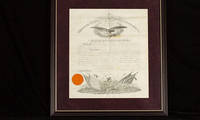
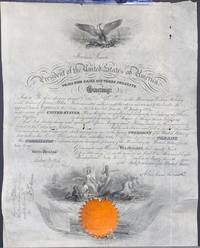
1864132067April 21 1864. American naval commission signed by Abraham Lincoln as President of the United States and Gideon Welles as Secretary of the Navy. Folio partially engraved on vellum the document is dated April 21 1864 and promotes Charles W. Tracy to the rank of Lieutenant. In near fine condition. Matted and framed with a portrait of Lincoln and engraved plate. The Commission measures 19 inches by 16 inches. The entire piece measures 34 inches by 29.5 inches. Abraham Lincoln served as the 16th President of the United States from March 1861 until his assassination in April 1865. He led the United States through the American Civil War the country's greatest moral cultural constitutional and political crisis and in doing so preserved the Union of the United States of America abolished slavery and strengthened the federal government. Lincoln ran for President in 1860 sweeping the North in victory. The South was outraged by Lincoln's election and in response secessionists implemented plans to leave the Union before he took office in March 1861. War began in April 1861 when secessionist forces attacked Fort Sumter in South Carolina just over a month after Lincoln's inauguration and after years of deadly military conflict officially ended on April 9 1865 when Confederate General Robert E. Lee surrendered to Union General Ulysses S. Grant at the Battle of Appomattox Court House. On April 14 1865 just days after the war's end at Appomattox Lincoln was attending a play at Ford's Theatre with his wife Mary when he was assassinated by Confederate sympathizer John Wilkes Booth. Lincoln is remembered as the martyr hero of the United States and is consistently ranked as one of the greatest presidents in American history. hardcover
1863172650Washington DC: 10 March 1863. Signed four months before the Battle of Gettysburg A military appointment signed by Abraham Lincoln at the height of the American Civil War. Such documents were instruments of authority and means of identification as soldiers crossed through military lines and took command. The document appoints James Gillette to the position of "Commissary of Subsistence of Volunteers with the rank of Captain". James Gillette 1838-81 enlisted as a private and rose quickly through the ranks. He served as Commissary of Subsistence for the 2nd Division XII Corps under General John W. Geary. For his meritorious service he was breveted lieutenant colonel U.S. Volunteers and for gallantry at the battle of Chancellorsville he was breveted major in the regular Army. A week earlier on 3 March Lincoln signed the Conscription Act mandating the impressment of able-bodied young men into the service of the Union Army. A clause allowing for exemption by paying a fee provoked national fury leading to riots in New York. Engraved military appointment 415 x 340 mm on vellum with the sections accomplished in manuscript attractive cartouche of the American eagle at the head and large trophy of arms at the foot engraved by J. V. N. and O. H. Throop blue wafer seal at left War Department docketing notations at upper left. Mounted and framed with UV conservation glazing framed size 64 x 53 cm. Originally folded into sixths leaving light creases as usual. Slightly discoloured at extremities ink a little faded but still clear. In very good condition. hardcover
1862190938Washington DC: 28 July 1862. Taxing the new state of Oregon to fund the Civil War Lincoln appoints Lawrence White Coe collector of federal taxes for the State of Oregon. In August 1861 Congress passed a new direct tax to fund the Civil War. Oregon's share was $35000 seven eighths of the state's annual revenue Bancroft p. 640. The measure marked both a substantial expansion of federal taxation and a wartime extension of presidential patronage through the appointment of tax officers. Oregon had become a state in 1859. Coe 1831-1897 resident in Wasco County had opened steam navigation on the upper Columbia River with the stern-wheeler Colonel Wright which was contracted to carry army supplies to Fort Walla Walla. His father Nathaniel Coe had been appointed by President Fillmore as the first postal agent in the Northwest. Printed document with manuscript additions 281 x 434 mm embossed seal of the US Treasury. Presented in a wooden frame with conservation acrylic glazing 555 x 425 cm. Minor chipping at extremities tape residue on verso from former framing minor soiling and light spotting. In very good condition. Hubert Howe Bancroft History of Oregon Vol. II 1888. unknown
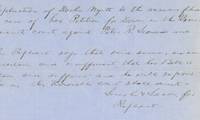
18533514603/11/1853. <blockquote><p>The case is well known and illustrates Lincoln’s penchant for aiding women who had been unjustly treated</p></blockquote><blockquote><p>""Said answers are untrue uncertain and insufficient that her Bill is true certain and sufficient and he Lincoln will so prove it to be""</p><p> </p></blockquote><p>During his 25-year legal career in Illinois Abraham Lincoln was involved in a substantial number of cases involving women as litigants. He was known for seeking to represent women and working to get justice for them in an era when women’s cases were often shunned by lawyers or not taken seriously.</p><p>Lincoln handled some 147 divorce cases about 40% of all divorce cases in his home county of Sangamon. Importantly more than half of the litigants he represented were women. He handled these cases with ""tender consideration"" learning from experience that the law could be a dangerous place for women who had few rights under the legal doctrines of the time. Lincoln also represented women in cases involving land disputes and in slander lawsuits which often involved accusations of adultery and were important for maintaining a woman's community reputation.</p><p>Lincoln was known for taking cases for women where he felt justice was on his client's side. Notable examples include: Nance Legins-Costley - In 1841 Lincoln successfully represented this African American woman to prevent her from being sold into slavery arguing that slavery was illegal in Illinois; Melissa Goings - He defended Mrs. Goings an elderly woman charged with her abusive husband's murder in a case based on self-defense; Doshia Wyatt - In 1853 Lincoln took on the case of Mrs. Wyatt a widow whose claim was that she was being cheated out of her inheritance.</p><p>A petition for dower is a legal request filed by a surviving spouse typically a widow to claim a portion of their deceased spouse's estate such as in real property based on common law dower rights. This is a formal process that requires the surviving spouse to file a petition in court describing the property and naming the heir or person with the next immediate estate of inheritance. The court then holds a hearing to determine the rights to dower and the property.</p><p>Doshia Wyatt widow of Robert Wyatt retained Lincoln and sued for her dower. Thomas Wyatt died in 1847 and left all of his property to his son Robert. Robert Wyatt lost part of the land the Mill Farm to satisfy a judgment against him in the U.S. District Court of Illinois. Robert Wyatt sold another property the Prue Farm to George Brewner. After Robert Wyatt's death in 1852 Doshia Wyatt sued Leonard and Brewner's heirs. Leonard contested the petition claiming that he did not believe Doshia and Robert Wyatt had been legally married. Leonard also claimed that Robert Wyatt had already left Doshia Wyatt land in his will which Leonard claimed was recorded.</p><p>Hearing the case was Judge David Davis a friend of Lincoln whom as President he would appoint to the U.S. Supreme Court. Ward Hill Lamon Lincoln’s co-attorney on the case began his professional association with Lincoln in 1852 when they became law partners. Though they had different styles they remained close personal and professional friends. After the partnership dissolved in 1857 their friendship continued and Lamon would later become Lincoln's bodyguard and U.S. Marshal for the District of Columbia during Lincoln's presidency. As the bodyguard Lamon was not in Washington on the night of Lincoln’s assassination being on assignment in Richmond at Lincoln’s request. In his Recollections of Abraham Lincoln Lamon reveals that before he left for Richmond he implored the President not to ""go out at night after he was gone particularly to the theatre.""</p><p>This document relates to the case of Doshia Wyatt. In a petition to the Court filed by Lincoln Wyatt stated her case: “Your petitioner would further represent to your honor that she your petitioner is the widow of the said Robert Wyatt — that she has never relinquished her dower to the said aforesaid land or any part thereof - nor has her dower ever been set off - or assigned her in said premises - that said Robert Wyatt on or about the 28th of July AD 1852 departed this life leaving her the said Doshia widow as aforesaid…Your petitioner would further pray that this honorable court appoints commissioners to assign her dower in & to all of the above described tracts or parcels of land according to the statue in such cases made and approved. And your petitioner would pray for such & gather relief as may be according to equity and good conscience and as in duly abound your petitioner will ever pray.â€</p><p>This is a pleading in Lincoln’s hand which contains the answer of Wyatt to the defendants’ responses to her allegations. <strong>Autograph document signed</strong> Vermillion County Illinois Circuit Court November 3 1853. <em>“The replication response of Doshia Wyatt to the defendants’ answers filed in the case for her Petition for Dower in the Vermillion Circuit Court against Peter R. Leonard and others. This repliant respondent says that said answers are untrue uncertain and insufficient that her Bill is true certain and sufficient and he Lincoln will so prove it to be as this Honorable Court shall direct. Lincoln & Lamon for Repliant respondent.â€</em> On the verso Lincoln has docketed the document <em>“Dosha Wyatt vs Peter R. Leonard Replication.â€</em> The clerk of court Samuel Craig then notes that the plea was filed on November 3 1853.</p><p>An uncommon document in Lincoln’s hand concerning his representation of women. As for the case the parties likely reached a settlement as Wyatt ended up dismissing the case while Leonard paid the costs.</p><p><img class=""alignnone wp-image-25018 size-post-window"" src=""https://cdn.raabcollection.com/wp-content/uploads/20231204144051/Folder-site-11-1600x1327.jpg"" alt="""" width=""1600"" height=""1327"" /></p> unknown
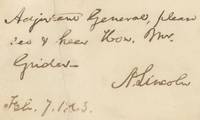
18633619207/02/1863. <blockquote><p>This document has been in a private collection for a generation</p><p> </p><p>Kentucky Unionists were important to Lincoln a Kentucky native as he famously said ""I hope to have God on my side but I must have Kentucky.â€</p><p> </p><p>The Congressman Henry Grider apparently needed to see Thomas to discuss the Act its impact on Kentucky and the details of how the recruitment would be handled</p></blockquote><p>Kentuckian Henry Grider was a Whig who served in Congress from 1843-1847 and then as a Unionist from March 4 1861 until 1865. For the Thirty-ninth Congress 1865–1867 Grider shifted to the Democratic Party but retained his commitment to the Union serving from March 4 1865 until his death in office on September 7 1866. Grider represented a Kentucky pro-slavery but Union-loyal constituency and he retained that point of view throughout the Civil War. Kentucky Unionists like Grider were particularly important to Abraham Lincoln a Kentucky native who had famously said ""I hope to have God on my side but I must have Kentucky.†Lincoln is known to have consulted with Grider about Kentucky affairs and relied on his support and that of the Kentucky delegation to Congress.</p><p>On February 7 1863 Congress passed an Act providing that “the Governor of the State of Kentucky by the consent and under the direction of the President of the United States shall have power to raise and organize into regiments a volunteer force not exceeding twenty thousand rank and file to be raised within the State of Kentucky to serve for the term of twelve months to be employed within the limits of Kentucky in repelling invasion suppressing insurrection and guarding and protecting the public property: Provided That at any time it may be necessary in the discretion of the President of the United States these troops may be employed out of the limits of Kentucky against the enemies of the United States.â€</p><p>Thus the Governor of Kentucky would raise a force of 20000 volunteers to serve in Kentucky but President Lincoln had the authority to order them used outside the state. This Act was received with mixed reviews in Kentucky and on the very day it was enacted Grider’s son Benjamin C. Grider a slave-holding Unionist resigned from the Union Army. From the timing of his resignation one can surmise that he disapproved of the Act. He had commanded the 9th Kentucky Volunteers.</p><p>Lorenzo Thomas was the Adjutant General of the U.S. Army at that time and his job was to maximize operational effectiveness of the army by manning recruiting for and sustaining military operations.</p><p><strong>Autograph note signed</strong> Washington February 7 1863 the day of the Act to Lorenzo Thomas expediting Grider’s ability to see Thomas. <em>“Adjutant General Please see and hear Hon. Mr. Grider. A. Lincoln.â€</em> It seems clear that Grider needed to see Thomas to discuss the Act its impact on Kentucky and the details of how the recruitment would be handled and managed. Not in Basler. A separation running vertically archivally mended.</p><p>This is a very scarce communication involving Lincoln aiding a Kentucky Unionist.</p><p><img class=""alignnone wp-image-25018 size-post-window"" src=""https://cdn.raabcollection.com/wp-content/uploads/20231204144051/Folder-site-11-1600x1327.jpg"" alt=""historical memorabilia dealer"" width=""1600"" height=""1327"" /></p> unknown
18623568928/02/1862. <blockquote><p>He was later promoted to Lt. Colonel for gallantry in action at the Battle of Groveton</p></blockquote><p><strong>Document signed</strong> with fine engravings of an eagle flags and cannons Washington February 28 1862 naming Percy B. Spear a Commissary of Subsistence of Volunteers with the rank of Captain effective November 30 1861. The document is countersigned by Secretary of War Edwin M. Stanton. The appointment is listed in the U.S. Army Register.</p><p>The Civil War Commissary Department was responsible for procuring storing and distributing food to soldiers. The rations managed by the department included such things as pork beef bread coffee and soap.</p><p>But Spear did not serve solely as a Commissary for the entire war. He would soon serve an aide-de-camp in the Fifth Corps in the Gettysburg campaign with Gen. James Barnes mentioning him with distinction in dispatches. Spear ended the war as a Brevet Major. In July 1865 he was appointed Lt. Colonel of Volunteers for meritorious service and for gallantry in action at the Battle of Groveton in 1862. After the war he was again named Commissary of Subsistence this time at the recommendation of Gen. George G. Meade.</p><p><img class=""alignnone wp-image-25018 size-post-window"" src=""https://cdn.raabcollection.com/wp-content/uploads/20231204144051/Folder-site-11-1600x1327.jpg"" alt="""" width=""1600"" height=""1327"" /></p> unknown
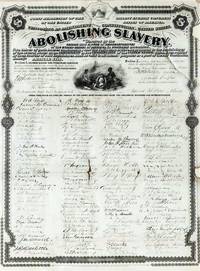
1868019219Chicago: Western Bank Note & Engraving Co. 1868. First Edition. Document. Recently backed with thin paper with several professional repairs of chips and tears. Very Good . Large folio 16-1/4" x 21-3/4" finely engraved and printed on good quality paper with elaborate decorative borders with a "US" monogram to upper corners a bold calligraphic heading with "ABOLISHING SLAVERY" in prominent decorated letters; at top center is a small vignette of the pyramid and all-seeing eye above an oval vignette of a slave family with child mourning over a cameo portrait of Lincoln. This is followed by the engraved signatures of President Lincoln Vice President Hamlin Schuyler Colfax and J. W. Forney Speaker and Secretary of the Senate and 164 Senators and Congressmen. An exceedingly rare and beautiful printing of the Thirteenth Amendment abolishing slavery: "Neither slavery nor involuntary servitude . Shall exist within the United States." This elaborately engraved Reconstruction-era broadside is based on the special "souvenir" copies on parchment signed by Lincoln and the others of which only a handful are known to have been made. The Thirteenth Amendment represents the first substantive change to how America interpreted those liberties guaranteed by the Bill of Rights since its ratification in 1791. The Emancipation Proclamation only freed the slaves in the openly rebellious states. The Amendment effectively put an end to slavery once and for all upon its passage on 1 February 1865. <br/><br/> Western Bank Note & Engraving Co. unknown
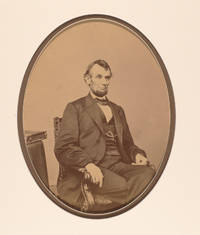
186442820809<p>Oval albumen print 8 x 6 in. original printed mount trimmed at bottom removing caption signed "BRADY & CO. PHOTOGRAPHERS." Browning and offsetting to mount light toning to image. Very good. Matted and framed.</p><p><strong>The classic Brady $5 bill photograph.</strong> This celebrated portrait the basis for the five-dollar bill engraving used for most of the 20th century is one of seven poses taken by Anthony Berger at Mathew Brady's Washington D. C. studio on February 9 1864. The most prolific photographer of Lincoln Brady himself did not actually operate his cameras during the war years instead training and employing men like Alexander Gardner and his successor Anthony Berger who took this picture to operate the camera.</p><p><strong>Lincoln's son Robert Todd Lincoln declared this famous portrait to be "the most satisfactory likeness" of Abraham Lincoln.</strong></p> Mathew Brady Gallery
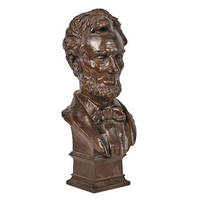
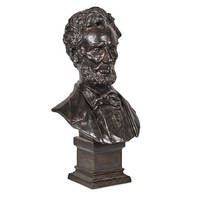
133797Patinated bronze portrait bust of Abraham Lincoln marked "GEO. E. BISSELL Sc GORHAM CO. FOUNDERS copyrighted" and stamped "G 47." This is one of a series of popular desktop busts of Lincoln produced by the Gorham foundry in the early part of the 20th century. In fine condition. The piece measures 18 inches in height. An exceptional piece of American history. unknown
600008"Abraham Lincoln" in black ink Washington February 10 1862. Folio. Partially printed document on vellum accomplished in a secretarial hand. Blue wafer seal intact. Lincoln's signature is dark. Appointment of Ethan Allen Hitchcock to the rank of Major General of Volunteers. Boldly co-signed by Edwin Stanton Secretary of War and Adjutant General L. Thomas a few small holes at the folds else fine fresh and dark. Lincoln 1809-65 16th President of the United States 1861-65 and one of the most important figures in American history. Hitchcock 1798-1870 Graduated West Point in 1817; served in Florida war; later with Winfield Scott in Mexico. He was commissioned Major-General of Volunteers as per this document in 1862 and rendered many valuable services to Lincoln's administration and the Union Army see Basler's Lincoln for numerous references to him. Signed by Authors. F. Soft cover. hardcover
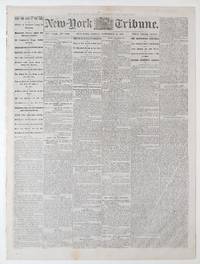
1863372898New York 1863. 8pp. printed in six columns on a single folded sheet. Large folio. Disbound. Natural paper flaw to first leaf not affecting text of the Gettysburg Address. Cloth portfolio. 8pp. printed in six columns on a single folded sheet. Large folio. The complete issue of the New-York Tribune printing the Gettysburg Address on the morning of Nov. 20 1863 the first possible date of the speech's printing. The previous day Lincoln delivered his great address at the dedication of a cemetery on the Gettysburg battlefield four months after the bloody and pivotal battle that turned the tide of the Civil War in favor of the Union. Lincoln's speech was preceded by an address from Edward Everett the most famous orator of his day. Everett's speech took between ninety minutes and two hours to deliver and today is largely forgotten. Lincoln's speech delivered in only a few minutes stands as a supreme distillation of American values and of the sacrifices necessary for the survival of liberty and freedom.<br /> <br /> Much controversy surrounds the circumstances and content of the address as it was actually delivered at Gettysburg. The words spoken in the speech differ in the versions appearing in newspapers and the text which appeared in Washington several days later published as The Gettysburg Solemnities and known in only four copies which is now taken as the closest version to Lincoln's final intent because of its correspondence to the known manuscript versions. Interestingly and according to Carbonell the text of the first appearance of the speech in book form published a few days later as An Oration Delivered on the Battlefield of Gettysburg is taken largely from this New York Tribune printing.<br /> <br /> As it appears here the address corresponds closely to the transcription printed in the same day's edition of the New York Times with slight variations in punctuation and capitalization "Four score and seven years ago our fathers brought forth on this continent a new Nation." in the Tribune versus "Fourscore and seven years ago our Fathers brought forth on this Continent a new nation." in the Times e.g. The address is printed on the first page at the bottom of the fifth column running to the top of the sixth. Significantly it notes the five places during Lincoln's speech where applause broke out thereby providing an important historical record of the reception of the speech as it was delivered by Lincoln. It is noted that the conclusion of the speech was met with "long continued applause" and that "three cheers were here given for the President and the Governors of the States." Lincoln's speech is preceded by the opening prayer of the Rev. Thomas H. Stockton and followed by Everett's speech which occupies the rest of the sixth column and the vast majority of space on page two. War news occupies the other column space on the front page.<br /> <br /> Together with examples from other newspapers of Nov. 20 1863 this issue of the New-York Tribune represents the first appearance of any version of the Gettysburg Address in print although at some variance with the version Lincoln eventually disseminated. The exact order in which the morning editions of November 20 were printed is practically impossible to determine at this point and as Carbonell states "will almost certainly never be known." Rightfully so Carbonell includes all November 20 morning newspaper printings of the Gettysburg Address as his first entry with no priority. Suffice to say this is as early a printing of one of the foundational documents of American life as one can ever encounter.<br /> <br /> "Lincoln's speech composed on the train on the way to Gettysburg and written down according to tradition on scratch-paper and the backs of envelopes comprised ten sentences and took only a few minutes to deliver. From the first words - 'Four score and seven years ago' - to the last - 'that government of the people by the people and for the people shall not perish from the earth' - it is immortal one of the supreme utterances of the principles of democratic freedom" PMM. Carbonell 1. Grolier American 100 72 ref. Streeter Sale 1748 ref. PMM 351 ref. Howes E233 ref. Monaghan 192 ref. Paul M. Angle "Four Lincoln Firsts" in Papers of the Bibliographical Society 36 Spring 1942 pp.13-17 unknown
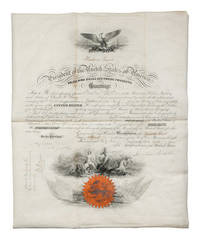
18638667<p>One partially printed vellum leaf dated February 21 1863 of the appointment of James Alden Jr. as a Captain in the Navy. Signed by President Abraham Lincoln and the Secretary of the Navy Gideon Welles. Orange embossed seal of the Department of the Navy to bottom. Previous owner's repair to upper right corner see image. Loses at folds see image. James Alden Jr. had an impressive career in the United States Navy having been appointed by Lincoln in aiding to split the Confederacy apart along the Mississippi River ultimately helping in the Battle of Vicksburg. Alden whose direct descendant came to America on the Mayflower assisted in the Mexican-American War before joining the Union during the Civil War.</p><p>The paper measures approximately 14.5 x 17.75 in 37 x 45 cm.</p>
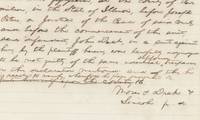
18573563230/10/1857. <p>John V. Drake and John C. Moses practiced law in Danville Illinois. They worked on cases appearing before the Vermilion County Circuit Court. When Abraham Lincoln had a case appearing in that court he would sometimes affiliate himself with Drake and Moses. Lincoln was before that court in October and November 1857.</p><p>Hezekiah Ballah sued John Deck and Zachariah Deck in a case heard in the Vermilion County Circuit Court. This was an action of trespass for castrating seventeen buck sheep and cutting up eight other ewes wethers and lambs. The Decks retained Lincoln who worked together with Drake and Moses in the case in October 1857. The Decks pleaded not guilty. Moreover John Deck also pleaded that he had been acquitted of the charge in Justice of the Peace court. The jury found the Decks not guilty. Hearing the case was Judge David Davis who Lincoln would one day name to the U.S. Supreme Court.</p><p><strong>Autograph document signed</strong> a draft pleading completely in Lincoln’s hand Vermilion County Circuit Court October 1857 being the pleading informing the Court that Deck had previously been acquitted of the same offense. The name of the case was John Deck impleaded with Zachariah Deck ads vs Hezekiah Ballah and it was filed In Trespass. <em>“And the said defendant John Deck comes and defends the force and injury…and says plaintiff actio non fails to act when there is a duty to act because he defendant says he is not guilty in manner and form as is in the declaration alleged; and of this he puts himself upon the country etc. citizens in a court or jury. Moses & Drake & Lincoln p.d.â€</em></p><p>Lincoln adds below: <em>“And for further plea in this behalf defendant John Deck says plaintiff actio non because he says that heretofore to wit on the __ day of __ in the year of our Lord one thousand eight hundred and fifty seven at the county of Vermillion in the state of Illinois before Joseph Peters a Justice of the Peace of said county and before commencement of this suit said defendant John Deck in a suit against him by the plaintiff herein was lawfully judged to be not guilty of the same identical supposed trespass in this declaration mentioned and this he is ready to verify therefore he prays judgment etc. Moses & Drake & Lincoln p.d.â€</em> The case is listed at lawofficeofabrahamlincoln.org.</p><p>An interesting pleading where Lincoln’s client has already been acquitted of the same offense.</p><p><img class=""alignnone wp-image-25018 size-post-window"" src=""https://cdn.raabcollection.com/wp-content/uploads/20231204144051/Folder-site-11-1600x1327.jpg"" alt="""" width=""1600"" height=""1327"" /></p> unknown
1718ST16605bWashington D.C.: U. S. Government 17 July 1862. 445 x 565 mm. 17 3/4 x 22 1/2". 17 lines of engraved text in copperplate script with names and dates completed in a fine secretarial hand. <br/> Loose as issued in an archival mylar sleeve. ◆Neatly mended two-and-three-quarters-inch tear to one edge well away from text half inch slit to end of one fold three very short separations along two folds only one touching text otherwise A FINE FRESH SPECIMEN clean and bright the signature dark and clear the wax-and-white-paper seal intact.<br/> <br/> This is an excellent example of a presidential document with Lincoln's full signature and with that of his Secretary of State William Henry Seward 1801-72 remembered for negotiating the purchase of Alaska from Russia. The consul appointed in this document Jay Haziel Sherman of Vermont served in Charlottetown Prince Edward Island from 1861 to 1865. It is likely this appointee was Jahaziel Blossom Sherman 1801-65 son of pioneering steamship captain Jahaziel Sherman 1770-1844 and that his unusual Old Testament name was misspelled by the scribe who filled in the appointment form. The younger Sherman died in Nova Scotia in 1865. U. S. Government unknown
131044Patinated bronze cast of Abraham Lincoln by George Bissell one of only three commissioned by Ralph Newman for THE USS AL. Boldly signed by the artist in the back Geo. E. Bissell Sc. George Bissell was an important American sculptor working in the late 19th and early 20th centuries. He produced two full length statues of Lincoln: one in Edinburgh and one in Clermont Iowa. According to the letter from Lincoln College Curator Paul Beaver the present item is one of three copies made from the school's original Bissell bronze bust of Lincoln by the Van Dyke Galleries of Chicago in the summer of 1989. One copy was presented to the USS Abraham Lincoln commissioned in 1989 one copy was sold to Mel Smith and the third to Barry and Louise Taper. In fine condition. The piece measures 25.5 inches in height. An exceptional piece. unknown
1946NM0881Corinthian Publications 1946. Hardcover. Very Good/Good. Some toning shelfwear to jacket. Corinthian Publications hardcover
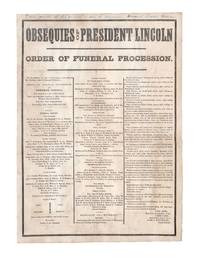
1865353589Springfield IL 1865. Broadside text in three columns mourning borders. Early manuscript note signed by Harriet Louise Greene in the upper margin "I was present at the funeral & saw the remains". 10-3/4 x 7-3/4 inches. Paper-backed at an early date with early newspaper clippings mounted on verso. Broadside text in three columns mourning borders. Early manuscript note signed by Harriet Louise Greene in the upper margin "I was present at the funeral & saw the remains". 10-3/4 x 7-3/4 inches. President Lincoln was assassinated on April 15 1865. His body lay in state in the White House on April 18 and a ceremonial funeral service took place in Washington D.C. around noon on April 19. Two days later President Lincoln's casket was loaded on a funeral train headed for Springfield Illinois stopping at Baltimore Harrisburg Philadelphia New York City Albany Buffalo Cleveland Columbus Indianapolis Michigan City and Chicago before arriving in Lincoln's adopted hometown early on the morning of May 3. <br /> <br /> Immediately upon arrival in Springfield Lincoln's coffin was transferred by hearse to Representatives' Hall inside the Illinois Old State Capitol. For the next twenty-four hours about 75000 mourners were allowed to pass by the open coffin of the slain president to pay last respects.<br /> <br /> According to the present broadside President Lincoln's funeral procession left the Old State Capitol "on Thursday the 4th Inst. at 10 o'clock a.m. precisely." The funeral party of over 10000 people then turned right on 7th Street to pass by the Lincoln family home and then right up Cook Street to proceed past the Governor's Mansion before heading north to Oak Ridge Cemetery.<br /> <br /> Surrounded by a heavy black band it lists all the persons and units involved their place in the procession and rules for the day. The entire procession was divided into eight divisions with Gen. Joseph Hooker acting as Marshal in Chief. The first three divisions were the military escort representing all the elements of the Army and Navy. After them came the attending clergy and Lincoln's attending physicians. Next was the casket itself the only wheeled vehicle in the procession with the pall bearers to each side followed by Lincoln's horse with reversed boots and then the immediate family. Next came government officials ambassadors and state officials followed by delegations from Springfield and other Illinois towns. Next were representatives of various organizations delegations from colleges lawyers doctors and the press. After this came Masons Odd Fellows and firemen. The final division was designated "Citizens at large. Colored Persons." Directions were given for the locations of each group forming up. Only marshals were allowed to be on horseback; all others walked. Bands were under the direction of the Committee on Music. Other particular directions complete the document.<br /> <br /> This broadside must have been widely distributed to assist the mourners but like all such ephemeral pieces few copies have survived. OCLC locates only six; at Indiana University the Abraham Lincoln Memorial Library the Boston Athenaeum the Chapin Library at Williams College the John Hay Library at Brown University and a copy formerly in the James S. Copley Library. There is also a copy at the Library of Congress. Two variants are recorded the other with a variant headline omitting "Order of" from title as well as a proof without the letters FUN of Funeral in the title. unknown