Abraham LincolnBiblio.com
11 347 résultats
ria9783337133429_inpPaperback. New. New Book; Fast Shipping from UK; Not signed; Not First Edition; Political Speeches and Debates of Abraham Lincoln and Stephen A. Douglas - 1854-1861 is an unchanged high-quality reprint of the original edition of 1895. Hansebooks is editor of the literature on different topic areas such as research paperback
ria9783337133696_inpPaperback. New. New Book; Fast Shipping from UK; Not signed; Not First Edition; Political Speeches and Debates - Of Abraham Lincoln and Stephen A. Douglas is an unchanged high-quality reprint of the original edition of 1895. Hansebooks is editor of the literature on different topic areas such as research and scien paperback
A9781345802023Hardback. New. hardcover
20181257665Omaha: The Conservative Tradition Library 2018. Leather bound. As new. Bound in full leather gilt edges marbled endpapers silk ribbon bookmark. Fine condition. Special edition for The Conservative Tradition Library. The Conservative Tradition Library unknown
B9783337133429Paperback / softback. New. paperback
B9783337133696Paperback / softback. New. paperback
20061-1432815970Thomson Gale 2006. Paperback. New. second edition edition. 276 pages. 9.25x6.00x0.68 inches. Thomson Gale paperback
0484481355.Ghardcover. Good. Access codes and supplements are not guaranteed with used items. May be an ex-library book. hardcover
0259815519.Gpaperback. Good. Access codes and supplements are not guaranteed with used items. May be an ex-library book. paperback
0484702009.Ghardcover. Good. Access codes and supplements are not guaranteed with used items. May be an ex-library book. hardcover
0666819513.Ghardcover. Good. Access codes and supplements are not guaranteed with used items. May be an ex-library book. hardcover
0332239802.Ghardcover. Good. Access codes and supplements are not guaranteed with used items. May be an ex-library book. hardcover
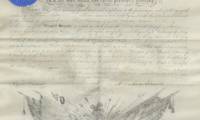
15073254115/07/1864. <blockquote><p>A real rarity the first Lincoln appointment to the Signal Corps for an officer active in Sherman’s Georgia Campaign we have seen</p></blockquote><p>On March 29 1860 the United States House of Representatives approved the Army appropriations bill for fiscal year 1861 which included the following amendment: ""For the manufacture or purchase of apparatus and equipment for field signals $2000; and that there be added to the staff of the Army one signal officer with the rank pay and allowance of a major of cavalry who shall have charge under the direction of the Secretary of War of all signal duty and all books papers and apparatus connected therewith."" The United States Senate eventually approved the appropriations bill over the objections of Jefferson Davis now Senator from Mississippi and President James Buchanan signed it into law on June 21 1860 the date now celebrated as the birthday of the modern U.S. Army Signal Corps.</p><p>Now armies on the go could report back to their civilian leadership in real time and those leaders could make decisions without waiting for a messenger on horse. This changed the face of warfare. President Lincoln himself spent significant time in the telegraph office sending and receiving war correspondence. He often walked alone from the White House to the office and chatted with the operators. As Bates later wrote “During the Civil War the President spent more of his waking hours in the War Department telegraph office than in any other place except the White House. While in the Telegraph Office he was comparatively free from official cares and therefore more apt to disclose his natural traits and disposition than elsewhere under other conditions.â€</p><p>John Quincy Adams first enlisted in 1862 with the 38th Ohio Volunteers. On October 15 of that year he was a quartermaster sergeant with the 10th Ohio Cavalry. After a stint as acting lieutenant on July 15 1864 he was appointed by the President Second Lieutenant to date from March 3 1863. Adams was actively involved in the Georgia campaign conducted by Gen. William T. Sherman. He was with left wing of the 16th Army Corps on the march to Chattanooga Tenn. In the Atlanta Campaign he participated in the battles of Resaca Dallas Kenesaw Mountain. and Jonesboro. He manned signal corps stations at Kenesaw Mt. and Allatoona.</p><p>Adams was in the engagements at Port McAllister and Rice Mill station in the campaign from Savannah through the Carolinas including battles at Columbia Bentonville and Raleigh; and at the surrender of Confederate Gen. Joseph E. Johnston to Sherman on April 26 1865. Adams was breveted 1st lieutenant for gallant and meritorious service in the Signal Corps at the battle of Allatoona; he was breveted captain for gallant and meritorious services in the Signal Corps at the capture of Fort McAllister and Savannah and throughout the war. Adams was mustered out August 22 1865. After the war he was in the 1st U. S. Cavalry and was in the Indian wars and finished his career as captain and aide to Gen. O.O. Howard in October 1884. He is listed on the roster of the U.S. Signal Corps in the Civil War.</p><p>Adams is also a protagonist in one of the most famous telegraph exchanges of the war during the battle near Allatoona. During this battle legend goes that Sherman signaled to General Corse and his men to ""hold the fort"" a phrase that inspired the later popular religious hymn entitled Hold the Fort by Chicago evangelist Philip P. Bliss which featured the chorus 'Hold the fort for I am coming’ which then became a common expression. We still use ""hold down the fort"" today. Adams was the signal officer who received that message or rather a variant as Sherman did not use that exact phrase though captured the sentiment.</p><p>This is President Lincoln’s appointment of Adams as Second Lieutenant. <strong>Document signed</strong> Washington July 15 1864 naming Adams <em>""Second Lieutenant in the Signal Corps""</em> dating from the third of March 1863.</p><p>This document is a real rarity as we have never before seen a Lincoln appointment to the Signal Corps for an officer active in Sherman’s March to the Sea. Moreover Lincoln Signal Corps appointments are themselves uncommon this being our first.</p><p>It was acquired from the Adams descendants and has never been offered for sale before.</p><p><img class=""alignnone wp-image-25018 size-post-window"" src=""https://cdn.raabcollection.com/wp-content/uploads/20231204144051/Folder-site-11-1600x1327.jpg"" alt="""" width=""1600"" height=""1327"" /></p> unknown
18623341204/03/1862. <p>As 1862 opened the war was not going well for the Union. In the east Bull Run had been a disaster and led to the shake-up of command with no results yet to show for it. In the west the loss at Wilson’s Creek gave the Confederates the upper hand. The Federal armies in the west then turned their attention to implementation of the Anaconda Plan – to cut the Confederacy in half by securing the Mississippi River from St. Louis all the way to the Gulf of Mexico and clearing a maritime invasion route into the heart of the Confederacy by taking the Tennessee and Cumberland Rivers which lay just to the east of the Mississippi. If successful these maneuvers would cut Texas Arkansas and Louisiana off from the main body of the South hold Kentucky and Missouri firmly in the Union and make it difficult for Tennessee to cooperate with her sister Confederate states. The first moves would be to take and hold commanding locations north on the Tennessee and Cumberland rivers and command of the operation was given to Brig. Gen. Ulysses S. Grant an obscure and largely unproven officer.</p><p>On February 6 1862 Fort Henry commanding the Tennessee River was captured by Grant’s forces. It had a poor defensive position and was reduced mainly by the bombardment of gunboats on the river. Nonetheless its fall opened the Tennessee River to Union gunboats and shipping past the Alabama border and provided a real victory for Union arms. Grant next focused his attention on Fort Donelson eleven miles away on the more strategically important Cumberland River. This fort had a much stronger physical position and the Confederates had placed some 20000 men and a number of senior commanders on site to engage in its defense. They were not about to concede the fort and they were ready and waiting for Grant. Grant arrived at Fort Donelson late on February 12 and on the 13th established his headquarters near the left side of the front of the line. That day was spent in battle preparation with a few small probing attacks being carried out against the Confederate defenses.</p><p>Grant's headquarters was at Cairo Ill where the head of Ordnance was Stephen Lyford. Grant arrived at Fort Donelson late on February 12 and on the 13th established his headquarters near the left side of the front of the line. That day was spent in battle preparation with a few small probing attacks being carried out against the Confederate defenses.</p><p>The battle was severe with nearly 1000 soldiers on both sides killed and about 3000 wounded. When Simon Buckner the Confederate commander asked for surrender terms Grant famously replied “No terms except unconditional and immediate surrender can be accepted“ adding “I propose to move immediately upon your works.†Buckner surrendered his command of about 15000 men; this was the first of three Confederate armies that Grant captured during the war.</p><p>The capture of Fort Donelson gave the North control of the Cumberland River which provided the road that opened the Deep South to Union invasion. It boosted morale in the North which now saw that the war could result in great victories and not just defeats. It gave President Lincoln the fighting general he was looking for and it made Grant’s career in the process; he was soon promoted to major general of volunteers.</p><p>Stephen C. Lyford had a long and distinguished career. He served from May to August 1861 in the defenses of Washington D. C. and in the Manassas Campaign participating in the Battle of Bull Run July 21 1861. He was Aide-de_Camp to Brig. General McDowell in the defenses of Washington D. C. August to October 1861 and Asst. Ordnance Officer at St. Louis Arsenal Mo. November 2 1861 to February 1 1862; in command of the Cairo Ordnance Depot Ill. February to May 1862 being detached to the Cumberland River and was present at the Surrender of Ft. Donelson. He was part of Gen. Halleck's Mississippi Campaign May to July 1862 being engaged in the Siege of Corinth May 1862 and was Chief of Ordnance for Department of the Tennessee July 11 1862 to September 6 1863 and fought in the Battle of Corinth. He would go on to teach at West Point and also serve as aide-de-camp for Gen. Halleck and as representative of the US to Japan to bring back information and technology relevant for American ordnance.</p><p><strong>Document signed</strong> with engravings of flags and weapons Washington March 4 1862 Naming Lyford a <em>“Second Lieutenant in the Ordnance Department.""</em></p><p><img class=""alignnone wp-image-25018 size-post-window"" src=""https://cdn.raabcollection.com/wp-content/uploads/20231204144051/Folder-site-11-1600x1327.jpg"" alt="""" width=""1600"" height=""1327"" /></p> unknown
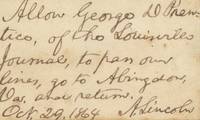
18643503129/10/1864. <blockquote><p>Journalist George D. Prentice's son was a Confederate officer captured by Union forces who would later be charged with murder</p></blockquote><p>George D. Prentice was born in Connecticut on December 18 1802 and graduated from Brown University in 1823. He came to Kentucky in 1830 to write a campaign biography entitled The Biography of Henry Clay and remained in this state until his death on January 22 1870 in Louisville. Prentice became the editor of the Louisville Journal the newspaper of the Whig Party. The main focus of this paper was the promotion of Henry Clay’s agenda and his multiple presidential campaigns. Prentice brought the Journal from upstart newspaper to the most widely read newspaper in the western United States because of his wit and command of the English language. Upon the failure of the Whig Party Prentice supported the Know-Nothing Party. Prentice then supported John Bell and his Unionist platform in the 1860 election calling for the Southern states to stay in the Union. Following the repeal of neutrality in Kentucky the pro-Union Prentice wrote in the Louisville Journal on September 19 1861: “Well thank God we at last have weighed anchor and set out for the haven of safety and of honor. Now let all possible sail be spread and the noble ship of state be driven into the lines of her insolent foe with the whole might of the valor and devotion of her true men.†Prentice became part of Lincoln’s core group of advisors for Kentucky affairs during the war. But despite Prentice’s Unionist satisfaction that Kentucky was no longer neutral his two sons fought in the Confederate army one dying in 1862 and the other being captured in 1863.</p><p>The son of Prentice Clarence J. Prentice was one of the most colorful Kentuckians in the Confederate Army. From 1863 to 1865 he commanded the 7th Confederate Cavalry Battalion. Based in southwestern Virginia the 7th was composed of mountaineers who resided along the Kentucky-Virginia border. The unit was difficult to discipline and was regarded as a ""black sheep"" battalion by other units in the department. While some members of the battalion accompanied Gen. John Hunt Morgan on his last Kentucky raid they were part of the dismounted brigade. Prentice and the balance of the 7th was left behind to guard Pound Gap. In his ""Kentucky Cavaliers in Dixie"" George Dallas Mosgrove left a lively pen portrait of the young officer. He described the 7th as wild and difficult to discipline but added that the men were afraid of Prentice who was a crack shot. Major Prentice was captured on March 31 1863.</p><p>George Prentice wrote to Lincoln to enlist his help in securing a parole for his son. In his letter to Lincoln dated Journal Office Louisville Ky. May 6 1863 Prentice stated: “I wrote to you last week in regard to my son Major Clarence Prentice now a rebel prisoner at Camp Chase. He would ere this have been forwarded for exchange but Gen. Burnside at my solicitation consented to have him detained until I could have time to hear from you. I think there has been time but I have received nothing from you either by mail or telegraph. I know that the pressure of the affairs of state upon you is very great. Perhaps you did not read my letter at all. Major Prentice is the only child left to me. My household is very desolate. My son is tired of the war but unfortunately he thinks the south right. I ask you to direct his release upon his taking the non combatants oath and giving bond and security for its scrupulous observance. If you cannot do this as I painfully fear you cannot I earnestly appeal to you to parole him to stay outside of both the United States and the Southern Confederacy until after the rebellion. I should scarcely venture Mr. President to make this appeal to you but that I think I have served the Union cause faithfully devotedly and successfully. I have suffered very much and sacrificed very much in its behalf—more I am sure than any other man in Kentucky; and I am likely even at the best to suffer and sacrifice much hereafter. I think there is not a candid and intelligent Union man in this state who would hesitate to say to you that I have saved it to the Union politically.</p><p>“And now dear sir pray grant me what I ask in behalf of my only son. His mother is half delirious and so am I. I am scarcely capable of performing my daily duties to the country but if my request were granted I feel I should be buoyant with new life. Please let me know your decision soon for if my son cannot be paroled upon either of the conditions I have mentioned I want him sent forward as soon as possible to City Point as he is extremely uncomfortable in his present situation.â€</p><p>Ten days later Lincoln issued an order written on the back of Prentice's letter instructing General Burnside to parole young Prentice ""to remain outside the limits of both the loyal and disloyal States or so-called 'Confederate States’…during the present rebellion and to abstain from in any wise aiding or abetting said rebellion."" He was released in May 1863. However Clarence Prentice immediately upon his release from Camp Chase violated his oath and re-entered the Confederate Army. He was promoted to lieutenant colonel. Only a few months after his parole he was back to robbing banks burning courthouses and spreading terror and destruction generally along the Kentucky-Virginia border.</p><p>In the fall of 1863 after being released from Union custody Prentice shot and killed a hotel proprietor named White in Abingdon Va. during a ""personal difficulty."" His trial was set for November 8 1864 in Abingdon and his father wanted to attend and assist him at his trial. George Prentice again wrote Lincoln asking for his assistance.</p><p>Lincoln complied with Prentice’s request. <strong>Autograph note signed</strong> Washington October 29 1864.<em> “Allow George D. Prentice of the Louisville Journal to pass our lines go to Abingdon Va. and return.â€</em></p><p>Prentice also wrote to Secretary of State William Seward on October 25 1864. A letter of Captain R. H. Baptist exists October 22 1864 to Prentice offering to give evidence in the forthcoming trial of his son saying “a conversation occurred between White & myself that ought to be made known in the trial of your son by all means.†Prentice sought Seward’s help in lining up Baptist up as a witness for his son: “Capt Baptist who formerly served under my son…and is now a prisoner…at Johnson's Island writes to me some facts which would be of vast importance to my erring child in his approaching trial…and which Capt. B. says he would state on oath…if he could be paroled to the Southern Confederacy or exchanged…I think that the exchange of Capt Baptist would subserve the cause of truth humanity and justice.’’ After being shown Baptist's letter Lincoln arranged for his parole so that he could testify on behalf of Clarence Prentice.</p><p>Thus did Lincoln intervene twice to aid his Kentucky advisor.</p><p>Clarence Prentice was acquitted of the murder charge. He continued to serve in the Confederate Army until the war ended.</p><p><img class=""alignnone wp-image-25018 size-post-window"" src=""https://cdn.raabcollection.com/wp-content/uploads/20231204144051/Folder-site-11-1600x1327.jpg"" alt="""" width=""1600"" height=""1327"" /></p> unknown
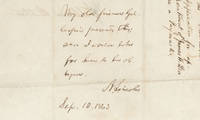
15093547615/09/1863. <blockquote><p>The letter itself was from Lamb a pallbearer after Lincoln's assassination</p></blockquote><p>Joseph Gillespie was a Whig member of the Illinois Assembly in 1840-41 and then served in the State Senate from 1847 to 1859. He joined the Republicans in 1856. Gillespie chaired the Illinois Republican State Convention in 1860 where presidential electors were selected who would vote for Abraham Lincoln and served as circuit court judge in Southern Illinois from 1861 to 1873.</p><p>From when they met in 1840 Gillespie was a key political ally lawyer and trusted and intimate friend to Abraham Lincoln. They consulted on legal cases and in political matters where they kept each other informed of political developments. Gillespie visited President-elect Lincoln at Springfield before he left for Washington. When Lincoln was president Gillespie occasionally went to Washington to see him and kept him informed about the political situation in the western states. Their correspondence shows a close personal bond.</p><p>James L. Lamb was a meatpacker industrialist and friend of Lincoln from Illinois known for his business dealings with the future President and his role as one of the pallbearers at Lincoln's funeral. In a letter addressed to President Lincoln Lamb wrote him from Springfield Ill. September 10 1863 to secure a position for a relative. “My friend and relative Mr. James H. Lea is an applicant for the position of paymaster in the army. His appointment I am sure would meet the approbation of all true friends of the Government who are acquainted with him. I have long known him as a reliable competent businessman and one whose integrity could be fully relied upon. His moral character is without blemish and the most satisfactory assurances can be given of his integrity and fitness for the position.†The docket states “Springfield Sep. 10/63 James L. Lamb to the President. Application for appointment of James H. Lea as a Paymaster.â€</p><p>This letter was not mailed by Lamb to Lincoln. Instead Lamb gave the letter to Gillespie to enlist his support and use his influence with Lincoln. Gillespie presented Lamb’s letter to Lincoln with his request that it be honored.</p><p><strong>Autograph endorsement signed</strong> Washington September 15 1863. <em>“My old friend Gillespie presents this; and I would like for him to be obliged.†</em>This is unpublished and not in Basler’s Collected Works of Abraham Lincoln. The wording of Lincoln’s endorsement saying that Gillespie presented this to Lincoln and the implication that Gillespie will need to be presenting this to the Secretary of War raises the possibility that Gillespie handed this to Lincoln in person and then took the endorsement to Stanton.</p><p>On October 10 Gillespie wrote Lincoln that the appointment had not yet been made and relating a communication with Stanton saying<em> “I would beg to call your attention to the subject of the appointment of my friend James H. Lea of Alton to the office of paymaster in the regular army. Secy. Stanton told me that he would retire one now on the list to make place for Mr Lea in a short time. I have heard nothing from him since. I would take it as a great favor if this thing could be done soon. I am aware how much you must be pressed with business of an engrossing character at this juncture but hope you may find leisure to jog the secretary’s memory.â€</em></p><p>According to papers in the Library of Congress James H. Lea was appointed an additional paymaster of volunteers to rank from February 23 1864. He signed his oath of office in April.</p><p>This is a fascinating endorsement showing how Lincoln sought to assist his old friends to the extent he appropriately could.</p><p><img class=""alignnone wp-image-25018 size-post-window"" src=""https://cdn.raabcollection.com/wp-content/uploads/20231204144051/Folder-site-11-1600x1327.jpg"" alt="""" width=""1600"" height=""1327"" /></p> unknown
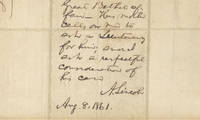
18613521508/08/1861. <blockquote><p>""It is said that the young man named within was in the Great Bethel affair. His mother calls on me to ask a Lieutenancy for him""</p><p> </p><p>We have never before a document on the market referencing Bethel by name or referring to the battle as great</p><p> </p><p>Part of a private collection assembled at Sesslers more than a half century ago</p></blockquote><p>The Civil War formally began with the bombardment of Fort Sumter on April 12–13 1861 but the first sustained clash between organized armies on land was the Battle of Big Bethel also called the Battle of Bethel Church fought on June 10 1861 near Hampton Virginia.</p><p>Virginia's decision to secede from the Union had been ratified by popular vote on May 23 and Confederate colonel later major general John B. Magruder was sent down to the peninsula to deter any advance on the state capital Richmond by Union troops based at the well-defended post of Fort Monroe.</p><p>Confederate forces under Magruder defeated a probing Union attack led by John Adams Dix and field commander Theodore Winthrop who was killed in the assault. The Union objective was to push back Confederate outposts guarding the Yorktown Road but poor coordination and a nighttime friendly-fire incident ruined surprise. When Union troops advanced at dawn they were repulsed by well-positioned Southern artillery and infantry around Big Bethel Church. The battle ended in a Confederate victory providing an early morale boost to the South while exposing the inexperience and disorganization of Union forces in the war’s opening weeks. It confirmed that the conflict would not be short or bloodless.</p><p>Abraham Lincoln was distressed by the Union defeat at Big Bethel. The battle underscored for him the Union's lack of military preparedness and the challenges in finding capable commanders reinforcing his determination to avoid future losses.</p><p>During his presidency Lincoln would regularly meet with members of the public who would wait to see him in the foyer of his office in the White House. This included soldiers and their family members.</p><p>Autograph letter signed Frank J. White as Captain of Company A 10th Regiment Fortress Monroe July 27 1861 seemingly given to the soldier himself or his sent to his family. ""Mr. Charles. J. Seymour has been a member of my company for three months and has gained my highest esteem for the excellent manner in which he has discharged his duties. He is well qualified to hold a much higher position than his present one.""</p><p><strong>Autograph document signed</strong> August 8 1861 on a detached leaf no recipient but likely Secretary of War Simon Cameron. <em>""It is said that the young man named within was in the Great Bethel affair. His mother calls on me to ask a Lieutenancy for him; and I ask a respectful consideration of his case.""</em></p><p>Seymour received the promotion Lincoln requested becoming a lieutenant just weeks later on August 27 1861. He served as Aide-de-Camp on the staff of Gen. Daniel E. Sickles and was later promoted to major. He also assisted in recruiting efforts in New York City.</p><p>This was acquired from Mabel Zahn at Sesslers in the 1970s.</p><p><img class=""alignnone wp-image-25018 size-post-window"" src=""https://cdn.raabcollection.com/wp-content/uploads/20231204144051/Folder-site-11-1600x1327.jpg"" alt="""" width=""1600"" height=""1327"" /></p> unknown
18623568928/02/1862. <blockquote><p>He was later promoted to Lt. Colonel for gallantry in action at the Battle of Groveton</p></blockquote><p><strong>Document signed</strong> with fine engravings of an eagle flags and cannons Washington February 28 1862 naming Percy B. Spear a Commissary of Subsistence of Volunteers with the rank of Captain effective November 30 1861. The document is countersigned by Secretary of War Edwin M. Stanton. The appointment is listed in the U.S. Army Register.</p><p>The Civil War Commissary Department was responsible for procuring storing and distributing food to soldiers. The rations managed by the department included such things as pork beef bread coffee and soap.</p><p>But Spear did not serve solely as a Commissary for the entire war. He would soon serve an aide-de-camp in the Fifth Corps in the Gettysburg campaign with Gen. James Barnes mentioning him with distinction in dispatches. Spear ended the war as a Brevet Major. In July 1865 he was appointed Lt. Colonel of Volunteers for meritorious service and for gallantry in action at the Battle of Groveton in 1862. After the war he was again named Commissary of Subsistence this time at the recommendation of Gen. George G. Meade.</p><p><img class=""alignnone wp-image-25018 size-post-window"" src=""https://cdn.raabcollection.com/wp-content/uploads/20231204144051/Folder-site-11-1600x1327.jpg"" alt="""" width=""1600"" height=""1327"" /></p> unknown
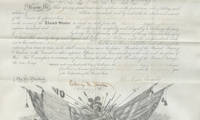
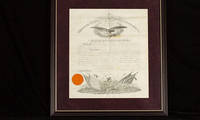
18643560801/08/1864. <blockquote><p>This appointment is listed in War Department General Orders no. 256</p></blockquote><p>According to the National Museum of Civil War Medicine and other sources Lt. Adam Miller of the 2nd Mass. Vols. aged twenty-three years was badly wounded August 9 1862 at the Battle of Cedar Mountain by an elongated musket ball which entered below the right eye socket and traversing the nasal cavity emerged through the left eye socket destroying the globe of the left eye and lacerating the left lower eyelid. He was made a prisoner and taken to a hospital at Charlottesville Va. where his wound ultimately formed a scar with great deformity. After being exchanged he entered the New York Eye Infirmary and on April 10 1863 a plastic surgical operation was performed by Dr. Henry B. Sands for the restoration of the eyelid. The operation was eminently successful and on April 22 1863 the parts were sufficiently healed to permit the insertion of an artificial eye. He thus survived a catastrophic facial wound and underwent pioneering plastic surgery.</p><p>Due to his injuries which made him unfit for active field duty but still capable of light service he was transferred to the Veteran Reserve Corps in August 1863 with his commission dating back to June 27 1863. The Veteran Reserve Corps was a military organization of the Union Army created for partially disabled or otherwise infirm soldiers who could still perform simple duties such as guarding prisoners or patrolling cities. This appointment is listed in War Department General Orders no. 256.</p><p><strong>Document signed</strong> with engravings of an eagle flags and weapons Washington August 1 1864 naming Adam Miller a lieutenant in the Veteran Reserve Corps effective June 27 1863.</p><p>An extraordinary Lincoln appointment of a soldier who made medical history in the Civil War.</p><p><img class=""alignnone wp-image-25018 size-post-window"" src=""https://cdn.raabcollection.com/wp-content/uploads/20231204144051/Folder-site-11-1600x1327.jpg"" alt="""" width=""1600"" height=""1327"" /></p> unknown
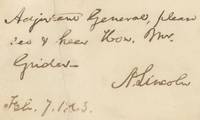
18633619207/02/1863. <blockquote><p>This document has been in a private collection for a generation</p><p> </p><p>Kentucky Unionists were important to Lincoln a Kentucky native as he famously said ""I hope to have God on my side but I must have Kentucky.â€</p><p> </p><p>The Congressman Henry Grider apparently needed to see Thomas to discuss the Act its impact on Kentucky and the details of how the recruitment would be handled</p></blockquote><p>Kentuckian Henry Grider was a Whig who served in Congress from 1843-1847 and then as a Unionist from March 4 1861 until 1865. For the Thirty-ninth Congress 1865–1867 Grider shifted to the Democratic Party but retained his commitment to the Union serving from March 4 1865 until his death in office on September 7 1866. Grider represented a Kentucky pro-slavery but Union-loyal constituency and he retained that point of view throughout the Civil War. Kentucky Unionists like Grider were particularly important to Abraham Lincoln a Kentucky native who had famously said ""I hope to have God on my side but I must have Kentucky.†Lincoln is known to have consulted with Grider about Kentucky affairs and relied on his support and that of the Kentucky delegation to Congress.</p><p>On February 7 1863 Congress passed an Act providing that “the Governor of the State of Kentucky by the consent and under the direction of the President of the United States shall have power to raise and organize into regiments a volunteer force not exceeding twenty thousand rank and file to be raised within the State of Kentucky to serve for the term of twelve months to be employed within the limits of Kentucky in repelling invasion suppressing insurrection and guarding and protecting the public property: Provided That at any time it may be necessary in the discretion of the President of the United States these troops may be employed out of the limits of Kentucky against the enemies of the United States.â€</p><p>Thus the Governor of Kentucky would raise a force of 20000 volunteers to serve in Kentucky but President Lincoln had the authority to order them used outside the state. This Act was received with mixed reviews in Kentucky and on the very day it was enacted Grider’s son Benjamin C. Grider a slave-holding Unionist resigned from the Union Army. From the timing of his resignation one can surmise that he disapproved of the Act. He had commanded the 9th Kentucky Volunteers.</p><p>Lorenzo Thomas was the Adjutant General of the U.S. Army at that time and his job was to maximize operational effectiveness of the army by manning recruiting for and sustaining military operations.</p><p><strong>Autograph note signed</strong> Washington February 7 1863 the day of the Act to Lorenzo Thomas expediting Grider’s ability to see Thomas. <em>“Adjutant General Please see and hear Hon. Mr. Grider. A. Lincoln.â€</em> It seems clear that Grider needed to see Thomas to discuss the Act its impact on Kentucky and the details of how the recruitment would be handled and managed. Not in Basler. A separation running vertically archivally mended.</p><p>This is a very scarce communication involving Lincoln aiding a Kentucky Unionist.</p><p><img class=""alignnone wp-image-25018 size-post-window"" src=""https://cdn.raabcollection.com/wp-content/uploads/20231204144051/Folder-site-11-1600x1327.jpg"" alt=""historical memorabilia dealer"" width=""1600"" height=""1327"" /></p> unknown
18642292021/03/1864. <blockquote><p>“If there is on file a request of Gen. Meigs that William Alexander may be appointed an Assistant Quarter-Master with the rank of Captain let him be appointed.â€</p><p> </p><p>There is no record of the appointment having been made with speculation being that Lincoln possibly sent the appointment to Stanton to die there</p><p> </p><p><img class=""alignnone wp-image-22921 size-post-window"" src=""https://cdn.raabcollection.com/wp-content/uploads/20231204160847/branding-Lincoln-March-21-1864-C-e1640668975889-1600x692.jpg"" alt="""" width=""1600"" height=""692"" /></p></blockquote><p>Lincoln had the rare quality of not taking opposition personally. During the Civil War he was vilified more than any other public figure in American history yet saw the issues as so great that they transcended any personal aspect. He bore no resentments because as he said he “never thought it paid.†He appointed men to high office because he perceived that they would be useful to the war effort. When Gen. George B. McClellan was insufferably rude to him he was willing to suffer the personal indignity if only McClellan would win. His most important civilian appointment shows this management principal in operation. Edwin Stanton had met Lincoln before the war when they had served as co-counsel in a famous lawsuit involving the McCormick reaper. Stanton who had a reputation for being stern imperious hot-tempered and controlling had snubbed him and then ridiculed him publicly as a gorilla and an imbecile. Lincoln also saw him as honest dedicated and extremely competent. Carrying no grudges he appointed Stanton to be Secretary of War and it was a brilliant choice. The two men came to respect and even like each other as they worked together daily to achieve victory.</p><p>Lincoln even used Stanton to deflect criticism from himself. Lincoln was inundated with requests for military positions requests in which he had little if any interest. But these requests often came from members of his administration from Union generals or other notables and the President could not decline them without angering his friends colleagues or other supporters of the Union cause. He shoveled these requests to Stanton with his endorsement. But Stanton would only approve those requests he deemed meritorious.</p><p><img class=""alignnone wp-image-22923 size-post-window"" src=""https://cdn.raabcollection.com/wp-content/uploads/20231204160837/Lincoln-March-21-1864-B-e1640669110694-1600x636.jpg"" alt="""" width=""1600"" height=""636"" /></p><p>Montgomery C. Meigs was a career United States Army officer civil engineer and construction engineer. At the start of the Civil War Lincoln appointed Meigs quartermaster general a crucial post that was perfectly suited to his organizational and management talents. Before the war Meigs played a key role in the extension and dome of the U.S. Capitol. After the war he oversaw much of the design and monument construction at Arlington National Cemetery.</p><p>Meigs had requested that Lincoln make an appointment in his department and the President wrote this letter to accommodate him. <strong>Autograph letter signed</strong> on Executive Mansion letterhead Washington March 21 1864 to <em>“Hon. Secretary of War.â€</em> Lincoln writes <em>“My dear Sir If there is on file a request of Gen. Meigs that William Alexander may be appointed an Assistant Quarter-Master with the rank of Captain let him be appointed. Yours truly A. Lincoln.â€</em></p><p>There is no record of the appointment having been made with speculation being that Lincoln sent the appointment to Stanton to die there. An interesting letter associating the President Secretary of War and Quartermaster General and taking place just eleven days after Grant assumed the role that led to Union victory.</p><p><img class=""alignnone wp-image-22732 size-post-window"" src=""https://cdn.raabcollection.com/wp-content/uploads/20231204162353/Folder-site-1600x1327.jpg"" alt="""" width=""1600"" height=""1327"" /></p> unknown
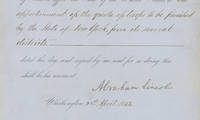
18642373223/04/1864. <blockquote><p>A search of public sale records going back 40 years fails to turn up even one other example of this document</p></blockquote><p>After the firing on Fort Sumter on April 12 1861 enthusiasm for enlisting in military service swept through both the North and South. In remarkable speed two large volunteer armies were created. Except for a tiny number of professional soldiers all expected to be in service for a brief term. Not just soldiers but the public and political leaders had fooled themselves about the war's likely duration. However the patriotic hope on each side that the war would be over in a matter of weeks or months was dashed in the first battle of Bull Run on July 21 1861. By late 1862 no sensible person believed that an early end to the bloody strife was possible and the knowledgeable expected peace to be far off in the future. Facing a protracted war maintaining a sufficiently sizable army became the greatest problem facing both Union leader Abraham Lincoln and Confederate leader Jefferson Davis.</p><p>In 1862 rather than institute a draft President Lincoln requested 300000 more men and assigned each state a quota. The states could meet their quota in any manner they saw fit. Most states offered cash incentives known as bounties to gain recruits. Depending on where one enlisted the combination of local state and federal bounties could exceed $1000. But the 1862 policy also did not recruit enough troops.</p><p><img class=""alignnone wp-image-24611 size-post-window"" src=""https://cdn.raabcollection.com/wp-content/uploads/20231204150003/Lincoln-April-23-1864-2-1600x602.jpg"" alt="""" width=""1600"" height=""602"" /></p><p>As the war dragged on with no end in sight the inflow of volunteers was drying up and the Union needed to keep the ranks filled. The U.S. Congress resorted to the first draft in the country’s history in March 1863. All able-bodied men between ages 20 and 45 were required to be enrolled and available for military service. Draftees were chosen by lottery. Once conscripted a man could avoid service for that particular round of the draft either by paying a $300 commutation fee or by hiring a substitute to take his place. As in the South this raised accusations that the war had become “a rich man’s war but a poor man’s fight.†Nevertheless in both North and South statistics indicate that wealthy men were represented in the service in at least the same proportion as they were in the general population.</p><p>A lot of blood was spilled in 1863 with the battles of Chancellorsville Gettysburg Vicksburg Chickamauga and Chattanooga among others. By year’s end President Lincoln and the Union leadership realized that more men were needed for the army and urgently. On February 1 1864 Lincoln called for 500000 men to serve for three years or for the duration of the war. Then on March 15 he supplemented this with a call for 250000 more. There would be another draft call in December 1864 but it was never completed due to the impending end of the war.</p><p>The March 1864 draft call stated: “Washington March 15 1864. In order to supply the force required to be drafted for the Navy and to provide an adequate reserve force for all contingencies in addition to the 500000 men called for Feb. 1 1864 the call is hereby made and a draft ordered for Two Hundred Thousand men for the military service – Army Navy and Marine corps of the United States. The proportional quotas for the different wards towns townships precincts or election districts or counties will be made known through the Provost Marshall General’s bureau and account will be taken of the credits and deficiencies of former quotas.</p><p>The 15th day of April 1864 is designated as the time up to which the numbers required from each ward of a city town etc. may be raised by voluntary enlistment; and drafts will be made in each ward of a city town etc. which shall not have filled the quota assigned to it within the time designated for the number required to fill said quota. The draft will be commenced as soon after the 15th of April as practicable…†It took little more than a week for everything to be in place.</p><p><img class=""alignnone wp-image-24623 size-full"" src=""https://cdn.raabcollection.com/wp-content/uploads/20231204145931/My-Movie-177ygbhbj.gif"" alt="""" width=""1920"" height=""1080"" /></p><p>The mechanics of the draft were that each state and district within a state were assigned quotas and the President would order that each state’s draft numbers and districts be implemented. This was the actual order for the draft. Then each individual district would receive from the President details of its requirements in a circular letter. One sees these individual district circular letters on the market every now and then. But what one never sees is the order to implement the draft for a state assigning the districts and number of troops being called forth. In fact a search of public sale records going back 40 years fails to turn up another example nor have we seen one before.</p><p><strong>Document signed</strong> as President Washington April 23 1864 being Lincoln’s implementation order for New York. <em>“I hereby authorize and direct the Secretary of State to affix the Seal of the United States to the apportionment of the quota of troops to be furnished by the State of New York from its several districts dated and this day signed by me and for so doing this shall be his warrant.â€</em></p><p>An extremely rare if not unique document showing Lincoln raising troops on the macro level of a state.</p><p><img class=""alignnone wp-image-23729 size-post-window"" src=""https://cdn.raabcollection.com/wp-content/uploads/20231204152429/Folder-site-7-1600x1327.jpg"" alt="""" width=""1600"" height=""1327"" /></p> unknown
18611571129/03/1861. <p>James E. Harrison though born in Virginia served the Union cause during the Civil War. He received his first appointment as a Second Lieutenant to the 2d U. S. Cavalry in June 1856 and was stationed in Texas and various forts in the West until December 1858 when he was assigned to scouting Indians. He returned East and with the Civil War imminent he was promoted to First Lieutenant 2d U.S. Cavalry in March 1861 and then to Captain 5th U.S. Cavalry in May of that year. Harrison was engaged in the Peninsular campaign and commanded a regiment in the Army of the Potomac from September 1862 to June 1863. During that time he served at the battles of Antietem Chancellorsville and Brandy Station among many others. He was Breveted Major U.S. Army for gallant and meritorious services at the battle of Hanover Court House and Brevet Lieutenant Colonel U.S. Army for gallant and meritorious services at the battle of Antietam. In July of 1864 Harrison was assigned to be Inspector-General of Cavalry in the Department of Arkansas and was later appointed as Special Inspector of Cavalry in West Mississippi.</p><p><strong>Document signed</strong> as President Washington March 29 1861 effective retroactively to February 27 1861 an ornate vignetted commission with an eagle cannons and flags appointing Harrison to the rank of “First Lieutenant in the Second Regiment of Cavalry.†The document is countersigned by Secretary of War Simon Cameron.</p> unknown
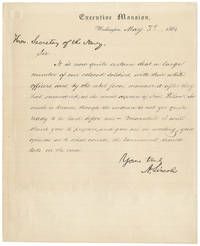
186424088<p>President Abraham Lincoln seeks counsel from his cabinet on the appropriate response to the massacre at Fort Pillow Tennessee three weeks earlier. More than 400 African-American Union troops and their white officers were slain many of them after surrendering.</p><p><strong>ABRAHAM LINCOLN.</strong> Letter Signed to Gideon Welles May 3 1864 Washington D.C. 1 p. 8 x 10 in. With: <strong>FORT PILLOW MASSACRE LYMAN TRUMBULL.</strong> Signed Presentation Copy. <em>Reports of the Committee on the Conduct of the War: Fort Pillow Massacre. Returned Prisoners.</em> 8vo. Illustrated with 8 portraits on 4 pages of woodcut engravings after photographic portraits of Belle Island POWs. Contemporary green cloth gilt with morocco spine label gilt-lettered. First Edition. Washington D.C. 1864. Inscribed on front fly leaf: <em>"Lyman Trumbull to D.J. Ely"</em>. The cover title of sammelband that contains two Senate Reports related to Confederate atrocities: 1. U.S. Congress. May 5 1864. - Ordered to be printed.Joint Resolution directing the Committee on the Conduct of the War to examine into the recent attack on Fort Pillow. Senate Report 38th Congress 1st Session. Senate Rep. Com. No. 63. Nevins I: 204. 2. U.S. Congress. May 9 1864 - Ordered That the report.be printed in connexion with the report of the committee in relation to the Fort Pillow massacre.Joint Resolution directing the Committee on the Conduct and Expenditures of the War. Senate Report 38th Congress 1st Session. Senate Rep. Com. No. 68.</p><p>On April 12 1864 1500 Confederate troops under Nathan Bedford Forrest attacked a Union outpost at Fort Pillow Tennessee. After four hours of intense fighting Forrest demanded the garrison surrender. Although outnumbered almost three to one the Union troops inside the fort at first refused. Confederate forces eventually captured the position. According to survivors Confederate troops motivated by racial hatred proceeded to kill Union prisoners as they pleaded for their lives. It is unclear how many were killed after the surrender but first-hand accounts suggest that the numbers were high. Of 262 black soldiers at Fort Pillow only 58 survived to be taken prisoner; of 395 white soldiers 168 survived as prisoners.</p><p>On May 3 President Lincoln sent a letter like this one to each of the members of his cabinet. Three days later Lincoln held a cabinet meeting at which each cabinet member read his opinion on the appropriate response. All agreed that the U.S. government should demand "an explanation" from the Confederacy. Seward Chase Stanton and Welles advised holding Confederate prisoners equal in numbers to the Union troops massacred as hostages; if the Confederate government avowed the massacre those prisoners would be executed. Usher Bates and Blair strongly disagreed with Blair pointing out that such a response "would not be justified by the rules of civilized warfare." Bates concurred noting that "retaliation is not mere justice. It is avowedly revenge; and it is wholly unjustifiable in law and conscience."</p><p>Little formal action beyond a Congressional investigation took place. Perhaps the greatest impact that Fort Pillow had was on the morale of black troops. Knowing what their fate would be if captured on the field by Confederate soldiers black Union soldiers charged into battle with the war cry "Remember Fort Pillow!"</p><p><strong>Complete Transcript</strong></p><p><em>Executive Mansion<br />Washington May 3d 1864</em></p><p><em>Hon. Secretary of the Navy.</em></p><p><em>Sir:</em></p><p><em>It is now quite certain that a large number of our colored soldiers with their white officers were by the rebel force massacred after they had surrendered at the recent capture of Fort-Pillow. So much is known though the evidence is not quite ready to be laid before me. Meanwhile I will thank you to prepare and give me in writing your opinion as to what course the Government should take in this case.</em></p><p><em>Yours truly<br />A. Lincoln</em></p><p>With abolitionist Senator Lyman Trumbull's signed presentation copy of Congressional reports.</p><p>Condition: very good.</p>
1333576048.Gpaperback. Good. Access codes and supplements are not guaranteed with used items. May be an ex-library book. paperback