9 915 résultats
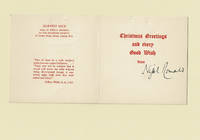
100784<p>Very good. - A 4 inch high by 4 inch wide Christmas card with a sienna-toned illustration of Sheila Dorrell's "Harvest Mice" identified in red on the recto with a quote from Gilbert White. "Christmas Greetings and every good wish from" is printed in red on the facing page signed in black ink by the British Ambassador to Portugal Nigel Ronald. There are staple holes through the top edge. Very good.</p><p>A wonderful association signed by the British ambassador to Portugal from the estate of the American ambassador to Portugal Lincoln MacVeagh.</p><p>The British civil servant and diplomat Nigel Ronald 1894-1973 joined the civil service in 1920 after serving with the King's Regiment during the first World War and the Grenadier Guards. Rising through the civil service he was appointed ambassador to Portugal in 1947.</p><p>From the estate of Lincoln MacVeagh 1890-1972 a Renaissance man who graduated from Harvard magna cum laude in 1913. He went on to study languages at the Sorbonne and became fluent in German French Spanish Latin Greek and Classical Greek. After World War I he became a director of the Henry Holt and Company publishing firm where he became friendly with the poet Robert Frost. In 1923 he left the firm and founded the Dial Press. His name appears on the imprint of many of their publications. In 1933 President Roosevelt appointed him Minister to Greece. He followed presentation of his credentials with a speech in Classical Greek. While in Greece he conducted excavations beneath the Acropolis and made archeological contributions to the National Museum in Athens. He left Greece in 1941 when the German army over ran the country. From there he was appointed the first US Minister to Iceland where he negotiated agreements for the construction of the Keflavik airfield. In late 1942 he became Minister to the Union of South Africa and coordinated American wartime agencies there. In 1943 he was sent to Cairo as Ambassador so that he could assist the governments in exile of Greece and Yugoslavia. He returned to Athens as Ambassador in 1944. MacVeagh gave secret testimony before Congress concerning the Balkans in 1947 testimony that was an important factor in the formation of the Truman Doctrine. In 1948 as Ambassador to Portugal MacVeagh was influential in admitting her into NATO. In 1952 President Truman named him Ambassador to Spain. President Truman wrote to him on March 9 1948: "On the occasion of your appointment as Ambassador to Portugal I would like to make some personal expression of appreciation for the high services you have already rendered your country. During the past fifteen critical years you have served with distinction as Chief of the United states Missions to Iceland the Union of South Africa Yugoslavia and Greece. In this last post especially - as Minister from 1933 to 1941 and as Ambassador since 1943 - your scholarly statesmanship and diplomatic judgment have been of the utmost value."</p>
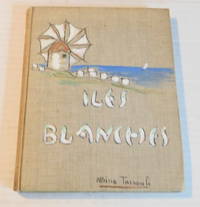
193998741Athenes: Imprimerie Rythmos 1939. 1939. Very good. ASSOCIATION COPY INSCRIBED BY THE AUTHOR TO THE AMERICAN MINISTER TO GREECE LINCOLN MACVEAGH - Quarto 8-1/2 inches high by 6-1/2 inches wide. Hardcover bound in tan buckram hand-painted with the image of a Skyros windmill in brown blue & white titled in white on the front cover and signed by Athina Tarsouli. The spine is slightly darkened. The original wrappers are bound in and feature a lithographic front cover with a variation of the Skyros windmill in blue & white. 133 pages with profuse textual illustrations in black and white & 3 tipped-in color plates. The text block is cracked opposite the title page and there is some occasional soiling and darkening to the top edges of a few pages. Very good. <p>First edition.<p>Inscribed by Athina Tarsouli on the title page: "A Monsieur et a Madame Mak Vey sic les grands amis de la Grece et auteurs inspires du beau livre 'Elliniko taxidi' / Hommage respectueux de l'auteur Decembre 1940." In addition to the personal inscription all copies of the book were signed by Tarsouli on the verso of the half-title. The reference she makes to the book by the MacVeaghs is to the Greek edition of "Greek Journey" an illustrated children's book by the couple published by Dodd Mead & Company in 1937.<p>The islands included in the description are Tinos Myconos Paros Antiparos Naxos Santorin and Skyros.<p>Athina Tarsouli 1887-1975 was born in Athens. She studied painting in France and as an artist was represented in several group exhibitions in Athens Alexandria and Cyprus. She was in addition to being a painter she was also a folklorist with a special interest in Greek folklore. She was a member of the literary section of "Parnassos" and the Lyceum of Greek Women.<p>From the library of Lincoln MacVeagh and his wife Margaret with their "Arcades Ambo" bookplate on the front paste down. Lincoln MacVeagh 1890-1972 a Renaissance man graduated from Harvard magna cum laude in 1913. He went on to study languages at the Sorbonne and became fluent in German French Spanish Latin Greek and Classical Greek. After World War I he became a director of the Henry Holt and Company publishing firm where he became friendly with the poet Robert Frost. In 1923 he left the firm and founded the Dial Press. His name appears on the imprint of many of their publications. In 1933 President Roosevelt appointed him Minister to Greece. He followed presentation of his credentials with a speech in Classical Greek. While in Greece he conducted excavations beneath the Acropolis and made archeological contributions to the National Museum in Athens. He left Greece in 1941 when the German army over ran the country. From there he was appointed the first US Minister to Iceland where he negotiated agreements for the construction of the Keflavik airfield. In late 1942 he became Minister to the Union of South Africa and coordinated American wartime agencies there. In 1943 he was sent to Cairo as Ambassador so that he could assist the governments in exile of Greece and Yugoslavia. He returned to Athens as Ambassador in 1944. MacVeagh gave secret testimony before Congress concerning the Balkans in 1947 testimony that was an important factor in the formation of the Truman Doctrine. In 1948 as Ambassador to Portugal MacVeagh was influential in admitting her into NATO. In 1952 President Truman named him Ambassador to Spain. President Truman wrote to him on March 9 1948: "On the occasion of your appointment as Ambassador to Portugal I would like to make some personal expression of appreciation for the high services you have already rendered your country. During the past fifteen critical years you have served with distinction as Chief of the United states Missions to Iceland the Union of South Africa Yugoslavia and Greece. In this last post especially - as Minister from 1933 to 1941 and as Ambassador since 1943 - your scholarly statesmanship and diplomatic judgment have been of the utmost value." Athenes: Imprimerie Rythmos, 1939. hardcover
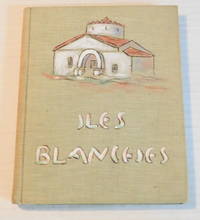
193998742Athenes: Imprimerie Rythmos 1939. 1939. Very good. ASSOCIATION COPY FROM THE LIBRARY OF THE AMERICAN MINISTER TO GREECE LINCOLN MACVEAGH - Quarto 8-1/2 inches high by 6-1/2 inches wide. Hardcover bound in tan buckram hand-painted with the image of a Skyros Greek Orthodox church in brown & white by Athina Tarsouli and titled in white on the front cover. The spine is slightly darkened. The original wrappers are bound in and feature a lithographic front cover with an illustration of the Skyros windmill in blue & white. 133 pages with profuse textual illustrations in black and white & 3 tipped-in color plates. The text block is starting to crack opposite the title page. There is some minor chipping to the bottom edges of the front endpaper and pastedown. Very good. <p>First edition signed by the author artist Athina Tarsouli.<p>The islands included in the description are Tinos Myconos Paros Antiparos Naxos Santorin and Skyros.<p>Athina Tarsouli 1887-1975 was born in Athens. She studied painting in France and as an artist was represented in several group exhibitions in Athens Alexandria and Cyprus. She was in addition to being a painter she was also a folklorist with a special interest in Greek folklore. She was a member of the literary section of "Parnassos" and the Lyceum of Greek Women.<p>From the library of Lincoln MacVeagh and his wife Margaret with their "Arcades Ambo" bookplate on the front paste down. Lincoln MacVeagh 1890-1972 a Renaissance man graduated from Harvard magna cum laude in 1913. He went on to study languages at the Sorbonne and became fluent in German French Spanish Latin Greek and Classical Greek. After World War I he became a director of the Henry Holt and Company publishing firm where he became friendly with the poet Robert Frost. In 1923 he left the firm and founded the Dial Press. His name appears on the imprint of many of their publications. In 1933 President Roosevelt appointed him Minister to Greece. He followed presentation of his credentials with a speech in Classical Greek. While in Greece he conducted excavations beneath the Acropolis and made archeological contributions to the National Museum in Athens. He left Greece in 1941 when the German army over ran the country. From there he was appointed the first US Minister to Iceland where he negotiated agreements for the construction of the Keflavik airfield. In late 1942 he became Minister to the Union of South Africa and coordinated American wartime agencies there. In 1943 he was sent to Cairo as Ambassador so that he could assist the governments in exile of Greece and Yugoslavia. He returned to Athens as Ambassador in 1944. MacVeagh gave secret testimony before Congress concerning the Balkans in 1947 testimony that was an important factor in the formation of the Truman Doctrine. In 1948 as Ambassador to Portugal MacVeagh was influential in admitting her into NATO. In 1952 President Truman named him Ambassador to Spain. President Truman wrote to him on March 9 1948: "On the occasion of your appointment as Ambassador to Portugal I would like to make some personal expression of appreciation for the high services you have already rendered your country. During the past fifteen critical years you have served with distinction as Chief of the United states Missions to Iceland the Union of South Africa Yugoslavia and Greece. In this last post especially - as Minister from 1933 to 1941 and as Ambassador since 1943 - your scholarly statesmanship and diplomatic judgment have been of the utmost value." Athenes: Imprimerie Rythmos, 1939. hardcover
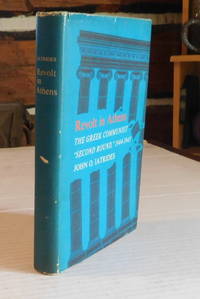
197299033<p>Princeton New Jersey: Princeton University Press 1972. 1972. Very good. - Octavo 8-1/2 inches high by 5-1/2 inches wide. Hardcover bound in blue cloth titled in white on the spine laid into a red white and blue dust wrapper featuring black Greek columns. The dust jacket is slightly soiled and rubbed with some minor chips to the jacket's edges. xiv & 340 pages. The fore and top edges of the book are foxed. Very good.</p><p>First edition.</p><p>Inscribed on the front endpaper: "To Mrs. Lincoln MacVeagh with my warmest regards John O. Iatrides." An author's compliments card is laid in.</p> Princeton, New Jersey: Princeton University Press, (1972). hardcover
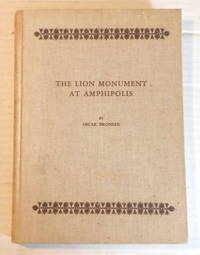
194198734Cambridge MA: Harvard University Press 1941. 1941. Very good. - Quarto 10 inches high by 7 inches wide. Hardcover bound in tan buckram titled in brown within brown decorative borders on the front cover. The titling on the spine is faded. xvii 3 pages 1-76 illustrated with a frontispiece and profuse photographic illustrations as well as a portfolio of 11 plates at the end of the book which includes photographs by MacVeagh. There is some minor foxing to the endpapers and pastedowns and the edges of the pastedowns are soiled. Near fine. <p>The RARE FIRST EDITION from the library of the book's Dedicatee "The Honorable Lincoln MacVeagh".<p>The prospectus "The Lion of Amphipolis - A Plea for its Reconstruction" by Lincoln MacVeagh is a 10 by 7-1/2 inch 4-page pamphlet with a 1934 photograph of the fragments of the lion laid in. It was published in Athens in 1934. ".recently during the progress of the great work in connection with the drainage of the Serres Plain and the deepening of the Amphipolis Gorge the engineers of the Monks-Ulen Company of New York became impressed with the majesty and immensity of the all-but-buried and half-forgotten fragments of the Lion of Amphipolis. Enthusiastically they brought the idea of its reconstruction to me. I visited the site; and the plan herein set forth in which it is my hope that a sufficient number of lovers of Greece and of Greek Art will join was born."<p>The lecture by MacVeagh "The Lion of Amphipolis" was delivered to The French School of Archaeology at Athens in 1937. It is a 10 by 7-1/4 inch 12-page pamphlet illustrated with 4 photographs and 2 maps showing the location of Amphipolis. The lecture is for the most part an account of the restoration work to date. "While the collaboration of the French and American Schools was thus producing unexpected results the Greek authorities were also helping and besides giving the whole enterprise their blessing kindly accorded the schools the collaboration of Mr. Panayiotakis of the National Museum. This able sculptor spent weeks at Amphipolis again thanks to the Monks-Ulen Companies which lent their camp and collected the necessary workmen and tools for his operations. With great effort and patience far from the conveniences of the city Mr. Panayiotakis successfully carried through the task of making moulds some of them of truly gigantic size of all the existing fragments of the Lion. From these he made casts on the spot and again with the help of the engineers fitted these together under an enormous shed and provided in plaster the missing pieces to complete the whole figure. This year it is planned to put the actual fragments themselves together and make the missing parts out of marble cement of a color agreeable to the rest."<p>From the library of Lincoln MacVeagh and his wife Margaret with their "Arcades Ambo" bookplate on the front paste down. Lincoln MacVeagh 1890-1972 a Renaissance man graduated from Harvard magna cum laude in 1913. He went on to study languages at the Sorbonne and became fluent in German French Spanish Latin Greek and Classical Greek. After World War I he became a director of the Henry Holt and Company publishing firm where he became friendly with the poet Robert Frost. In 1923 he left the firm and founded the Dial Press. His name appears on the imprint of many of their publications. In 1933 President Roosevelt appointed him Minister to Greece. He followed presentation of his credentials with a speech in Classical Greek. While in Greece he conducted excavations beneath the Acropolis and made archeological contributions to the National Museum in Athens. He left Greece in 1941 when the German army over ran the country. From there he was appointed the first US Minister to Iceland where he negotiated agreements for the construction of the Keflavik airfield. In late 1942 he became Minister to the Union of South Africa and coordinated American wartime agencies there. In 1943 he was sent to Cairo as Ambassador so that he could assist the governments in exile of Greece and Yugoslavia. He returned to Athens as Ambassador in 1944. MacVeagh gave secret testimony before Congress concerning the Balkans in 1947 testimony that was an important factor in the formation of the Truman Doctrine. In 1948 as Ambassador to Portugal MacVeagh was influential in admitting her into NATO. In 1952 President Truman named him Ambassador to Spain. President Truman wrote to him on March 9 1948: "On the occasion of your appointment as Ambassador to Portugal I would like to make some personal expression of appreciation for the high services you have already rendered your country. During the past fifteen critical years you have served with distinction as Chief of the United states Missions to Iceland the Union of South Africa Yugoslavia and Greece. In this last post especially - as Minister from 1933 to 1941 and as Ambassador since 1943 - your scholarly statesmanship and diplomatic judgment have been of the utmost value." Cambridge, MA: Harvard University Press, 1941. hardcover
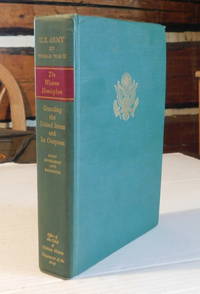
196498740Washington DC: Office of the Chief of Military History / Department of the Army 1964. 1964. Very good. - Octavo 9-3/4 inches high by 6-3/4 inches wide. Hardcover bound in green cloth with the American Bald Eagle crest stamped in gilt on the front cover and titled in gilt on the spine. The corners of the covers and the head and tail of the spine are bumped. xvii 1 & 593 pages with numerous photographic illustrations 4 fold-out maps and an additional 2 large folding maps in a rear pocket. The edges of the last few pages are lightly creased as a result of the thick pocket mounted at the rear. Very good. <p>First edition.<p>Inscribed on a special presentation plate on the front endpaper to the "Honorable Lincoln MacVeagh" who is mentioned in the book for his activities as Minister to Iceland during the war. The presentation plate is signed by each of the three authors and by the Chief of Military History Brigadier General Hal C. Pattison.<p>From the library of Lincoln MacVeagh and his wife Margaret with their "Arcades ambo" bookplate. Lincoln MacVeagh 1890-1972 a Renaissance man graduated from Harvard magna cum laude in 1913. He went on to study languages at the Sorbonne and became fluent in German French Spanish Latin Greek and Classical Greek. He served in the Atois St. Mihiel and Meuse Argonne campaigns of World War I as an aide to the commanding general of the 80th Division and of the Ninth and Sixth Army Corps. He rose to the rank of Major. After the war he became a director of the Henry Holt and Company publishing firm where he became friendly with the poet Robert Frost. In 1923 he left the firm and founded the Dial Press. His name appears on the imprint of many of their publications. In 1933 President Roosevelt appointed him Minister to Greece. He followed presentation of his credentials with a speech in Classical Greek. While in Greece he conducted excavations beneath the Acropolis and made archeological contributions to the National Museum in Athens. He left Greece in 1941 when the German army over ran the country. From there he was appointed the first US Minister to Iceland where he negotiated agreements for the construction of the Keflavik airfield. In late 1942 he became Minister to the Union of South Africa and coordinated American wartime agencies there. In 1943 he was sent to Cairo as Ambassador so that he could assist the governments in exile of Greece and Yugoslavia. He returned to Athens as Ambassador in 1944. MacVeagh gave secret testimony before Congress concerning the Balkans in 1947 testimony that was an important factor in the formation of the Truman Doctrine. In 1948 as Ambassador to Portugal MacVeagh was influential in admitting her into NATO. In 1952 President Truman named him Ambassador to Spain. President Truman wrote to him on March 9 1948: "On the occasion of your appointment as Ambassador to Portugal I would like to make some personal expression of appreciation for the high services you have already rendered your country. During the past fifteen critical years you have served with distinction as Chief of the United states Missions to Iceland the Union of South Africa Yugoslavia and Greece. In this last post especially - as Minister from 1933 to 1941 and as Ambassador since 1943 - your scholarly statesmanship and diplomatic judgment have been of the utmost value." Washington, DC: Office of the Chief of Military History / Department of the Army, 1964. hardcover
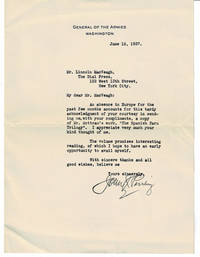
192798654Washington D.C.: June 18 1927. 1927. Very good. - Over 85 words typed on 9-1/4 inch high by 7 inch wide "GENERAL OF THE ARMIES" letterhead with attached integral blank leaf. General Pershing writes to Lincoln MacVeagh founder and president of The Dial Press thanking him for sending "a copy of Mr. Mottram's work 'The Spanish Farm Trilogy'. I appreciate very much your kind thought of me". The letter is signed in full "John J. Pershing". The World War I novel which Pershing mentions centers on a Flemish farm woman around whom the author relates his war experiences. MacVeagh published the work at his Dial Press in 1927 the year of this letter. Folded for mailing with some light creases to the edges and inner corners. Very good. <p>A wonderful association as "With the American Expeditionary Force in World War 1 Mr. MacVeagh served in the Artois St. Mihiel and Meuse Argonne campaigns as an aide to the commanding general of the 80th Division and of the Ninth and Sixth Army Corps. He rose to major and was cited by General of the Armies John J. Pershing in 1919 for exceptionally meritorious services". - Quoted from the New York Times January 17 1972 issue.<p>John Joseph Pershing 1860-1948 nicknamed "Black Jack" was a senior United States Army officer. He served most famously as the commander of the American Expeditionary Forces during World War I from 1917 to 1920. Pershing is the only American to be promoted in his own lifetime to General of the Armies the highest possible rank in the United States Army.<p>Lincoln MacVeagh 1890-1972 a Renaissance man graduated from Harvard magna cum laude in 1913. He went on to study languages at the Sorbonne and became fluent in German French Spanish Latin Greek and Classical Greek. After World War I he became a director of the Henry Holt and Company publishing firm where he became friendly with the poet Robert Frost. In 1923 he left the firm and founded the Dial Press. His name appears on the imprint of many of their publications. In 1933 President Roosevelt appointed him Minister to Greece. He followed presentation of his credentials with a speech in Classical Greek. While in Greece he conducted excavations beneath the Acropolis and made archeological contributions to the National Museum in Athens. He left Greece in 1941 when the German army over ran the country. From there he was appointed the first US Minister to Iceland where he negotiated agreements for the construction of the Keflavik airfield. In late 1942 he became Minister to the Union of South Africa and coordinated American wartime agencies there. In 1943 he was sent to Cairo as Ambassador so that he could assist the governments in exile of Greece and Yugoslavia. He returned to Athens as Ambassador in 1944. MacVeagh gave secret testimony before Congress concerning the Balkans in 1947 testimony that was an important factor in the formation of the Truman Doctrine. In 1948 as Ambassador to Portugal MacVeagh was influential in admitting her into NATO. In 1952 President Truman named him Ambassador to Spain. President Truman wrote to him on March 9 1948: "On the occasion of your appointment as Ambassador to Portugal I would like to make some personal expression of appreciation for the high services you have already rendered your country. During the past fifteen critical years you have served with distinction as Chief of the United states Missions to Iceland the Union of South Africa Yugoslavia and Greece. In this last post especially - as Minister from 1933 to 1941 and as Ambassador since 1943 - your scholarly statesmanship and diplomatic judgment have been of the utmost value." Washington, D.C.: June 18, 1927. unknown
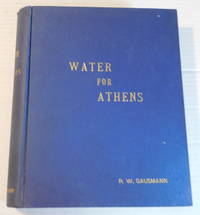
194098653Athens Greece 1940. 1940. Very good. - Quarto 11-3/8 inches high by 9 inches wide. Hardcover bound in blue cloth titled in gilt on the front cover and on the spine. 2 x & 328 mechanically reproduced pages printed on the rectos only. Illustrated with an original photograph as the frontispiece a pictorial title page 60 inserted charts and plates not included in the pagination and a folding plate reproducing a document. Most of the plates with drawings were created by the author. Near fine. <p>A RARE AND VALUABLE UNPUBLISHED WORK. Of 15 mimeographed copies this is No. 5 designated for Lincoln MacVeagh and was his copy.<p>Laid into the book is a map outlining the Parnassos Aqueduct with notes on the stages of construction and a "General Plan" of the Athens-Piraeus Waterworks in 1945.<p>The author Roy W. Gausmann was one of the designing engineers of the Marathon Dam and until 1941 the general manager of EEY the Greek Water Company. He trained as an engineer at Columbia University and worked for Ulen & Co. on the Shandaken Tunnel bringing water from the Catskill Mountains to New York City. During World War II he supervised camouflaging the dam and purification plant in Athens in order to prevent the Germans from taking control of the water company.<p>From the library of Lincoln MacVeagh and his wife Margaret with their "Arcades ambo" bookplate. Lincoln MacVeagh 1890-1972 a Renaissance man graduated from Harvard magna cum laude in 1913. He went on to study languages at the Sorbonne and became fluent in German French Spanish Latin Greek and Classical Greek. He served in the Atois St. Mihiel and Meuse Argonne campaigns of World War I as an aide to the commanding general of the 80th Division and of the Ninth and Sixth Army Corps. He rose to the rank of Major. After the war he became a director of the Henry Holt and Company publishing firm where he became friendly with the poet Robert Frost. In 1923 he left the firm and founded the Dial Press. His name appears on the imprint of many of their publications. In 1933 President Roosevelt appointed him Minister to Greece. He followed presentation of his credentials with a speech in Classical Greek. While in Greece he conducted excavations beneath the Acropolis and made archeological contributions to the National Museum in Athens. He left Greece in 1941 when the German army over ran the country. From there he was appointed the first US Minister to Iceland where he negotiated agreements for the construction of the Keflavik airfield. In late 1942 he became Minister to the Union of South Africa and coordinated American wartime agencies there. In 1943 he was sent to Cairo as Ambassador so that he could assist the governments in exile of Greece and Yugoslavia. He returned to Athens as Ambassador in 1944. MacVeagh gave secret testimony before Congress concerning the Balkans in 1947 testimony that was an important factor in the formation of the Truman Doctrine. In 1948 as Ambassador to Portugal MacVeagh was influential in admitting her into NATO. In 1952 President Truman named him Ambassador to Spain. President Truman wrote to him on March 9 1948: "On the occasion of your appointment as Ambassador to Portugal I would like to make some personal expression of appreciation for the high services you have already rendered your country. During the past fifteen critical years you have served with distinction as Chief of the United states Missions to Iceland the Union of South Africa Yugoslavia and Greece. In this last post especially - as Minister from 1933 to 1941 and as Ambassador since 1943 - your scholarly statesmanship and diplomatic judgment have been of the utmost value." Athens, Greece, 1940. hardcover
1863244615Washington D.C.: GPO 1863. First edition. 802 pp. 1 vols. Thick 8vo. Quarter morocco pine perished fine internally. Bookplate of James Torr Harmer. First edition. 802 pp. 1 vols. Thick 8vo. <br/><br/> GPO unknown
195018093Worcester Mass: Achilles St. Onge 1950. One of 1500 copies printed from Monotype Plantin type on J. Barcham Green's hand made all rag wove paper by the Chiswick Press. Photographs. 1 vols. 12mo 3 x 2 inches. Bound in full blue morocco by Sangorski & Sutcliffe. One of 1500 copies printed from Monotype Plantin type on J. Barcham Green's hand made all rag wove paper by the Chiswick Press. Photographs. 1 vols. 12mo 3 x 2 inches. Inscribed "To Joseph Miller with kindest regards Achille St. Onge. Achilles St. Onge unknown
3531968vo & 12mo. Abiout fine. 8vo & 12mo. unknown
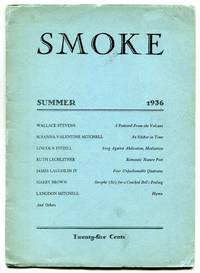
1936615315Providence Rhode Island: Smoke 1936. Softcover. Very Good. Vol. V No. 2 Summer 1936. Stapled wrappers. Wrappers soiled and worn still very good. Contains "A Postcard From the Volcano" by Wallace Stevens "An Edifice in Time" by Susanna Valentine Mitchell and more. Smoke unknown
1314065238.Gpaperback. Good. Access codes and supplements are not guaranteed with used items. May be an ex-library book. paperback
1313406716.Gpaperback. Good. Access codes and supplements are not guaranteed with used items. May be an ex-library book. paperback
1313406724.Gpaperback. Good. Access codes and supplements are not guaranteed with used items. May be an ex-library book. paperback
186424901.02<p>"<i>with the same determination to divide the country unless they can secure universal abolition we are exposed to the same dangers every day and God only knows in what unlucky hour our ruin may be consummated. Compare his policy with McClellan's expression of readiness to receive any State when its people offer to submit to the Union.</i>"</p><p>This Democratic Party campaign pamphlet quotes an April 1864 letter to argue that Lincoln gave Lieutenant General Ulysses S. Grant free rein to conduct the war after having interfered with and micromanaged McClellan's Peninsula Campaign in 1862. The publication also declared that Republicans were stained with "<i>The Taint of Disunion</i>" and quoted from Republican speeches and editorials to insist that the Democrats were the party of "<i>UNION AND PEACE</i>."</p> <b>ABRAHAM LINCOLN.</b>Printed Document. Democrat Campaign "<i>Document No. 12</i>" with headings "<i>Lincoln's Treatment of Gen. Grant</i>" "<i>Mr. Lincoln's Treatment of Gen. McClellan</i>" and "<i>The Taint of Disunion</i>." New York 1864. 8 pp. 5¾ x 8â… in.<p><b><br /></b></p><p><b>Excerpts:</b></p><p>Lincoln to Grant April 30 1864</p><p>"<i>I wish to express in this way my entire satisfaction with what you have done up to this time so far as I understand it. The particulars of your plans I neither know nor seek to know. You are vigilant and self-reliant; and pleased with this I wish not to obtrude any restrains or constraints upon you while I am very anxious that any real disaster or capture of our men in great numbers be avoided.</i>" p1/c1</p><p>"<i>Such in brief are some of the most notable instances in which Mr. Lincoln interfered with General McClellan when he occupied a position similar to that held by General Grant. They reflect so severely upon the President that no attempt to gloss them over by his apparent subsequent repentance can disabuse the patriotic portion of the nation of the matured conviction that he is to be held responsible for the lack of decisive victories in Eastern Virginia. The blame must and will rest upon him to whom it belongs.</i>" p5/c2</p><p>"<i>Having shown by copious extracts from the speeches of Abraham Lincoln W. H. Seward Wendell Phillips Wm. Lloyd Garrison and from the editorial writings of the Chicago Tribune and the N. Y. Tribune… that they were all <b>original secessionists and disunion men</b> we propose now to give the evidence that Mr. Lincoln himself has within the last three months been concerned in a movement to make peace with Jeff. Davis on terms involving the direct proposal to divide the Union and let the South go.</i>" p7/c2-p8/c1</p><p>"<i>with the same determination to divide the country unless they can secure universal abolition we are exposed to the same dangers every day and God only knows in what unlucky hour our ruin may be consummated. Mark how Mr. Lincoln constantly keeps up the idea of negotiating only with Jefferson Davis. Why does he never address himself to the people or the States of the South. Compare his policy with McClellan's expression of readiness to receive any State when its people offer to submit to the Union.</i>" p8/c2</p><p><b>Historical Background</b></p><p>The 1864 presidential election pitted President Lincoln against his Democratic challenger General George B. McClellan. Although McClellan had been the commander of the Army of the Potomac and general-in-chief of the Union Army the Peace platform adopted by the Democratic National Convention in Chicago declared the war a failure. The party was bitterly divided between War Democrats who favored continuing the war to restore the Union while leaving slavery alone; moderate Peace Democrats who favored an armistice and a negotiated peace that would likely protect slavery in a reconstructed union and radical Peace Democrats who favored an immediate end to the war without securing Union victory. McClellan was a War Democrat but the platform was written by radical Peace Democrat Clement Vallandigham and Peace Democrat George H. Pendleton was nominated for vice president.</p><p>In 1864 Republicans created the National Union Party to attract War Democrats Unconditional Unionists and Unionist Party members who would not vote for the Republican Party though most state Republican parties did not change their name. President Abraham Lincoln won the nomination of the "National Union Party" at its Baltimore convention and won re-election with new running mate War Democrat Andrew Johnson.</p><p>Although Lincoln was convinced by August 1864 that he would not be reelected General William T. Sherman's capture of Atlanta in early September and General Philip Sheridan's successes in the Shenandoah Valley of Virginia from August to October ensured his victory. Without the participation of the seceded states Lincoln and Johnson won 55 percent of the popular vote and an overwhelming 212-to-21 victory in the Electoral College. McClellan and Pendleton carried only Kentucky Delaware and McClellan's home state of New Jersey.</p>
192435526Peoria Illinois: Edward J. Jacob Printer Peoria Illinois 1924. First Edition. Privately Printed. Hardcover. Fair. Octavo. 2 127 pages. 4. Illustrated with frontispiece photograph of Lincoln illustrations and folding facsimiles. Half leather binding with tan cloth covered boards. Tooled leather spine with raised bands and gilt lettered title. Marbled end papers. Leather spine rubbed. Front hinge is broken exposing the spine. Board is secure to the binding. Rear hinge cracked. Inscribed and signed by the printer on the limitations page. Limited to 100 copies printed. Fair. Edward J. Jacob, Printer Peoria, Illinois hardcover
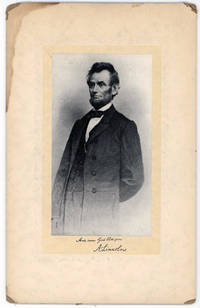
1909000014161Boston: M.T. Sheahan 1909 1909. Cabinet Card. Good. 27.5 cm x 17.5 cm. Photograph measures 17 cm x 9.25 cm. A cabinet card in black and white mounted and inset on a cream-colored paper board. A portrait of Lincoln with the caption "And now God bless you A. Lincoln." A striking image of the sixteenth President of the United States. A dampstain on the left edge of the cabinet card light chipping to the paper and a private namestamp on the verso. M.T. Sheahan [1909] unknown
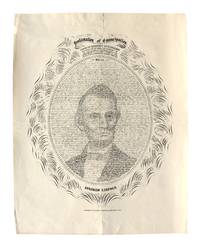
190027986Denver CO: Issued by Halsey M. Rhoads 1900. Very Good. Denver CO: Issued by Halsey M. Rhoads ca. 1900. Later printing. Broadside with calligraphic portrait of Abraham Lincoln in which the script of the Emancipation Proclamation forms the image within a decorative frame surrounded by the names of the members of Congress who voted for the amendment of the U.S. Constitution. 48 x 37 3/4 cm. A few tears to edges with tape mend to verso top edge; folds; minor edge wear; paper residue to verso from previous mount; overall Very Good. <br /> <br /> The original design was by W.H. Pratt in 1865 with just portrait and border and the names to the outside added to later printings. Halsey Rhoads was publisher of the Rocky Mountain Herald and a well known and prominent Denver citizen--even his bout with appendicitis in 1901 treated with leeches and ice garnered several writeups in contemporary newspaper accounts. <br /> This broadside scarce in any printing. <br /> <br /> See Eberstadt 42. Issued by Halsey M. Rhoads unknown
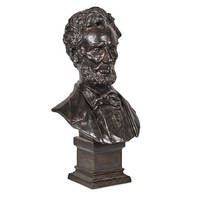
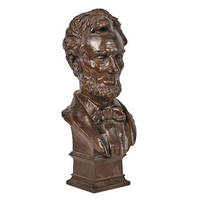
131044Patinated bronze cast of Abraham Lincoln by George Bissell one of only three commissioned by Ralph Newman for THE USS AL. Boldly signed by the artist in the back Geo. E. Bissell Sc. George Bissell was an important American sculptor working in the late 19th and early 20th centuries. He produced two full length statues of Lincoln: one in Edinburgh and one in Clermont Iowa. According to the letter from Lincoln College Curator Paul Beaver the present item is one of three copies made from the school's original Bissell bronze bust of Lincoln by the Van Dyke Galleries of Chicago in the summer of 1989. One copy was presented to the USS Abraham Lincoln commissioned in 1989 one copy was sold to Mel Smith and the third to Barry and Louise Taper. In fine condition. The piece measures 25.5 inches in height. An exceptional piece. unknown
133797Patinated bronze portrait bust of Abraham Lincoln marked "GEO. E. BISSELL Sc GORHAM CO. FOUNDERS copyrighted" and stamped "G 47." This is one of a series of popular desktop busts of Lincoln produced by the Gorham foundry in the early part of the 20th century. In fine condition. The piece measures 18 inches in height. An exceptional piece of American history. unknown
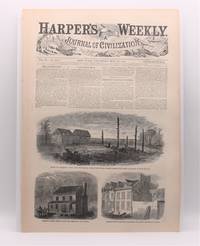
1865W2380New York: Harper's Weekly 1865. 16 pages. Large folio 16 inches by 11 1/4 inches. Original complete issue of Harper's Weekly. Harper's Weekly was the most important American pictorial newspaper in the 19th century. Because the original wood engravings in virtually every issue are highly collectible complete issues are becoming more difficult to obtain. The issue offered here focuses on the events following the assassination of Lincoln. On the front page are articles on the assassination and the funeral along with three original wood engravings: one showing the ruins of the Garrett barn where John Wilkes Booth was shot; another showing the house where Booth died; and a third engraving of the house of Booth's co-conspirator David Herold. On the interior are multiple engravings of various Lincoln funeral sites. Among the unrelated engravings is the double-page centerfold by Thomas Nast entitled "Palm Sunday"--one side portraying the arrival of Jesus in Jerusalem and the other side Lee surrendering to Grant. This issue of Harper's Weekly is disbound from an annual volume and has the usual sewing holes along the binding edge but it is still in very good condition: clean and bright with minimal toning of the paper. Note: we have available more than 500 complete issues of Harper's Weekly as well as thousands of individual wood engravings. Please inquire if you are looking for specific items. First Edition. Paperback. Very Good. Elephant Folio - over 15" - 23" tall. Magazine. Harper's Weekly Paperback
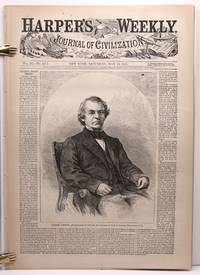
1865W2422<p>New York: Harper's Weekly 1865. 16 pages. Harper's Weekly was the most important American pictorial newspaper in the 19th century. Because the original wood engravings in virtually every issue are highly collectible complete issues are becoming more difficult to obtain. The issue here focuses on Lincoln's New York City funeral procession and the capture and killing of John Wilkes Booth. The front page features a wood engraving of the newly sworn-in President Andrew Johnson. It is based on a photograph by Alexander Gardner. The centerfold is a double-page wood engraving captioned "President Lincoln's Funeral--Procession in New York City." It is based on a photograph by Matthew Brady. Other wood engravings include "Sergeant Boston Corbett" a portrait based on a Brady photograph of the man who shot Booth; "Planning the Capture of Booth and Harold" based on a Gardner photograph; "Booth's Capture--The Assassin Brought to Bay" a recreated view of Booth in the burning barn in which he was killed; "President Lincoln's Funeral--Removal of the Body from the City Hall to the Funeral Car New York"; and "Post-Mortem Examination of Booth's Body on Board the Monitor 'Montauk'." There is text accompanying most images. Especially striking is the lengthy description of the interaction between Booth and his pursuers before he was killed. This newspaper is disbound from an annual volume and has the usual sewing holes along the binding edge but it is still in very good condition: clean and bright with minimal toning of the paper; a long but neat closed tear along the centerfold line of the double-page engraving; a one-inch closed tear limited to the blank margin of the front page; and a 1.5 inch by 3.5 inch triangular chip out of a corner of the last leaf primarily impacting one word in the title of an advertisement. Note: we have available more than 500 complete issues of Harper's Weekly as well as thousands of individual wood engravings. Please inquire if you are looking for specific items. . First Edition. Paperback. Very Good. Elephant Folio - over 15" - 23" tall. Magazine.</p> Harper's Weekly paperback
186525618<p>Frank Leslie published this print as a premium for his new family magazine <i>Frank Leslie's Chimney Corner</i> and copyrighted it on April 8 1865 just a week before Lincoln's death. The image created by engraver Henry B. Major and lithographer Joseph Knapp portrays Lincoln flanked by the First Lady and Vice President Andrew Johnson greeting Julia Dent Grant wife of Lieutenant General Ulysses S. Grant who stands nearby.</p><p>According to a notice printed at the bottom right corner "<i>Every Person who pays Ten Cents each for numbers 1 and 2 of Frank Leslie's Chimney Corner The New Family Paper is entitled to a copy of this PLATE without extra charge</i>" or individuals could purchase the print for $3.</p> <b>ABRAHAM LINCOLN.</b>Lithograph. "Grand Reception of the Notabilities of the Nation at the White House 1865" New York: Frank Leslie April 1865. 1 p. 19 x 23¾ in.<p><br /></p><p>In the first issue of <i>The Chimney Corner</i> Leslie described the "Grand Reception" image as "the most costly gift plate ever presented by any publisher in the United States having been produced at an expense of $10000."</p><p>"Every family should possess this truly national picture and carefully preserve it" Leslie continued "as it will transmit to future generations the men who have restored our great national unity. It is especially valuable as it contains an excellent likeness of our late lamented President introducing General Grant and his wife to Mrs. Lincoln." The picture contains "nearly 100 portraits of our most celebrated Generals Statesmen and Civilians also of many of our most distinguished American ladies. The likenesses are admirable having been taken from photographs by Brady."</p><p>The key giving the names of each individual portrait was published in issue number 4 of the <i>Chimney Corner</i> on June 24.</p><p>Included in the image are Generals Ulysses S. Grant John G. Foster William T. Sherman Hugh J. Kilpatrick Nathaniel P. Banks Philip H. Sheridan Winfield S. Hancock John A. Logan Joseph Hooker Benjamin F. Butler Oliver O. Howard John A. Dix and Henry W. Slocum. Admirals David Farragut and David Dixon Porter represent the Navy. Members of the cabinet include Secretary of War Edwin M. Stanton Secretary of State William H. Seward and Secretary of the Navy Gideon Welles. Members of Congress include Senator Henry B. Anthony of Rhode Island Senator William P. Fessenden of Maine Senator Charles Sumner of Massachusetts and Speaker of the House Schuyler Colfax of Indiana. Chief Justice Salmon P. Chase represents the U.S. Supreme Court. New York newspaper editors Horace Greeley Henry J. Raymond and James Gordon Bennett are also present. Prominent women include First Lady Mary Lincoln Ann S. Stephens dime novelist and magazine editor Miriam Folline Squier wife of Leslie's former editor-in-chief and Leslie's future wife Julia Dent Grant wife of Ulysses S. Grant Kate Chase Sprague daughter of Chief Justice and wife of Rhode Island Senator and Adele Cutts Douglas widow of Stephen A. Douglas. Others identified in the key include Ephraim G. Squier Leslie's former editor-in-chief archaeologist and U.S. commissioner to Peru Governor Andrew G. Curtin of Pennsylvania and Ambassador to Russia Cassius M. Clay of Kentucky.</p><p>Despite Leslie's copyright Anton Hohenstein created a very similar image entitled "Lincoln's Last Reception" which also featured Lincoln's meeting General Ulysses S. Grant's wife Julia. Published by John Smith in Philadelphia in 1865 and hand-colored "Lincoln's Last Reception" also included more than thirty military and political leaders and a few prominent women among the onlookers in the ballroom.</p><p><b><i>Frank Leslie's Chimney Corner</i></b> 1865-1884 was a weekly family newspaper published "every Tuesday" in New York by Frank Leslie. Each illustrated issue of sixteen pages contained serial fiction short stories poetry biographies history travel sketches natural history anecdotes and other subjects. According to the prospectus the newspaper would be "a welcome messenger of instruction and amusement to the young and old in the family and by the fireside—that altar around which cluster our holiest and most cherished recollections." Leslie had copyrighted the title in 1861 but "the great Rebellion now happily closing intervened to put a stop to the enterprise."</p><p><b>Frank Leslie</b> 1821-1880 was born in England as Henry Carter but he adopted the pseudonym of Frank Leslie to keep his artistic activities a secret from his relatives who disapproved. He came to the United States in 1848 and settled in New York in 1853 to engrave woodcuts for P. T. Barnum's <i>Illustrated News</i>. When that publication failed Leslie began work on his own series of illustrated publications including <i>Frank Leslie's Illustrated Newspaper</i> <i>The Budget of Fun</i> <i>Frank Leslie's Chimney Corner</i> and others. At his death he was deeply in debt but his second wife Miriam Folline Squier 1836-1914 continued his publications and again made them profitable even legally changing her name to Frank Leslie in 1881.</p><p><b>Condition</b></p><p>Spot-mounted to modern board mat toning moderate foxing minor edge wear. Would benefit from conservation.</p> Frank Leslie
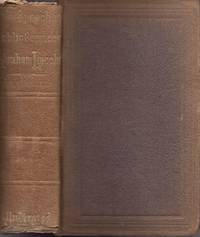
186533818New York: Moore Wilstach & Baldwin 1865. Hardcover. Fair. Thick octavo. 1 842 pages 6 pages of advertisements 1. Frontispiece engraving of Lincoln. Illustrations in text. Brown cloth hardcover ruled in blind on the covers with title on the spine. Cloth binding edge worn with chips head and base of the spine. Cracked hinges. Interior contents clean. Previous owners illustrated bookplate on the right front flyleaf. Another owner inscription on the front blank end sheet. First copyrighted ion 1860. The 1865 edition contains up to date information and the details of assassination of Lincoln. Fair. Moore, Wilstach & Baldwin hardcover