GUILLAUME (Édouard) Ed.Livre Rare Book

58 résultats
1893SPN-1020Paris : Édouard Dentu, Collection "Guillaume", 1893. Pour les 8 premiers fascicules : demi-reliure in-8 (21 x 12 cm), dos titré sur pièce de cuir noir, filets dorés et pointillés, illustrations en noir et blanc in et hors-texte. Pour les 4 derniers fascicules : demi-reliure in-8 (20 x 12 cm) à coins et filets dorés; titrage doré et fleuronné, illustrations en noir et blanc in et hors-texte. 12 fascicules en 8 volumes : I et II (2 fascicules en 1 volume) : Avertissement - Notes et croquis de Sourya. A l'ombre et au soleil : Petits théâtres et grandes baraques - J. H. Rosny. Eyrimah, roman lacustre - Jacques Soldanelle. Chronique + Notes et croquis de Sourya. Petits théâtres et grandes baraques (suite) - J. H. Rosny. Eyrimah (suite) - Jacques Soldanelle. Chronique : La Grande tueuse. III et IV (2 fascicules en 1 volume) : Notes et croquis de Sourya. A l'ombre et au soleil : Les Halles - Rosny. Eyrimah (suite) - Henri de Villebois. Idylle (nouvelle) - Soldanelle. Chronique : Le mystère de l'eau + Notes et croquis de Sourya. A l'ombre et au soleil : Jardins - Rosny. Eyrimah (suite) - J. Acheroni. Salon de 1893 : Le triomphe de l'étain - Soldanelle. Chronique : L'avenir de l'alcool. V et VI (2 fascicules en 1 volume) : Notes et croquis de Sourya. A l'ombre et au soleil : Les Courses - Rosny. Eyrimah (suite) - Prince Bojidar Karageorgevitch. Impressions de désert - William Ritter, traduction. La Fille de l'Empereur et le fils de la veuve (conte roumain) - Soldanelle. Chronique : Les maladies artificielles + Notes et croquis de Sourya. A l'ombre et au soleil : Le 14 Juillet - Paul Margueritte. Une Flaque (nouvelle) - Rosny. Le Miracle (nouvelle) - Soldanelle. Chronique : Le langage des singes. VII et VIII (2 fascicules en 1volume) : Notes et croquis de Sourya. A l'ombre et au soleil : La Seine - Rosny. Nymphée (roman) - Gustave Geffroy. Le Coeur et l'esprit : Les Ombres - Jérôme Doucet. la Chanson des choses (courts poèmes) - Soldanelle. Chronique : Le cheval en bicyclette + Notes et croquis de Sourya. La Seine (suite) - Rosny. Nymphée (suite) - Gustave Geffroy. Le Coeur et l'esprit : Les Ombres (suite) - Jérôme Doucet. La Chanson des choses (courts poèmes) - Soldanelle. Chronique : Le chauffage par le pôle. IX : Notes et croquis de Sourya. A l'ombre et au soleil : Notre Dame - Paul Margueritte. A la mer (nouvelle) - Paul Radiot. Isolette (nouvelle) - Gustave Geffroy. Le Coeur et l'esprit : Les Ombres (suite et fin) - Jacques Soldanelle. Chronique : Les guerres de demain. X : Notes et croquis de Sourya. A l'ombre et au soleil : La Seine (Les Misérables) - André Theuriet. Deuil de veuve (nouvelle) - William Ritter. Sang viennois (nouvelle) - Soldanelle. Chronique : La cyclomanie. XI : Notes et croquis de Sourya. A l'ombre et au soleil : Le Marché de La Villette - André Theuriet. Deuil de veuve (suite et fin) - Armand Charpentier. L'Abonnement funéraire (nouvelle) - Alexandre Piedagnel. Trois croquis d'Espagne (poèmes) - Rosny. L'Epreuve (nouvelle) - Soldanelle. Chronique : Le ciel inconnu. XII : Notes et croquis de Sourya. A l'ombre et au soleil : Les Abattoirs - Jean Rameau. La Bonne fortune de Cadet (nouvelle) - V. Korolenko. Une Nuit de Pâques (nouvelle) - Rosny. Le Monstre (nouvelle) - Soldanelle. Chronique : Chiens parisiens - A nos lecteurs - Collection BAMBOU : Table générale des 12 fascicules formant la collection. Nota : un dessin sur étain du sculpteur Jules Desbois (1851-1935), réalisé pour le Salon du Champ-de-Mars de 1893 fut livré en supplément dans le fascicule IV, en préambule de l'article d'Acheroni sur ce même salon ("Salon de 1893 : Le Triomphe de l'étain"). La revue innovait en fournissant au lecteur-collectionneur le conseil de l'artiste : comment patiner en vieil étain la planche incluse. Ce dessin manque malheureusement dans notre exemplaire. [TBE, quelques rousseurs, ex-libris à l'encre. Le dessin sur étain manque dans le fascicule 4. Par ailleurs, le relieur des 4 derniers volumes n'a pas jugé opportun de reprendre les couvertures des fascicules. Il manquent donc et le texte commence directement avec la feuille de titre et tomaison, sommaire au revers]
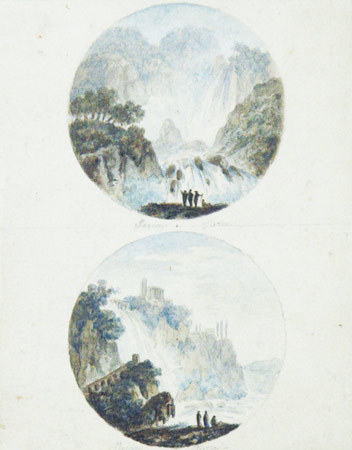
100021aafS.d., XVIIIe s., 2 ronds (8.5 cm de diam.) sur une même feuille 17.5 x 14 cm, 2 dessins au lavis brun et bleu sur une feuille, encadrement en bois (30 x 24.5 cm).
177659527S. n. | s. l. (Circa 1776) | 32 x 40.50 cm | une feuille encadrée
177659527s. l.: S. n. 1776. Fine. S. n. s. l. Circa 1776 32 x 40.50 cm une feuille encadrée Original drawing in ink and watercolor. Modern frame. Drawing made during the journey with the Marquis de Sade in 1776. Jean-Baptiste Tierce 1737-1794 student at the École des Beaux-arts in Rouen then at the Academy of Painting and Sculpture in Paris quickly distinguished himself as a landscape painter for his views of Southern France and Italy. His paintings are preserved in the Uffizi in Florence and in several French museums. When in December 1775 Sade left Rome for Naples he was welcomed by the son-in-law of his friend Doctor Mesny Jean-Baptiste Tierce who at that time received commissions from Cardinal de Bernis. He found lodging for the Marquis ""who intended to see everything in the region learn about everything judge admire criticize love hate in short to give free rein to that insatiable and passionate curiosity which led him into museums galleries churches palaces and libraries as well as into caves vaults catacombs and even into the bowels of volcanoes. He was not content to contemplate works of art ancient or modern monuments he also observed customs politics religion administration social life. The beauty of women worldly customs the quality of performances ways of eating drinking dressing praying conducting oneself in society: nothing left him indifferent. He wanted to grasp all the present and all the past of this civilization to embrace it entirely in a single and universal vision. A gigantic program matching his exceptional imagination but which he no longer had to fulfill which it was impossible for him to fulfill. Yet such was his first ambition as a writer: grandiose excessive. With this 'great work' in view Sade took hasty notes at roadsides or in inns which he completed with notes from his correspondents Mesny and Iberti. Thus was built this monument he intended for the public but which would not see the light of day until the twentieth century. Jean-Baptiste Tierce collaborated closely: he reread the notes and recorded his observations in small notebooks with numbers referring to the works described. Sade took the greatest account of them. Often the painter accompanied him on his walks his sketch pad in hand drawing the buildings and landscapes they had before their eyes. A hundred of these drawings and gouaches were recently found in the Sade family archives. They give the Voyage en Italie the appearance of a true reportage."" Maurice Levert Sade pp. 283-284. Provenance: Sade family archives. S. n. unknown
177659528S. n. | s. l. (Circa 1776) | 40 x 50 cm | une feuille encadrée
177659528s. l.: S. n. 1776. Fine. S. n. s. l. Circa 1776 40 x 50 cm une feuille encadrée Italian scene: animated seaside with square tower Original pencil drawing showing an animated seaside scene. Modern black wooden frame. A drawing done during the journey the artist undertook with Sade in 1776. Jean-Baptiste Tierce 1737-1794 who studied at the School of Fine Arts in Rouen and subsequently at the Academy of Painting and Sculpture in Paris quickly built a reputation as a landscapist for his views of the South of France and Italy. His paintings are in the Uffizi in Florence and several French museums. When in December 1775 Sade left Rome for Naples he was welcomed by the son-in-law of his friend Dr. Mesny Jean-Baptiste Tierce who at the time was working on commissions for Cardinal de Bernis. He found lodgings for the Marquis who intends to see everything of the region learn everything judge admire critique love hate in short give himself over to the insatiable and passionate curiosity that takes him to museums galleries churches palaces and libraries as well as grottoes caves catacombs and right down to the very innards of volcanoes. He was not content merely to look at the various works of art and ancient and modern monuments; he also set out to observe the local mores politics religion administration and social life. The beauty of the women the local traditions the quality of plays table manners and the way people drank dressed prayed and made their way in the world all interested him. He wanted to take in both the present and the past of this culture to encompass it all in a unique and universal vision. A massive undertaking to match his extraordinary imagination which he was however unable to fulfil it being impossible for him to do so. This was however the nature of his central ambition as a writer: grandiose and outsized. With a view to this great work Sade took hurried notes at the side of the road or in hostelries which he then complemented with notes from his correspondents Mesny and Iberti. Thus he built up the monument he intended to put before the public but which did not end up seeing the light of day until the 20th century. Jean-Baptiste Tierce was a close collaborator: he re-read Sade's notes and gave his observations on the little notebooks with numbers referring to the works mentioned. Sade took the greatest notice of his views. Often the painter accompanied him on his rambles sketchbook in hand drawing the buildings and landscapes before them. A hundred or so of these drawings and watercolors were recently found in the Sade family archives. They give the Voyage en Italie the charm of a real travel diary. Maurice Levert Sade pp. 283-284. Provenance : Sade family archives. S. n. unknown
177659469S. n. | s. l. (circa 1776) | 32 x 40.50 cm | une feuille encadrée
177659469s. l.: S. n. 1776. Fine. S. n. s. l. circa 1776 32 x 40.50 cm une feuille encadrée Original drawing in ink and watercolor depicting an animated seaside view with a village perched on a cliff. Modern framing in blonde molding. Drawing executed during the journey made with the Marquis de Sade during the year 1776. Jean-Baptiste Tierce 1737-1794 student at the École des Beaux-arts in Rouen then at the Academy of Painting and Sculpture in Paris quickly distinguished himself as a landscape painter for his views of the South of France and Italy. His paintings are preserved at the Uffizi in Florence and in several French museums. When in December 1775 Sade left Rome for Naples he was welcomed by the son-in-law of his friend Doctor Mesny Jean-Baptiste Tierce who at that time was receiving commissions from Cardinal de Bernis. He found lodging for the Marquis ""who intended to see everything in the region learn about everything judge admire criticize love hate in short to give free rein to that insatiable and passionate curiosity which led him into museums galleries churches palaces and libraries as well as into grottos vaults catacombs and even into the bowels of volcanoes. He was not content to contemplate works of art ancient or modern monuments; he also observed customs politics religion administration social life. The beauty of women worldly customs the quality of entertainments ways of eating drinking dressing praying conducting oneself in society: nothing left him indifferent. He wanted to grasp all the present and all the past of this civilization to embrace it entirely in a single and universal vision. A gigantic program commensurate with his exceptional imagination but which he could no longer fulfill which was impossible for him to fulfill. Yet such was his first ambition as a writer: grandiose excessive. With this 'great work' in view Sade hastily took notes at roadsides or in inns which he supplemented with the notes of his correspondents Mesny and Iberti. Thus was built this monument which he intended for the public but which would not see the light of day until the 20thth century. Jean-Baptiste Tierce collaborated closely: he reread the notes and recorded his observations in small notebooks with numbers referring to the works described. Sade took the greatest account of them. Often the painter accompanied him on his excursions his sketchbook in hand drawing the buildings and landscapes before their eyes. About a hundred of these drawings and gouaches were recently found in the archives of the Sade family. They give the Journey to Italy the appearance of a true reportage."" Maurice Levert Sade pp. 283-284. Provenance: archives of the Sade family. S. n. unknown