530 résultats
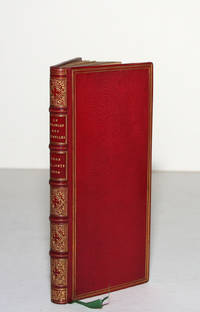
15335435Lyons: François Juste 1533. Hardcover. Near Fine. 8vo 14 x 6.3 cm. 1 f. 80 ff. woodcut architectural title border incorporating printer's initials 29 small woodcuts flanked by columns black-on-white woodcut initials. Bound in 19th-century red morocco gilt by Trautz-Bauzonnet gold-tooled green morocco doublures marbled endpapers all edges gilt in a pale blue chemise with green morocco spine label. Binding pristine with the fine ex libris of its previous owners affixed to the front flyleaf. A 1-cm paper flaw at f. 38 affecting a few letters very faint uniform browning. Only recorded copy of a very early illustrated edition 3rd of this anonymous collection of 'nouvelles' a literary genre presenting brief prose narratives taken from bourgeois life. The Parangon des nouvelles honnestes utiles et delectables following the famous Les cent nouvelles nouvelles c. 1460 collected vernacular tales purporting to be both true and current i.e. relating to recent events hence 'nouvelle' and so eschewed more established prose forms which relied on classical mythology historical exempla chivalric fantasy and animal fable in favor of reports on greedy merchants drunken millers lascivious housewives and the like. Largely derived from the Decameron of Boccaccio Lorenzo Valla's Apologues Poggio Bracciolini's Facetiae and the anonymous Germanic Ulenspiegel the Parangon packaged together old and new for popular consumption resulting in what one scholar has called "a magma ready for every kind of metamorphosis" Pérouse 1977 p. 7 that is to say the unformed raw material that soon would cool into the more recognizable and longstanding genres of the novel and short story. These "issues of novelty fictional accreditation historical veracity and the chivalric narrative past . were also played out in a variety of other critical settings encompassing works both of shorter and longer fiction" most famously in François Rabelais' proto-novels Pantagruel 1532 and Gargantua 1534 exact contemporaries of the Parangon G. Norton p. 306. Often bawdy and salacious the nouvelle was initially overlooked by scholars of early-modern literature but today its status as a "non-mimetic self-conscious intertextual ironic perhaps even skeptical mode of writing" has cemented it as a pivotal precursor to a modern literary sensibility LaGuardia p. 16. In short the nouvelle frustrates and delights scholars today much as it did its contemporaries and its importance springs from the uneasy active reading it requires from its readers. The present volume's tall and slender 'agenda' format - a shape associated with easy portability and personal use - is very rare in this period occurring when it does almost exclusively in French Books of Hours a genre which blends private devotion prayer with a need for constant practical reference liturgical hours calendars see the Heures printed by Antoine Chappiel 1504 Pierre le Dru 1505-6 Gillet Hardouin 1509 and 1515 T. Kerver 1514 and Germain Hardouin 1534 and 1526; a notable secular exception is the Manuale Vergilianum Strasbourg Johann Grüninger 1507-10. It is intriguing that the impious casual tales of the Parangon should have been printed in a physical format with such pious overtones: does its unusual form merely result from a desire for easy practical use or does it carry some surplus of ironic meaning Even the book's program of illustration participates in an oddly modern mixing of material: its numerous woodcuts are quite clearly borrowed from other still untraced sources: figures seated at dinner a scholar with his amanuensis women spinning yarn a statue of Mars a monk preaching in his pulpit lovers embracing a man drunk on wine a mourner bent over a shrouded corpse a Janus-faced figure a sword duel - these all invite readers to puzzle out how such images might relate to each other and to the texts they supposedly elucidate. <br/> <br/> François Juste hardcover books
15731669261573. ROMAN EMPERORS. Imagines XXIIII Caesarum a Iulio ad Alexandrum Severum usque ab antiquis marmoribus excerptae nuper impressae. Edited and engraved by Donato Bertelli. Engraved title-page and 24 full-page engraved portraits numbered I-XXIV of Roman Emperors from Julius Caesar to Severus Alexander. 4to. 228 x 168 mm bound in later Italian quarter vellum over boards edges speckled red. Venice: apud Donatum Bertellum ad signum divi Marci 1573. These 24 expressive portrait plates "extracted from antique marbles" show 23 of the 27 emperors who ruled during the Julio-Claudian Flavian and Nervan-Antonian dynasties in profile or three-quarter perspective plus a profile of Lucius Aelius AD 101-138 "L. Helius Verus Imp. XX" the adopted son of Hadrian who never ascended the throne. The group excludes Lucius Verus AD 130-169 co-emperor with Marcus Aurelius; Didius Julianus d. AD 193; Geta AD 189-211; and Macrinus who ruled temporarily with his son Diadumenian both executed in AD 218 according with the other known copies of this book which have 23-25 plates. The engraver and printer of this series Donato Bertelli fl. 1565-1574 is most famous for his cartographic publications notably Le vere imagini et descriptioni delle più belle città del mondo 1569 dedicated to J. J. Fugger von Kirchberg. Sparse annotations in contemporary ink. The plates are mounted on laid paper and bound out of order. Very rare. No known copies in the U.S. and no records at auction in ABPC. OCLC locates just one copy in Freiburg Germany and the Italian census EDIT 16 adds one more Biblioteca Ambrosiana Milan: CNCE 68584. DBI online Bertelli. Le Blanc Manuel de l'amateur d'estampes I p. 307. Not in Cicognara. hardcover books
200822827Portland and Various 2008-2018 and counting. The collection is in generally fine condition. Complete with all inserts booklets ephemera etc. Lacking only perishables which were eaten by your cataloguer and occasional assorted Powell's swag mugs totes and like which were also appropriated by your cataloguer. More than 125 columes in total a complete inventory is available. <br/><br/>For more than ten years and over seventy installments Powell's Books Portland has been issuing their semi-monthly INDIESPENSIBLE series a subscription-only selection of specially-produced typically limited edition volumes from many of the most prominent names in literature Claire Messud George Saunders Michael Chabon Annie Proulx Donna Tartt J.M. Coetzee Jeffrey Eugenides Jonathan Franzen Siri Hustvedt and publishing MsSweeney's Graywolf Algonquin. Installments commonly include a signed and slipcased recent release as well as one of more promotional titles usually ARCs or like but sometimes advance excerpts. We've been subscribers since volume one and over the ensuing decade this collection has come to represent one of the most diverse and vibrant portraits of contemporary letters and modern bookselling around — a tribute to both independent publishing and independent bookselling. With limitations for the initial installments were in the low hundreds not an easy collection to recreate esp. with all included ephemera and inserts — most of which include interviews with the featured writers not published elsewhere. A biographically and bibliographically significant collection. Price is as of current volume #76. Subscription will be maintained until sold. Price therefore subject to change. unknown books
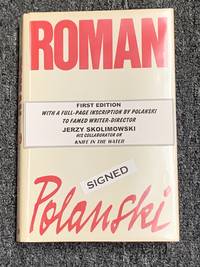
198412801<b>Signed & Inscribed First Edition First State copy a presentation copy by the internationally famed director to noted Polish writer/director Jerzy Skolimowski writer of Polanski's breakthrough film KNIFE IN THE WATER. Much better than very good copy slightly foxed to topedge leaves in like dust jacket showing light wear and a modicum of stain to spine & back panel not affecting the author portrait. This copy is a rarity indeed: it bears a full-page inscription by Polanski in Polish to Skolimowski translation provided by him on a laid-in sheet. In blue ink: "Romek. So you see what is happening / I am signing my biography to you / And it is in English / You could not have foreseen this / during those hot evenings / on Narutowicra Street / when you were served / fruit juices by Kuba / Love/ R." Signature a rarity today highly sought after; an inscription by him particularly one with this degree of meaning & history in such an association on a presentation copy is an extraordinary uniquity.</b> Morrow hardcover books
1520WRCAM17720Augsburg 1520. 4pp. Small quarto. Later plain paper boards. Marginal tears and old fold marks with slight discoloration else very good. "After the death of Ferdinand II Charles V succeeded to the Kingdom of Spain. In 1517 he proceeded to Spain which he left in 1520. At his departure he was very unpopular; he made this speech when he left and said 'That he did not see the happy faces with which he had been received.' He also mentions America in the following words: 'He might have been satisfied with the Spanish Empire the Balearic Islands and Sardinia the Kingdom of Sicily Italy and a large part of Germany and Gaul AND THAT OTHER GOLD-BEARING WORLD'" - Maggs. <br> <br> EUROPEAN AMERICANA locates only two copies at The New York Public Library and the Bibliothèque Nationale. There is also a Rome edition of which a copy is located at Harvard. The present copy appears to be the only one offered for sale in this century. EUROPEAN AMERICANA 520/17. MAGGS BIBLIOTHECA AMERICANA I:33 this copy. PALAU 44419. ROTHSCHILD 3137. hardcover books
11339Used; Like New/Used; Like New. Oblong 1957 photograph of the renowned American architect and the renowned American poet both ex-Chicagoans and old friends boldly signed by each in the lower blank margin. Original photograph by Art Siegel 7 1/2 x 9". On verso notations record the place each autograph was obtained: Sandburg's in Flat Rock North Carolina and Wright's in Scottsdale Arizona January 1958. A few areas of surface loss to the image which have been in-painted with dye and an area of evident creasing or tearing repaired by a clumsily affixed small adhesive light paper skinning on the lower edge none of these faults affecting either of the signatures. Simply matted and framed under plexiglass. Signed photographs of Wright are very rare.<br><br><br />The image depicts these two great American originals as they met to appear together in 1957 on television's Omnibus hosted by Alistair Cooke. They were old friends by this point having met as young men in Oak Park Illinois and had been close for nearly half a century. Around this time they also participated together in a lively discussion eventually published in Long Island's 'Newsday' under the headline "Meeting of the Titans." That encounter concluded when the interviewer Alicia Patterson asked "What do you think of each other" Wright spoke first: "I wouldn't have any one of my friends improved.I like Carl as he is." Sandburg answered: "I think I will write a Frankl Lloyd Wright poem and it will have music and it will have dimensions in it." When Wright asked: "Third dimensions" Sandburg replied: "I will even suggest a fourth one." unknown books
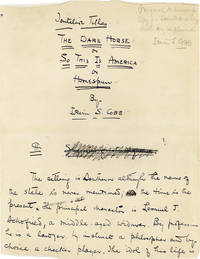
193446764N.p.: S.i. 1934. Holograph manuscript composed in dark blue ink on 152 numbered leaves rectos and housed in a bespoke chemise and slipcase by Barrieri. With presentation inscription from Cobb to MGM film produced and screenwriter Samuel Marx in pencil at upper right corner of title leaf: "Original manuscript copy for Sam Marx Esq / with my compliments / Irvin S. Cobb." A heavily-revised draft with extensive holograph additions and elisions in pencil and in pen throughout marking substantial textual differences between this and the final draft of the screenplay. Mild wear and handling; preliminary leaves with faint creasing to extremities with subtle toning to title leaf; Very Good or better. Slipcase with some light wear and minute board exposure to points around opening else Near Fine. Early unpublished manuscript treatment of the 1939 Paramount Studios film Our Leading Citizen directed by Alfred Santell with a screenplay by Jack Moffitt. A "Capital vs. Labor" story set in a once-small town that has evolved into an industrial city and centered around Lem Schofield an attorney and homespun philosopher and Clay Clinton son of Schofield's deceased partner. Clinton in love with Schofield's daughter and anxious for quick success joins the employ of J.T. Tapley the town's corrupt and influential industrialist. "When Tapley imposes a ten percent wage cut at his factory the workers walk out on strike precipitating a labor war. Lem immediately withdraws as Tapley's attorney but Clay ignorant of the nefarious tactics that Tapley is planning stays on. To crush the strike Tapley calls in a gang of strikebreakers led by Shep Muir. While pacifist union leader Jim Hanna struggles to end the strike peacefully communist agitator Jerry Perkins arrives in town to advocate radicalism and violence. Riots break out and amid an atmosphere of fear and suffering Lem steps in to quell the unrest. After insuring the arrest of agitators Peters and Muir Lem works to institute a labor settlement and Clay finally recognizing Lem's virtues nominates him for the position of United States Senator" TCM. While the final script faulted greedy capitalists and violent revolutionaries alike the film was blacklisted by V.J. Jerome head of the communist cultural commission who got an early look at the script and together with film critic Howard Rushmore deemed it potentially anti-communist. S.i. unknown books
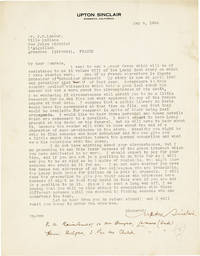
46769V.p.: 1946-47. Archive of six TNS typed notes signed five TLS typed letters signed and one Western Union telegram from Upton Sinclair to the Paris literary agent and translator Jean-Robert Lamour better known by his pseudonym Yves Malartic. Together with ten of Lamour's retained carbons of communications to Sinclair and others. Correspondence spans the period January 1946 to December 1947 and deals with Lamour's efforts to secure publishing contracts for French-language translations of Sinclair's works including The Jungle They Call Me Carpenter Our Lady and others as well as Sinclair's ongoing work on the Lanny Budd series. Sinclair's letters range from notes of as few as four lines to letters of two pages the entirety comprising approximately 2500 words with numerous hand-corrections and signatures in blue or black ink. Lamour's letters to Sinclair comprise nine pieces of correspondence of which three are partial and one draft contract with a total of approximately 3000 words. Three of Lamour's letters are in French addressed to French correspondents all on matters concerning the translation and publication of Sinclair's works. Occasional toning; old folds; onion-skin carbons creased at margins; Very Good. Excellent archive of original correspondence dating from Sinclair's productive wartime and post-War period during which he produced the monumental eleven-volume Lanny Budd series of novels including the Pulitzer Prize-winning Dragon's Teeth. <br/><br/>The correspondence appears to have been struck up by Lamour in late 1945 those letters not present here seeking rights to translate and publish a number of Sinclair's early proletarian novels including The Jungle They Call Me Carpenter Samuel the Seeker as well as such shorter works as No Pasaran! The Flivver King Depression Island and others. Lamour born ca. 1911 at this date in the early stages of his literary career would go on to translate numerous works by American authors in particular Chester Himes and Alex Haley under the pseudonym "Yves Malartic." In his letters to Sinclair Lamour/Malartic shows careful reading and textual analysis of the novels under consideration expresses admiration for Sinclair's body of work and is clearly excited about exercising a newly-available liberty to publish leftist works after the long occupation of Paris stating in one undated letter: "France is groping for a notion of human socialism and french sic people are very interested in everything that refers to U.S.A." At another point Lamour dismisses the publisher Bernard Grasset who had turned down several of Sinclair's works for translation during war-time: "In 1944 Grasset has been deprived of his ownership for collaboration and a manager has been appointed by the government." indeed following the dismissal of its principal the firm of Grasset would become the primary publisher for many of Sinclair's works in France. <br/><br/>Sinclair's replies range from long admiring letters to brief acknowledgments and notes of transmittal. Throughout he shows concern not only for his own legacy among French readers but for the wellbeing of his putative translator - Lamour who does in fact appear to have been driven by a somewhat altruistic impulse at one point appears to suggest that he is willing to translate and edit Sinclair's works without compensation to which Sinclair replies: "." Sinclair's ongoing consuming work on Presidential Mission and One Clear Call the eighth and ninth installments in his Lanny Budd series forms a backdrop to the entire correspondence; at one point he attempts to engage Lamour's assistance with background research on One Clear Call; at several others he begs off new writing assignments because of the all-consuming nature of his work even declining to read a recently-published short story by Lamour claiming that all his energies are consumed by the Lanny Budd project. Indeed Sinclair's output during this period was phenomenal: in the two-year span in which these letters were written Sinclair well into his sixties produced three massive novels - A World to Win Presidential Mission and One Clear Call - and was well along on a fourth O Shepherd Speak! published in 1949. <br/><br/>While Sinclair letters are hardly an oddity in commerce the current archive of correspondence is noteworthy for providing real insight not only into Sinclair's working methods but also into the post-war literary climate in France where it is clear that writers on the left who had been radically disenfranchized during the long Occupation were eager to take on any project that might re-establish their careers while also hopefully putting food on the table. unknown books
189544165New York December 8th 1895. Autograph letter signed on recto and verso of single cream laid sheet 22x14.5cm.; approx. 85 words; dated 26 West 61st N.Y. Dec 8th and simply addressed to "Parker" presumably Stanton's friend and fellow-suffragist Parker Pillsbury 1809-1898 who with Stanton had co-edited the women's rights newsletter "The Revolution" twenty years earlier. Faint mail folds small unobtrusive archival paper remnants to two corners from having been previously mounted else Near Fine and still quite fresh. Brief contemporary 1897 pencil note at bottom edge "Mrs. Stanton - born Nov. 12 1815 Now past 82 - C.E.R." though based on contents we would place this letter as having been written around 1895. Brief but significant missive addressed to Parker Pillsbury the American minister and women's suffrage advocate regarding a copy of Stanton's "Woman's Bible" she had just sent him. "I wonder if I could interest them a "Mrs. White" and one other sufficiently in the Woman's Bible to sell ten or twenty copies in there sic respective woman's clubs It is published at my expense hence I am trying to push its circulation." The controversial "Woman's Bible" a series of commentaries pertaining to the portions of the Bible relating to women was published in two parts in 1895 and 1898 and composed almost entirely by Stanton alone her committee of Bible revisors finding the project too controversial and harmful to the cause of women's suffrage. Clearly at the time of writing this letter the book was still meeting with resistance thus our placing the date at around 1895 Stanton turning to Pillsbury as a potential source of influential and wealthy patrons she inquires "Is Mrs. White still living & working Is that rich woman that Mr. illegible used to visit in Maine living". But by 1897 the book had become a best seller though many of the members of the women's suffrage movement would continue to distance themselves from it. This letter quite significant as a testimony to the aging Stanton organizer of the historical 1848 Seneca Falls Convention and her continuing indefatigable efforts and initial lack of support in getting this work circulated. See Tracy A. Thomas "Elizabeth Cady Stanton and the Feminist Foundation of Family Law" 2016 pp. 15 & 223. unknown books
15212954Mainz: Johann Schöffer 1521. Bound with: Undergerichts ordnung des Ertzstiffts Meyntz. Mainz: Johann Schöffer 23 May 1534. 2 vols. in one small folio 278 x 193 mm. 1 23 leaves of 24 final blank removed. Woodcut title border composed of ten blocks. incorporating whimsical scenes ornamental borders and at bottom the arms of the Archbishop-Elector Albrecht of Brandenburg gothic types two typographic Fraktur initials. Bound at end is a leaf with a one-page contemporary manuscript commentary wider than the text block and folding. Title-leaf rehinged slightly darkened and with effaced marginal inscriptions initial on A2r hidden in gutter initial on A2v shaved quire E with a couple of small corner repairs. 2 35 leaves of 36 final blank removed. Large woodcut white-on-black pointillé opening initial Fraktur initials throughout. Marginal dampstaining last quire on a guard. Early 20th-century pastepaper over boards manuscript spine label.First Edition of the judicial statutes of the Electorate of Mainz the largest ecclesiastical province of Germany and one of the most prestigious and powerful states of the Holy Roman Empire; bound with the First Edition of the statutes of the lower court of the Mainz Prince-Bishopric or Erzstift. The archbishops under the Holy Roman Empire wielded secular as well as pastoral power. Part of the Emperor's program of consolidation of the far-flung empire was the codification and standardization of provincial laws. Both these procedural codes explicitly adopted the ius commune gemeines Recht a combination of Roman and canon law. Both establish precise rules for court procedure and include copious down-to-earth details including where the courts reside who should serve in them and how trials are to be conducted. As is common for German law books these editions are handsomely printed.1 The Mainz Hofgerichts Ordnung was drawn up in 1516 by Albrecht of Brandenburg Archbishop and Elector of Mainz and by his chancellor Johann Fürderer and approved in 1521 by the Emperor Charles V. The latter's ratification is printed at the beginning and end of the statutes. These cover the location of the court required functionaries a judge and a jury of at least 11 members of the nobility although a Doctor or university graduate would suffice duties of other judicial administrators including the court scribes frequency and timing of sessions and jurisdiction by subject and area. Also included are a dozen varieties of oaths for different court officials including the scribe and for special segments of the population e.g. poor people witnesses legal representatives and Jews for whom there is a special preface to the oath itself in which the Jewish defendant or witness must swear that should he not be telling the truth he must renounce all rights to the Holy Land or to participation in the coming of the Messiah. One statute establishes the right of the poor to legal representation which must be covered by the court. Procedural instructions are provided for every activity and eventuality including the recording of testimony of plaintiffs and witnesses fines and punishments for those who don't show up at court proper written documentation and forms rules for appeals execution of sentences and payment of attorneys. OCLC lists three copies in the US Harvard Law LC and Indiana U. VD 16 M 262; Otto Stobbe Geschichte der deutschen Rechtsquellen 1860-64 2: 410-11.  2 The 1534 lower court rules prescribe further details for the conduct of court business. These include how to handle the "law books" i.e. the court records which are to be maintained in "two volumes with locks kept in a safe place." f. 4r; more procedures to follow for uncooperative defendants a long section: evidently a common occurrence; bonds and bail; more oaths; and formularies for various charges appeals and judgments. These Mainz laws were adopted in 1538 by the archdiocese of Cologne and influenced other lower court statutes including those of Württemberg issued in 1555 Stintzing.OCLC locates one US copy Harvard Law. VD 16 M 273; Stobbe 2: 258 note & 411; Stintzing and Landsberg Geschichte der deutschen Rechtswissenschaft 1880 I:543. Johann Schöffer unknown books
17423993Frankfurt am Main: Johann David Jung 1742. First Edition. Hardcover. Very Good. 18 double-page or folding plates comprising 6 of processions and 12 of interior and exterior views; 19 portraits; 2 double-page floor plans of coronation events. 100 306 80 2 38 4 96 8 2 28; 20 128 52 2 26 2 34 2 30; 4 20 8 2 10 2 26 48 pages including half-titles in first 2 volumes. Together 3 volumes in one. Frankfurt am Main: Johann David Jung 1742-43. First edition of an account of festivities and events surrounding the coronation of Charles VII 1697-1745. Lipperheide 1963 2517. Folio contemporary vellum; 19th-century institutional stamp on Volume 1 half-title large folding procession plate in Volume 2 lightly dampstained and backed with sheets from 19th-century literary journal. Very rare complete copy of this wonderfully illustrated book in handsome comdition. <br/><br/> Johann David Jung hardcover books
194447333New York: Reynal and Hitchcock 1944. First Edition. First Printing. Octavo 21.25cm; yellow cloth with titles stamped in black and red on spine and front cover; dustjacket; x1793pp. Signed by Miller in blue ball-point pen on the title page. Spine ends gently nudged some trivial wear to lower board edges with a hint of sunning to upper board edges and a faint shallow stain to lower edge of rear cover; Near Fine. Dustjacket is unclipped priced $2.00 with two tiny tears at crown and a faint vertical crease along left joint; a bright very Near Fine example. Laid into this copy is an untitled seven-page carbon typescript on onionskin 8" x 10.5" written by Miller in 1943 relating details about the book's conception; horizontal fold at center staple holes at upper left corner with two neat punctures along left margin; Very Good. Attractive copy of the Pulitzer Prize-winning playwright's first book based on his experiences researching the war correspondence of journalist Ernie Pyle. The title derives from the widely-used military acronym slang "SNAFU" Situation Normal: All Fucked Up which translates to a bad situation that is a normal state of affairs. Miller was tasked by Hollywood to gather material for "an honest movie" about American GI's during the war about their training daily life their hopes dreams and why they are fighting. Miller visited several Army camps training living and interviewing soldiers and taking down the unvarnished truth of his discoveries. "I was the person fate picked out of Brooklyn to go among the soldiers and pick up enough facts honest-to-God true facts to make a soldier picture which soldiers could sit through until the end without once laughing in derision. A picture that would properly end all soldier pictures" p.1. The film in question was William A. Wellman's The Story of G.I. Joe to be adapted by Miller for Lester Cowan from Pyle's 1943 book This Is Your War. Miller version was ultimatley not produced likely due to ideological differences and his communist sympathies. The typescript written the year before Situation Normal was published summarizes the conception of the book detailing his early meetings with Ernie Pyle over how his work would be translated into film and what they wanted to accomplish. "I bring up the idea that it would be a shame to show this massive canvas without reducing what is chaos to at least an inkling of purpose and order and of course he agrees. But we both feel that to lard on ideology where there is no ideology would be to wrap the truth. You can't have soldiers talking about four freedoms when all they want is to go home. Myself I curse the press and the million textbooks that turn out the billions of words and never add up to an excuse for dying" typescript p.5. A superlative copy of an important debut. Reynal and Hitchcock unknown books
197912223New York: Andy Warhol Books/Grosset & Dunlap 1979. First edition. Used; Like New/Used; Like New. Hardcover with dustjacket Warhol's first photography book with 360 b/w photos of friends and celebrities most of them both. 4to 10 x 11 inches. 255 pages. Signed on the half-title page "To Kevin and Steven / his pushy manager / Love/ pushy Andy Warhol" adding below the title a large sketch of a heart signed "AW" and an additional similarly signed heart drawing on the opposite-facing blank. Nicely bound in black tyvek with a cover design referencing the original dust jacket of the edition and including actual elements of that dust jacket incorporated into the design including Warhol's face in profile. And sold together with the original dj flap also signed "Andy Warhol" with the signature quite faded corners worn but suitable as a nice bookmark for the volume!<br>A more unusual than generally encountered copy of this volume sometimes found signed twice but rarely with several added sketches and such an amusing inscription. Andy Warhol Books/Grosset & Dunlap hardcover books
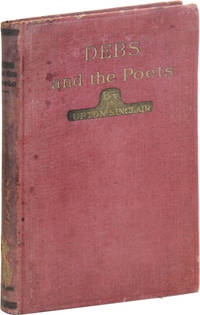
192046734Pasadena: Upton Sinclair 1920. Two octavo volumes 18.75cm; maroon cloth with titles stamped in gilt on spine and front cover; ii9911pp. The first copy is inscribed by Eugene Debs to American film actress screenwriter and editor Helen Louise Gardner on the front endpaper: "To Helen L. Gardner / With love and greetings and with deep appreciation for her beautiful character her lofty spirit her rare vision courage understanding and her high ideals and noble aspirations - Eugene V. Debs / Terre Haute Indiana / December 1924." Gentle sunning to spine oxidation to gilt with moderate scattered soil to covers light wear to extremities and heavier wear with resulting board exposure to upper right corner of front cover; mild offset to endpapers from binders glue; Good. Housed in a clamshell case. <br/><br/>The second copy is inscribed to Gardner by Ruth Le Prade opposite the title page: "To Helen Gardner - with cordial greetings / Ruth Le Prade." Spine-sunned cloth edge-worn and lightly soiled with oxidation to gilt a few small stains to front cover some erosion to cloth toward lower spine and mild offset to endpapers from binders glue; Good. Poems honoring socialist leader Eugene Debs by a variety of radical 20th century poets including Witter Bynner Max Eastman Charlotte Perkins Gilman Carl Sandburg Siegfried Sassoon Horace Traubel and Israel Zangwill many others. Sinclair contributed the foreword along with letters from H.G. Wells and George Bernard Shaw who states: "Clearly the White House is the only safe place for an honest man like Debs". An interesting pair of copies inscribed to Gardner 1884-1968 acclaimed stage actress and the first actress to form her own production company. <br/><br/>Moved by his circumstances and deeply influenced by his speeches she visited him in prison in 1920 bringing him an autographed photo and beginning a correspondence that would last through the mid-1920's. In a December 21 1920 letter she writes: "Let me tell you that I was surprised to find my emotional self somewhat unaffected while I listened to you talk. I know the reason now. It is the same with you as it was with Epictetus prison walls cannot confine the spirit -- the mind is ever free. So in a way I did not feel your plight as keenly as I would that of another who had little vision little intelligence little understanding about his body being so small a part of the real him that his confinement was of the physical order only." While the "special edition" of 500 with signed bookplate by Debs appears with some frequency inscribed copies of Debs and the Poets are genuinely uncommon. Upton Sinclair unknown books
155000152972057593498894297: Magdeburg: s. n. Line "Gedrukt zu Magdeburg" at the end of preface hidden under a broad stroke of printer's ink 1550. First German edition; 7 3/4 x 5 3/4; pp. 68 collated; contemporary plain beige wraps; a few small rubbed spots and minor loss of paper to lower corners of wraps and spine; age-toning and some staining to margins mostly not affecting text; cut to fore-edge of third leaf; contemporary notes to margins and underlining; overall very good-.A German translation of the ordinance of 1550 issued by Holy Roman Emperor Charles V against dangerous heretical books. Also included in the publication were the Louvain Index of April 1550 of forbidden books and a list of "good" and "approved" books to be read in schools. The Louvain Index was first drawn on Charles V's demand in 1546 by the University of Louvain and published simultaneously in Latin Dutch and French. In 1550 the list of pernicious books was greatly enlarged the current edition. The books were listed in alphabetical order by author's name and also included were books by anonymous authors and translators by language Welsh New Testament editions Greek and Latin bibles etc. The translator Matthias Flacius Illyricus 1520 â 1575 was a Lutheran reformer from Istria present day Croatia. He was appointed Professor of Hebrew at the the University of Wittenberg in 1544 where he came under the influence of Philipp Melanchthon and Martin Luther. Though as time went by Illyricus began vehemently opposing the two Lutheran reformers who in turn spoke of him as "we have nourished a snake in our bosom." In the preface to his current work which he claimed he had translated from the Flemish he wholeheartedly attacked Charles V and his lists of prohibitions. USTC 681462. Magdeburg: s. n. (Line "Gedrukt zu Magdeburg" at the end of preface, hidden under a broad stroke of printer's ink) paperback books
195347331New York: The Blue Heron Press 1953. Fiftieth Anniversary Edition. One of an unstated number of copies signed by the author on a decorative plate tipped onto the front pastedown this being copy no.497. Octavo 21cm; publisher's mauve and white patterned paper-covered boards and black cloth backstrip with titles stamped in gilt on spine; mauve topstain; publisher's original glassine overlay; xviii2646pp. Trivial wear to lower corners tiny tear with attendant crease to right margin of half-title page else very Near Fine in a glassine with numerous tears creases and small losses. Handsome edition of this cornerstone sociological work by Du Bois first published by A.C. McClurg in 1903. "Souls Of Black Folk was written beautifully in a style which Du Bois labored to perfect. It is one of the noteworthy books not merely of the period but of the epoch. The monumental work was the opening salvo in the struggle that has dominated the century for black and white Americans: the quest for dignity justice and equality.Every page is filled with spirituality and with spontaneity" Blockson 52. This edition bears a new foreword by Du Bois titled "Fifty Years After" and introductory matter by his wife Shirley Graham Du Bois. The Blue Heron Press unknown books
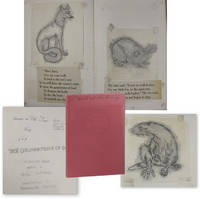
14294Roosevelt NJ: ca 1969-70. Octavo 23.5cm. Red paper-covered boards; 28pp. Original hand-made "dummy" of 28 pages with text and illustrations tipped on to blank pages. Includes a hand-lettered title page and 26 original pencil drawings by Bernarda Shahn illustrating the mostly animal characters in the text. In fine condition as made. The published book was issued by Holt Rinehart and Winston in 1970. An enigmatic folktale in which a fox and a horse each starving to death must decide among themselves which one is to die. Shahn's animal illustrations are lively and accurate throughout. This is presumably an unused trial version as an ink note to the front cover states "do not use this dummy." Carl Withers was the author of the well-known 1948 poetry anthology A Rocket in My Pocket. Bernarda Bryson's 1963 book The Sun Is A Golden Earring was a Caldecott medalist. unknown books
193238355New York: E.p. Dutton & Co. Inc 1932. First Edition. Quarto 31cm; turquoise cloth with black and yellow printed title labels applied to spine and front cover; dustjacket; 822pp; illus. Moderate offsetting to front pastedown from binders glue faint discoloration to cloth along upper and lower edges with a gentle bump to upper front board corner and a paper-clip impression at upper front endpaper; clean throughout; Near Fine. Dustjacket with trivial wear to extremities two shallow nicks to crown with a few short tears and four unnecessary tape reinforcements on verso; Near Fine. A stunning copy of Hirschfield's first book an iconic volume dedicated to capturing the the personalities behind the counter at Manhattan's various speakeasies. Published the year prior to the repeal of Prohibition the book features 36 full-page illustrations by Hirschfeld with accompanying text describing each establishment and a signature cocktail recipe suggested by the bartender. With an introduction by Heywood Broun. A superior copy of this wear-prone Jazz Age classic. E.p. Dutton & Co., Inc unknown books
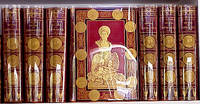
18794026Paris. Librairie Hachette. 1879. Bound in extravagantly ornate gilt pictorial red Morocco depicting gilt tooled Roman emblematic seals and large embellishment of armour eagles and statuary to front and rear covers. Gilt tooled spine compartments embellished with seals and laurel leaves. Raised bands. White silk moire endsheets. a.e.g. Thick 4to. New Edition. Illustrated with 50 brilliantly illuminated full page tissue-guarded chromolithographic plates. Further illustrated with over 3400 gravure engravings and 30 colour maps. A monumental work in a most impressive Hachette gilt binding - truly one of the most stunning bindings we've encountered. Sumptuously illustrated with eye-boggling iridescent Chromolithographs this extremely rare set is a true work of design art. Some chipping to head and tailpieces to various volumes with some small bits lacking hinges rubbed on various volumes some corners bumped through front cover of Vol. 1 starting mild scattered foxing throughout else Very Good. A bright crisp gleaming gilt gem.Featured Sets. Librairie Hachette. hardcover books
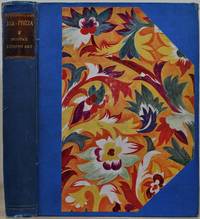
1921019231Berlin Germany: Verlag Alexander Kogan Russische Kunst G.m.b.H. 1921. Book. Very good condition. Hardcover. First Edition. Folio - over 12 - 15" tall. Bound volume containing the first nine issues of this publication including one double issue. There is a title page inserted with a Brentano's Inc. slug on it stating that there are 10 issues within but there is no indication that these issues are original issues and are not reprints. The text is in Russian with some captions in German and French and a few summary articles are in English. Beautifully lithographed covers with numerous tipped-in color plates portraits and black-and-white illustrations. Small bump to the top corner and the cloth of the rear hinge is torn but the inner hinge remains strong. The texts are clean and unmarked. Ezhemesiachnyi literaturno-khudozhestvennyi illiustrirovannyi zhurnal. Russische Montasschrift für Kunst u. Literatur revue russe d'art et de littérature. Issues 1 2 3 and 4-5 were issued in 1921 and 6-9 were issued in 1922. First edition. Verlag Alexander Kogan Russische Kunst G.m.b.H. Hardcover books
189444281New York: D. Appleton and Company 1894. First Edition. First Printing. Octavo 17.5cm; flexible dark brown cloth boards with titles stamped in gilt on spine; ii45-666pp ads. Light wear to extremities hint of softening to corners with a faint diagonal tear to rear pastedown; contemporary owners ink signature to front endpaper Gertrude H. Souther / March 1895 with holograph pencil notes relative to the weight of two babies on rear endpaper; Very Good. Influential manual for mothers and nurses by Holt 1855-1924 an American author physician and pioneer in the field of pediatrics who helped shape the New York Babies Hospital into the leading pediatric facility of its time. The book was expanded from Holt's Catechism for Nurses 1893 a pamphlet prepared for nursery-maids during their four months training at the Babies Hospital. "The nurses studied the catechism and when they graduated took it with them. There followed requests for copies from their employers and the supply was soon exhausted. It was apparent there was a popular demand for something of the kind. The catechism was expanded and in 1894 The Care and Feeding of Children made its appearance.Probably no one would have been more surprised than Dr. Holt or his publishers had they been told that they were launching a volume that was to go through seventy-five printings and which was to be translated into Spanish Russian and Chinese.The book became the mainstay of many a worried mother and exerted no inconsiderable influence on the profession as well for the practitioners had to keep abreast of the pediatric knowledge which the mothers possessed" DUFFUS R.L. L. Emmett Holt. NY 1940 pp.116-117. <br/><br/>Prior to the publication of The Care and Feeding of Children there was no standard text for pediatric care in print for laymen or medical professionals. A revolutionary volume written in clear simple language providing an orderly presentation of pediatric knowledge which empowered women to care for their children. A cornerstone work responsible for "lifting child sickness and care out of the neglect of the past" Dunn Peter M. "Dr. Emmett Holt 1855-1924 and the foundation of North American paediatrics." Archives of Disease in Childhood - Fetal and Neonatal Edition 2000. Rare in the first edition; we find no copies for sale in trade May 2019 with the last copy at auction sold at the Streeter Sale. ATWATER 1743 citing the 1895 edition; STREETER 4159; Grolier American 100 97. D. Appleton and Company unknown books
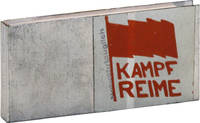
196947929Hamburg: Quer-Verlag 1969. Second Expanded edition. Oblong 16mo ca. 7x13cm.; original red staplebound card wrappers taped into cloth tape-backed sharp aluminum boards decorative element mounted to upper cover; 61ll. printed mimeographed on white and red paper. Old ballpoint manuscript spine title boards a bit tarnished else Very Good or better contents fresh and fine. Rubberstamp to upper cover: "Notwehrtauglich" "suitable for self-defense" the title page describing this as "Handliche mit scharfen kanten ausgestettatet kampfausgabe für die phase des revolutionären widerstands" a "handy sharp-edged combat edition for the next phase in revolutionary resistance" - our/google's translation. Collection of rhymed chants first issued by the author's publishing house Quer-Verlag in 1968 for members of the German Student Movement and the protests staged that year. The author the son of a dock worker was himself a member of the leftist literary group Hamburg Linksliteratisch. This work a curious example of a book as weapon in the literal sense the boards' fore-edges extending beyond the text block and are both sharp and the corners quite pointed so that while the book is small enough to fit in the palm of one's hand one can imagine the harm it could do to a vulnerable jugular. Quite scarce OCLC locates three copies of any edition in the United States as of March 2020 at Yale U. Iowa and Harvard. Quer-Verlag unknown books
4186The gelatin silver print is attached to the cover of a photography bifold board and also held in place with three pieces of age-stained tape. The photograph is framed with the top board on which Vishniac has signed in pencil near the image opening at lower right "R. Vishniac." The photograph measures 5.25 x 7 inches laid onto an 11 1/4 x 8 inch bifold board. The tape is well hidden by the signed cover mat. Uncommon image. unknown books
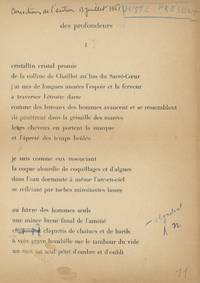
13128Used; Like New/Used; Like New. An interesting set of proofs for the final poetry collection by the Romanian and French avant-garde poet essayist and performance artist known for being a founding member of the Dada movement. Proof pages in advance of the 1961 publication page numbers in pencil lower right corresponding to the published pagination the manuscript identified in another hand at the head "corrections de l'auteur 13 Juillet 1961" and bearing Tzara's corrections in blue ink on six pages. The included poems are as follows: I des profondeurs - page 11-12; II des profondeurs - page 15; III des profondeurs - page 16;  épigramme - page 19; une longue absence - page 20; la voix - page 23; fin d'un été - page 24; saison - page 27; aujourd'hui - page 28; à une morte - page 31-32; juste présent - page 35-36; 39-42.  Toned a few stains overall in fine condition. From the collection of the French writer and poet and artist Alain Jouffroy 1928 - 2015.<br style=""><br style="">Sold together with a signed but largely incomplete copy of the first edition of Le Fruit Permis Tzara's 1956 collection of poems. Signed and inscribed on the half title page in French in black ink to Jouffroy "a Alain Jouffroy en toute amitié poetique et.adding a little sketch of a pointing hand Tristan Tzara le 8 mai 1957."  Printed on Marais one of only sixty copies issued however this copy sadly lacking the official signed limitation page as well as the 4 pochoirs by Sonia Delaunay as well as many of the poem texts -  included here in other words only for the signature and association and supporting provenance of the manuscript above.   9 x 11.25 inches. Softcover loose as issued mild wear to spine. Paris: L'Imprimerie Caracteres 1956. Bénézit 4-390 ; Monod 10799.<br>Tzara moved to Paris from Zurich in 1919 and it was apparently one of his manifestos that made Sonia and Robert Delaunay who had lived in Spain and then Portugal since 1914 aware of the renewed artistic vitality of Paris after the end of the war and determined their return to France. After World War II there were two collaborations with Sonia: for Le Fruit permis 1956 her first book since La Prose du Transsibérien Sonia contributed four pochoir compositions and for Juste présent 1961 the present collection of 11 poems written between 1947 and 1950 she made eight full-page colour etchings and an additional colour etching for the slipcase. <br style=""> paperback books
193939022Tromøy Norway 1939. Octavo 20.5cm.; contemporary blue cloth upper cover lettered in gilt decorative endpapers; 1454pp. typed on rectos only. Cloth very slightly worn spine a hint sunned shallow loss to front free endpaper fore-edge shallow creasing to three leaves else Very Good or better. Occasional autograph corrections in the author's hand throughout. German-born author poet editor and translator Max Barth began his career as an editor of the pacifist socialist paper Sonntags-Zeitung before founding his own radical socialist paper Die Richtung in 1932 at Stuttgart. The paper only survived a few issues before being confiscated by the Nazi-infiltrated Stuttgart populace the following year after which Barth fled to Switzerland. Found guilty of "High Treason" by the Third Reich Barth found himself exiled making his way to Norway from which this collection was compiled and finally the United States where he remained until after the end of World War II. <br/><br/>The present collection consists of seventy poems written between 1919 and 1939 including some previously unpublished selected for the author's sister and preceded by a letter of introduction addressed to her "Li Fri" and signed in manuscript "Max." In the letter Barth explains that the collection was compiled entirely with her in mind and includes certain pieces dear to him despite their lesser literary quality. In a final postscript the author notes that in the poem "Abseits" he has rhymed the word "Fjord" with "Spur" because the word "Fjord" in Norwegian is pronounced "Fjur." The letter is dated September 1 1939 the day the Germans invaded Poland leading France and Britain to declare war on Germany two days later thus marking the start of World War II. The author was certainly unaware of such developments as no mention is made to the catastrophic events simultaneously unfolding.<br/><br/>Reference: John M. Spalek and Joseph Strelka eds. Deutschsprachige Exilliteratur seit 1933 Vol. 2 1989 pp. 24-37. unknown books