859 259 résultats
92 items, ca. 260 pages in all, mainly 8vo, autograph address panels to the postcards, some on Mann's printed stationery, with a few unpublished greeting cards, mainly 1894-1901, together with letters to Erna Grautoff and Karl Federn, mainly Munich and Rome and a few items from Naples, Unterach, Riva del Garda, Dresden, Bad Tölz, Oberammergau and Paris, September 1894-7 July 1925, about twelve letters incomplete (mostly undated letters from ca. 1895-1896), the first two letters with sections cut away, occasional dust-marking and splitting at folds, each letter carefully annotated in pencil by the Austrian National Library (July 1938) and some also with editorial dating (ca. 1975). Important series of ca. 90 early autograph letters and postcards, to Otto Grautoff, about Buddenbrooks, including eleven unpublished items, with poems and transcriptions about his writing, reporting his commission from the publishers Fischer to write a long prose work, specifying the mid-nineteenth-century milieu to be treated in Buddenbrooks, its length and plans to finish it, and finally giving Grautoff a long analysis of its Germanic and Wagnerian nature, discussing Goethe (with quotations of "Alles Vergängliche", from Faust), Shakespeare (Hamlet; Romeo and Juliet), Wagner (Tristan und Isolde), Turgenev, Nietzsche, his brother Hermann, Balzac, Dehmel, Fontane and many other writers, the publisher Fischer, the journals "Simplicissimus" and "Neue Deutsche Rundschau", and reporting his travels in Italy, mainly Rome during the years 1895 to 1897; the collection also includes two autograph poems by Mann, 'Weihnacht' ("O festlich Sternenzelt!"), and, in a letter of 1898, the apparently newly-composed poem 'Nur Eins' ("Wir, denen Gott den trüben Sinn gegeben"), together with a transcription from the love duet in Tristan und Isolde ("Bricht mein Blick sich..."), and from Romeo and Juliet ("Komm, Nacht...Verhülle mit dem schwarzen Mantel mir"), poems by August von Platen and others. T. Mann, Briefe an Otto Grautoff 1894-1901 und Ida Boy-Ed 1903-1928, ed. by Peter de Mendelssohn (1975).
- Poulet-Malassis & De Broise, Paris 1857, 12,1x18,8cm, relié sous étui. - Les Fleurs du Mal [Flowers of Evil] Poulet-Malassis & De Broise | Paris 1857 | 12,1 x 18,8 cm | bound in morocco with custom slipcase First edition, printed on vélin d'Angoulême paper, with the usual misprints and including the six condemned poems, one of the few copies given to the author and "intended for friends who do not deliver literary services". Full emerald morocco binding, Jansenist spine in four compartments, paste down lined with garnet morocco framed with a gilt fillet, gilt silk endpapers stitched with Japanese-style flower motifs, the following in marbled paper, wrappers of the third issue (with two marginal restorations to the second board) and spine preserved, all gilt over untrimmed edges, marbled paper slipcase lined in morocco. Binding signed by Marius Michel. Precious presentation copy inscribed and signed by the author in pencil on the half-title page: "à M. Tenré fils, souvenir de bonne camaraderie, Ch. Baudelaire" ("to M. Tenré Jnr, a reminder of good friendship, Ch. Baudelaire") and three handwritten corrections, in pencil on pages 29 and 110 and in ink on page 43. Exceptional inscription to a childhood friend, banker and intellectual, one of the rare contemporary inscriptions that were not motivated by judicial necessity or editorial interests. Indeed, even the few examples on Holland paper were largely devoted to strategic gifts in order to counter or reduce the wrath of justice that, in June 1857, had not yet returned its decision. Poulet-Malassis will hold a bitter memory of it: "Baudelaire got his hands on all thick paper copies and addressed them to more or less influential people as a means of corruption. Since they have not got him out of trouble, I believe he would do well to ask for them back." Baudelaire's correspondence makes it possible to define quite precisely the different types of inscriptions the poet made on the publication of his collection. He himself sent a list to de Broise to mention those to whom the press deliveries were dedicated, mainly possible judicial intercessors and influential literary critics. The poet then requires "twenty-five [copies] on ordinary paper, intended for friends who do not deliver literary services." A letter to his mother tells us that he only got twenty. Some of them were sent in June 1857 to his friends, including one for Louis-Ludovic Tenré. Others were saved by the poet or offered late like the ones for Achille Bourdilliat and Jules de Saint-Félix. If Tenré, this childhood friend whom Baudelaire has just found again in December 1856, is honored with one of the poet's rare personal copies of the Fleurs du mal publication, the three misprints he immediately noticed having been carefully corrected by hand, it is not on account of a service delivered or in anticipation of an immediate benefit. However, as always with Baudelaire, neither did he send his masterpiece to his boarding companion from Louis-le-Grand school as a simple "reminder of good friendship." As early as 1848, Louis-Ludovic Tenré took over from his father, the publisher Louis Tenré, who, like other major publishers, moved into investment, providing loans and discounts exclusively for those in the book industry. These bookseller-bankers played a key role in the fragile publishing economy and contributed to the extreme diversity of literary production in the nineteenth century, supporting the activities of small but bold publishers and liquidating other major judicial clashes. In December 1856, Baudelaire tells Poulet-Malassis that he had deposited an expired banknote with this "old school mate," which Tenré, out of friendship, agreed to accept. It was the initial advance for "the printing of one thousand copies [of a collection] of verses entitled Les Fleurs du Mal." With this copy hot off the presses, Baudelaire then offers Tenré the precious result of the work discounted by his new banker. It is
89022unknown
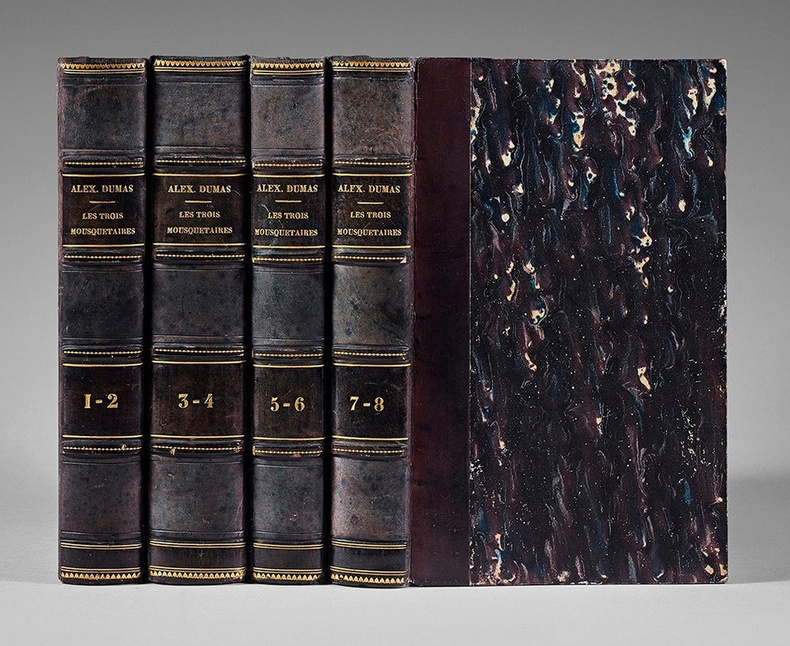
LCS-17546Superbe exemplaire, très pur, provenant de la bibliothèque Robert Von Hirsch. Paris, Baudry, Libraire-Editeur, 1844.8 tomes reliés en 4 volumes in-8 de : I/ (2) ff., 349 pp. (mal chiffrées 449), (1) f. de table ; (2) ff., 329 pp., (1) f. de table ; II/ (2) ff., 386 pp., (1) f. de table ; (2) ff., 363 pp., table au verso de la p. 363 ; III/ (2) ff., 310 pp., (1) f. de table ; (2) ff., 287 pp., (1) p. de table ; IV/ (2) ff., 297 pp., (1) f. de table ; (2) ff., 329 pp, (1) f. de table.Demi-veau bleu glacé, dos à nerfs ornés de filets dorés, plats de papier marbré, tranches mouchetées. Élégantes reliure de l’époque. 207 x 129 mm.
153162079Valencia, Francisco Diaz Romano, 1531. 4to (205 x 145 mm). Exquisitely bound in a sumptuous richly blind-ornamented and gilt 20th century full calf binding. Five raised bands, gilt lettering, and smaller gilt decorations to richly blindstamped spine. Boards elaborately blindstamped with frames in different patterns and with smaller dispersed gilt ornamentations. Front board with a large centre-piece, also elaborately blindstamed and with gilt ornamentations, at the center of which the words “Libre de Consells de Jaume Roig” in gilt Gothic lettering. Back board with the same large centre-piece repeated, inside which a gilt centre-illustration (reminiscent of Bacchus) and the words “a bon seny no hi valengan” (Old Catalan for “common sense is not worth it”) in gilt lettering underneath. Binding signed Miquerlius to lower inside of front board. Single gilt line to edges of boards and broad inner gilt dentelles. All edges gilt. Leaf A4 with ink-annotations in contemporary hand. First leaves with marginal repairs and a closed wormtract, with loss of a few letters. Leaves L-O with closed wormtract in upper outer margin. Last leaves with marginal repairs and final leaf (woodcut illustration) with closed tear and a few wormholes, with minor loss of the illustration. With occasional brownspotting and a few leaves evenly browned. Washed. 139, (1) pp. (A-R8, S4)
Augsburg, Alexander Weissenhorn, 1537. Folio. Bound in a late medieval liturgical manuscript-leaf of vellum with handpainted capitals in blue and red, over cardboard-binding, and housed in a vellum-box. Title-page with a small paper-restoration to the blank, outer margin, far from affecting printing or illustration. Light brownspotting throughout, but overall a truly excellent copy with no significant flaws. The woodcuts are all clear bright. (6), CII ff. Large woodcut title-illustration and 18 large woodcut illustrations in the text (measuring 10,8x14,3 cm.).
LCS-17935Exceptionnel exemplaire contenant 3 corrections manuscrites de l’époque aux pages 9, 57 et 176 avec adjonction de mots, le bequet de la page 45 et le premier état avec les deux fautes « donner le lustre » et « amplète » à la 6è et 18è ligne au verso du feuillet Oii. Paris, Claude Barbin, 1668. Avec Privilège du Roy. In-4 de (28) ff., 284 pp. et (1) f. pour l’Épilogue et le Privilège (daté du 6 juin 1667 avec la cession de Barbin à Thierry pour la moitié), suivi de Achevé d’imprimer pour la première fois le 31 mars 1668. Plein veau havane granité, dos à nerfs orné, coupes décorées, tranches jaspées, coiffes et coins anciennement restaurés. Reliure strictement de l’époque. 243 x 177 mm.
- Poulet-Malassis et de Broise, Paris 1859, 11,5x18cm, relié. - Théophile Gautier. Notice littéraire précédée d'une lettre de Victor Hugo Poulet-Malassis et de Broise | Paris 1859 | 11.5 x18 cm | full morocco First edition, of which only 500 copies were printed. Portrait of Théophile Gautier etched by Emile Thérond on the frontispiece. Important preface letter by Victor Hugo. Bound in red morocco, gilt date at the foot of spine, marbled endpapers, Baudelairian ex-libris from Renée Cortot's collection glued on the first endpaper, wrappers preserved, top edge gilt. Pale foxing affecting the first and last leaves, beautiful copy perfectly set. Rare handwritten inscription signed by Charles Baudelaire: " à mon ami Paul Meurice. Ch. Baudelaire. " ("To my friend Paul Meurice. Ch. Baudelaire.") This exceptional handwritten dedication to Paul Meurice, a real surrogate brother to Victor Hugo, bears witness to a unique literary meeting between two of the most important French poets, Hugo and Baudelaire. Paul Meurice was indeed the essential intermediary between the condemned poet and his illustrious exiled peer, since asking Victor Hugo to combine their names in this Théophile Gautier elegy was one Charles Baudelaire's most daring acts and would, no doubt, not have had a chance of being realised without Paul Meurice's precious support. Paul Meurice, Dumas' ghost-writer, author of Fanfan la Tulipe and the theatre adaptations of Victor Hugo, George Sand, Alexandre Dumas and Théophile Gautier, was a talented writer who was shadowed by the great artists of his time. His unique relationship with Victor Hugo, however, gave him a decisive role in literary history. More than a friend, alongside Auguste Vacquerie, Paul replaced Victor Hugo's deceased brothers: "I lost my two brothers; him and you, you and him, you replace them; only I was the youngest; I became the eldest, that's the only difference." It is to this brother at heart (whose marriage he witnessed alongside Ingres and Dumas) that the exile entrusted his literary and financial interests and it is he who he will appoint, along with Auguste Vacquerie, as executor of his will. After the poet's death, Meurice founded the Maison Victor Hugo, which is still today one of the writer's most famous residences. In 1859, Paul's house then became Victor Hugo's Parisian antechamber on the Anglo-Norman rock, and so naturally Baudelaire went to speak to this official ambassador. The two did not know each other well but they had a mutual friend, Théophile Gautier, with whom Meurice had worked since 1842 on an adaptation of Falstaff. Consequently, he is the ideal intermediary to guarantee the inaccessible Hugo's benevolence. Baudelaire had, however, already briefly met Victor Hugo. At the age of 19 he asked for an interview with the greatest modern poet, whom he had worshiped since childhood: "I love you as one loves a hero, a book, as one loves everything beautiful purely and without interest." He already dreamed of himself as a worthy successor, as he tacitly confessed to him: "at nineteen years old would you have hesitated over writing as much to [...] Chateaubriand for example?" For the young apprentice poet, Victor Hugo belonged to the past, and Baudelaire will quickly want to free himself of this heavy model. From his first work, Le Salon de 1845, the iconoclast Baudelaire criticized his old idol by declaring the end of Romanticism, of which Hugo is the absolute representative: "These are the last ancient ruins of romanticism [...] It is Mr Victor Hugo who lost Boulanger - after having lost so many others - It is the poet who caused the painter to fall into the pit." One year later, in Le Salon de 1846 he reiterated his attack even more fiercely, removing the Romantic master from his throne: "because if my definition of romanticism (intimacy, spirituality, etc.) puts Delacroix at the head of romanticism, it naturally excludes Mr Victor Hugo. [...] Mr Victor Hugo, whose nobility and m
A trove of 424 catalogued items, comprising correspondence including letters by Albert Einstein, Thomas Mann, Franz Werfel, and Salman Schocken; Klopstock's manuscripts and personal documents; more than 50 books from his library (among them inscribed copies by Max Brod, Klaus and Thomas Mann, and Franz Werfel), and a large collection of photographs. When Kafka died in the Austrian lung sanitarium of Kierling in 1924, it was (to employ the phrase used by Klaus Mann) in the arms of his friend Robert Klopstock, an Hungarian-born medical student with literary ambitions whom Kafka had met three years earlier at a different sanitarium, a fellow sufferer from tuberculosis. Klopstock's estate now makes accessible the largely unknown biography of the physician who was forced into emigration in 1938 and became a U.S. citizen in 1945. His manuscripts, his personal documents, his copious collection of photographs, the inscribed books in his library, as well as his correspondence with such eminent figures as Thomas Mann, Franz Werfel, Albert Einstein, Albert Schweitzer, and Salman Schocken now permit us to trace for the first time the path which the life of Kafka's last friend took. - Mann and Einstein both interceded on Klopstock's behalf to help him emigrate and find employment in the United States. In one of these letters, Mann directly invoked Klopstock's role as the selfless care-giver that would come to define his image in Kafka scholarship: "I first met Dr. Klopstock through the gifted young German writer Franz Kafka, for whom Dr. Klopstock did so much professionally and spiritually before he died". From Franz Werfel we have the now-famous 1934 letter in which he describes, in quasi-religious terms, his own relationship to Kafka, in whom he recognized (as he confides to Klopstock) the "Herald of the King". - Indeed, Klopstock himself was well-connected within German and Hungarian literary circles and active as a translator, especially of the humourous stories of Frigyes Karinthy, on which he consulted Kafka. Later increasingly private in his personal affairs and notoriously reticent about his famous companion, the physician was dubbed "crazy Dr. Klopstock" by Max Brod, who appears to have begrudged him his friendship with Kafka, viewing him, perhaps, as something of an interloper. Klopstock held and jealously guarded the Hungarian translation rights to Kafka's works; together with his wife Giselle, Klopstock undertook the first Hungarian translation of Kafka's "Trial", the beginning of which is preserved here. Giselle's own novel "Without Destination", set in a lung sanitarium, won the approval of Thomas Mann, who recommended it to Knopf, his American publisher. - Robert Klopstock died in New York in 1972, a highly respected surgeon and scientist whose research led to significant contributions in the field of pulmonary tuberculosis. His estate forms an extraordinary collection in which important discoveries still remain to be made. A PDF catalogue is available on request. Kafkas letzter Freund. Der Nachlaß Robert Klopstock (1899-1972). Wien, Inlibris, 2003.
Cabinet photograph, oval albumen print (vintage) with three autograph lines in ink on the reverse. 110 x 166 mm. On card imprinted by the studio Konstantin Shapiro, St Petersburg. Fine head-and-shoulders portrait. The reverse bears an uncommonly personal three-line inscription to his brother, the architect Andrey Mikhailovich Dostoevsky (1825-97): "Dorogomu bratu / Andreju ot brata / Fedora 12 Oktob[ra] / 79" ("For my dear brother Andrey from his brother Fyodor, 12 October 1879"). - Not listed in the census of Dostevsky's inscriptions, published in 1990. Altogether, the editors of the scholarly 30-volume Academy of Sciences edition of Dostoevsky's works count only 42 inscriptions, of which 16 are on photographs - a surprisingly small number for a so prolific and significant author of his day. - The St Petersburg photographer and Hebrew poet Constantin Shapiro (1839-1900) was a close friend of Dostevsky's and produced several portraits of him. His fashionable studio on Nevsky Prospect was popular with celebrities, and his many famous sitters included Tolstoy, Chekhov, Tchaikovsky, Turgenev, and Gontcharov. - Tissue guards to both sides, protecting image and inscription (somewhat wrinkled); in very appealing condition. An extremely fine example of an inscribed Dostoevsky portrait, exceedingly rare. Cf. Dostoevsky, Polnoe sobranie socinenij v tridcati tomah, XXX.2 (Dopolneniâ k izdaniû. Darstvennye i drugie nadpisi i pomety na pis'mah. Svodnye ukazateli), pp. 57-65.
LCS-1864089000Unique exemplaire répertorié, parmi les 75 sur grand papier vélin fort réunissant reliure d’époque mosaïquée signée d’un grand maître - Chambolle Duru actif à compter de 1863 - et couvertures tirées spécialement pour ces exemplaires de luxe de l’édition originale. In-12, maroquin citron, filet doré, bordure brisée aux angles dessinée au moyen de deux listels bleu canard sertis de filets dorés et accompagnés de longues branches dorées avec boutons de roses rouges, petit fer spécial différent aux angles, dos orné, répétition du décor dans les entre-nerfs, doublure de maroquin bleu, encadrement de filets, dentelle de rat, pointillés et large guirlande florale, doubles gardes de papier marbré, tranches dorées sur témoins, couvertures conservées, chemise de demi-maroquin bleu, étui. Chambolle-Duru. 186 x 123 mm.
4to (161 x 202 mm). 27 pp. Ink on lined paper, numbered in pencil in another hand. Fastened with brass tack at upper left corner. Stored in a quarter morocco clamshell case. (With:) The Strand Magazine. London, George Newnes, November 1921 issue (No. 371, Vol. 62), story published on pp. 380-388. The complete autograph manuscript of a work widely considered one of Doyle's best ghost stories. The macabre tale unites two of the author's great passions, boxing and Spiritualism, to create the tale of a sinister prize fighter whose physical brutality does not die. The present manuscript contains mostly minor edits, though a handful of pages include more substantial excisions and additions: on page nine, for example, "the man who accosted them" has been replaced with simply "him", and the description of "a surly red face" has been expanded to include "with an ill-fitting lower lip". On page 13, nearly twenty words have been crossed out. Includes a fine, bright copy of the "Strand Magazine" issue in which the story was first published. - Some spotting and soiling, most visible on first and final pages. Centre crease throughout. Ink a little faded in some places; final page with a little creasing and a couple short closed tears. Provenance: Sotheby’s New York, 10 Dec. 1993, lot 320. Latterly in the collection of the U.S. lawyer Edward R. Leahy (b. 1947).
I) Lucrèce Borgia. 1833. (2), XI, (1), 192 pp. II) Le Roi s'amuse. 1832. (8), XXIII, (1), 183 pp. III) Marie Tudor. 1833. (6), IV, 214 pp. Each with frontispiece. All three bound in a single volume in slightly later half calf with giltstamped spine and marbled covers. A matching second volume contains: 1) Borgia, Lucrezia (1480-1519). Letter signed. Rome, 20 Nov. 1501. ½ p. Folio. 2) Hugo, Victor (1802-1885). Autograph ink caricature, mounted on backing paper. 10 x 13 cm. 3) Mocquard, Jean-François (1791-1864). Autograph letter signed. Paris, 15 Jan. 1853. 1 p. 8vo. 4) Fournier, Louis Edouard (1857-1917). Autograph drawing inscribed. 12.5 x 20.5 cm. 5) Donizetti, Gaetano (1797-1848). Autograph musical manuscript (fragment). 6 pp., ca. 33 x 12 cm. 6) Hugo, Victor (1802-1885). Two autograph instructions signed. 26 Dec. 1839 and 20 Feb. (no year). Oblong 8vo. 2 pp. Both volumes stored together in a matching calf-entry marbled slipcase. A charming ensemble of three first editions of Victor Hugo's plays, each one inscribed by the author to his elder brother, the essayist and military writer Abel Hugo (1798-1855). When the set was auctioned at the sale of the library of the author's grandson Georges-Victor Hugo, it was acquired by Arthur Meyer, the director of the prestigious daily "Le Gaulois" and a passionate collector who was wont to enrich, or "truffle", his books with appropriate rare autographs and drawings. In this case, the addenda, bound in a matching half-calf volume, greatly surpass in value the works they accompany: 1) A precious letter by the Renaissance noblewoman Lucrezia Borgia, famous for her marriages and her affair with Pietro Bembo (signed "Lucretia Esteri de Borgia"), written in recommendation of Hector Beringero to the poet Antonio Tebaldeo (1463-1537), secretary to Francesco II Gonzaga, Marquess of Mantua (later Lucrezia's lover). Meyer had acquired this outstanding document from the collection of Alfred Morrison (cf. Catalogue of the Collection of Autograph Letters and Historical Documents Formed Between 1865 and 1882 by Alfred Morrison, 1883, p. 100). - 2) Almost equally striking is the original, highly expressive pen-and-ink drawing by Victor Hugo, showing the dark shape of a portly figure holding a candle (an illustration of Act III, Scene 1 of his 1843 play "Les Burgraves"), captioned by the artist in his own hand: "Mm. Mélingue criant: Caïn! de la Coulisse". In the original production, the actress Rosaline Mélingue had played the role of Guanhumara, providing the off-stage voice for the eerie scene. - 3) Also included is a letter by J.-F. Mocquard, chief-of-staff to Napoleon III, addressed to Auguste Romieu, the directeur des beaux-arts, concerning matters of theatrical censorship (including Hugo's play "Lucrèce Borgia"). 4) The associations are reinforced in an expressive charcoal drawing showing Victor Hugo reading to his brother Abel the first act of "Lucrèce Borgia", inscribed in pencil to the collector by the artist L. E. Fournier: "A M. Arthur Meyer très cordialement". 5) Finally, Meyer was able to include a fragment of Gaetano Donizetti's original manuscript of his 1833 opera "Lucrezia Borgia", which he had based on Hugo's play. 6) At the very end are two brief notes by Victor Hugo in which the author instructs his publisher Renduel to issue to the bearer copies of his works, including "Lucrèce Borgia". - Provenance: bookplates of Arthur Meyer and Jean Inglessi, as well as an additional monogrammed bookplate. Last in the collection of Pierre Bergé (1930-2017).
Folio. 1 p. Ink and pencil on wove paper. Three edges gilt. Heine's short, self-ironic poem "Das Glück ist eine leichte Dirne", probably written between 1848 and 1851 and published in 1851 in his late collection "Romanzero": an unknown version, departing from the published text, penned as a dedication for Marie Buloz, who had visited the ailing poet on 19 March 1853 with her husband François, editor of the "Revue des Deux Mondes". Beside the German text (in ink) Heine has pencilled a French translation. A remarkable document from Heine's final years in what he called his "mattress tomb", during which writing, especially with pen and ink, cost him the greatest of efforts and he almost entirely limited himself to the use of the pencil. The album leaf was considered lost and was known to scholarship through an incomplete manuscript copy of the French translation only (by an unidentified scribe) in the Spoelberch de Loevenjoul collection, Musée de Chantilly, on which all critical editions base their text. - Occasional slight smudging to pencil; a small trace of red ink near the German text. Heine, Werke, Säkularausgabe, vol. 3, commentary, ed. by R. Francke (Berlin 2008), p. 244f. ("lost"). Heine, Historisch-kritische Gesamtausgabe der Werke, Düsseldorfer Ausgabe, vol. 3/2 (Hamburg 1992), p. 734f. ("lost"). French text first printed: Heine, Briefwechsel. Reichvermehrte Gesamtausgabe, ed. by Friedrich Hirth, vol. 3 (Berlin 1920), p. 334f., no. 990 (French text only, based on a ms. copy); reprinted: Heine, Briefe. Erste Gesamtausgabe nach den Handschriften, ed. by Friedrich Hirth, vol. 3 (Mainz 1952), p. 459f., no. 1189 (in French and German parallel text, German text supplied from the published version). Poem first published in: Heine, Romanzero (Hamburg: Hoffmann & Campe, 1851), p. 118.
150262086Strasbourg, Johannes Grüninger, 28 August 1502. Folio (298 x 204 mm). Bound in an exquisite later (c. 1850) brown full morocco binding by John Clarke with gilt title and five raised bands to spine. Gilt and blindstamped lines to spine. Boards with gilt and blindstamped lines and gilt fleurons to corners. Edges and inside of boards with gilt and blindstamped lines. All edges gilt. Kept in a marbled slipcase. Slight wear to capitals and outer hinges. Armorial exlibris pasted to inside of front board. Woodcut title page remargined. Several underlinings and interlinear and marginal annotations in at least two different contemporary (or near-contemporary) hands. A6 and colophon leaf mounted (no loss). Four insignificant wormholes in lower margin, not affecting the text, from B1 through E2. A few scattered brownspots, otherwise a clean copy. Text of varying length surrounded by 72 lines of commentary. With all 214 woodcut illustrations as well as numerous woodcut initials. 449 leaves: A6 B-S8 (H +1) T-V10 x-z8 AA-HH8 II6 KK-VV8 XX6 YY-ZZ8 a-f8 aa-cc8 dd10.
Oblong 4to (216 x 123 mm), mounted on cardboard (270 x 190 mm), showing some foxing throughout. Two quills used by J. W. v. Goethe are fastened with string to the lower part of the note. Framed and glazed. A note in German written to Wilhelmine Taschner, who had asked permission to meet Goethe and perhaps receive a small memento from the poet: "My father-in-law instructs me to let you know you that he much regrets his being unable to fulfil your wish, as his time is currently fully engaged by old acquaintances who are here at the moment. Yours, Ottilie v. Goethe". - In the 1820s Wilhelmine Taschner (1805-82), wife of the Eisenach physician Dr. Friedrich Taschner, visited Weimar and there called on her friend Ottilie von Goethe, receiving the two quills with the attached note. After Wilhelmine Taschner's death her husband gifted the ensemble to his foster daughter Else Dröseke, who married the educator Franz Emil Brandstätter of Witten. In the late 1920s the merchant Paul Geiss of Witten acquired the quills from the estate of Dr. Brandstäter through the intermediation of an acquaintance. Several attempts in the 1940s and 1950s at selling the mementos to the Frankfurt Goethe Museum, the Goethe House in New York, or to the oil magnate J. Paul Getty, were abandoned. The relevant correspondence and a contemporary newspaper report, which certify the provenance, are included.
"There never was a time when Frank Thiess was not controversial", the celebration publication in honour of the writer's 60th birthday states (Frank Thiess. Werk und Dichter, p. 30). Before the National Socialists seized power in 1933, the writer had enjoyed great success with his historical novels, and his literary importance was largely undisputed. His novel "Tsushima" (1937), translated as "The Voyage of Forgotten Men", was printed in several hundred thousand copies; Hemingway even included Thiess in his 1942 anthology "Men at War". After the War, Thiess coined the term "Inner Emigration" to describe the situation of artists who, as he did, remained in Germany during the Nazi years without personally agreeing with German politics of the time. Thiess argued that this attitude was superior to that of emigrants proper such as Thomas Mann, who supposedly had watched the destruction of Germany from "balcony seats". Although most of Thiess's works were seized by the Nazis and some were even burned publicly, his decision to remain in Germany and his bitter feud with Mann proved great obstacles when he tried to regain his old position in German literature after the War. - The present partial Nachlass, from the estate of his second wife, Yvonne Thiess, sheds light on his role during the last years of Nazi Germany and the postwar years until 1965. In these roughly 500 letters and postcards to his wife, 22 years his junior, he reflects extensively upon his life and work. While he has apparently resigned himself during the War years to being unable to provide for his family, he is baffled by the problems he encounters after the War, complaining of unfair treatment, feuds with other writers, and the difficulties in joining the literary scene of postwar Germany. - Detailed list available upon request. Frank Thiess. Werk und Dichter. Ed. by R. Italiaander (Hamburg, 1950). Cf. E. Hemingway, Men at War: The Best War Stories of all Times (New York, 1942). Y. Wolf, Frank Thiess und der Nationalsozialismus. Ein konservativer Revolutionär als Dissident (Tübingen, 2003).
174858458(Sankt Petersburg, 1748). 8vo. Bound with five other tragedies/dramas in a slightly later (late 18th century) full calf binding with gilt line-borders to boards and richly gilt spine with red and blue title- and tome-labels. Spine with some wear and corners bumped. Upper capital worn. Internally generally nice and clean and on good paper, but ""Hamlet"" - which has clearly been well red and presumably used for a stage set-up - has some light pencil-annotations and pencil-crossovers, occasional brownspotting, a few paper restorations - no loss of text, a tear to one leaf - no loss, and one leaf slighly loosening at the bottom. Hamlet: 68, (2) pp. - separately paginated. 26pp. + 79, (1) pp. + 62 pp. + 68, (2) pp. + 78 pp. + 1 f. blank + 29 pp.
(Sankt Petersburg, 1748). 8vo. Bound with five other tragedies/dramas in a slightly later (late 18th century) full calf binding with gilt line-borders to boards and richly gilt spine with red and blue title- and tome-labels. Spine with some wear and corners bumped. Upper capital worn. Internally generally nice and clean and on good paper, but ""Hamlet"" - which has clearly been well red and presumably used for a stage set-up - has some light pencil-annotations and pencil-crossovers, occasional brownspotting, a few paper restorations - no loss of text, a tear to one leaf - no loss, and one leaf slighly loosening at the bottom. Hamlet: 68, (2) pp. - separately paginated. 26pp. + 79, (1) pp. + 62 pp. + 68, (2) pp. + 78 pp. + 1 f. blank + 29 pp.
Oblong 8vo. 1 p. Wove paper, backed with Japanese paper. One of the most prominent pieces from the famous autograph collection of Carl Künzel, written on Goethe's 80th birthday: "Chaque jour est un bien que du ciel je reçoi, / Profitons aujourdhui de celui qu'il nous donne; / Il n'appartient pas plus aux jeunes gens q'uà moi, / Et celui de demain n'appartient à Personne" (a verse written in 1699 by the eighty-year-old poet François de Maucroix: "Every day is a gift I receive from Heaven / Let us enjoy today that which it bestows on me. / It belongs no more to the young than to me, / And tomorrow belongs to no one"). - If one is to believe an anonymous report published in the London Athenaeum, then Künzel, barely 21 years old in 1829, "came to Weimar, entered Goethe's house, and, with all his personal and national naiveté, asked the great man's valet to hide him somewhere in the hall, that he ('a Suabian' as he called himself when the domestic questioned him about his name, &c.) might only 'have a peep' at the celebrated poet, who, he was told, would soon pass for his usual promenade. The attendant complied with Herr Kunzel's wish, and then answered his master's bell; but returned almost instantly with the message that 'his Excellency' wanted to see the traveller. Herr Kunzel, not dreaming of such an honour, felt rather bewildered; but, following the servant, who gently pushed him into 'his Excellency's' presence, he a minute later, saw the Author of Faust standing before him, tall and majestic, but stretching out a friendly hand and benignly addressing him with the words - 'The Suabian is not only to see me; I, too, will see the Suabian.' A conversation about Suabia and Schiller’s sister (a patronizing friend of Herr Kunzel’s) followed, at the end of which the tribute of one or more autographs was granted. These autographs of Goethe became the nucleus of Herr Kunzel’s present collection" (no. 1452, 25 August 1855, p. 979). Ultimately, Künzel's collection was to comprise not only this Goethean French quotation, but also a quatrain in German, Goethe's garden hat, his breakfast cup, and a quill. - Carl Künzel (1808-77), then a travelling salesman for the Heilbronn-based Rauch paper factory, kept an autograph album on his many journeys; other signatories includedBrentano, Eichendorff, Goethe, Grillparzer, Hölderlin, Mörike, and Uhland. "In 1936 it was dispersed at auction, according to its owner's wish; no buyer had stepped forward who wished to acquire the book as a whole" (cf. Mecklenburg, p. 54). Like his uncle, Carl Künzel's nephew Wilhelm (1819-96) was a passionate collector of autographs who increased the collection to "the ultimate scope of 15,233 items [...], which were auctioned after his death by List und Francke in Leipzig between 1896 and 1898 versteigert wurden" (cf. Scheible, p. 518). "These two collectors, uncle and nephew, are of especial importance for the history of the autograph business, for today's collectors and antiquarians still encounter at every step the traces of their worldly doings" (cf. Mecklenburg, ibid.). Heinz Scheible, Melanchthon und die Reformation. Forschungsbeiträge. Hg. v. Gerhard May und Rolf Decot (Mainz, 1996). Günther Mecklenburg, Vom Autographensammeln. Versuch einer Darstellung seines Wesens und seiner Geschichte im deutschen Sprachgebiet (Marburg, 1963).
A total of 57½ pp. on 54 ff. 4to und (oblong) (large) 8vo. Includes 5 additional letters by Adele Hesse, Bruno Hesse and Ninon Hesse to the Gundert family. Extensive, substantial collection of letters (mostly autobiographical) to his closest relations, hitherto entirely unpublished. Hesse gives lengthy accounts of his life and work, also remarking on his personal feelings and states of mind. Less than two weeks after the death of Thomas Mann, he writes: "It is a great loss. There are newer and younger friends, but no more old comrades and companions like him" (to Gertrud, letter dated 25 Aug. 1955). Furthermore, he recounts an amusing episode with a reader (no. 7, to Adele, February 1940), discussses other writers ("the poet Poe is one of the few great American poets of ther 19th century" (no. 27, to Gertrude, 1952) and even his own creative work (cf. his letters to Marulla, 1932, or no. 41, to Gertrud, postmarked 24 Feb. 1957). - A detailed list ist available upon request.
Large 8vo (223:145 mm). 1 p. (20 lines in pencil on paper lined in blue). To his friend Robert Klopstock, an Hungarian-born medical student with literary ambitions whom Kafka had met three years earlier at a different sanitarium, a fellow sufferer from tuberculosis: "Lieber Robert, was sind Sie doch für ein Mensch! Fräulein Irene ist aufgenommen. Ein Mädchen, das in 26 Jahren (offenbar entsprechend ihren Anlagen) keine andere Kunstarbeit gemacht hat, als die schlechte Kopie einer schlechten Ansichtskarte, keine andere Ausstellung gesehn hat als die von Hauptmann Holub, keinen Vortrag gehört hat, ausser den von Saphir, keine Zeitung gelesen hat ausser die Karpathenpost - dieses Mädchen ist aufgenommen, schreibt halbglückliche Briefe nicht ohne Feinheit, ist die Freundin eines offenbar bedeutenden Mädchens. Wunder über Wunder und von Ihnen heraufgezaubert. Ich wärme mich daran in diesem traurigen Winter". H. Wetscherek (ed.), Kafkas letzter Freund. Der Nachlaß Robert Klopstock (Vienna, Inlibris, 2003), no. 9. M. Brod (ed.), Kafkas Briefe 1902-1924 (Frankfurt/M., S. Fischer, 1958), p. 364.
LCS-18590Le Marquis de Paulmy (1722-1787) lecteur des «Romans» du XVe siècle. Paris, chez Moutard, 1779-1781. 24 volumes in-8, complet. Maroquin rouge, triple filet doré autour des plats, armoiries au centre, dos richement ornés, pièces vertes, tranches dorées. Reliure armoriée de l’époque. 193 x 130 mm.
2 p. in-8 (175 x 115 mm) sur papier de deuil, waterford, lettre non datée [1905-1906], trace de double feuillet (sur la page en vis à vis manquante devait figurer un dessin qui semble avoir été découpé). "KKKKKWA? - HHHHOE. - NNNNNAN Bonjours Fasché? NNNNNAN [...] au sujet "d'un dessin synthétique (purement imaginé de tous les dessins de mythologiques Turner. Et le commentaire que Ruskin eut écrit sur ce dessin. Ce commentaire est d'une justesse telle (Reynaldo) d'une facilité si convaincante (Reynaldo) d'une science si profuse (Reynaldo) d'une ressemblance si réussie (Reynaldo) d'une élocution si charmeresse (Reynaldo) et d'une si transcendante philosophie, que je vous prie de me le renvhoyier ou de le garsder, mais en me corrigeant les fautes d'anglais [...]" Et termine sa lettre avec une portée de musique sur laquelle figure le nom de Paul Gold Schmidt. Le 19 avril 1913, Proust va entendre la Sonate pour piano et violon de César Franck jouée par Paul Goldschmidt (1877-1957) et Georges Enesco. Il s'en inspirera pour un passage sur la sonate de Vinteuil. Céleste l'évoquait comme "richissime", "collet monté", "du côté de Sodome", ami d'un jeune Anglais du nom de Charlie [Humphries]. - "Mon petit Genstil. Mon petit genstil. Mon Buncht. Dites genstil si calmants ont réussi, s'ils ont produit un bon effet moral et consultation [ ?] de même. Je caresse votre petite tête mon petit genstil" (S.l.n.d., un feuillet in-8 écrit au recto à l'encre noire, 174 x 111 mm). - Lettre de Reynaldo à un destinataire inconnu, signée Hahn, pour lui rendre compte de sa soirée : "Je rentre du concert [...] et je t'envoie quelques lignes de renseignements. Symphonie de Beethoven fort bien jouée, l'orchestre a fait de grand progrès. Mélodie de Lefèbre très emmerdante et [ ...] toutes deux chantées par Mlle Montabant". Il continue sa lettre sur la page en vis-à-vis: "je devais coucher chez toi ce soir mais je suis si fatigué que je reste chez moi, à travailler un peu. Mille embrassades. Hahn. Je vais te faire voir bien des choses et je t'enverrai ces jours ci […]". La lettre se termine sur le dernier feuillet par trois cœurs fléchés. (S.l.n.d., 4 p. in-8 sur un feuillet double, encre noire).
8vo. 2 pp. on bifolium. In German. Mounted on the flyleaf of: The same. Don Karlos Infant von Spanien. Leipzig, Georg Joachim Göschen, 1802. 8vo. 432 pp. With engraved frontispiece and 5 engraved plates. Contemporary marbled full calf, gilt. Marbled endpapers. A fine and early letter to his publisher Georg Joachim Göschen, discussing matters of censorship: "I have fulfilled the wish of your and my Censor, dear friend, and send you the note you asked for. This, I hope, will silence the intolerant part of the public. Have the goodness to assure the Herr Censor (whose name pray give me in your next letter) that I consider myself fortunate in knowing my Thalia is in such discriminating hands. He has quickly grasped the point from which my two poems must be viewed; and how few will do that! I have received what I asked you for, and I see in your ready response a fresh confirmation of your friendship and brotherly sympathy. Farewell, dear friend, and continue to love me […]". - Schiller had anticipated that two poems intended for his journal "Thalia", namely "Freigeisterei der Leidenschaft" ("Passion's Free Thought") and "Resignation", might encounter difficulties with the censor. Saxon censorship was notoriously strict, and a performance of "Die Räuber" had been banned in Leipzig. In this case however, the censor in question, the Leipzig historian Friedrich August Wilhelm Wenck (1741-1810), "proved amenable and reasonable. It was contended that the tendency of the poems might be represented to be an apology for immorality if read by the ignorant and intolerant, and the Censor asked Goschen to procure an explanation from the author showing the baselessness of such a charge. Schiller at once complied with the request" (V. Goschen, pp. 122f.). - From the collection of the Copenhagen critic and theatre director Einar Christiansen (1861-1939) with his bookplate to the front pastedown. Schillers Briefe, ed. Fritz Jonas. Vol. 1 (Stuttgart 1892), p. 276, no. 148. Viscount Goschen, The Life and Times of Georg Joachim Goschen (London, 1903) I, p. 123. Trömel 169.