VOLTAIRE [Francois Marie Arouet] deBiblio.com
364 résultats
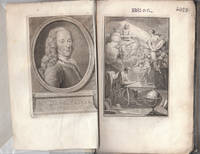
1658-05Amsterdam Jacques Desbordes 1738. gr.-8°. Gest. Portrait Voltaires gest. Frontisp. Portr. Newtons v. I. Folkema nach L. F. Dubourg Tit. in Rot u. Schwarz mit gest. Vign. v. Duflos 399 1 S. Mit 6 Kupfertaf. 106 Textkupfern dav. 48 ornament. Vign. u. 58 naturwissensch. Kpf. 3 Textholzschn. u. 1 gefalt. Tabelle in Kupfer. Pbd. d. Zt. m. hs. Rückentit. Berieb. Frontip. u. Tit. m. Nummernstempel 2 Bll. m. Einriß. Fast fleckenfreies unbeschnittenes Exemplar in einem Interimsband. Cohen-de Ricci 1037f.; Sander 1996; Gray Newton 155 - Zweite Ausgabe der Erstausgabe welche im selben Jahr bei Etienne Ledet in Amsterdam erschienen ist. Die ornamentalen Kupfer stammen u. a. v. L.-F. Dubourg J. Folkema F. M. La Cave B. Picart J. v. Schley. - Hervorragendes Beispiel für die französische Buchillustration des Rokokos in dem sich Illustrationen und aufgeklärte Naturwissenschaften harmonisch miteinander verbinden. - Voltaire verhalf mit diesem Werk die Erkenntnisse Newtons am Kontinent zu verbreiten. - "One of his Newton's greatest champions in France was Voltaire whose 'Elemens.' was wideley read. / Die Principia sind ein schwieriges Werk und so ist es nicht überraschend daß es nur wenige Zeitgenossen vollständig gelesen haben. Einer seiner berühmtesten Verfechter war in Frankreich Voltaire dessen 'Elemens de la Philosophie de Neuton' von 1738 in weiten Kreisen gelesen wurden" Carter-Muir S. 304. Amsterdam, Jacques Desbordes 1738. unknown
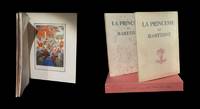
1928293221928. A Paris Javal et Bourdeaux 1928. Un vol. au format in-4 333 x 253 mm de 88 pp. en feuilles sous couverture ˆ rabats rempliÂŽs 1 volume de mÂme format renfermant les suites ; le tout sous coffret de pleine percaline satinÂŽe vieux-rose ˆ fermoirs dos lisse titre dorÂŽ en long. Tirage unique ˆ 40 exemplaires seulement ; tous sur Japon impÂŽrial. Exemplaire revÂtu ˆ la justification de la signature autographe de Leonetto Cappiello. Outre les compositions contenues dans l'ouvrage gravÂŽes sur cuivre par Lorrain cet ensemble recÂle sous chemise titrÂŽe une triple suite desdites compositions ÂŽtat en deux couleurs ÂŽtat en bleu ÂŽtat en noir. ''AprÂs des ÂŽtudes ˆ Livourne Cappiello exposa en 1892 ˆ Florence et vint ˆ Paris la mÂme annÂŽe pour collaborer au Rire .''. in Osterwalder citant la prÂŽsente contribution de l'artiste. ''Voyage philosophique dans lÕEurope des LumiÂres La Princesse de Babylone constitue un conte oriental somptueux o entre humour et coups de griffe Voltaire dans une course amoureuse ˆ travers le monde dÂŽnigre la sottise du pouvoir absolu et prÂche la tolÂŽrance lՎtat de nature et de libertÂŽ.'' MahÂŽ RÂŽpertoire des ÂŽditons de luxe p. 41 - Monod I Manuel de l'amateur de livres illustrÂŽs modernes 11434 - Osterwalder I Dictionnaire des illustrateurs p. 214. Un fermoir du coffret absent. Couverture renfermant les suite nettement piquÂŽe. TrÂs rares au premier plat couverture du volume de texte. Excellente condition intÂŽrieure. Rare. b42961 unknown
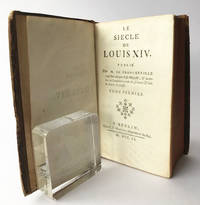
175116247Berlin: C F Henning. Very Good- with no dust jacket. 1751. First Edition; First Printing. Hardcover. Vellum darkened and with some surface cracking light extremity wear; light foxing. No half-title pages. Errata page for both volumes bound at end of Vol I. Two custom owners' bookplates in first volume. Solid hardcovers. ; French language. Half vellum binding with marbled boards. Two of two volumes complete. Bengesco I 1178. This work was the most researched and carefully prepared of Voltaire's works. He began work on this project in 1734 while at the Chateau Cirey put it aside in 1738 and resumed work on it in 1750. First Edition First Printing of Voltaire's pioneering historical study of the age of King Louis XIV published while Voltaire was resident at the court of King Frederick II of Prussia.; xii 488 2 errata; ii 466 in 2v pages . C F Henning hardcover
17512359The first edition of Voltaire's brilliant historical study of the age of King Louis XIV. Begun as early as 1732 Voltaire sent a manuscript version to Frederic II who was enthusiastic and encouraged its publication. In 1739 Voltaire published a 'Plan Raisonné' of the project including two finished chapters but this was condemned by the court and seized. In 1750 Voltaire left France for Frederic's court at Berlin where he set himself to complete the work. Failing to obtain the 'privilège royal' or even the non-written 'permission tacite' he decided to go ahead and publish the work in Berlin at his own expence. Voltaire continued to add to the work in subsequent editions most notably in the 1753 Berlin edition where he added a supplement in which he refuted the attacks made by La Beaumelle.<br /><br /><i>Two volumes in one 12mo 144 x 85mm pp. xiv 488 1 errata; ii 466 2 errata with the half-title to the first volume in contemporary calf rather worn spine gilt in compartments foot of spine chipped wormhole to the head of spine wanting the front endpaper red edges.</i><br /><br />BN Voltaire Catalogue 3361-3363. C.F. Henning
1795ILTPVOLT95Paris: Didot Le Jeune L'An Troisième 1795. 1795. 2 Volumes. 4to. pp. 211; 212. with half-titles. engraved frontis. portrait of Jeanne d'Arc by Gaucher & 21 engraved plates by engraved by A very tall fine crisp copy on thick paper deckle edge visible on some leaves bound in contemporary tree calf gilt backs all edges gilt some surface scarring to covers but still a very nice copy. First Edition with these Illustrations the frontispiece portrait of Jeanne d'Arc by Gaucher and the other twenty-one plates engraved by Bacquoy Choffard Delignon Delvaux Duhamel Dupréel Lemire Lingée Malbeste Patas Pauquet Ponce and Romanet after designs by Lebarbier Marillier Monnet and Monsiau. "Très belle édition." Cohen-De Ricci Cohen-De Ricci 1034. Brunet V 1362. Bengesco 513. F. Hardcover. Paris: Didot Le Jeune, L'An Troisième [1795]. Hardcover
15912Paris: Delangle Freres Incomplete set. 39 of 97 volumes. Written in French. First editions. 1825-1834. 8vo 8 1/2" tall. Uniform dark red cloth binding stamped in gilt on spine. Orange page edges. Includes: Tome 1- "Biographie" 1828 487 pages; Tome 26 & 27 - "Siecle de Louis XIV" 1827 484 pages & 502 pages; Tome 28 - "Siecle of Louis XV" 1827 400 pages; Tome 30 - "Histoire de Charles XII" 1827 537 pages; Tome 31 - "Histoire de Russie" 1827 505 pages; Tomes 32-33 - "Annales de l'empire" 1827 426 and 412 pages; Tomes 35-36 - "Melanges Historiques" 1827 416 and 471 pages. Tomes 68-95 - "Correspondance" 1827-1832 Complete correspondence volumes 1-28. Ex-college library with bookplates and a few marks otherwise beautiful tight sharp and bright without wear. Very clean with a few widely scattered fox spots due to its age. Excellent. Delangle Freres hardcover
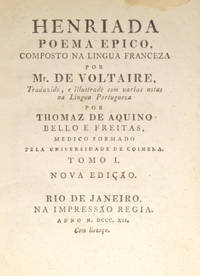
2308RS272<p>POEMA EPICO Composto na Lingua Franceza por Mr. DE VOLTAIRE Traduzido e illustrado com varias notas na Lingua Portuguesa por THOMAZ DE AQUINO BELLO E FREITAS Medico Formado pela Universidade de Coimbra. Tomo I Tomo II. Nova Edição. RIO DE JANEIRO. Na impressão Regia. Anno M. DCCC. XII 1812. Com licença.</p>_x000d_<p>2 Volumes in 16.º de 14x105 cm. Com xix i em br 193; ii 179 págs.</p>_x000d_<p>Encadernações da época inteiras de pele com ferros a ouro em esquadrias com três filetes nas pastas e ferros a ouro e rótulos nas lombadas. Cortes das folhas marmoreados e folhas de guarda decorativos. Incluem uma fita em cetim verde-claro.</p>_x000d_<p>Exemplar assinatura de posse coeva acompanhada da rubrica de António Justiniano Baptista Botelho em Escalos de Cima Comarca de Castelo Branco e notas a lápis na folha de guarda anterior dos volumes. Com nota a tinta coeva na página 32 dos dois volumes a explicar o erro na encadernação. Por erro de encadernação as páginas do segundo volume a partir da página 33 encontra-se no primeiro volume depois da página 32 e vice-versa.</p>_x000d_<p>Nova edição muito rara com notas de rodapé por Tomás de Aquino e Freitas prefacio do editor e história abreviada dos acontecimentos que deram origem ao poema. A primeira edição foi impressa no Porto 1789 na Officina de Antonio Alvares Ribeiro.</p>_x000d_<p>François-Marie Arouet Paris Reino da França 1694 - Paris Reino da França 1778 foi um escritor filósofo e historiador do Iluminismo francês conhecido por seu pseudónimo M. de Voltaire foi defensor da liberdade de expressão da liberdade de religião e da separação entre a igreja e estado. Estudou no Colégio Louis-le-Grand em 1713 seu pai conseguiu-lhe um emprego como secretário do novo embaixador francês na Holanda o marquês de Châteauneuf.</p>_x000d_<p>Escritor versátil e prolífico produzindo obras em quase todas as formas literárias incluindo peças de teatro com mais de 50 peças incluindo inacabadas entre elas: <em>Édipo</em> 1717<em> Irène</em> 1778; poemas como: <em>Henriade</em> 1723 <em>Le Mondain</em> 1736; romances ensaios histórias exposições científicas escreveu também mais de 20 mil cartas e 2 mil livros e panfletos.</p>_x000d_<p>Tomás de Aquino Bello e Freitas Ribeirão do Carmo Minas Gerais 1744 - Coimbra 1835 foi tradutor bacharelou-se em Artes em Coimbra em 1744 graduou-se em Filosofia no mesmo ano e em medicina em 1746. Foi médico do Hospital Militar de Vila Rica. Seu nome é mencionado nas Cartas Chilenas: Frondélio bom médico.</p>_x000d_<p>EN 2 Volumes in Sextodecimo sixteenmo. 14x105 cm. xix i bl. 193; ii 179 pp.</p>_x000d_<p>Contemporary full leather bindings with gilt frames with three fillets on the boards and gilt tools and labels on the spines. Marbled edges and decorative endpapers. Includes a light green satin ribbon marker.</p>_x000d_<p>Copy with handwritten coeval ownership title accompanied by the rubric of António Justiniano Baptista Botelho in Escalos de Cima district of Castelo Branco and notes in pencil on the front flyleaf of the volumes. With a note in ink on page 32 of both volumes explaining the error in the binding. Due to a binding error the pages of the second volume from page 33 onwards are in the first volume after page 32 and vice versa.</p>_x000d_<p>Very rare new edition with footnotes by Tomás de Aquino e Freitas a preface by the editor and an abbreviated history of the events that gave rise to the poem. The first edition was printed in Porto 1789 at the Officina de Antonio Alvares Ribeiro.</p>_x000d_<p>François-Marie Arouet Paris Kingdom of France 1694 - Paris Kingdom of France 1778 was a writer philosopher and historian of the French Enlightenment known by his pseudonym M. de Voltaire. He was a defender of freedom of expression freedom of religion and the separation of church and state. He studied at the Collège Louis-le-Grand and in 1713 his father got him a job as secretary to the new French ambassador to Holland the Marquis de Châteauneuf.</p>_x000d_<p>Versatile and prolific writer producing works in almost all literary forms including theatre plays with more than 50 plays including unfinished ones among them: <em>Édipo</em> 1717<em> Irène</em> 1778; poems such as: <em>Henriade</em> 1723 <em>Le Mondain</em> 1736; novels essays histories scientific expositions he also wrote more than 20000 letters and 2000 books and pamphlets.</p>_x000d_<p>Tomás de Aquino Bello e Freitas Ribeirão do Carmo Minas Gerais 1744 - Coimbra 1835 was a translator who graduated in Arts from Coimbra in 1744 in Philosophy in the same year and in Medicine in 1746. He was a doctor at the Vila Rica Military Hospital. His name is mentioned in the Cartas Chilenas: Frondélio good doctor.</p>_x000d_<p>Referências/References:</p>_x000d_<p>Inocêncio VII p. 336.</p>_x000d_<p>Ana Maria Camargo 303 e 304.</p>_x000d_<p>Borba de Morais Vol II 327.</p> M-7-E-20 hardcover
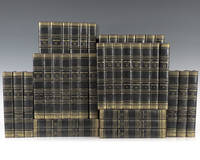
1820801014Paris: E.A. Lequien 1820-1826. leather_bound. stark abgenutzt. Zusammen ca. 35000 Seiten. Ganzleder der Zeit mit Gold- und Blindprägung auf Rücken und Deckeln Stehkanten mit Goldprägung Innenkanten mit Blindprägung marmoriertem Schnitt und Vorsätzen aus Marmorpapier nur wenig berieben und bestoßen Bände 18 23 35 39 40 42 50 54 68 mit kleinen Fehlstellen im Leder nur wenig störend Gelenke vereinzelt mit kleinen Einrissen bzw. restaurierten Einrissen innen nur wenig gebräunt bzw. stockfleckig im Ganzen gute wohlerhaltene Exemplare. - Schönes dekoratives Exemplar der bei P. Didot L'Aisne gedruckten Ausgabe die aufgestellt eine Länge von 220 cm beansprucht. Inhalt der Bände: Bd. 1: Elogen u.a. von Friedrich II. König von Preussen "Vie de Voltaire" von Condorcet; Bd. 2-9: Theatre; Bd. 10: La Henriade; Bd. 11: La Pucelle d'Orleans; Bd. 12-14: Poesies; Bd. 15-18: Essai sur les Moeurs; Bd. 19-20: Siècle de Louis XIV; Bd. 21: Siècle de Louis XV; Bd. 22: Histoire de Charles XII; Bd. 23: Histoire de Russie; Bd. 24: Annales de L'Empire; Bd. 25: Histoire du Parlement; Bd. 26-27: Melanges Historiques; Bd. 28-29: Politique et Législation; Bd. 30: Physique; Bd. 31-34: Philosophie; Bd. 35: Dialogues et Entretiens Philosophiques; Bd. 36-42: Dictionaire Philosophique; Bd. 43-44: Romans; Bd. 45: Facéties; Bd. 46-47: Mélanges Littéraires; Bd. 48-49: Commentaires sur Corneille; Bd. 50-52: Correspondance avec le Roi de Prusse; Bd. 53: Correspondance avec l'Imperatrice de Russie etc.; Bd. 54-55: Correspondance avec d'Alembert; Bd. 56-69: Correspondance générale; Bd. 70: Table analytique des Oeuvres de Voltaire composée par J.B.J. Champagnac. Orientiert sich hinsichtlich der Bandeinteilung nicht aber hinsichtlioch der Numerierung und der Reihenfolge der Werkgruppen an der Ausgabe Kehl. - Bengesco IV 2153 - Vicaire VII Sp. 1137. - Weitere Bilder auf Anfrage oder auf unserer Homepage. Wegen Urlaub kann Ihre Bestellung / Anfrage erst nach dem 21.06.2026 bearbeitet werden. - Because of holidays your order / question can be handled only after 06/21/2026. E.A. Lequien hardcover
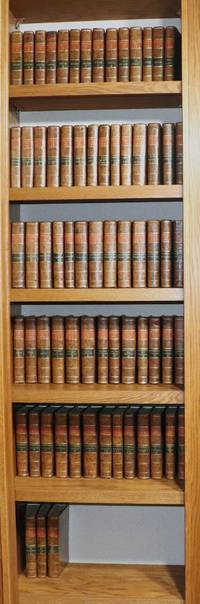
1789000012023Paris: La Société Littéraire-Typographique 1789. First edition. Hardcover. Very Good. 70 vol. 8vo. Please inquire if you require any pagination information. Contemporary full calf spines in six and a half compartments each with a red and a green morocco label lettered in gilt; several edges decoratively stained yellow. With 104 of the 122 recorded plates Cohen-DeRicci calls for 122 plates volume one is missing the tableau the folding plate and the dedication plate. Due to the vagaries of hand-press-era binding and to the large size of the set it is difficult to determine which of the other 16 plates are the ones missing. The plates present depict Voltaire scenes from his plays and several fascinating figures from European History including of course Enlightenment-era figures. All other half-titles present see condition statement. Bengesco 2142. Brunet 681. Cohen-DeRicci 1042-1047. This edition is the set most lauded for its completeness and beautiful typography. Baskerville's type was purchased to produce this sizeable set of Voltaire's writings. The later editions of Voltaire's works are said to be based on this edition. Voltaire's career was nothing short of prolific as demonstrated by these 70 volumes. With a biting wit and a clever pen the philosophe lampooned Leibniz wrote countless plays and historical dramas and corresponded with his fellow Enlightenment-era intellectuals. He walked the line of philosopher and literary figure and made great contributions to science in his translation of Newton's writings into French. He was a champion not only of the natural sciences but of liberty and of personal pleasure. Voltaire dreamed that European society would and could move forward away from tyrannical monarchies towards a more sophisticated and benevolent system of governance. He stands out as one of the most popular and influential figures of the Enlightenment era. Volume 37 lacks its free front endpaper a few leaves in the volumes have an occasional dampspot volume 43 lacks leaf CC8 and its half-title. La Société Littéraire-Typographique hardcover
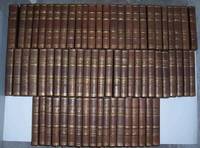
182896178Paris: Deslangle Frères 1828-34. Finely bound set of the complete works of Voltaire with historic scientific and literary notes. Octavo 97 volumes bound in three quarters morocco over marbled boards gilt titles and tooling to the spine in five compartments within raised gilt bands marbled endpapers frontispieces with tissues guards and half titles as issued. In very good condition. A complete set covering the broad scope of the versatile and prolific writer. One of the most influential thinkers of the French Enlightenment François-Marie Arouet know by the nom de plum Voltaire was a resourceful and prolific writer. His works touched nearly every literary form including plays poems novels theoretical essays and scientific treatises. A forthright and candid advocate of civil liberties he frequently criticized the institutions of religious dogma and classism prevalent in 18th century France often doing so through satire to avoid censorship and imprisonment. Deslangle Frères hardcover
173360085London C. Davis and A. Lyon 1733. 8vo. Lovely contemporary full Cambridge-style binding with five raised bands to spine and blindstamped ornamental borders to boards. . Double gilt line-borders to boards. All edges of boards with gilt borders. Gilt title to spine. Hinges neatly and professionally re-inforced. Internally very nice clean and fresh. A lovely crisp and large copy with good margins printed on heavy fine paper. 16 -including preface contents advertisements 253 1 18 -Index pp. <br/><br/><em>The important actual first edition of this highly celebrated key work of the Enlightenment in which the anecdote of how Newton discovered gravity the story about Newton and the falling apple appeared for the first time together with the description of the difference between the physical world view of the English and the French the "plenum" and the "vacuum". This seminal work in which Voltaire famously depicts British philosophy science society and culture in comparison to French can be viewed as the Enlightenment equivalent to Tocqueville's "Democracy in America". This series of essays which is based on Voltaire's experiences when living in England was actually written by Voltaire mostly in English which he mastered to perfection. It has often been presumed that the first edition of the work was that published in French in 1734 but actually the present English edition constitutes the actual first appearance of the work as well as the version that is closest to Voltaire's intention as the French language version is the re-written one and the English version the original. Curiously almost all modern English versions are translations into English of the French edition instead of the original English version making this edition of the utmost importance.After the original English edition of 1733 two French editions soon followed the first in 1734. Unlike the British the French resented the book and already in 1734 the French Parliament issued an order for the author's arrest and condemned the work causing the impact of it in France to be delayed. The book was burned for being "dangerous to religion and civil order". At the same time the work became a bestseller in Britain and as much as 14 editions of the work were published in the eighteenth century. "Inspired by Voltaire's two-year stay in England 1726-8 this is one of the key works of the Enlightenment. Exactly contemporary with Gulliver's Travels and The Beggar's Opera Voltaire's controversial pronouncements on politics philosophy religion and literature have placed the Letters among the great Augustan satires. Voltaire wrote most of the book in English in which he was fluent and witty and it fast became a bestseller in Britain. He re-wrote it in French as the Lettres philosophiques and current editions in English translate his French." Nicholas Cronk Introduction to the Oxford's Classics edition from 1999.The great French philosopher Voltaire was greatly impressed by the philosophical and scientific achievements of the English especially those of Newton Locke and Bacon. As a disseminator of scientific knowledge Voltaire came to play a great rôle in the popularization of Newtonian science and its discoveries the present work being a prime example. Although the work was condemned by the French authorities it still came to play a great rôle in the spreading of Newtonian ideas in France. The present work generally came to play a dominant rôle in Enlightenment accounts of the history of science and philosophy. The work focuses on British science and thought and uses the accounts of these to emphasize what is lacking in French society and French thought. The work is generally very critical towards the French "ancient régime" and when Voltaire here discusses the emergence of empiricism it is viewed as an English tradition that stands in opposition to the French rationalist tradition with Descartes as the prime example. This view is taken over by the following Enlightenment historians of science and philosophy e.g. d'Alembert see for instance his "Preliminary Discourse" of 1751. Some of the most influential passages of the work are probably those on Bacon who Voltaire sees as the founder of modern experimental science Newton and Descartes. Letters XIV on Descartes and Newton XV on attraction and XVI on Newton's Optics from 1704 are among the most influential essays of the work. In XVI Voltaire reflects upon Newton's "Optics" and the way that he rejected Descartes' theory and set out his own account of the properties of light. In XV he presents the first account of Newton and the falling apple: "As he was walking one Day in his Garden and saw some Fruits fall from a Tree he fell into profound Meditation on that Gravity the Cause of which had so long been sought but in vain by all the Philosophers whilst the Vulgar think there is nothing mysterious in it. He said to himself that from what height soever in our Hemisphere those Bodies might descend their Fall wou'd certainly be in the Progression discover'd by Galileo; and the Spaces they run thro' would be as the Square of the Times. Why may not this Power which causes heavy Bodies to descend and is the fame without any sensible Diminution at the remotest Distance from the Center of the Earth or on the Summits of the highest Mountains; Why said Sir Isaac may not this Power extend as high as the Moon." pp. 127-28.But perhaps the most famous passage in the volume is the opening of Letter XIV: "A Frenchman who arrives in London will find Philosophy like every Thing else very much chang'd there. He had left the World a "plenum" and he now finds it a "vacuum". At Paris the Universe is seen compos'd of Vortices of subtile Matter; but nothing like it is seen in London. In France 'tis the Pressure of the Moon that causes the Tides; but in England 'tis the Sea that gravitates towards the Moon; so that when you think that the Moon should make it Flood with us those Gentlemen fancy it should be Ebb which very unluckily cannot be prov'd." pp. 109-10. </em> hardcover
STLS0115Kehl De l'Imprimerie de la Societe Litteraire-Typographique 1785 - 1789. 23 x 15 cm. Zus. Ca 35 000 S. Mit insgesamt 145 gest. Tafeln davon 38 Porträts 14 physikal. Tafeln. 108 Tafeln sind von Moreau le jeune gestochen. Zahlr. Abb. im Text. Dekorative Halblederbände d. Zt. mit roten Rückenschildchen Rückengoldpräg. Lederecken. 4 Rückenschildchen fehlen einige Bände restauriert. Unser Exemplar stammt aus der Bibliothek des Wiener Verlegers Paul von Zsolnay. Bengesco 2142; Brunet V1353 ""Edition celebre""; Cohen/R.1042-48; Lewine 564. Die bedeutendste und schönste aller Voltaire-Ausgaben.Von Beaumarchais herausgegeben großteils von von Moreau le jeune mit Kupfern ausgestattet. Die Bände 71 u. 72 Paris Deterville 1801 enthalten ein umfangreiches Inhaltsverzeichnis von C. Chantreau sowie Reihentitelbll. vgl. Brunet V1354. (Kehl), De l'Imprimerie de la Societe Litteraire-Typographique 1785 - 1789. unknown
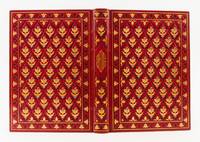
1893ST17884Paris: Imprimé pour Les Amis de Livres par Chamerot et Renouard 1893. No. 55 OF 115 COPIES printed for M. Van der Vrecken de Bormans. 275 x 190 mm. 10 3/4 x 7 1/2". 4 p.l. 159 3. <br/> DAZZLING CONTEMPORARY SCARLET MOROCCO VERY ORNATELY DECORATED IN GILT SILVER AND BLACK AS WELL AS INLAID BY MARIUS MICHEL stamp-signed on front doublure covers elaborately embellished with a floral frame enclosing a large central panel filled with diapered compartments formed by gently curving black leaves each compartment containing a floral sprig tooled in silver and gold flat spine with similarly decorated ogival compartments and gilt titling OLIVE BROWN MOROCCO DOUBLURES filled with rows of inlaid red carnations with dark green pedicels leather hinges jacquard silk endleaves in pink blue and green pattern marbled flyleaves all edges gilt. Original white textured paper wrappers bound in. In a slightly worn brown morocco-trimmed marbled paper slipcase. With eight pleasing color engravings by Rops 4 Robaudi 2 and Garnier 2 depicting scenes from the story accompanied by 29 proofs in red yellow cyan and black & white as called for in the colophon. A Large Paper Copy. Front flyleaf with INK INSCRIPTION SIGNED BY MARIUS MICHEL and dated Mai 1920 noting that he had bound this copy for M. Van der Vrecken de Bormans in 1896 for a very substantial price of 600 francs. Carteret IV 407; Vicaire I 47. Three blank front flyleaves with narrow faint brown horizontal blemish across most of the page apparently a tape shadow; in all other ways A BEAUTIFUL COPY clean fresh and bright internally IN A PRISTINE BINDING.<br/> <br/> This ravishing object is a bibliophile's treasure: an illustrated luxury edition in Large Paper format of Voltaire's philosophical novel offered in a binding from a pre-eminent Parisian atelier. The impressive binding stands out not only because of its remarkable condition but also because of the variety and unerring execution of its decorative elements--from the vigorous use of black gold and silver on the cover and spine to the particularly animated inlaid morocco doublures. Considered the best binder of his generation as well as the founder of modern French bookbinding Henri Marius Michel 1846-1925 began his career in the workshop established by his father Jean in Paris in 1849 where they produced distinguished bindings in the prevailing historical styles for two decades. After the father's death in 1890 the firm came to even greater prominence when Henri began producing bindings in a completely new and original style that did nothing less than change the course of modern bookbinding in France. According to Duncan & De Bartha Henri believed passionately "that bookbinding needed a new vocabulary of ornamentation in order to express the mood and spirit of contemporary authors." The "vocabulary of ornamentation" he developed was based on nature the revolutionary "La Flore Ornamentale" style that he unveiled at the 1878 International Exposition. His favored floral forms dominate the present binding both as inlays and as silver and gold tooling. Our binding was commissioned by Paul Van der Vrecken Baron de Bormans an attaché at the Belgian Embassy in Paris and a bibliophile who belonged to "La société du livre contemporain" as well as the "Cercle Parisien du livre." The 600 francs the binding cost would have bought a very great deal in France at the end of the 19th century. Another copy of this work with the same special features and also bound in inlaid morocco by Marius Michel sold at Sotheby's in 1995 for the hammer price equivalent of $31200. Imprimé pour Les Amis de Livres par Chamerot et Renouard unknown
1759752Genève Geneva: Cramer 1759. First Edition. 3 vols. in one 12mo 164 x 100mm pp. 2 291 1; 133 1 35 1. First printing of the great 18th century philosophical narrative with all the points correct. Including the 3 usual cancels the right title page ornament repeated pages 193 and 266 the misprints of “que ce ce fut†page 103 line 4 and “précisément†page 125 line 4 the correction removing a paragraph break page 31 the rewritten lines about the Lisbon earthquake page 41 etc. Contemporary full calf red calf label rebacked with the original spine saved and laid down recornered marbled endpapers gilt rubbed inner paper hinges strengthened old ink signatures on the endpaper and front blank tiny signature on the title page one tissue strengthened tear at the bottom of A2 touching the last 3 lines of text without any loss otherwise internally quite nice clean and very good. Bound without N7 a blank and N8 a notice to the binder as is usual agreeing in all respects to what you would have received if you had purchased a copy in sheets on publication day then bought the sequels and then handed them over to the most local Swiss bindery. Ref: PMM 204. There were 18 editions of Candide in 1759. It took 221 years for a clear and convincing bibliography to first sort them out and then got accepted and once accepted our real 1st edition was confirmed as rare. In the last 15 years however that bibliographical data has been more widely circulated and several 1st editions that weren’t on the original 22–copy census have come into market. It is still scarce more so in a contemporary binding.<br /> <br /> Candide bides as the epitomic philosophical fable of the French Enlightenment and the genotype of irony without exaggeration and though it’s laced with more salt than the postwar streets of Carthage it repeatedly tolls a reminder that light hearts live long. Most importantly Candide remains remarkably relevant when examined through contemporary frameworks functioning as an incisive proto-postcolonial text that anticipates modern discourse on global inequality systems of oppression and the limitations of Enlightenment rationality. The novel's scathing portrayal of slavery conquest and religious persecution resonates with intersectional analyses that recognize how power structures interlock across racial gender and economic dimensions. The savage irony throughout the text dismantles not just philosophical optimism but also European exceptionalism exposing the hypocrisy of colonial enterprises and religious institutions alike. The narrative's episodic structure—with its global movements between Europe South America and the Ottoman Empire—invites discussions of transnationalism and diasporic experience while Candide's concluding retreat to cultivate his garden has been reinterpreted by ecocritical scholars as both an acknowledgment of environmental interdependence and a potentially problematic withdrawal from systems-level political engagement.<br /> <br /> “Do you believe†said Candide “that men have always massacred each other as they do to-day that they have always been liars cheats traitors ingrates brigands idiots thieves scoundrels gluttons drunkards misers envious ambitious bloody–minded calumniators debauchees fanatics hypocrites and fools†“Do you believe†said Martin “that hawks have always eaten pigeons when they have found them†<br /> –Voltaire Candide. Cramer unknown