VOLTAIRE (François-Marie Arouet de).Livre Rare Book
866 résultats
17385783A Amsterdam, chez Etienne Ledet & Compagnie, 1738. In-8 de 1 frontispice gravé, 2 portraits, (6)-XII-(2)-399-(1)-(400 à) 410-(6) pp., veau brun, dos orné à nerfs, pièce de titre en maroquin rouge (reliure de l'époque).
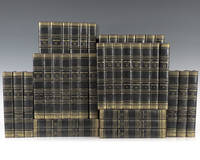
182896178Paris: Deslangle Frères 1828-34. Finely bound set of the complete works of Voltaire with historic scientific and literary notes. Octavo 97 volumes bound in three quarters morocco over marbled boards gilt titles and tooling to the spine in five compartments within raised gilt bands marbled endpapers frontispieces with tissues guards and half titles as issued. In very good condition. A complete set covering the broad scope of the versatile and prolific writer. One of the most influential thinkers of the French Enlightenment François-Marie Arouet know by the nom de plum Voltaire was a resourceful and prolific writer. His works touched nearly every literary form including plays poems novels theoretical essays and scientific treatises. A forthright and candid advocate of civil liberties he frequently criticized the institutions of religious dogma and classism prevalent in 18th century France often doing so through satire to avoid censorship and imprisonment. Deslangle Frères hardcover
182896178Paris: Deslangle Freres 1828-34. Finely bound set of the complete works of Voltaire with historic scientific and literary notes. Octavo 97 volumes text in French. Bound in three quarters morocco over marbled boards gilt titles and tooling to the spine in five compartments within raised gilt bands marbled endpapers frontispieces with tissues guards and half-titles as issued. In very good condition. A complete set covering the broad scope of the versatile and prolific writer. One of the most influential thinkers of the French Enlightenment Francois-Marie Arouet know by the nom de plum Voltaire was a resourceful and prolific writer. His works touched nearly every literary form including plays poems novels theoretical essays and scientific treatises. A forthright and candid advocate of civil liberties he frequently criticized the institutions of religious dogma and classism prevalent in 18th century France often doing so through satire to avoid censorship and imprisonment. Deslangle Freres hardcover books
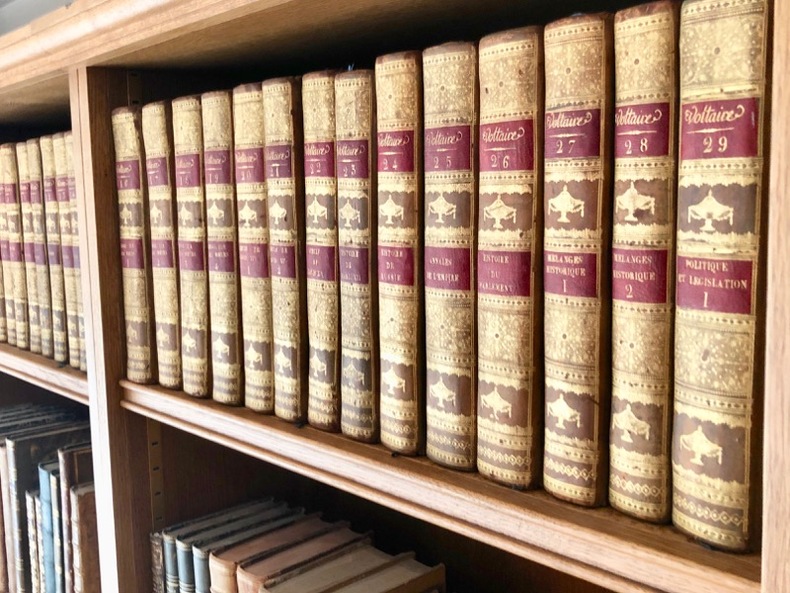
178439990Kehl, De l'Imprimerie de la Société littéraire-typographique, 1784-1789. 70 volumes in-8, demi-veau vert, dos lisses très ornés de fleurons, palmes et palettes, pièces de titre et de tomaison en maroquin rouge (reliure de l'époque).
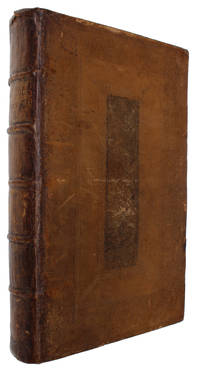
173360085London C. Davis and A. Lyon 1733. 8vo. Lovely contemporary full Cambridge-style binding with five raised bands to spine and blindstamped ornamental borders to boards. . Double gilt line-borders to boards. All edges of boards with gilt borders. Gilt title to spine. Hinges neatly and professionally re-inforced. Internally very nice clean and fresh. A lovely crisp and large copy with good margins printed on heavy fine paper. 16 -including preface contents advertisements 253 1 18 -Index pp. <br/><br/><em>The important actual first edition of this highly celebrated key work of the Enlightenment in which the anecdote of how Newton discovered gravity the story about Newton and the falling apple appeared for the first time together with the description of the difference between the physical world view of the English and the French the "plenum" and the "vacuum". This seminal work in which Voltaire famously depicts British philosophy science society and culture in comparison to French can be viewed as the Enlightenment equivalent to Tocqueville's "Democracy in America". This series of essays which is based on Voltaire's experiences when living in England was actually written by Voltaire mostly in English which he mastered to perfection. It has often been presumed that the first edition of the work was that published in French in 1734 but actually the present English edition constitutes the actual first appearance of the work as well as the version that is closest to Voltaire's intention as the French language version is the re-written one and the English version the original. Curiously almost all modern English versions are translations into English of the French edition instead of the original English version making this edition of the utmost importance.After the original English edition of 1733 two French editions soon followed the first in 1734. Unlike the British the French resented the book and already in 1734 the French Parliament issued an order for the author's arrest and condemned the work causing the impact of it in France to be delayed. The book was burned for being "dangerous to religion and civil order". At the same time the work became a bestseller in Britain and as much as 14 editions of the work were published in the eighteenth century. "Inspired by Voltaire's two-year stay in England 1726-8 this is one of the key works of the Enlightenment. Exactly contemporary with Gulliver's Travels and The Beggar's Opera Voltaire's controversial pronouncements on politics philosophy religion and literature have placed the Letters among the great Augustan satires. Voltaire wrote most of the book in English in which he was fluent and witty and it fast became a bestseller in Britain. He re-wrote it in French as the Lettres philosophiques and current editions in English translate his French." Nicholas Cronk Introduction to the Oxford's Classics edition from 1999.The great French philosopher Voltaire was greatly impressed by the philosophical and scientific achievements of the English especially those of Newton Locke and Bacon. As a disseminator of scientific knowledge Voltaire came to play a great rôle in the popularization of Newtonian science and its discoveries the present work being a prime example. Although the work was condemned by the French authorities it still came to play a great rôle in the spreading of Newtonian ideas in France. The present work generally came to play a dominant rôle in Enlightenment accounts of the history of science and philosophy. The work focuses on British science and thought and uses the accounts of these to emphasize what is lacking in French society and French thought. The work is generally very critical towards the French "ancient régime" and when Voltaire here discusses the emergence of empiricism it is viewed as an English tradition that stands in opposition to the French rationalist tradition with Descartes as the prime example. This view is taken over by the following Enlightenment historians of science and philosophy e.g. d'Alembert see for instance his "Preliminary Discourse" of 1751. Some of the most influential passages of the work are probably those on Bacon who Voltaire sees as the founder of modern experimental science Newton and Descartes. Letters XIV on Descartes and Newton XV on attraction and XVI on Newton's Optics from 1704 are among the most influential essays of the work. In XVI Voltaire reflects upon Newton's "Optics" and the way that he rejected Descartes' theory and set out his own account of the properties of light. In XV he presents the first account of Newton and the falling apple: "As he was walking one Day in his Garden and saw some Fruits fall from a Tree he fell into profound Meditation on that Gravity the Cause of which had so long been sought but in vain by all the Philosophers whilst the Vulgar think there is nothing mysterious in it. He said to himself that from what height soever in our Hemisphere those Bodies might descend their Fall wou'd certainly be in the Progression discover'd by Galileo; and the Spaces they run thro' would be as the Square of the Times. Why may not this Power which causes heavy Bodies to descend and is the fame without any sensible Diminution at the remotest Distance from the Center of the Earth or on the Summits of the highest Mountains; Why said Sir Isaac may not this Power extend as high as the Moon." pp. 127-28.But perhaps the most famous passage in the volume is the opening of Letter XIV: "A Frenchman who arrives in London will find Philosophy like every Thing else very much chang'd there. He had left the World a "plenum" and he now finds it a "vacuum". At Paris the Universe is seen compos'd of Vortices of subtile Matter; but nothing like it is seen in London. In France 'tis the Pressure of the Moon that causes the Tides; but in England 'tis the Sea that gravitates towards the Moon; so that when you think that the Moon should make it Flood with us those Gentlemen fancy it should be Ebb which very unluckily cannot be prov'd." pp. 109-10. </em> hardcover
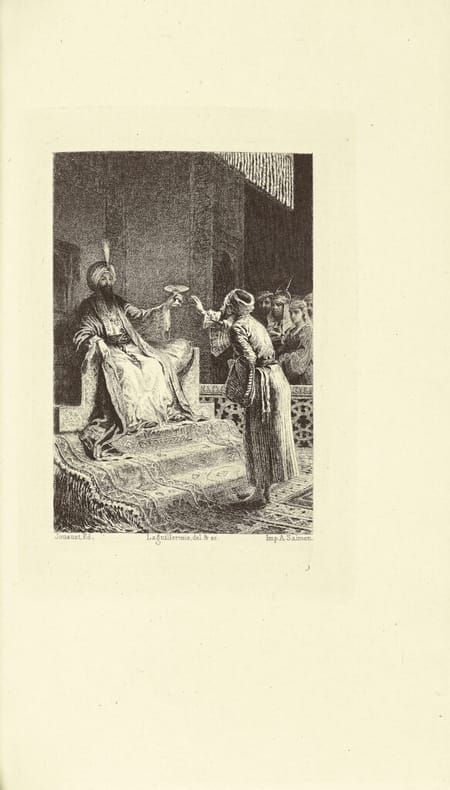
LCS-18383Luxueux exemplaire, l’un des 20 imprimés sur papier de Chine contenant la suite des eaux-fortes en double état. Paris, Librairie des Bibliophiles, rue Saint-Honoré, 1878. 7 tomes en 5 volumes grand in-8 ornés d’un portrait et de 11 eaux-fortes, l’ensemble en double-état, avant et avec la lettre. Maroquin rouge, triple filet encadrant les plats, dos à nerfs, double filet sur les coupes, tranches dorés. Reliure signée Chambolle-Duru. 214 x 130 mm.
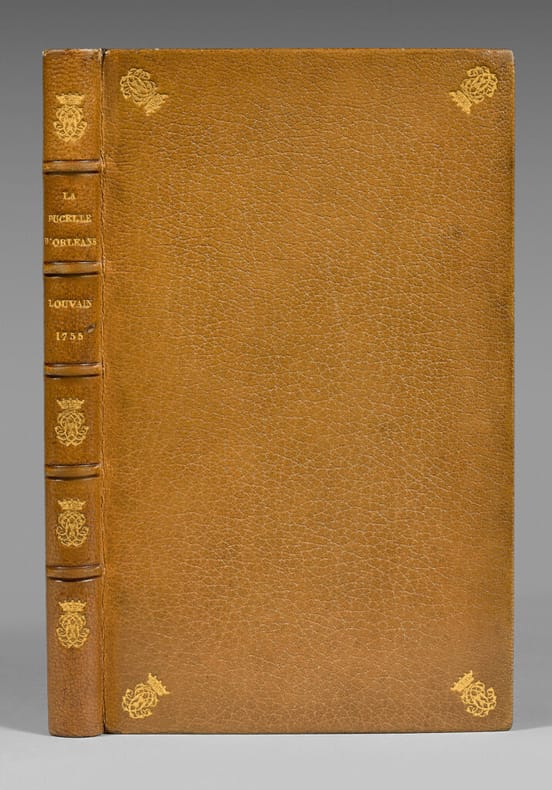
LCS-18572Précieux exemplaire à marges immenses (hauteur 175 mm) des bibliothèques Lurde et Ruble. Louvain (Francfort?), 1755. Petit in-8 de (2) ff., 161 pp. Plein maroquin citron, chiffre doré dans les angles des plats, dos à nerfs orné du même chiffre doré et répété, double filet or sur les coupes, roulette dorée intérieure, tranches dorées. Motte. 175 x 105 mm.
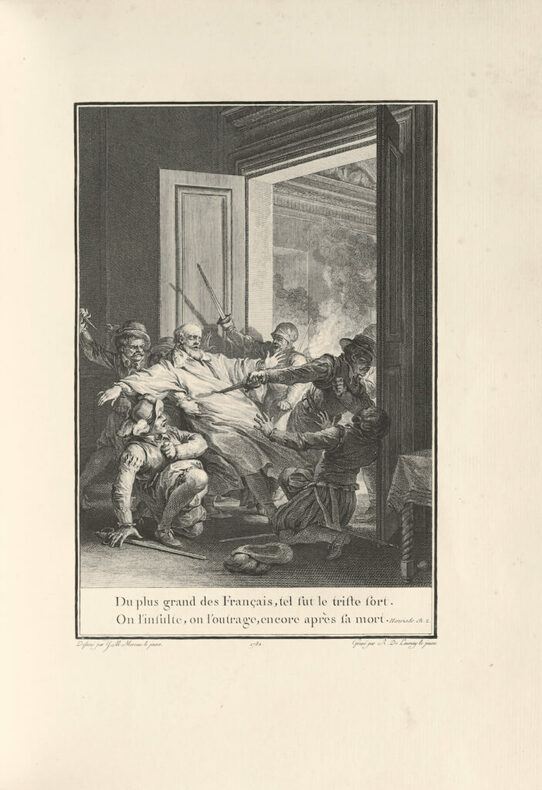
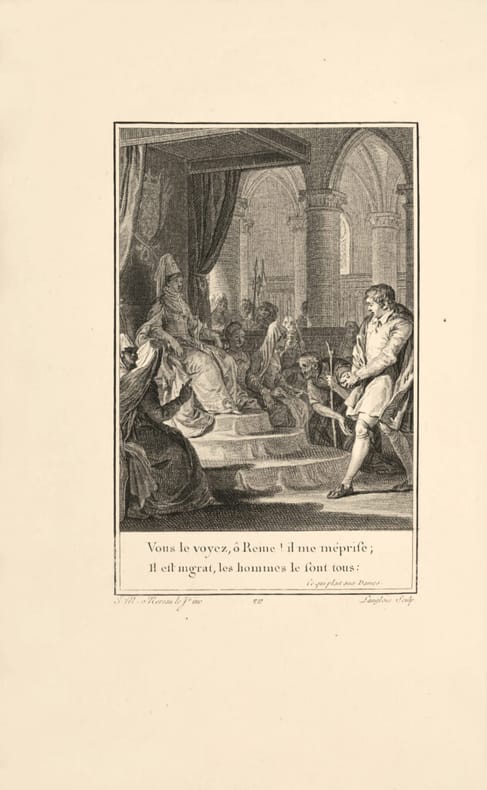
178588781785 [Kehl], de limprimerie de la Société Typographique, 1785 1789. 70 volumes grand in-8° (175 x 270 mm). Exemplaire dexception sur très grand papier vélin de la fameuse édition de Voltaire financée par Beaumarchais, comportant dune part lillustration destinée aux tirages de luxe de cette édition (soit 93 planches de Jean-Michel Moreau le jeune, 12 portraits, 14 planches de physique, 1 plan, 1tableau des oeuvres de Voltaire), plus un large supplément dillustrations destinées à lédition Renouard des Oeuvres de Voltaire en 66 volumes in-8° publiée entre 1819 et 1825. Louvrage contient ainsi un total de 196 planches hors texte, soit : 113 figures de Moreau le jeune (44 pour le Théâtre, volumes 1 9; 10 pour la Henriade, volume 10; 21 pour la Pucelle dOrléans, volume 11; 6 pour les Contes en vers, volume 14; 2 pour le Siècle de Louis XIV, volumes 20 et 21; 1 pour le Siècle de Louis XV, volume 22; 1 pour lHistoire de Charles XII, volume 23; 1 pour lHistoire de Russie, volume 24; 27 pour les Romans et Contes, volumes 44 et 45); 67 portraits (33 gravés par Augustin de Saint-Aubin et 34 de graveurs divers dont Renouard possédait les cuivres); 14 planches de physique (volume 31) ; 1 plan («Camp des Tartares», volume 24 ); 1 tableau dépliant des oeuvres de Voltaire, volume 70). Impressionnantes reliures en demi-basane maroquinée bordeaux à coins, plats de papier rouge, dos lisse ornés, tranches ébarbées. Datant des environs de 1825 1830, elles sont signées (au dos du volume I): «Rel[ié] p[ar] les Dl[l]es Cotty». On ignore tout de ces personnes, dont on peut seulement supposer quelles étaient apparentées à Jean-Etienne Cotty, relieur actif à Paris de 1776 à 1820, que «Lesné [...] place parmi les bons relieurs de second ordre de son temps» (Thoinan, Les Relieurs français, page 234). Bas de la charnière inférieure du volume 11 fendu sur la moitié de sa longueur, quelques coiffes frottées, coins çà et là un peu émoussés, mais dans lensemble la collection est dans un état absolument désirable. Etiquettes collées aux premiers contreplats: «Louvard, libraire, rue du Bac, no 78»; ex-libris illustré: «André Gutzwiller» (1922 2014), banquier et bibliophile bâlois.
STLS0115Kehl De l'Imprimerie de la Societe Litteraire-Typographique 1785 - 1789. 23 x 15 cm. Zus. Ca 35 000 S. Mit insgesamt 145 gest. Tafeln davon 38 Porträts 14 physikal. Tafeln. 108 Tafeln sind von Moreau le jeune gestochen. Zahlr. Abb. im Text. Dekorative Halblederbände d. Zt. mit roten Rückenschildchen Rückengoldpräg. Lederecken. 4 Rückenschildchen fehlen einige Bände restauriert. Unser Exemplar stammt aus der Bibliothek des Wiener Verlegers Paul von Zsolnay. Bengesco 2142; Brunet V1353 ""Edition celebre""; Cohen/R.1042-48; Lewine 564. Die bedeutendste und schönste aller Voltaire-Ausgaben.Von Beaumarchais herausgegeben großteils von von Moreau le jeune mit Kupfern ausgestattet. Die Bände 71 u. 72 Paris Deterville 1801 enthalten ein umfangreiches Inhaltsverzeichnis von C. Chantreau sowie Reihentitelbll. vgl. Brunet V1354. (Kehl), De l'Imprimerie de la Societe Litteraire-Typographique 1785 - 1789. unknown
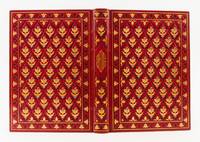
1893ST17884Paris: Imprimé pour Les Amis de Livres par Chamerot et Renouard 1893. No. 55 OF 115 COPIES printed for M. Van der Vrecken de Bormans. 275 x 190 mm. 10 3/4 x 7 1/2". 4 p.l. 159 3. <br/> DAZZLING CONTEMPORARY SCARLET MOROCCO VERY ORNATELY DECORATED IN GILT SILVER AND BLACK AS WELL AS INLAID BY MARIUS MICHEL stamp-signed on front doublure covers elaborately embellished with a floral frame enclosing a large central panel filled with diapered compartments formed by gently curving black leaves each compartment containing a floral sprig tooled in silver and gold flat spine with similarly decorated ogival compartments and gilt titling OLIVE BROWN MOROCCO DOUBLURES filled with rows of inlaid red carnations with dark green pedicels leather hinges jacquard silk endleaves in pink blue and green pattern marbled flyleaves all edges gilt. Original white textured paper wrappers bound in. In a slightly worn brown morocco-trimmed marbled paper slipcase. With eight pleasing color engravings by Rops 4 Robaudi 2 and Garnier 2 depicting scenes from the story accompanied by 29 proofs in red yellow cyan and black & white as called for in the colophon. A Large Paper Copy. Front flyleaf with INK INSCRIPTION SIGNED BY MARIUS MICHEL and dated Mai 1920 noting that he had bound this copy for M. Van der Vrecken de Bormans in 1896 for a very substantial price of 600 francs. Carteret IV 407; Vicaire I 47. Three blank front flyleaves with narrow faint brown horizontal blemish across most of the page apparently a tape shadow; in all other ways A BEAUTIFUL COPY clean fresh and bright internally IN A PRISTINE BINDING.<br/> <br/> This ravishing object is a bibliophile's treasure: an illustrated luxury edition in Large Paper format of Voltaire's philosophical novel offered in a binding from a pre-eminent Parisian atelier. The impressive binding stands out not only because of its remarkable condition but also because of the variety and unerring execution of its decorative elements--from the vigorous use of black gold and silver on the cover and spine to the particularly animated inlaid morocco doublures. Considered the best binder of his generation as well as the founder of modern French bookbinding Henri Marius Michel 1846-1925 began his career in the workshop established by his father Jean in Paris in 1849 where they produced distinguished bindings in the prevailing historical styles for two decades. After the father's death in 1890 the firm came to even greater prominence when Henri began producing bindings in a completely new and original style that did nothing less than change the course of modern bookbinding in France. According to Duncan & De Bartha Henri believed passionately "that bookbinding needed a new vocabulary of ornamentation in order to express the mood and spirit of contemporary authors." The "vocabulary of ornamentation" he developed was based on nature the revolutionary "La Flore Ornamentale" style that he unveiled at the 1878 International Exposition. His favored floral forms dominate the present binding both as inlays and as silver and gold tooling. Our binding was commissioned by Paul Van der Vrecken Baron de Bormans an attaché at the Belgian Embassy in Paris and a bibliophile who belonged to "La société du livre contemporain" as well as the "Cercle Parisien du livre." The 600 francs the binding cost would have bought a very great deal in France at the end of the 19th century. Another copy of this work with the same special features and also bound in inlaid morocco by Marius Michel sold at Sotheby's in 1995 for the hammer price equivalent of $31200. Imprimé pour Les Amis de Livres par Chamerot et Renouard unknown
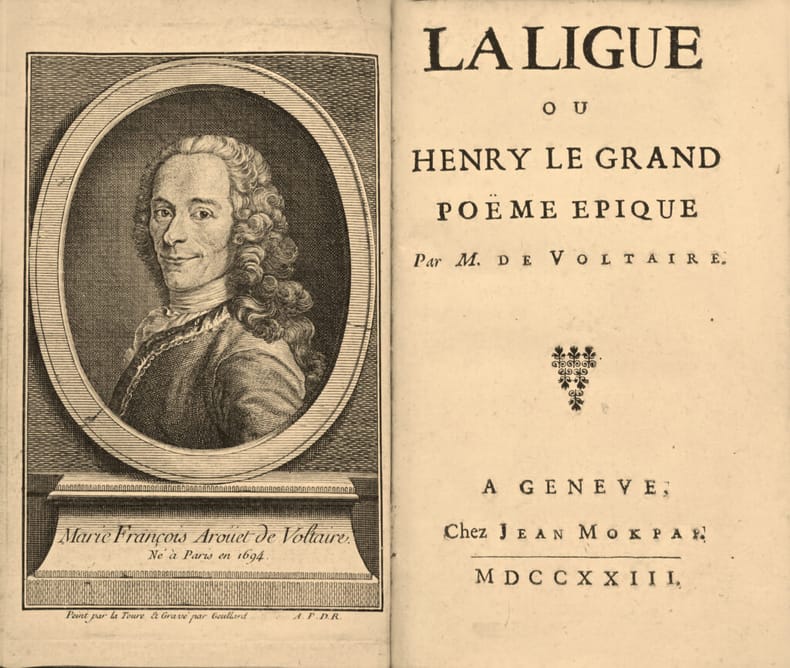
LCS-18493Exceptionnel exemplaire de l’édition originale relié en maroquin de l’époque armorié, condition absolument rarissime pour cette œuvre précoce de Voltaire. Genève [Rouen], Jean Mokpap [Viret], 1723. In-8 de viii pp., 231 pp., (1) f. bl, enrichi du portrait de Voltaire peint par La Toure. Plein maroquin olive, triple filet doré autour des plats, armoiries frappées or au centre, dos à nerfs finement orné, roulette intérieure, coupes décorées, tranches dorées sur marbrures. Reliure en maroquin armorié de l’époque. 184 x 113 mm.
175908228Geneva: Gabriel Cramer 1759. First Edition. Full Leather. Fine. The third of the first four editions according to Bengesco 1436 and the fourth edition according to Wade see Voltaire and Candide 1959 p. 201 dated 1759 with 299 pages clandestinely printed and published by Cramer in Geneva and preceeding the other 16 different editions published throughout Europe in 1759. The present copy conforms to Bengesco 1436 in every respect which is "page by page line for line like the first edition" except for the "que ce ce fut" error on page 103 an error which was introduced by Cramer into the early printings then doubtless not "fixed" as it was correct in the first place. Note that the fleurons agree exactly with Bengesco 1436 as follows: p. 134 is a basket of fruits; p. 228 shows two horns 'a plenty; the fleuron at p. 115 is repeated on pages 179 and 193; fleuron on page 213 is signed N. C. and is repeated on page 279; page 277 is paginated 177. The present copy also agrees with Wade see Voltaire and Candide 1959 p. 201 in every respect including that page 17 is numbered 15. Both the above references to Bengesco and Wade show signatures A-N3 meaning they are bound without the Table of Chapters; the present copy like 7 of the 10 known copies of the first edition shows signatures A-N6 without the final leaves N7 a blank and without N8 instructions to the binder concerning the cancellation of two pairs of leaves B4 B9 and D6 D7. In addition to the above let us state the textual points in the present copy: page 31 B4 an unnecessary paragraph break was eliminated. The words "mais il y a une raison." do NOT start a new paragraph; page 41 B9 several short sentences about the Lisbon earthquake were rewritten as "car dit-il tout ceci est."; page 84 D6 D7 reads "Nos filles se trouverent."; page 103 reads "que ce fut." as explained above was correct to begin with then discovered by Cramer and was not "fixed"; page 125 reads "mais ils se leverent precisement."; page 242 the paragraph beginning "Candide etait afflige."; has been removed by Voltaire while the book was being printed as it was critical of German poets. Pages 121 - 168 signatures F and G are a larger type than the rest of the book. In summation the present copy agrees with the first edition except that the "que ce ce fut." error was discovered and not inserted and the fleurons differ but are by Cramer who printed the first four editions. This a wide margined copy is larger than other copies we have seen at 165 mm x 95 mm; beautifully bound in late 19th Century full tan leather with raised bands and gilt decoration on spine with a brown leather lettering piece marbled end papers all edges gilt; printed on laid paper. The text is remarkably clean and bright; a fine copy. PMM204. <br/><br/> Gabriel Cramer hardcover books
1759752Genève Geneva: Cramer 1759. First Edition. 3 vols. in one 12mo 164 x 100mm pp. 2 291 1; 133 1 35 1. First printing of the great 18th century philosophical narrative with all the points correct. Including the 3 usual cancels the right title page ornament repeated pages 193 and 266 the misprints of “que ce ce fut†page 103 line 4 and “précisément†page 125 line 4 the correction removing a paragraph break page 31 the rewritten lines about the Lisbon earthquake page 41 etc. Contemporary full calf red calf label rebacked with the original spine saved and laid down recornered marbled endpapers gilt rubbed inner paper hinges strengthened old ink signatures on the endpaper and front blank tiny signature on the title page one tissue strengthened tear at the bottom of A2 touching the last 3 lines of text without any loss otherwise internally quite nice clean and very good. Bound without N7 a blank and N8 a notice to the binder as is usual agreeing in all respects to what you would have received if you had purchased a copy in sheets on publication day then bought the sequels and then handed them over to the most local Swiss bindery. Ref: PMM 204. There were 18 editions of Candide in 1759. It took 221 years for a clear and convincing bibliography to first sort them out and then got accepted and once accepted our real 1st edition was confirmed as rare. In the last 15 years however that bibliographical data has been more widely circulated and several 1st editions that weren’t on the original 22–copy census have come into market. It is still scarce more so in a contemporary binding.<br /> <br /> Candide bides as the epitomic philosophical fable of the French Enlightenment and the genotype of irony without exaggeration and though it’s laced with more salt than the postwar streets of Carthage it repeatedly tolls a reminder that light hearts live long. Most importantly Candide remains remarkably relevant when examined through contemporary frameworks functioning as an incisive proto-postcolonial text that anticipates modern discourse on global inequality systems of oppression and the limitations of Enlightenment rationality. The novel's scathing portrayal of slavery conquest and religious persecution resonates with intersectional analyses that recognize how power structures interlock across racial gender and economic dimensions. The savage irony throughout the text dismantles not just philosophical optimism but also European exceptionalism exposing the hypocrisy of colonial enterprises and religious institutions alike. The narrative's episodic structure—with its global movements between Europe South America and the Ottoman Empire—invites discussions of transnationalism and diasporic experience while Candide's concluding retreat to cultivate his garden has been reinterpreted by ecocritical scholars as both an acknowledgment of environmental interdependence and a potentially problematic withdrawal from systems-level political engagement.<br /> <br /> “Do you believe†said Candide “that men have always massacred each other as they do to-day that they have always been liars cheats traitors ingrates brigands idiots thieves scoundrels gluttons drunkards misers envious ambitious bloody–minded calumniators debauchees fanatics hypocrites and fools†“Do you believe†said Martin “that hawks have always eaten pigeons when they have found them†<br /> –Voltaire Candide. Cramer unknown
LCS-18355La Henriade de Voltaire conservé dans son maroquin de l’époque mosaïqué et armorié, condition d’exception pour un livre imprimé au cours de la Révolution française. Paris, P. Didot, fils aîné de F.A. Didot l’aîné, 1790. Grand in-4 de 1 portrait, 1 pl. hors-texte, xl pp., 222 pp., (1) f., 12 planches hors-texte. Plein maroquin rouge à grain long, plats richement ornés de filets, grecque et roulette dorées, dos à faux-nerfs mosaïqué avec incrustation de bandeaux de maroquin vert, pièces de titre et de tomaison en maroquin vert, chiffre doré du prince Albert de Saxe-Teschen répété cinq fois dans les entre-nerfs, coupes décorées, roulette intérieure, tranches dorées. Reliure armoriée et mosaïquée de l’époque. 308 x 228 mm.
LCS-18034Cette édition originale de Candide est très rare. S.l. [Genève, Cramer], 1759. [Reliés à la suite] : II- [Maubert de Gouvest, Jean-Henri]. Ephraïm justifié. Mémoire historique et raisonné sur l’état passé, présent et futur des finances de Saxe... adressé par le Juif Ephraïm à son cousin Manasses d’Amsterdam. Nouvelle édition. Erlangen, 1758. III- [Du même]. Lettre du Prince de Prusse mourant, au Roi son frère. Erlangen, 1758. IV- [Rémond de Saint-Sauveur]. Remerciement d’un Particulier à Messieurs les Philosophes du Jour. V-[Coyer, Gabriel-François]. Lettre au R.P. Berthier sur le matérialisme. Genève (Paris), 1759. Soit 5 ouvrages reliés en 1 volumes in-12 de : I/ (1) f.bl., 299 pp. (signatures A-Nh), (1) f.bl. ; II/ viii pp., 103 ; III/ 23 pp. ; IV/ 8 pp. ; V/ 77 pp. L’encre noire a légèrement déchargé en transparence lors de l’impression de Candide. Reliure de l’époque en veau marbré, dos lisse orné de motifs dorés, pièce de titre de maroquin rouge, tranches rouges. Reliure de l’époque. 161 x 93 mm.
LCS-186414L’un des exemplaires imprimés sur grand papier fin. De l’imprimerie de la Société Littéraire typographique 1784-1789. 70 volumes. Grand in-8, maroquin vert, encadrement doré sur les plats, roulette intérieure et coupes finement ornées, dos lisses ornés de motifs dorés (certains légèrement passés), pièces de titre et de tomaison de maroquin rouge, tranches dorées. Quelques rousseurs inhérentes au papier. Reliure de l’époque. 245 x 150 mm.