866 résultats
1957WRCLIT54227Paris: Plon 1957. Large octavo. Printed wrappers. Color frontis portrait. First edition ordinary issue. Edited by Theodore Besterman. Wrappers lightly soiled internally fine. Plon unknown books
elala5774London: Au dépens de la Compagnie 1757. Originally published at The Hague in 1738 this collection of writings begins with the letter on the soul. It should not be confused with Voltaire’s Lettres Philosophiques Letters Concerning the English Nation. Bengesco II p. 20 1558n. 8vo. pp. 285 3. woodcut tailpieces. 19th century bds. worn. elala5774 London: Au dépens de la Compagnie, 1757 unknown
elala5775London: Au dépens de la Compagnie 1775. Originally published at The Hague in 1738 this collection of writings begins with the letter on the soul. It should not be confused with Voltaire’s Lettres Philosophiques Letters Concerning the English Nation. Bengesco II p. 20 1558n citing 8vo. 12mo. pp. 316. Uncut in original wrs. elala5775 London: Au dépens de la Compagnie, 1775 unknown
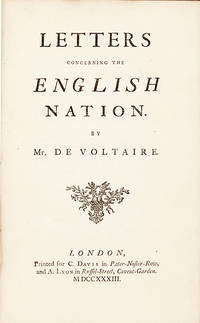
173327422London: Printed for C. Davis and A. Lyon 1733 1733. First edition. Cf. Bengeso 1558; Sabin 100751 noting Voltaire's letters on William Penn and the Pennsylvania Quakers. Fine copy. 8vo contemporary paneled calf rebacked with a new spine and raised bands. The first appearance of an early and important prose work by Voltaire a series of epistolary observations comparing British and French society culture science and philosophy. Written when he was living in England 1727-28 Voltaire's opinions shed a favorable light on British institutions and individuals including Sir Isaac Newton. Voltaire tells an early version of the apple falling from the tree story that inspired Newton's theory of gravity. When Letters was published on the continent as Lettres Philosophiques 1734 it was condemned by French authorities and precipitated one of Voltaire's many conflicts with the crown. <br/><br/> London: Printed for C. Davis and A. Lyon, 1733 unknown books
117621Glasgow Printed by Robert Urie 1759. . Fourth edition; 12mo 18 x 10.5 cm; a little toned front hinge reinforced; contemporary tree calf contrasting red morocco lettering-piece to spine joint and headcap repaired slightly scuffed and rubbed very good; 6 3-149 13pp.<br /> An early Glasgow printing of this interesting outsider's take on English society and its people precipitated by Voltaire's exile to Great Britain in 1726. <br /><br />The resulting Letters first published in 1734 following his return to Paris express his great admiration for the comparative religious freedom enjoyed by England's Quakers and Socinians as well as its constitutional monarchy 'where the Prince is all powerful to do good and at the same time restrain'd from committing evil' the implication being that England could provide a model for France's reform p.53. When the French edition was published the following year without the approval of the royal censor as Lettres Philosophique it caused a storm with copies confiscated and publicly burnt and Voltaire again forced to flee Paris.<br /><br />The work remains one of Voltaire's most widely known and read texts which helped introduce Bacon Locke and Newton to Europe's Enlightenment thinkers. It also contains an early account of Newton's famous discovery of gravity passed on to Voltaire by Newton's niece Catherine Barton as well as an early translation into French verse of Hamlet's soliloquy from Act 3 Scene 1: 'Demeure il faut choisir & passer à l'instant / De la vie à la mort ou d l'Etre au neant.' p.173.<br /><br />Widely ranked as Voltaire's most important early philosophical work and 'the first bomb hurled against the Ancien Régime' Babson.<br /> ESTC T137639. Glasgow, Printed by Robert Urie, 1759. unknown
173360085London C. Davis and A. Lyon 1733. 8vo. Lovely contemporary full Cambridge-style binding with five raised bands to spine and blindstamped ornamental borders to boards. . Double gilt line-borders to boards. All edges of boards with gilt borders. Gilt title to spine. Hinges neatly and professionally re-inforced. Internally very nice clean and fresh. A lovely crisp and large copy with good margins printed on heavy fine paper. 16 -including preface contents advertisements 253 1 18 -Index pp. <br/><br/><em>The important actual first edition of this highly celebrated key work of the Enlightenment in which the anecdote of how Newton discovered gravity the story about Newton and the falling apple appeared for the first time together with the description of the difference between the physical world view of the English and the French the "plenum" and the "vacuum". This seminal work in which Voltaire famously depicts British philosophy science society and culture in comparison to French can be viewed as the Enlightenment equivalent to Tocqueville's "Democracy in America". This series of essays which is based on Voltaire's experiences when living in England was actually written by Voltaire mostly in English which he mastered to perfection. It has often been presumed that the first edition of the work was that published in French in 1734 but actually the present English edition constitutes the actual first appearance of the work as well as the version that is closest to Voltaire's intention as the French language version is the re-written one and the English version the original. Curiously almost all modern English versions are translations into English of the French edition instead of the original English version making this edition of the utmost importance.After the original English edition of 1733 two French editions soon followed the first in 1734. Unlike the British the French resented the book and already in 1734 the French Parliament issued an order for the author's arrest and condemned the work causing the impact of it in France to be delayed. The book was burned for being "dangerous to religion and civil order". At the same time the work became a bestseller in Britain and as much as 14 editions of the work were published in the eighteenth century. "Inspired by Voltaire's two-year stay in England 1726-8 this is one of the key works of the Enlightenment. Exactly contemporary with Gulliver's Travels and The Beggar's Opera Voltaire's controversial pronouncements on politics philosophy religion and literature have placed the Letters among the great Augustan satires. Voltaire wrote most of the book in English in which he was fluent and witty and it fast became a bestseller in Britain. He re-wrote it in French as the Lettres philosophiques and current editions in English translate his French." Nicholas Cronk Introduction to the Oxford's Classics edition from 1999.The great French philosopher Voltaire was greatly impressed by the philosophical and scientific achievements of the English especially those of Newton Locke and Bacon. As a disseminator of scientific knowledge Voltaire came to play a great rôle in the popularization of Newtonian science and its discoveries the present work being a prime example. Although the work was condemned by the French authorities it still came to play a great rôle in the spreading of Newtonian ideas in France. The present work generally came to play a dominant rôle in Enlightenment accounts of the history of science and philosophy. The work focuses on British science and thought and uses the accounts of these to emphasize what is lacking in French society and French thought. The work is generally very critical towards the French "ancient régime" and when Voltaire here discusses the emergence of empiricism it is viewed as an English tradition that stands in opposition to the French rationalist tradition with Descartes as the prime example. This view is taken over by the following Enlightenment historians of science and philosophy e.g. d'Alembert see for instance his "Preliminary Discourse" of 1751. Some of the most influential passages of the work are probably those on Bacon who Voltaire sees as the founder of modern experimental science Newton and Descartes. Letters XIV on Descartes and Newton XV on attraction and XVI on Newton's Optics from 1704 are among the most influential essays of the work. In XVI Voltaire reflects upon Newton's "Optics" and the way that he rejected Descartes' theory and set out his own account of the properties of light. In XV he presents the first account of Newton and the falling apple: "As he was walking one Day in his Garden and saw some Fruits fall from a Tree he fell into profound Meditation on that Gravity the Cause of which had so long been sought but in vain by all the Philosophers whilst the Vulgar think there is nothing mysterious in it. He said to himself that from what height soever in our Hemisphere those Bodies might descend their Fall wou'd certainly be in the Progression discover'd by Galileo; and the Spaces they run thro' would be as the Square of the Times. Why may not this Power which causes heavy Bodies to descend and is the fame without any sensible Diminution at the remotest Distance from the Center of the Earth or on the Summits of the highest Mountains; Why said Sir Isaac may not this Power extend as high as the Moon." pp. 127-28.But perhaps the most famous passage in the volume is the opening of Letter XIV: "A Frenchman who arrives in London will find Philosophy like every Thing else very much chang'd there. He had left the World a "plenum" and he now finds it a "vacuum". At Paris the Universe is seen compos'd of Vortices of subtile Matter; but nothing like it is seen in London. In France 'tis the Pressure of the Moon that causes the Tides; but in England 'tis the Sea that gravitates towards the Moon; so that when you think that the Moon should make it Flood with us those Gentlemen fancy it should be Ebb which very unluckily cannot be prov'd." pp. 109-10. </em> hardcover
17639356Londres, J. Nourse, 1763. In-12 de 213 pages, plein maroquin vert, dos lisse richement orné, triple filet doré encadrant les plats, fleurons aux angles, filet doré sur les coupes, tranches dorées, dentelle dorée intérieure, garde de soie jaune.
1963LFA01414Un ouvrage de 692 pages, format 185 x 120 mm, illustré, relié cartonnage dos cuir, publié en 1963, Editions Garnier Frères (Paris), bon état
40520Paris Librairie Universelle de P. Mongie ainé 1821 in 8 (21x13) 1 volume reliure demi veaur rouge de l'époque, dos à nerfs soulignés d'une roulette dorée et orné de flaurons estampés à froid, tranches marbées, 264 pages. Adressées à M. Dupont, avocat au conseil souverain de Colmar; précédées d'un jugement philosophique et littéraire sur Voltaire, et suivies d'une épître inédite au roi de Prusse, et de fragmens de lettres à Grimm, Diderot, Helvétius, Thiriot, Damilaville, au marquis de Fraigne et autres. Bon exemplaire ( Photographies sur demande / We can send pictures of this book on simple request )
36479Genève, Librairie Droz, 1952. In-8°, XLIII-316p. Broché, couverture illustrée.
32894Paris, Dupont, 1826. In-8 broché de II + 380 + XXXVIII (Tables) pages. Portrait-frontispice, vignette dans le titre (château de Ferney), 1 fac-similé dépliant de l'écriture de Voltaire. Editions originale. Extrait des Œuvres Complètes éditées chez Dupont, 70e volume. Couverture imprimée en état médiocre (manques au dos, déchirures ou petits manques sur les plats). Intérieur correct avec des rousseurs.
187210066Paris GARNIER 1872 1 Ornée d'une galerie de portraits historiques d'après les dessins de Philippoteaux et de Staal. Paris, Garnier Frères, 1872, in-8, demi-chagrin rouge, dos orné à 4 nerfs, tranches dorées, 622 pp.
17902859A Londres, sans nom, 1790. 2 tomes en 1 volume in-8 de XII-126, IV-144 pages. Cartonnage de papier marbré, dos lisse et muet.
1766144011766 Genève (Amsterdam), sans nom d'éditeur (Robinet), 1766, in 8 de (8)-16-200 pp., rel. d'ép. plein veau fauve marbré, dos lisse orné de fers dorés, pièce de titre de maroquin vert amande, tranches rouges, bel ex.
177538798Amsterdam Geneva: Jean Robert 1775. Early reprint of 1770 first edition. Half-bound blue leather spine and edges blue cloth covered boards. Gilt stamped lettering to spine navy endpapers. TEG red edgestain. Wear and rubbing to binding light soiling to leather and sunning to edges. Bookplate to front pastedown lacks front free endpaper. Age-toning to paper. An About VG copy. viii 174 2 blank pp. 7-3/4" x 5" <br/><br/>"Madame de Caylus was the mother of the noted French archeologist engraver and man of letters Comte de Caylus. She was a close relative of Madame de Maintenon who brought her up like her own daughter and introduced her to the life at court. She wrote valuable memoirs of the court of Louis XIV entitled 'Souvenirs'; these were edited by Voltaire and by many later editors." Encyclopedia Britannica. Voltaire studied and wrote about this historical period and was the first to edit the 'Souvenirs'. He added interesting observations critical remarks corrections of Madame de Caylus' statements - completing the vivid sketch of life at the court. Jean Robert hardcover books
1945293861945. Paris Les Editions nationales 1945. Un vol. au format in-4 288 x 232 mm de 234 pp. brochÂŽ sous couverture ˆ rabats rempliÂŽs et ÂŽtui-chemise de plein cartonnage crÂme dos lisse piÂce de titre contrecollÂŽe sertie d'un double filet en noir. Un des 500 exemplaires numÂŽrotÂŽs du tirage sur pur-fil Johannot second papier aprÂs les 100 de tÂte sur vÂŽlin d'Arches. L'ouvrage s'agrÂŽmente - ici en premier tirage - de 52 eaux-fortes dont 12 hors-texte de Jean-Louis Viard. ''Le rythme de Voltaire est ˆ lui et insÂŽparable de la forme de son esprit. En dÂŽpit qu'en aient les renchÂŽris et les ergoteurs ce voltairianisme dont les pages qui vont suivre sont la fleur est bien la crÂŽation de Voltaire comme sa langue''. Absent de Monod Manuel de l'amateur de livres illustrÂŽs modernes. Marques d'eau et claires rousseurs affectant l'ÂŽtui-chemise. Du reste trÂs belle condition. Peu courant. b42961 unknown
490Amsterdam [Genève] : Jean Robert, 1770. RARE EXEMPLAIRE DE PREMIÈRE ÉMISSION AVANT LES CARTONS ENTIÈREMENT NON ROGNÉ ET EN CARTONNAGE DE L'ÉPOQUE
1926WRCLIT59286Paris: René Kieffer 1926. Small quarto. Handsome color lithographed pictorial wrapper over stiff wrappers. About fine in nicked glassine wrapper. First edition in this format. Illustrated with over thirty vignettes and decorations by Braun colored via pochoir. From an edition of 550 numbered copies this is one of five hundred copies on vélin blanc. Monod asserts that despite the colophon publication actually took place in 1930. MONOD 11440. René Kieffer unknown books
1020887923.Ghardcover. Good. Access codes and supplements are not guaranteed with used items. May be an ex-library book. hardcover
1113034068.Gpaperback. Good. Access codes and supplements are not guaranteed with used items. May be an ex-library book. paperback
3439Paris: Librairie des Bibliophiles / D. Jouaust 1880. FIRST EDITION of one of Voltaire's most unusual works with a lot of explicit erotic verse. A SPECIAL LARGE-PAPER COPY ON CHINESE PAPER PRINTED FOR JOUAUST THE PUBLISHER. 2 leaves; XL 151 pp. plus frontispiece etched portrait of Voltaire also on Chinese paper. 8vo. Bound in contemporary cloth with leather spine label surely for Jouaust whose engraved bookplate is on the front pastedown. Entirely uncut and unopened. Leather spine label worn else fine and bright. Bengesco 1891 vol. II p. 363. <br/><br/> Paris: Librairie des Bibliophiles / D. Jouaust, 1880 hardcover
6930413like new. unknown
175116247Berlin: C F Henning. Very Good- with no dust jacket. 1751. First Edition; First Printing. Hardcover. Vellum darkened and with some surface cracking light extremity wear; light foxing. No half-title pages. Errata page for both volumes bound at end of Vol I. Two custom owners' bookplates in first volume. Solid hardcovers. ; French language. Half vellum binding with marbled boards. Two of two volumes complete. Bengesco I 1178. This work was the most researched and carefully prepared of Voltaire's works. He began work on this project in 1734 while at the Chateau Cirey put it aside in 1738 and resumed work on it in 1750. First Edition First Printing of Voltaire's pioneering historical study of the age of King Louis XIV published while Voltaire was resident at the court of King Frederick II of Prussia.; xii 488 2 errata; ii 466 in 2v pages . C F Henning hardcover
17512359The first edition of Voltaire's brilliant historical study of the age of King Louis XIV. Begun as early as 1732 Voltaire sent a manuscript version to Frederic II who was enthusiastic and encouraged its publication. In 1739 Voltaire published a 'Plan Raisonné' of the project including two finished chapters but this was condemned by the court and seized. In 1750 Voltaire left France for Frederic's court at Berlin where he set himself to complete the work. Failing to obtain the 'privilège royal' or even the non-written 'permission tacite' he decided to go ahead and publish the work in Berlin at his own expence. Voltaire continued to add to the work in subsequent editions most notably in the 1753 Berlin edition where he added a supplement in which he refuted the attacks made by La Beaumelle.<br /><br /><i>Two volumes in one 12mo 144 x 85mm pp. xiv 488 1 errata; ii 466 2 errata with the half-title to the first volume in contemporary calf rather worn spine gilt in compartments foot of spine chipped wormhole to the head of spine wanting the front endpaper red edges.</i><br /><br />BN Voltaire Catalogue 3361-3363. C.F. Henning
1785320871785. S.l. Editions d'Art Seper / Le Chant des SphÂres / Arts et couleurs 1986. 2 forts vol. au format pt in-4 262 x 205 mm de 201 et 216 pp. Reliures d'ÂŽdition de plein skyvertex lie-de-vin ˆ l'imitation de maroquin filets d'encadrement dorÂŽs et ˆ froid sur les plats lesquels s'ornent d'une large frise d'encadrement ˆ froid composition figurative en relief au centre frappÂŽe des armes dorÂŽes de France jeux de filets en relief formant croisillons sur fond de lys en relief fleurons dorÂŽs dos ˆ nerfs ornÂŽs de filets maigres ˆ froid caissons d'encadrement dorÂŽs entrelacs de fleurons en relief ˆ froid armes de France et fleuron hÂŽraldique dorÂŽs titre dorÂŽ tomaison dorÂŽe tÂtes dorÂŽes gardes de pleine moire lie-de-vin sous ÂŽtuis bordÂŽs. Un des exemplaires du tirage numÂŽrotÂŽ ; complet de son certificat d'authenticitÂŽ volant. Ensemble complet des deux volumes le constituant. Chacun s'agrÂŽmente de nombreuses autant que dÂŽlicates compositions en couleurs par Jean Gradassi. ''Toutes les illustrations de cette collection en trois volumes vÂŽritables reconstitutions historiques en couleurs ont ÂŽtÂŽ reproduites ˆ partir de sÂŽlections manuelles et rehaussÂŽes d'aquarelle au pochoir. ConfÂŽrant ˆ cette ÂŽdition une grande valeur artistique''. ''PassionnÂŽ d'Histoire Jean Gradassi se spÂŽcialise dans cet art difficile qu'est l'illustration et pour lequel l'ÂŽtude des costumes civils et militaires de l'architecture du mobilier d'ÂŽpoque sont une base indispensable ˆ sa crÂŽation artistique o chaque dÂŽtail mÂŽrite d'Âtre examinÂŽ ˆ la loupe. Quand on sait avec quelle minutie et quel souci du dÂŽtail chaque architecture chaque costume chaque personnage sont mis au point et avec quelle Ç maestria È dans la couleur il parvient ˆ faire vivre toutes ces scÂnes spirituelles et animÂŽes on est transportÂŽ d'admiration pour son art''. Voltaire cÂŽlÂbre ici les idÂŽes progressistes des LumiÂres fait ÂŽtat des avancÂŽes culturelles techniques et ÂŽconomiques rÂŽalisÂŽes au cours du rÂgne de Louis XV. TrÂs belle condition. b42961 unknown