455 résultats
1813003676London: R. Ackermann 1813. Leather. Very Good. William Blake. Original half brown morocco over pebbled boards five raised bands gilt title and decorated compartments marbled endpapers 14" x 11 1/2". Dedication to the Queen by Blake List of Subscribers from 1808 issue Advertisement signed Cromak Remarks signed Fuseli Biographical sketch of Robert Blair Biographical sketch of Lewis Schiavonetti Biographical sketch of Robert Hartley Cromek Text of poem 37 pages Of the Designs; Engraved Blake portrait engraved titlepage of 1808 plus 11 full-page plates engraved by Schiavonetti after William Blake at rear. Some general exterior wear bumped corners and rubbing; typical light foxing heaviest on Blake portrait and engraved title page else internally clean. Provenance: Armorial bookplate of George Baird Stichill. Size: Folio <br/> <br/> R. Ackermann hardcover
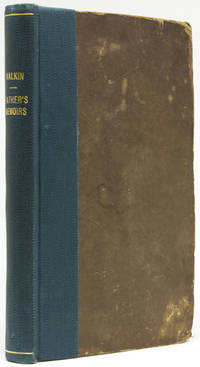
1806220643London: T. Bensley for Longman Hurst Rees and Orme 1806. First edition. Engraved frontispiece by Robert Cromek after the design by William Blake and Haye and three plates one folding map. xlviii 172 pp. 1 vols. 8vo 25 x 15.5 cm. UNCUT in the original boards; rebacked in cloth endpapers renewed. Fine tall copy. First edition. Engraved frontispiece by Robert Cromek after the design by William Blake and Haye and three plates one folding map. xlviii 172 pp. 1 vols. 8vo 25 x 15.5 cm. A William Blake Milestone: the First Account of His Life. A book of paramount importance to Blake studies. Malkin was a personal friend of William Blake with whom he shared an interest in radical politics and on the death of his gifted six-year-old son Thomas in 1802 Malkin commissioned Blake to design the frontispiece for Malkin's FATHER'S MEMOIR. In his Preface to this work Malkin gives what the DNB calls the "first and fullest" account of Blake's early life and career and it was with this very tribute to his friend's idiosyncratic genius that Malkin first gave impetus to a more general appreciation of William Blake's art. Keynes 80; Bentley Blake Books p. 18 T. Bensley for Longman, Hurst, Rees, and Orme unknown books
1813109308e. London: Bensley for Ackermann 1813 i.e. 1870. 4to 2 liv 42 pp. With a portrait frontispiece etched title and 11 plates all with tissue guards. Blind-stamped black cloth rebacked with black cloth lettered in gilt. § Third quarto edition printed from the same plates as the 1813 edition but actually issued by or for John Camden Hotten in 1870. Of this version Essick wrote: “I've also seen the true 1813 text and plates in a very similar cloth binding with just a few differences in the blind stamping but very much the same style and period. My theory on that is that Camden Hotten who produced the 1870 issues not only got the copperplates from Ackermann with the Spanish inscriptions for de Mora but also some remainders of the impressions and letterpress and bound these up in a slightly different just the blind stamping and perhaps the cloth color or weave fashion. He removed the Spanish on the coppers and had an engraver restore the 1813 English inscriptions then printed for both the portfolio and the 1870 issue of the text with the engravings. Bentley lists the 1870 issue in Blake Books but I don't believe he lists the portfolio issue of the plates only. I have a vague recollection however that he did note it in one of his later checklists of publications in the Blake Quarterly.†Bentley Blake Books 435E. Bensley for Ackermann hardcover books
18771229001877. London: John Pearson 1877. <br /> <br /> Large 4to 100 plates printed in black and white with black framing lines. Original upper blue-gray wrapper backstrip and lower wrapper supplied text block untrimmed. <br /> <br /> § A wonderful facsimile of copy D now at Harvard limited to 100 copies per Bentley and Keynes but an old Quaritch catalogue stated 250 an unlikely number although a copy is recorded with the number "385" on the front wrapper. This copy numbered 5 on the upper cover. Bentley attributed the publication to Chatto but revised it to Pearson in his Blake Books Supplement. The Rinder copy reproduced by the Trianon Press is in a smaller format and this large quarto has a much more imposing and appealing presence and seems to be a better facsimile - certainly this copy is clearer and more striking than copy C. Bentley BB 76 and BBS p. 88. <br /> <br /> "Blake's final and longest epic in illuminated printing constitutes a recapitulation and summation of his multiple interests ranging from his own mythology to biblical history from sexuality to epistemology and from the Druids to Newton. The cast of characters is vast but Los the artist's imagination at work in the material world Jerusalem and Albion the female and male portions of divided humanity who must be reunited the nature goddess Vala and Jesus play major roles." The Blake Archive Blake made five copies of Jerusalem but only colored one. A suite of 25 plates was also colored by Blake and a few posthumous copies were printed in tints. The one-hundred plates of Jerusalem were etched in relief with many designs in white-line etching between c. 1804 the date on the title page and 1820. unknown
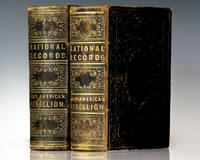
1863133068Columbus Ohio: Gilmore and Brush 1863-1866. Complete first edition set of Blake's scarce history of the American Civil War. Quarto two volumes original publisher's gull morocco elaborately decorated in gilt marbled endpapers all edges marbled illustrated. In good condition. A rare complete set of this scarce work far more rare than Blake's better-known History of Slavery and the Slave Trade. Gilmore and Brush unknown
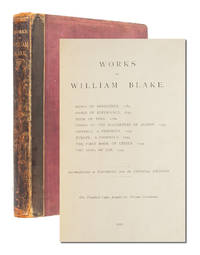
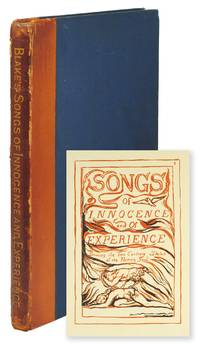
18766180N.P.: N.P. 1876. Very Good. One of 100 copies printed for private circulation. Quarter roan over cloth with gilt to spine. Spine rubbed and corners worn. Front hinge split; rear hinge starting. Bookplate of Albert May Todd to front pastedown else no signs of ownership or use. Aside from an extra-illustrated and handcolored copy that appeared recently at auction no other is in the modern auction record since 1936.<br /> <br /> This edition "made available for the first time complete reproductions of Songs of Innocence and of Experience The Book of Thel Visions of the Daughters of Albion America Europe The Book of Urizen and The Song of Los. and therefore has some historical importance as a pioneering albeit flawed project" Paley. It remains a visually pleasing work for lovers of Blake's poetry. Very Good. [N.P.] unknown
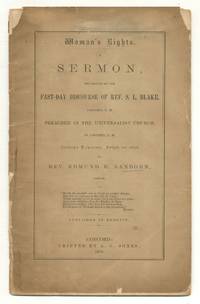
1870527239Concord New Hampshire: Printed by A. G. Jones 1870. Softcover. Good. First edition. Octavo. 24pp. Sewn light brown wrappers printed in black. A good or better copy; the wrappers are present but partially detached along spine moderate soiling and small stains on unprinted rear wrapper and final printed page with a few small chips at corners of covers the printed text has light foxing and soiling. An 1870 sermon by Rev. Edmund R. Sanborn in defense of woman's rights and the education of women in response to a discourse by Rev. S. L. Blake in opposition to woman's rights. Very scarce. OCLC lists two holdings. Printed by A. G. Jones unknown
1828107872Single plate by William Blake. London: for the author and sold by Longman 1828. Single plate by William Blake cleaned by Court Benson. § From the first and only edition of this elusive Blake item. Includes Blake's figure of the constellation 'Cancer' which may be a caricature self-portrait of Blake himself. Keynes 248: 'extremely rare'. Bentley Blake Books 501. for the author and sold by Longman unknown books
18281078721828. London: for the author and sold by Longman 1828. <br /> <br /> Single plate by William Blake cleaned by Court Benson. Framed.<br /> <br /> § From the first and only edition of this elusive Blake item. Includes Blake's figure of the constellation 'Cancer' which may be a caricature self-portrait of Blake himself. Keynes 248: 'extremely rare'. Bentley Blake Books 501. unknown
1861836Columbus Ohio: H. Miller 1861. Publishers full embossed leather binding. Near Fine. Book is in Near Fine condition beautifully bound in publishers full embossed leather binding. Binding and hinges are excellent inside front hinge reinforced with Japanese tissue pages are remarkably bright and clean without marks and little to no foxing. Beautifully illustrated throughout. Book measures 10.25" x 7.25" 165 Years Old. A beautiful example scarce in this condition. H. Miller unknown
1886d2793London: Kegan Paul Trench & Co. G : in good condition. Covers rubbed and soiled. Eps darkened. Fold-out repaired with archive tape. 1886. First Edition. Blue hardback boards with cream vellum spines. 320mm x 240mm 13" x 9". vi 160pp; viii 160pp iv; vii 160pp plates. 37 plates 24 b/w 13 sepia 1 fold-out. Published 1886-18878. With Glasgow Arts Club bookplate. Heavy set extra shipping needed for overseas. . Kegan Paul, Trench & Co hardcover
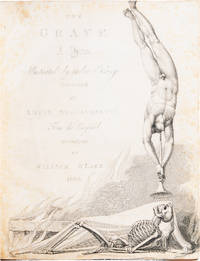
18701278541870. BLAKE William BLAIR Robert. The Grave. London: John Camden Hotten circa 1870. Folio 11 by 14 inches modern three-quarter red morocco raised bands top edge gilt. $1650.Third edition of Blair's singular poetic achievement with splendid engraved frontispiece portrait of William Blake and 12 engraved plates rendered by Shiavonetti after Blake's original designs including the engraved title page. In October 1805 Blake was commissioned by the engraver and would-be publisher Robert H. Cromek to prepare 40 drawings for Robert Blair's Grave from which Cromek planned to select 20. While The Grave originally appeared in 1743 the illustrations in this very scarce second edition and the rarely found 1808 first edition are especially famous for vividly demonstrating ""the rare imaginative power of William Blake"" Magnusson 162. ""In fact Blair had a perceptible influence on Blake the poet as well as on Blake the painter"" Kunitz & Haycraft 46. A dispute over a preliminary etching ""in white-line"" called ""Death's Door"" which Cromek rejected resulted in Blake's being prevented from engraving his own designs so the 12 drawings eventually selected were rendered by Louis Schiavonetti ""with a mingled grace and grandeur which won for them a wider popularity Never has the theme of death been handled in pictorial art with more elevation and beauty"" DNB. Also featured is Blake's dedicatory poem ""To the Queen"" a prefatory comment on the designs by Henry Fuseli and a concluding section ""Of the Designs."" Preceded by the rare 1808 edition of less than 600 copies and the large folio second edition of 1813. This third edition was produced by John Camden Hotten sometime around 1870 after Gilchrist's 1863 Life of William Blake reawakened an interest in the poet/artist. With minor alterations Gilchrist was able to use the original plates from the 1813 edition with the reset text being a very close imitation of the original; the letterpress title page is still for the 1813 Ackermann edition for instance with no mention of Hotten or 1870. Bentley Blake Books 350A. Keynes 82. Ray Illustrator and the Book in England 6a. See Lewine 68. Fine condition. hardcover
183459712New York: published by Peter Hill no. 94 Broadway 1834. Large 8vo in 4s approx. 10¼" x 6½" pp. 6 960; alphabetical text in double column; engraved oval frontispiece portrait of George Washington and 22 lithographs by Pendleton of notable American architecture; contemporary quarter diced russia over marbled boards; boards worn neatly rebacked with old spine laid down; internally clean and the binding remains sound. Early owner's ownership signature on two flyleaves and recto of the frontispiece. Originally published in monthly parts beginning in 1832 of which no copies in OCLC this is the first book edition. Among the buildings represented are City Hall Augusta Georgia; Columbia College; the Deaf and Dumb Asylum Philadelphia; Mount Auburn Cemetery; Andover Theological Seminary; Mount Vernon; the Arcade in Providence; Kenyon College; Dartmouth College; the Capitol of Pennsylvania at Harrisburg; Yale College and State House; The White House State House in Boston and City Hall in New York among others. That six of the nine records in OCLC are for individual plates suggests that this was a book often broken up for the lithographs. OCLC locates a total of only 7 copies: Yale Boston Athenaeum Boston Public Harvard Lehigh Houston and the University of Edinburgh. Not noted in Walsh Anglo-American General Encyclopedias. Not in the Arents Collection of Books in Parts. American Imprints 23440; Sabin 5782. published by Peter Hill, no. 94 Broadway unknown
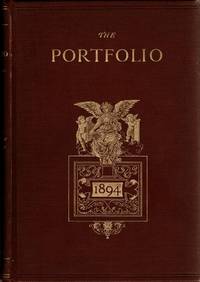
189432183AB1894. Original / First Edition. 21 Volumes bound in seven Volumes. London Seeley and Co. 1894-1896. Quarto 19.2 cm wide x 27.2 cm high. c. 1600 pages with a total of 37 Etchings / Engravings. Hardcover / All Volumes in their original very decorative Art Nouveau-Bindings with gilt lettering and ornament on spine and frontcover. All Bindings in protective Collectors-Mylar. Excellent actually stunning condition with only minor signs of wear and occasional foxing to some of the illustrations only. One layer loosened in the 1895-Volume. This collection of 21 Volumes Bound in seven Volumes includes: 1. 1894 - Annual Volume One 3 Volumes in 1: I. William Sharp - "Fair Women In Painting and Poetry" With Etchings by Alma-Tadema / Sir Peter Lely / Daniel Mytens etc. II. C.J.Cornish - "The New Forest" Illustrated by Lancelot Speed Alexander Ansted and John Fullwood III. Walter Armstrong - "Thomas Gainsborough" _______________________________________________________ 2. 1894 Annual Volume Two - 3 Volumes in 1: I. P.G.Hamerton - "The Etchings of Rembrandt" With Plates Etched in Facsimile by Amand Durand The four wonderful Rembrandt-Etchings are: a. Rembrandt with the Broad Hat and Embroiderd Mantle b. The Rat Killer c. Johannes Lutma d. Rembrandt's Mother seated looking to the right II. Rev. W.K.R.Bedford - "MALTA and the Knights Hospitallers" With Plates etched: a. "Isola Point" - Etched by A. Ansted b. "Rabato Gozo" - Drawn by T.H.Crawford and Engraved by Walter L. Colls c. "Citta Vecchia" - Etched by A. Ansted from a drawing by Edward Lear d. "Chapel of our Lady of Philermos" - Engraved by Walter L. Colls III. A.H. Church - "Josiah Wedgwood - Master-Potter" His Precursors / His Early Years / As Master-Potter / His Ceramic Improvements / His Invention of the "Jasper" Body / The Barberini or Portland Vase / Cameo His Cameos Medallions and Plaques / His Portrait Cameos / Vases in the Jasper Body / Miscellaneous Productions in Jasper / Later Years / Position as an Art-Potter / Collections and Collectors // Illustrations in the Wedgwood-Volume include: 1. Portland Vase / 2. Plaque Sacrifice of Iphigenia / 3. Two Medallions A Zephyr / 4. Medallion Portrait of Flaxman __________________________________________________ 3. 1895 - Annual Volume One - 3 Volumes in 1: I. C.J.Cornish - "The Isle of Wight" a. With an original etching by John Fullwood: "Freshwater Gate" Frontispiece b. With an original etching after E.Duncan: "Isle of Wight - The Fleet leaving Portsmouth" c. With an original etching by John Fullwood: "Bonchurch" d. With an original etching by Thomas Huson: "Sandown Bay" Also includes several text-illustrations of the Isle of Wight II. Julia Cartwright - "Raphael in Rome" III. L.Binyon - "Dutch Etchers" _____________________________________________________ 4. 1895 - Annual Volume Two - 3 Volumes in 1: I. Julia Cartwright Mrs. Henry Ady - "The Early Work of Raphael" Illustrated II. Walter Armstrong - "The Art of William Quiller Orchardson" WIth original engravings and text-illustrations III. George Grahame - "Claude Lorrain - Painter & Etcher" Illustrated _______________________________________________________ 5. 1895 - Annual Volume Three - 3 Volumes in 1: I. Richard Garnett - "William Blake - Painter and Poet" With an etching "The Sons of God" and several illustrations also in colour: a. "The Sons of God" From the Book of Job b. "The Lamb and Infant Joy" from Songs of Innocence c. "The Fly and the Tiger" From Songs of Experience d. "The Book of Thel Title-page in two facsimiles by W.Griggsl e. "America" With 19 further text-illustrations by William Blake including a rare portrait of Blake II. Olivier Georges Destree - "The Renaissance of Sculpture in Belgium" Illustrated III. W.H.James Weale - "Gerard David - Painter and Illuminator" Illustrated ______________________________________________________________________ 6. 1895 - Annual Volume Four - 3 Volumes in 1: I. W.J.Loftie - "Whitehall" With many interesting historical illustrations on Whitehall and Scotland-Yard II. Professor Anderson - "Japanese Wood-Engravings" Illustrated beautifully some in colour after Utagawa Toyokuni Utamaro Katsugawa Shuncho etc. III. Claude Phillips - Antoine Watteau Illustrated _______________________________________________________________ 7. 1896 - Annual Volume - 3 Volumes in 1: I. Claude Phillips - The Picture Gallery of Charles I. Illustrated II. Cecilia Waern - "John La Farge - Artist and Writer" Illustrated with a stunning engraving of "Prosperitas" an illustration of "The Wolf Charmer" etc. etc. III. Richard Garnett - Richmond on The Thames Illustrated with stunning engravings by a. John Fullwood "Richmond Hill" - Engraving b. Clough Bromley "The Thames from Buccleugh Gardens" - Engraving c. T.Huson "The View from Richmond Hill" - Engraving d. T.Huson "Richmond Bridge" - Engraving and many text-illustrations "The Portfolio" was a British monthly art magazine published in London from 1870 to 1893. It was founded by Philip Gilbert Hamerton and promoted contemporary printmaking especially etching and was important in the British Etching Revival. Early contributors included Francis Turner Palgrave 18241897 and Sidney Colvin 18451927. The mid-nineteenth century in France and Britain saw a rise in the interest in etching. Hamerton had spent the 1860s in France with his French wife Eugénie. The impetus for the launch of The Portfolio came in the wake of the foundation in Paris of the Société des aquafortistes in 1862 and to a lesser extent from the longer established Etching Club from 1838. Etchings by many French etchers such as Paul Rajon 18431888 and Alfred Brunet-Debaines 18451939 were a marked feature of the publication. Indeed The Standard remarked in 1874 that the publication's "speciality as probably most people know is the etchings with which it is adorned." Rajon published twelve etchings in the periodical before his untimely death. The New York Times lavished praise on the publication when in 1875 it remarked that it could not "eulogize too highly the merits of this periodical in all its departments. It is without question the most beautiful in regard to illustration which emanates from the press." The late nineteenth-century British author George Gissing wrote in his diary for December 1895 sic. that he took the magazine for his son because of its good pictures. In a survey of the etching revival in 1878 the Magazine of Art highlighted the centrality of Hamerton and his monthly magazine which had "so ably and unceasingly pleaded the cause of etching" in Britain. Wikipedia ______________________________________________________________________ Philip Gilbert Hamerton 10 September 1834 4 November 1894 was an English artist art critic and author. He was a keen advocate of contemporary printmaking and most of his writings concern the graphic arts. He was an important theorist of the English Etching Revival. Hamerton was born at Laneside a hamlet near Shaw and Crompton Lancashire England. His mother died giving birth to him and his father died ten years later. When he was about five he was sent to live with his two aunts at an estate called the Hollins1 on the edge of Burnley where he attended Burnley Grammar School. Hamerton's first literary attempt a volume of poems was unsuccessful leading him to devote himself for a time entirely to landscape painting; he camped out in the Scottish Highlands where he eventually rented the former island of Inistrynich in Loch Awe upon which he settled with his wife Eugénie Gindriez the daughter of a French republican magistrate in 1858. Discovering after a time that he was more suited to art criticism than painting he moved to Sens and later to Autun3 where he produced his Painter's Camp in the Highlands 1863 which was very successful and prepared the way for his standard work on Etching and Etchers 1866. In the following year he published Contemporary French Painters and in 1868 a continuation Painting in France after the Decline of Classicism. He had by now become art critic to the Saturday Review which necessitated frequent visits to England forcing him to give it up. He proceeded in 1870 to establish and edit an art journal of his own The Portfolio a monthly periodical each number of which included of a monograph upon some artist or group of artists often written by him. The journal championed printmaking especially etching. He selected and wrote the accompanying text for Etchings by French and English Artists London: Seeley 1874 which included work by Alphonse Legros and Léon Gaucherel. The discontinuation of his painting gave him time for writing and he successively produced The Intellectual Life 1873 perhaps the best known and most valuable of his writings; Round my House 1876 notes on French society by a resident; and Modern Frenchmen 1879 admirable short biographies. He also wrote two novels Wenderholme 1870 and Marmorne 1878. In 1884 Human Intercourse another volume of essays was published and shortly afterwards Hamerton began his autobiography which he brought down to 1858. In 1882 he issued a finely illustrated work on the technique of the great masters of various arts under the title of The Graphic Arts and three years later another splendidly illustrated volume Landscape which traces the influence of landscape upon the mind of man. His last books were: Portfolio Papers 1889 and French and English 1889. In 1891 he removed to Villa Clématis in the Parc des Princes district of Boulogne-Billancourt in the southwest suburbs of Paris. He died there suddenly on 4 November 1894 aged sixty occupied to the last with his labours on The Portfolio and other writings on art. In 1897 'Philip Gilbert Hamerton: an Autobiography 18341858; and a Memoir by his wife 18581894' was published. Wikipedia hardcover
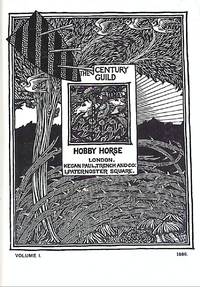
1886302951London: Kegan Paul Trench and Co 1886. Folding facsimile of the Blake broadside by William Muir. With explanatory note by Herbert Gilchrist at pp. 159-60. 1 vols. 4to. Blake plate folded fine. Volume bound in contmporary quarter brown morocco and cloth marbled endsheets t.e.g. Minor rubbing to joints. Very good. Folding facsimile of the Blake broadside by William Muir. With explanatory note by Herbert Gilchrist at pp. 159-60. 1 vols. 4to. First volume of the Hobby Horse publication of the influential Century Guild. Notable for the fine facsimile of the rare Blake broadside Little Tom the Sailor. The ballad is by William Hayley and in the autumn of 1800 Blake engraved the two images on pewter. The broadside was "Printed for & Sold by the Widow Spicer of Folkstone for the benefit of her orphans". The facsimile is uncredited but is by William Muir. Bentley 407b Kegan, Paul, Trench and Co unknown books
18931270451893. London: Quaritch 1893. <br /> <br /> Large 4to xxi pp. text 54 leaves printed in outline in reddish brown. Original half hardgrain morocco first blank and title-page foxed otherwise internally a very fine copy with some light wear to the backstrip.<br /> <br /> § A very scarce companion volume to the colored version both issued by Quaritch at the same time. Bentley Blake Books 173. Bookplate at the front of Pickford Waller and in the back that of Harris Elliott Kirk. unknown
1886302951London: Kegan Paul Trench and Co 1886. Folding facsimile of the Blake broadside by William Muir. With explanatory note by Herbert Gilchrist at pp. 159-60. 1 vols. 4to. Blake plate folded fine. Volume bound in contmporary quarter brown morocco and cloth marbled endsheets t.e.g. Minor rubbing to joints. Very good. Folding facsimile of the Blake broadside by William Muir. With explanatory note by Herbert Gilchrist at pp. 159-60. 1 vols. 4to. First volume of the Hobby Horse publication of the influential Century Guild. Notable for the fine facsimile of the rare Blake broadside Little Tom the Sailor. The ballad is by William Hayley and in the autumn of 1800 Blake engraved the two images on pewter. The broadside was "Printed for & Sold by the Widow Spicer of Folkstone for the benefit of her orphans". The facsimile is uncredited but is by William Muir. Bentley 407b Kegan, Paul, Trench and Co unknown
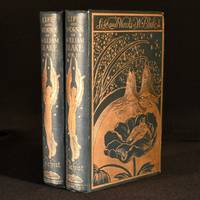
1893WRCLIT73714London: Bernard Quaritch 1893. Three volumes. Large thick octavo. Original green cloth spines and upper covers elaborately decorated in pictorial gilt after designs by Blake t.e.g. others untrimmed. Portrait facsimiles and plates. Spines somewhat rubbed and dull some shelfwear to joints and lower edges and bumps and wear to fore-tips endsheets a bit foxed and cloth a bit handsoiled some cracking and subtle repairs to inner hinges; still not a wholly disagreeable set of a work particularly susceptible to such issues. First edition. One of five hundred sets comprising the regular paper issue. Controversial in its interpretation of Blake's texts this work nonetheless remains in this issue and binding something of a landmark of 1890s book production. "The enthusiasm and comprehensiveness of this work are of considerable historical importance" - Bentley. Wade quotes Yeats's inscription in his own copy about the nature of this collaboration: "The writing of this book is mainly Ellis's the thinking is as much mine as his. The biography is by him. He re-wrote and trebled in size a biography of mine. The greater part of the 'symbolic system' is my writing; the rest of the book was written by Ellis working over short accounts of the books by me except in the case of the 'literary period' the account of the minor poems & the account of Blake's art theories which are all his own except in so far as we discussed everything together." WADE 218. BENTLEY 369. Bernard Quaritch hardcover books
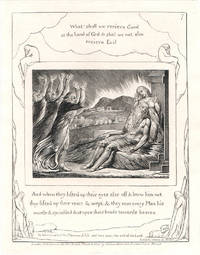
1828107781e 1825 but published 1826. London: March 8 1828 i.e 1825 but published 1826. Single leaf recently cleaned. § First edition one of 100 sets printed directly onto Whatman wove with the word “proof†removed. Blake had a long pictorial engagement with the biblical story of Job. This a single leaf from a series of 21 engravings commissioned by John Linnell in 1823 that are generally considered to be Blake's masterpiece as an intaglio printmaker. "Rather than using the customary "mixed method" of preliminary etching followed by engraving Blake used pure line engraving in the Job plates. Perhaps one of his motivations was to evoke the art of the master engravers of the Renaissance whom Blake greatly admired such as Albrecht Dürer." The William Blake Archive.In the Book of Job Job and his old friends argue at length over the divine purpose of Job's afflictions. This plate illustrates the moment the youthful Elihu overcomes his respect for his elders and bursts into the conversation to explain why he thinks both sides are wrong Job 32:6. In Blake's elaborate borders the figure of Job's Humanity sleeps while soaring angels try to awaken him.Bentley Blake Books 421A. Bindman Complete Graphic Works of Blake 625–641C. March 8 unknown books
1828107776e 1825 but published 1826. London: March 8 1828 i.e 1825 but published 1826. Single leaf recently cleaned. § First edition one of 100 sets printed directly onto Whatman wove with the word “proof†removed. Bentley Blake Books 421A. Bindman Complete Graphic Works of Blake 625–641C. March 8 unknown books
1828107778e 1825 but published 1826. London: March 8 1828 i.e 1825 but published 1826. Single leaf recently cleaned. § First edition one of 100 sets printed directly onto Whatman wove with the word “proof†removed. Bentley Blake Books 421A. Bindman Complete Graphic Works of Blake 625–641C. March 8 unknown books
1828107779e 1825 but published 1826. London: March 8 1828 i.e 1825 but published 1826. Single leaf recently cleaned. § First edition one of 100 sets printed directly onto Whatman wove with the word “proof†removed. Bentley Blake Books 421A. Bindman Complete Graphic Works of Blake 625–641C. March 8 unknown books
1880927P34London: Macmillan and Co 1880. Cloth. Very Good. 9.5" by 6.5". William Blake. The second and expanded edition of Alexander Gilchrist's illustrated biography on the life and work of William Blake. The second expanded edition.Complete in two volumes.An insightful biography on the life and work of William Blake by Alexander Gilchrist. The first volume is his biography whereas Volume II contains a compilation of Blake's own writings. At the time of this publication Blake remain fairly obscure with little known of his life.Blake was a Romantic poet and painter a seminal figure of the era. He wrote prophetic works though he was largely unrecognised during his lifetime.Volume I is illustrated with a frontispiece twenty-three plates and many in-text engravings.Volume II is illustrated with a frontispiece twenty-three plates and many in-text engravings.The illustrations are from Blake's own works done in facsimile by W. J. Linton.Collated complete.Gilchrist's biography remains a standard reference work on Blake however he died before the work was published. The work was mostly finished upon his death and was complete by his wife Anne with help from Dante Gabriel Rossetti and William Michael Rossetti. In the original publisher's cloth binding. Externally smart. Light bumping to the head and tail of the spines and to the extremities. Spines are a little faded. Light rubbing to the boards and spines including to the gilt. A few minor marks to the cloth. Small chip to the front joint and front board of Volume II and to the rear joint of Volume I. Bookseller's label to the rear paste down of Volume I. Internally firmly bound. Pages are bright and clean with the occasional spot mostly to the first and last few pages. Very Good Macmillan and Co hardcover
1808951London: T. Bensley for R. H. Cromek 1808. First Edition. William Blake. 1st edition quarto xiv 36 4. of Blake’s illustrations for Blair’s 1743 poem. Portrait frontispiece after Phillips etched title page 11 plates by Luigi Schiavonetti engraved after Blake's designs. One of about 590 copies published by subscription. Some foxing particularly concentrated at the portrait and etched title page else very good in 20th century ¾ calf and marbled boards. In October 1805 Blake was commissioned by the publisher Cromek to prepare 40 drawings for the poem. Disagreements between Blake and Comek about the artistic direction led to hiring Schiavonetti for the engraving. Bentley Blake Books 435B. Bindman Complete Graphic Works of Blake 465-476. Keynes 81. Ray 6. T. Bensley for R. H. Cromek unknown
1808109096London: Printed by T. Bensley for R.H. Cromek 1808. Rare first edition subscriber's copy of Robert Blair`s famous poem which initiated a fashion for mortuary poems illustrated with 11 etchings by William Blake. Quarto bound in three quarters morocco marbled endpapers with the famous engraved frontispiece portrait of William Blake after the painting by Phillips engraved title page with 11 additional plates engraved by Louis Schiavonetti after Blake's drawings designed at the request of Cromek. With the poem dedicated to the Queen by Blake list of subscribers four-page prospectus for the Procession of Chaucer`s Pilgrims to Canterbury by Thomas Stothard at rear. In very good condition. Ownership inscription. Rare and desirable. In October 1805 Blake was commissioned by the engraver and would-be publisher Robert H. Cromek to prepare 40 drawings for Robert Blair's Grave from which Cromek planned to select twenty for this deluxe edition of the poem. While The Grave originally appeared in 1743 this 1808 edition was to become famous for its illustrations demonstrating "the rare imaginative power of William Blake" Magnusson 162. A dispute over a preliminary etching "in white-line" called "Death's Door" which Cromek rejected resulted in Blake's being prevented from engraving his own designs so the 12 drawings eventually selected were rendered by Louis Schiavonetti "with a mingled grace and grandeur which won for them a wider popularity. Never has the theme of death been handled in pictorial art with more elevation and beauty" DNB. Printed by T. Bensley for R.H. Cromek unknown books