Blake, William Hayley, WilliamBiblio.com
455 résultats
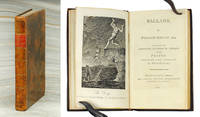
18051228731805. Chichester: J.Seagrave for Richard Phillips 1805. <br /> <br /> Small 8vo 6 212 1 indexpp. with 5 plates designed and engraved by Blake. Overall a clean and very pleasing copy in contemporary calf skillfully rebacked retaining the original backstrip and red label. Bookplate of Benjamin Dickinson ink signature of J.W. Dickinson dated Oct. 9th 1824 later bookplate of Walter Hirst.<br /> <br /> § First edition with plates 1-3 in the first state. An important book in the Blake canon being his second version of the Ballads after the extremely rare 1802 edition see above for the frontispiece. "For this 1805 volume Hayley added twelve ballads to the four first published in 1802. Blake engraved new plates of his designs for three of the 1802 ballads plates 1-3 and both designed and engraved new illustrations for two of the additional ballads plates 4-5. Blake and Phillips were to "go equal shares . . . in the expense and the profits" Blake's letter to Hayley of 22 January 1805 Erdman page 763. Robert Southey's mocking review of Hayley's poems and Blake's illustration to "The Dog" Plate 1 appeared in the Annual Review for 1805." Bentley BB 465. Easson and Essick WBBI Vol. I VIII. Bindman Complete Graphic Works of Blake 403-407. unknown
1885303029Edmonton 1885. No. 39 of 50 copies on Hodgkinson wove paper. William Muir facsimile. Preface and 11 hand-colored plates. 1 vols. 4to. Full dark green levant preserving wrappers with an unrecorded folding announcement from Muir bound in at front. No. 39 of 50 copies on Hodgkinson wove paper. William Muir facsimile. Preface and 11 hand-colored plates. 1 vols. 4to. Muir Facsimile. Bentley 249c unknown books
18881088084to. Edmonton: William Muir 1888. 4to intaglio title page iv text prologue 18 leaves with Muir's black and white intaglio engraved plates sewed and more recently bound in vellum and new endpapers and fitted into a modern marbled slipcase. Original Muir wrappers not bound in. § Possibly one of the copies Quaritch had for sale as recently as 1942 when their catalogue records only 31 copies had been published rather than the 50 first envisaged and of these 31 at least some were still being offered for sale. The facsimile is convincing enough that plates from it have been offered as originals on occasion. Copies in such fine condition are almost unheard of. Bentley BB 249m. William Muir hardcover books
1885303029Edmonton 1885. No. 39 of 50 copies on Hodgkinson wove paper. William Muir facsimile. Preface and 11 hand-colored plates. 1 vols. 4to. Full dark green levant preserving wrappers with an unrecorded folding announcement from Muir bound in at front. No. 39 of 50 copies on Hodgkinson wove paper. William Muir facsimile. Preface and 11 hand-colored plates. 1 vols. 4to. Bentley 249c unknown
18851088074to. Edmonton: William Muir 1885. 4to 1 preface by Muir 8 hand- colored leaves; 1preface by Muir 11 hand-colored leaves bound with tissue guards in original gray wrappers as issued by Muir: copies 24 and 30. Bound in contemporary half navy calf gilt with navy morocco and gilt label on cover and navy cloth boards with H.C. Plimmer's bookplate. Very good. § The Thel facsimile is based on copy D colored by hand and limited to about 50 copies. Essick notes three versions of the ca. 1885 edition one entirely executed by hand this version with the correction of ’sprin’ to ’springs’ on leaf 5 line 7 and with the two final plates numbered 7 and 8 and a third version with the final two leaves correctly numbered 5 and 6 as in Blake’s original. The Visions facsimile also limited to around 50 copies is on Hodgkinson wove paper some copies were printed on a thinner “Antique Note†laid paper. Based on copy A in the British Museum. Bentley Blake Books 249 b and c William Muir hardcover books
18011227331801. London : Dalla Stamperia di Gul. Bulmer 1801. <br /> <br /> Thick 4to 2 1 1-721 pp. Printed in English and Italian. Contemporary red straight-grained goatskin flat spine banded with double gilt rules single gilt rule to the margins of the boards all edges gilt some foxing to the preliminaries binding repaired and refurbished still showing some scratches and stains but still an attractive copy.<br /> <br /> § Only edition of absolute rarity three copies recorded none at auctionone in the marketplace bought by Yale. Maggs wrote of this copy: "Written by an associate of William Blake this is a profoundly eccentric production full of the revolutionary spirit of the times combining mysticism philosophy electricity and magnetism. One of an unknown number of copies privately printed for the author without a title page by George Bulmer all of them intended for presentation to the author's friends this copy bearing the 19th Century ownership inscription 'Girdlestone' for whose identity there are several candidates none completely convincing.<br /> <br /> It is in two parts the first "An Investigation into Principles" written in English is a series of reflections on the nature of elements gravitation "the pressure of the general ethereal fluid against our orb" time "Look for time in the vast expanse Eternity will start to view and time revolve no more" tides earthquakes and the lack of salt in rain when raised into the sky by waterspouts it is sweetened by the action of electricity. His logic is baffling at times demonstrating the wisdom of a forward five year old or of an experienced haschischan : for instance he observes that gravity isn't all that Newton cracked it up to be since water "from a known principle in hydraulics" rises to the top of mountains which truth he derives from the fact that rivers never run dry. "On the Barleycorn" is a dialogue between Mata and Ata based on a conversation with George Finch Earl of Winchilsea concerning wisdom folly genius reason the individuality and the faculty of the soul.<br /> <br /> The second part is titled "On the Soul. On Magnetism. Magnetic Productions." and comprises the transcripts of Avena's automatic writings see below in Italian many with English introductions and some untranscribed writings dismissed as "too confused to merit attention". There are a total 51 sessions in the first year dated to "Alessandria 1796" 52 in the second year and 27 in the third and last year. The last two years have almost no English narrative.<br /> <br /> In researching this book we Maggs rely heavily on the intoxicating and brilliant essay by Marsha Schuchard "Blake's Healing Trio: Magnetism Medicine and Mania" published in Blake an Illustrated Quarterly Vol 23 Issue 1 which explores Blake's relationship with the "eclectic network of illuminés which included Swedenborgians Freemasons and Cabalists who shared his interest in animal magnetism spirit-communication and erotic trances". George Baldwin was one of these and is included as "Baldwin of Egypt's Lake" in a vicious later 1808 - 1811 poem attacking their lack of commitment to his studies.<br /> <br /> Baldwin born in 1744 was an author and diplomat who became very wealthy in the later years of the 18th century establishing trade links for the East India Company with Egypt owning a monopoly of the British trade route through Suez demonstrating remarkable prescience about the importance to British trade of this route to the east. He was British Consul-General in Egypt from 1786 to 1796 in which position he warned the British Government of French plans to take over Egypt a warning which was largely ignored. When the French invaded Egypt in 1798 he left the country for Italy leaving behind substantial property in Alexandria which was seized by the French. He was of considerable help in the planning of the British counter invasion returning to Egypt in 1801 with the British forces and claimed the credit for the decision to breach the canal in Alexandria and flood Lake Mareotis to hinder French navigation which played a significant role in the recapture of Egypt - this is what Blake refers to when he mentions "Baldwin of Egypt's Lake." It is attractive to think of a time in which a man could be a senior servant of the state as well as indulging in such arcane personal tastes.<br /> <br /> Baldwin's wife Jane Malpass a famous Greek beauty sat for her portrait to Sir Joshua Reynolds and to Richard Cosway who introduced Baldwin to English devotees who believed in healing by magnetism which although he was a popular figure in English society made him the subject of some ridicule. Some Blake scholars believe that Jane Malpass is one of the figures in Blake's 'Vala' manuscript. Baldwin had come across what he claimed were many cures in Egypt using magnetism and experimented on himself with he said considerable success. His Magus so to speak was an itinerant poet one Cesare Avena di Valdieri who passed on his gifts to Baldwin during magnetic sleep. The 'Principles' begins in English with a history of the development of Animal Magnetism then turns to Italian and intertwines the further exploration of the theme with the story of Baldwin's 'contact' with the spirit of his lost first love through the mediumship of Valdieri in a magnetised trance. Both Blake and Baldwin believed that the same Muse that dictated spirit writings to them also inspired Milton in the writing of 'Paradise Lost'. <br /> <br /> Baldwin was in London from 1781-6 where he must have first encountered the English school of Animal Magnetism a fashionable science begun largely by Franz Anton Mesmer who was for a while very successful as a practitioner in London society. It is highly likely that Baldwin made the acquaintance of Blake during these years. Mesmer was soon eclipsed by his disciple Dr. John Bonniot de Mainaduc who became a very rich man treating the great and the good of British society from Royalty downwards. Mainaduc published in 1798 a series of lectures with a frontispiece by Cosway where much of the phraseology bears a striking resemblance to the writings of Blake. Baldwin was back in Egypt in 1786 from where he ordered many publications on Animal Magnetism and on his interest in 'native' medicines with their use of magic and trance states. He set himself up as a practitioner and claimed much success as a healer - it is thought that a drawing from Blake's notebooks showing a cloaked man wearing a turban treating a young crippled girl represents Baldwin. Baldwin even claimed to be able to heal the plague rife in Egypt at the time mainly by the use of massage with olive oil. <br /> <br /> This publication originated with Baldwin's meeting with Valdieri and his consequent magnetisation of the poet who poured forth the verse printed here dictated to him by spirits. In 1797 Baldwin was visited in Egypt by the art connoisseur Thomas Hope a devotee of Animal Magnetism. The copy of this book in Emory University Library is inscribed to Hope's brother Henry a wealthy banker and disciple of Mainaduc. The inscription reads 'To Henry Hope Esq from his humble servant George Baldwin author of the English part of this work and editor only of the Italian'. Baldwin himself categorises the principles of the title as 'the discovery of a spiritual influence on the physical temperature of man'.<br /> <br /> Worldcat reports only two copies in institutions worldwide Emory University and the University of Chicago but a deeper poke reveals a mis-catalogued copy in the British Library. Not in Crabtree Animal Magnetism early hypnotism and psychical research an annotated bibliography. 1766-1925."<br /> <br /> DNB notes: "Baldwin was welcomed into London society as an exotic newcomer. He was described by Wright as 'lolling on oriental cushions amid strange hangings' T. Wright Life of William Blake 1929 2.31 and had some interesting pictures to share. Baldwin became intrigued by Cosway's keen interest in the therapeutic powers of magnetism as expounded by John de Mainauduc. Baldwin's presence was noted in William Blake's lines:<br /> Cosway Frazer and Baldwin of Egypt's lake<br /> Fear to associate with Blake<br /> This life is a warfare against evils<br /> They heal the sick he Blake casts out devils."<br /> Bentley BBS 495 p. 404. unknown
18861088064to. Edmonton: William Muir 1886. 4to 4 45 hand-colored plates 2 leaves. Contemporary half navy calf gilt with navy morocco and gilt label on cover and navy cloth boards original wrappers bound in. A fine copy with the bookplate of H.C. Plimmer. § Limited to about 50 copies by Muir and his team based on copy A. Muir’s preface is five pages and at the end is a three-page facsimile of Blake’s letter of March 16 1804. The first facsimile of the second-longest and penultimate of Blake’s illuminated books which is known in only four copies. The poem follows the poet John Milton returned from heaven to the mortal world on a journey of self-discovery and renewal The William Blake Archive. Blake himself is present as the personification of Imagination and the poem contains many biographical allusions. It is exceptionally rich with numerous full-page plates. Blake’s famous poem “Jerusalem†appears in the preface to Milton only in copies A and B. Bentley BB 249f. William Muir hardcover books
18881223864to. Edmonton: William Muir 1888. 4to intaglio title page iv text prologue 18 leaves with Muir's black and white intaglio engraved plates sewed. with 25 leaves including the preliminary and final blank. Original wrappers upper cover lettered in manuscript and signed and numbered by Muir. with 1 leaf signed and numbered by Muir. Dark green straight grain morocco panelled in gilt gilt top backstrip lettered in gilt slightly worn but internally perfect. § The "Gates" is copy #17 signed by Muir. The facsimile is convincing enough that plates from it have been offered as originals on occasion. Bentley BB 249m. "There is No Natural Religion" is copy #4 and includes “ All Religions are One†and Muir's own version of the missing plate b5. Essick notes: There is No Natural Religion. The "Preface" dated 1886 indicates that the facsimile is based on plates "in the British Museum copy A and from some papers in my own possession copy L." Upper wrapper present. "On Homer's Poetry" is a single leaf #4 signed by Muir. Bentley BB 249 h. William Muir unknown books
18081078254to. London: Bensley for Cromek 1808. 4to xiv 36 4 pp. With a portrait frontispiece after Phillips etched title page and 11 plates engraved by Luigi Schiavonetti after Blake’s designs. Original drab gray boards printed paper label on upper cover preserved in a red cloth box worn. The finest copy we have ever seen. § First quarto edition of exceptional rarity in boards as issued. A completely untrimmed copy thus with the title-page uncropped. Bentley Blake Books 435B. Bindman Complete Graphic Works of Blake 465-476."In October 1805 Blake was commissioned by the engraver and would-be publisher Robert H. Cromek to prepare forty drawings illustrating Robert Blair's The Grave a popular "Graveyard" school poem first published in 1743. Cromek planned to select twenty of these designs for a deluxe edition of the poem. In Cromek's first prospectus of November 1805 Blake is named as both the designer and engraver of fifteen designs. Blake etched one image Deaths Door in white-line but Cromek rejected it. The dark power of the white-line print appeals to modern tastes but was far from fashionable in the early nineteenth century. In a second prospectus also of November 1805 Cromek announced that Luigi or Louis Schiavonetti would engrave twelve designs for the new edition. Blake had lost the potentially lucrative commission to engrave his own designs; his relationship with Cromek descended into anger and argument. In spite of their disagreement Cromek included a portrait of Blake as a frontispiece to the volume published in 1808. Cromek promoted the book aggressively and the illustrations to The Grave became Blake's best known work through much of the nineteenth century." The William Blake Archive Bensley for Cromek hardcover books
1887109161Folio. Edmonton: William Muir 1887. Folio 18 plates printed in blue. Original wrappers rebacbacked top edge gilt fine. § Uncolored Muir facsimile limited to around 50 copies of which according to Keynes in 1921 only 6 were hand-colored. This is copy #3 signed priced and numbered by Muir. "In the first of his "Continental Prophecies" see also Europe and The Song of Los Blake explores the radical paradigms of political repression and revolt through a highly imaginative treatment of the American Revolution. While historical figures such as Washington and Paine appear much of the symbolic and thematic weight is placed on Blake's own invented mythological figures including "Albions Angel" and "Londons Guardian" forces of the British government Urizen the god of restrictive reason and the origin of political repression and fiery Orc the spirit of revolt. The American Revolution is viewed as a harbinger of universal revolution epistemological as much as political." The Blake Archive. Eighteen copies of the original are known to exist. William Muir's facsimiles of Blake's works were the most ambitious and in many cases the first of their kind until the Trianon Press began work for the Blake Trust in 1951. Upon establishing the Blake Press at Edmonton his goals were clear: "My desire and intention is to reproduce ALL the important works by Wm Blake that exist in book form and also some of his finest designs and this by methods of working as nearly the same as Blake himself used as the need of maintaining fidelity to his results will allow. I will not use either photography or chromolithography. All outlines are drawn and all the colouring is by hand. I produce fifty copies only of each book and each of them is numbered".Keri Davies writes "‘Muir’s facsimiles not only made Blake’s works in “Illuminated Printing†accessible for the first time in reliable copies and helped establish Blake’s reputation as visual artist alongside his reputation as poet but I feel must also have contributed to the most advanced ideas in English art of the 1880s." Bentley Blake Books 249j. William Muir unknown books
1884303028Edmonton: John Pearson for Bernard Quaritch 1884. Each title one of 50 copies. With 8 26 11 and 21 plates in the four works 66 total. 1 vols. 4to. Contemporary full white vellum gilt spine and upper cover titled in gilt t.e.g. others untrimmed. Fine copy. Cloth slipcase. Each title one of 50 copies. With 8 26 11 and 21 plates in the four works 66 total. 1 vols. 4to. Four Muir Facsimiles in Special Binding. The Muir facsimiles were produced in editions of 50 copies; a few copies would have been bound up by Quaritch the distributor in white vellum as here. The wrappers are not preserved but the books are complete. Bentley 249 bce & g John Pearson for Bernard Quaritch unknown books
1887109160Folio. Edmonton: William Muir 1887. Folio 17 plates richly hand colored. Original printed wrappers dated September 1887 backstrip renewed gilt top fine. § Limited to fewer than 50 copies this copy numbered #11 signed priced and numbered by Muir. Based on three different copies see below. With the frontispiece “The Ancient of Days†which is perhaps Blake’s most famous image. Bentley BB 249k1: "plates 1 and 4 are from originals in Mr. Muir's possession copy c plates 2 5-6 and 8 are from copy D and plate 7 9-18 from copy A." See also Bentley Blake Books Supplement pp.66-69. William Muir unknown books
1884303028Edmonton: John Pearson for Bernard Quaritch 1884. Each title one of 50 copies. With 8 26 11 and 21 plates in the four works 66 total. 1 vols. 4to. Contemporary full white vellum gilt spine and upper cover titled in gilt t.e.g. others untrimmed. Fine copy. Cloth slipcase. Each title one of 50 copies. With 8 26 11 and 21 plates in the four works 66 total. 1 vols. 4to. The Muir facsimiles were produced in editions of 50 copies; a few copies would have been bound up by Quaritch the distributor in white vellum as here. The wrappers are not preserved but the books are complete. Bentley 249 bce & g John Pearson for Bernard Quaritch unknown
18851228882 vols. Edmonton: William Muir 1885. 2 vols. 4to 34; 30 leaves hand-colored with the original blue-gray wrappers as issued enclosed in a modern quarter-blue morocco folding box lettered in gilt. § Limited to around 50 copies of each "Innocence" inscribed "No. 0 Pearson's copy" and "Experience" inscribed "for The Times". These are amongst the most alluring and successful of Muir’s facsimiles. Songs of Innocence was taken from the Pearson copy and he is recorded at the end as the Publisher in London in 1884 but his death caused Muir to take the project to Quaritch who distributed the whole series. Songs of Experience is taken from the Beckford copy. The general title to both works is found at the end of Experience. Bentley BB 249 a and 249 d. Loosely inserted in the box is a prospectus from John Pearson for a series of facsimiles after Blake and a 4-pp ALS from Muir to the editor of The Times. Last sold by Heritage Bookshop in 1998. William Muir unknown books
18851223852 vols. Edmonton: William Muir 1885. 2 vols. in one. 4to 34; 30 leaves hand-colored with the original blue-gray wrappers as issued; copies No. 24 Innocence and 11 Experience. Full dark red morocco gilt top gilt-lettered backstrip with gilt device at foot bookplates of Thomas William Waller and Willis Vickery. Very good with tissue guards as issued. § Limited to around 50 copies of each. These are amongst the most alluring and successful of Muir’s facsimiles. Songs of Innocence was taken from the Pearson copy and he is recorded at the end as the publisher in London in 1884 but his death caused Muir to take the project to Quaritch who distributed the whole series. Songs of Experience is taken from the Beckford copy. The general title to both works is found at the end of Experience. Bentley BB 249 a and 249 d. William Muir unknown books
18061087301806. London: J Johnson 1806. <br /> <br /> 2 vols. 4to xviii 423 4 index and plate list; iv 419 6 index and plate list pp with 40 hand-coloured plates in both vol I and vol II as called for plus hand-coloured title page to vol I and coloured vignette to both volumes. 16 of the plates and the two title page vignettes are by Blake. Contemporary diamond calf with gilt rules and decoration including to spine with general light wear the front cover of vol I rehinged; internally good some offsetting and spotting to reverse of a few plates occasional mild foxing to margins but generally a good clean copy. <br /> <br /> § Second edition revised and enlarged very scarce colored. Stedman's account of the slave rebellion in Dutch Guiana 1772-1777 with 40 hand-colored plates 16 by William Blake. A best-seller in its day and translated many times Stedman's narrative was an important resource for the abolitionist movement across Europe even though Stedman himself was not straightforwardly anti-slavery. Stedman based the text on personal diaries he kept on his travels now held by the University of Minnesota albeit with his numerous accounts of sexual liaisons with free and enslaved women reduced and romaticised. Essick writes that "Stedman's narrative of the brutalities of slavery very probably influenced Blake's own anti-slavery position"; Blake's graphic illustrations of abused slaves infused with human dignity undoubtedly influenced the reading public and advanced the abolitionist's cause. Essick William Blake's Commercial Book Illustrations XXXIII. Bentley Blake Books 499. unknown
1827105078Printed in black ink on thick card. London: William Blake 1827. Printed in black ink on thick card. Very finely printed in good condition though trimmed very close to the image at the left and right edges once pasted down and thus with traces of mounting on the verso and pencil notes from an earlier collector c. 1950 image and plate mark exactly as per Essick 1DD. § Blake’s last engraving executed for one of his closest friends. The images invoke one of Blake’s greatest themes—the relationships between time and eternity. Although probably intended as a calling card two books have been located with this card pasted in both written by George Cumberland Jr. Thus it has on occasion been sold as a “bookplateâ€. Examples on card not in Cumberland's book are exceptionally rare and have been presumed to be of the earliest printing and possibly by Blake himself. All other impressions on laid paper most often are posthumous. Thirty-nine examples in all are known to Essick not including examples now untraced of which eight are on card of which one is described as printed in green ink. Essick The Separate Plates of William Blake XXI see entry 1DD for identical measurements but not this copy. Bindman Complete Graphic Works of Blake 654. William Blake unknown books
18271050781827. London: William Blake 1827. <br /> <br /> Printed in black ink on thick card. Very finely printed in good condition though trimmed very close to the image at the left and right edges once pasted down and thus with traces of mounting on the verso and pencil notes from an earlier collector c. 1950 image and plate mark exactly as per Essick 1DD.<br /> <br /> § Blake's last engraving executed for one of his closest friends. "Blake inscribed the plate lower right with his name and age "A Æ 70." He may have sensed that 1827 could well be the last year of his life but took pride in being capable of pursuing his art and craft to the end. Blake was in fact 69 when he died; perhaps he inscribed "70" on the Cumberland card in anticipation of working on it until he turned that age. At least when considered in retrospect this most unusual inscription contributes to the elegiac and prophetic iconography of the design."<br /> <br /> The images invoke one of Blake's greatest themes-the relationships between time and eternity. Although probably intended as a calling card two books have been located with this card pasted in both written by George Cumberland Jr. Thus it has on occasion been sold as a "bookplate." Examples on card not in Cumberland's book are exceptionally rare and have been presumed to be of the earliest printing and possibly by Blake himself. All other impressions on laid paper most often are posthumous. Thirty-nine examples in all are known to Essick not including examples now untraced of which eight are on card of which one is described as printed in green ink. Essick The Separate Plates of William Blake XXI see entry 1DD for identical measurements but not this copy. Bindman Complete Graphic Works of Blake 654. unknown
1881108279Impression measures 93. London: Colnaghi printing after 5 March 1881. Impression measures 93.9 x 30 cm. printed on laid India paper; recently cleaned. § Final state: it is worth noting that the only difference between the so-called fourth and fifth states is the absence of the scratched dry-point inscriptions clearly visible in a few prints and less and less visible until completely absent by the time Sessler was printing the plate. Instead of “states†the more accurate definitions might be very early to very late 4th state and in that scheme then this print would be well after the early impressions with some or most of the scratched inscriptions visible but before the Sessler printings of the 1940s none of which were on laid India. “‘Chaucers Canterbury Pilgrims’ was one of Blake’s major attempts at building a reputation as a painter-engraver and achieving the sort of critical and financial success that had escaped him for so many years.…†However Blake wasn’t to meet with the critical success he had hoped for and the competition created when Thomas Stothard executed a plate of the same subject caused him to become bitter. “Most contemporary connoisseurs probably found the print old-fashioned and ‘Gothic’ in the pejorative sense.… The record of prices brought by the print at auction indicates that it has attracted strong interest from collectors only in the last few years†Essick pp. 86-88. “It is only in the last two states of the plate that we find Blake’s mature artistry as an original printmaker bringing to his largest and most ambitious single print the same techniques distinguishing his Job and Dante engravings.†Essick Separate Plates of William Blake XVI and see William Blake Printmaker. Colnaghi printing unknown books
1839368615London: W. Pickering . and W. Newbery 1839. First letterpress edition issue without "The Little Vagabond. xxi iii 74 pp. 1 vols. 8vo. Full green morocco gilt. Fine copy. Circular gilt vellum label of William Twopeny. First letterpress edition issue without "The Little Vagabond". xxi iii 74 pp. 1 vols. 8vo. The first letterpress edition of Blake's Songs of Innocence and Experience preceded only by the small number of copies of the illuminated first edition engraved and colored by Blake. With a laudatory Preface by the Swedenborgian James John Garth Wilkinson 1812-99 who edited and arranged the present volume for publication. Wilkinson worked from Charles Augustus Tulk's copy of the illuminated first edition c.1795-1807; Tulk had previously lent his copy to Coleridge. The work appears in two issues with or without a poem entitled "The Little Vagabound" at page 71 which was supposedly canceled by the editor out of prudishness. No priority has been established<br /> Both issues appear with about equal frequency which is to say not often. Keynes 135; Bentley & Nurmi 161B; Bentley Blake Books 171 W. Pickering ... and W. Newbery unknown
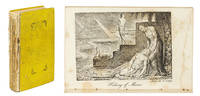
182511080112mo. London: I. Poole 1825. 12mo frontispiece "A Tribute of Regard."; title-page "Remember Me" etc. with 1826 beneath "Christmas Present"; second engraved leaf recto "Calendar and Album 1826." verso January and February next three leaves with the rest of the Calendar; verso of third leaf "The Virgin Child and St. Johnâ€; 8 pp. of engraved music; contents and introduction i ii-xxiv; plate "Her screams aroused her servant"; 1 2-336. With the Blake plate at p. 32 and color plates at 42 73 88 89 93 148 149 275 b/w The Storm and 326 color. Publisher’s original printed yellow paper boards no backstrip occasional spotting but a good copy of this fragile booklet in its rarest format preserved in a cloth box. § Second issue of the book no variance in the plate the contents omits the blank leaves and the misnumbered leaves at the end. One of the rarest of all of the plates designed and engraved by Blake here in its rarest format. The plate titled ‘The Hiding of Moses’ was the last plate designed and engraved by Blake himself for a commercial publication; the original drawing ‘Moses placed in the Ark of Bulrushes’ which closely echoes a tempera now untraced that was executed some 25 years earlier is in the Huntington Library. BB #490B. Easson and Essick William Blake Book Illustrator XI recording the Rosenwald proof and 3 copies. Keynes Blake Studies XIX recording 7 variants but not mentioning the 1826 printing. Also see Bentley’s detailed essay and census of copies in “Remember Me! Customs and Costumes of Blake’s Gift Book†University of Toronto Quarterly 80.4 fall 2011: 880-92. I. Poole hardcover books
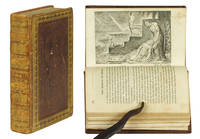
18241245961824. London: I. Poole 1824. <br /> <br /> Small 8vo xxiv 372pp. With an engraved frontispiece 4 full-page engravings including one by Blake 8 hand-colored botanical plates 8 plates of engraved music a calendar with an engraved title-page and 6 plates and 12 blank leaves titled "Album 1825" recorded by Keynes but not noted in other copies we have had. Publisher's original full brown calf central panels on both covers blind-stamped within a richly gilt border backstrip with four raised bands gilt-decorated lettered REMEMBER ME slightly scuffed and small black splotch ink on lower cover occasional small spots on plates as usual a very good copy of a de luxe issue binding on the first of three editions of the book.<br /> <br /> § First edition first issue of the book no state variance in the plate with a very early pencil inscription from one woman to another illegible repeated on the next leaf. One of the rarest of all of the plates designed and engraved by Blake. There was a reissue dated 1826 as part of the title probably published late in 1825. The plate titled 'The Hiding of Moses' was the last plate designed and engraved by Blake himself for a commercial publication; the original drawing 'Moses placed in the Ark of Bulrushes' which closely echoes a tempera now untraced that was executed some 25 years earlier is in the Huntington Library. Bentley BB 490B. Easson and Essick WBBI Vol. I XI recording the Rosenwald proof and 3 copies. Keynes Blake Studies XIX recording 7 variants but not mentioning the 1826 printing. Also see Bentley's detailed essay and census of copies in "Remember Me! Customs and Costumes of Blake's Gift Book" University of Toronto Quarterly 80.4 fall 2011: 880-92. Bentley in the U of T Quarterly 2011 noted: "The gift book Remember Me! with Blake's wonderful engraving of the 'Hiding of Moses' was more remarkable for its decorations than for its literary contents. Of the twenty-four copies recorded each differs from the others in the pattern of binding colour of fore-edges endpapers and the decorated sleeve-case. Despite this varied elegance the work had only a modest sale and the same sheets were re-issued in 1825 for the 1826 gift-giving season. This paucity of sales may be related to the fact that the publisher John Poole had little experience of book distribution. His speciality was as a maker of Marble Paper and Fancy Pocket-Books not in selling them.". unknown
182665634ìBlakeÃs Most Widely Known Achievementî BLAKE William. Illustrations of the Book of Job. Invented & engraved by William Blake 1825. London: Published by the Author and Mr. J. Linnell 1874. One of 100 sets printed on india paper. Folio sheets: 20 x 14 inches; 510 x 350 mm. engravings 8 1/4 x 6 1/2 inches; 209 x 158 mm. Line-engraved title and twenty-one line- and stipple-engraved plates by and after Blake. Also with an additional letterpress title-page not issued with the book. Printed from the original plates. Evidence of the word proof on the lower edge of engravings number 5 7 8 10 11 12 14 18 and 20. Bound in quarter reverse calf over black cloth. Spine lettered and ruled in gilt. With black and red morocco spine labels lettered in gilt. Marbled endpapers. Corners a bit bumped and cloth lightly scuffed. Sheets mounted on stubs. A bit of very light foxing to some of the sheets generally not affecting engravings mainly title-page sheet and sheet of plate 20. Plate 14 with the mounting sheet trimmed at top margin about 1.5 inches not affecting plate. A fine strikingly clean copy of ìBlakeÃs most widely known achievementî Keynes. The engravings were commissioned by John Linnell on March 25 1823. Despite the date 1825 on the engravings the plates were not actually issued until March 1826. The entire edition consisted of 315 sets: 150 ìProofî sets on India paper and sixty-five on French paper were printed in March 1826 at which time the word ìProofî was removed from the plates and 100 sets were printed on drawing paper see Bentley. BlakeÃs original copperplates remained in the possession of the Linnell family and as late as 1863 Linnell was offering for sale sets of the India-paper and French-paper issues. By 1874 these must have been sold as a further 100 sets of the engravings were printed at that time the present copy is from this set. No more pulls were taken between 1874 and 1919 when the copperplates were given by Herbert Linnell to the British Museum. Linnell's son wrote "My father considered the plates at the last 1874 were as good as they ever were for the work being cut by a graver and not etched it is durable- and is not worn by the printing as is the case with an etching." Bentley Books p. 523. Bentley 421A. Binyon 105-126. Russell 33. HBS 65634. $32500 William Blake hardcover books
182665634London: William Blake 1826. BLAKE William. Invented & engraved by William Blake 1825. London: Published by the Author and Mr. J. Linnell 1874.<br> <br> One of 100 sets printed on india paper. Folio sheets: 20 x 14 inches; 510 x 350 mm. engravings 8 1/4 x 6 1/2 inches; 209 x 158 mm. Line-engraved title and twenty-one line- and stipple-engraved plates by and after Blake. Also with an additional letterpress title-page not issued with the book. Printed from the original plates. Evidence of the word proof on the lower edge of engravings number 5 7 8 10 11 12 14 18 and 20.<br> <br> Bound in quarter reverse calf over black cloth. Spine lettered and ruled in gilt. With black and red morocco spine labels lettered in gilt. Marbled endpapers. Corners a bit bumped and cloth lightly scuffed. Sheets mounted on stubs. A bit of very light foxing to some of the sheets generally not affecting engravings mainly title-page sheet and sheet of plate 20. Plate 14 with the mounting sheet trimmed at top margin about 1.5 inches not affecting plate. A fine strikingly clean copy of "Blake's most widely known achievement" Keynes.<br> <br> The engravings were commissioned by John Linnell on March 25 1823. Despite the date 1825 on the engravings the plates were not actually issued until March 1826. The entire edition consisted of 315 sets: 150 "Proof" sets on India paper and sixty-five on French paper were printed in March 1826 at which time the word "Proof" was removed from the plates and 100 sets were printed on drawing paper see Bentley. Blake's original copperplates remained in the possession of the Linnell family and as late as 1863 Linnell was offering for sale sets of the India-paper and French-paper issues. By 1874 these must have been sold as a further 100 sets of the engravings were printed at that time the present copy is from this set. No more pulls were taken between 1874 and 1919 when the copperplates were given by Herbert Linnell to the British Museum.<br> <br> Linnell's son wrote "My father considered the plates at the last 1874 were as good as they ever were for the work being cut by a graver and not etched it is durable- and is not worn by the printing as is the case with an etching." Bentley Books p. 523.<br> <br> Bentley 421A. Binyon 105-126. Russell 33.<br> <br> HBS 65634.<br> <br> $32500. William Blake unknown
1821VBF48<p><b>BLAKE</b> William</p><p><i><b>The Pastorals of Virgil</b></i> With a course of English Reading adapted for Schools . enabling youth to acquire the Latin Language in the shortest period of time. Edited by Robert John <b>Thornton</b>. </p><p>London: F C & J Rivington 1821. </p><p>Two volumes illustrated with engraved frontispieces 230 illustrations: of which William Blake has contributed 17 original woodblock designs for the First Eclogue six copperplates of Classical poets and philosophers all of which he also engraved and with four additional Blake designs engraved by other hands. These are WILLIAM BLAKE's only woodcut designs and have remained amongst the most influential woodcuts in the history of British art. Their influence can be seen in the prints of Edward Calvert and Samuel Palmer. The original blocks survive and are preserved in the British Library London last restruck in 1977 by Iain Bain.</p><p>8vo. xii -vii/viii 12 xxiv -i/iv 214 pp. i 215-592 pp. plates erratic preliminaries nonetheless complete as matching collations in both Keynes and Easson/Essick; matching contemporary sheep leather possibly as published.</p><p>Third edition first thus</p><p>Provenance: George R. Gardner pasted bookplate inside covers</p> F C & J Rivington hardcover books