Blake William.ABAA

1 088 résultats
18861088104to. Edmonton: William Muir 1886. 4to printed upper wrapper; 1 blank 2 Preface 3-23 text; lower wrapper printed on the inside with the “Programme†dated November 1885. All bound into modern blue buckram red morocco label on backstrip bookplate of Joseph Holland and a Moncure Biddle typed library record at front Houghton Library Phil Hofer manuscript note pasted in at the back. A fine copy. § Copy No. 11 of 50.Includes “ All Religions are One†and Muir's own version of the missing plate b5. Essick notes: There is No Natural Religion. The "Preface" dated 1886 indicates that the facsimile is based on plates "in the British Museum copy A and from some papers in my own possession copy L." However the printed front wrapper of Muir's Europe facsimile 1887 indicates that "Mr. Burt's copy H--which according to Joseph Viscomi is a forgery" was also used. This would seem to be correct since copies A and L are printed in olive and green whereas plates a1 a2 and b1 in the facsimile are in brown as in copy H. Also includes plate 2 of All Religions are One the original of which is bound into There is No Natural Religion copy M and Muir's own version of the missing plate b5. Delivered to Quaritch 8 Sept. 1886. Note: There is No Natural Religion copy M also printed in brown but it seems unlikely that this was "Mr. Burt's copy" since copy M was in the Tulk family collection until 1956.†Bentley BB 249 G. William Muir hardcover books
1803104400Roy. Chichester: J. Seagrave for T. Cadell and W. Davies 1803. Roy. 8vo 9.5 x 5.75 ins. xii 165 pages. With 6 engraved plates by William Blake after Maria Flaxman. Later half green morocco gilt top other edges untrimmed an excellent copy with wide margins. § A large-paper copy unusually clean and with fine dark impressions of the plates. First edition of Blake’s engravings after these dreamy and slightly surreal illustrations. Bentley Blake Books 471A. Essick William Blake’s Commercial Book Illustrations XLIII. DNB notes of Hayley: “Possibly his greatest achievement however was his didactic poem Triumphs of Temper 1781 which ‘was to reform the entire feminine mind of England by the advice’ Bishop 53. This allegorical work aspired in rhyming couplets to teach young women the virtues of a pleasant nature. Its advice was heeded by some: Emma Hamilton thanked Hayley ‘for the lessons she had learnt from the poem’ P. Jaffe Drawings by George Romney 1978 44 and asked Romney to inform Hayley that his poem ‘made me Lady H. … for Sir W. minds more temper than beauty’ ibid. Triumphs of Temper ran into fourteen editions and proved to be the most durable of all his publications.†J. Seagrave for T. Cadell and W. Davies unknown books
18061087518vo. London: Richard Phillips 1806. 8vo xxiv 270pp ii publisher's booklist with Blake's engraved frontispiece of Sir Joshua Reynolds design " The Graphic Muse". Original blue-grey boards spine slightly darkened and worn at edges. § First edition a very scarce book especially in boards. With the bookplates of Gilbert Redgrave and George Goyder : there are also signatures of Sir Edward Hoare an early owner on the title page and other pages. Bentley Blake Books 474. Essick William Blake's Commercial Book Illustrations XLVIII. Richard Phillips hardcover books
1886108532Small slim 4to. London: Pickering & Co. 1886. Small slim 4to printed blue upper wrapper serving as the title-page 12 leaves with illustrations printed lithographically in reddish-brown highlighted in black of which 3 are colored. Early full brown morocco binding by Riviere dark green glazed endpapers backstrip lettered in gilt lower cover rehinged. § § Large-paper copy privately printed for Pickering in an edition of 50 copies. One of the rarest Blake facsimiles and only in the large-paper edition very well executed the rest were not colored and were printed in a dark brown without highlights. Not in Bentley but see Blake Books Supplement page 140. Essick notes: “According to BBS page 140 the plates reproduced are the same as those in the Muir facsimile of 1886 apparently from copies A L and perhaps H. However Joseph Viscomi Blake and the Idea of the Book pp. 205 212-13 demonstrates that most of the plates a1 a2 a4 a8 a9 b3 b4 b12 in this Pickering facsimile were based on copy I one of the early “bogus†or facsimile copies now in the Morgan Library. The remaining plates a2 a5 a6 a7 were probably based on copy D Harvard or copy G Morgan according to Viscomi.†Pickering & Co unknown books
1920123193Slim 4to. Edmonton: William Muir 1920. Slim 4to 8 unnumbered hand-colored plates. Half red calf upper cover lettered in gilt upper cover slightly soiled. § The second Muir facsimile based on copy J in the Houghton Library and limited to 50 copies so stated. With Muir's limitation statement and copy number 5 pasted in the front. Bentley Blake Books 249b. William Muir unknown books
1825215604London: W. Sams Book & Printseller to the Royal family opposite St James's Palace 1825. Third state the first being produced in 1818. Hand-colored aquatint with etched outline. 1 vols. 20 x 26 inches matted and framed to 27 x 33 inches overall. Third state the first being produced in 1818. Hand-colored aquatint with etched outline. 1 vols. 20 x 26 inches matted and framed to 27 x 33 inches overall. A large and important depiction of an exhibition sparring match held in Fives Court in London's Little St. Martin's Street a tennis and fives court hired for such events the participants unlike a regular bare-knuckle bout being fitted with gloves "mittens" or "mufflers". The contestants shown were Ned Turner "The Out-and-Outer" who had killed a man in the ring serving time for manslaughter and Jack Randall "The Prime Irish Lad" unbeaten throughout 12 years of ring activity. The two had fought an epic fight in 1818 which Randall won to become the Lightweight champion. A large number of famous pugilists are pictured in the audience not always accurately Jem Belcher the famed champion and the first real sporting celebrity in the modern sense is shown although he was dead and it is a fair portrait of "The Fancy" as the mix of often raffish sporting professionals and upscale spectators including nobility came to be known. THE MOST FAMOUS BOXING PRINT EVER PRODUCED AND AN IMPERISHABLE EVOCATION OF REGENCY SPORT. Snelgrove British Sporting and Animal Prints p. 48-9 color plate 5; Siltzer pp. 319 320 325; Wilder Sporting Prints p. 178 color plate p. 179; Magriel The Ring and the Glove pp. 17-18 W. Sams, Book & Printseller, to the Royal family opposite St James's Palace unknown books
1941432602New York 1941. Hardcover. Very Good. Quarto measuring 10" x 11.5". Textured cloth over stiff paper boards. Contains 32 black and white silver gelatin photographs measuring between 2" x 3" and 8" x 10" with some captions. Very good album with near fine photographs.<br/><br/>A photo album and scrapbook kept by Betty Blake while serving with the British & American Ambulance Corp. and the American Theatre Wing during World War II. Both were humanitarian organizations created to aid in relief and fundraise during the war. They were frequently used together and often put on events for war charities. Betty worked for both organizations as an actress and includes 8" x 10" photos of headshots and performances throughout. She also worked as a "Hospital Hostess" and can be seen stuffing envelopes making calls and painting a "V" on a vehicle. Two photos show a group of women wearing British & American Ambulance Corps sashes posed by a truck. Betty's scrapbook also includes a typed note signed by actress Antoinette "Toni" Perry inviting her to tea. A program and newsletter from the New York Theatre Critics' Review is laid in at the end of the album.<br/><br/>The American Theatre Wing had originally been founded during World War I in 1917 as the Stage Women's War Relief by playwright and director Rachel Crothers. By 1939 Crothers brought the organization back through the British War Relief Society. This time members included Mary Antoinette "Toni" Perry Helen Hayes Lynn Fontaine and Tallulah Bankhead among others. They set out to fundraise and organize donations of clothing for European refugees displaced during the war. During World War II they opened the Stage Door Canteen in New York to entertain servicemen. After the war many of the actresses continued on with the organization to help with post-war relief. <br/><br/>An interesting collection documenting a young actress' service during World War II. hardcover books
1999CNJL1299London: Enitharmon Press 1999. Limited Edition. Hardcover. Fine. Rego Paula. Number 23 of 75 copies of the deluxe edition folio size 46 pp. signed by Blake Morrison and Paula Rego. Paula Rego b. 1935 a native of Portugal studied art at the Slade School London where she now mainly lives and works. This work is based almost unbelievably so on factual history: "the Children's Crusade of 1212 remains an enigmatic historical episode recorded in only a few contemporary accounts but it captured the imagination of the acclaimed painter Paula Rego as a story steeped in imaginative possibilities and contemporary relevance. It touches not only on children's love of adventure but also on darker issues including fears of the unknown incipient sexuality and exploitation. In his introduction Blake Morrison brilliantly illuminates Rego's twelve hand-coloured etchings and their relation to the crusade and the scene is set by two passages from medieval chronicles. The book concludes with an extensive and revealing interview with Paula Rego in which she explains her fascination with the subject." N.B. from the website of the publisher.<br/><br/>___DESCRIPTION: Original gray linen covered boards with the illustration "Voices II" inlaid to the upper board fore- and tail-edges uncut color printed reproductions of the original etchings tipped in; text has been hand-set in Monotype Caslon printed on Arches Vélin paper folio size 12.75" by 10" pagination: 1-6 7-45 1 colophon limited edition this number 23 of 75 copies of the deluxe edition total edition 190 signed by Blake Morrison and Paula Rego. Rego's signed original etching "Bait" is laid loose into a wallet in the slipcase; the etching has been printed on 300 gsm Somerset Velvet; the book and the etching are housed in a matching gray linen slipcase with a printed label inlaid to the upper board.<br/><br/>___CONDITION: A fine copy; crisp clean like new; no prior owner markings the separate etching also fine absolutely clean and without wear; the slipcase is fine overall strong and sturdy the cloth is unrubbed with no frayed edges; a few minor stray spots of faint foxing to the case else fine.<br/><br/>___CITATION: Rosenthal "Paula Rego the Complete Graphic Work" pp. 130-145.<br/><br/>___POSTAGE: International customers please note that additional postage may apply as the standard shipping charge does not always cover costs; please inquire for details.<br/><br/>___Swan's Fine Books is pleased to be a member of the ABAA ILAB and IOBA and we stand behind book we sell. Please contact us with any questions you may have we are here to help. Enitharmon Press hardcover books
1973263500London: Trianon Press 1973. Copy #1 of 32 special copies. Color facsimile accompanied with a set of paltes showing progressive stages of the collotype and hand stencil process together with a guide sheet and stencil Only in Roman numeral copies and unique to COPY ONE the etched copper plate for the title-page tipped in at back and etched in "Copy 1". 1 vols. 4to 11 x 9 inches ; 22.5 x28 cm. Bound in publisher's full black morocco as new in original slipcase. Blake William. Copy #1 of 32 special copies. Color facsimile accompanied with a set of paltes showing progressive stages of the collotype and hand stencil process together with a guide sheet and stencil Only in Roman numeral copies and unique to COPY ONE the etched copper plate for the title-page tipped in at back and etched in "Copy 1". 1 vols. 4to 11 x 9 inches ; 22.5 x28 cm. COPY NUMBER ONE WITH COPPER PLATE. Trianon Press unknown books
19511088124to. London: Trianon Press for The William Blake Trust 1951. 4to 6 ix 100 color plates. Very good in original dark blue buckram with protective acetate wrapper in a folding box with grey cloth spine and patterned paper covers slight fraying to cloth at top and bottom of front cloth spine for c 1/2" and tiny chip of loss to paper at top of rear of box. § Copy No. 393 of 516 issued. The first of the magnificent series of Blake Trust collotype and pochoir facsimiles by the Trianon Press of Blake’s illuminated books edited by Geoffrey Keynes. Bentley BB 78. Trianon Press for The William Blake Trust hardcover books
19511005614to. London: Trianon Press for the William Blake Trust 1951. 4to 6 ix text and 100 pochoir colorplates. Blue buckram gilt title. Very good copy in a worn folding box. § Limited to 516 copies. The definitive facsimile of one of Blake’s greatest works and the first of the magnificent series of facsimiles created by the Trianon Press of Blake’s illuminated books. The Preludium is by Joseph Wicksteed and the Bibliographical Statement by Geoffrey Keynes. Bentley 78. "Blake's etched copperplates giving the text of his poem and the basis of the designs were printed by him in a rich orange ink and were then illuminated by hand in water colours and gold. The etched base has now been reproduced by collotype in orange and the prints have then been coloured by hand by a stencilling process so that the final result bears the closest possible resemblance to Blake's original plates. An average of forty-four applications of water colours was required for each full page illustration of which there are four. Of the remainder fifty-one have some text with designs filling half the page or more and thirty-five have text with small marginal decorations.". Introduction Trianon Press for the William Blake Trust hardcover books
108281Printed for & sold by the Widow Spicer of Folkstone for the Benefit of her Orphans. n.d. 55.9 x 22.9 cm. single sheet folded once with some traces of mounting tape on the vertical margin some creases but very good. § The very fine William Muir facsimile often mistaken in the past as the original. The poem was composed by William Hayley. Originally etched in relief and white line by Blake on four plates printed in black ink uncolored; copies are also known hand colored or printed in brown ink. This is one of Blake’s rarest works; it is also amongst the rarest of Muir’s facsimiles; some were issued in The Hobby Horse and some separately - this is one of the separate issues and the only copy I have ever seen. They can be distinguished from the Hobby Horse examples since the latter were cut into two pieces to fit in the magazine always with slight loss of text at the cut or folded twice. Bentley Blake Books 470B or D. Bindman Complete Graphic Works of Blake 384. See also Keynes Blake Studies 2nd ed. who reports that the Muir facsimile was exhibited for some years as the original at the Pierpont Morgan Library.Essick notes: Muir “Little Tom†copies from my collection handlist. Gives the full watermark of the example bound in the Hobby Horse and Muir’s statement see first entry that his facsimile is based on an original owned by H. H. Gilchrist.Little Tom the Sailor. Datable to 1886. Laid paper leaf 56.8 x 23.1 cm. with watermark "POUNCY." On the printed front wrapper of his 1887 Europe facsimile Muir notes that his facsimile of Little Tom is "from Mr. Gilchrist's copy" now untraced. The facsimile is attributed to Emery Walker Ltd. rather than Muir in Keynes Blake Studies 2nd ed. page 109; this paper listed by Keynes as no. iii on page 110. Matted. Acquired July 1971 from Charles Sessler Books $200. BB#249i 470C or D. Idem. Laid paper leaf 61.8 x 21.3 cm. with watermark “JOHN DICKINSON & Co†this paper listed in Keynes Blake Studies 2nd ed. page 110 no. i. Folded twice and bound in The Century Guild Hobby Horse vol. 1 no. 4 Oct. 1886 which see under Biography and Criticism Periodicals through 1900. BB#249i 470B 1683. Idem. With the headpiece and tailpiece hand color in imitation of the original in the British Museum very probably hand colored by Blake or his wife Catherine. Inscribed in pen and brown ink “No 3 Wm Muir†upper left leaf of wove paper without watermark 60.3 x 23.0 cm. Quaritch records the delivery from Muir of a “coloured†copy of Little Tom on 11 May 1925 no copy number recorded. Quaritch’s catalogue 401 of May 1926 offers as item 243 a Muir facsimile of Little Tom with “two illustrations coloured by hand from the copy in the British Museum†for £1.1s. This catalogue dates the work to “1925†apparently the date of coloring possibly of printing but not of original execution as a lithograph. The same entry appears in Quaritch’s Dec. 1926 catalogue 405 item 256 1926 catalogue 427 item 248 and 1930 catalogue 434 item 2065. Acquired Nov. 2012 on $1316.99. BB#249i 470C or D hand colored copies not listed. Muir “Little Tom†copies from my collection handlist. Gives the full watermark of the example bound in the Hobby Horse and M unknown books
1808109096London: Printed by T. Bensley for R.H. Cromek 1808. Rare first edition subscriber's copy of Robert Blair`s famous poem which initiated a fashion for mortuary poems illustrated with 11 etchings by William Blake. Quarto bound in three quarters morocco marbled endpapers with the famous engraved frontispiece portrait of William Blake after the painting by Phillips engraved title page with 11 additional plates engraved by Louis Schiavonetti after Blake's drawings designed at the request of Cromek. With the poem dedicated to the Queen by Blake list of subscribers four-page prospectus for the Procession of Chaucer`s Pilgrims to Canterbury by Thomas Stothard at rear. In very good condition. Ownership inscription. Rare and desirable. In October 1805 Blake was commissioned by the engraver and would-be publisher Robert H. Cromek to prepare 40 drawings for Robert Blair's Grave from which Cromek planned to select twenty for this deluxe edition of the poem. While The Grave originally appeared in 1743 this 1808 edition was to become famous for its illustrations demonstrating "the rare imaginative power of William Blake" Magnusson 162. A dispute over a preliminary etching "in white-line" called "Death's Door" which Cromek rejected resulted in Blake's being prevented from engraving his own designs so the 12 drawings eventually selected were rendered by Louis Schiavonetti "with a mingled grace and grandeur which won for them a wider popularity. Never has the theme of death been handled in pictorial art with more elevation and beauty" DNB. Printed by T. Bensley for R.H. Cromek unknown books
18931087763 vols. London: Quaritch 1893. 3 vols. large 8vo. profusely illustrated. In original green cloth with extensive gilt stampings of Blake designs to covers in bright condition although spines now a little dulled with rubbing to edges and spine ends. All volumes very clean internally with traces of dustiness to the uncut page edges. § First edition of one of the most influential works on Blake. “The enthusiasm and comprehensiveness of this work are of considerable historical importance†Bentley 369 who cautions that the scholarly value of the work is at best uneven. The book is also treasured by devotees of gilt-stamped bindings of which this is a striking example. Quaritch hardcover books
19511091744to. London: Trianon Press 1951. 4to 6 ix text and 100 color plates. Original blue cloth folding box worn very good. § Limited to 516 copies. The first of the magnificent series of facsimiles by the Trianon Press of Blake’s illuminated books edited by Geoffrey Keynes. Bentley Blake Books 78. Butlin noted in the Blake Quarterly: “The long list of color facsimiles produced by the Trianon Press under Arnold Fawcus for the William Blake Trust were above all objects of beauty recreating as near to perfection as possible Blake’s original achievements.†Trianon Press hardcover books
19651047324to. London: Trianon Press 1965. 4to 8 plates 5 pp. text plus the extra materials. Full brown morocco marbled paper-covered slipcase gilt lettering to backstrip. A fine copy. § Edition limited to 426 copies de luxe issue being copy XII of XX copies with a suite of progressive states of one plate an original guide-sheet and stencil etc. One of the more difficult Trianon Press books to find. Bentley Blake Books 26. “The first the simplest and the most charming of the prophetic books. best understood as a rewriting of Milton’s Comus.†Trianon Press unknown books
1795140940833London: J. Johnson 1795. First Edition. Very Good. First Edition in English of Catullus' complete works side by side with the original Latin. xxxvi 223 3; iv 236 2 pp. Contemporary full calf edges ruled in gilt spine elaborately stamped in gilt with black title label and red numerical label. Complete in two volumes. Includes both half-titles and William Blake's two engraved frontispieces foxed in vol. I offset to the title page in vol. II strengthened joints not rebacked. Occasional light penciled "Xs" to margins easily erasable; offsetting to endpapers; a few dog-eared pages; Very Good. Rare.<br /> <br /> The first attempt to translate the entire body of work of the licentious witty Latin poet of the late Roman era Catullus 84 BC-54 BC into English around 116 poems. None other than visionary English poet artist and printmaker William Blake designed the frontispieces. J. Johnson unknown books
19571231793 vols. London: The Nonesuch Press; New York: Random House 1957. 3 vols. in one roy. 8vo 364 397 and 429 pp. Illustrated with 58 plates. Original full brown morocco extra a very good copy with the bookplate of Scott Cunningham at the front. § From a limited edition of 1500 copies on Vidalon handmade paper this is #L of 75 copies on Oxford India paper numbered I to LXXV. Bentley Blake Books 370 A. The Nonesuch Press; New York Random House unknown books
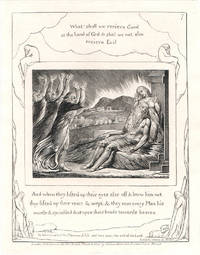
1828107781e 1825 but published 1826. London: March 8 1828 i.e 1825 but published 1826. Single leaf recently cleaned. § First edition one of 100 sets printed directly onto Whatman wove with the word “proof†removed. Blake had a long pictorial engagement with the biblical story of Job. This a single leaf from a series of 21 engravings commissioned by John Linnell in 1823 that are generally considered to be Blake's masterpiece as an intaglio printmaker. "Rather than using the customary "mixed method" of preliminary etching followed by engraving Blake used pure line engraving in the Job plates. Perhaps one of his motivations was to evoke the art of the master engravers of the Renaissance whom Blake greatly admired such as Albrecht Dürer." The William Blake Archive.In the Book of Job Job and his old friends argue at length over the divine purpose of Job's afflictions. This plate illustrates the moment the youthful Elihu overcomes his respect for his elders and bursts into the conversation to explain why he thinks both sides are wrong Job 32:6. In Blake's elaborate borders the figure of Job's Humanity sleeps while soaring angels try to awaken him.Bentley Blake Books 421A. Bindman Complete Graphic Works of Blake 625–641C. March 8 unknown books
1828107776e 1825 but published 1826. London: March 8 1828 i.e 1825 but published 1826. Single leaf recently cleaned. § First edition one of 100 sets printed directly onto Whatman wove with the word “proof†removed. Bentley Blake Books 421A. Bindman Complete Graphic Works of Blake 625–641C. March 8 unknown books
1828107778e 1825 but published 1826. London: March 8 1828 i.e 1825 but published 1826. Single leaf recently cleaned. § First edition one of 100 sets printed directly onto Whatman wove with the word “proof†removed. Bentley Blake Books 421A. Bindman Complete Graphic Works of Blake 625–641C. March 8 unknown books
1828107779e 1825 but published 1826. London: March 8 1828 i.e 1825 but published 1826. Single leaf recently cleaned. § First edition one of 100 sets printed directly onto Whatman wove with the word “proof†removed. Bentley Blake Books 421A. Bindman Complete Graphic Works of Blake 625–641C. March 8 unknown books
19261107072 vols. London: The Nonesuch Press 1926. 2 vols. in 1 8vo viii 283; xii 359 pp. Title pages in sepia and black 27 black-and-white plates. Full stiff vellum gilt-lettered backstrip covers slightly bowed and spotted in the vellum. Two gift inscriptions at front. § De luxe edition limited to 95 copies on India paper copies. One of the finest of the Nonesuch Press books with excellent reproductions of the watercolors and extensive notes on them by Geoffrey Keynes. Bentley Blake Books 394. The Nonesuch Press hardcover books
197291063 volumes. London: Trianon Press 1972. 3 volumes folio with 116 color facsimile leaves reproduced by collo-type and hand-stencil color the text of the poems reproduced from copper-plate with 3 additional printings to reproduce Blake's pencillings and the tone of the paper. Marbled boards morocco backstrips slipcases a very good set as issued. § Limited to 220 copies thus; 100 copies were issued unbound in Port-folio and 36 de luxe copies with extra material. The 116 water-color illustrations to Thomas Gray's poems are among Blake's major achievements as an illustrator. They were commissioned in 1797 by Blake's friend the sculptor John Flaxman as a gift for his wife Ann to whom Blake addressed the poem that ends the series. The commission may have been inspired by the Flaxmans' seeing Blake's water-color designs to Edward Young's Night Thoughts begun in 1795. The Gray illustrations follow the same basic format. Blake cut windows in large sheets of the same type of Whatman paper used for the Night Thoughts illustrations and mounted in these windows the texts of Gray's poems from a 1790 octavo edition published by John Murray leaving out some prefatory materials fly-titles the notes and the 7 engraved illustrations. Blake then drew and colored his designs surrounding the letterpress texts. On blank versos near the beginning of each poem and in one case on a separate piece of paper pasted over letterpress text Blake inscribed with pen and ink either titles for each design or quotations from the poem to indicate the passage illustrated. On most text pages Blake also drew a pencil cross left of the first line of the illustrated passage. He numbered most leaves consecutively in pen and ink beginning a new sequence for each of the 13 poems.Blake conceived of his work as an illustrated book rather than a series of unbound designs as indicated by his offsetting Gray's texts above and to the right left on versos from the middle of each leaf—then the convention for all letterpress books. Although listed by William Michael Rossetti in his catalogue of Blake's drawings and paintings published in the 1863 and 1880 editions of Alexander Gilchrist's Life of William Blake the Gray illustrations were virtually unknown until their rediscovery by Herbert Grierson in 1919.The Trianon Press reproductions are recognized as the finest examples of the art of facsimile reproduction; working from the originals in Paul Mellon’s collection each leaf is faithfully hand-colored through stencils to achieve an astonishing exactitude. The Times Literary Supplement stated that nothing like these books had ever been printed before and that it was highly unlikely that they could be printed again. Bentley Blake Books 385. Trianon Press hardcover books
1893WRCLIT73714London: Bernard Quaritch 1893. Three volumes. Large thick octavo. Original green cloth spines and upper covers elaborately decorated in pictorial gilt after designs by Blake t.e.g. others untrimmed. Portrait facsimiles and plates. Spines somewhat rubbed and dull some shelfwear to joints and lower edges and bumps and wear to fore-tips endsheets a bit foxed and cloth a bit handsoiled some cracking and subtle repairs to inner hinges; still not a wholly disagreeable set of a work particularly susceptible to such issues. First edition. One of five hundred sets comprising the regular paper issue. Controversial in its interpretation of Blake's texts this work nonetheless remains in this issue and binding something of a landmark of 1890s book production. "The enthusiasm and comprehensiveness of this work are of considerable historical importance" - Bentley. Wade quotes Yeats's inscription in his own copy about the nature of this collaboration: "The writing of this book is mainly Ellis's the thinking is as much mine as his. The biography is by him. He re-wrote and trebled in size a biography of mine. The greater part of the 'symbolic system' is my writing; the rest of the book was written by Ellis working over short accounts of the books by me except in the case of the 'literary period' the account of the minor poems & the account of Blake's art theories which are all his own except in so far as we discussed everything together." WADE 218. BENTLEY 369. Bernard Quaritch hardcover books