Blake William.ABAA

18 324 résultats
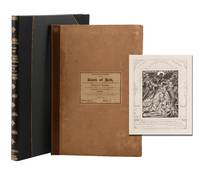
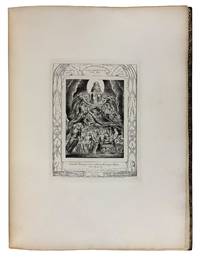
107296London: plates dated 1825 but published 1826. Folio 320 x 254 mm engraved title and 21 plates. Proofs on India paper mounted on handmade paper some leaves watermarked J. Whatman Turkey Mill 1825. Matted a brilliant set with the original printed label preserved. § First edition limited to 150 proof sets 65 sets were also printed on French paper and 100 sets on drawing paper with the word ‘proof’removed. This is the finest set of the proofs I have ever seen and far outshines the other two original printings and the later re-issue. The India paper set is the best printing of these famous plates which comprise Blake’s major single achievement as a printmaker after the illuminated books. Illustrations of the Book of Job was Blake’s last completed prophetic book: the text a series of biblical quotations is above and below each image. “It was produced while Blake was still working on Jerusalem his most obscure book; yet the illustrations are Blake’s most lucid; and they are the supreme example of his reading the Bible in its spiritual sense†S. Foster Damon A Blake Dictionary p. 217. “The modest size of the central panels does not prevent them from ranking with the supreme masterpieces of graphic art†Ray Illustrator and the Book in England #8. [plates dated] 1825 [but published 1826]. Folio unknown books
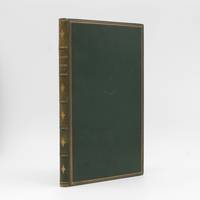
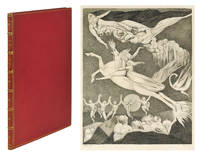
123190London: plates dated 1825 but published 1826. Folio 320 x 254 mm engraved title and 21 plates. Proofs on India paper mounted on handmade paper some leaves 2 5 6 11 14 17 18 watermarked J. Whatman Turkey Mill 1825. Gilt-ruled green morocco over thick boards fleurons at the outer corners double-rule inner frame enclosing a bloom roll gilt-ruled spine sewing bands with gilt red morocco onlays thick dark blue endleaves all edges gilt by Riviere: a brilliant set with no foxing at all interleaved with blanks at the time of binding with no offsetting. Lower cover of the binding at some time tied up with string with ensuing indentation. § First edition limited to 150 proof sets 65 sets were also printed on French paper and 100 sets on drawing paper with the word ‘proof’ removed. This is one of finest sets of the proofs I have ever seen and far outshines the other two original printings and the later re-issue. The India paper set is the best printing of these famous plates which comprise Blake’s major single achievement as a printmaker after the illuminated books. Illustrations of the Book of Job was Blake’s last completed prophetic book: the text a series of biblical quotations is above and below each image. “It was produced while Blake was still working on Jerusalem his most obscure book; yet the illustrations are Blake’s most lucid; and they are the supreme example of his reading the Bible in its spiritual sense†S. Foster Damon A Blake Dictionary p. 217. “The modest size of the central panels does not prevent them from ranking with the supreme masterpieces of graphic art†Ray Illustrator and the Book in England #8. Note: as always the first plate after the title-page is misdated 1828. [plates dated] 1825 [but published 1826]. Folio hardcover books
1826140948122London: Published by the Author 1826. First Edition. Near Fine. First edition of Blake's visionary interpretation of the first of the Poetic Books in the Old Testament. Folio. Engraved title and 21 engravings on drawing paper. Original buff paste board covers with publisher's printed label over quarter brown cloth; cloth perished at spine rebacked. A beautiful copy retaining the original boards housed in a custom clamshell case with spine tooled in gilt.<br /> <br /> <p>The first edition was printed in a run of 315 copies and issued in three versions: 150 copies on laid India with the word "Proof" printed in the bottom margin of plates 65 copies on French paper with "Proof" and 100 on Whatman paper with the word "Proof" removed from the copper plates but still faintly visible in some pulls. This copy is from the latter which Keynes calls the Ordinary Issue. Two plates with watermark of "J Whatman Turkey Mill 1825" and one watermarked "J Whatman 1825" Plate No. 1 incorrectly dated "1828".<p><br /> <br /> Rubbing to covers light soiling light offsetting and subtle repairs to end sheets. Small chip to corner margin of Plate No. 5 far from the engraving. Provenance: armorial bookplate of Frederick Pollock to front pastedown additional mounted printed note from antiquarian bookseller "This book was purchased in 1941 from London whilst the great battle for civilization was in progress. -Francis Edward Ltd."<br /> <br /> <p>An impressive production hailed by many to be Blake's greatest masterpiece completed just before the end of his life. "The story which Blake called 'Job's Captivity' fascinated him all his life. He alluded to it throughout his drawings and writings made a large separate print of Job in 1793 and then a series of twenty-one designs for his faithful patron Thomas Butts about 1810" Bentley. Blake took the plates from Butts' earlier commissions and began work on a second set for John Linnell his friend and fellow artist in 1821. Hoping to earn his impoverished aging friend much needed income Linnell completely backed the project monetarily while Blake went to task engraving. <br /> <br /> <p>Only 20 of the 315 sets were sold during Blake's lifetime mostly to members of his inner circle marking this a commercial failure. However the work was widely recognized as an artistic success amongst the nobility and upper gentry with copies purchased for the King's Library and The Royal Academy. Like many artists Blake did not receive proper recognition until after his death. Admired by John Ruskin he writes highly of the artist in his 1857 text The Elements of Drawing that "The Book of Job . is of the highest rank in certain characters of imagination and expression; in the mode of obtaining certain effects of light it will also prove a very useful example to you. In expressing conditions of glaring and flickering light Blake is greater than Rembrandt." Bentley 421A Keynes 55 vi Ray 8. Published by the Author unknown
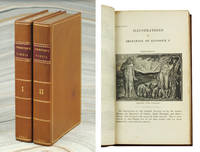
107152London: 1821. 2 vols. small 8vo xii -vii/viii 12 xxiv -i/iv 214; I 215-592 pp. With an engraved frontispiece to each volume and 230 illustrations including 17 woodcuts and 6 engraved plates by Blake and four other designs by Blake engraved by others. Original full rose sheep backstrips lettered in gilt slight wear to joints vol. 1 invisibly repaired by Phil Dusel. A very fine set internally perfect. Enclosed in a modern protective box. § Presentation copy inscribed by Thornton to his daughter. A very fine copy of a scarce work in any condition as it was issued for use in schools; the impressions of the woodcuts in this copy are the richest I have ever seen. Blake contributed 17 woodcuts to this volume as well as 10 other plates of which he engraved six which were not well received; nor were they well treated by the publisher who cut down the blocks and printed them poorly. Only a few proofs before they were trimmed are now extant. These blocks have remained amongst the most influential woodcuts in the history of British art and their influence can be seen from Calvert and Palmer all the way up to the present day. The blocks were saved by Linnell and were printed not long after Blake's death as separate impressions perhaps by Calvert and again in 1977 as a set by Iain Bain. Any impressions are now very hard to find. For a full discussion of this wonderful book see Essick's masterly monograph A Troubled Paradise. San Francisco: John Windle 1999. Bentley Blake Books 504. Bindman 602-18. Easson and Essick I X. 1821. 2 vols unknown books
18211071521821. London: 1821. <br /> <br /> 2 vols. small 8vo xii -vii/viii 12 xxiv -i/iv 214; I 215-592 pp. With an engraved frontispiece to each volume and 230 illustrations including 17 woodcuts and 6 engraved plates by Blake and four other designs by Blake engraved by others. Original full rose sheep backstrips lettered in gilt slight wear to joints vol. 1 invisibly repaired. A very fine set internally perfect. Enclosed in a modern protective box.<br /> <br /> § Presentation copy inscribed by Thornton to his daughter. A very fine copy of a scarce work in any condition as it was issued for use in schools; the impressions of the woodcuts in this copy are the richest I have ever seen. Blake contributed 17 woodcuts to this volume as well as 10 other plates of which he engraved six which were not well received; nor were they well treated by the publisher who cut down the blocks and printed them poorly. Only a few proofs before they were trimmed are now extant. These blocks have remained amongst the most influential woodcuts in the history of British art and their influence can be seen from Calvert see below and Palmer all the way up to the present day. The blocks were saved by Linnell and were printed not long after Blake's death as separate impressions perhaps by Calvert also see below and again in 1977 as a set by Iain Bain see below. Any impressions are now very hard to find. For a full discussion of this wonderful book see Essick's masterly monograph A Troubled Paradise. San Francisco: John Windle 1999. Bentley BB 504. Bindman 602-18. Easson and Essick I X. unknown
107341Chichester. Printed by J. Seagrave and sold by him and P. Humphry et al. for W. Blake 1802. Frontispiece 250 x 174 sheet 175 x 160 platemark mm printed in black on wove paper. Recently cleaned trimmed close to the right plate mark but not touching it other margins wide. § Frontispiece to the first edition of the rarest letterpress publication containing engravings by Blake Hayley's Ballads 1802. The frontispiece Adam and the Beasts is one of Blake’s most alluring images. The illustrations were drawn engraved printed and published by Blake himself. The work was a financial disaster and unfortunately Blake had borne most of the publication costs. He was eventually reduced to reusing unsewn sheets of the 1802 Ballads for sketch paper. Geoffrey Keynes writing in 1921 states: “This edition of the ballads is now extremely rare.†Bentley Blake Books 466. Easson and Essick William Blake Book Illustrator vol. 1 VI. Bindman Complete Graphic Works of Blake 385-398. Essick “A Census of Complete Copies of Designs to a Series of Ballads 1802†Blake: An Illustrated Quarterly spring 2000. “This edition of the ballads is now extremely rare...†Bentley unknown books
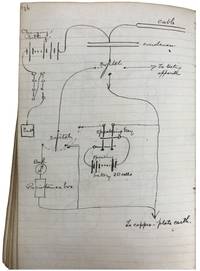
191335824Various places chiefly United States and Europe 1913. A substantial archive documenting the scientific technical and personal life of Francis Blake Jr. inventor and electrical engineer associated with the early development of the telephone. The material traces Blake’s career from his work with the U.S. Coast and Geodetic Survey through his experimental work on telephone transmission and his later involvement in patent disputes and the business of telephony.<br/> <br/> "If the Blake name is unrecognizable today this is no reflection of his accomplishments which were significant but of Blake's loathing for publicity and public attention. Ultimately Blake reached the goals he sought and achieved the anonymity he preferred. Whatever lesson that offers us today the significance of Blake's life and his inventions endures. His story is a compelling and fascinating chronicle of unbounded energy independence and genius" Elton W. Hall Francis Blake: An Inventor's Life Massachusetts Historical Society: 2003 p. xi. At a very young age Francis Blake Jr. the youngest of five children born to Francis Blake Sr. an itinerant businessman and Caroline Trumbull Blake was recognized for his high aptitude in science and math. His uncle a Commodore in the U.S. Navy secured for him an appointment to the U.S. Coast and Geodetic Survey where starting at the age of 16 he excelled at triangulation hydrographic work astronomical measurements and the complicated method of determining trans-Atlantic and trans-continental longitude via telegraphy. His work with the U.S.C.G.S. brought him to France Cuba and all over the United States. Blake's fascination with the technical equipment he encountered and the drive to perfect each piece of apparatus developed into a career as an inventor. Leaving the U.S.C.G.S. in 1877 he began working to that end. Blake first learned of Alexander Graham Bell's invention from his Coast supervisor Julius E. Hilgard who had been one of several judges that had awarded Bell a prize at the 1876 Centennial Exhibition. The telegraphic work Blake had done during his years at the Coast Survey had provided him with a highly sophisticated understanding of electricity Hall pp. 71-72. While Bell had been the first to invent the telephone his first apparatus had a significant flaw: while it listened well it could not transmit speech with distinct quality or sufficient volume for communicants to easily understand one another and carry a meaningful conversation. Famed inventor Thomas J. Edison jumped on the opportunity and sold a better transmitter to Western Union which was poised to take the lion's share of the new telephone market. Working from his home workshop however Blake bested both Bell and Edison inventing a transmitter using a carbon microphone and contacts that telephonically produced better sound quality than anything before. The addition of the Blake transmitter would immediately launch Bell Telephone as the gold standard for the next century. The present archive is predominantly comprised of material from his U.S.C.G.S. work as well as the period during and immediately after the invention of his transmitter. Evidenced throughout are two key components of Blake's character: his continual drive for perfection whether related to an invention construction on his estate Keewaydin or the quality of oats delivered from a local merchant; and his firm belief in his own claims whether related to the endless patent infringement litigation which followed his invention to the monies owed to him from a bequest after the death of a relative. Included are several daily manuscript journals and account books a retained carbon copy letterbook from 1881 and numerous books and pamphlets from his own library related to the telephone including Bell's The Telephone: A Lecture Entitled Researches in Electric Telephony . delivered before The Society of Telegraph Engineers October 31st 1877. Other printed material includes Blake's true copy of the seminal 1879 contract between Western Union and Bell Telephone in which the former agreed to withdraw from the telephone business. Significant holdings of Blake material are found in the Massachusetts Historical Society donated by the descendants of Francis Blake Jr. in May 1964. The present archive was part of the Blake family's Dover Massachusetts residence the contents sold at public auction in 2018. An itemized catalogue of the full Francis Blake archive is available upon request.<br/> <br/> Elton W. Hall Francis Blake: An Inventors Life Massachusetts Historical Society: 2003. unknown
18211228771821. London: 1821. <br /> <br /> 2 vols. small 8vo xii -vii/viii 12 xxiv -i/iv 214 pp; I 215-592 pp. With an engraved frontispiece to each volume and 230 illustrations including 17 woodcuts and 6 engraved plates by Blake and four other designs by Blake engraved by others. Retrospective early 19th century full calf red labels by Court Benson. <br /> <br /> § A very good copy of a scarce work in any condition as it was issued for use in schools. Blake contributed 17 woodcuts to this volume as well as 10 other plates of which he engraved six which were not well received; nor were they well treated by the publisher who cut down the blocks and printed them poorly. Only a few proofs before they were trimmed are now extant. These blocks have remained amongst the most influential woodcuts in the history of British art and their influence can be seen from Calvert and Palmer all the way up to the present day. The blocks were saved by Linnell and were printed not long after Blake's death as separate impressions perhaps by Calvert and again in 1977 as a set by Iain Bain. Any impressions are now hard to find. For a full discussion of this wonderful book see Essick's masterly monograph A Troubled Paradise. San Francisco: John Windle 1999. Bentley Blake Books 504. Bindman 602-18. Easson and Essick I X. unknown
182641830London: William Blake 1826. Folio. 17 x 13 inches. Engraved pictorial title and 21 engraved plates by Blake each being mounted India paper proofs each plate marked "Proof" in the lower right corner on paper watermarked J. Whatman Turkey Mill 1825. Plate No. 1 misdated "1828". Later straight-grained green morocco gilt with Riviere & Sons spine gilt in compartments<br/> <br/> Blake's renowned engravings for the Book of Job: one of 150 proof sets on India Paper.<br/> <br/> "The story which Blake called 'Job's Captivity' fascinated him all his life. He alluded to it throughout his drawings and writings made a large separate print of Job in 1793 and then a series of twenty-one designs now in the Morgan Library for his faithful patron Thomas Butts about 1810" Bentley. Blake had completed the designs for what would become his Illustrations for the Book of Job around 1805-1806 for Thomas Butts a clerk to the commissary general of musters who had by then become Blake's major patron. The publication was not conceived of until ten years later when Linnell hoping to provide his ageing friend with a much needed income offered to finance the engraving and printing. The plates were borrowed back from Butts in 1821 and Blake began the arduous task of the engraving. Although the title page is dated 1825 publication was delayed until 1826 and the date amended on a label pasted to the boards in which the plates were issued. This striking work was printed in four different series during the 19th century: a first set of 150 "proof" copies on india paper 1826 to which series the present set belongs; a second set of 65 "proof" copies on French paper 1826; 100 sets on drawing paper with the word "Proof" removed from the plates 1826; and finally 100 sets on India mounted on heavy paper 1874 pulled from the original plates by Linnell. The 1826 India paper proof sets like the present are the best printing of these famous plates being richly inked strong impressions. Damon describes the illustrations as "Blake's most lucid; and they are the supreme example of his reading the Bible in its spiritual sense." Ray adds that they are "supreme masterpieces of graphic art."<br/> <br/> Ray Illustrator and the Book in England 8; Damon p. 217; Bindman 625-646; Keynes 55; Binyon 105-126; Bentley 421A. William Blake unknown
19684215011968. Very Good. A large archive of manuscripts and related literary papers of gay writer Richard Blake Brown including novels plays poetry travel writing and memoirs. The collection consists of about 130 holograph and typescript manuscripts: 50 notebooks of holograph manuscripts; 38 volumes of bound typescripts; 39 unbound typescripts; two holograph booklets; one unbound holograph manuscript; seven of Brown’s published novels five of which are annotated by him and have extra material laid in; and about 60 miscellaneous items including manuscript extracts letters. and photographs. The bulk of the writings date from the late 1920s-1950s.<br /> <br /> Richard Blake Brown 1902-1968 is an overlooked figure in the British literary scene of the interwar period: a remarkable man and an exceptional writer Brown’s open homosexuality was a source of puzzlement even to fellow gay writer Denton Welch who once exclaimed in response to a 1946 letter from Brown: "Is this exhibitionism or vanity or what"<br /> <br /> The collection contains a number of references to the Queen’s dressmaker Norman Hartnell another prominent homosexual and lifelong friend of Brown's and Brown’s homosexual sensibility permeates the whole of the present collection: from his teenage memoir The Remarkable History of Hilden Abbey – in which he describes dressing up with his brother Lincoln and Tonbridge schoolfellow Rupert Croft-Cooke as monks and abbots – to a number of misogynistic limericks written in the late 1960s; and in other writings such as My Aunt in Pink and The Gaiety of God. However such honesty was received at the time it now looks courageous in the light of the sort of punishment meted out to Croft-Cooke who was imprisoned for homosexual activities in 1953. Whatever view the authorities may have taken it does appear that Brown was indulged by his friends: a copy of Graham Greene’s 1958 play The Potting Shed survives not in this collection inscribed to: "My dear Richard Many thanks for your letter which has broken a long silence. I am glad you liked the play. What have you been doing with yourself Any more books on the way I heard rumours of you at the wedding and how you eclipsed every other male there. Affectionately Graham."<br /> <br /> A useful account of Brown’s life up to 1947 can be found in his unpublished autobiography A Life in the Shade: born in 1902 in Boston ‘of American parents who brought him to England later in the same year’ because his father had invented a system of power-signaling for London’s Underground Railways he attended Tonbridge and Berkhamsted public schools and Magdalene College Cambridge graduating in 1923. He then joined the Old Vic Company for a season of Shakespeare as a student-actor uncertain as to whether the stage or the church should be his profession. Having decided on the latter he studied theology at St. Stephen’s House Oxford and became one of the 12 curates of the famous parish of St. Mary’s Portsea but voluntarily resigned his orders three years later. He then published 12 books during the 1930s including The Apology of a Young Ex-Parson and returned to the exercise of his ministry with the approval of Archbishop of Canterbury Doctor Cosmo Gordon Lang and went to work in a mining village in Derbyshire. For six years he was a temporary chaplain R.N.V.R. including chaplain of the Flagship HMS Renown during the sinking of the Bismarck episode. After the war he continued in his ministry as a prison chaplain.<br /> <br /> Brown remained an inveterate writer throughout his life and published 14 novels: Miss Higgs and her Silver Flamingo Duckworth 1931 Yellow Brimstone Duckworth 1931 The Apology of a Young Ex-Parson Duckworth 1932 A Broth of a Boy Fortune Press 1934 The Blank Cheque Fortune Press 1934 Joy in Jeopardy Fortune Press 1935 Rococo Coffin Fortune Press 1936 My Aunt in Pink Martin Secker 1936 Spinsters Awake! Martin Secker 1937 Bicycle Belle Fortune Press 1937 God by Lamplight Skeffington 1938 Mr. Prune on Cotswold Martin Secker 1938 Yet Trouble Came Cassell 1957 and Bright Glades Cassell 1959.<br /> <br /> Not only does the archive contain some of the manuscripts of these books including Miss Higgs and her Silver Flamingo My Aunty in Pink and Bright Glades but even more important are the large number of unpublished novels and other unpublished writings in the collection including poetry plays and short stories.<br /> <br /> Although an assessment of such a large body of published and unpublished work is difficult a writer such as Brown praised by the English writer and feminist Vera Brittan for his "scintillating phrases" and "conscious brilliance" deserves to be taken seriously. In response to being described as a "Firbankian" novelist Brown wrote in 1951: "I grow so weary of being told that my books have been strongly influenced by Ronald Firbank of whom few people in these days would ever had heard but for his 'Valmouth' being turned into a modern musical a few years ago … I admit I enjoyed several of Firbank’s short novels … but I possess far too vivid an imagination of my own."<br /> <br /> Brown’s writing is often described as being unusual and idiosyncratic. Several of the novels Yellow Brimstone; Yet Trouble Came; Thunder are set in the future and although the influence of Firbank is apparent so is that of Anthony Trollope and Thomas Love Peacock. In Vera Brittan’s 1931 review of Yellow Brimstone she wrote: "The author whose delicate improprieties are subtly reminiscent of Mr. James Branch Cabell undoubtedly regards himself – by no means without justification – as a very clever young man. He is not yet however sufficiently aware that the New Morality which his scintillating phrases embody has been stated before; though never perhaps with such conscious brilliance."<br /> <br /> The following year on the publication of Brown’s autobiography The Apology of a Young Ex-Parson another novelist Norman Collins commented that it hard to believe that Blake Brown was not "strenuously parodying himself" in "this unbelievable diary": "Anyone who reads this book will agree with the author when he says of himself; 'I am quite a singular person.' An orthodox churchman – one of the kind that the author hates – might even see evidence of benevolent creation in the fact that Mr. Blake Brown is unique."<br /> <br /> The condition of the collection is very good overall with damp-staining to several intermittent volumes mostly confined to the covers only or just to the covers and margins of the endleaves and not affecting any autograph or typescript pages. A few volumes have some additional damp-staining pervading into the leaves at the front or back with no visible damage to the manuscript pages. Four volumes with partial damage are noted in the individual description. Several volumes have later manuscript notes by RBB including some in which he added or removed a photograph or other tipped-in material.<br /> <br /> A detailed finding aid to the collection divided into eight sections: Novels; Poetry; Short stories; Non-fiction; Drama; Travel; Miscellaneous; Published works is available. unknown
1821VBF48<p><b>BLAKE</b> William</p><p><i><b>The Pastorals of Virgil</b></i> With a course of English Reading adapted for Schools . enabling youth to acquire the Latin Language in the shortest period of time. Edited by Robert John <b>Thornton</b>. </p><p>London: F C & J Rivington 1821. </p><p>Two volumes illustrated with engraved frontispieces 230 illustrations: of which William Blake has contributed 17 original woodblock designs for the First Eclogue six copperplates of Classical poets and philosophers all of which he also engraved and with four additional Blake designs engraved by other hands. These are WILLIAM BLAKE's only woodcut designs and have remained amongst the most influential woodcuts in the history of British art. Their influence can be seen in the prints of Edward Calvert and Samuel Palmer. The original blocks survive and are preserved in the British Library London last restruck in 1977 by Iain Bain.</p><p>8vo. xii -vii/viii 12 xxiv -i/iv 214 pp. i 215-592 pp. plates erratic preliminaries nonetheless complete as matching collations in both Keynes and Easson/Essick; matching contemporary sheep leather possibly as published.</p><p>Third edition first thus</p><p>Provenance: George R. Gardner pasted bookplate inside covers</p> F C & J Rivington hardcover books
183918535London: William Pickering 1839. First letterpress edition of Blake’s best-loved works which had been available previously only in the poet’s privately printed and unobtainable hand-painted and engraved editions. Edited with a lengthy 18-page preface by the Swedenborgian James John Garth Wilkinson 1812-1899 who used Charles Augustus Tulk’s copy of the illuminated first edition c.1795-1807 to make his selection. This edition appears in two issues with and without a poem entitled “The Little Vagabond†at page 71. The poem was reportedly canceled by the editor out of prudishness. It is not present in this copy. No priority between the two issues has been established. Keynes 135; Bentley & Nurmi 161B; Bentley Blake Books 171 The English poet and dramatist John Drinkwater’s copy with his ownership signature dated 1923 on the front free endpaper and his bibliographical annotations beneath in pencil and his delightful little gilt embossed leather bookplate on the front endsheet. The book also bears the engraved bookplate of Elizabeth Walbridge on the front endsheet. Elizabeth Walbridge was married to S. Cornell Walbridge a major figure in the glass industry in Toledo Ohio aka “Glass City†and an avid book collector in the early years of the Twentieth Century. There is also a contemporary ownership signature on the front free endpaper that is difficult to decipher: possibly “Miss Mare or Miss Marie†and the remnant of a red wax seal beneath the tipped-in Walbridge bookplate. Head and tail of spine very slightly worn spine faintly sunned with covers fading slightly toward the margins otherwise a remarkably attractive and clean copy of this rare and important edition. 8vo original plum cloth. Head and tail of spine very slightly worn spine faintly sunned with covers fading slightly toward the margins otherwise a remarkably attractive and clean copy of this rare and important edition. William Pickering unknown
182665634ìBlakeÃs Most Widely Known Achievementî BLAKE William. Illustrations of the Book of Job. Invented & engraved by William Blake 1825. London: Published by the Author and Mr. J. Linnell 1874. One of 100 sets printed on india paper. Folio sheets: 20 x 14 inches; 510 x 350 mm. engravings 8 1/4 x 6 1/2 inches; 209 x 158 mm. Line-engraved title and twenty-one line- and stipple-engraved plates by and after Blake. Also with an additional letterpress title-page not issued with the book. Printed from the original plates. Evidence of the word proof on the lower edge of engravings number 5 7 8 10 11 12 14 18 and 20. Bound in quarter reverse calf over black cloth. Spine lettered and ruled in gilt. With black and red morocco spine labels lettered in gilt. Marbled endpapers. Corners a bit bumped and cloth lightly scuffed. Sheets mounted on stubs. A bit of very light foxing to some of the sheets generally not affecting engravings mainly title-page sheet and sheet of plate 20. Plate 14 with the mounting sheet trimmed at top margin about 1.5 inches not affecting plate. A fine strikingly clean copy of ìBlakeÃs most widely known achievementî Keynes. The engravings were commissioned by John Linnell on March 25 1823. Despite the date 1825 on the engravings the plates were not actually issued until March 1826. The entire edition consisted of 315 sets: 150 ìProofî sets on India paper and sixty-five on French paper were printed in March 1826 at which time the word ìProofî was removed from the plates and 100 sets were printed on drawing paper see Bentley. BlakeÃs original copperplates remained in the possession of the Linnell family and as late as 1863 Linnell was offering for sale sets of the India-paper and French-paper issues. By 1874 these must have been sold as a further 100 sets of the engravings were printed at that time the present copy is from this set. No more pulls were taken between 1874 and 1919 when the copperplates were given by Herbert Linnell to the British Museum. Linnell's son wrote "My father considered the plates at the last 1874 were as good as they ever were for the work being cut by a graver and not etched it is durable- and is not worn by the printing as is the case with an etching." Bentley Books p. 523. Bentley 421A. Binyon 105-126. Russell 33. HBS 65634. $32500 William Blake hardcover books
182665634London: William Blake 1826. BLAKE William. Invented & engraved by William Blake 1825. London: Published by the Author and Mr. J. Linnell 1874.<br> <br> One of 100 sets printed on india paper. Folio sheets: 20 x 14 inches; 510 x 350 mm. engravings 8 1/4 x 6 1/2 inches; 209 x 158 mm. Line-engraved title and twenty-one line- and stipple-engraved plates by and after Blake. Also with an additional letterpress title-page not issued with the book. Printed from the original plates. Evidence of the word proof on the lower edge of engravings number 5 7 8 10 11 12 14 18 and 20.<br> <br> Bound in quarter reverse calf over black cloth. Spine lettered and ruled in gilt. With black and red morocco spine labels lettered in gilt. Marbled endpapers. Corners a bit bumped and cloth lightly scuffed. Sheets mounted on stubs. A bit of very light foxing to some of the sheets generally not affecting engravings mainly title-page sheet and sheet of plate 20. Plate 14 with the mounting sheet trimmed at top margin about 1.5 inches not affecting plate. A fine strikingly clean copy of "Blake's most widely known achievement" Keynes.<br> <br> The engravings were commissioned by John Linnell on March 25 1823. Despite the date 1825 on the engravings the plates were not actually issued until March 1826. The entire edition consisted of 315 sets: 150 "Proof" sets on India paper and sixty-five on French paper were printed in March 1826 at which time the word "Proof" was removed from the plates and 100 sets were printed on drawing paper see Bentley. Blake's original copperplates remained in the possession of the Linnell family and as late as 1863 Linnell was offering for sale sets of the India-paper and French-paper issues. By 1874 these must have been sold as a further 100 sets of the engravings were printed at that time the present copy is from this set. No more pulls were taken between 1874 and 1919 when the copperplates were given by Herbert Linnell to the British Museum.<br> <br> Linnell's son wrote "My father considered the plates at the last 1874 were as good as they ever were for the work being cut by a graver and not etched it is durable- and is not worn by the printing as is the case with an etching." Bentley Books p. 523.<br> <br> Bentley 421A. Binyon 105-126. Russell 33.<br> <br> HBS 65634.<br> <br> $32500. William Blake unknown
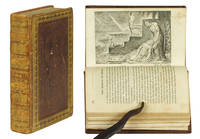
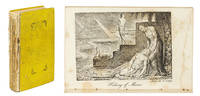
18241245961824. London: I. Poole 1824. <br /> <br /> Small 8vo xxiv 372pp. With an engraved frontispiece 4 full-page engravings including one by Blake 8 hand-colored botanical plates 8 plates of engraved music a calendar with an engraved title-page and 6 plates and 12 blank leaves titled "Album 1825" recorded by Keynes but not noted in other copies we have had. Publisher's original full brown calf central panels on both covers blind-stamped within a richly gilt border backstrip with four raised bands gilt-decorated lettered REMEMBER ME slightly scuffed and small black splotch ink on lower cover occasional small spots on plates as usual a very good copy of a de luxe issue binding on the first of three editions of the book.<br /> <br /> § First edition first issue of the book no state variance in the plate with a very early pencil inscription from one woman to another illegible repeated on the next leaf. One of the rarest of all of the plates designed and engraved by Blake. There was a reissue dated 1826 as part of the title probably published late in 1825. The plate titled 'The Hiding of Moses' was the last plate designed and engraved by Blake himself for a commercial publication; the original drawing 'Moses placed in the Ark of Bulrushes' which closely echoes a tempera now untraced that was executed some 25 years earlier is in the Huntington Library. Bentley BB 490B. Easson and Essick WBBI Vol. I XI recording the Rosenwald proof and 3 copies. Keynes Blake Studies XIX recording 7 variants but not mentioning the 1826 printing. Also see Bentley's detailed essay and census of copies in "Remember Me! Customs and Costumes of Blake's Gift Book" University of Toronto Quarterly 80.4 fall 2011: 880-92. Bentley in the U of T Quarterly 2011 noted: "The gift book Remember Me! with Blake's wonderful engraving of the 'Hiding of Moses' was more remarkable for its decorations than for its literary contents. Of the twenty-four copies recorded each differs from the others in the pattern of binding colour of fore-edges endpapers and the decorated sleeve-case. Despite this varied elegance the work had only a modest sale and the same sheets were re-issued in 1825 for the 1826 gift-giving season. This paucity of sales may be related to the fact that the publisher John Poole had little experience of book distribution. His speciality was as a maker of Marble Paper and Fancy Pocket-Books not in selling them.". unknown
182511080112mo. London: I. Poole 1825. 12mo frontispiece "A Tribute of Regard."; title-page "Remember Me" etc. with 1826 beneath "Christmas Present"; second engraved leaf recto "Calendar and Album 1826." verso January and February next three leaves with the rest of the Calendar; verso of third leaf "The Virgin Child and St. Johnâ€; 8 pp. of engraved music; contents and introduction i ii-xxiv; plate "Her screams aroused her servant"; 1 2-336. With the Blake plate at p. 32 and color plates at 42 73 88 89 93 148 149 275 b/w The Storm and 326 color. Publisher’s original printed yellow paper boards no backstrip occasional spotting but a good copy of this fragile booklet in its rarest format preserved in a cloth box. § Second issue of the book no variance in the plate the contents omits the blank leaves and the misnumbered leaves at the end. One of the rarest of all of the plates designed and engraved by Blake here in its rarest format. The plate titled ‘The Hiding of Moses’ was the last plate designed and engraved by Blake himself for a commercial publication; the original drawing ‘Moses placed in the Ark of Bulrushes’ which closely echoes a tempera now untraced that was executed some 25 years earlier is in the Huntington Library. BB #490B. Easson and Essick William Blake Book Illustrator XI recording the Rosenwald proof and 3 copies. Keynes Blake Studies XIX recording 7 variants but not mentioning the 1826 printing. Also see Bentley’s detailed essay and census of copies in “Remember Me! Customs and Costumes of Blake’s Gift Book†University of Toronto Quarterly 80.4 fall 2011: 880-92. I. Poole hardcover books
1839368615London: W. Pickering . and W. Newbery 1839. First letterpress edition issue without "The Little Vagabond. xxi iii 74 pp. 1 vols. 8vo. Full green morocco gilt. Fine copy. Circular gilt vellum label of William Twopeny. First letterpress edition issue without "The Little Vagabond". xxi iii 74 pp. 1 vols. 8vo. The first letterpress edition of Blake's Songs of Innocence and Experience preceded only by the small number of copies of the illuminated first edition engraved and colored by Blake. With a laudatory Preface by the Swedenborgian James John Garth Wilkinson 1812-99 who edited and arranged the present volume for publication. Wilkinson worked from Charles Augustus Tulk's copy of the illuminated first edition c.1795-1807; Tulk had previously lent his copy to Coleridge. The work appears in two issues with or without a poem entitled "The Little Vagabound" at page 71 which was supposedly canceled by the editor out of prudishness. No priority has been established<br /> Both issues appear with about equal frequency which is to say not often. Keynes 135; Bentley & Nurmi 161B; Bentley Blake Books 171 W. Pickering ... and W. Newbery unknown
1881108279Impression measures 93. London: Colnaghi printing after 5 March 1881. Impression measures 93.9 x 30 cm. printed on laid India paper; recently cleaned. § Final state: it is worth noting that the only difference between the so-called fourth and fifth states is the absence of the scratched dry-point inscriptions clearly visible in a few prints and less and less visible until completely absent by the time Sessler was printing the plate. Instead of “states†the more accurate definitions might be very early to very late 4th state and in that scheme then this print would be well after the early impressions with some or most of the scratched inscriptions visible but before the Sessler printings of the 1940s none of which were on laid India. “‘Chaucers Canterbury Pilgrims’ was one of Blake’s major attempts at building a reputation as a painter-engraver and achieving the sort of critical and financial success that had escaped him for so many years.…†However Blake wasn’t to meet with the critical success he had hoped for and the competition created when Thomas Stothard executed a plate of the same subject caused him to become bitter. “Most contemporary connoisseurs probably found the print old-fashioned and ‘Gothic’ in the pejorative sense.… The record of prices brought by the print at auction indicates that it has attracted strong interest from collectors only in the last few years†Essick pp. 86-88. “It is only in the last two states of the plate that we find Blake’s mature artistry as an original printmaker bringing to his largest and most ambitious single print the same techniques distinguishing his Job and Dante engravings.†Essick Separate Plates of William Blake XVI and see William Blake Printmaker. Colnaghi printing unknown books
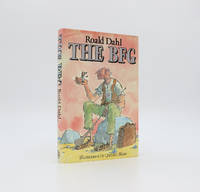
29315London: Jonathan Cape. 1982. First edition first printing. First edition first printing. Signed and inscribed by the illustrator with original drawings across five pages. Publisher's original light grey cloth with gilt titles to the spine in the Quentin Blake illustrated dustwrapper. Illustrated with ink and wash drawings throughout by Quentin Blake. A near fine copy the binding square and firm the cloth and gilt bright with some very light bumping to the spine tips and corner. The contents with the unavoidable toning to the text block are otherwise clean throughout. Complete with the lightly rubbed and creased dustwrapper that is bright and without loss or tears. Not price-clipped £6.50 net to the lower front flap. An exceptional example embellished with original drawings of Sophie and the BFG spanning the front pastedown endpaper and following page and the BFG running over moonlit fields to the rear endpaper and pastedown. Signed and dated 'August 31st 2014' by Quentin Blake on the half title and further inscribed "& new endpapers" on the title page. A beautifully hand-illustrated and unique first edition of Roald Dahl's much-loved 'The BFG'. The story has inspired numerous stage and screen adaptations most notably the 2016 Walt Disney Pictures film directed by Steven Spielberg starring Mark Rylance Ruby Barnhill Penelope Wilton Jemaine Clement Rebecca Hall Rafe Spall and Bill Hader. The Big Friendly Giant first appeared as a character in 'Danny the Champion of the World' 1975 told as a story by Danny's father. This exceptional copy was embellished by Quentin Blake to raise funds at a charity auction held at Sotheby's on 8 December 2014. The auction titled 'First Editions: Redrawn' invited celebrated illustrators and authors to annotate inscribe and re-illustrate their most iconic children's books in support of Blake's charity the House of Illustration which is dedicated to championing illustrators in the UK. Blake's BFG was offered alongside similarly enhanced first editions by Judith Kerr Lauren Child Richard Adams Cressida Cowell Michael Bond and Raymond Briggs. Further details and images for any of the items listed are available on request. Lucius Books welcomes direct contact with our customers. London: Jonathan Cape. 1982 hardcover
1827105078Printed in black ink on thick card. London: William Blake 1827. Printed in black ink on thick card. Very finely printed in good condition though trimmed very close to the image at the left and right edges once pasted down and thus with traces of mounting on the verso and pencil notes from an earlier collector c. 1950 image and plate mark exactly as per Essick 1DD. § Blake’s last engraving executed for one of his closest friends. The images invoke one of Blake’s greatest themes—the relationships between time and eternity. Although probably intended as a calling card two books have been located with this card pasted in both written by George Cumberland Jr. Thus it has on occasion been sold as a “bookplateâ€. Examples on card not in Cumberland's book are exceptionally rare and have been presumed to be of the earliest printing and possibly by Blake himself. All other impressions on laid paper most often are posthumous. Thirty-nine examples in all are known to Essick not including examples now untraced of which eight are on card of which one is described as printed in green ink. Essick The Separate Plates of William Blake XXI see entry 1DD for identical measurements but not this copy. Bindman Complete Graphic Works of Blake 654. William Blake unknown books
18271050781827. London: William Blake 1827. <br /> <br /> Printed in black ink on thick card. Very finely printed in good condition though trimmed very close to the image at the left and right edges once pasted down and thus with traces of mounting on the verso and pencil notes from an earlier collector c. 1950 image and plate mark exactly as per Essick 1DD.<br /> <br /> § Blake's last engraving executed for one of his closest friends. "Blake inscribed the plate lower right with his name and age "A Æ 70." He may have sensed that 1827 could well be the last year of his life but took pride in being capable of pursuing his art and craft to the end. Blake was in fact 69 when he died; perhaps he inscribed "70" on the Cumberland card in anticipation of working on it until he turned that age. At least when considered in retrospect this most unusual inscription contributes to the elegiac and prophetic iconography of the design."<br /> <br /> The images invoke one of Blake's greatest themes-the relationships between time and eternity. Although probably intended as a calling card two books have been located with this card pasted in both written by George Cumberland Jr. Thus it has on occasion been sold as a "bookplate." Examples on card not in Cumberland's book are exceptionally rare and have been presumed to be of the earliest printing and possibly by Blake himself. All other impressions on laid paper most often are posthumous. Thirty-nine examples in all are known to Essick not including examples now untraced of which eight are on card of which one is described as printed in green ink. Essick The Separate Plates of William Blake XXI see entry 1DD for identical measurements but not this copy. Bindman Complete Graphic Works of Blake 654. unknown
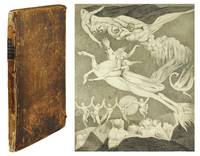
17961246441796. London: by S. Gosnell for William Miller 1796. <br /> <br /> Slim 4to xi 16 pp. With a frontispiece and 2 illustrations headpiece and tailpiece designed by Blake and engraved by Perry. Later full red straight-grain morocco gilt-lettered backstrip a fine copy with a faded inscription on the title-page "Sophia Baillie".<br /> <br /> § First edition with Blake's illustrations ridiculed in the press upon publication. One of the rarest letterpress books to contain illustrations designed by Blake. Four copies have sold in the last 40 years; two have appeared at auction. The year 1796 saw three translations of Burger's Lenore one by J. T. Stanley one by H. J. Pye the Poet Laureate and a third by W. R. Spencer with designs by Lady Diana Beauclerk. Blake was commissioned to create three illustrations for the Stanley translation including the frontispiece "Lenore clasping her spectral bridegroom" which is famous for supposedly having hung as a separate print in C.G. Jung's office. The British Critic for September 1796 spitefully compared Lady Diana's pictures with those of Blake's: "We are highly impressed by the propriety decorum and grace which characterizes all the figures of this elegant artist Lady Beauclerk even those of a preternatural kind; forming a most striking contrast to the distorted absurd and impossible monsters exhibited in the frontispiece to Mr. Stanley's last edition i.e. Blake's design. Nor can we pass by this opportunity of execrating that detestable taste founded on the depraved fancy of one man of genius which substitutes deformity and extravagance for force and expression and draws men and women without skin with their joints all dislocated; or imaginary beings which neither can nor ought to exist." The Analytical Review chimed in with comments including "perfectly ludicrous instead of terrific." Lenore had a profound effect on the development of Romantic literature throughout Europe7 and a strong influence on the English ballad-writing revival of the 1790s.8 According to German language scholar John George Robertson5<br /> <br /> Lenore exerted a more widespread influence than perhaps any other short poem in the literature of the world. . like wildfire this remarkable ballad swept across Europe from Scotland to Poland and Russia from Scandinavia to Italy. The eerie tramp of the ghostly horse which carries Lenore to her doom re-echoed in every literature and to many a young sensitive soul was the revelation of a new world of poetry. No production of the German "Sturm und Drang"-not even Goethe's Werther which appeared a few months later-had such far-reaching effects on other literatures as Bürger's Lenore; it helped materially to call the Romantic movement in Europe to life.<br /> <br /> In a similar tone English literature scholar Marti Lee claims that:6<br /> <br /> "Lenore" had tremendous influence on the literature of the late eighteenth- and early nineteenth-centuries and in fact today's popular horror books and movies are still feeling the reverberations. . In short Bürger's achievement while minor in itself helped father an international movement that led directly to the massive popularity of Gothic works then and now. . As the Gothic novel borrowed many of its original conventions from the German ballads as popularized by "Lenore" we can fairly say that Bürger is one of the most influential founding fathers of the Gothic and horror genres.Bentley Blake Books 440. Easson and Essick William Blake Book Illustrator vol. 2 XLVI. Bindman Complete Graphic Works of Blake 380-382. unknown
17961233581796. London: William Miller 1796 etc. <br /> <br /> 9 titles mostly bound together and the magazine printing present Burger G. A. Blake William illustrator. Leonora also 'Lenore' and 'Lenora'' Eight different printings six in English and two in German as listed below including the edition illustrated by Blake. London: William Miller 1796 etc. 7 titles bound together and the magazine printing present separately. With a frontispiece and 2 illustrations headpiece and tailpiece designed by Blake and engraved by Perry and other illustrations not by Blake as described below. Old calf very worn covers detached preserved in a new box.<br /> § Nine printings of Burger's hugely influential poem bound together including the first edition with Blake's illustrations ridiculed in the press upon publication. One of the rarest letterpress books to contain illustrations designed by Blake. Four copies have sold in the last 60 years; none have appeared at auction. No recorded copy has seven versions of the poem bound together let alone the Monthly Magazine printing which preceded them. Although the binding is in very poor condition it was deemed best to keep the "sammelband" in original condition just as it was assembled by the first owner.<br /> <br /> Contents: <br /> <br /> 1 Leonora. A Tale. London: William Miller 1796. 8vo viii 13p. Frontispiece after Daniel Chodowiecki engraved by Harding head- and tailpiece by Harding. Interesting early manuscript notes about the book on half-title see below. 8.5 x 5.5 ins.<br /> <br /> 2 Lenore. Ein Gedicht. London: gedruckt bey S. Gosnell 1796. 8vo 3 4- 14 2p. Not illustrated. 8.5 x 5.5 ins. Text in German.<br /> <br /> 3 Leonora. A Tale. Translated and altered from the German. by J.T. Stanley. A New Edition. London: printed by S. Gosnell for William Miller 1796. 4to frontispiece by Blake engraved by Perry half-title xi 16p. inserted additional frontispiece by Chodowiecki not called for headpiece and tailpiece by Blake engraved by Perry 16p. 12 x 9 ins.<br /> <br /> 4 Leonora. Translated from the German. by W.R. Spencer Esq. With Designs by the right Honourable Lady Diana Beauclerc. London: T. Bensley; for J. Edwards and E. and S. Harding 1796. Large 4to 8 3 4-35p. Frontispiece 4 full-page plates 2 headpieces and 2 tailpieces engraved by Bartolozzi Harding etc. Text in German and English. 14.5 x 10.5 ins.<br /> <br /> 5 Ellenore a Ballad originally written in German. Norwich: John <br /> March and sold by J. Johnson 1796. Sm. to 4 14 2 ad.pp. 11 x 9 ins. Not illustrated.<br /> <br /> 6 Lenore a Tale. Translated from the German. by Henry James Pye. London: for the author and sold by Sampson Low 1796. Sm. 4to 4 1799. 11 x 9 ins. Not illustrated.<br /> <br /> 7 Lenore. Ein Gedicht. London: gedrucht bey S. Gosnell 1796. Sm. 4to 2 12p. Head- and tail-piece by Harding. 11 x 9 ins.<br /> <br /> 8-9 Lenora a Ballad from Bürger. Monthly Magazine: London: March 1796. 8vo 89-196 pp. In modern paper wrappers.<br /> This copy bears the bookplate of Frederick Collins Wilson "a keen amateur actor at Cambridge playing female roles. a friend of Alfred Austin." Reilly Mid-Victorian Poetry 1860-1879 1999. and another copy in modern brown wrappers. <br /> <br /> A manuscript note to the half-title of the first book bound here reads: "Dr. Edward Ash of Holles Street Cavendish Square one of the travelling students of physic upon the Radcliffe Foundation at Oxford and who at Gottingen became Master of the German language translated eight stanzas of this poem and showed them to Mr. Stanley: but refusing to compleat the work it was undertaken by Mr. Stanley. Mr. St. communicated his translation from day to day as it advanced to Lady Di. Beauclerc who without disclosing her intention prepared her drawings since published with the work to put £100 in the pocket of Mr. Spencer Ld. Charles Spencer's son then employed in a translation of it. Upon the discovery of this by Mr. Stanley he immediately sent out this publication; and there was a great fracas between the parties." Writer unknown but perhaps Wilson.<br /> <br /> The year 1796 saw four translations of Burger's "Lenore" one by J. T. Stanley one by H. J. Pye one by William Taylor the Poet Laureate and a fourth by W. R. Spencer with designs by Lady Diana Beauclerc. Blake was commissioned to create three illustrations for the Stanley translation including the famous frontispiece "Lenore clasping her spectral bridegroom." The British Critic for September 1796 spitefully compared Lady Diana's pictures with those of Blake's: "We are highly impressed by the propriety decorum and grace which characterizes all the figures of this elegant artist Lady Beauclerc even those of a preternatural kind; forming a most striking contrast to the distorted absurd and impossible monsters exhibited in the frontispiece to Mr. Stanley's last edition i.e. Blake's design. Nor can we pass by this opportunity of execrating that detestable taste founded on the depraved fancy of one man of genius which substitutes deformity and extravagance for force and expression and draws men and women without skin with their joints all dislocated; or imaginary beings which neither can nor ought to exist." The Analytical Review chimed in with comments including "perfectly ludicrous instead of terrific." <br /> <br /> According to German language scholar John George Robertson in his "History of German Literature" 1970 "Lenore exerted a more widespread influence than perhaps any other short poem in the literature of the world. . like wildfire this remarkable ballad swept across Europe from Scotland to Poland and Russia from Scandinavia to Italy. The eerie tramp of the ghostly horse which carries Lenore to her doom re-echoed in every literature and to many a young sensitive soul was the revelation of a new world of poetry. No production of the German "Sturm und Drang"-not even Goethe's Werther which appeared a few months later-had such far-reaching effects on other literatures as Bürger's Lenore; it helped materially to call the Romantic movement in Europe to life." It is also seen by some as a foundational book in the literature of vampirism. <br /> <br /> Bentley BB 440; BBS p. 203 noting that the Nat. Lib. Scotland copy is colored. Easson and Essick WBBI Vol. II XLVI. Bindman Complete Graphic Works of Blake 380-382. At the Vershbow auction two bidders quickly drove the Leonora watercolor of the tailpiece well past the high estimate of $80000. The work sold for a hammer price of $170000 $207750 with the premium. 123358<br /> $29750.separately. With a frontispiece and 2 illustrations headpiece and tailpiece designed by Blake and engraved by Perry and other illustrations not by Blake as described below. Old calf very worn covers detached preserved in a new box.<br /> <br /> § Eight printings of Burger's hugely influential poem bound together including the first edition with Blake's illustrations ridiculed in the press upon publication. One of the rarest letterpress books to contain illustrations designed by Blake. Four copies have sold in the last 60 years; none have appeared at auction. No recorded copy has seven versions of the poem bound together let alone the Monthly Magazine printing which preceded them. Although the binding is in very poor condition it was deemed best to keep the "sammelband" in original condition just as it was assembled by the first owner.<br /> <br /> Contents: <br /> <br /> 1 Leonora. A Tale. London: William Miller 1796. 8vo viii 13p. Frontispiece after Daniel Chodowiecki engraved by Harding head- and tailpiece by Harding. Interesting early manuscript notes about the book on half-title see below. 8.5 x 5.5 ins.<br /> <br /> 2 Lenore. Ein Gedicht. London: gedruckt bey S. Gosnell 1796. 8vo 3 4- 14 2p. Not illustrated. 8.5 x 5.5 ins. Text in German.<br /> <br /> 3 Leonora. A Tale. Translated and altered from the German. by J.T. Stanley. A New Edition. London: printed by S. Gosnell for William Miller 1796. 4to frontispiece by Blake engraved by Perry half-title xi 16p. inserted additional frontispiece by Chodowiecki not called for headpiece and tailpiece by Blake engraved by Perry 16p. 12 x 9 ins.<br /> <br /> 4 Leonora. Translated from the German. by W.R. Spencer Esq. With Designs by the right Honourable Lady Diana Beauclerc. London: T. Bensley; for J. Edwards and E. and S. Harding 1796. Large 4to 8 3 4-35p. Frontispiece 4 full-page plates 2 headpieces and 2 tailpieces engraved by Bartolozzi Harding etc. Text in German and English. 14.5 x 10.5 ins.<br /> <br /> 5 Ellenore a Ballad originally written in German. Norwich: John <br /> March and sold by J. Johnson 1796. Sm. to 4 14 2 ad.pp. 11 x 9 ins. Not illustrated.<br /> <br /> 6 Lenore a Tale. Translated from the German. by Henry James Pye. London: for the author and sold by Sampson Low 1796. Sm. 4to 4 1799. 11 x 9 ins. Not illustrated.<br /> <br /> 7 Lenore. Ein Gedicht. London: gedrucht bey S. Gosnell 1796. Sm. 4to 2 12p. Head- and tail-piece by Harding. 11 x 9 ins.<br /> <br /> 8 Lenora a Ballad from Bürger. Monthly Magazine: London: March 1796. 8vo 89-196 pp. In modern paper wrappers.<br /> This copy bears the bookplate of Frederick Collins Wilson "a keen amateur actor at Cambridge playing female roles. a friend of Alfred Austin." Reilly Mid-Victorian Poetry 1860-1879 1999. <br /> <br /> A manuscript note to the half-title of the first book bound here reads: "Dr. Edward Ash of Holles Street Cavendish Square one of the travelling students of physic upon the Radcliffe Foundation at Oxford and who at Gottingen became Master of the German language translated eight stanzas of this poem and showed them to Mr. Stanley: but refusing to compleat the work it was undertaken by Mr. Stanley. Mr. St. communicated his translation from day to day as it advanced to Lady Di. Beauclerc who without disclosing her intention prepared her drawings since published with the work to put £100 in the pocket of Mr. Spencer Ld. Charles Spencer's son then employed in a translation of it. Upon the discovery of this by Mr. Stanley he immediately sent out this publication; and there was a great fracas between the parties." Writer unknown but perhaps Wilson.<br /> <br /> The year 1796 saw four translations of Burger's "Lenore" one by J. T. Stanley one by H. J. Pye one by William Taylor the Poet Laureate and a fourth by W. R. Spencer with designs by Lady Diana Beauclerc. Blake was commissioned to create three illustrations for the Stanley translation including the famous frontispiece "Lenore clasping her spectral bridegroom." The British Critic for September 1796 spitefully compared Lady Diana's pictures with those of Blake's: "We are highly impressed by the propriety decorum and grace which characterizes all the figures of this elegant artist Lady Beauclerc even those of a preternatural kind; forming a most striking contrast to the distorted absurd and impossible monsters exhibited in the frontispiece to Mr. Stanley's last edition i.e. Blake's design. Nor can we pass by this opportunity of execrating that detestable taste founded on the depraved fancy of one man of genius which substitutes deformity and extravagance for force and expression and draws men and women without skin with their joints all dislocated; or imaginary beings which neither can nor ought to exist." The Analytical Review chimed in with comments including "perfectly ludicrous instead of terrific." <br /> <br /> According to German language scholar John George Robertson in his "History of German Literature" 1970 "Lenore exerted a more widespread influence than perhaps any other short poem in the literature of the world. . like wildfire this remarkable ballad swept across Europe from Scotland to Poland and Russia from Scandinavia to Italy. The eerie tramp of the ghostly horse which carries Lenore to her doom re-echoed in every literature and to many a young sensitive soul was the revelation of a new world of poetry. No production of the German "Sturm und Drang"-not even Goethe's Werther which appeared a few months later-had such far-reaching effects on other literatures as Bürger's Lenore; it helped materially to call the Romantic movement in Europe to life." It is also seen by some as a foundational book in the literature of vampirism. <br /> <br /> Bentley BB 440; BBS p. 203 noting that the Nat. Lib. Scotland copy is colored. Easson and Essick WBBI Vol. II XLVI. Bindman Complete Graphic Works of Blake 380-382. At the Vershbow auction two bidders quickly drove the Leonora watercolor of the tailpiece well past the high estimate of $80000. The work sold for a hammer price of $170000 $207750 with the premium. unknown
108730London: J Johnson 1806. 2 vols. 4to xviii 423 4 index and plate list; iv 419 6 index and plate list pp with 40 hand-coloured plates in both vol I and vol II as called for plus hand-coloured title page to vol I and coloured vignette to both volumes. 16 of the plates and the two title page vignettes are by Blake. Contemporary diamond calf with gilt rules and decoration including to spine with general light wear the front cover of vol I rehinged; internally good some offsetting and spotting to reverse of a few plates occasional mild foxing to margins but generally a good clean copy. § Second edition revised and enlarged very scarce colored. Stedman's account of the slave rebellion in Dutch Guiana 1772-1777 with 40 hand-colored plates 16 by William Blake. A best-seller in its day and translated many times Stedman's narrative was an important resource for the abolitionist movement across Europe even though Stedman himself was not straightforwardly anti-slavery. Stedman based the text on personal diaries he kept on his travels now held by the University of Minnesota albeit with his numerous accounts of sexual liaisons with free and enslaved women reduced and romaticised. Essick writes that "Stedman's narrative of the brutalities of slavery very probably influenced Blake's own anti-slavery position"; Blake's graphic illustrations of abused slaves infused with human dignity undoubtedly influenced the reading public and advanced the abolitionist's cause. Essick William Blake's Commercial Book Illustrations XXXIII. Bentley Blake Books 499. J unknown books
18061087301806. London: J Johnson 1806. <br /> <br /> 2 vols. 4to xviii 423 4 index and plate list; iv 419 6 index and plate list pp with 40 hand-coloured plates in both vol I and vol II as called for plus hand-coloured title page to vol I and coloured vignette to both volumes. 16 of the plates and the two title page vignettes are by Blake. Contemporary diamond calf with gilt rules and decoration including to spine with general light wear the front cover of vol I rehinged; internally good some offsetting and spotting to reverse of a few plates occasional mild foxing to margins but generally a good clean copy. <br /> <br /> § Second edition revised and enlarged very scarce colored. Stedman's account of the slave rebellion in Dutch Guiana 1772-1777 with 40 hand-colored plates 16 by William Blake. A best-seller in its day and translated many times Stedman's narrative was an important resource for the abolitionist movement across Europe even though Stedman himself was not straightforwardly anti-slavery. Stedman based the text on personal diaries he kept on his travels now held by the University of Minnesota albeit with his numerous accounts of sexual liaisons with free and enslaved women reduced and romaticised. Essick writes that "Stedman's narrative of the brutalities of slavery very probably influenced Blake's own anti-slavery position"; Blake's graphic illustrations of abused slaves infused with human dignity undoubtedly influenced the reading public and advanced the abolitionist's cause. Essick William Blake's Commercial Book Illustrations XXXIII. Bentley Blake Books 499. unknown