Livre Rare Book
172 résultats
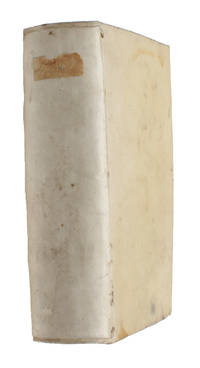
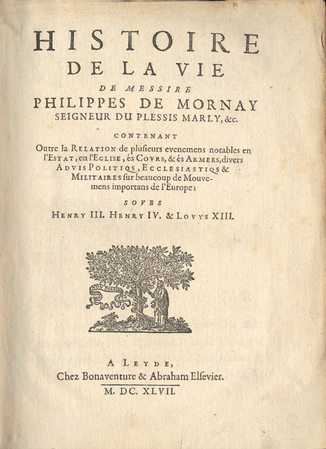
1647112055Bonaventure Elsevier 1647 A Leyde, Chez Bonaventure & Abraham Elsevier, 1647, 1 volume in-4 de 180x230 mm environ, (6) ff. (page de titre, épistre), 732 p., (2) ff. (sommaire). Pleine reliure postérieure restaurée, dos à 5 nerfs portant titres dorés et caissons ornés, roulette dorée sur les coupes, tranches teintées rouges. Dos, d'origine (en veau glacé) partiellement conservé, discrètes rayures sur les plats, deux coins émoussés, infimes manques de cuir, garde annotée à l'encre, de rares rousseurs, bel état général.
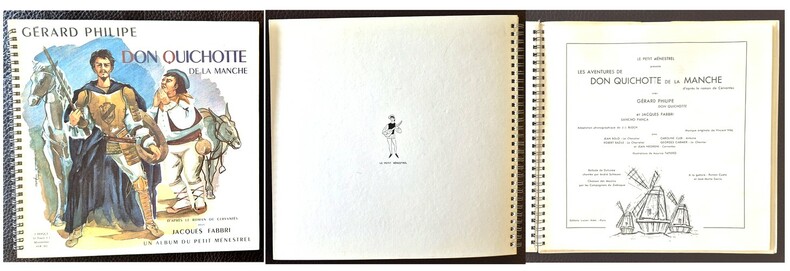
161931599Disques Adès. Le Petit Ménestrel – ALB 302 / Livre-Disque, reliure à spirales, Microsillon 33 tours au format 25 cm de 1957. Couverture illustrée par Maurice Tapiero. Livret illustrée par Maurice Tapiero, de 16 pages. Adaptation du roman picaresque de Miguel de Cervantès. Musique de Jean Vial avec Ramon Cueto et José Maria Sierra à la guitare. Chansons en français interprétées par André Schlesser et les Compagnons du Zodiaque. de Jean Baïtzouroff. Sancho Pança est joué par Gérard Philippe et Don Qhuichotte par Jacques Fabbri. Microsillon jamais écouté. Pochette en superbe état, proche du neuf. Rare édition en 1er pressage.
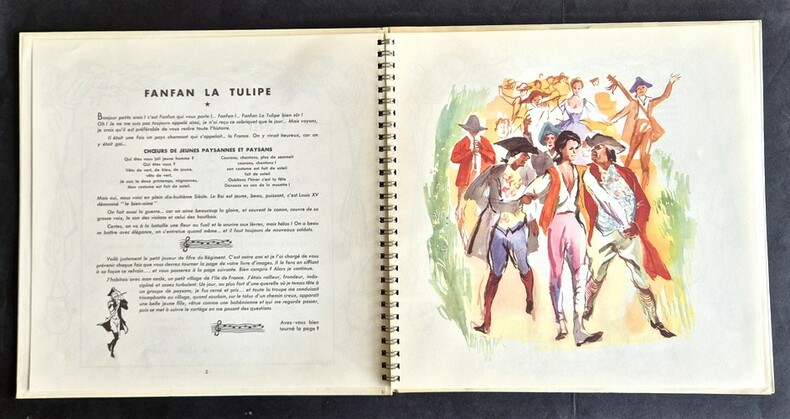
161931663Disques Adès. Le Petit Ménestrel – ALB 302 / Livre-Disque, reliure à spirales, Microsillon 33 tours au format 25 cm de 1954. Couverture illustrée par Jacques Pecnard. Livret illustrée par Jacques Pecnard, de 24 pages. Adaptation pour enfants du film de Christian-Jaque, d'après le scénario de René Wheeler, René Fallet et Henri Jeanson. Musique Maurice Thiriet, Georges van Parys et Maurice Jarre. Fanfan la Tulipe est joué par Gérard Philippe. Microsillon jamais écouté. Pochette en superbe état, proche du neuf. Rare édition en 1er pressage.
164561075Paris Elzevir 1645. 12mo. In contemporary full vellum with yapp edges. Small paper-label to upper part of spine. Previous owner's name in contemporary hand to front free end-paper. Light wear to extremities but an overall nice and clean copy. 40 539 pp. The two parts in continuous pagination. <br/><br/><em>Second Elzevir-edition the first being from 1641 of Philippe de Béthune’s famous and influential political treatise or manual which summarized in an easy accessible form most of the early 17th century political ideas. It was published a total of 5 times between 1632 and 1665. "Béthune's treatise was the work of a man at the end of his career who had served the monarchy at home and abroad through the bumpy years of dynastic transition and who thanks to his longevity had witnessed the crisis of the religious wars as well as France's slow rise from the ashes thereafter. He brought to bear his wide knowledge and experience of French government but also his thorough acquaintance with Rome and Italy and both informed the political ideas he mobilised in his treatise" Reinhardt p. 56 Philippe de Béthune was a prominent figure in French politics during the late 16th and early 17th centuries. He served as a diplomat and administrator under Henri III and Henri IV with key roles in diplomatic missions to Scotland Rome and Savoy. Béthune's efforts aimed at securing peace in Italy and resolving conflicts between European powers. He remained influential in diplomatic circles particularly under the guidance of Cardinal Richelieu. Béthune's political career was marked by his dedication to diplomacy and his efforts to navigate complex European relations during a tumultuous period. Willems 1024 "Plus belle mais moins rare que la première parue en 1641".Barbier I 696. </em> hardcover
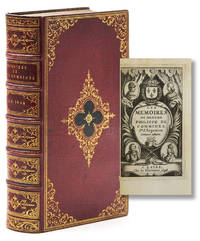
1648311279A Leide: chez les Elzevirs 1648. First Elzevier edition. Engraved title 2476519pp. 1 vols. 12mo 13.3 x 7.5 cm. Beautifully bound in 19th century polished claret red crushed levant with spine and corners richly tooled in gilt with a intricately gilt center ornament of inlaid black morocco gilt inner dentelles a.e.g. by Duru dated 1850. Three bookseller's descriptions tipped to binders blank some minor foxing but a very near fine copy. With the bookplate of Thomas Westwood and of Ex Musaeo PIN Elzéar-Stern. First Elzevier edition. Engraved title 2476519pp. 1 vols. 12mo 13.3 x 7.5 cm. The celebrated memoirs of the foremost French Renaissance historian 1445-1509 notable as an important analysis of 15th century culture politics and personality. ".The graphic style of his narrative and above all the keenness of his insight into the motives of his contemporaries an insight undimmed by undue regard for principles of right and wrong make this work one of the great classics of history" - ENCYC. BRITANNICA. <br /> "Authoritative and rare.printed in Paris probably by Le Gras" - Rostenberg & Stern THE HOUSE OF ELZEVIR 27 referencing this edition in their offering of the 1661 edition. "Jolie édition dont les exemplaires grands de marge et bien conservés sont fort recherchés" - Brunet. Rahir 630; Brunet II:191. Willems 634 chez les Elzevirs unknown
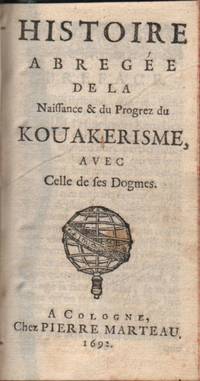
1682441Cologne: Pierre Marteau 1682. First edition. Printer’s device on title page head-pieces and initials throughout. In contemporary leather. Spine gilt with five raised bands with red title vignette. Marbled pastedown. Notes in ink by unknown hand on verso of front pastedown from the 19th century. Overall a good copy. First edition. Printer’s device on title page head-pieces and initials throughout. In contemporary leather. Spine gilt with five raised bands with red title vignette. Marbled pastedown. 24 174 In this copy pp. 107–110 bound here second time 6 p. <p><br /> First edition of the earliest book about the Quakers to be published in French a survey and critique of the movement by Philippe Naudé 1654–1729 the French mathematician and Huguenot theologian.<br /> <p><p><br /> Ref.: Sabin 66927.; Smith J.: Bibliotheca Anti-Quakeriana p. 26.; Bibliotheca Furliana 158.<br /> <p>. Pierre Marteau unknown
169368094Paris: Jean Boudot 1693. Later hardcover. Engraved title page 263422 pp. and 8 engraved plates. Text in French new binding low margins sometimes a little loss see pictures pages 283/284 misbound paper browned Although still very good very rare see pictures Jean Boudot hardcover
16891531689 Amsterdam - Bruxelles, chez Henry Desbordes - Gille Serstevens, 1689.
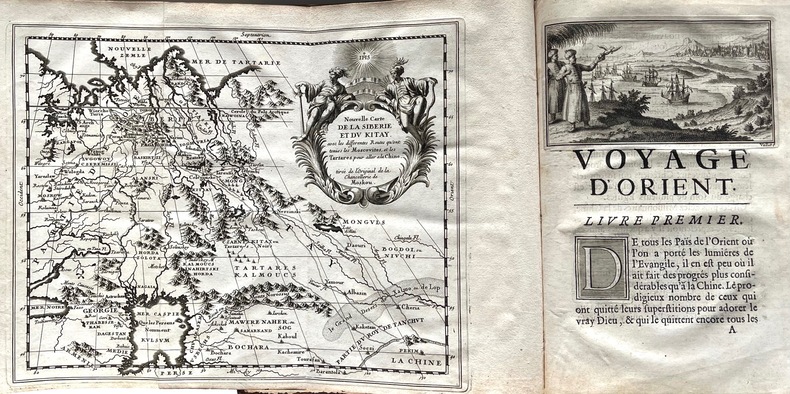
1692BS44GLTBN504Paris: Claude Barbin 1692. Hardback later mottled calf gilt title to spine label. 24.5cm x 19cm. Engraved portrait of Stanislaus Jablonowski by Picart one folding map 3 engraved plates engraved headpieces all by Vallet historiated initials. 1st edition 1692. Binding is slightly rubbed and worn with a few very small worm holes not going all the way through. Some dampstaining to front free end-paper and to inner lower margin of last few pages of the Table at rear but otherwise contents is generally clean. Scarce. bs44. 1st Edition. Hard Cover. Good. Claude Barbin Hardcover
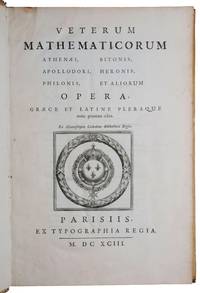
16936467Paris: Typographia Regia 1693. First edition. <p>First edition a very fine copy of this collection of early Greek writings on technology especially military technology and hydrostatics. It contains several treatises on the mechanics and siege operations or poliorcetica of the Hellenistic period the period between Alexander and Augustus including the construction and management of projectile engines.</p>. DIBNER 84: ANCIENT GREEK TECHNOLOGY. <p>First edition of this collection of early Greek writings on technology especially military technology and hydrostatics. It contains several treatises on the mechanics and siege operations or poliorcetica used in the Hellenistic period the period between Alexander and Augustus including the construction and management of their projectile engines. The first six works in the volume comprise the writings on the subject of military engines that were compiled by Athenaeus Apollodorus Biton Heron and Philon. These works include the first edition in both Greek and Latin of Biton's Construction of War Machines and Artillery of extant part of the Mechanike Syntaxis attributed to Philon of Byzantium and of the Poliorcetica of Apollodorus of Damascus. These are followed by the Greek and Latin texts of Hero of Alexandria's works on hydrostatics the Pneumatica and Automata which include what some regard as the first description of a steam-engine; this is the first printing of the Greek text of these works. Thévenot the King's librarian to Louis XIV prepared the present work from a rather defective secondary manuscript Codex Parisinus 2435. After Thévenot's death in 1692 it was revised by the mathematician La Hire with insightful annotations by Boivin an official in the King's library. It is one of three early publications of the French Academy of Sciences grouped together as Dibner 84. "Printed at the royal press in small editions they were intended as gifts for the King and Academy. In size binding and beauty of the plates they are among the most sumptuous books in science" Dibner. This is a rare book on the market only eight copies having appeared at auction in the last 40 years. The Evelyn copy was sold at Christie's in 1977.</p> <br /> <p>To gain access to the walls of a site under siege a siege tower or ram was brought into position and used to launch an attack onto the walkway aided by missile fire from the higher levels of the tower. Simultaneous attacks with scaling ladders took place. A siege tower is a specialized siege engine constructed to protect assailants and the ladders used when approaching the defensive walls of a fortification. The tower was usually rectangular with four wheels and a height roughly equal to that of the wall; it was sometimes higher to allow archers to stand on the top and fire into the fortification. The tower was made chiefly of wood but sometimes there were metal components as well. They were unwieldy to manoeuvre and slow to assemble and consequently were usually constructed at the siege site. Sometimes siege towers themselves incorporated other devices including artillery rams and dropbridges. Two main types of artillery equipment were used in this period: bolt-throwers ballistae: used for picking off prominent individuals and stone-throwers scorpiones onagri. Stone throwers could cause structural damage but were generally confined to firing at towers gates or siege machinery. Artillery might use incendiary ammunition when firing at gates or equipment.</p> <br /> <p>In common with much Byzantine literature poliorcetica draw heavily on earlier classical material. Since these were composed before the development of heavy artillery the poliorcetica are not so much concerned with large machines but rather with describing techniques for bringing men close to fortifications and then ways of undermining them. They also suggest various psychological tricks which might be used to outwit the enemy. Such ancient works on military machines were a source of fascination to the Italians of the late 15th and 16th centuries not only because of their historic interest but also as a source for modern inventions to be used in contemporary warfare and several of these works were first published in Renaissance Italy.</p> <br /> <p>The present volume begins with the De Machinis of Athenaeus a Cilician ex-statesman living in Rome in the 20s B.C. and a contemporary of the architect-engineer Vitruvius who like Vitruvius worked under the patronage of the Emperor Augustus Vitruvius devoted Book 10 of his De Architectura to machines. In addition to describing individual siege engines and theorizing on tactics Athenaeus draws on actual instances from history of the use of these machines in order to make various points and elucidate his text.</p> <br /> <p>The author of the next text is Apollodorus of Damascus who was a Roman architect and engineer of the late 1st to early 2nd century A.D. As Emperor Trajan's architect and military engineer he was responsible for Trajan's forum and possibly Trajan's column and produced designs for new siege machines. In his treatise Poliorcetica he describes a system of banks and ditches and also sheds that would be needed to protect the legionaries during undermining work or to carry battering rams against a tower gate or wall. Next he describes the construction of a siege tower followed by a system of interlocking ladders. He concludes his treatise with a description of a battlemented raft for river assaults. Although some of the elaborations are considered somewhat unrealistic − for example the addition of a torsion-powered truncheon to the end of a battering ram − and some of these are believed to have been added by a later editor the core of Apollodorus' text is believed to be authentic and to accurately describe highly effective machinery. Apollodorus dedicated Poliorcetica to the Emperor Hadrian perhaps an attempt to gain forgiveness for an earlier insult. On that occasion Trajan was discussing with Apollodorus the buildings which the great architect had built in Rome. Hadrian's assessment only demonstrated his ignorance which was bluntly pointed out by Apollodorus. Hadrian never forgot the insult and when he came to power banished Apollodorus accused him of several crimes and had him put to death.</p> <br /> <p>The third text in the volume is the Mechanike Syntaxis attributed to Philon of Byzantium who is believed to have been born about 280 B.C. in Byzantium and to have died around 220 B.C. Only the fourth and fifth books of this work have come down to us. Although there are few references to him in literature he is mentioned by Vitruvius. Amongst other weapons of siegecraft he describes the catapult recently invented by Ctesibius fl. 285-222 BC a Greek or Egyptian inventor and mathematician and probably the first head of the Museum at Alexandria. From this Philon's treatise can be dated fairly accurately to around 250 B.C. He describes journeys he made to Rhodes and to Alexandria to study catapults and it seems he may have earned his living advising military rulers.</p> <br /> <p>"The fourth book is headed κ τν Φιλνο βελοποιικν and the general subject is the manufacture of missiles. He mentions in it an invention of his own which he denominates ξυβλη p. 56. In the fifth book we are shocked to find that while recommending a besieging army to devastate the open country on the approach of an enemy he advises them to poison the springs and the grain which they cannot dispose of p. 103; and what renders this the worse he mentions his having treated of poisons in his book on the preparations that should be made for a war. What principally attracted attention to this work in modern times is his notice of the invention of Ctesibius p. 77. &c. The instrument described by him named εÏτονο acted on the property of air when condensed and is evidently in principle the same with the modern air-gun" A Dictionary of Greek and Roman Biography and Mythology<br /> William Smith ed. </p> <br /> <p>Philon's work is followed by the brief treatise of Biton of Pergamon 3rd or 2nd century B.C. about whom little is known; it is the only extant work to give a full description of advanced tension catapults. Biton's handbook describes four tension bow catapults a helepolis city-taker = siege tower and a sambuca mechanical scaling ladder. The bow catapults consisted of two stone throwers small and large and two bolt shooters a medium "belly bow" and mountain "belly bow". The latter took their name from the concave rest at their rear end against which the archer braced his stomach while drawing the bow. The work is dedicated to a King Attalus and was therefore composed between about 230 BC when Attalus I assumed the title of King and 133 BC death of Attalus III. As Biton mentions older types of catapults but not the torsion catapult that was otherwise well attested from the end of the 4th cent. BC the work probably belongs to the early years of the reign of Attalus I King of Pergamum 241-197 B.C. We do not know if Attalus employed the devices Biton described but they were definitely used in numerous later sieges and naval battles.</p> <br /> <p>The final two texts of siegecraft in the volume the Belopoeica and the Cheiroballistra are both attributed to Heron of Alexandria ca. 10-75 AD. Heron possibly taught at the Museum at Alexandria since many of his writings have the appearance of student lecture notes. The Belopoeica "On arrow making" describes the hand-held "belly bow" also discussed by Biton. The Cheiroballistra describes a small hand-held catapult. Some of Heron's designs derived from the works of Ctesibius none of whose works survive although they are mentioned by Vitruvius Athenaeus and Philo of Byzantium as well as Heron. In 1616 Bernardino Baldi 1553-1617 published a Latin translation of Heron's Belopoeica along with Heron's Greek text and a biography of Heron also written in Latin. Some of Baldi's commentary is appended to the present work.</p> <br /> <p>The volume concludes with the Pneumatica and Automata of Hero or Heron of Alexandria fl. 62 CE. "The Pneumatica in two books describes a menagerie of mechanical devices or "toys": singing birds puppets coin-operated machines a fire engine a water organ and his most famous invention the aeolipile the first steam-powered engine. This last device consists of a sphere mounted on a boiler by an axial shaft with two canted nozzles that produce a rotary motion as steam escapes" Britannica. "The introduction treats the occurrence of a vacuum in nature and the pressure of air and water . Some of the theory is right some is wrong for instance the horror vacui of nature but it was the best theoretical explanation to be had at the time . The first chapters most of them taken from Philo's Pneumatics describe experiments to show that air is a body and that it will keep water out of a vessel unless it can find an outlet and will keep water in if it cannot enter. Hero goes on to siphons . With very few exceptions it is evident that the chapters were written by Hero himself and without exception they are very clear: each instrument can be reconstructed from the description and the figure. While there is no order at all in the general arrangement of the chapters we find here and there a short series of related chapters in which it is clear that Hero is searching for a better solution to a mechanical problem. This shows unmistakably that he was an inventor; it is therefore probable that he himself invented the dioptra the screw-cutter and the odometer as well as several pneumatic apparatuses" DSB. The first appearance in print of Pneumatica was a Latin paraphrase in Giorgio Valla's De expetendis et fugiendis rebus 1501; the complete text was first published in Latin by Federico Commandino 1509-75 in 1575. The excellence of Commandino's translation persuaded the editors that it was unnecessary to include a further Latin translation in the present work and therefore only the Greek text of Pneumatica appears. Some of the commentary on Pneumatica from the 1589 Italian translation by Giovanni Battista Aleotti 1546-1636 is appended to the present work.</p> <br /> <p>"The Automata or Automatic Theater describes two sorts of puppet shows one moving and the other stationary; both of them perform without being touched by human hands. The former moves before the audience by itself and shows a temple in which a fire is lit on an altar and the god Dionysus pours out a libation while bacchantes dance about him to the sound of trumpets and drums. After the performance the theater withdraws. The stationary theater opens and shuts its doors on the performance of the myth of Nauplius. The shipwrights work; the ships are launched and cross a sea in which dolphins leap; Nauplius lights the false beacon to lead them astray; the ship is wrecked; and Athena destroys the defiant Ajax with thunder and lightning. The driving power in both cases was a heavy lead weight resting on a heap of millet grains which escaped through a hole. The weight was attached by a rope to an axle and the turning of this axle brought about all the movements by means of strings and drums. Strings and drums constituted practically all the machinery; no springs or cogwheels were used. It represents a marvel of ingenuity with very scant mechanical means" DSB. The Automata was first published in Italian by Baldi in 1589.</p> <br /> <p>"The design of this collection was formed by Thévenot 1620-92 deputy librarian of the Royal library in the reign of Louis XIV and after his death it was carried out by De la Hire 1640-1718. Thévenot's plan was to publish an accurate transcript of the MSS. of the several authors. The inevitable obscurity arising from the numerous corruptions which had crept into the manuscripts was to be remedied by an appendix of notes and a Latin translation. But for the Pneumatics of Hero it seemed sufficient to adopt the already well-known translation of Commandine; and in consequence of the eight MSS. of this treatise existing in the Royal Library that one was chosen which most nearly agreed with the Latin version" The Pneumatics of Hero of Alexandria translated and edited by Bennet Woodcroft 1851 preface.</p> <br /> <p>Brunet V 1163; Dibner Heralds 84; Norman 2148; Schweiger I 358. For a detailed account of the works contained in the present volume see Marsden Greek and Roman Artillery: Historical Development 1969.</p> <br/> <br/> Folio 432 x 288 mm pp. xvi including half-title 279 290-365 9 index & colophon occasional mostly light browning. Text in double columns Greek or parallel Greek and Latin many engraved diagrams and illustrations in text engraved head- and tail-pieces. Contemporary blind-stamped vellum. A very fine copy. Typographia Regia unknown
16934930Paris: Typographia Regia 1693. First edition. <p>First edition the Stanhope copy of this collection of early Greek writings on technology especially military technology and hydrostatics. It contains several treatises on the mechanics and siege operations or poliorcetica of the Hellenistic period the period between Alexander and Augustus including the construction and management of projectile engines.</p>. DIBNER 84: ANCIENT GREEK TECHNOLOGY. <p>First edition the Stanhope copy of this collection of early Greek writings on technology especially military technology and hydrostatics. It contains several treatises on the mechanics and siege operations or poliorcetica used in the Hellenistic period the period between Alexander and Augustus including the construction and management of their projectile engines. The first six works in the volume comprise the writings on the subject of military engines that were compiled by Athenaeus Apollodorus Biton Heron and Philon. These works include the first edition in both Greek and Latin of Biton's Construction of War Machines and Artillery of extant part of the Mechanike Syntaxis attributed to Philon of Byzantium and of the Poliorcetica of Apollodorus of Damascus. These are followed by the Greek and Latin texts of Hero of Alexandria's works on hydrostatics the Pneumatica and Automata which include what some regard as the first description of a steam-engine; this is the first printing of the Greek text of these works. Thévenot the King's librarian to Louis XIV prepared the present work from a rather defective secondary manuscript Codex Parisinus 2435. After Thévenot's death in 1692 it was revised by the mathematician La Hire with insightful annotations by Boivin an official in the King's library. It is one of three early publications of the French Academy of Sciences grouped together as Dibner 84. "Printed at the royal press in small editions they were intended as gifts for the King and Academy. In size binding and beauty of the plates they are among the most sumptuous books in science" Dibner. This is a rare book on the market only eight copies having appeared at auction in the last 40 years. The Evelyn copy was sold at Christie's in 1977.</p> <br /> <p>Provenance: Philip Stanhope 2nd Earl Stanhope 1714-86 bookplate on front paste-down. Stanhope was a Fellow of the Royal Society from 1735 and had a lifelong interest in mathematics. A student of Abraham de Moivre Stanhope made significant contributions to probability theory. He was also a patron of various mathematicians notably Thomas Bayes; Stanhope was responsible for Bayes's election to the Royal Society and probably also for Bayes taking up the study of probability Bellhouse pp. 190 & 201. </p> <br /> <p>To gain access to the walls of a site under siege a siege tower or ram was brought into position and used to launch an attack onto the walkway aided by missile fire from the higher levels of the tower. Simultaneous attacks with scaling ladders took place. A siege tower is a specialized siege engine constructed to protect assailants and the ladders used when approaching the defensive walls of a fortification. The tower was usually rectangular with four wheels and a height roughly equal to that of the wall; it was sometimes higher to allow archers to stand on the top and fire into the fortification. The tower was made chiefly of wood but sometimes there were metal components as well. They were unwieldy to manoeuvre and slow to assemble and consequently were usually constructed at the siege site. Sometimes siege towers themselves incorporated other devices including artillery rams and dropbridges. Two main types of artillery equipment were used in this period: bolt-throwers ballistae: used for picking off prominent individuals and stone-throwers scorpiones onagri. Stone throwers could cause structural damage but were generally confined to firing at towers gates or siege machinery. Artillery might use incendiary ammunition when firing at gates or equipment.</p> <br /> <p>In common with much Byzantine literature poliorcetica draw heavily on earlier classical material. Since these were composed before the development of heavy artillery the poliorcetica are not so much concerned with large machines but rather with describing techniques for bringing men close to fortifications and then ways of undermining them. They also suggest various psychological tricks which might be used to outwit the enemy. Such ancient works on military machines were a source of fascination to the Italians of the late 15th and 16th centuries not only because of their historic interest but also as a source for modern inventions to be used in contemporary warfare and several of these works were first published in Renaissance Italy.</p> <br /> <p>The present volume begins with the De Machinis of Athenaeus a Cilician ex-statesman living in Rome in the 20s B.C. and a contemporary of the architect-engineer Vitruvius who like Vitruvius worked under the patronage of the Emperor Augustus Vitruvius devoted Book 10 of his De Architectura to machines. In addition to describing individual siege engines and theorizing on tactics Athenaeus draws on actual instances from history of the use of these machines in order to make various points and elucidate his text.</p> <br /> <p>The author of the next text is Apollodorus of Damascus who was a Roman architect and engineer of the late 1st to early 2nd century A.D. As Emperor Trajan's architect and military engineer he was responsible for Trajan's forum and possibly Trajan's column and produced designs for new siege machines. In his treatise Poliorcetica he describes a system of banks and ditches and also sheds that would be needed to protect the legionaries during undermining work or to carry battering rams against a tower gate or wall. Next he describes the construction of a siege tower followed by a system of interlocking ladders. He concludes his treatise with a description of a battlemented raft for river assaults. Although some of the elaborations are considered somewhat unrealistic − for example the addition of a torsion-powered truncheon to the end of a battering ram − and some of these are believed to have been added by a later editor the core of Apollodorus' text is believed to be authentic and to accurately describe highly effective machinery. Apollodorus dedicated Poliorcetica to the Emperor Hadrian perhaps an attempt to gain forgiveness for an earlier insult. On that occasion Trajan was discussing with Apollodorus the buildings which the great architect had built in Rome. Hadrian's assessment only demonstrated his ignorance which was bluntly pointed out by Apollodorus. Hadrian never forgot the insult and when he came to power banished Apollodorus accused his of several crimes and had him put to death.</p> <br /> <p>The third text in the volume is the Mechanike Syntaxis attributed to Philon of Byzantium who is believed to have been born about 280 B.C. in Byzantium and to have died around 220 B.C. Only the fourth and fifth books of this work have come down to us. Although there are few references to him in literature he is mentioned by Vitruvius. Amongst other weapons of siegecraft he describes the catapult recently invented by Ctesibius fl. 285-222 BC a Greek or Egyptian inventor and mathematician and probably the first head of the Museum at Alexandria. From this Philon's treatise can be dated fairly accurately to around 250 B.C. He describes journeys he made to Rhodes and to Alexandria to study catapults and it seems he may have earned his living advising military rulers.</p> <br /> <p>"The fourth book is headed κ τν Φιλνο βελοποιικν and the general subject is the manufacture of missiles. He mentions in it an invention of his own which he denominates ξυβλη p. 56. In the fifth book we are shocked to find that while recommending a besieging army to devastate the open country on the approach of an enemy he advises them to poison the springs and the grain which they cannot dispose of p. 103; and what renders this the worse he mentions his having treated of poisons in his book on the preparations that should be made for a war. What principally attracted attention to this work in modern times is his notice of the invention of Ctesibius p. 77. &c. The instrument described by him named εÏτονο acted on the property of air when condensed and is evidently in principle the same with the modern air-gun" A Dictionary of Greek and Roman Biography and Mythology<br /> William Smith ed. </p> <br /> <p>Philon's work is followed by the brief treatise of Biton of Pergamon 3rd or 2nd century B.C. about whom little is known; it is the only extant work to give a full description of advanced tension catapults. Biton's handbook describes four tension bow catapults a helepolis city-taker = siege tower and a sambuca mechanical scaling ladder. The bow catapults consisted of two stone throwers small and large and two bolt shooters a medium "belly bow" and mountain "belly bow". The latter took their name from the concave rest at their rear end against which the archer braced his stomach while drawing the bow. The work is dedicated to a King Attalus and was therefore composed between about 230 BC when Attalus I assumed the title of King and 133 BC death of Attalus III. As Biton mentions older types of catapults but not the torsion catapult that was otherwise well attested from the end of the 4th cent. BC the work probably belongs to the early years of the reign of Attalus I King of Pergamum 241-197 B.C. We do not know if Attalus employed the devices Biton described but they were definitely used in numerous later sieges and naval battles.</p> <br /> <p>The final two texts of siegecraft in the volume the Belopoeica and the Cheiroballistra are both attributed to Heron of Alexandria ca. 10-75 AD. Heron possibly taught at the Museum at Alexandria since many of his writings have the appearance of student lecture notes. The Belopoeica "On arrow making" describes the hand-held "belly bow" also discussed by Biton. The Cheiroballistra describes a small hand-held catapult. Some of Heron's designs derived from the works of Ctesibius none of whose works survive although they are mentioned by Vitruvius Athenaeus and Philo of Byzantium as well as Heron. In 1616 Bernardino Baldi 1553-1617 published a Latin translation of Heron's Belopoeica along with Heron's Greek text and a biography of Heron also written in Latin. Some of Baldi's commentary is appended to the present work.</p> <br /> <p>The volume concludes with the Pneumatica and Automata of Hero or Heron of Alexandria fl. 62 CE. "The Pneumatica in two books describes a menagerie of mechanical devices or "toys": singing birds puppets coin-operated machines a fire engine a water organ and his most famous invention the aeolipile the first steam-powered engine. This last device consists of a sphere mounted on a boiler by an axial shaft with two canted nozzles that produce a rotary motion as steam escapes" Britannica. "The introduction treats the occurrence of a vacuum in nature and the pressure of air and water . Some of the theory is right some is wrong for instance the horror vacui of nature but it was the best theoretical explanation to be had at the time . The first chapters most of them taken from Philo's Pneumatics describe experiments to show that air is a body and that it will keep water out of a vessel unless it can find an outlet and will keep water in if it cannot enter. Hero goes on to siphons . With very few exceptions it is evident that the chapters were written by Hero himself and without exception they are very clear: each instrument can be reconstructed from the description and the figure. While there is no order at all in the general arrangement of the chapters we find here and there a short series of related chapters in which it is clear that Hero is searching for a better solution to a mechanical problem. This shows unmistakably that he was an inventor; it is therefore probable that he himself invented the dioptra the screw-cutter and the odometer as well as several pneumatic apparatuses" DSB. The first appearance in print of Pneumatica was a Latin paraphrase in Giorgio Valla's De expetendis et fugiendis rebus 1501; the complete text was first published in Latin by Federico Commandino 1509-75 in 1575. The excellence of Commandino's translation persuaded the editors that it was unnecessary to include a further Latin translation in the present work and therefore only the Greek text of Pneumatica appears. Some of the commentary on Pneumatica from the 1589 Italian translation by Giovanni Battista Aleotti 1546-1636 is appended to the present work.</p> <br /> <p>"The Automata or Automatic Theater describes two sorts of puppet shows one moving and the other stationary; both of them perform without being touched by human hands. The former moves before the audience by itself and shows a temple in which a fire is lit on an altar and the god Dionysus pours out a libation while bacchantes dance about him to the sound of trumpets and drums. After the performance the theater withdraws. The stationary theater opens and shuts its doors on the performance of the myth of Nauplius. The shipwrights work; the ships are launched and cross a sea in which dolphins leap; Nauplius lights the false beacon to lead them astray; the ship is wrecked; and Athena destroys the defiant Ajax with thunder and lightning. The driving power in both cases was a heavy lead weight resting on a heap of millet grains which escaped through a hole. The weight was attached by a rope to an axle and the turning of this axle brought about all the movements by means of strings and drums. Strings and drums constituted practically all the machinery; no springs or cogwheels were used. It represents a marvel of ingenuity with very scant mechanical means" DSB. The Automata was first published in Italian by Baldi in 1589.</p> <br /> <p>"The design of this collection was formed by Thévenot 1620-92 deputy librarian of the Royal library in the reign of Louis XIV and after his death it was carried out by De la Hire 1640-1718. Thévenot's plan was to publish an accurate transcript of the MSS. of the several authors. The inevitable obscurity arising from the numerous corruptions which had crept into the manuscripts was to be remedied by an appendix of notes and a Latin translation. But for the Pneumatics of Hero it seemed sufficient to adopt the already well-known translation of Commandine; and in consequence of the eight MSS. of this treatise existing in the Royal Library that one was chosen which most nearly agreed with the Latin version" The Pneumatics of Hero of Alexandria translated and edited by Bennet Woodcroft 1851 preface.</p> <br /> <p>Brunet V 1163; Dibner Heralds 84; Norman 2148; Schweiger I 358. For a detailed account of the works contained in the present volume see Marsden Greek and Roman Artillery: Historical Development 1969.</p> <br/> <br/> Folio 432 x 284mm pp. xvi including half-title 279 290-365 9 index & colophon occasional mostly light browning. Text in double columns Greek or parallel Greek and Latin many engraved diagrams and illustrations in text engraved head- and tail-pieces. Eighteenth-century mottled calf spine richly gilt in compartments with red lettering-piece. Bookplate of Philip Earl Stanhope on front paste-down. This is a very large copy 10mm taller than the Norman copy. Typographia Regia unknown
16476363Leyde, Bonaventure et Abraham Elsevier, 1647 ; marque "le solitaire" ; in-4 ; plein vélin ivoire rigide de l'époque, titre manuscrit au dos ; (12), 732, (6) pp.
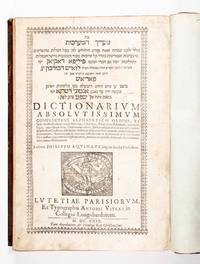
162948838Paris: Antoine Vitré 1629. First edition. Hardcover. Good. Folio. Signed: a4 e2 A-3B6 3C4 = 298 leaves. 12 584pp. Paginated from right to left. Full title and imprint in both Hebrew and Latin with woodcut printer's device; title within decorative letterpress border; woodcut lettrines and head-pieces; printed marginalia. Text in two columns. Eighteenth-century calf scuffed especially at front cover; spine with raised bands and gilt morocco morocco labels; edges stained red; green silk ribbon marker. Title leaf skilfully mounted on eighteenth-century paper. Text crisp and clean with ample borders.<br /> <br /> Only edition of this rare and highly unusual Hebrew and Aramaic dictionary composed by the formerly Jewish convert to Catholicism Mordechai Cresque of Carpentras who derived his new name Philippus d’Aquin or Aquinas; 1578-1650 from the place of his baptism in Aquino Italy. Printed almost entirely in the fine bold rashi characters "grosse glose hebraicque" cut by Guillaume I Le Bé in 1592 only the vocalised quotations and the lemmata are in Le Bé's square Hebrew script. Apart from the Latin title dedication approbations a poetic encomium and the alpha-numeric leaf signatures the work is printed entirely in Hebrew characters. It ends with a short notice in Latin and Hebrew on the printing errors which are corrected on the last three pages. The author announces at the title that all Hebrew biblical and rabbinic-talmudic and Aramaic terms are to be found in Ma'arikh ha-Ma'arakhot including many that do not appear in any existing lexicons among Jews or Christians. D'Aquin notes in particular that rare and difficult terms in rabbinic and cabalistic literature along with obscure abbreviations are all clearly explained. <br /> <br /> "The work is called in Hebrew Maarik ha-maarikot i. e. “Survey of the orders†a term which in the plural is also applied to "battle-lines" Wolf 140 translates Disponens ordines sive acies. One cannot help wonder if there is not a connection with the political situation at the time when the Huguenot town of La Rochelle had to submit to the French Crown in 1628. The privilege for our book has "Données au Camp devant la Rochelle le 19. Septembre 1628" and the work is dedicated to Cardinal Richelieu whose conquest of La Rochelle is also extolled in a Hebrew poem by the author. But the types are also reminiscent of war: did not Le Bé cut them "après le siège de Paris pour passer l'ennui" see Carter & Vervliet p. 15. They were prominently displayed afterwards in Vitray's type-specimen of 1636" Smitskamp. Among the eleven scholars whose approbations grace the present volume are Gabriel Sionita 1577-1645; professor of Arabic and Syriac at the College de France; Gilbert Gaulmin 1585-1665; Orientalist; Denis Petau 1583-1652; Jesuit theologian; and Jean Morin 1591-1659; theologian and Orientalist. Morin offers quite extravagent praise: "nihil hactenus in eo studii genere comparandum vidit Europa." <br /> <br /> Provenance: A morocco label on the spine reads Me-izabin. Hirsch. Wolf Kola i. e. From the legacy of Hirsch. References: Baillet Jugement de Scavans 3 1685: 729. Fürst 1:47-48. Gesenius Geschichte 113: “umfasst auch das Chadaïsche und Rabbinische†Hebrew title incorrectly transcribed without the definite article and indication of plural. Smitskamp Cat. no. 611 but notably not in Philologia Orientalis. Steinschneider Handbuch 129: “Früher sehr gesucht und selten. Heidenheim wollte se zuerst wieder ediren s. Catal. p. 739.†Wolf Historia lexicorum 140. For the interest of Richelieu in typographical matters and his foundation of the Imprimerie Royale in 1640 see Updike 1:238-40. Not in Goldsmith<br /> <br /> Hebrew title: מעריך המערכות. Antoine Vitré hardcover
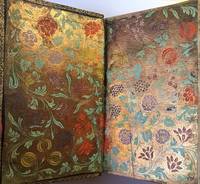
17004057dParis: Jean Baptiste Coignard 1700. 12mo 157 x 94 mm. 12 259 5 pp. Woodcut title vignette headpiece and initial. Ruled in red throughout. Some discoloration and a few spots. Eighteenth-century French dark blue Jansenist goatskin spine with red morocco gilt lettering-piece gilt edges turn-ins gold-tooled brocade paper endpapers with multiple colored stencilling on a gauffered gold ground; joints and extremities rubbed. Provenance: Martine-Marie-Pol de Béhague comtesse de Béarn 1870-1939 by inheritance to her nephew Hubert de Ganay and thence to his heirs; bookplate with initials H H. First Edition of this translation of St. Augustine's De spiritu et littera by the Academician Philippe Dubois or Dubois-Goibaud who also translated the Confessions. The Approbation dated 8 August 1697 is followed by a royal privilege dated January 1698 to an anonymous libraire who soon after transferred the privilege to the Royal Printer Jean-Baptiste Coignard II. Coignard finished the printing on 23 December 1699. The book's sober undecorated covers the mark of the so-called janséniste style open to reveal exuberantly colored German floral endpapers. Called "papier doré gauffré" in French brocade paper was a specialty of Augsburg and Nürnberg and was probably first produced by engravers or goldsmiths. The pattern was printed either in negative relief with the motifs in intaglio so that the "gold" leaf actually a mixture of brass and an alloy of copper tin zinc and sometimes lead appears as the ground as here; or in positive relief usually showing the patterns in gold on a colored ground. The colors were applied successively using stencils usually cut in oiled paper or in thin metal sheets. Cf. C. Kopylov Papiers dorés d'Allemagne au siècle des Lumières 2012 pp. 17-19. Jean Baptiste Coignard unknown books
16925782Paris, Barbin, Boudot, Josse, 1692. 1692 1 vol in-4° (250 x 185 mm) de : [10] ff. (faux titre, titre, épître, préface) ; 1 portrait gravé de Stanislaw Jablonowski (1634-1702) ; 406 pp. ; [11] ff. (Table) ; 3 planches gravées ; 1 carte dépliante de la Sibérie. Ex-libris : Ray m. Lud Sabatie D'astors. Baumés fecit Monspelii.. (trou de verre sur plusieurs feuillets, tâches). Plein veau fauve marbré dépoque, dos à nerfs orné, titre doré, roulettes sur les coupes, tranches mouchetées de rouge. (manque à la coiffe supérieure manquante, petit manque à la coiffe inférieure, 4 coins émoussés avec manques aux coins).
169215848Claude Barbin, Jean Boudot, Georges & Louis Josse Paris 1692 1 vol. In-4 de X 406 pp. 12 ff.n.ch. (table), plein veau brun de l'époque, dos à nerfs orné, roulette dorée sur les coupes.
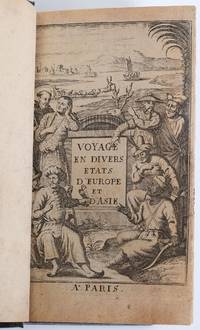
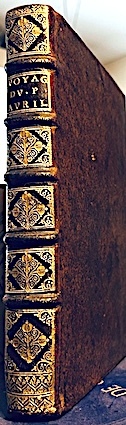
169314946<p><b>1693 CHINA 1ed Avril Travels Asia Arabia Voyages Syria Iraq Iran Russia Poland</b></p><p>Philippe Avril was a 17th-century Jesuit French explorer who spent numerous years in China Tartary and the Middle East. While on his voyages Avril wrote an incredible historical account of his discoveries and experiences. '<i>Travels in the Divers Parts of Europe and Asia'</i> covers the entirety of his voyages giving attention to each country he visited including Syria Kurdistan Iraq and Iran Armenia Persia Russia Moldovia Poland and of course China.</p><p><b>This 1693 first English edition</b> like the original French has regular anti-Catholic and anti-Jewish undertones throughout highlighting cultural superstitions and marking the differences between Christianity and other religious views.</p><p>Item number: #14946</p><p>Price: $1500</p><p>AVRIL Philippe</p><p><b><i>Travels into divers parts of Europe and Asia: undertaken by the French King's order to discover a new way by land into China. Containing many curious remarks in natural philosophy geography hydrography and history. Together with a description of Great Tartary and of th different people who inhabit there</i></b></p><p>London : printed for Tim. Goodwin at the Maidenhead over-against St. Dunstan's-Church in Fleetstreet MDCXCIII. 1693. <b>First English edition.</b></p><p><br /></p><p><u>Details</u>: </p><p>· Collation: Complete with all pages</p><p>o 10 191 1; 178 2</p><p>· References: Wing A 4275; ESTC R 16481; De Backer/Sommervogel I 706; Löwendahl 207</p><p>· Language: English</p><p>· Binding: Leather; tight & secure</p><p>· Size: ~6.5in X 4in 16.5cm x 10cm</p><p>· Very rare and desirable</p><p>Our Guarantee:</p><p>Very Fast. Very Safe. Free Shipping Worldwide.</p><p>Customer satisfaction is our priority! Notify us with 7 days of receiving and we will offer a full refund without reservation!</p><p>14946</p><p>Photos available upon request. </p> for Tim. Goodwin, at the Maidenhead over-against St. Dunstan's-Church in Fleetstreet hardcover
1667290471Paris.: Francois Preuveray. 1667. Folio. Contemporary mottled leather raised bands gilt spine decorations red speckled edges. Very good some rippling to pages. 36.5x24.5x6 cm. French text. A documentary history of the embassy of the young Louis XIII to the Holy Roman Emperor with commentary by Bethune. Scarce. Heavy book will require extra shipping. weight: 6.2 lb. Woodcut head- and tail-pieces initial letters and title page decoration title page printed in red and black. Francois Preuveray. hardcover
1665122984Paris: par la Compagnie des Libraires du Palais 1665. Later edition first 1633 of one of the great political treatises of the 17th century by the diplomat-bibliophile Philippe de Béthune 1561/6-1649. Béthune started his career as a "mignon" of Henri III before becoming conseiller du roi in 1599 and ambassador in Rome for Henri IV in 1601 after which point he completed several other diplomatic missions to Rome in 1624 and 1630. "Béthune's treatise was the work of a man at the end of his career who had served the monarchy at home and abroad through the bumpy years of dynastic transition and who thanks to his longevity had witnessed the crisis of the religious wars as well as France's slow rise from the ashes thereafter. He brought to bear his wide knowledge and experience of French government but also his thorough acquaintance with Rome and Italy and both informed the political ideas he mobilised in his treatise" Reinhardt p. 56. Le conseiller d'Etat ran to five editions between 1632 and 1665 testament to its profound influence at the time. It is scarce: WorldCat locates only three copies in institutional holdings worldwide SCD Paris BM Lyon and Bayerische Staatsbibliothek. Duodecimo 147 x 80 mm. Additional vignette title page which states "divise en trois parties" engraved head- and tailpieces. Contemporary speckled calf tan morocco spine label compartments elaborately tooled in gilt raised bands edges sprinkled red. Headcap chipped extremities rubbed and corners bumped joints starting contents browned with the occasional spotting and very faint dampstain to the fore edges of S3 and V4 otherwise a very good copy. INED 481 first edition. Nicole Reinhardt Voices of Conscience: Royal Confessors and Political Counsel in 17th-Century Spain and France 2016. hardcover
1648311279A Leide: chez les Elzevirs 1648. First Elzevier edition. Engraved title 2476519pp. 1 vols. 12mo 13.3 x 7.5 cm. Beautifully bound in 19th century polished claret red crushed levant with spine and corners richly tooled in gilt with a intricately gilt center ornament of inlaid black morocco gilt inner dentelles a.e.g. by Duru dated 1850. Three bookseller's descriptions tipped to binders blank some minor foxing but a very near fine copy. With the bookplate of Thomas Westwood and of Ex Musaeo PIN Elzéar-Stern. First Elzevier edition. Engraved title 2476519pp. 1 vols. 12mo 13.3 x 7.5 cm. The celebrated memoirs of the foremost French Renaissance historian 1445-1509 notable as an important analysis of 15th century culture politics and personality. ".The graphic style of his narrative and above all the keenness of his insight into the motives of his contemporaries an insight undimmed by undue regard for principles of right and wrong make this work one of the great classics of history" - ENCYC. BRITANNICA. <br/>"Authoritative and rare.printed in Paris probably by Le Gras" - Rostenberg & Stern THE HOUSE OF ELZEVIR 27 referencing this edition in their offering of the 1661 edition. "Jolie édition dont les exemplaires grands de marge et bien conservés sont fort recherchés" - Brunet. Rahir 630; Brunet II:191. Willems 634 chez les Elzevirs unknown books
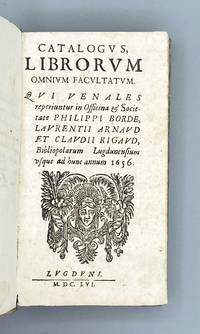
165611982Lyon: for Ph. Borde Laur. Arnaud and Cl. II Rigaud 1656. Contemporary card boards small hole in the front panel flat spine. <p> A REMARKABLE STOCK CATALOG OF SOME TEN THOUSAND SIXTEENTH- AND SEVENTEENTH-CENTURY TITLES REPRESENTING THE COMBINED INVENTORIES OF EIGHT DOMINANT LYONESE PUBLISHERS AND BOOKSELLERS ACTIVE FROM 1555 TO 1656.<br /> Beginning in the 1620s the book trade in the France’s second city experienced dramatic consolidation through inheritance and liquidation. Philippe Borde Laurent Arnaud and Claude II Rigaud stood the principal beneficiaries. Between 1650 and 1655 they partnered to purchase the stocks of the Lyonese Giunta of Horace Cardon of Horace Boissat of the Rouillé family and of Claude Prost.<br /> The partners had to sell and this catalog clearly prepared in haste is the result. It swarms with minor errors like reversed and upside-down sorts repeated pagination errors in dates and orthography and chase marks likely arising from the rush to have it ready in time for the Lyon trade fair.<br /> The material is grouped into thirteen categories. The nine subject divisions list only Latin texts in the fields of theology Scripture councils scholastics morals controversies asceticism spirituality preaching manuals law medicine philosophy history politics and civics sciences astronomy mathematics architecture atlases cabbala the humanities grammar rhetoric ancient classics and liturgy. Four sections gather material by language — Greek Hebrew and Arabic together Italian Spanish and French — regardless of subject. In each class entries are arranged alphabetically by author and each work is identified by its author title format printing place date and number of volumes if a set. Imprints span Naples to London and Madrid to Hamburg.<br /> The present example has been marked up in manuscript. Two dozen entries have been canceled in whole or in part across eight different categories motivated in every case but two by religion. Machiavelli's dangerous political ideas and G.B. Marino’s personal immorality earned censure. Hundreds of entries have been ticked in the left margins sometimes four or five to a page. I have located one example in the U.S. Grolier Club. In good condition one quire browned narrow pale stain to the second half of the volume.<br /> ¶Pollard & Ehrman Distribution of Books by Catalogue 117 120 301 355 Arnaud 361 Borde & 511 Rigaud; Mirto Stampatori editori librai nella seconda metà del Seicento I: 70; Mellot & Queval Répertoire d’imprimeurs/libraires vers 1500-vers 1810 2004 nos. 107 Arnaud 634 Borde & 474 Rigaud; Répertoire bibliographique des livres imprimés en France au XVIIe siecle: Lyon ed. Merland I: 142-143-84 Arnaud II: 149-66 Borde & VI: 202-4 Rigaud.</p> for Ph. Borde, Laur. Arnaud and Cl. II Rigaud unknown
169478201694 veau brun, dos à nerfs, fleurs de lys et dauphin dans la palette inf., (1 petit mq. à une coiffe). 2 vol. in-4, (8ff.), 510pp., (36ff.) et (8ff.), 585pp., (31ff.), Paris ches les Associez 1694,
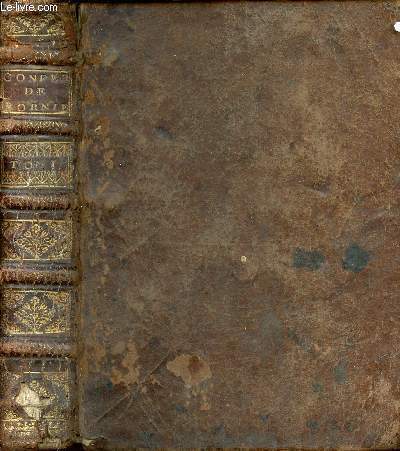
16945007Chez les associés choisis par ordre de Sa Majesté 20,5 x 26 Paris 1694 Deux volumes in-4, reliure plein veau brun d'époque, dos à cinq nerfs caissonné et orné de fleurons dorés, titres et tomaisons dorés, roulettes dorées sur les coupes Tome I. Pour les matières civiles, [16]-510 p., suivies de la "Tables des principales matières contenues dans l'ordonnance de l'année 1667 pour les matières civiles" de 72 p. Tome II. Pour les matières criminelles, [16]-371 p., [suivies de] Conférences des nouvelles ordonnances édit du Roy, servant de règlement pour le commerce des négociants en gros et en détail, donné à St Germain en Laye au mois de mars 1673, pp. 372-498, [suivies de] Règlement que le Roy veut estre observé en son Conseil d'Etat, pp. 499-585, [suivi de] la "Table alphabétique des principales matières contenues dans l'ordonnance pour les matières criminelles et pour le commerce" de 64 p. Nouvelle édition reveuë, corrigée et augmentée. Réunion des trois ordonnances qui illustrent l'oeuvre de codification de la Monarchie sous Louis XIV, dont les enjeux sont autant judiciaires que politiques. L'ordonnance civile de 1667 et sa continuation en 1669 forment un code de procédure civile soumettant toutes les juridictions royales, hautes et basses, à un style unifié. L'ordonnance criminelle de 1670 unifie quant à elle la procédure pénale. Le règlement pour le commerce de 1673 ou code Savary fixe les règles à suivre dans la pratique du commerce sur terre ou sur la mer. Dussort, doyen du Conseil du Roi et oncle de Colbert, entouré de conseillers d'Etat et de maîtres des requêtes, et auquel est dédié le tome II, en a été la cheville ouvrière. Ces ordonnances sont l'expression du pouvoir législatif de la Monarchie louis-quatorzienne, tenant à l'écart le Parlement de Paris consulté in extremis et pourtant "dépositaire des lois"...Bonne reliure et bon intérieur, coins inférieurs du tome I émoussés, coiffe en queue du tome II arasée,. Bon exemplaire. Ex-libris manuscrit "de la Cleraiserie". (EvB26) PHOTOS NUMERIQUES DISPONIBLES PAR EMAIL SUR SIMPLE DEMANDE-DIGITAL PHOTOGRAPS MAY BE AVAILABLE ON REQUEST
16945007Chez les associés choisis par ordre de Sa Majesté 20,5 x 26 Paris 1694 Deux volumes in-4, reliure plein veau brun d'époque, dos à cinq nerfs caissonné et orné de fleurons dorés, titres et tomaisons dorés, roulettes dorées sur les coupes Tome I. Pour les matières civiles, [16]-510 p., suivies de la "Tables des principales matières contenues dans l'ordonnance de l'année 1667 pour les matières civiles" de 72 p. Tome II. Pour les matières criminelles, [16]-371 p., [suivies de] Conférences des nouvelles ordonnances édit du Roy, servant de règlement pour le commerce des négociants en gros et en détail, donné à St Germain en Laye au mois de mars 1673, pp. 372-498, [suivies de] Règlement que le Roy veut estre observé en son Conseil d'Etat, pp. 499-585, [suivi de] la "Table alphabétique des principales matières contenues dans l'ordonnance pour les matières criminelles et pour le commerce" de 64 p. Nouvelle édition reveuë, corrigée et augmentée. Réunion des trois ordonnances qui illustrent l'oeuvre de codification de la Monarchie sous Louis XIV, dont les enjeux sont autant judiciaires que politiques. L'ordonnance civile de 1667 et sa continuation en 1669 forment un code de procédure civile soumettant toutes les juridictions royales, hautes et basses, à un style unifié. L'ordonnance criminelle de 1670 unifie quant à elle la procédure pénale. Le règlement pour le commerce de 1673 ou code Savary fixe les règles à suivre dans la pratique du commerce sur terre ou sur la mer. Dussort, doyen du Conseil du Roi et oncle de Colbert, entouré de conseillers d'Etat et de maîtres des requêtes, et auquel est dédié le tome II, en a été la cheville ouvrière. Ces ordonnances sont l'expression du pouvoir législatif de la Monarchie louis-quatorzienne, tenant à l'écart le Parlement de Paris consulté in extremis et pourtant "dépositaire des lois"...Bonne reliure et bon intérieur, coins inférieurs du tome I émoussés, coiffe en queue du tome II arasée,. Bon exemplaire. Ex-libris manuscrit "de la Cleraiserie". (EvB26) PHOTOS NUMERIQUES DISPONIBLES PAR EMAIL SUR SIMPLE DEMANDE-DIGITAL PHOTOGRAPS MAY BE AVAILABLE ON REQUEST
1700R320130055Chez les Associez choisis par ordre de sa majesté. 1700. In-4. Relié plein cuir. Etat d'usage, Plats abîmés, Coiffe en pied abîmée, Mouillures. 449 pages + environ 50 pages (table alphabétique des principales matières) - coiffes abîmées - titre, tomaison et caissons dorés sur le dos - coins frottés - plats frottés - papier jauni - annotations sur les contres plats et sur la page de titre - légères traces de mouillures en tête de page sans réelle conséquence sur la lecture.. . . . Classification Dewey : 840.04-XVII ème siècle