45 064 résultats
BOH 217FASCINATING MEDIEVAL BOOK OF HOURS WITH EXTENSIVE ILLUMINATIONS BY THREE DIFFERENT ARTISTS. In Latin and some French illuminated manuscript on parchment Southern Netherlands Mons c. 1460 original portion c. 1480-1490 updated. Dimensions 167 x 116 mm. 199 folios lacking one text leaf written by two different scribes in gothic textualis bookhand in single column on 17 lines; BINDING: seventeenth century brown calf over wooden boards spine with four raised bands gold-tooled gilt title "OFFICIU / BEATEM / VIRGIN" partly worn out gilt edges. ILLUSTRATION: 22 full-page miniatures within full rinceaux borders by the Mildmay Master 13 the Master of Philippe de Croÿ 7 and a third Mons illuminator follower of Simon Marmion 2 and 4 small miniatures by the Mildmay Master additional sixteen full rinceaux borders and 5-line initials in pink or blue on burnished gold grounds. The Mildmay Master was responsible for the core of the original manuscript; the artist paints elongated figures with small heads and slender bodies mostly situated on pale yellow tiled grounds. His outdoor landscapes are cursory. Unusual here are his delicate acanthus and floral borders sprinkled with fanciful grotesques. The artist responsible for updating the manuscript is the Philippe de Croÿ Master. He favors tiled floors in brown or gray and white with a generally somber almost grisaille palette with blue and white grey and a burnt brownish orange. A third painter a follower of Simon Marmion intervened during this second campaign. The most skilled of the three illuminators his delicate figures are well-modeled with tiny hands and individualized faces. PROVENANCE: The manuscript was made in Southern Netherlands probably in two different stages. The core of the Hours and the calendar were written in Mons for an unknown patron c. 1460. Then around 1480 the manuscript was updated also in Mons for a couple represented in prayer in the manuscript: Jean Antoine de Mahieu Lord of Bosqueau and his wife Jacqueline de Sivry Lady of Buath; belonged to Jean-Baptiste-Florentin Gabriel de Meyran marquis de Lagoy 1764-1829; inside front cover: "Jean Fransois de Lescluse demeurant a Frasne." CONDITION: ink stain in the margin of f. 1 water stains in lower margins of first 32 leaves colors slightly faded on marginal decoration f. 120v stain in the marginal decoration f. 77v other minor signs of use otherwise in very good condition. Binding condition: leather very rubbed gold tooling worn front cover almost detached hinges of the back cover fragile. Full description and images available. BOH 217 Southern Netherlands, Mons, c. 1460 (original portion), updated c. 1480-1490
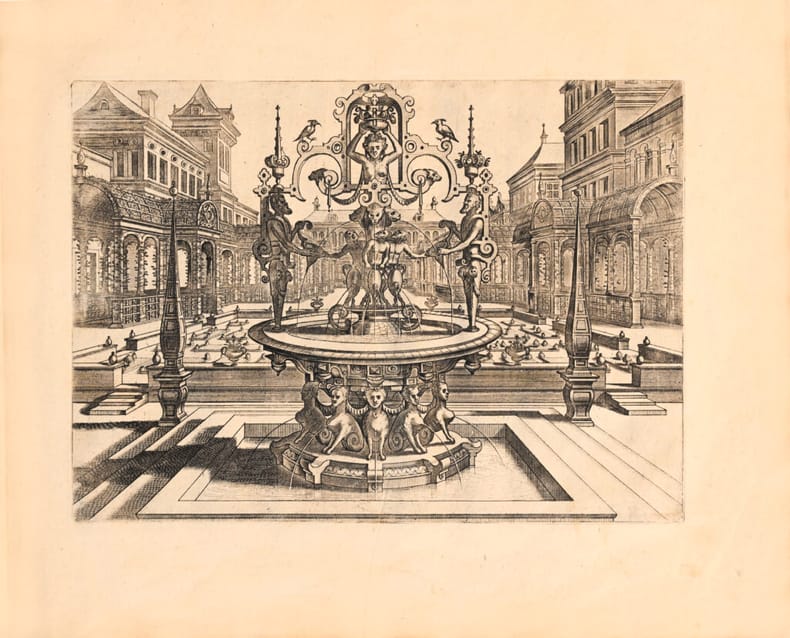
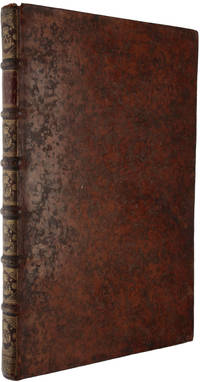
LCS-18476Provenance: Rothschild; Baron Alexis de Rédé. Vredeman de Vries, Jan (1527-1609), Floris, Cornelis (1514-1575) et Galle, Philippe (1537-1612). - Hortorum viridariorumque elegantes & multiplicis formae… Anvers, Philippe Galle, 1583. In-folio oblong (260 x 323 mm). Titre-frontispice et 20 planches de jardins, numérotées. Edition originale. Berlin Kat. 3390 ; Hollstein XLVIII, 470-490. - [Relié avec] : du même : Jardins. Anvers, Philippe Galle, c. 1583. 6 gravures numérotées. Edition originale. - [Relié avec] : du même : Artis Perspectiuae plurium generum elegantissimae Formulae, [graphic], multigenis Fontibus, nonnullisq[ue] Hortulis affabre factis exornatae, in comodum Artificum, eorumq[ue] qui Architectura, aedificiorumq[ue] comensurata uarietate delectantur, antea nunquam impressae. Anvers, Gerardus de Jode, 1568. Titre-frontispice et 17 gravures. Edition originale. - [Relié avec] : du même : Puits et fontaines. Anvers, Philippe Galle, 1573. 24 gravures numérotées sur 12 feuillets, minime déchirure à une planche. - [Relié avec] : Floris, Cornelis. Veelderleij niewe inventien van antijcksche sepultueren diemen nou zeere ghebruijkende is met noch zeer fraeije grotissen... Anvers, Jerôme Cock, 1557. Titre et 15 planches gravées montrant des décorations fantastiques, et des monuments funéraires dans le style grotesque. Edition originale rarissime. Reliure en vélin ancien, gardes renouvelées. Titre de la première suite frotté et effrangé avec déchirures marginales et pliure et joint à la garde ; taches à quelques planches. 257 x 326 mm.
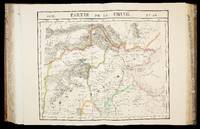
182715962Brussels 1827. 540 by 410mm. 21.25 by 16.25 inches. 6 volumes. Folio 6 letterpress half-titles and title-pages dedication leaf 42 pages of text 'Statistique de l'Europe' 7 lithographed index maps one of comparative heights with contemporary hand-colour in full and 382 numbered double-page maps by Henri Ode with contemporary hand-colour in outline some very occasional spotting; contemporary half tree calf drab paper boards some wear. The maps in the atlas make up the first map of the world on a uniform scale constructed as a modified conical projection and if assembled forming a globe with a diameter of 7.75 metres although only one such was known to have been made by the author himself and requiring a specially designed room. "Philippe Vandermaelen was born in Brussels in 1795 the son of a rich soap manufacturer. After his father's death in 1816 he devoted himself to maps and eleven years later produced this quite remarkable atlas. It was totally at his own expense and like so many innovations in the past it came about through the single-minded efforts of a man who could afford failure. It offered the largest picture of the earth's surface available in the nineteenth century thereby giving the lesser known areas such as Australia South Africa and the West coast of America all developing countries a much greater coverage than before. And perhaps most importantly of all it was the first atlas to be produced by lithography" Wardington Catalogue. cf. Koeman III Vdm 1; NMM 3:179; Philips Atlases 749 hardcover
NY47<p>22 août 1498.</p><p>Small gothic 4to 208 x 145 mm printed on vellum skin of 72 ll. a-i8 33 lines per page mark of the printer on the title historiated borders on each page 21 large full-page engravings not including the anatomical man numerous small initials illuminated with gold on red or blue background. </p><p>Full light brown morocco entirely decorated with blind-stamped motifs with a dark brown morocco mosaïc spine ribbed and decorated double inner gilt fillets framing gilt edges. Elegant binding signed by<i> Marius Michel</i>. </p><p><b>Incunabular partly first edition printed on vellum skin in Paris by Philippe Pigouchet for Simon Vostre considered by a large number of critics as the most beautiful French illustrated book of all times.</b></p><p>" <i>The back of the title contains the almanac from 1488 to 1508 the front of the 2nd l. the anatomical man and on the back the Holy Grail different from the edition of 1497. </i>There is in the text 21 figures 6 more than in the one from 1497<i> and we notice among them the Tree of Jesse the Combat where Uric was killed the Last Judgment and the Mass of S. Gregory. Several of these ancient subjects have been remade after new drawings better than the first ones. On the borderpieces that are also beautifuk we notice the theological and cardinal Virtues the life of J.-C. and the Virgin Mary Suzanne the Child Prodigy les 15 Signs 48 subjects of the Dance of Death and several repeated ornaments. There are copies that only contain 18 large plates. The subjects of the Danse of the dead occupy the eight ll. of the quire f. A copy on vellum is preserved in the cabinet of Mr. Didot; this is perhaps the same that has been sold 399 fr. The Prévost in 1857; another one is located at the imperial Library.</i> " Brunet V 1582-1583.</p><p>Soon after Udalric Gering and his two associates introduced in Paris the miraculous invention of Gutenberg perfected by Fust and Schoyffer and thus made the composter regularity and the economical speed of the press succeed to the ever so slow unprecised and above all expensive work of the scribes and rubricators the booksellers of the capital thought to exploit to their profit an art that by simplifying in a so sensitive way the fabrication of books was offering them an harvest as abundant as easy to collect. As they were first looking to apply the typography to fast flowing works it seems like they should have begin with these prayers books used by the devotees of all classes that they printed later under the title <i>Horæ</i>and <i>Officium</i> or even <i>Heures</i> and <i>Office</i> that were incarnating since a long time the main branch of their activity; but difficulty came and delayed for a while the printing of this type of works. Prayer books that were then used were all written on vellum decorated with initials painted in gold and in colours and almost all of them were also supplemented with more or less numerous and more or less well executed miniatures. For the calendar there were small subjects delightfully painted where were represented works occupations and games related to every month of the year; for the moveable feasts and the liturgy of deaths were larger miniatures representing subjects drawn from the Holy Scripture or related to the mystery celebrated or to the life of the invoked saint; we could almost always see represented there for examplethe <i>Martyr of St John the Evangelist</i> the <i>Angelus</i> the<i> Nativity of Jesus-Christ</i><i>the Sheperds Vision</i> <i>the Adoration of the Magi</i> the<i> Flight into Egypt</i> <i>the Massacre of the innocentsdes</i> <i>ordered by Herode</i> <i>David and Batsheba</i> etc. We also noticed in some of these precious manuscripts some more or less varied borderpieces more or less rich framing all of the pages and that were usually offering flowers birds insects and gracious arabesques where gold was skilfully married to brighter colours. Those rich volumes were considered rightfully as prized jewels and were transmitted by succession in families generation after generation. Being used then to read Hours in such illustrated books how could we have welcomed simple typographical productions entirely depraved of these ornaments necessary for all pious reading To succeed in this type of craftsmanship it was needed then to use the help of woodcut that was then being perfected and to reproduce as much as possible the drawings spreaded out in the manuscript Hours and to illustrate the prints with those. If until now the bibliographers couldn't agree on the real date of the most ancient illustrated Book of Hours produced on press<b> they usuallly recognize however that the printer Philippe Pigouchet and the bookseller Simon Vostre were the firsts in Paris who knew how to combine with success engraving with typography. </b>We can believe that those two booksellers already practiced woodcut themselves and that they knew how to join forces with skilled tailors in order to give to their small woodcuts the degree of perfection that they perfected. It is then to anonymous artists from the end of the 15th century and not as pretended Papillon to Mercure Jollat appeared thirty years later that we must give credit for the main part of the engraving of <b>those </b><i><b>Hours</b></i><b> so remarkable by the beauty of its vellum the quality of its inking and above all the variery of its borderpieces where pleasing arabesques singular grotesque subjects alternatively succeed with hunts games subjects drawn from Holy Scripture or even secular history and mythology and at last with those dances of dead imitated from the </b><i><b>men and women dance of death</b></i> which was then in vogue small compositions whose spicy expression can be admired. These borders which as can be judged from the specimens placed around these pages are more remarkable for the finish of the engraving than for the design consisted of small compartments which were divided changed and reunited at will according to the size and format of the volume in which they were to appear; so that while almost always using the same parts it was nevertheless so easy to give the different editions published an appearance of variety that one can hardly find two that reproduce themselves exactly page by page. The large plates intended to receive the embellishment of the painting are generally less finished than the small ones but one always recognises the same workmanship.</p><p>Let's hear now an English bibliographer who dedicated at least a hundred pages in one of his most interesting works to the description of ancient Hours printed in Paris and to the figuration with a conscientious exactitude of the most curious ornaments. This is then how T.-F. Dibdin expresses himself at the page 7 of the second day of his <i>Bibliographical Decameron</i>: "<i>Let us howerer… suppose that some spirited Collector or a select committee of the Roxburghe Club should unite their tastes and purses to put forth from the Shakespeare press an octavo volume of prayers from the liturgy decorated in a manner similar to what we observe in the devotional publications just alluded to – do you think the attempt would be successful In other words where are the ink and vellum which can match with what we see in the Missals of old The doubtful success of such an experiment would render it extremely hazardous; even were it not attended with what may be called an immensity of expense. Welcome therefore again I exclaim the rich and fanciful furniture which garnishes the texts of early printed books of devotion….</i>"</p><p>"Those parisian impressions of which foreigners are the first to recognize their superiority…"</p><p>Philippe Pigouchet not only printed almost all the Hours published by Simon Vostre from 1488 to 1502 as well as several other Hours for Pierre Regnault bookseller in Caen and for Guillaume Eustache bookseller in Paris of which we can find the article below; but before having put his press to the service of those three booksellers he had already published under his own name and on his own account several Books of Hours including the Almanac indicating the dates of Easter began in the year 1488.</p><p>The name of Simon Vostre who began to appear during the year 1488 at the latest cannot be found after 1520.</p><p>It is in this type of publication that Simon Vostre won over all of his concurrents. We can see thanks to his discerning taste the charming borderpieces in arabesques illustrating all these Hours and the pretty small figures appearing on the same borderpieces. First rarely varied but already remarkable in the editions given by him around 1488 those borderpieces were presenting since then a suite of small subjects who began to multiply enough to finally stop him from repeating several times in a row the same suite of plates as he was obliged to do in the beginning and even enough to make possible the fact of making them vary from an edition to another. </p><p>All of these suites are generally accompanied by a very short text in Latin or by a few particularly naive verses in French where we can read words we are surprized to see in a book of piet words we won't dare to print in letters now even in more mundane works. This is perhaps a crucial point in the research of those singular productions today and what will make their price increase as time progresses. The most curious copies in our opinion are the ones that contain a larger number of those pious quatrains and that gather the main part of the small suites that we just talked about. As for the choice of the proofs the editions around 1498 are superior to the subsequent ones for the variety of the arabesques the beauty of the printing. This is here an advantage that won't deny the artists neither the amateurs of ancient woodcuts who will find this mostly in copies in larger format and to whom we advise to choose non illuminated. </p><p><b>" There is something sure the Hours by Pigouchet exécutéd for Simon Vostre have always made the admiration of bibliophiles and connaisseurs</b><i><b>. </b>They bear the artistic mark of the old French School. The drawer</i> said J. Renouvier <i>stepped in the schema of the gothic iconography; He places on the first pages the representations that the sculptor used to put on the steps of the church on the sides of the portal and he adds as he pleases more familiar and more cheerful motifs small subjects of manners whose kindness touches us all the more because we see the tradition faithfully observed by country people and by children. We didn't make anything similar abroad : this is ultimate French art.</i> <b>As we flip through the leaves we would think being transported unders the naves of our ancient gothic cathedrals. </b></p><p><i>On sent vibrer dans ces images de la vie du Christ des Sacrements des Signes de la fin du Monde et de la Danse macabre la foi naïve et robuste de nos pères.</i></p><p><i>Outre les bordures dont nous avons présenté des échantillons la plupart des livres d'heures exécutés pour Simon Vostre dans la seconde manière de Pigouchet en contiennent d'autres figurant la Danse macabre des Hommes et des Femmes. Le cycle complet de la Danse des Morts se compose de soixante-six sujets ; trente scènes sont contenues dans dix bordures pour la Danse des Hommes et trente-six scènes en douze bordures pour la Danse des Femmes. Ce sont les mêmes personnages qui figurent dans la Danse macabre de Guy Marchant. Le dessinateur dispose adroitement ses couples dans un petit espace. Il drape la Mort d'un bout de linge lui donne pour instruments le pic et la pelle plutôt que la faux qui tiendrait trop de place et il la fait grimacer comme un singe en présence d'un partenaire merveilleusement signalé par son costume. C'est un vif dialogue une mimique piquante qu'ont avec la Mort le Bourgeois l'Usurier le Médecin l'Enfant la Reine la Chambrière la Mignote la Femme de village tous entraînés vers la danse finale</i>. " A. Claudin.</p><p><b>Claudin</b> <i>Histoire de l'imprimerie en France</i><b> dedicates 20 pages and numerous reproductions to this edition that we can consider as one of the most beautiful from the incunabular printing in the western world and that constitutes an important date in the evolution of ornamentation : " </b><i>des personnages fantastiques accompagnent dans leur chevauchée des chimères de toutes sortes le tout brochant sur une flore incomparable : telles sont ces bordures d'une exquise conception</i> " Claudin 44.</p><p><b>Superb copy printed on vellum skin of this incunabular Book of Hours so important in the history of printing in France entirely rubricated with gold on an alternated red and blue background. </b></p><p>The purity of its printing is such that it made its way into the collection of the greatest amateur <i>Georges Wendling </i>with ex-libris.</p><p>In 2004 14 years ago Pierre Berès described and catalogued ford 130 000 € the Hours of 1498 by Simon Vostre bound in the 19th century<i>. </i>Réf : Pierre Berès September 15-28 2004 n°2.</p><p><br /></p><p><u>Français</u><br /></p><p>Philippe Pigouchet sur le titre.</p><p>22 août 1498.</p><p>Petit in-4 gothique imprimé sur peau de vélin de 72 ff. a-i8 33 lignes par page marque de l'imprimeur sur le titre bordures historiées pour chaque page 21 grandes gravures à pleine page sans compter l'homme anatomique nombreuses petites initiales enluminées à l'or sur fond rouge ou bleu. </p><p>Plein maroquin havane entièrement décoré de motifs à froid avec mosaïque de maroquin brun foncé dos à nerfs orné coupes décorées à froid double encadrement de filets dorés intérieurs tranches dorées. Élégante reliure signée de<i>Marius Michel</i>. </p><p>208 x 145 mm.</p><p><b>Edition incunable en partie originale achevée d'imprimer sur peau de vélin à Paris par Philippe Pigouchet pour Simon Vostre considérée par nombre de critiques comme le plus beau livre français illustré du temps.</b></p><p>" <i>Le verso du titre contient l'almanach de 1488 à 1508 le recto du 2ème f. l'homme anatomique et le verso le saint Graal différent de celui de l'édition de 1497. </i>Il y a dans le texte 21 figures 6 de plus que dans celle de 1497<i> et parmi lesquelles on remarque l'Arbre de Jessé le Combat où Uric fut tué le Jugement dernier et la Messe de S. Grégoire. Plusieurs des anciens sujets ont été refaits sur de nouveaux dessins meilleurs que les premiers. Dans les bordures qui sont aussi fort belles on remarque les Vertus théologales et cardinales la Vie de J.-C. et de la Vierge Marie Suzanne l'Enfant prodigue les 15 Signes 48 sujets de la Danse des morts et divers ornements répétés. Il y a des exemplaires qui n'ont que 18 grandes planches. Les sujets de la Dans des morts occupent les huit ff. du cahier f. Un exemplaire sur vélin est conservé dans le cabinet de M. Didot ; c'est peut-être le même que celui qui a été vendu 399 fr. Le Prévost en 1857 ; un autre se trouve à la Bibliothèque impériale.</i> " Brunet V 1582-1583.</p><p>Peu de temps après qu'Udalric Gering et ses deux associés eurent introduit à Paris l'invention miraculeuse de Gutenberg perfectionnée par Fust et Schoyffer et y eurent ainsi fait succéder la régularité du composteur et l'économique célérité de la presse au travail si lent si peu exact et surtout si dispendieux des scribes et des rubriqueurs les libraires de cette capitale songèrent à exploiter à leur profit un art qui en simplifiant d'une manière si sensible la fabrication des livres leur offrait une moisson aussi abondante que facile à recueillir. Comme ils cherchèrent d'abord à appliquer la typographie à des ouvrages d'un débit rapide il semble qu'ils auraient dû commencer par ces livres de prières à l'usage des fidèles de toutes les classes que plus tard ils imprimèrent sous le titre d'<i>Horæ</i> et d'<i>Officium</i> ou sous celui d'<i>Heures</i> et d'<i>Office</i> et qui depuis longtemps formaient la principale branche de leur commerce ; mais voici la difficulté qui retarda quelque temps l'impression de ces sortes d'ouvrages. Les livres de prières dont on se servait alors étaient tous écrits sur vélin décorés d'initiales peintes en or et en couleurs et presque tous aussi enrichis de miniatures plus ou moins nombreuses et plus ou moins bien exécutées. Au calendrier c'était des petits sujets délicatement peints où figuraient les travaux les occupations et les jeux analogues à chaque mois de l'année ; aux fêtes mobiles au propre des saints et à l'office des morts se trouvaient de plus grandes miniatures représentant des sujets tirés de l'Écriture sainte ou relatifs au mystère que l'on célébrait ou à la vie du saint qu'on invoquait ; on y voyait presque toujours figurer par exemple le <i>Martyre de saint Jean l'évangéliste</i> la <i>Salutation angélique</i> <i>la Naissance de Jésus-Christ</i> <i>la Vision des bergers</i><i>l'Adoration des mages</i> <i>la Fuite en Égypte</i> <i>le Massacre des innocents</i> <i>ordonné par Hérode</i> <i>David et Betzabée</i> etc. On remarquait aussi dans une partie de ces manuscrits précieux des bordures plus ou moins variées plus ou moins riches qui en entouraient toutes les pages et qui offraient ordinairement des fleurs des oiseaux des insectes et des arabesques gracieuses où l'or se mariait habilement aux couleurs les plus vives. Ces riches volumes étaient avec raison considérés comme des bijoux de prix et se transmettaient par succession dans les familles de génération en génération. Accoutumé qu'on était alors à lire ses Heures dans des livres ainsi décorés comment aurait-on pu accueillir de simples productions typographiques entièrement dépourvues de ces ornements devenus un accompagnement nécessaire de toute lecture pieuse Pour réussir dans ce genre de fabrication il fallut donc emprunter le secours de la gravure sur bois qui commençait à se perfectionner et reproduire autant que possible les dessins répandus dans les Heures manuscrites et en décorer les imprimées. Si jusqu'ici les bibliographes n'ont pu tomber d'accord sur la véritable date du plus ancien livre d'Heures illustré qu'ait produit la presse<b> ils reconnaissent pourtant généralement que l'imprimeur Philippe Pigouchet et le libraire Simon Vostre furent les premiers à Paris qui surent allier avec succès la gravure à la typographie</b>. Il est à croire que ces deux libraires avaient déjà pratiqué par eux-mêmes la taille sur bois et qu'ils surent s'adjoindre des tailleurs assez habiles pour donner successivement à leurs petits bois le degré de perfection auquel ils les ont portés. C'est donc à des artistes anonymes de la fin du quinzième siècle et non pas comme l'a prétendu Papillon à Mercure Jollat venu trente ans plus tard qu'il faut attribuer la principale part dans<b>la gravure de ces </b><i><b>Heures</b></i><b> si remarquables par la beauté du vélin la qualité de l'encre et surtout par la variété des bordures où à des arabesques les plus agréables à des sujets grotesques les plus singuliers succèdent alternativement des chasses des jeux des sujets tirés de l'Écriture sainte ou même de l'histoire profane et de la mythologie et enfin ces Danses des morts imitées de la </b><i><b>Danse macabre des hommes et des femmes</b></i><b> </b>qui était alors dans toute sa vogue petites compositions dont on admire encore la piquante expression. Ces bordures qui ainsi qu'on peut en juger par les spécimens placés autour de ces pages sont d'ailleurs plus remarquables pour le fini de la gravure que pour le dessin se composaient de petits compartiments qui se divisaient se changeaient se réunissaient à volonté selon l'étendue et le format du volume où elles devaient figurer ; en sorte que tout en employant presque toujours les mêmes pièces il était cependant si facile de donner aux différentes éditions qu'on publiait une apparence de variété qu'à peine en trouve-t-on deux qui se reproduisent exactement page par page. Les grandes planches destinées à recevoir l'embellissement de la peinture sont en général moins terminées que les petites mais on y reconnaît toujours un même faire.</p><p>Laissons parler ici un bibliographe anglais qui a consacré cent pages au moins du plus intéressant de ses ouvrages à décrire les anciennes Heures imprimées à Paris et à en figurer avec une exactitude scrupuleuse les plus curieux ornements. Voici donc comme s'exprime T.-F. Dibdin à la page 7 de la seconde journée de son <i>Bibliographical Decameron</i>: " <i>Let us howerer… suppose that some spirited Collector or a select committee of the Roxburghe Club should unite their tastes and purses to put forth from the Shakespeare press an octavo volume of prayers from the liturgy decorated in a manner similar to what we observe in the devotional publications just alluded to – do you think the attempt would be successful In other words where are the ink and vellum which can match with what we see in the Missals of old The doubtful success of such an experiment would render it extremely hazardous; even were it not attended with what may be called an immensity of expense. Welcome therefore again I exclaim the rich and fanciful furniture which garnishes the texts of early printed books of devotion….</i> "</p><p>" <i>Ces impressions parisiennes dont les étrangers sont les premiers à reconnaître toute la supériorité…</i> ".</p><p>Philippe Pigouchet a non seulement imprimé presque toutes les Heures publiées par Simon Vostre de 1488 à 1502 ainsi que plusieurs autres Heures pour Pierre Regnault libraire de Caen et pour Guillaume Eustache libraire de Paris dont on trouvera plus bas l'article ; mais avant d'avoir mis sa presse au service de ces trois libraires il avait déjà publié sous son seul nom et pour son propre compte plusieurs livres d'Heures dont l'Almanach indiquant les dates de Pâques commence à l'année 1488.</p><p>Le nom de Simon Vostre qui commence à paraître l'année 1488 au plus tard ne se trouve plus après 1520.</p><p>C'est dans ce genre de publication que Simon Vostre l'a emporté sur tous ses concurrents. Nous devons à son goût éclairé les charmantes bordures en arabesques qui décorent toutes ses Heures et les jolies petites figures qu'offrent ces mêmes bordures. D'abord peu variées mais déjà fort remarquables dans les éditions données par lui vers 1488 ces bordures présentaient dès lors une suite de petits sujets qui peu à peu se multiplièrent assez pour qu'il pût enfin se dispenser de répéter plusieurs fois de suite les mêmes planches comme il avait été obligé de le faire dans l'origine et même pour qu'il fût possible de les varier d'une édition à l'autre. </p><p>Toutes ces suites sont ordinairement accompagnées d'un texte fort court en latin ou de quelques vers français d'une naïveté remarquable et où se lisent des mots qu'on est fort surpris de trouver dans un livre de piété des mots qu'on n'oserait plus imprimer en toutes lettres maintenant même dans les ouvrages les plus mondains. Voilà peut-être ce qui contribue le plus à faire rechercher aujourd'hui ces singulières productions et ce qui en augmentera le prix à mesure que nous nous éloignerons davantage de l'époque de leur publication. Les exemplaires les plus curieux à notre avis sont ceux qui renferment un plus grand nombre de ces pieux quatrains et qui réunissent la plus grande partie des petites suites que nous venons de signaler. Pour le choix des épreuves pour la variété des arabesques pour la beauté du tirage les éditions données vers 1498 l'emportent sur les dernières. C'est là un avantage que ne négligeront ni les artistes ni les amateurs d'anciennes gravures sur bois et qu'ils trouveront surtout dans les exemplaires en grand format que nous leur conseillons de choisir non enluminés. </p><p><b>" Il est un fait certain c'est que les Heures de Pigouchet exécutées pour Simon Vostre ont fait de tout temps l'admiration des bibliophiles et des connaisseurs</b><i><b>. </b>Elles portent le cachet artistique de la vieille École française. Le dessinateur</i> dit J. Renouvier <i>est entré d'emblée dans le plan de l'iconographie gothique ; il place aux premières pages les représentations que le sculpteur mettait aux marches de l'église sur les côtés du portail et il ajoute de son gré des motifs plus familiers et plus gais de petits sujets de mœurs dont la gentillesse nous touche d'autant plus que nous en voyons la tradition fidèlement observée par les campagnards et par les enfants. On n'a rien fait de semblable à l'étranger ; c'est de l'art français par excellence.</i> <b>En tournant ces feuillets on se croirait transporté sous les nefs de nos vieilles cathédrales gothiques.</b> <i>On sent vibrer dans ces images de la vie du Christ des Sacrements des Signes de la fin du Monde et de la Danse macabre la foi naïve et robuste de nos pères.</i></p><p><i>Outre les bordures dont nous avons présenté des échantillons la plupart des livres d'heures exécutés pour Simon Vostre dans la seconde manière de Pigouchet en contiennent d'autres figurant la Danse macabre des Hommes et des Femmes. Le cycle complet de la Danse des Morts se compose de soixante-six sujets ; trente scènes sont contenues dans dix bordures pour la Danse des Hommes et trente-six scènes en douze bordures pour la Danse des Femmes. Ce sont les mêmes personnages qui figurent dans la Danse macabre de Guy Marchant. Le dessinateur dispose adroitement ses couples dans un petit espace. Il drape la Mort d'un bout de linge lui donne pour instruments le pic et la pelle plutôt que la faux qui tiendrait trop de place et il la fait grimacer comme un singe en présence d'un partenaire merveilleusement signalé par son costume. C'est un vif dialogue une mimique piquante qu'ont avec la Mort le Bourgeois l'Usurier le Médecin l'Enfant la Reine la Chambrière la Mignote la Femme de village tous entraînés vers la danse finale</i>. " A. Claudin.</p><p><b>Claudin</b> <i>Histoire de l'imprimerie en France</i> <b>consacre 20 pages et de nombreuses reproductions à cette édition que l'on peut considérer comme l'une des plus belles de l'imprimerie incunable d'Occident</b> et qui constitue une date importante dans l'évolution de l'ornementation : " <i>des personnages fantastiques accompagnent dans leur chevauchée des chimères de toutes sortes le tout brochant sur une flore incomparable : telles sont ces bordures d'une exquise conception</i> " Claudin 44.</p><p><b>Superbe exemplaire imprimé sur peau de vélin de ce livre d'heures incunable si important dans l'histoire de l'imprimerie en France entièrement rubriqué à l'or sur fond rouge et bleu alterné.</b></p><p>La pureté de son tirage est telle qu'il entra dans la collection du grand amateur <i>Georges Wendling </i>avec ex-libris.</p><p>En 2004 il y a 14 ans Pierre Berès décrivait et cataloguait 130 000 € les Heures de 1498 de Simon Vostre reliées au XIXe siècle<i>. </i>Réf : Pierre Berès 15-28 septembre 2004 n°2.</p> hardcover
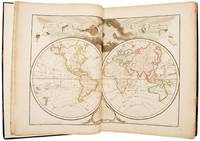
178951612Paris: chez Dezauche 1789. Updating the work of "one of the key figures in the development of French cartography" First edition thus and uncommon with just four listings on WorldCat three of these for the BnF and no complete copy at auction for 30 years; an excellent complete and inclusive French atlas of the 18th century. Jean-Claude Dezauche 1745-1824 was one of the geographer-publishers most influential in the establishment of the French theoretical approach to cartography. This movement which downplayed the decorative elements valued by the Dutch school in favour of scientific rigour and accuracy can be traced back to the work of Guillaume Delisle - "one of the key figures in the development of French cartography" Tooley - who had studied under Jean-Dominique Cassini director of the Paris observatory. Delisle's business was inherited by his son-in-law Philippe Buache who had studied with him and who entered the Depôt des Cartes et Plans de Marine in 1721 in 1729 being appointed "premier géographe du roi" a position previously held by his father-in-law. On Buache's death his widow sold his work to Jean Nicholas Buache de la Neuville Philippe's nephew and in 1780 Dezauche bought it from him together with work by Delisle Jaillot and others. He in turn made his own alterations and improvements to the maps and then re-issued them in a revised form. For example the twin- and four-hemispheric world maps in volume I the former dated 1792 have been revised to include the latest discoveries from Cook's voyages. 2 vols folio 453 x 375 mm. Engraved allegorical title page and contents leaves to each and 151 double-page or folding maps all coloured in outline. Contemporary calf rebacked red morocco labels. Somewhat rubbed and with some restoration at the corners light dampstain in the lower margin of vol. I slightly heavier at the title page which has been reinforced with archival tissue map of Paris shaved to the ruled border at the upper margin a few minor splits and chips in the margins but overall very good. unknown
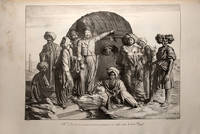
114525Paris Imprimerie Royale 1819. . First edition; elephant folio; 80 plates including 70 lithographs 8 aquatints & 2 engravings; contemporary calf over blue paper boards red morocco label to upper cover vellum tips; spine rubbed corners worn; internally a fine clean uncut example.<br /> The scarce first edition of Forbin's Voyage with text and plates together of which Brunet says only 325 copies were printed.<br /><br />Forbin's was one of the first important French books to use lithography on a grand scale and the standard of production is equal to that of Napoleon's Description de l'Égypte. The plates are after drawings by Forbin Isabey Prevost Fragonard and Carle Vernet. The aquatinted plates are all after drawings by Forbin himself. Most of the plates illustrate views in Egypt and Syria including the famous view of Drovetti French consul in Egypt measuring a giant head. In 1816 Forbin replaced Denon as Director of Museums and in 1817 he undertook a year-long voyage to the Levant having been authorised to purchase antiquities for the Louvre. He travelled to Milos where his son-in-law had negotiated the purchase of the recently discovered Venus de Milo and from there to Athens Constantinople Asia Minor Syria and Palestine. From Jaffa he travelled overland to Egypt and visited Alexandria.<br /> Atabey 447; Blackmer 614; Colas 1089; Hilmy I 163; Koç I 209; Weber 70; Paris, Imprimerie Royale, 1819. hardcover
elala5777Paris: Simon Le Moyne 1635. First Edition of the first Canadian flora and one of the earliest North American herbals. The author Jacques Philippe Cornut was professor of medicine at the University of Paris. Although he himself never visited New France he was able to study specimens which were brought or sent back to France by explorers and Jesuits. Many were provided by Jean and Vespasien Robin who supervised the gardens of Henry IV and the garden of the Paris Faculty of Medicine and from Pierre Morin and his family who owned several Parisian commercial nurseries. Eighty-six different species are described thirty native to north-eastern America a number of them for the first time. Among these is the Guernsey lily so-named from its introduction into England some fifty years later when specimens were found on the island following the wreck of a ship lost en route from Cape Town with bulbs among the cargo cfBlunt The Art of Botanical Illustration 1950. Also illustrated here for the first time are five South African bulbous plants. The sixty-eight finely executed botanical etchings have been attributed to Louis Vallet 1575-1657. Appended to the main text is a catalogue of plants by Cornut entitled L’Enchiridion botanicum parisiense apparently the first made of the flora of the environs of Paris. Linnaeus made reference to Cornut's work several times in his Species Plantarum and Charles Plumier named the genus Cornutia in the family Lamiaceae in his honour. "The fact that the Historia was grounded in medical botany is important to understanding the convention by which Cornut and his artist worked in producing and engraving the illustrations. Cornut's work stands near the end of a very old tradition of herbal literature and the illustrations reflect a convention established in the mid-sixteenth century. At the same time Cornut's illustrations were not printed from woodcuts but from engraved copper plates and his text reflected not only medical usage but horticultural observations. The title of Cornut's work also suggests that he has at least attempted to prepare a regional flora and he has prepared it by working with a living collection a garden. These two aspects of Cornut's work herbal on the one hand and regional flora on the other mark it as transitional between the Renaissance and the early modern period" Victoria Dickenson Drawn from Life: Science and Art in the Portrayal of the New World page 80-81. European Americana 635/37. Bell C493. Blunt p. 102. Brunet Suppt. 316-17. Dionne II 99. Gagnon II 519. Harrisse 59. Hunt 227. JCB II p. 255. Lande 157. Leclerc 705. Muller p. 36. Nissen 406. Pritzel 1894. Sabin 16809. TPL 4663. Vlach 183. Wellcome 1612. 4to. pp. 8 p.l. 238 2. 68 full-page botanical etchings in the text. woodcut ornaments initials & title vignette. modern morocco paper lightly browned marginal dampstain to 2 leaves ownership entries on title inked out although the date ‘1670’ is clearly visible it is this owner who appears to be the author of the ms. notes found in the text – mostly in the appendix. bookplate of American botanist Edward Sandford Burgess. elala5777 Paris: Simon Le Moyne, 1635 unknown
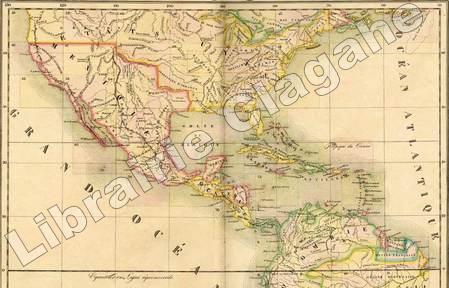
18279452Bruxelles, PMG Vandermaelen éditeur, 1827 ; cinq tomes (Europe, Asie, Afrique, Amérique Septentrionale, Amérique Méridionale), in-folio atlantique (52,5 x 36 cm) ; demi-veau havane à petits coins verts, dos à faux-nerfs dorés, palette décorative dorée en tête et en pied, titre doré, tranches marbrées (reliure uniforme de l'époque) ; 1- Europe : (4), 43 pp., (1) p., tableau comparatif des principales hauteurs du globe (illustré en couleurs), carte d'assemblage de l'Europe et 29 cartes doubles. 2- Asie : (6) pp., carte d'assemblage de l'Asie et 111 cartes doubles. 3- Afrique : (4) pp., tableau d'assemblage de l'Afrique et 60 cartes doubles. 4- Amérique Septentrionale : (4), tableau d'assemblage et tableau provisoire d'assemblage d'une partie de l'Amérique Seple et d'une partie de l'Amérique Méridionale et 77 cartes doubles. 5- Amérique Méridionale : (4), carte d'assemblage d'Amérique Méridionale et 44 cartes doubles. Toutes les cartes sont en couleurs à quelques rares exceptions près et montées sur onglets.
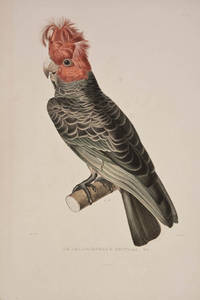
98481Paris Arthus Bertrand 1837. . First edition. 3 vols comprising 2 vols 4to text and 1 vol. folio atlas 53 x 35 cms text a little spotted as usual atlas with 56 plates comprising 34 lithographed views and portraits after V. Adam Sabatier and others from sketches by E.B. de la Touanne printed by Bernard & Frey 12 hand-colored engraved natural history plates after P. Bessa and J.-G. Pretre by Coutant H. Legrand Oudet Dumenil and Massard double-page hand-colored aquatint of various native vessels folding engraved map 2 double-page coastal profiles and 6 double-page engraved maps and charts by A. Tardieu after E.B. de la Touanne usual sporadic toning and light staining plate 4 a bit foxed contemporary calf-backed marbled boards atlas rebacked to match a very good set. <br /> The official record of Bougainville's voyage around the world. The main intention of the voyage was political: to extend French influence in Indochina. However Bougainville also touched at Pondicherry Manila Macao Surabaya Sydney Port Jackson Valparaiso and Rio de Janeiro. Bougainville son of the explorer Louis Antoine de Bougainville had served as an eighteen-year-old ensign on the Baudin voyage and after distinguished service in the Napoleonic wars he was given command of the frigate La Thetis and the corvette L'Esprance. He spent several months in and around Sydney where most of the ornithological material gathered by the voyage had been collected here and resulted in three drawings by Bessa of four species of birds including 'superb illustrations' Wood of the male and female Gang-gang or red-crested parrot. From here both ships crossed to Valparaiso where La Touanne commenced his overland journey to rejoin the expedition at Rio. The account of this journey takes up much of the second volume together with R.-P. Lesson's account of the natural history.<br /> Ayer/Zimmer p83; Borba de Moraes I115; Ferguson 2236; Fine Bird Books p79; Hill 162; Nissen ZBI 483; Sabin 6875; Whittell p68; Wood p251. Paris, Arthus Bertrand, 1837. hardcover
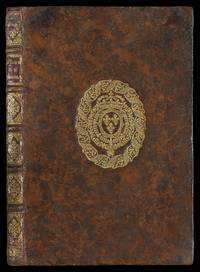
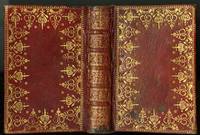
LCS-17816« Dernière édition publiée du vivant de l’auteur, elle est très complète, très belle et justement estimée ». (Tchemerzine, II, 890). Paris, Mamert Patisson, 1600. 1 volume in-8 de (8) ff., 338 pp., (6) ff. Maroquin rouge, plats ornés d’un décor doré à la fanfare, dos à nerfs richement orné, filet or sur les coupes, roulette intérieure, tranches dorées sur marbrures. Reliure signée de Trautz-Bauzonnet vers 1860. 172 x 105 mm.
15695032541569. Book. A lengthy series of royal edicts / decrees / writs produced by the court under Philippe's close scrutiny in 1569 regarding financial and other obligations on the part of the persons in the area of Castro del Rio and elsewhere. 49 vellum leaves 98pp of manuscript 4 blank pages. The last page of which bears the date 18 November 1569 and the elaborate signatures and marks of the King and a number of his courtiers. Each page of the text bears 2 flourishes ie initials likely by the King and by the person responsible for the production of the document. In the original leather covers much rubbing and wear with remnants of the binding ribbons but the document still well-bound and with we think the original tri-coloured spine-cord binding the text to the cover. The first page with ornate decoration and illustrations in ink embellished with gold detailing and flourishes. Exquisite calligraphy throughout on well-preserved vellum. No seals present. 14" x 10". hardcover
177230530Paris: Edme 1772. Folio. 19 3/4 x 13 1/8 inches. Engraved frontispiece by B.L. Prevost after Sullier engraved portrait frontispiece by J. Baptiste Michel after Harguinier engraved title vignette by and after Prevost engraved arms of Charles-Eugene de Lorraine on dedication 56 hand-coloured engraved plates by B. Michel Adam femme Fessard F.A. Aveline C. Baquoy Benard Ch. Beulier L. Bosse Prevost and others after Harguinier Lafosse Saullier 19 folding and 7 engraved headpieces by Delaunay Hubert Levilain Lucas Mlle Massard Mesnil Michel after Le Carpentier type-ornament headpieces woodcut head- and tailpieces and initials. Contemporary calf covers bordered with gilt double fillet expertly rebacked to style spine gilt retaining the original red morocco lettering piece period marbled endpapers<br/> <br/> Deluxe hand-coloured first edition of the best 18th century French work on equine medicine and the anatomy of the horse.<br/> <br/> Cours d'hippiatrique is distinguished not only by Lafosse's anatomical skill and knowledge of equitation gained through both study and practice of the subject but also by the excellence of its execution: "Ce livre est un veritable monument eleve a l'Hippologie. Papier impression dessin gravure sont egalement signes" Mennessier de la Lance. The vivid colouring of the anatomical plates elevates this hand coloured issue far beyond the regular black and white edition. "Ouvrage fort bien execute et qui a ete longtemps le meilleur que l'on eut sur cette science" Brunet.<br/> <br/> Brunet III 765; Cohen-de Ricci col.587; Huth p.46; Mellon Books on Horses and Horsemanship 61; Mennessier de la Lance II pp.20-21; Nissen ZBI 2360. Edme unknown
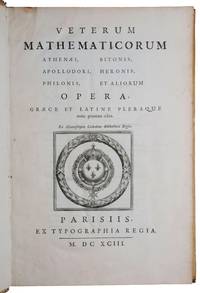
16936467Paris: Typographia Regia 1693. First edition. <p>First edition a very fine copy of this collection of early Greek writings on technology especially military technology and hydrostatics. It contains several treatises on the mechanics and siege operations or poliorcetica of the Hellenistic period the period between Alexander and Augustus including the construction and management of projectile engines.</p>. DIBNER 84: ANCIENT GREEK TECHNOLOGY. <p>First edition of this collection of early Greek writings on technology especially military technology and hydrostatics. It contains several treatises on the mechanics and siege operations or poliorcetica used in the Hellenistic period the period between Alexander and Augustus including the construction and management of their projectile engines. The first six works in the volume comprise the writings on the subject of military engines that were compiled by Athenaeus Apollodorus Biton Heron and Philon. These works include the first edition in both Greek and Latin of Biton's Construction of War Machines and Artillery of extant part of the Mechanike Syntaxis attributed to Philon of Byzantium and of the Poliorcetica of Apollodorus of Damascus. These are followed by the Greek and Latin texts of Hero of Alexandria's works on hydrostatics the Pneumatica and Automata which include what some regard as the first description of a steam-engine; this is the first printing of the Greek text of these works. Thévenot the King's librarian to Louis XIV prepared the present work from a rather defective secondary manuscript Codex Parisinus 2435. After Thévenot's death in 1692 it was revised by the mathematician La Hire with insightful annotations by Boivin an official in the King's library. It is one of three early publications of the French Academy of Sciences grouped together as Dibner 84. "Printed at the royal press in small editions they were intended as gifts for the King and Academy. In size binding and beauty of the plates they are among the most sumptuous books in science" Dibner. This is a rare book on the market only eight copies having appeared at auction in the last 40 years. The Evelyn copy was sold at Christie's in 1977.</p> <br /> <p>To gain access to the walls of a site under siege a siege tower or ram was brought into position and used to launch an attack onto the walkway aided by missile fire from the higher levels of the tower. Simultaneous attacks with scaling ladders took place. A siege tower is a specialized siege engine constructed to protect assailants and the ladders used when approaching the defensive walls of a fortification. The tower was usually rectangular with four wheels and a height roughly equal to that of the wall; it was sometimes higher to allow archers to stand on the top and fire into the fortification. The tower was made chiefly of wood but sometimes there were metal components as well. They were unwieldy to manoeuvre and slow to assemble and consequently were usually constructed at the siege site. Sometimes siege towers themselves incorporated other devices including artillery rams and dropbridges. Two main types of artillery equipment were used in this period: bolt-throwers ballistae: used for picking off prominent individuals and stone-throwers scorpiones onagri. Stone throwers could cause structural damage but were generally confined to firing at towers gates or siege machinery. Artillery might use incendiary ammunition when firing at gates or equipment.</p> <br /> <p>In common with much Byzantine literature poliorcetica draw heavily on earlier classical material. Since these were composed before the development of heavy artillery the poliorcetica are not so much concerned with large machines but rather with describing techniques for bringing men close to fortifications and then ways of undermining them. They also suggest various psychological tricks which might be used to outwit the enemy. Such ancient works on military machines were a source of fascination to the Italians of the late 15th and 16th centuries not only because of their historic interest but also as a source for modern inventions to be used in contemporary warfare and several of these works were first published in Renaissance Italy.</p> <br /> <p>The present volume begins with the De Machinis of Athenaeus a Cilician ex-statesman living in Rome in the 20s B.C. and a contemporary of the architect-engineer Vitruvius who like Vitruvius worked under the patronage of the Emperor Augustus Vitruvius devoted Book 10 of his De Architectura to machines. In addition to describing individual siege engines and theorizing on tactics Athenaeus draws on actual instances from history of the use of these machines in order to make various points and elucidate his text.</p> <br /> <p>The author of the next text is Apollodorus of Damascus who was a Roman architect and engineer of the late 1st to early 2nd century A.D. As Emperor Trajan's architect and military engineer he was responsible for Trajan's forum and possibly Trajan's column and produced designs for new siege machines. In his treatise Poliorcetica he describes a system of banks and ditches and also sheds that would be needed to protect the legionaries during undermining work or to carry battering rams against a tower gate or wall. Next he describes the construction of a siege tower followed by a system of interlocking ladders. He concludes his treatise with a description of a battlemented raft for river assaults. Although some of the elaborations are considered somewhat unrealistic − for example the addition of a torsion-powered truncheon to the end of a battering ram − and some of these are believed to have been added by a later editor the core of Apollodorus' text is believed to be authentic and to accurately describe highly effective machinery. Apollodorus dedicated Poliorcetica to the Emperor Hadrian perhaps an attempt to gain forgiveness for an earlier insult. On that occasion Trajan was discussing with Apollodorus the buildings which the great architect had built in Rome. Hadrian's assessment only demonstrated his ignorance which was bluntly pointed out by Apollodorus. Hadrian never forgot the insult and when he came to power banished Apollodorus accused him of several crimes and had him put to death.</p> <br /> <p>The third text in the volume is the Mechanike Syntaxis attributed to Philon of Byzantium who is believed to have been born about 280 B.C. in Byzantium and to have died around 220 B.C. Only the fourth and fifth books of this work have come down to us. Although there are few references to him in literature he is mentioned by Vitruvius. Amongst other weapons of siegecraft he describes the catapult recently invented by Ctesibius fl. 285-222 BC a Greek or Egyptian inventor and mathematician and probably the first head of the Museum at Alexandria. From this Philon's treatise can be dated fairly accurately to around 250 B.C. He describes journeys he made to Rhodes and to Alexandria to study catapults and it seems he may have earned his living advising military rulers.</p> <br /> <p>"The fourth book is headed κ τν Φιλνο βελοποιικν and the general subject is the manufacture of missiles. He mentions in it an invention of his own which he denominates ξυβλη p. 56. In the fifth book we are shocked to find that while recommending a besieging army to devastate the open country on the approach of an enemy he advises them to poison the springs and the grain which they cannot dispose of p. 103; and what renders this the worse he mentions his having treated of poisons in his book on the preparations that should be made for a war. What principally attracted attention to this work in modern times is his notice of the invention of Ctesibius p. 77. &c. The instrument described by him named εÏτονο acted on the property of air when condensed and is evidently in principle the same with the modern air-gun" A Dictionary of Greek and Roman Biography and Mythology<br /> William Smith ed. </p> <br /> <p>Philon's work is followed by the brief treatise of Biton of Pergamon 3rd or 2nd century B.C. about whom little is known; it is the only extant work to give a full description of advanced tension catapults. Biton's handbook describes four tension bow catapults a helepolis city-taker = siege tower and a sambuca mechanical scaling ladder. The bow catapults consisted of two stone throwers small and large and two bolt shooters a medium "belly bow" and mountain "belly bow". The latter took their name from the concave rest at their rear end against which the archer braced his stomach while drawing the bow. The work is dedicated to a King Attalus and was therefore composed between about 230 BC when Attalus I assumed the title of King and 133 BC death of Attalus III. As Biton mentions older types of catapults but not the torsion catapult that was otherwise well attested from the end of the 4th cent. BC the work probably belongs to the early years of the reign of Attalus I King of Pergamum 241-197 B.C. We do not know if Attalus employed the devices Biton described but they were definitely used in numerous later sieges and naval battles.</p> <br /> <p>The final two texts of siegecraft in the volume the Belopoeica and the Cheiroballistra are both attributed to Heron of Alexandria ca. 10-75 AD. Heron possibly taught at the Museum at Alexandria since many of his writings have the appearance of student lecture notes. The Belopoeica "On arrow making" describes the hand-held "belly bow" also discussed by Biton. The Cheiroballistra describes a small hand-held catapult. Some of Heron's designs derived from the works of Ctesibius none of whose works survive although they are mentioned by Vitruvius Athenaeus and Philo of Byzantium as well as Heron. In 1616 Bernardino Baldi 1553-1617 published a Latin translation of Heron's Belopoeica along with Heron's Greek text and a biography of Heron also written in Latin. Some of Baldi's commentary is appended to the present work.</p> <br /> <p>The volume concludes with the Pneumatica and Automata of Hero or Heron of Alexandria fl. 62 CE. "The Pneumatica in two books describes a menagerie of mechanical devices or "toys": singing birds puppets coin-operated machines a fire engine a water organ and his most famous invention the aeolipile the first steam-powered engine. This last device consists of a sphere mounted on a boiler by an axial shaft with two canted nozzles that produce a rotary motion as steam escapes" Britannica. "The introduction treats the occurrence of a vacuum in nature and the pressure of air and water . Some of the theory is right some is wrong for instance the horror vacui of nature but it was the best theoretical explanation to be had at the time . The first chapters most of them taken from Philo's Pneumatics describe experiments to show that air is a body and that it will keep water out of a vessel unless it can find an outlet and will keep water in if it cannot enter. Hero goes on to siphons . With very few exceptions it is evident that the chapters were written by Hero himself and without exception they are very clear: each instrument can be reconstructed from the description and the figure. While there is no order at all in the general arrangement of the chapters we find here and there a short series of related chapters in which it is clear that Hero is searching for a better solution to a mechanical problem. This shows unmistakably that he was an inventor; it is therefore probable that he himself invented the dioptra the screw-cutter and the odometer as well as several pneumatic apparatuses" DSB. The first appearance in print of Pneumatica was a Latin paraphrase in Giorgio Valla's De expetendis et fugiendis rebus 1501; the complete text was first published in Latin by Federico Commandino 1509-75 in 1575. The excellence of Commandino's translation persuaded the editors that it was unnecessary to include a further Latin translation in the present work and therefore only the Greek text of Pneumatica appears. Some of the commentary on Pneumatica from the 1589 Italian translation by Giovanni Battista Aleotti 1546-1636 is appended to the present work.</p> <br /> <p>"The Automata or Automatic Theater describes two sorts of puppet shows one moving and the other stationary; both of them perform without being touched by human hands. The former moves before the audience by itself and shows a temple in which a fire is lit on an altar and the god Dionysus pours out a libation while bacchantes dance about him to the sound of trumpets and drums. After the performance the theater withdraws. The stationary theater opens and shuts its doors on the performance of the myth of Nauplius. The shipwrights work; the ships are launched and cross a sea in which dolphins leap; Nauplius lights the false beacon to lead them astray; the ship is wrecked; and Athena destroys the defiant Ajax with thunder and lightning. The driving power in both cases was a heavy lead weight resting on a heap of millet grains which escaped through a hole. The weight was attached by a rope to an axle and the turning of this axle brought about all the movements by means of strings and drums. Strings and drums constituted practically all the machinery; no springs or cogwheels were used. It represents a marvel of ingenuity with very scant mechanical means" DSB. The Automata was first published in Italian by Baldi in 1589.</p> <br /> <p>"The design of this collection was formed by Thévenot 1620-92 deputy librarian of the Royal library in the reign of Louis XIV and after his death it was carried out by De la Hire 1640-1718. Thévenot's plan was to publish an accurate transcript of the MSS. of the several authors. The inevitable obscurity arising from the numerous corruptions which had crept into the manuscripts was to be remedied by an appendix of notes and a Latin translation. But for the Pneumatics of Hero it seemed sufficient to adopt the already well-known translation of Commandine; and in consequence of the eight MSS. of this treatise existing in the Royal Library that one was chosen which most nearly agreed with the Latin version" The Pneumatics of Hero of Alexandria translated and edited by Bennet Woodcroft 1851 preface.</p> <br /> <p>Brunet V 1163; Dibner Heralds 84; Norman 2148; Schweiger I 358. For a detailed account of the works contained in the present volume see Marsden Greek and Roman Artillery: Historical Development 1969.</p> <br/> <br/> Folio 432 x 288 mm pp. xvi including half-title 279 290-365 9 index & colophon occasional mostly light browning. Text in double columns Greek or parallel Greek and Latin many engraved diagrams and illustrations in text engraved head- and tail-pieces. Contemporary blind-stamped vellum. A very fine copy. Typographia Regia unknown
16934930Paris: Typographia Regia 1693. First edition. <p>First edition the Stanhope copy of this collection of early Greek writings on technology especially military technology and hydrostatics. It contains several treatises on the mechanics and siege operations or poliorcetica of the Hellenistic period the period between Alexander and Augustus including the construction and management of projectile engines.</p>. DIBNER 84: ANCIENT GREEK TECHNOLOGY. <p>First edition the Stanhope copy of this collection of early Greek writings on technology especially military technology and hydrostatics. It contains several treatises on the mechanics and siege operations or poliorcetica used in the Hellenistic period the period between Alexander and Augustus including the construction and management of their projectile engines. The first six works in the volume comprise the writings on the subject of military engines that were compiled by Athenaeus Apollodorus Biton Heron and Philon. These works include the first edition in both Greek and Latin of Biton's Construction of War Machines and Artillery of extant part of the Mechanike Syntaxis attributed to Philon of Byzantium and of the Poliorcetica of Apollodorus of Damascus. These are followed by the Greek and Latin texts of Hero of Alexandria's works on hydrostatics the Pneumatica and Automata which include what some regard as the first description of a steam-engine; this is the first printing of the Greek text of these works. Thévenot the King's librarian to Louis XIV prepared the present work from a rather defective secondary manuscript Codex Parisinus 2435. After Thévenot's death in 1692 it was revised by the mathematician La Hire with insightful annotations by Boivin an official in the King's library. It is one of three early publications of the French Academy of Sciences grouped together as Dibner 84. "Printed at the royal press in small editions they were intended as gifts for the King and Academy. In size binding and beauty of the plates they are among the most sumptuous books in science" Dibner. This is a rare book on the market only eight copies having appeared at auction in the last 40 years. The Evelyn copy was sold at Christie's in 1977.</p> <br /> <p>Provenance: Philip Stanhope 2nd Earl Stanhope 1714-86 bookplate on front paste-down. Stanhope was a Fellow of the Royal Society from 1735 and had a lifelong interest in mathematics. A student of Abraham de Moivre Stanhope made significant contributions to probability theory. He was also a patron of various mathematicians notably Thomas Bayes; Stanhope was responsible for Bayes's election to the Royal Society and probably also for Bayes taking up the study of probability Bellhouse pp. 190 & 201. </p> <br /> <p>To gain access to the walls of a site under siege a siege tower or ram was brought into position and used to launch an attack onto the walkway aided by missile fire from the higher levels of the tower. Simultaneous attacks with scaling ladders took place. A siege tower is a specialized siege engine constructed to protect assailants and the ladders used when approaching the defensive walls of a fortification. The tower was usually rectangular with four wheels and a height roughly equal to that of the wall; it was sometimes higher to allow archers to stand on the top and fire into the fortification. The tower was made chiefly of wood but sometimes there were metal components as well. They were unwieldy to manoeuvre and slow to assemble and consequently were usually constructed at the siege site. Sometimes siege towers themselves incorporated other devices including artillery rams and dropbridges. Two main types of artillery equipment were used in this period: bolt-throwers ballistae: used for picking off prominent individuals and stone-throwers scorpiones onagri. Stone throwers could cause structural damage but were generally confined to firing at towers gates or siege machinery. Artillery might use incendiary ammunition when firing at gates or equipment.</p> <br /> <p>In common with much Byzantine literature poliorcetica draw heavily on earlier classical material. Since these were composed before the development of heavy artillery the poliorcetica are not so much concerned with large machines but rather with describing techniques for bringing men close to fortifications and then ways of undermining them. They also suggest various psychological tricks which might be used to outwit the enemy. Such ancient works on military machines were a source of fascination to the Italians of the late 15th and 16th centuries not only because of their historic interest but also as a source for modern inventions to be used in contemporary warfare and several of these works were first published in Renaissance Italy.</p> <br /> <p>The present volume begins with the De Machinis of Athenaeus a Cilician ex-statesman living in Rome in the 20s B.C. and a contemporary of the architect-engineer Vitruvius who like Vitruvius worked under the patronage of the Emperor Augustus Vitruvius devoted Book 10 of his De Architectura to machines. In addition to describing individual siege engines and theorizing on tactics Athenaeus draws on actual instances from history of the use of these machines in order to make various points and elucidate his text.</p> <br /> <p>The author of the next text is Apollodorus of Damascus who was a Roman architect and engineer of the late 1st to early 2nd century A.D. As Emperor Trajan's architect and military engineer he was responsible for Trajan's forum and possibly Trajan's column and produced designs for new siege machines. In his treatise Poliorcetica he describes a system of banks and ditches and also sheds that would be needed to protect the legionaries during undermining work or to carry battering rams against a tower gate or wall. Next he describes the construction of a siege tower followed by a system of interlocking ladders. He concludes his treatise with a description of a battlemented raft for river assaults. Although some of the elaborations are considered somewhat unrealistic − for example the addition of a torsion-powered truncheon to the end of a battering ram − and some of these are believed to have been added by a later editor the core of Apollodorus' text is believed to be authentic and to accurately describe highly effective machinery. Apollodorus dedicated Poliorcetica to the Emperor Hadrian perhaps an attempt to gain forgiveness for an earlier insult. On that occasion Trajan was discussing with Apollodorus the buildings which the great architect had built in Rome. Hadrian's assessment only demonstrated his ignorance which was bluntly pointed out by Apollodorus. Hadrian never forgot the insult and when he came to power banished Apollodorus accused his of several crimes and had him put to death.</p> <br /> <p>The third text in the volume is the Mechanike Syntaxis attributed to Philon of Byzantium who is believed to have been born about 280 B.C. in Byzantium and to have died around 220 B.C. Only the fourth and fifth books of this work have come down to us. Although there are few references to him in literature he is mentioned by Vitruvius. Amongst other weapons of siegecraft he describes the catapult recently invented by Ctesibius fl. 285-222 BC a Greek or Egyptian inventor and mathematician and probably the first head of the Museum at Alexandria. From this Philon's treatise can be dated fairly accurately to around 250 B.C. He describes journeys he made to Rhodes and to Alexandria to study catapults and it seems he may have earned his living advising military rulers.</p> <br /> <p>"The fourth book is headed κ τν Φιλνο βελοποιικν and the general subject is the manufacture of missiles. He mentions in it an invention of his own which he denominates ξυβλη p. 56. In the fifth book we are shocked to find that while recommending a besieging army to devastate the open country on the approach of an enemy he advises them to poison the springs and the grain which they cannot dispose of p. 103; and what renders this the worse he mentions his having treated of poisons in his book on the preparations that should be made for a war. What principally attracted attention to this work in modern times is his notice of the invention of Ctesibius p. 77. &c. The instrument described by him named εÏτονο acted on the property of air when condensed and is evidently in principle the same with the modern air-gun" A Dictionary of Greek and Roman Biography and Mythology<br /> William Smith ed. </p> <br /> <p>Philon's work is followed by the brief treatise of Biton of Pergamon 3rd or 2nd century B.C. about whom little is known; it is the only extant work to give a full description of advanced tension catapults. Biton's handbook describes four tension bow catapults a helepolis city-taker = siege tower and a sambuca mechanical scaling ladder. The bow catapults consisted of two stone throwers small and large and two bolt shooters a medium "belly bow" and mountain "belly bow". The latter took their name from the concave rest at their rear end against which the archer braced his stomach while drawing the bow. The work is dedicated to a King Attalus and was therefore composed between about 230 BC when Attalus I assumed the title of King and 133 BC death of Attalus III. As Biton mentions older types of catapults but not the torsion catapult that was otherwise well attested from the end of the 4th cent. BC the work probably belongs to the early years of the reign of Attalus I King of Pergamum 241-197 B.C. We do not know if Attalus employed the devices Biton described but they were definitely used in numerous later sieges and naval battles.</p> <br /> <p>The final two texts of siegecraft in the volume the Belopoeica and the Cheiroballistra are both attributed to Heron of Alexandria ca. 10-75 AD. Heron possibly taught at the Museum at Alexandria since many of his writings have the appearance of student lecture notes. The Belopoeica "On arrow making" describes the hand-held "belly bow" also discussed by Biton. The Cheiroballistra describes a small hand-held catapult. Some of Heron's designs derived from the works of Ctesibius none of whose works survive although they are mentioned by Vitruvius Athenaeus and Philo of Byzantium as well as Heron. In 1616 Bernardino Baldi 1553-1617 published a Latin translation of Heron's Belopoeica along with Heron's Greek text and a biography of Heron also written in Latin. Some of Baldi's commentary is appended to the present work.</p> <br /> <p>The volume concludes with the Pneumatica and Automata of Hero or Heron of Alexandria fl. 62 CE. "The Pneumatica in two books describes a menagerie of mechanical devices or "toys": singing birds puppets coin-operated machines a fire engine a water organ and his most famous invention the aeolipile the first steam-powered engine. This last device consists of a sphere mounted on a boiler by an axial shaft with two canted nozzles that produce a rotary motion as steam escapes" Britannica. "The introduction treats the occurrence of a vacuum in nature and the pressure of air and water . Some of the theory is right some is wrong for instance the horror vacui of nature but it was the best theoretical explanation to be had at the time . The first chapters most of them taken from Philo's Pneumatics describe experiments to show that air is a body and that it will keep water out of a vessel unless it can find an outlet and will keep water in if it cannot enter. Hero goes on to siphons . With very few exceptions it is evident that the chapters were written by Hero himself and without exception they are very clear: each instrument can be reconstructed from the description and the figure. While there is no order at all in the general arrangement of the chapters we find here and there a short series of related chapters in which it is clear that Hero is searching for a better solution to a mechanical problem. This shows unmistakably that he was an inventor; it is therefore probable that he himself invented the dioptra the screw-cutter and the odometer as well as several pneumatic apparatuses" DSB. The first appearance in print of Pneumatica was a Latin paraphrase in Giorgio Valla's De expetendis et fugiendis rebus 1501; the complete text was first published in Latin by Federico Commandino 1509-75 in 1575. The excellence of Commandino's translation persuaded the editors that it was unnecessary to include a further Latin translation in the present work and therefore only the Greek text of Pneumatica appears. Some of the commentary on Pneumatica from the 1589 Italian translation by Giovanni Battista Aleotti 1546-1636 is appended to the present work.</p> <br /> <p>"The Automata or Automatic Theater describes two sorts of puppet shows one moving and the other stationary; both of them perform without being touched by human hands. The former moves before the audience by itself and shows a temple in which a fire is lit on an altar and the god Dionysus pours out a libation while bacchantes dance about him to the sound of trumpets and drums. After the performance the theater withdraws. The stationary theater opens and shuts its doors on the performance of the myth of Nauplius. The shipwrights work; the ships are launched and cross a sea in which dolphins leap; Nauplius lights the false beacon to lead them astray; the ship is wrecked; and Athena destroys the defiant Ajax with thunder and lightning. The driving power in both cases was a heavy lead weight resting on a heap of millet grains which escaped through a hole. The weight was attached by a rope to an axle and the turning of this axle brought about all the movements by means of strings and drums. Strings and drums constituted practically all the machinery; no springs or cogwheels were used. It represents a marvel of ingenuity with very scant mechanical means" DSB. The Automata was first published in Italian by Baldi in 1589.</p> <br /> <p>"The design of this collection was formed by Thévenot 1620-92 deputy librarian of the Royal library in the reign of Louis XIV and after his death it was carried out by De la Hire 1640-1718. Thévenot's plan was to publish an accurate transcript of the MSS. of the several authors. The inevitable obscurity arising from the numerous corruptions which had crept into the manuscripts was to be remedied by an appendix of notes and a Latin translation. But for the Pneumatics of Hero it seemed sufficient to adopt the already well-known translation of Commandine; and in consequence of the eight MSS. of this treatise existing in the Royal Library that one was chosen which most nearly agreed with the Latin version" The Pneumatics of Hero of Alexandria translated and edited by Bennet Woodcroft 1851 preface.</p> <br /> <p>Brunet V 1163; Dibner Heralds 84; Norman 2148; Schweiger I 358. For a detailed account of the works contained in the present volume see Marsden Greek and Roman Artillery: Historical Development 1969.</p> <br/> <br/> Folio 432 x 284mm pp. xvi including half-title 279 290-365 9 index & colophon occasional mostly light browning. Text in double columns Greek or parallel Greek and Latin many engraved diagrams and illustrations in text engraved head- and tail-pieces. Eighteenth-century mottled calf spine richly gilt in compartments with red lettering-piece. Bookplate of Philip Earl Stanhope on front paste-down. This is a very large copy 10mm taller than the Norman copy. Typographia Regia unknown
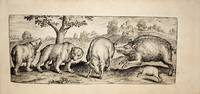
ABAA-75TH-VBF-16<p>Antwerp 1582.</p><p>Oblong 8vo 260 x 113 mm with 1 frontispiece and 47 plates. Restoration in the white margin of plates 46 and 47.</p><p>Quarter-vellum ex libris <em>Sir Thomas North Dik Lauder of Grange and Fountain Hall Brt. 1822</em> on the front cover flat spine. Case. <em>Binding from the beginning of the 19th century</em>.</p><p><strong>First edition second Issue.</strong></p><p>Cat. Schwerdt I 76; Sage <em>A catalogue of the coll. of books on angling</em>… p. 38.</p><p><strong>One of the most beautiful collections of engravings from the sixteenth century dedicated to hunting and fishing illustrated with a frontispiece inserted in a frame animated with scenes of hunting and fishing and 47 copper engravings </strong>212 x 82 mm <strong> illustrating the art of hunting falconry and fishing.</strong></p><p>Bibliographers underline the rarity of this collection: " <em>Very rare. To compose this magnificent series of figures J. Bol was undoubtedly inspired by Stradanus' prints whose first edition of 'Venationes' was published in 1578</em> <em>".</em> J. Thiebaud <em>Bibliographie des ouvrages français sur la chasse</em> 110. <strong>First edition second issue </strong>according to Schwerdt I 76 with the plates numbered. Second edition according to Thiébaud 110. <em>Philippe Galle</em> a draftsman and a chisel engraver became a member of the Guild of Antwerp in 1570 and a citizen of the same city in 1571. An eminent member of the Dutch School he mainly engraved works by Brueghel. <strong>his talent applied to hunt falconry and fishing excels in this series of engravings one of the most famous of the 16th century.<br /><br /></strong>FR<strong><br /><br /></strong></p><p>Anvers 1582.</p><p>In-8 oblong. 1 titre-frontispice et 47 planches. Restauration ds. la marge blanche des pl. 46 et 47.</p><p>Demi-vélin à coins ex-libris <em>Sir Thomas North Dik Lauder of Grange and Fountain Hall Brt. 1822</em> accolé sur le plat supérieur dos lisse. Étui<em>. Reliure du début du XIXe siècle</em>.</p><p>260 x 113 mm.</p><p><strong>Edition originale seconde émission.</strong></p><p>Cat. Schwerdt I 76; Sage <em>A catalogue of the coll. of books on angling</em>… p. 38.</p><p><strong>L'un des plus jolis recueils de gravures du XVIe siècle sur la chasse et la pêche orné d'un titre-frontispice inséré dans un encadrement animé de scènes de chasse et de pêche et de 47 estampes gravées sur cuivre </strong>212 x 82 mm<strong> illustrant l'art de la chasse de la fauconnerie et de la pêche.</strong></p><p>Les bibliographes soulignent la rareté de ce recueil :</p><p>" <em>Très rare</em>. <em>Pour composer cette magnifique série de figures J. Bol s'est sans doute inspiré des estampes de Stradan dont la première édition des 'Venationes' parut en 1578 ".</em></p><p>J. Thiebaud <em>Bibliographie des ouvrages français sur la chasse</em> 110.</p><p><strong>Première édition seconde émission</strong> selon Schwerdt I 76 avec les planches numérotées. Seconde édition selon Thiébaud 110.</p><p><em>Philippe Galle</em> dessinateur et graveur au burin devint membre de la Gilde d'Anvers en 1570 et citoyen de cette même ville en 1571. Membre éminent de l'École Hollandaise il a principalement gravé des œuvres de Brueghel.</p><p><strong>Son talent appliqué à la chasse à la fauconnerie et à la pêche excelle dans cette suite de gravures l'une des plus célèbres du XVIe siècle.</strong></p> hardcover
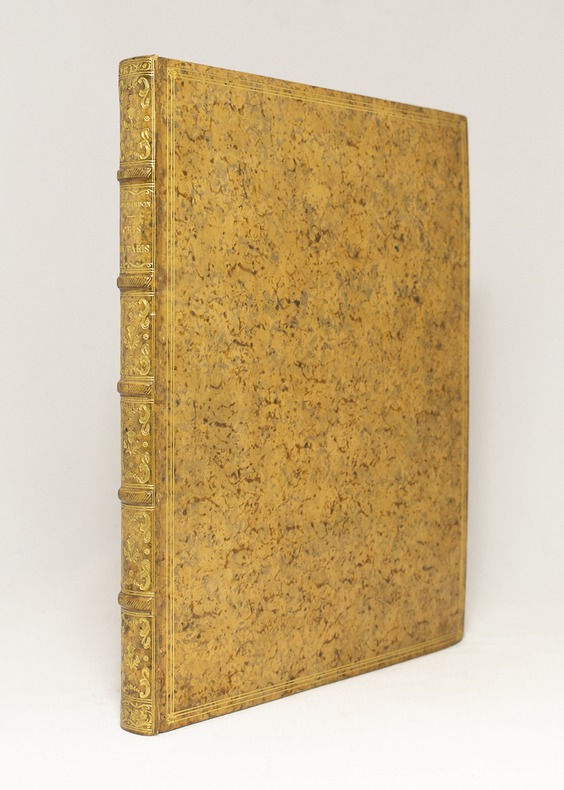
15999Paris, Chez Fessard, 1737 - 1746. In-folio de [60] feuillets montés sur onglets, plein veau moucheté, dos à nerfs orné de filets et fleurons dorés, triple filet doré en encadrement des plats, roulette dorée aux coupes, dentelle dorée intérieure. Jolie reliure pastiche signée Pagnant.Pretty binding imitation signed by Pagnant.
51-0523Paris: Alphonse Lemerre Editeur 1869. 10.5 x 14.5 inches. width x height 270 x 370 cm. Bound in contemporary red cloth. Original wrappers bound in. One of 350 copies this one certified by the printer of the text J.Claye and of the etchings A. Salmon. The editor who selected the poets and artists was Philippe Burty. This is considered the first livre de peintre with text by the major poets of the period and accompanying full page etchings by the major French artists of the mid Nineteenth century. There are 42 etchings. This one includes a second copy of the etching by 10 artists .VICAIRE.MANUEL DE L'AMATEUR de Livres du xixe siècle1801-1893579SONNETS et eaux-fortes. MDCCCLXIX. Alphonse Lemrerre éditeur Paris Impr. J. Claye in-fol. couv. impr.1 f. faux-titre; au v° justification du tirage ; 1 f. titre rouge et noir orné d'un dessin de E. Renard gravé sur boispar A. Prunaire; x f. « Aux poëtes et aux artistes qui ont collaboré à cette OEuvre à M. Philippe Burty qui en adirigé l'illustration. L’éditeur reconnaissant A. Lemerre » ; 42 ff. sonnets; 1 f. n. ch. table; et 1 f. n. ch. achevéd'imprimer.45 42 in fact eaux-fortes et 1 dessin hors texte savoir1° La Mer sonnet de Jean Aicard eau-forte de Léon Gaucherel.2° Le Masque sonnet de Joseph Autran eau-forte d'Emile Lévy.3° Promenade galante sonnet de Théodore de Banville eau-forte d'Edmond Morin.4° To Kalon sonnet d'Auguste Barbier eau-forte de Giacomotti.5° Le Sang des géants sonnet de Louis Bouilhet eau-forte de Célestin Nanteuil.6° Le Sphinx sonnet d'Henri Cazalis eau-forte de Queyroy.7° Le Lion sonnet de Léon Cladel eau-forte de Gustave Doré.8° Le Fils de Louis XI sonnet de François Coppée eau-forte de Charles Courtry.9° Supplice de Judas sonnet d'Antoni Deschamps eau-forte de Veyrassat.10° Dernier mirage; sonnet d'Émile Deschamps eau-forte de Ranvier.11° Révolte sonnet de Léon Dierx eau-forte de G. Howard.12° Les Incroyables sonnet d'Emmanuel des Essarts eau-forte de Jundt.13° Un Sénateur romain sonnet d'Anatole France eau-forte de Gérôme.14° Promenade hors des murs sonnet de Théophile Gautier eau-forte de Leys.15° Le Roman comique sonnet d'Albert Glatigny eau-forte de Félix Régamcy.16° La Salina sonnet d'Edouard Grenier eau-forte d'E. Edwards.17° Les Conquérants sonnet de José-Maria de Heredia eau-forte de Claudius Popelin.18° La Rookery sonnet d'Ernest d'Hervilly eau-forte de Seymour Haden.19° Le Pays inconnu sonnet d’Arsène Houssaye eau-forte de Tancrède Abraham.20° La Fontaine sonnet de Georges Lafenestre eau-forte de Lansyer.21° Au bord du puits sonnet de Victor de Laprade eau-forte de Francais.22° Réverie sonnet de Laurent-Pichat eau-forte de Jules Héreau.23° Le Combat homérique sonnet de Leconte de Lisle eau-forte de Léopold Flameng.24° Paysage normand sonnet d'André Lemoyne eau-forte de Corot.25° Batavia sonnet de Robert Luzarche eau-forte de Jongkindt Jongkind.26° Le Verger sonnet de Gabriel Marc eau-forte de Daubigny.27° La Pivoine sonnet de Judith Mendès eau-forte de Jacquemart.28° Théodora sonnet de Catulle Mendès eau-forte d'Ingomar Frankel.29° Sur une composition de F. Millet sonnet d'Albert Mérat eau-forte de F. Millet.30° L'Eclair sonnet de Paul Meurice dessin de Victor Hugo.31° Le Dernier amour de Charlemagne sonnet de Claudius Popelin eau-forte d'Ehrmann.32° Fleur exotique sonnet d'Armand Renaud eau-forte de Manet.33° Théroigne de Méricourt sonnet de Louis Xavier de Ricard eau-forte de Victor Giraud.34° Le Pont des Arts sonnet de Sainte-Beuve eau-forte de Maxime Lalanne.35° Une grande douleur sonnet de Joséphin Soulary eau-forte de Ribot.36° Silence et nuit des bois sonnet de Sully Prudhomme eau-forte d'Hédouin.37° Nénuphars sonnet d'Armand Silvestre eau-forte de Feyen-Perrin.38° Souvenir du Bas-Bréau sonnet d'André Theuriet eau-forte de Michelin.39° L'Éclipse sonnet d'Auguste Vacquerie eau-forte de Bracquemond.40° La Chute sonnet de Léon Valade eau-forte de Solon.41° Le Pitre sonnet de Paul Verlaine eau-forte de Rajon.42° Après la harangue sonnet de Jean Vireton eau-forte de Boilvin. Paris: Alphonse Lemerre Editeur, 1869. hardcover
170417661Paris: De l'Imprimerie de L.V. Thiboust 1704. Books""Description et explication des globes With the Arms of the Sun King Octavo. Contemporary speckled calf gilt. In 1678 the Cardinal d'Estrées commissioned Vincenzo Coronelli to make an enormous pair of globes as an unparalled gift for Louis XIV: the celestial globe depicts the constellations as they would have been on the evening of Louis XIV's birth. This monumental pair - a terrestrial and a celestial globe - was constructed in Paris between 1681 and 1683 eventually measuring four metres in diameter supported on bronze stands. To this day these globes remain unequalled in both beauty and technical prowess. The giant globes were originally intended for display at the equally opulent Palace of Versailles but they were transferred to the King's Marly """"retreat"""" in 1703. Completely hidden in a thick forested valley Marly took more than five years to complete. Louis XIV first visited in November 1683 but only stayed there for the first time in 1686. In the centre of the grounds was a large pavilion for the King surrounded by twelve smaller pavilions for guests like the planets circling the sun. Next to the Royal pavilion were four service pavilions and in 1688 baths for the guests were added and in 1703 two further pavilions on either side of the central pool were refurbished to house Coronelli's magnificent globes. There they stayed until they were moved to the Royal Library in 1722 where a room of globes was installed in 1731. Afterwards they were displayed in the Grand Palais but are now on permanent display in the Bibliothèque nationale de France. Once installed at Marly two permanent curators were appointed to care for the globes: Robert Crosnier for the celestial; and François Lelarge for the terrestrial. Lelarge transcribed the inscriptions and described the figures which ornamented the terrestrial globe. Philippe de la Hire 1640-1719 the Astronomer of Paris was commanded by the King to write the current treatise on the use of the globes. A large paper example bound in red morocco also emblazoned with the Royal arms and described as being printed for the Sun King's """"own use"""" was offered by Sotheby's in 1859 as part of the 'Choicer portion of the magnificent library formed by M. Guglielmo Libri'. It is likely that Louis had a number of examples of the book bound for presentation including this one. La Hire was the son of Laurent de la Hire a renowned painter and engraver. An early interest in geometry led to surveying work particularly with Jean Picard on his map of France and diverting the Eure to the grounds of Versailles. His earliest major work was 'Nouvelle method de Geometrie pour les sections de superficie coniques et cylindriques qui ont pour base des cercles ou des paraboles des ellipses ou des hyperboles' 1673 but he published numerous treatises on various scientific subjects and became a member of the Academie Royale des Sciences in 1678. Rare: only one other example offered in available records the Macclesfield copy Sotheby's 2005 Provenance: 1. With the supra-libros of the Sun King Louis XIV of France 1638-1715 on each cover; 2. Armorial bookplate of a Viscomte on front paste-down De l'Imprimerie de L.V. Thiboust, unknown
1500046291Paris: Philippe Pigouchet 1500. Hardcover Full Leather. Very Good Condition. Early ca. early 17th c. full red calf elaborately gilt modest wear at hinges a few surface marks and scuffs but a lovely binding. 4 old bookplates on endpapers Syston Park Howard Pease John William Pease old pencil note on endpaper. 1 leaf with long vertical cut in the outer margin 1 leaf with mended tear. Last leaf cut in lower part and filled out with paper. Some foxing spotting and discoloration mostly to the few few and last few leaves generally quite clean. Trimmed a little close in the top margin touching the border. Added section of final leaf says “printed in Paris by Philippe Pigouchet. Quaritch notesâ€. In a custom clamshell box. 116 leaves incomplete lacking title anatomical man and 6 calendar leaves signed Aa1-8Bb1-10a1-7lacks one leaf g1-4b1-8c1-8d1-8e1-8f1-8h1-8i1-8k1-4A1-8B1-8C1-3lacks C4-8 D1-8. A fine and largely complete example of a printed book of hours on vellum with 17 nearly full-page cuts and 27 smaller cuts from the life of Christ and page borders featuring figures and mythical creatures; each page with a decorative border letters with color added throughout in blue red and gold. Pigouchet produced around 150 printed books of hours creating techniques along the way to bring them to life in the manner of the manuscript versions so revered by the aristocracy. Size: Octavo 8vo. Quantity Available: 1. Shipped Weight: Under 1 kilo. Category: Religion & Theology; Incunabula. Inventory No: 046291. Philippe Pigouchet hardcover
16766181Paris; Paris: chez l'autheur et Thomas Moette; np 1676. First edition. <p>First edition extremely rare of these two works of which the Nouvelle Méthode is the first substantial treatment of projective geometry explicating the Brouillon Projet of Girard Desargues 1591-1661. "The BrouillonProjet 1639 was published in an edition of only 50 copies and won very little support . Projective geometry secured a place in mathematics only with the publication of a book by Philippe de Hire 1673" Stillwell Mathematics and its History.</p>. PROJECTIVE GEOMETRY SECURES A PLACE IN MATHEMATICS. <p>First edition extremely rare of these two works of which the Nouvelle Méthode is the first substantial treatment of projective geometry explicating the Brouillon Projet of Girard Desargues 1591-1661. "The BrouillonProjet 1639 was published in an edition of only 50 copies and won very little support. In fact its reception was generally hostile and Desargues was engaged in a pamphleteering battle for years with his detractors. At first his only supporters were Pascal most of whose work on projective geometry is also lost and the engraver Abraham Bosse. Desargues became discouraged by the attacks on his work and left the dissemination of his ideas up to Bosse who was not really mathematically equipped for the task. Projective geometry secured a place in mathematics only with the publication of a book by Philippe de Hire 1673. It seems quite likely that La Hire's book influenced Newton see below" Stillwell p. 153. Michel Chasles writing in 1837 noted that La Hire's work is "extrêmement rare" Chasles p. 128. "The treatise of 1673 is where De La Hire shows himself to be truly original and innovative and which leads us to regard him as one of the founders of modern geometry" translated from ibid. "La Hire certainly read the Rough Draft on Conics Brouillon Projet thoroughly; for a long time the only known copy of the work was one made by La Hire himself in 1679. Possibly he made his own handwritten copy of the Rough Draft on Conics from a printed copy belonging to his father the painter Laurent de la Hire 1606-1656 a pupil of Desargues and a friend and colleague of Abraham Bosse at the Académie. Philippe de la Hire had by then written his first book on geometry his Nouvelle Méthode en Géométrie . It too has become extremely rare and he was later to write that his new method had been found difficult because it involved planes and solids" Field & Gray p. 37. La Hire's point of view in his Nouvelle Methode was entirely projective. He regarded all conics as projections of circles and used the harmonic division of four points which he showed was projectively invariant to obtain theorems about poles and polars. The work is in two parts. In the first pp. 1-72 La Hire treats conics as sections of the cone which are then projected onto the plane of the base of the cone; this approach was later expanded in his Sectiones conicae 1685. In the second Les Planiconiques pp. 73-94 he treats conics by entirely planar methods; Chasles notes that this part which Chasles regards as the more original "offered the first sufficiently general method for transforming figures of one kind into other figures of the same kind". The Planiconiques was published one year after the Nouvelle Méthode and was not added to all copies the Lyon and Marburg copies of the Nouvelle Méthode end at p. 72. The second work in the present volume De Cycloid Lemma is even rarer than the Nouvelle Méthode. It presents a geometrical construction of the tangent at any point of the cycloid - the method was discovered by Descartes and Fermat but they did not publish it. OCLC list 12 copies of the Nouvelle Méthode worldwide Columbia only in US and 6 copies of De Cycloide Lemma of which three are bound with the Nouvelle Méthode including Columbia and three are bound separately BL Erfurt & Lyon the first two of which hold the Nouvelle Méthode. It is unclear how many of the copies of the cycloid pamphlet are complete as several lack the plate e.g. the BNF copy. RBH lists only the Macclesfield copy of the Nouvelle Méthode since 1961 bound with De Cycloide Lemma but lacking its plate and no other copy of the cycloid pamphlet.</p> <br /> <p>"When Desargues circulated fifty copies of his Brouillon Project d'une Atteinte aux Événemens des Rencontres du Cone avec un Plan Rough Draft of an Essay on the results of taking plane sections of a cone in 1639 he was contributing to a lively contemporary study of geometry. Descartes's novel algebraic methods had been published two years before and in 1639 Mydorge published a more classical treatment of the conic sections. The classical authors themselves were increasingly well studied. Desargues had available Commandino's Latin edition of Euclid's Elements published in 1572 as well as his Latin edition of the first four books of Apollonius' Conics published in 1566 with extensive commentaries by Eutocius Pappus and Commandino himself. The last four books of the Conics were unknown in Desargues' time" Field & Gray p. 1.</p> <br /> <p>"The Brouillon Projet on conics of which he published fifty copies in 1639 is a daring projective presentation of the theory of conic sections; although considered at first in three-dimensional space as plane sections of a cone of revolution these curves are in fact studied as plane perspective figures by means of involution a transformation that holds a place of distinction in the series of demonstrations. But the use of an original vocabulary and the refusal to resort to Cartesian symbolism make the reading of this essay rather difficult and partially explain its meager success.</p> <br /> <p>"Although he praised the unitary conception that inspired Desargues Descartes doubted that the use of geometry alone could yield results as good as those that a recourse to algebra would provide. As for Fermat he reserved his judgment and the only geometer who really comprehended the originality and breadth of Desargues's views was the young Blaise Pascal who in 1640 published the brief Essay pour les Coniques inspired directly by the Brouillon Projet. But since the great Traité des Coniques that Pascal later wrote has been lost Desargues's example survived only in certain of the youthful works of Philippe de La Hire and perhaps in a few essays of the young Newton" DSB.</p> <br /> <p>"Philippe de la Hire 1640-1718 published three treatises on conics in 1673 in 1679 and in 1685. From the point of view of modern geometry the treatise of 1673 is by far the most original. Unfortunately because of its rarity it did not have a very wide circulation and today too many historians of science pass over it in silence concentrating instead on the Latin treatise of 1685 which is merely a development of the first part of the treatise of 1673. Although La Hire in a note attached to his copy of the Brouillon Projet of Desargues claims not to have known the treatise of Desargues until after 1673 and not to have been inspired by it it seems to us on the contrary that this inspiration is manifest. A first reason is that La Hire's father the king's painter was a diligent student of Desargues's oral lectures so it would be very surprising if he were unaware of the existence of this treatise and were unable to make its content known to his son. The second and most important reason is drawn from the study of the text. It seems that La Hire knowing at least the spirit of Desargues's treatise has tried to derive from it a work using the same principles but avoiding the faults that were the source of the violent criticisms by Desargues's adversaries.</p> <br /> <p>"Indeed La Hire seems to want to make a synthesis of the theories of Desargues while giving them a classical gloss . His method . amounts to deducing the projective properties of an arbitrary conic in space situated on a cone with a horizontal circular base from the properties of the base circle via the intermediary of the projection of the conic section onto the plane of the base. He uses in fact the properties of cylindrical projection for the passage from the curve in space to its projection and of homology for the passage from the conic to the projection of the base circle.</p> <br /> <p>"The method for studying the properties of conic sections 'in the cone' led quite logically to another procedure for studying them which consists in deducing directly - in the plane - every conic from a circle by a homology. This is the object of the second part of La Hire's small treatise titled Les Planiconiques. This very ingenious method is applied with the aid of several lemmas on the elementary properties of homology. So here apparently we have a treatise which although inspired by the ideas of Desargues is not afraid to develop them further" translated from Taton pp. 204-205.</p> <br /> <p>Chasles pp. 128-9 describes the method of the Planiconiques as follows. "Suppose that we have in a plane two straight lines parallel to each other which the author calls the formatrice and directrice and a point called the pole.Through each point M of a given curve in the plane one draws in an arbitrary direction a transversal; it meets the directrix at a point which one joins to the pole by a line;and the former at a second point through which we draw a parallel to this line.This parallel meets the straight line which goes from the point M to the pole in a point M' which is said to be formed by the point M.Each point of the proposed curve will thus form a corresponding point of a second curve. The points of a straight line form points belonging to a second straight line and these two straight lines will intersect on the formatrice.Finally the points of a circle will form the points of a conic section. Such is the method by which De La Hire studied in the plane without the need for any solid nor any other plane than that of the figure the sections of a cone.This is what he called reducing the cone and its sections to a plane."</p> <br /> <p>"Whiteside has pointed out Mathematical Papers of Isaac Newton VI 271 n.70 that the Nouvelle Méthode received a favourable review probably from CoIlins in 1676 and that Newton may have read it for Hooke wrote to him mentioning it in 1679. There are certainly similarities between ingenious projective transformations described by both men . In Book I of his Principia Newton showed how to solve all of the six different problems of the form: find the conic through k points and tangent to m lines k m = 5. In the course of accomplishing this feat he introduced a projective transformation capable as he remarked of transforming any conic to a circle . It is strikingly similar to the one given by La Hire in his Planiconiques which was printed in the same volume as his Nouvelle Méthode" Field & Gray p. 37. The Nouvelle Méthode also influenced Leibniz. "The ideas of Desargues and Pascal led Leibniz to a 'dynamical' vision of geometry. In the years 1672-76 Leibniz was in Paris where he greatly increased his mathematical knowledge. In 1673 he was informed on Desargues' perspective through La Hire's Nouvelle Méthodeen Géométrie ." Del Centini & Fiocca.</p> <br /> <p>Determining the properties of the cycloid the curve traced out by a point on the circumference of a circle as it rolls along a straight line served as a test bed for the techniques of seventeenth century mathematics. The earliest significant work on the cycloid is due to Gilles Personne de Roberval 1602-75 who obtained many of its properties before 1636 although he kept his results secret and they remained unpublished until 1693. Roberval in particular gave a construction of the tangent at a point on the cycloid using his method of 'composition of movements' a precursor of the differential calculus. This problem was also solved by Pierre de Fermat and René Descartes although they also did not publish their work. It was instead first published by La Hire in the first part of his De Cycloide Lemma pp. 1-4. The remainder of this little pamphlet is devoted to a problem relating to conics which is perhaps why it is often although not always found bound together with the Nouvelle Méthode.</p> <br /> <p>Chasles AperVu historique des Méthodes en Géométrie 1837. Del Centini & Fiocca 'Boscovich's geometrical principle of continuity and the 'msyteies of infinity' Historia Mathematica 45 2018 pp. 131-175. Field & Gray The Geometrical Work of Girard Desargues 1987. Stillwell Mathematics and its History 3rd edition 2010. Taton Le Prehistoire de la 'Geometrie moderne' Revue d'Histoire des Sciences et de leurs Applications 2 1949 pp. 197-224.</p> <br/> <br/> 4to 201 x 162 mm. Nouvelle Méthode: pp. viii 94 with 25 folding engraved plates 10 bound before title page 15 at end of volume the last 2 referring to Les Planiconiques woodcut vignette on title woodcut initials head- and tail-pieces. De Cycloide Lemma: pp. 6 with 13 figures on one plate cut up with each figure tipped in at the appropriate place in the text. chez l'autheur et Thomas Moette; [np] unknown
168692213Christophe Ballard | Paris 1686 | 19.3 x 24.9 cm | Relié
BIBLIO-LIVE-4-14Excudebat Antverpie Everardus Hoeswinckel anno 1583.<p>Very elongated oblong 4to 275 x 120 mm. Few scratches on the covers. <i>Contemporary soft vellum</i>. </p><p><b>First state of the 20 engravings.</b></p><p>The set comprises "<b>a frontispiece and 20 copper-engraved plates 210 x 85 mm </b><i><b>unnumbered</b></i><b>".</b></p><p><b>J. Thiebaud </b><i>Bibliographie des ouvrages français sur la chasse</i><b> says it is "very rare". </b></p><p><b>The engravings represent</b> <i>horses deers cows rabbits bears boars dog butterflies ostriches birds ducks swans peacocks …</i></p><p><b>They are the work of Queen Elizabeth of England's painter Marcus Gheeraerts the Elder</b> born in Bruges towards 1530.</p><p>Painter and engraver he studied with his father Eghbert Gerards in the Guilde in Bruges in 1558 then with Marten de Vos. In 1571 he was a painter for the queen Elizabeth of England.</p><p><b>A work by a great artist in contemporary condition.</b></p><p><b><br /></b></p><p><u>FR</u></p><p>Excudebat Antverpie Everardus Hoeswinckel anno 1583.</p><p>In-4 oblong très allongé. Plats épidermés. <i>Vélin souple de l'époque</i>. </p><p>275 x 120 mm.</p><p><b>Premier tirage des 20 estampes.</b></p><p>La suite comprend " <b>un frontispice et 20 planches gravées sur cuivres 210 x 85 mm </b><i><b>non numérotées</b></i><b> ".</b></p><p><b>J. Thiebaud</b><b> </b><i>Bibliographie des ouvrages français sur la chasse</i><b> la qualifie de " très rare ".</b></p><b>Les gravures représentent</b><i>des chevaux des cerfs des vaches lapins ours sangliers chiens papillons autruches oiseaux canards cygnes paons</i>…<p><b>Elles sont l'œuvre du peintre de la reine Elisabeth d'Angleterre Marcus Gerards le Vieux</b> né à Bruges vers 1530.</p><p>Peintre et graveur il fut élève de son père Egbert Gérards dans la Gilde à Bruges en 1558 puis de Martin de Vos. En 1571 il était peintre de la reine Elisabeth d'Angleterre.</p><p><b>L'œuvre d'un grand artiste en condition de l'époque.</b></p> hardcover
165611982Lyon: for Ph. Borde Laur. Arnaud and Cl. II Rigaud 1656. Contemporary card boards small hole in the front panel flat spine. <p> A REMARKABLE STOCK CATALOG OF SOME TEN THOUSAND SIXTEENTH- AND SEVENTEENTH-CENTURY TITLES REPRESENTING THE COMBINED INVENTORIES OF EIGHT DOMINANT LYONESE PUBLISHERS AND BOOKSELLERS ACTIVE FROM 1555 TO 1656.<br /> Beginning in the 1620s the book trade in the France’s second city experienced dramatic consolidation through inheritance and liquidation. Philippe Borde Laurent Arnaud and Claude II Rigaud stood the principal beneficiaries. Between 1650 and 1655 they partnered to purchase the stocks of the Lyonese Giunta of Horace Cardon of Horace Boissat of the Rouillé family and of Claude Prost.<br /> The partners had to sell and this catalog clearly prepared in haste is the result. It swarms with minor errors like reversed and upside-down sorts repeated pagination errors in dates and orthography and chase marks likely arising from the rush to have it ready in time for the Lyon trade fair.<br /> The material is grouped into thirteen categories. The nine subject divisions list only Latin texts in the fields of theology Scripture councils scholastics morals controversies asceticism spirituality preaching manuals law medicine philosophy history politics and civics sciences astronomy mathematics architecture atlases cabbala the humanities grammar rhetoric ancient classics and liturgy. Four sections gather material by language — Greek Hebrew and Arabic together Italian Spanish and French — regardless of subject. In each class entries are arranged alphabetically by author and each work is identified by its author title format printing place date and number of volumes if a set. Imprints span Naples to London and Madrid to Hamburg.<br /> The present example has been marked up in manuscript. Two dozen entries have been canceled in whole or in part across eight different categories motivated in every case but two by religion. Machiavelli's dangerous political ideas and G.B. Marino’s personal immorality earned censure. Hundreds of entries have been ticked in the left margins sometimes four or five to a page. I have located one example in the U.S. Grolier Club. In good condition one quire browned narrow pale stain to the second half of the volume.<br /> ¶Pollard & Ehrman Distribution of Books by Catalogue 117 120 301 355 Arnaud 361 Borde & 511 Rigaud; Mirto Stampatori editori librai nella seconda metà del Seicento I: 70; Mellot & Queval Répertoire d’imprimeurs/libraires vers 1500-vers 1810 2004 nos. 107 Arnaud 634 Borde & 474 Rigaud; Répertoire bibliographique des livres imprimés en France au XVIIe siecle: Lyon ed. Merland I: 142-143-84 Arnaud II: 149-66 Borde & VI: 202-4 Rigaud.</p> for Ph. Borde, Laur. Arnaud and Cl. II Rigaud unknown
51-4752Paris: Imprimerie royale 1819. Large folio. New full calf by the artisan bookbinder Sasha Mosalov. Part of original spine and front cover title preserved Complete with 80 plates.Colas 1089; Brunet II 1337; not in OCLC.Nicolas Nicolaides: Baron Louis Nicolas Philippe Auguste de Forbin later count de Forbin la Roque-d'Anthéron 1777 – ΠαÏίσι 1841 was a French painter author and antiquarian. He was also a pupil of painter Jacques-Louis David. During the Bourbon restauration Forbin served as general director of the Louvre Museum and other museums of France.Inspired by the travels of François-René de Chateaubriand Forbin sailed out from Toulon on 22 August 1817 to tour the eastern Mediterranean. Like Chateaubriand Forbin travelled on his own initiative without an order from the French government; however since the aim of his journey was to discover Greek and Roman antiquities and to draw landscapes of the places he would visit he was able to travel on the ships of the French fleet of the Levant Flotte du Levant.In his venture Forbin was accompanied by painters Pierre Prevost and Léon Matthieu Cochereau also a pupil of David and a nephew of Prévost as well as architect Jean-Nicolas Huyot. Abbé de Forbin-Janson later bishop of Nancy was also a member of the company for the first part of the journey while Huyot had to retire when he fractured his leg on Milos island. In addition twenty-four year old Cochereau died of dysentery off the coast of Cythera and was replaced by Linant de Bellefonds who at the time was a mate on "Cleopatra" the mission's ship. De Bellefonds resigned from his position on the ship and participated in the expedition as a painter and chartographer. When the expedition ended in December of 1817 de Bellefonds decided to stay on in Egypt and explored its territory as member of several missions. From 1831 to 1869 he served the kingdom of Egypt as chief engineer of several public works including the Suez Canal.The expedition sailed to Acre Galilee and thenceforth travelled by land. While in Palestine the travellers visited the Dead Sea and Jordan river reached Cairo and sailed the Nile down to Upper Egypt. The main places they visited includde Milos island Athens Constantinople Ephesus Acre Jerusalem Gaza Damietta Cairo Luxor Thebes Rosetta and Alexandria. When the expedition returned to France in April 1818 Forbin had spent approximately 28.000 francs on the purchase and transportation of antiquities some of which ended up in the Louvre collections at the time Royal Museum of France. Prevost drew panoramic views of Jerusalem and Athens but succumbed to pneumonia in 1823 without completing his panorama of Constantinople.The descriptions of Forbin show him to be a mature observer in possession of deep humanistic culture. Forbin also travelled to Sicily in 1820 and published his travel account as he had done with his expedition of 1817.Moyen-Orient - FORBIN Claude Comte de. Voyage dans le Levant. Paris Imprimerie Royale 1819.Atlas seul in-folio 74 x 55 cm ; demi-maroquin rouge à coins dos lisse orné. 3 ff. 110 pp. 1 f. pp. 111-132 80 planches numérotées 1-78 dont 70 lithographies par Baltard Bourgeois Fragonard Lecomte Vernet… d’après Forbin Vernet Isabey et Fragonard 8 aquatintes par Debucourt et 2 plans in fine.L'atlas in-folio qui accompagne l'édition originale du Voyage dans le Levant en 1817 et 1818 de Forbin ne fut tiré qu'à 325 exemplaires.Peintre et archéologue élève de David le Comte de Forbin fut nommé par Louis XVIII directeur du Musée du Louvre. Il entreprit ce voyage en Grèce en Asie Mineure en Palestine et en Égypte en 1817 et 1818 sur une frégate de l'escadre du Levant. Sa mission était d'acheter des antiquités pour le Louvre.De la bibliothèque Paul Lagrave avec son ex-libris au contreplat et de la bibliothèque du Comte François Chandon de Briailles 1892-1953 descendant des fondateurs de la fameuse maison de Champagne avec son ex-libris sur la première garde. Paris: Imprimerie royale, 1819. unknown