82 résultats
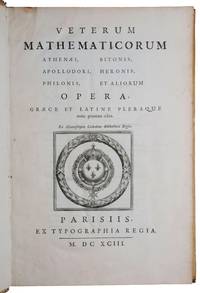
16936467Paris: Typographia Regia 1693. First edition. <p>First edition a very fine copy of this collection of early Greek writings on technology especially military technology and hydrostatics. It contains several treatises on the mechanics and siege operations or poliorcetica of the Hellenistic period the period between Alexander and Augustus including the construction and management of projectile engines.</p>. DIBNER 84: ANCIENT GREEK TECHNOLOGY. <p>First edition of this collection of early Greek writings on technology especially military technology and hydrostatics. It contains several treatises on the mechanics and siege operations or poliorcetica used in the Hellenistic period the period between Alexander and Augustus including the construction and management of their projectile engines. The first six works in the volume comprise the writings on the subject of military engines that were compiled by Athenaeus Apollodorus Biton Heron and Philon. These works include the first edition in both Greek and Latin of Biton's Construction of War Machines and Artillery of extant part of the Mechanike Syntaxis attributed to Philon of Byzantium and of the Poliorcetica of Apollodorus of Damascus. These are followed by the Greek and Latin texts of Hero of Alexandria's works on hydrostatics the Pneumatica and Automata which include what some regard as the first description of a steam-engine; this is the first printing of the Greek text of these works. Thévenot the King's librarian to Louis XIV prepared the present work from a rather defective secondary manuscript Codex Parisinus 2435. After Thévenot's death in 1692 it was revised by the mathematician La Hire with insightful annotations by Boivin an official in the King's library. It is one of three early publications of the French Academy of Sciences grouped together as Dibner 84. "Printed at the royal press in small editions they were intended as gifts for the King and Academy. In size binding and beauty of the plates they are among the most sumptuous books in science" Dibner. This is a rare book on the market only eight copies having appeared at auction in the last 40 years. The Evelyn copy was sold at Christie's in 1977.</p> <br /> <p>To gain access to the walls of a site under siege a siege tower or ram was brought into position and used to launch an attack onto the walkway aided by missile fire from the higher levels of the tower. Simultaneous attacks with scaling ladders took place. A siege tower is a specialized siege engine constructed to protect assailants and the ladders used when approaching the defensive walls of a fortification. The tower was usually rectangular with four wheels and a height roughly equal to that of the wall; it was sometimes higher to allow archers to stand on the top and fire into the fortification. The tower was made chiefly of wood but sometimes there were metal components as well. They were unwieldy to manoeuvre and slow to assemble and consequently were usually constructed at the siege site. Sometimes siege towers themselves incorporated other devices including artillery rams and dropbridges. Two main types of artillery equipment were used in this period: bolt-throwers ballistae: used for picking off prominent individuals and stone-throwers scorpiones onagri. Stone throwers could cause structural damage but were generally confined to firing at towers gates or siege machinery. Artillery might use incendiary ammunition when firing at gates or equipment.</p> <br /> <p>In common with much Byzantine literature poliorcetica draw heavily on earlier classical material. Since these were composed before the development of heavy artillery the poliorcetica are not so much concerned with large machines but rather with describing techniques for bringing men close to fortifications and then ways of undermining them. They also suggest various psychological tricks which might be used to outwit the enemy. Such ancient works on military machines were a source of fascination to the Italians of the late 15th and 16th centuries not only because of their historic interest but also as a source for modern inventions to be used in contemporary warfare and several of these works were first published in Renaissance Italy.</p> <br /> <p>The present volume begins with the De Machinis of Athenaeus a Cilician ex-statesman living in Rome in the 20s B.C. and a contemporary of the architect-engineer Vitruvius who like Vitruvius worked under the patronage of the Emperor Augustus Vitruvius devoted Book 10 of his De Architectura to machines. In addition to describing individual siege engines and theorizing on tactics Athenaeus draws on actual instances from history of the use of these machines in order to make various points and elucidate his text.</p> <br /> <p>The author of the next text is Apollodorus of Damascus who was a Roman architect and engineer of the late 1st to early 2nd century A.D. As Emperor Trajan's architect and military engineer he was responsible for Trajan's forum and possibly Trajan's column and produced designs for new siege machines. In his treatise Poliorcetica he describes a system of banks and ditches and also sheds that would be needed to protect the legionaries during undermining work or to carry battering rams against a tower gate or wall. Next he describes the construction of a siege tower followed by a system of interlocking ladders. He concludes his treatise with a description of a battlemented raft for river assaults. Although some of the elaborations are considered somewhat unrealistic − for example the addition of a torsion-powered truncheon to the end of a battering ram − and some of these are believed to have been added by a later editor the core of Apollodorus' text is believed to be authentic and to accurately describe highly effective machinery. Apollodorus dedicated Poliorcetica to the Emperor Hadrian perhaps an attempt to gain forgiveness for an earlier insult. On that occasion Trajan was discussing with Apollodorus the buildings which the great architect had built in Rome. Hadrian's assessment only demonstrated his ignorance which was bluntly pointed out by Apollodorus. Hadrian never forgot the insult and when he came to power banished Apollodorus accused him of several crimes and had him put to death.</p> <br /> <p>The third text in the volume is the Mechanike Syntaxis attributed to Philon of Byzantium who is believed to have been born about 280 B.C. in Byzantium and to have died around 220 B.C. Only the fourth and fifth books of this work have come down to us. Although there are few references to him in literature he is mentioned by Vitruvius. Amongst other weapons of siegecraft he describes the catapult recently invented by Ctesibius fl. 285-222 BC a Greek or Egyptian inventor and mathematician and probably the first head of the Museum at Alexandria. From this Philon's treatise can be dated fairly accurately to around 250 B.C. He describes journeys he made to Rhodes and to Alexandria to study catapults and it seems he may have earned his living advising military rulers.</p> <br /> <p>"The fourth book is headed κ τν Φιλνο βελοποιικν and the general subject is the manufacture of missiles. He mentions in it an invention of his own which he denominates ξυβλη p. 56. In the fifth book we are shocked to find that while recommending a besieging army to devastate the open country on the approach of an enemy he advises them to poison the springs and the grain which they cannot dispose of p. 103; and what renders this the worse he mentions his having treated of poisons in his book on the preparations that should be made for a war. What principally attracted attention to this work in modern times is his notice of the invention of Ctesibius p. 77. &c. The instrument described by him named εÏτονο acted on the property of air when condensed and is evidently in principle the same with the modern air-gun" A Dictionary of Greek and Roman Biography and Mythology<br /> William Smith ed. </p> <br /> <p>Philon's work is followed by the brief treatise of Biton of Pergamon 3rd or 2nd century B.C. about whom little is known; it is the only extant work to give a full description of advanced tension catapults. Biton's handbook describes four tension bow catapults a helepolis city-taker = siege tower and a sambuca mechanical scaling ladder. The bow catapults consisted of two stone throwers small and large and two bolt shooters a medium "belly bow" and mountain "belly bow". The latter took their name from the concave rest at their rear end against which the archer braced his stomach while drawing the bow. The work is dedicated to a King Attalus and was therefore composed between about 230 BC when Attalus I assumed the title of King and 133 BC death of Attalus III. As Biton mentions older types of catapults but not the torsion catapult that was otherwise well attested from the end of the 4th cent. BC the work probably belongs to the early years of the reign of Attalus I King of Pergamum 241-197 B.C. We do not know if Attalus employed the devices Biton described but they were definitely used in numerous later sieges and naval battles.</p> <br /> <p>The final two texts of siegecraft in the volume the Belopoeica and the Cheiroballistra are both attributed to Heron of Alexandria ca. 10-75 AD. Heron possibly taught at the Museum at Alexandria since many of his writings have the appearance of student lecture notes. The Belopoeica "On arrow making" describes the hand-held "belly bow" also discussed by Biton. The Cheiroballistra describes a small hand-held catapult. Some of Heron's designs derived from the works of Ctesibius none of whose works survive although they are mentioned by Vitruvius Athenaeus and Philo of Byzantium as well as Heron. In 1616 Bernardino Baldi 1553-1617 published a Latin translation of Heron's Belopoeica along with Heron's Greek text and a biography of Heron also written in Latin. Some of Baldi's commentary is appended to the present work.</p> <br /> <p>The volume concludes with the Pneumatica and Automata of Hero or Heron of Alexandria fl. 62 CE. "The Pneumatica in two books describes a menagerie of mechanical devices or "toys": singing birds puppets coin-operated machines a fire engine a water organ and his most famous invention the aeolipile the first steam-powered engine. This last device consists of a sphere mounted on a boiler by an axial shaft with two canted nozzles that produce a rotary motion as steam escapes" Britannica. "The introduction treats the occurrence of a vacuum in nature and the pressure of air and water . Some of the theory is right some is wrong for instance the horror vacui of nature but it was the best theoretical explanation to be had at the time . The first chapters most of them taken from Philo's Pneumatics describe experiments to show that air is a body and that it will keep water out of a vessel unless it can find an outlet and will keep water in if it cannot enter. Hero goes on to siphons . With very few exceptions it is evident that the chapters were written by Hero himself and without exception they are very clear: each instrument can be reconstructed from the description and the figure. While there is no order at all in the general arrangement of the chapters we find here and there a short series of related chapters in which it is clear that Hero is searching for a better solution to a mechanical problem. This shows unmistakably that he was an inventor; it is therefore probable that he himself invented the dioptra the screw-cutter and the odometer as well as several pneumatic apparatuses" DSB. The first appearance in print of Pneumatica was a Latin paraphrase in Giorgio Valla's De expetendis et fugiendis rebus 1501; the complete text was first published in Latin by Federico Commandino 1509-75 in 1575. The excellence of Commandino's translation persuaded the editors that it was unnecessary to include a further Latin translation in the present work and therefore only the Greek text of Pneumatica appears. Some of the commentary on Pneumatica from the 1589 Italian translation by Giovanni Battista Aleotti 1546-1636 is appended to the present work.</p> <br /> <p>"The Automata or Automatic Theater describes two sorts of puppet shows one moving and the other stationary; both of them perform without being touched by human hands. The former moves before the audience by itself and shows a temple in which a fire is lit on an altar and the god Dionysus pours out a libation while bacchantes dance about him to the sound of trumpets and drums. After the performance the theater withdraws. The stationary theater opens and shuts its doors on the performance of the myth of Nauplius. The shipwrights work; the ships are launched and cross a sea in which dolphins leap; Nauplius lights the false beacon to lead them astray; the ship is wrecked; and Athena destroys the defiant Ajax with thunder and lightning. The driving power in both cases was a heavy lead weight resting on a heap of millet grains which escaped through a hole. The weight was attached by a rope to an axle and the turning of this axle brought about all the movements by means of strings and drums. Strings and drums constituted practically all the machinery; no springs or cogwheels were used. It represents a marvel of ingenuity with very scant mechanical means" DSB. The Automata was first published in Italian by Baldi in 1589.</p> <br /> <p>"The design of this collection was formed by Thévenot 1620-92 deputy librarian of the Royal library in the reign of Louis XIV and after his death it was carried out by De la Hire 1640-1718. Thévenot's plan was to publish an accurate transcript of the MSS. of the several authors. The inevitable obscurity arising from the numerous corruptions which had crept into the manuscripts was to be remedied by an appendix of notes and a Latin translation. But for the Pneumatics of Hero it seemed sufficient to adopt the already well-known translation of Commandine; and in consequence of the eight MSS. of this treatise existing in the Royal Library that one was chosen which most nearly agreed with the Latin version" The Pneumatics of Hero of Alexandria translated and edited by Bennet Woodcroft 1851 preface.</p> <br /> <p>Brunet V 1163; Dibner Heralds 84; Norman 2148; Schweiger I 358. For a detailed account of the works contained in the present volume see Marsden Greek and Roman Artillery: Historical Development 1969.</p> <br/> <br/> Folio 432 x 288 mm pp. xvi including half-title 279 290-365 9 index & colophon occasional mostly light browning. Text in double columns Greek or parallel Greek and Latin many engraved diagrams and illustrations in text engraved head- and tail-pieces. Contemporary blind-stamped vellum. A very fine copy. Typographia Regia unknown
16934930Paris: Typographia Regia 1693. First edition. <p>First edition the Stanhope copy of this collection of early Greek writings on technology especially military technology and hydrostatics. It contains several treatises on the mechanics and siege operations or poliorcetica of the Hellenistic period the period between Alexander and Augustus including the construction and management of projectile engines.</p>. DIBNER 84: ANCIENT GREEK TECHNOLOGY. <p>First edition the Stanhope copy of this collection of early Greek writings on technology especially military technology and hydrostatics. It contains several treatises on the mechanics and siege operations or poliorcetica used in the Hellenistic period the period between Alexander and Augustus including the construction and management of their projectile engines. The first six works in the volume comprise the writings on the subject of military engines that were compiled by Athenaeus Apollodorus Biton Heron and Philon. These works include the first edition in both Greek and Latin of Biton's Construction of War Machines and Artillery of extant part of the Mechanike Syntaxis attributed to Philon of Byzantium and of the Poliorcetica of Apollodorus of Damascus. These are followed by the Greek and Latin texts of Hero of Alexandria's works on hydrostatics the Pneumatica and Automata which include what some regard as the first description of a steam-engine; this is the first printing of the Greek text of these works. Thévenot the King's librarian to Louis XIV prepared the present work from a rather defective secondary manuscript Codex Parisinus 2435. After Thévenot's death in 1692 it was revised by the mathematician La Hire with insightful annotations by Boivin an official in the King's library. It is one of three early publications of the French Academy of Sciences grouped together as Dibner 84. "Printed at the royal press in small editions they were intended as gifts for the King and Academy. In size binding and beauty of the plates they are among the most sumptuous books in science" Dibner. This is a rare book on the market only eight copies having appeared at auction in the last 40 years. The Evelyn copy was sold at Christie's in 1977.</p> <br /> <p>Provenance: Philip Stanhope 2nd Earl Stanhope 1714-86 bookplate on front paste-down. Stanhope was a Fellow of the Royal Society from 1735 and had a lifelong interest in mathematics. A student of Abraham de Moivre Stanhope made significant contributions to probability theory. He was also a patron of various mathematicians notably Thomas Bayes; Stanhope was responsible for Bayes's election to the Royal Society and probably also for Bayes taking up the study of probability Bellhouse pp. 190 & 201. </p> <br /> <p>To gain access to the walls of a site under siege a siege tower or ram was brought into position and used to launch an attack onto the walkway aided by missile fire from the higher levels of the tower. Simultaneous attacks with scaling ladders took place. A siege tower is a specialized siege engine constructed to protect assailants and the ladders used when approaching the defensive walls of a fortification. The tower was usually rectangular with four wheels and a height roughly equal to that of the wall; it was sometimes higher to allow archers to stand on the top and fire into the fortification. The tower was made chiefly of wood but sometimes there were metal components as well. They were unwieldy to manoeuvre and slow to assemble and consequently were usually constructed at the siege site. Sometimes siege towers themselves incorporated other devices including artillery rams and dropbridges. Two main types of artillery equipment were used in this period: bolt-throwers ballistae: used for picking off prominent individuals and stone-throwers scorpiones onagri. Stone throwers could cause structural damage but were generally confined to firing at towers gates or siege machinery. Artillery might use incendiary ammunition when firing at gates or equipment.</p> <br /> <p>In common with much Byzantine literature poliorcetica draw heavily on earlier classical material. Since these were composed before the development of heavy artillery the poliorcetica are not so much concerned with large machines but rather with describing techniques for bringing men close to fortifications and then ways of undermining them. They also suggest various psychological tricks which might be used to outwit the enemy. Such ancient works on military machines were a source of fascination to the Italians of the late 15th and 16th centuries not only because of their historic interest but also as a source for modern inventions to be used in contemporary warfare and several of these works were first published in Renaissance Italy.</p> <br /> <p>The present volume begins with the De Machinis of Athenaeus a Cilician ex-statesman living in Rome in the 20s B.C. and a contemporary of the architect-engineer Vitruvius who like Vitruvius worked under the patronage of the Emperor Augustus Vitruvius devoted Book 10 of his De Architectura to machines. In addition to describing individual siege engines and theorizing on tactics Athenaeus draws on actual instances from history of the use of these machines in order to make various points and elucidate his text.</p> <br /> <p>The author of the next text is Apollodorus of Damascus who was a Roman architect and engineer of the late 1st to early 2nd century A.D. As Emperor Trajan's architect and military engineer he was responsible for Trajan's forum and possibly Trajan's column and produced designs for new siege machines. In his treatise Poliorcetica he describes a system of banks and ditches and also sheds that would be needed to protect the legionaries during undermining work or to carry battering rams against a tower gate or wall. Next he describes the construction of a siege tower followed by a system of interlocking ladders. He concludes his treatise with a description of a battlemented raft for river assaults. Although some of the elaborations are considered somewhat unrealistic − for example the addition of a torsion-powered truncheon to the end of a battering ram − and some of these are believed to have been added by a later editor the core of Apollodorus' text is believed to be authentic and to accurately describe highly effective machinery. Apollodorus dedicated Poliorcetica to the Emperor Hadrian perhaps an attempt to gain forgiveness for an earlier insult. On that occasion Trajan was discussing with Apollodorus the buildings which the great architect had built in Rome. Hadrian's assessment only demonstrated his ignorance which was bluntly pointed out by Apollodorus. Hadrian never forgot the insult and when he came to power banished Apollodorus accused his of several crimes and had him put to death.</p> <br /> <p>The third text in the volume is the Mechanike Syntaxis attributed to Philon of Byzantium who is believed to have been born about 280 B.C. in Byzantium and to have died around 220 B.C. Only the fourth and fifth books of this work have come down to us. Although there are few references to him in literature he is mentioned by Vitruvius. Amongst other weapons of siegecraft he describes the catapult recently invented by Ctesibius fl. 285-222 BC a Greek or Egyptian inventor and mathematician and probably the first head of the Museum at Alexandria. From this Philon's treatise can be dated fairly accurately to around 250 B.C. He describes journeys he made to Rhodes and to Alexandria to study catapults and it seems he may have earned his living advising military rulers.</p> <br /> <p>"The fourth book is headed κ τν Φιλνο βελοποιικν and the general subject is the manufacture of missiles. He mentions in it an invention of his own which he denominates ξυβλη p. 56. In the fifth book we are shocked to find that while recommending a besieging army to devastate the open country on the approach of an enemy he advises them to poison the springs and the grain which they cannot dispose of p. 103; and what renders this the worse he mentions his having treated of poisons in his book on the preparations that should be made for a war. What principally attracted attention to this work in modern times is his notice of the invention of Ctesibius p. 77. &c. The instrument described by him named εÏτονο acted on the property of air when condensed and is evidently in principle the same with the modern air-gun" A Dictionary of Greek and Roman Biography and Mythology<br /> William Smith ed. </p> <br /> <p>Philon's work is followed by the brief treatise of Biton of Pergamon 3rd or 2nd century B.C. about whom little is known; it is the only extant work to give a full description of advanced tension catapults. Biton's handbook describes four tension bow catapults a helepolis city-taker = siege tower and a sambuca mechanical scaling ladder. The bow catapults consisted of two stone throwers small and large and two bolt shooters a medium "belly bow" and mountain "belly bow". The latter took their name from the concave rest at their rear end against which the archer braced his stomach while drawing the bow. The work is dedicated to a King Attalus and was therefore composed between about 230 BC when Attalus I assumed the title of King and 133 BC death of Attalus III. As Biton mentions older types of catapults but not the torsion catapult that was otherwise well attested from the end of the 4th cent. BC the work probably belongs to the early years of the reign of Attalus I King of Pergamum 241-197 B.C. We do not know if Attalus employed the devices Biton described but they were definitely used in numerous later sieges and naval battles.</p> <br /> <p>The final two texts of siegecraft in the volume the Belopoeica and the Cheiroballistra are both attributed to Heron of Alexandria ca. 10-75 AD. Heron possibly taught at the Museum at Alexandria since many of his writings have the appearance of student lecture notes. The Belopoeica "On arrow making" describes the hand-held "belly bow" also discussed by Biton. The Cheiroballistra describes a small hand-held catapult. Some of Heron's designs derived from the works of Ctesibius none of whose works survive although they are mentioned by Vitruvius Athenaeus and Philo of Byzantium as well as Heron. In 1616 Bernardino Baldi 1553-1617 published a Latin translation of Heron's Belopoeica along with Heron's Greek text and a biography of Heron also written in Latin. Some of Baldi's commentary is appended to the present work.</p> <br /> <p>The volume concludes with the Pneumatica and Automata of Hero or Heron of Alexandria fl. 62 CE. "The Pneumatica in two books describes a menagerie of mechanical devices or "toys": singing birds puppets coin-operated machines a fire engine a water organ and his most famous invention the aeolipile the first steam-powered engine. This last device consists of a sphere mounted on a boiler by an axial shaft with two canted nozzles that produce a rotary motion as steam escapes" Britannica. "The introduction treats the occurrence of a vacuum in nature and the pressure of air and water . Some of the theory is right some is wrong for instance the horror vacui of nature but it was the best theoretical explanation to be had at the time . The first chapters most of them taken from Philo's Pneumatics describe experiments to show that air is a body and that it will keep water out of a vessel unless it can find an outlet and will keep water in if it cannot enter. Hero goes on to siphons . With very few exceptions it is evident that the chapters were written by Hero himself and without exception they are very clear: each instrument can be reconstructed from the description and the figure. While there is no order at all in the general arrangement of the chapters we find here and there a short series of related chapters in which it is clear that Hero is searching for a better solution to a mechanical problem. This shows unmistakably that he was an inventor; it is therefore probable that he himself invented the dioptra the screw-cutter and the odometer as well as several pneumatic apparatuses" DSB. The first appearance in print of Pneumatica was a Latin paraphrase in Giorgio Valla's De expetendis et fugiendis rebus 1501; the complete text was first published in Latin by Federico Commandino 1509-75 in 1575. The excellence of Commandino's translation persuaded the editors that it was unnecessary to include a further Latin translation in the present work and therefore only the Greek text of Pneumatica appears. Some of the commentary on Pneumatica from the 1589 Italian translation by Giovanni Battista Aleotti 1546-1636 is appended to the present work.</p> <br /> <p>"The Automata or Automatic Theater describes two sorts of puppet shows one moving and the other stationary; both of them perform without being touched by human hands. The former moves before the audience by itself and shows a temple in which a fire is lit on an altar and the god Dionysus pours out a libation while bacchantes dance about him to the sound of trumpets and drums. After the performance the theater withdraws. The stationary theater opens and shuts its doors on the performance of the myth of Nauplius. The shipwrights work; the ships are launched and cross a sea in which dolphins leap; Nauplius lights the false beacon to lead them astray; the ship is wrecked; and Athena destroys the defiant Ajax with thunder and lightning. The driving power in both cases was a heavy lead weight resting on a heap of millet grains which escaped through a hole. The weight was attached by a rope to an axle and the turning of this axle brought about all the movements by means of strings and drums. Strings and drums constituted practically all the machinery; no springs or cogwheels were used. It represents a marvel of ingenuity with very scant mechanical means" DSB. The Automata was first published in Italian by Baldi in 1589.</p> <br /> <p>"The design of this collection was formed by Thévenot 1620-92 deputy librarian of the Royal library in the reign of Louis XIV and after his death it was carried out by De la Hire 1640-1718. Thévenot's plan was to publish an accurate transcript of the MSS. of the several authors. The inevitable obscurity arising from the numerous corruptions which had crept into the manuscripts was to be remedied by an appendix of notes and a Latin translation. But for the Pneumatics of Hero it seemed sufficient to adopt the already well-known translation of Commandine; and in consequence of the eight MSS. of this treatise existing in the Royal Library that one was chosen which most nearly agreed with the Latin version" The Pneumatics of Hero of Alexandria translated and edited by Bennet Woodcroft 1851 preface.</p> <br /> <p>Brunet V 1163; Dibner Heralds 84; Norman 2148; Schweiger I 358. For a detailed account of the works contained in the present volume see Marsden Greek and Roman Artillery: Historical Development 1969.</p> <br/> <br/> Folio 432 x 284mm pp. xvi including half-title 279 290-365 9 index & colophon occasional mostly light browning. Text in double columns Greek or parallel Greek and Latin many engraved diagrams and illustrations in text engraved head- and tail-pieces. Eighteenth-century mottled calf spine richly gilt in compartments with red lettering-piece. Bookplate of Philip Earl Stanhope on front paste-down. This is a very large copy 10mm taller than the Norman copy. Typographia Regia unknown
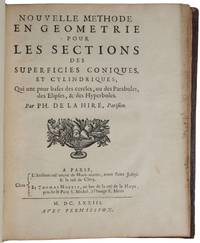
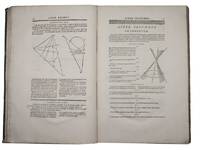
16766181Paris; Paris: chez l'autheur et Thomas Moette; np 1676. First edition. <p>First edition extremely rare of these two works of which the Nouvelle Méthode is the first substantial treatment of projective geometry explicating the Brouillon Projet of Girard Desargues 1591-1661. "The BrouillonProjet 1639 was published in an edition of only 50 copies and won very little support . Projective geometry secured a place in mathematics only with the publication of a book by Philippe de Hire 1673" Stillwell Mathematics and its History.</p>. PROJECTIVE GEOMETRY SECURES A PLACE IN MATHEMATICS. <p>First edition extremely rare of these two works of which the Nouvelle Méthode is the first substantial treatment of projective geometry explicating the Brouillon Projet of Girard Desargues 1591-1661. "The BrouillonProjet 1639 was published in an edition of only 50 copies and won very little support. In fact its reception was generally hostile and Desargues was engaged in a pamphleteering battle for years with his detractors. At first his only supporters were Pascal most of whose work on projective geometry is also lost and the engraver Abraham Bosse. Desargues became discouraged by the attacks on his work and left the dissemination of his ideas up to Bosse who was not really mathematically equipped for the task. Projective geometry secured a place in mathematics only with the publication of a book by Philippe de Hire 1673. It seems quite likely that La Hire's book influenced Newton see below" Stillwell p. 153. Michel Chasles writing in 1837 noted that La Hire's work is "extrêmement rare" Chasles p. 128. "The treatise of 1673 is where De La Hire shows himself to be truly original and innovative and which leads us to regard him as one of the founders of modern geometry" translated from ibid. "La Hire certainly read the Rough Draft on Conics Brouillon Projet thoroughly; for a long time the only known copy of the work was one made by La Hire himself in 1679. Possibly he made his own handwritten copy of the Rough Draft on Conics from a printed copy belonging to his father the painter Laurent de la Hire 1606-1656 a pupil of Desargues and a friend and colleague of Abraham Bosse at the Académie. Philippe de la Hire had by then written his first book on geometry his Nouvelle Méthode en Géométrie . It too has become extremely rare and he was later to write that his new method had been found difficult because it involved planes and solids" Field & Gray p. 37. La Hire's point of view in his Nouvelle Methode was entirely projective. He regarded all conics as projections of circles and used the harmonic division of four points which he showed was projectively invariant to obtain theorems about poles and polars. The work is in two parts. In the first pp. 1-72 La Hire treats conics as sections of the cone which are then projected onto the plane of the base of the cone; this approach was later expanded in his Sectiones conicae 1685. In the second Les Planiconiques pp. 73-94 he treats conics by entirely planar methods; Chasles notes that this part which Chasles regards as the more original "offered the first sufficiently general method for transforming figures of one kind into other figures of the same kind". The Planiconiques was published one year after the Nouvelle Méthode and was not added to all copies the Lyon and Marburg copies of the Nouvelle Méthode end at p. 72. The second work in the present volume De Cycloid Lemma is even rarer than the Nouvelle Méthode. It presents a geometrical construction of the tangent at any point of the cycloid - the method was discovered by Descartes and Fermat but they did not publish it. OCLC list 12 copies of the Nouvelle Méthode worldwide Columbia only in US and 6 copies of De Cycloide Lemma of which three are bound with the Nouvelle Méthode including Columbia and three are bound separately BL Erfurt & Lyon the first two of which hold the Nouvelle Méthode. It is unclear how many of the copies of the cycloid pamphlet are complete as several lack the plate e.g. the BNF copy. RBH lists only the Macclesfield copy of the Nouvelle Méthode since 1961 bound with De Cycloide Lemma but lacking its plate and no other copy of the cycloid pamphlet.</p> <br /> <p>"When Desargues circulated fifty copies of his Brouillon Project d'une Atteinte aux Événemens des Rencontres du Cone avec un Plan Rough Draft of an Essay on the results of taking plane sections of a cone in 1639 he was contributing to a lively contemporary study of geometry. Descartes's novel algebraic methods had been published two years before and in 1639 Mydorge published a more classical treatment of the conic sections. The classical authors themselves were increasingly well studied. Desargues had available Commandino's Latin edition of Euclid's Elements published in 1572 as well as his Latin edition of the first four books of Apollonius' Conics published in 1566 with extensive commentaries by Eutocius Pappus and Commandino himself. The last four books of the Conics were unknown in Desargues' time" Field & Gray p. 1.</p> <br /> <p>"The Brouillon Projet on conics of which he published fifty copies in 1639 is a daring projective presentation of the theory of conic sections; although considered at first in three-dimensional space as plane sections of a cone of revolution these curves are in fact studied as plane perspective figures by means of involution a transformation that holds a place of distinction in the series of demonstrations. But the use of an original vocabulary and the refusal to resort to Cartesian symbolism make the reading of this essay rather difficult and partially explain its meager success.</p> <br /> <p>"Although he praised the unitary conception that inspired Desargues Descartes doubted that the use of geometry alone could yield results as good as those that a recourse to algebra would provide. As for Fermat he reserved his judgment and the only geometer who really comprehended the originality and breadth of Desargues's views was the young Blaise Pascal who in 1640 published the brief Essay pour les Coniques inspired directly by the Brouillon Projet. But since the great Traité des Coniques that Pascal later wrote has been lost Desargues's example survived only in certain of the youthful works of Philippe de La Hire and perhaps in a few essays of the young Newton" DSB.</p> <br /> <p>"Philippe de la Hire 1640-1718 published three treatises on conics in 1673 in 1679 and in 1685. From the point of view of modern geometry the treatise of 1673 is by far the most original. Unfortunately because of its rarity it did not have a very wide circulation and today too many historians of science pass over it in silence concentrating instead on the Latin treatise of 1685 which is merely a development of the first part of the treatise of 1673. Although La Hire in a note attached to his copy of the Brouillon Projet of Desargues claims not to have known the treatise of Desargues until after 1673 and not to have been inspired by it it seems to us on the contrary that this inspiration is manifest. A first reason is that La Hire's father the king's painter was a diligent student of Desargues's oral lectures so it would be very surprising if he were unaware of the existence of this treatise and were unable to make its content known to his son. The second and most important reason is drawn from the study of the text. It seems that La Hire knowing at least the spirit of Desargues's treatise has tried to derive from it a work using the same principles but avoiding the faults that were the source of the violent criticisms by Desargues's adversaries.</p> <br /> <p>"Indeed La Hire seems to want to make a synthesis of the theories of Desargues while giving them a classical gloss . His method . amounts to deducing the projective properties of an arbitrary conic in space situated on a cone with a horizontal circular base from the properties of the base circle via the intermediary of the projection of the conic section onto the plane of the base. He uses in fact the properties of cylindrical projection for the passage from the curve in space to its projection and of homology for the passage from the conic to the projection of the base circle.</p> <br /> <p>"The method for studying the properties of conic sections 'in the cone' led quite logically to another procedure for studying them which consists in deducing directly - in the plane - every conic from a circle by a homology. This is the object of the second part of La Hire's small treatise titled Les Planiconiques. This very ingenious method is applied with the aid of several lemmas on the elementary properties of homology. So here apparently we have a treatise which although inspired by the ideas of Desargues is not afraid to develop them further" translated from Taton pp. 204-205.</p> <br /> <p>Chasles pp. 128-9 describes the method of the Planiconiques as follows. "Suppose that we have in a plane two straight lines parallel to each other which the author calls the formatrice and directrice and a point called the pole.Through each point M of a given curve in the plane one draws in an arbitrary direction a transversal; it meets the directrix at a point which one joins to the pole by a line;and the former at a second point through which we draw a parallel to this line.This parallel meets the straight line which goes from the point M to the pole in a point M' which is said to be formed by the point M.Each point of the proposed curve will thus form a corresponding point of a second curve. The points of a straight line form points belonging to a second straight line and these two straight lines will intersect on the formatrice.Finally the points of a circle will form the points of a conic section. Such is the method by which De La Hire studied in the plane without the need for any solid nor any other plane than that of the figure the sections of a cone.This is what he called reducing the cone and its sections to a plane."</p> <br /> <p>"Whiteside has pointed out Mathematical Papers of Isaac Newton VI 271 n.70 that the Nouvelle Méthode received a favourable review probably from CoIlins in 1676 and that Newton may have read it for Hooke wrote to him mentioning it in 1679. There are certainly similarities between ingenious projective transformations described by both men . In Book I of his Principia Newton showed how to solve all of the six different problems of the form: find the conic through k points and tangent to m lines k m = 5. In the course of accomplishing this feat he introduced a projective transformation capable as he remarked of transforming any conic to a circle . It is strikingly similar to the one given by La Hire in his Planiconiques which was printed in the same volume as his Nouvelle Méthode" Field & Gray p. 37. The Nouvelle Méthode also influenced Leibniz. "The ideas of Desargues and Pascal led Leibniz to a 'dynamical' vision of geometry. In the years 1672-76 Leibniz was in Paris where he greatly increased his mathematical knowledge. In 1673 he was informed on Desargues' perspective through La Hire's Nouvelle Méthodeen Géométrie ." Del Centini & Fiocca.</p> <br /> <p>Determining the properties of the cycloid the curve traced out by a point on the circumference of a circle as it rolls along a straight line served as a test bed for the techniques of seventeenth century mathematics. The earliest significant work on the cycloid is due to Gilles Personne de Roberval 1602-75 who obtained many of its properties before 1636 although he kept his results secret and they remained unpublished until 1693. Roberval in particular gave a construction of the tangent at a point on the cycloid using his method of 'composition of movements' a precursor of the differential calculus. This problem was also solved by Pierre de Fermat and René Descartes although they also did not publish their work. It was instead first published by La Hire in the first part of his De Cycloide Lemma pp. 1-4. The remainder of this little pamphlet is devoted to a problem relating to conics which is perhaps why it is often although not always found bound together with the Nouvelle Méthode.</p> <br /> <p>Chasles AperVu historique des Méthodes en Géométrie 1837. Del Centini & Fiocca 'Boscovich's geometrical principle of continuity and the 'msyteies of infinity' Historia Mathematica 45 2018 pp. 131-175. Field & Gray The Geometrical Work of Girard Desargues 1987. Stillwell Mathematics and its History 3rd edition 2010. Taton Le Prehistoire de la 'Geometrie moderne' Revue d'Histoire des Sciences et de leurs Applications 2 1949 pp. 197-224.</p> <br/> <br/> 4to 201 x 162 mm. Nouvelle Méthode: pp. viii 94 with 25 folding engraved plates 10 bound before title page 15 at end of volume the last 2 referring to Les Planiconiques woodcut vignette on title woodcut initials head- and tail-pieces. De Cycloide Lemma: pp. 6 with 13 figures on one plate cut up with each figure tipped in at the appropriate place in the text. chez l'autheur et Thomas Moette; [np] unknown
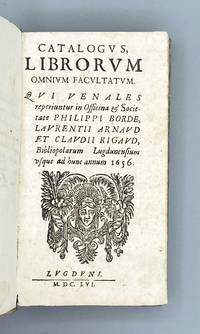
165611982Lyon: for Ph. Borde Laur. Arnaud and Cl. II Rigaud 1656. Contemporary card boards small hole in the front panel flat spine. <p> A REMARKABLE STOCK CATALOG OF SOME TEN THOUSAND SIXTEENTH- AND SEVENTEENTH-CENTURY TITLES REPRESENTING THE COMBINED INVENTORIES OF EIGHT DOMINANT LYONESE PUBLISHERS AND BOOKSELLERS ACTIVE FROM 1555 TO 1656.<br /> Beginning in the 1620s the book trade in the France’s second city experienced dramatic consolidation through inheritance and liquidation. Philippe Borde Laurent Arnaud and Claude II Rigaud stood the principal beneficiaries. Between 1650 and 1655 they partnered to purchase the stocks of the Lyonese Giunta of Horace Cardon of Horace Boissat of the Rouillé family and of Claude Prost.<br /> The partners had to sell and this catalog clearly prepared in haste is the result. It swarms with minor errors like reversed and upside-down sorts repeated pagination errors in dates and orthography and chase marks likely arising from the rush to have it ready in time for the Lyon trade fair.<br /> The material is grouped into thirteen categories. The nine subject divisions list only Latin texts in the fields of theology Scripture councils scholastics morals controversies asceticism spirituality preaching manuals law medicine philosophy history politics and civics sciences astronomy mathematics architecture atlases cabbala the humanities grammar rhetoric ancient classics and liturgy. Four sections gather material by language — Greek Hebrew and Arabic together Italian Spanish and French — regardless of subject. In each class entries are arranged alphabetically by author and each work is identified by its author title format printing place date and number of volumes if a set. Imprints span Naples to London and Madrid to Hamburg.<br /> The present example has been marked up in manuscript. Two dozen entries have been canceled in whole or in part across eight different categories motivated in every case but two by religion. Machiavelli's dangerous political ideas and G.B. Marino’s personal immorality earned censure. Hundreds of entries have been ticked in the left margins sometimes four or five to a page. I have located one example in the U.S. Grolier Club. In good condition one quire browned narrow pale stain to the second half of the volume.<br /> ¶Pollard & Ehrman Distribution of Books by Catalogue 117 120 301 355 Arnaud 361 Borde & 511 Rigaud; Mirto Stampatori editori librai nella seconda metà del Seicento I: 70; Mellot & Queval Répertoire d’imprimeurs/libraires vers 1500-vers 1810 2004 nos. 107 Arnaud 634 Borde & 474 Rigaud; Répertoire bibliographique des livres imprimés en France au XVIIe siecle: Lyon ed. Merland I: 142-143-84 Arnaud II: 149-66 Borde & VI: 202-4 Rigaud.</p> for Ph. Borde, Laur. Arnaud and Cl. II Rigaud unknown
16766349Paris; Paris: chez l'autheur et Thomas Moette; n.p. 1676. First edition. <p>First edition extremely rare of these two works of which the Nouvelle Méthode is the first substantial treatment of projective geometry explicating the Brouillon Projet of Girard Desargues 1591-1661. "The BrouillonProjet 1639 was published in an edition of only 50 copies and won very little support . Projective geometry secured a place in mathematics only with the publication of a book by Philippe de Hire 1673" Stillwell Mathematics and its History.</p>. PROJECTIVE GEOMETRY SECURES A PLACE IN MATHEMATICS. <p>First edition extremely rare of these two works of which the Nouvelle Méthode is the first substantial treatment of projective geometry explicating the Brouillon Projet of Girard Desargues 1591-1661. "The BrouillonProjet 1639 was published in an edition of only 50 copies and won very little support. In fact its reception was generally hostile and Desargues was engaged in a pamphleteering battle for years with his detractors. At first his only supporters were Pascal most of whose work on projective geometry is also lost and the engraver Abraham Bosse. Desargues became discouraged by the attacks on his work and left the dissemination of his ideas up to Bosse who was not really mathematically equipped for the task. Projective geometry secured a place in mathematics only with the publication of a book by Philippe de Hire 1673. It seems quite likely that La Hire's book influenced Newton see below" Stillwell p. 153. Michel Chasles writing in 1837 noted that La Hire's work is "extrêmement rare" Chasles p. 128. "The treatise of 1673 is where De La Hire shows himself to be truly original and innovative and which leads us to regard him as one of the founders of modern geometry" translated from ibid. "La Hire certainly read the Rough Draft on Conics Brouillon Projet thoroughly; for a long time the only known copy of the work was one made by La Hire himself in 1679. Possibly he made his own handwritten copy of the Rough Draft on Conics from a printed copy belonging to his father the painter Laurent de la Hire 1606-1656 a pupil of Desargues and a friend and colleague of Abraham Bosse at the Académie. Philippe de la Hire had by then written his first book on geometry his Nouvelle Méthode en Géométrie . It too has become extremely rare and he was later to write that his new method had been found difficult because it involved planes and solids" Field & Gray p. 37. La Hire's point of view in his Nouvelle Methode was entirely projective. He regarded all conics as projections of circles and used the harmonic division of four points which he showed was projectively invariant to obtain theorems about poles and polars. The work is in two parts. In the first pp. 1-72 La Hire treats conics as sections of the cone which are then projected onto the plane of the base of the cone; this approach was later expanded in his Sectiones conicae 1685. In the second Les Planiconiques pp. 73-94 he treats conics by entirely planar methods; Chasles notes that this part which Chasles regards as the more original "offered the first sufficiently general method for transforming figures of one kind into other figures of the same kind". The Planiconiques was published one year after the Nouvelle Méthode and was not added to all copies the Lyon and Marburg copies of the Nouvelle Méthode end at p. 72. The second work in the present volume De Cycloid Lemma is even rarer than the Nouvelle Méthode. It presents a geometrical construction of the tangent at any point of the cycloid - the method was discovered by Descartes and Fermat but they did not publish it. OCLC lists 12 copies of the Nouvelle Méthode worldwide Columbia only in US and 6 copies of De Cycloide Lemma of which three are bound with the Nouvelle Méthode including Columbia and three are bound separately BL Erfurt & Lyon the first two of which hold the Nouvelle Méthode. It is unclear how many of the copies of the cycloid pamphlet are complete as several lack the plate e.g. the BNF copy. RBH lists only the Macclesfield copy of the Nouvelle Méthode since 1961 bound with De Cycloide Lemma but lacking its plate and no other copy of the cycloid pamphlet.</p> <br /> <p>"When Desargues circulated fifty copies of his Brouillon Project d'une Atteinte aux Événemens des Rencontres du Cone avec un Plan Rough Draft of an Essay on the results of taking plane sections of a cone in 1639 he was contributing to a lively contemporary study of geometry. Descartes's novel algebraic methods had been published two years before and in 1639 Mydorge published a more classical treatment of the conic sections. The classical authors themselves were increasingly well studied. Desargues had available Commandino's Latin edition of Euclid's Elements published in 1572 as well as his Latin edition of the first four books of Apollonius' Conics published in 1566 with extensive commentaries by Eutocius Pappus and Commandino himself. The last four books of the Conics were unknown in Desargues' time" Field & Gray p. 1.</p> <br /> <p>"The Brouillon Projet on conics of which he published fifty copies in 1639 is a daring projective presentation of the theory of conic sections; although considered at first in three-dimensional space as plane sections of a cone of revolution these curves are in fact studied as plane perspective figures by means of involution a transformation that holds a place of distinction in the series of demonstrations. But the use of an original vocabulary and the refusal to resort to Cartesian symbolism make the reading of this essay rather difficult and partially explain its meager success.</p> <br /> <p>"Although he praised the unitary conception that inspired Desargues Descartes doubted that the use of geometry alone could yield results as good as those that a recourse to algebra would provide. As for Fermat he reserved his judgment and the only geometer who really comprehended the originality and breadth of Desargues's views was the young Blaise Pascal who in 1640 published the brief Essay pour les Coniques inspired directly by the Brouillon Projet. But since the great Traité des Coniques that Pascal later wrote has been lost Desargues's example survived only in certain of the youthful works of Philippe de La Hire and perhaps in a few essays of the young Newton" DSB.</p> <br /> <p>"Philippe de la Hire 1640-1718 published three treatises on conics in 1673 in 1679 and in 1685. From the point of view of modern geometry the treatise of 1673 is by far the most original. Unfortunately because of its rarity it did not have a very wide circulation and today too many historians of science pass over it in silence concentrating instead on the Latin treatise of 1685 which is merely a development of the first part of the treatise of 1673. Although La Hire in a note attached to his copy of the Brouillon Projet of Desargues claims not to have known the treatise of Desargues until after 1673 and not to have been inspired by it it seems to us on the contrary that this inspiration is manifest. A first reason is that La Hire's father the king's painter was a diligent student of Desargues's oral lectures so it would be very surprising if he were unaware of the existence of this treatise and were unable to make its content known to his son. The second and most important reason is drawn from the study of the text. It seems that La Hire knowing at least the spirit of Desargues's treatise has tried to derive from it a work using the same principles but avoiding the faults that were the source of the violent criticisms by Desargues's adversaries.</p> <br /> <p>"Indeed La Hire seems to want to make a synthesis of the theories of Desargues while giving them a classical gloss . His method . amounts to deducing the projective properties of an arbitrary conic in space situated on a cone with a horizontal circular base from the properties of the base circle via the intermediary of the projection of the conic section onto the plane of the base. He uses in fact the properties of cylindrical projection for the passage from the curve in space to its projection and of homology for the passage from the conic to the projection of the base circle.</p> <br /> <p>"The method for studying the properties of conic sections 'in the cone' led quite logically to another procedure for studying them which consists in deducing directly - in the plane - every conic from a circle by a homology. This is the object of the second part of La Hire's small treatise titled Les Planiconiques. This very ingenious method is applied with the aid of several lemmas on the elementary properties of homology. So here apparently we have a treatise which although inspired by the ideas of Desargues is not afraid to develop them further" translated from Taton pp. 204-205.</p> <br /> <p>Chasles pp. 128-9 describes the method of the Planiconiques as follows. "Suppose that we have in a plane two straight lines parallel to each other which the author calls the formatrice and directrice and a point called the pole.Through each point M of a given curve in the plane one draws in an arbitrary direction a transversal; it meets the directrix at a point which one joins to the pole by a line;and the former at a second point through which we draw a parallel to this line.This parallel meets the straight line which goes from the point M to the pole in a point M' which is said to be formed by the point M.Each point of the proposed curve will thus form a corresponding point of a second curve. The points of a straight line form points belonging to a second straight line and these two straight lines will intersect on the formatrice.Finally the points of a circle will form the points of a conic section. Such is the method by which De La Hire studied in the plane without the need for any solid nor any other plane than that of the figure the sections of a cone.This is what he called reducing the cone and its sections to a plane."</p> <br /> <p>"Whiteside has pointed out Mathematical Papers of Isaac Newton VI 271 n.70 that the Nouvelle Méthode received a favourable review probably from CoIlins in 1676 and that Newton may have read it for Hooke wrote to him mentioning it in 1679. There are certainly similarities between ingenious projective transformations described by both men . In Book I of his Principia Newton showed how to solve all of the six different problems of the form: find the conic through k points and tangent to m lines k m = 5. In the course of accomplishing this feat he introduced a projective transformation capable as he remarked of transforming any conic to a circle . It is strikingly similar to the one given by La Hire in his Planiconiques which was printed in the same volume as his Nouvelle Méthode" Field & Gray p. 37. The Nouvelle Méthode also influenced Leibniz. "The ideas of Desargues and Pascal led Leibniz to a 'dynamical' vision of geometry. In the years 1672-76 Leibniz was in Paris where he greatly increased his mathematical knowledge. In 1673 he was informed on Desargues' perspective through La Hire's Nouvelle Méthodeen Géométrie ." Del Centini & Fiocca.</p> <br /> <p>Determining the properties of the cycloid the curve traced out by a point on the circumference of a circle as it rolls along a straight line served as a test bed for the techniques of seventeenth century mathematics. The earliest significant work on the cycloid is due to Gilles Personne de Roberval 1602-75 who obtained many of its properties before 1636 although he kept his results secret and they remained unpublished until 1693. Roberval in particular gave a construction of the tangent at a point on the cycloid using his method of 'composition of movements' a precursor of the differential calculus. This problem was also solved by Pierre de Fermat and René Descartes although they also did not publish their work. It was instead first published by La Hire in the first part of his De Cycloide Lemma pp. 1-4. The remainder of this little pamphlet is devoted to a problem relating to conics which is perhaps why it is often although not always found bound together with the Nouvelle Méthode.</p> <br /> <p>Chasles AperVu historique des Méthodes en Géométrie 1837. Del Centini & Fiocca 'Boscovich's geometrical principle of continuity and the 'msyteies of infinity' Historia Mathematica 45 2018 pp. 131-175. Field & Gray The Geometrical Work of Girard Desargues 1987. Stillwell Mathematics and its History 3rd edition 2010. Taton Le Prehistoire de la 'Geometrie moderne' Revue d'Histoire des Sciences et de leurs Applications 2 1949 pp. 197-224.</p> <br/> <br/> 4to 201 x 162 mm. Nouvelle Méthode: pp. viii 94 with 25 folding engraved plates 10 bound before title page 15 at end of volume the last 2 referring to Les Planiconiques woodcut vignette on title woodcut initials head- and tail-pieces. De Cycloide Lemma: pp. 6 with 13 figures on one plate cut up with each figure tipped in at the appropriate place in the text. chez l'autheur et Thomas Moette; [n.p.] unknown
16854671Paris: Etienne Michallet 1685. 19th-century boards ca. 1820 covered with blue paste-paper sewn on 4 cords with gold-tooled red vellum spine-label. Large folio 38 x 26 cm. With a charming woodcut headpiece at the beginning of the main text with a perspective drawing of sliced cones and double cones in a decorative border hundreds of woodcut diagrams in the text woodcut tailpieces one repeated on the title-page 2 woodcut decorated initials 2 series and numerous decorations built up from cast fleurons. First and only early edition in Latin of a comprehensive and influential text book on conic sections discussing the standard classical Greek work of Apollonius the projective methods of Desargues and the application of Cartesian analytical geometry by the artist mathematician and astronomer Philippe de La Hire "among the best of the followers of Desargues and Descartes" DSB. It "seemed to be the last word on the subject" and La Hire's "pre-eminence in this field" was still acknowledged in 1738 Kemp p. 121. La Hire here provides the clearest and most fully developed presentation of the projective principles pioneered by Desargues whose work became generally known through La Hire's further development and improved presentation of his ideas. With a few leaves slightly browned 2 severely or foxed the last leaf extensively but otherwise in very good condition and largely untrimmed with many deckles intact and large margins. Binding rubbed and spine damaged.l Honeyman coll. 1886; Kemp The science of art pp. 221-222 & passim; for La Hire: DSB VII pp. 576-579. Etienne Michallet, hardcover
1700B7152Nuremberg: Jean Zieger & George Lehmann. 1700. Some leaves with repairs otherwise text and plates are clean and crisp. . Binding: Original vellum boards rebacked. Spine with red morocco label. Top and front edges speckled red. Notes: Dual Language Edition; text in German and French Size: Folio 340 x 220mm Illustration: Near fine example of this important work on horsemanship. Illustrated with 73 large fine copperplates including engraved title and the armorial plate on the verso of the French title all double-page and/or folding. Translation of the original English edition. Text printed in two columns German in Gothic font on the left French on the right. Some inconsistencies in plate numbering; includes one duplicate plate. Pagination jumps from 290 to 293 text continuous. Lacking the German title in red and black. <br><br> Provenance: Ex-Libris; ownership stamp plus bookplate of Dodgson Hamilton Madden on front pastedown. References: Brunet I 1700; Graesse II 93; Huth 23; Lowndes 1663; Mennessier de la Lance II p. 250; Nissen ZBI 848 Pages: P Double-page engraved title. 4 double-page plates. Dedication. Blank. French Title. Large armorial engraving. German dedication. Publisher’s preface 3. Solleysel’s advertisement 5. Notice to the reader 5. Table of names 3. Contents 7. Pp. 1-301. Category: Book Natural History; Jean Zieger & George Lehmann. hardcover
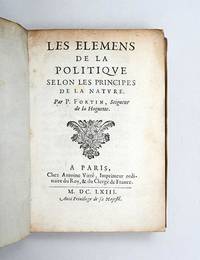
1663144980Paris: Chez Antoine Vitré 1663. Government and society in the reign of Louis XIV First edition of the final major work by the soldier and philosopher. Fortin's work of political theory yokes together the public and the private relating the development of government to the control of four essential vices: murder theft false witness and adultery. The book mirrors contemporary attitudes towards marriage and sexuality and it has been read as by Leslie Tuttle as reflecting the social imperialism imposed on France's new North American colonies in the 1660s p.79. As a soldier Philippe Fortin de la Hoguette 1585-1668 fought in the French Wars of Religion and was present at the siege of La Rochelle in 1627. As a philosopher he wrote several works of Catholic fideism corresponded extensively with the Dupuy brothers and smuggled many of Francis Bacon's manuscripts out of England after his death in 1626. Octavo 166 x 113 mm Contemporary vellum spine lettered in manuscript edges sprinkled in red and green. Woodcut vignette to title page headpiece and initial. Lightly toned and with some natural creasing front pastedown free rear pastedown starting to free minor browning to endpapers and content margins occasional small mark: a very good copy in an attractive contemporary binding. Leslie Tuttle Conceiving the Old Regime: Pronatalism and the Politics of Reproduction in Early Modern France 2010. hardcover
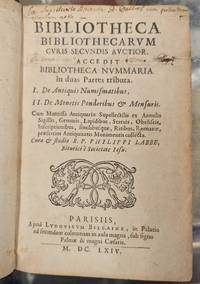
1664116810Ludovicum Billiane 1664. Hardcover. Very good/No jacket. In Latin. The first bibliography of bibliographies and the first bibliography of Numismatics. <br /> <br /> Leather covers shelfworn. Pen notations and marks along the margins throughout. Ludovicum Billiane hardcover
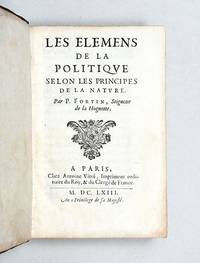
1663144254Paris: Chez Antoine Vitré 1663. Government and society in the reign of Louis XIV First edition of the final major work by the soldier and philosopher. Fortin's work of political theory yokes together the public and the private relating the development of government to the control of four essential vices: murder theft false witness and adultery. The book mirrors contemporary attitudes towards marriage and sexuality and it has been read as by Leslie Tuttle as reflecting the social imperialism imposed on France's new North American colonies in the 1660s p.79. Philippe Fortin de la Hoguette 1585-1668 fought in the French Wars of Religion and was present at the siege of La Rochelle in 1627. In his spare time he wrote several works of Catholic fideism corresponded extensively with the Dupuy brothers and smuggled many of Francis Bacon's manuscripts out of England after his death in 1626. Octavo 172 x 112 mm. Woodcut vignette to title page headpiece and initial. Contemporary mottled calf spine lettered panelled and decorated in gilt raised bands edges sprinkled red and brown. Ink manuscript "Elem: Pol:" to upper edge. Remnants of shelf label to lower spine end. Light wear loss to lower spine end front joint cracked but holding firm minor browning and foxing to endpapers and contents: a very good copy. Leslie Tuttle Conceiving the Old Regime: Pronatalism and the Politics of Reproduction in Early Modern France 2010. hardcover
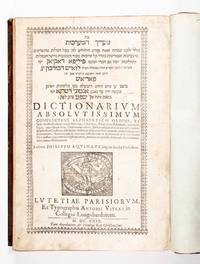
162948838Paris: Antoine Vitré 1629. First edition. Hardcover. Good. Folio. Signed: a4 e2 A-3B6 3C4 = 298 leaves. 12 584pp. Paginated from right to left. Full title and imprint in both Hebrew and Latin with woodcut printer's device; title within decorative letterpress border; woodcut lettrines and head-pieces; printed marginalia. Text in two columns. Eighteenth-century calf scuffed especially at front cover; spine with raised bands and gilt morocco morocco labels; edges stained red; green silk ribbon marker. Title leaf skilfully mounted on eighteenth-century paper. Text crisp and clean with ample borders.<br /> <br /> Only edition of this rare and highly unusual Hebrew and Aramaic dictionary composed by the formerly Jewish convert to Catholicism Mordechai Cresque of Carpentras who derived his new name Philippus d’Aquin or Aquinas; 1578-1650 from the place of his baptism in Aquino Italy. Printed almost entirely in the fine bold rashi characters "grosse glose hebraicque" cut by Guillaume I Le Bé in 1592 only the vocalised quotations and the lemmata are in Le Bé's square Hebrew script. Apart from the Latin title dedication approbations a poetic encomium and the alpha-numeric leaf signatures the work is printed entirely in Hebrew characters. It ends with a short notice in Latin and Hebrew on the printing errors which are corrected on the last three pages. The author announces at the title that all Hebrew biblical and rabbinic-talmudic and Aramaic terms are to be found in Ma'arikh ha-Ma'arakhot including many that do not appear in any existing lexicons among Jews or Christians. D'Aquin notes in particular that rare and difficult terms in rabbinic and cabalistic literature along with obscure abbreviations are all clearly explained. <br /> <br /> "The work is called in Hebrew Maarik ha-maarikot i. e. “Survey of the orders†a term which in the plural is also applied to "battle-lines" Wolf 140 translates Disponens ordines sive acies. One cannot help wonder if there is not a connection with the political situation at the time when the Huguenot town of La Rochelle had to submit to the French Crown in 1628. The privilege for our book has "Données au Camp devant la Rochelle le 19. Septembre 1628" and the work is dedicated to Cardinal Richelieu whose conquest of La Rochelle is also extolled in a Hebrew poem by the author. But the types are also reminiscent of war: did not Le Bé cut them "après le siège de Paris pour passer l'ennui" see Carter & Vervliet p. 15. They were prominently displayed afterwards in Vitray's type-specimen of 1636" Smitskamp. Among the eleven scholars whose approbations grace the present volume are Gabriel Sionita 1577-1645; professor of Arabic and Syriac at the College de France; Gilbert Gaulmin 1585-1665; Orientalist; Denis Petau 1583-1652; Jesuit theologian; and Jean Morin 1591-1659; theologian and Orientalist. Morin offers quite extravagent praise: "nihil hactenus in eo studii genere comparandum vidit Europa." <br /> <br /> Provenance: A morocco label on the spine reads Me-izabin. Hirsch. Wolf Kola i. e. From the legacy of Hirsch. References: Baillet Jugement de Scavans 3 1685: 729. Fürst 1:47-48. Gesenius Geschichte 113: “umfasst auch das Chadaïsche und Rabbinische†Hebrew title incorrectly transcribed without the definite article and indication of plural. Smitskamp Cat. no. 611 but notably not in Philologia Orientalis. Steinschneider Handbuch 129: “Früher sehr gesucht und selten. Heidenheim wollte se zuerst wieder ediren s. Catal. p. 739.†Wolf Historia lexicorum 140. For the interest of Richelieu in typographical matters and his foundation of the Imprimerie Royale in 1640 see Updike 1:238-40. Not in Goldsmith<br /> <br /> Hebrew title: מעריך המערכות. Antoine Vitré hardcover
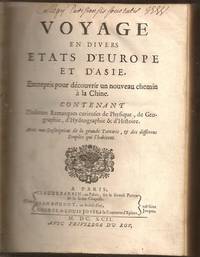
1692E0527titlepictorial platexviifolding map406xxiv pages with engraved initials and vignettes and three additional plates and index. Royal octavo 9 3/4" x 7 1/2" bound in full leather with five raised bands and lettering in gilt and decorative vignettes. First edition.<br /><br />Philippe Avril was a Jesuit explorer of the Far East and professor of philosophy and mathematics at Paris when he was dispatched to the Jesuit missions of China. He was summoned by the Jesuit missions and sent as a Jesuit to the missions in China. Following the instructions of Ferdinand Verbiest another Jesuit then at Peking suggested that he attempted an overland journey which he ended up traveling for six years through Kurdistan Armenia Astrakhan Persia and other countries of eastern Asia arriving at Moscow. He now traveled to Grodno in Poland where he renewed an acquaintance with Count de Syri who had formerly befriended him at Astrakham. The count at the suggestion of Avril applied ot the French government for the appointment of ambassador from the King of France to the Emperor of China. He succeed in obtaining the appointment and it was arranged that Avril should accompany him. They set out to Moscow together. An accident detained Avril and the count arrived at Moscow days before his companion. On the arrival of Avril he received the intelligence that the Russian authorities and compelled the count to proceed and was refused permission to over take him. Avril proceeded to Warsaw and through the assistance of Prince Jablonowksi to reach Constantinople by way of Moldavia. Here he was seized with spitting of blood and he found himself compelled to relinquish his mission and returned to France. He landed at Toulon in 1690 and published an account of his travels. Avril's journal and writings provide a significant amount of useful material for modern historians and demographers.<br /><br /><b>Condition:</b><br /><br />Corners bumped and rubbed lacking 3E4 blank leaf between the end of the main text and start of the Table de Metiers occasional toning ink inscription to title spine ends and raised spine rubbed some spotting to leather else a good to very good copy. Claude Barbin, Jean Boudot, George & Louis Josse hardcover
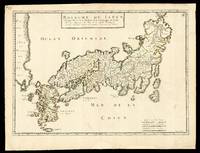
165815988Paris: Chez Pierre Mariette rue S.t Iacques a l'Esperance 1658. 457 by 572mm. 18 by 22.5 inches. Hand-coloured engraved map. The second state of the plate published separately and extensively corrected with the addition of: the four cardinal points added midway along the graticule scale around the map; 'ou Saycock a io 10 Roy.mes' and'ou Tokoesi a 4. R.'; and additional titles for the 'kingdoms' throughout the map. Hubbard points out that this is "an enormous number of corrections for the engraver Somer to make" although many other errors remain. Briet 1601-1668 came from the same town Abbeville as Nicolas Sanson I and examples of this map have been found in composite atlases largely made up of maps by Sanson. Sanson and Mariette who published this map also had a business relationship that eventually ended badly. The engraver Jan van Somer worked for Sanson in Paris. A Jesuit from 1619 Briet was also a teacher of humanities and rhetoric. He wrote literature as well as history and historical geography. He published his 'Paralella Geographica' in 1648 and 1649 with 144 maps of Europe. He had intended further volumes of maps of the other continents but only managed a manuscript for the Asia volume which was never published. Many of the maps from the original work were republished in his 'Theatre Geographique de L'Europe' and 'Theatrum Geographicum Europae Veteris' in 1653. Hubbard 31.2. Chez Pierre Mariette, rue S.t Iacques a l'Esperance, unknown
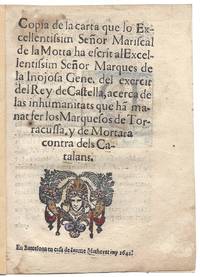
16422051En Barcelona: en casa de Iaume Methevat Jaime Matevad 1642. First edition. With a woodcut device on title page and a large woodcut initial both colored by a later hand and typographic head and tailpieces. In later marbled paper. Light brown stains throughout paper tanned otherwise in fine condition. First edition. With a woodcut device on title page and a large woodcut initial both colored by a later hand and typographic head and tailpieces. In later marbled paper. 4 p. <p><br /> Extremely rare document related to the early episodes of the Catalan Revolt.<br /> <p><p><br /> Written by Philippe de La Mothe-Houdancourt 1605–1657 French soldier and Marshal of France who was serving as the French Viceroy of Catalonia during the Reaper’s War or Catalan Revolt 1640–1659 to the parallel Spanish Viceroy of Catalan Juan Ramirez de Arellano y Manrique de Lara 1606-1643 the Marquis of Hinojosa to complain about the inhumanities that the Catalans suffer.<br /> <p><p><br /> Scarce IB locates only 3 copies in libraries Biblioteca de Catalunya Barcelona; Biblioteca Nacional de Portugal Lisbon; Biblioteca-Museo Víctor Balaguer; Villanueva y Geltrú / Vilanova i la Geltrú. <br /> <p><p><br /> IB B68429; Palau 61205<br /> <p>. en casa de Iaume Methevat [Jaime Matevad] unknown
1685743Lyon: Jean Girin & Barthélemy Rivière 1685. First edition. <br /> <br /> A landmark in the cultural and scientific history of coffee tea and chocolate — the three “new beverages†of early modern Europe. Written by Philippe Sylvestre Dufour 1622–1687 a Lyon apothecary physician and merchant this 1685 first edition is among the earliest treatises devoted to the preparation medicinal properties and social virtues of these drinks. Dufour discusses the origin of coffee in the Ottoman Empire tea in China and cacao in the Americas blending pharmacological observation with moral reflection on their consumption. The work marks an important moment in the spread of global trade and early modern dietary theory illustrating how exotic imports became staples of European life and medicine.<br /> <br /> Illustrated with three full-page engravings and an engraved frontispiece including a striking depiction of an Ottoman coffee drinker a Chinese tea ceremony and a native American holding a chocolate vessel. These plates helped define the visual iconography of coffee and chocolate in the 17th century. Dufour’s Traitez became the foundational French-language reference on these drinks influencing subsequent European authors. This copy shows early marginal notes and the presence of all plates noted for the true first edition confirming its completeness and authenticity.<br /> <br /> Condition & Binding: Contemporary full mottled calf spine gilt in compartments with floral ornaments and gilt title “TRAITÉ DU CAFÉ.†Light rubbing and edge wear; some cracking along joints but binding remains solid and entirely original. Mild staining and toning to a few leaves; scattered foxing consistent with age. Engravings crisp and well-inked showing excellent impression quality. Early manuscript notes on title and endpaper likely from an 18th-century hand. Overall- good. Jean Girin & Barthélemy Rivière unknown
1692LV1992Paris:: Chez Claude Barbin Jean Boudot George & Louis Josse avec privilege du Roy 1692. 1692. Sm. 4to. xx 406 xxiv pp. 6 chapter vignettes engraved by Vallet pp. aii 1 71 165 231 323 large engraved portrait of General Stanislas Jablonowski by Picart large folding map of Siberia 3 engraved plates: engr. pl. of transport sled of Moscow facing p.150 engr. pl. of a Calmouc Tartar facing p. 195 "Esquiss des Cosaques" facing p. 356. Nineteenth century quarter maroon morocco maroon paper over boards; rubbed. Rubber-stamp of Abbe E. Emile Longin Beaujeu fl.1904; receipt of sale of this copy to Armand Pushman 1932 NYC. First edition. This work was first translated into English in 1693. "At this time a major preoccupation of the Catholic Church and its China mission was to discover a safe land route from Europe to Peking through central Asia. This was due to the large numbers of out-going clergy who perished tragically every year at sea." Ames & Love p. 202. "The last decade of the century saw the publication of the accounts of several overland travelers to China and their destinations of China's inner-Asian neighbors. The story of the Jesuit Philippe Avril's attempt to establish a route across Russia for the safe passage of missionaries to China appeared in 1692 and includes descriptions of both the routes from Moscow to China and the peoples on China's frontiers. Avril himself however did not travel beyond Moscow and his descriptions therefore are not the result of his own observations." Lach & Kley pp. 1685-1686. The same for Nicolaas Witsen. Avril Philippe a Jesuit born in France explored extensively throughout Asia and the Far East. He was a professor of mathematics and philosophy in Paris before he began his overland journey. He traveled for six years through Kurdistan Armenia Astrakhan Persia and other parts of the southeast. At one point he came to Moscow and was refused entry to Tatary. He was sent by the government to Poland via Istanbul and back to France. Apparently affected by exhaustion and disease he still undertook another voyage his last for the ship was lost at sea circa 1698. – Love Ronald S. "A Passage to China: A French Jesuit's Perceptions of Siberia in the 1680s." French Colonial History 3: p. 94 2003. Ames & Love offer: "Though obliged to leave Moscow Avril did not return to France with Louis Barnabe . . . Remaining instead at Warsaw the two Jesuits had entered in early March 1688 Avril attempted twice more to achieve his objective or reaching China by land – if not through Siberia then via Persia and Central Asia. Aided in part by the Polish monarch John Sobieski r.1674-1696 and his ambassador to Russia the French priest once again traveled to Moscow in late spring. Just two days after his arrival in the Muscovite capital however Avril was ordered summarily out of the country. Once again he appealed the command in vain. 'Russia intended to keep her trade with China a secret.' Nor did he have better luck later the same year 1688 when he and a fellow Jesuit Pere de Beauvillier tried going south to Constantinople instead and thence through Persia to Bokhara Samarkland and the Chinese frontier. Crossing secretly into Ottoman territory the two men were arrested as spies. After several weeks they secured their release and resumed their trek. But Avril whose health had been waning as a result of relentless exertions suddenly developed a hemorrhage. Ordered to abandon the search and return home by his superiors he reached France in autumn 1689." Ames & Love p. 219. For Abbe Emile Longin provenance: see Bulletin de la Societe des sciences et arts du Beaujolais 1904 p.92. There is a Maggs Bros. London booksellers receipt of sale of this copy to Armand Pushman 10 Nov. 1932. Armand was one of two sons of Hovsep Pushman 1877-1966 an American artist of Armenian descent. He had studied art at the Imperial School of Fine Arts Istanbul. For a time Pushman lived at the famous Mission Inn Riverside California. He was also involved in the founding of the Laguna Beach Art Association. Armand Pushman d.1999 lived to 98 years and had been throughout his career a partner with his brother in their carpet business Pushman & Company. See: NYT Obituary January 11 1999. See: Henri Cordier Bibliotheca Sinica Dictionnaire Bibliographique des ouvrages relatifs a l'Empire chinois t. III 2088; De Backer Augustin & Carlos S.J. Sommervogel Bibliotheque de la Compagnie de Jesus. Bibliographie tome I p.706; Donald F. Lach Edwin J. Van Kley Asia in the Making of Europe Volume III: A Century of Advance book 4: East Asia. University of Chicago Press 1998; Glenn Joseph Ames Ronald S. Love Distant Lands and Diverse Cultures: The French Experience in Asia 1600-1700. Praeger 2003 – pp. 202 219; Howgego A142; Salmaslian Armenag Bibliographie de l'Armenie 1946 p. 238; Walravens Hartmut China illustrata. Das europaische Chinaverstandnis im Spiegel des 16. bis 18. Jahrhunderts. Mit einem Beitrag von David E. Mungello. Ausstellung im Zeughaus der Herzog August Bibliothek Wolfenbuttel vom 21. Marz bis 23. August 1987. Ausstellungskataloge der Herzog-August-Bibliothek Nr. 55 Wolfenbuttel: Herzog August Bibliothek 1987 55. 1691. Chez, Claude Barbin, Jean Boudot, George & Louis Josse, avec privilege du Roy, 1692. hardcover
1685262811Lyons: Girin 1685. hardcover. very good. 3 full page copperplate engravings and 4 engraved chapter headings. Thick 12mo 22 445 5 pages rubricated title and edges full calf gilt spine chipped and worn. Lyons: Jean Girin & B. Riviere 1685. Scarce. Very good .<br/> <br/> Sabin 21146; Wellcome II p. 494; Bitting 134.<br/> <br/> Girin unknown
167539689Paris: Christophe Ballard seul Imprimeur du Roy pour la Musique ruë Saint Jean de Beauvais au Mont Parnasse . Par exprés commandement de Sa Majesté 1675. Small quarto. Modern marbled boards with paper title label to upper and spine. 1f. recto title verso blank 1f. "Acteurs du Prologue" 4ff. "Prologue" 1f. "Acteurs de la Tragedie" 76 pp. With woodcut device to title including Apollo with lyre figures in Greco-Roman dress with harp and lute and a pegasus; exceptionally fine woodcut headpiece to Prologue and additional headpieces to each act; decorative woodcut initials and tailpieces throughout.<br /> <br /> Full named cast lists for the "Acteurs du Prologue" and the "Acteurs de la Tragedie."<br /> <br /> Small holes to blank inner margins from previous sewing; slightly worn; very occasional minor foxing soiling and stains; minor loss to blank upper outer corner of pp. 31/32. First Edition fourth issue. Sonneck Librettos p. 1069. Schmidt LLC3-2.3. <br /> <br /> Thesée a tragédie en musique in a prologue and five acts to a libretto by Quinault after Ovid's Metamorphoses was first performed at St Germain-en-Laye on 11 January 1675.<br /> <br /> "The orchestra and chorus are used with brilliant effect in several divertissements but especially in the evocation of battle throughout Act 1. Medea's role like that of Lully's final lovesick sorceress Armide is replete with expressive monologue airs: 'Doux repos' 'Dépit mortel' 'Sortez Ombres' and 'Ah! faut-il me venger'. Thésée was part of the standard repertory at the Paris Opéra from 1675 until 1767; in addition it was selected to represent Lully when in 1779 the Opéra presented an historical survey of French operatic styles. Lully's score was substantially modernized by editors for productions from 1754 onwards." Lois Rosow in Grove Music Online. Christophe Ballard, seul Imprimeur du Roy, pour la Musique, ruë Saint Jean de Beauvais au Mont Parnasse ... Par exprés command unknown
166512246Paris: G. Quinet 1665. Contemporary vellum over stiff boards scuffed light soiling flat spine with manuscript title. <p>       Only Edition of this collection of some 6000 proverbs on marriage fortune lust doctors lawyers confessors wine women food and household management. For this Le Duc put many common sayings into rhyming couplets including numerous misogynistic maxims with which Le Duc claims in his preface not to agree with. A poem on personal hygiene diet exercise and sleep closes the book. In good condition some spots inscription “4 7bris 1689 Amsterdam†on verso of final flyleaf bookplate of the Belgian book and art collector Anselme Van Den Bogaerde 1766-1866; Catalogue 1866 3923.<br /> ¶Viollet-le-Duc Catalogue des livres composant la bibliothèque poétique 523-4 “rareâ€; Cioranescu 41567.</p> G. Quinet unknown
1626elala975cLe Forest-sur-Sèvre: 1626-28. 1626. 2 Volumes. 4to. pp. 4 p.l. 978 16contents & index; 2 p.l. 640. woodcut ornaments & initials. contemporary mottled calf spines partly restored spine labels wanting scattered light foxing & browning some marginal dampstaining scattered stains small hole in last leaf costing several letters. Second Edition of the memoirs of one of the most eminent members of the French protestant party at the end of the sixteenth century. These memoirs begin with his narrow escape from the Massacre of St. Bartholomew in 1572 and his taking up arms for the Huguenots in 1575. Shortly thereafter he entered the service of Henri of Navarre who employed him in important negotiations. One of his most significant achievements was the role which he played in the reconciliation of Henri III and the King of Navarre in 1589 for which he was rewarded with the government of Saumur. He became a member of Henri IV's council and retained the monarch's favour after the latter had abjured his religion. Two further volumes of memoirs covering the period 1600-1623 were published by Elzevier at Amsterdam in 1651-52. Brunet III 1912. cfGoldsmith BM STC French M1495. [cLe Forest-sur-Sèvre]: 1626-28. unknown
1648227751Leide: Elzeviers 1648. hardcover. very good. Beautifully engraved title page with a small stamped crown monogram in the lower margin. 24 765 19 pages. Thick 12mo full contemporary vellum. Leide: Ezeviers. 1648. Le Dernier Edition. A very good copy of this rare edition.<br/> <br/> First Elzevir edition of these famous memoirs of the renowned French Renaissance historian 1445- 1509. A great classics of history. - Brunet II 191.<br/> <br/> Elzeviers unknown
16855021242050<p>"Traitez Nouveaux & Curieux du Café du Thé et du Chocolat. Ouvrage Également Nécessaire aux Medecins & à Tous Ceux qui Aiment Leur Santé." by Philippe Sylvestre Dufour Jean Girin & B. Riviere 1685. First Edition. French language. 20 445 5 pp. Added engraved title page with 3 frontispiece engravings one each for treatise: on coffee tea and chocolate. 12mo 16x8.5 cm 6¼x3½" period calf raised bands spine lettered in gilt. Moderate binding wear with cracked joints and some worming; title page with several holes possibly burn marks engraved title with short tear to fore-edge affecting image throughout light foxing some toning overall still Very Good.</p><p>This book is one of the first comprehensive European treatises on coffee tea and chocolate detailing their origins preparation medicinal properties and cultural importance. It helped introduce and popularize these beverages in Europe during the late 17th century a time when they were still considered novelties.</p> Jean Girin & B. Riviere hardcover
1692019576Amstelodami Amsterdam: Peter Le Clert 1692. Book. Very good condition. Hardcover. Early edition. Octavo 8vo. Book I: xxxiv 372 pages of text viii pages of index. Book II: xxiv 274 pages. Book III; 275-638 pages followed by vi pages of index. In book III pages 451-537 are mis-numbered 551-637. Original full vellum binding with minor shelfwear moderate soiling hand-lettered spine and a small paper label. Gilt heraldic device stamped on the front cover. Measures 196mm x 157mm. Illustrated with a frontisportrait of the author and complete with two 2-page tables and a large fold-out table. Title printed in red and black. Previous owner's bookplate affixed to the inside of the front cover over a remnant of another bookplate: Bruno Kisch Pragensis. Previous owner's markings on the front endpaper and stamped on the back of the title page. There is a small amount of minor damp-staining and rippling to the bottom corner of the final half of the text. The final two endpapers have a small crease. Numismatics. Early printing. Peter Le Clert Hardcover
160212702Amsterdam Herman de Buck 1602. 12 287 5 folia. Origineel overslaand Perkament 4°. Goed exemplaar van de eerste druk van deze verdediging van de waarheid van de christelijke religie. Eigenaarsnaam in oud handschrift op het eerste vrije schutblad: ""J. v. Vliet Boskoop Voorganger chr. Geref. Gem."". De originele band is vlekkerig en heeft aan beide zijden goudstempels. Op de rug is naast het originele titelopschrift nog een keer de titel geschreven in later handschrift. Philippe du Plessis-Mornay 1549 - 1623 was een Frans protestants theoloog staatsman en leider van de hugenoten. Na zijn studie in Parijs diende hij onder Hendrik I van Bourbon-Condé in de Tweede Franse Godsdienstoorlog. Hij overleefde in 1572 ternauwernood de Bartholomeusnacht door naar Engeland te vluchten. Vervolgens ging Mornay werken voor Frans van Anjou en namens hem trad hij in contact met Lodewijk van Nassau over eventuele steun van de hertog aan de militaire campagnes in de Nederlanden. In 1576 trad hij in dienst van koning Hendrik van Navarra en deze zag het belang in van het slagen van de Nederlandse Opstand en leende daarom Mornay tot aan het jaar 1582 met enige regelmaat uit aan Willem van Oranje. Hij behoorde samen met Marnix Villiers en Taffin tot de naaste medewerkers van de Prins. In 1589 werd Mornay aangesteld als gouverneur van Saumur waar hij een protestantse kerk liet bouwen en in 1593 een protestantse academie oprichtte. Hij bleef in zijn activiteiten zoeken naar religieuze tolerantie en hij was betrokken bij de totstandkoming van het Edict van Nantes in 1598. Toen de vervolgingen van protestanten weer op gang kwam tijdens de regering van Lodewijk XIII van Frankrijk werd zijn gouverneurschap hem ontnomen en ging Mornay met pensioen. Hij leefde tot aan zijn dood in zijn kasteel in de Poitou. Hij schreef naast enkele vlugschriften gericht tegen Spanje ook mee aan de Apologie van Willem van Oranje in 1580. Amsterdam, Herman de Buck unknown
1665122984Paris: par la Compagnie des Libraires du Palais 1665. Later edition first 1633 of one of the great political treatises of the 17th century by the diplomat-bibliophile Philippe de Béthune 1561/6-1649. Béthune started his career as a "mignon" of Henri III before becoming conseiller du roi in 1599 and ambassador in Rome for Henri IV in 1601 after which point he completed several other diplomatic missions to Rome in 1624 and 1630. "Béthune's treatise was the work of a man at the end of his career who had served the monarchy at home and abroad through the bumpy years of dynastic transition and who thanks to his longevity had witnessed the crisis of the religious wars as well as France's slow rise from the ashes thereafter. He brought to bear his wide knowledge and experience of French government but also his thorough acquaintance with Rome and Italy and both informed the political ideas he mobilised in his treatise" Reinhardt p. 56. Le conseiller d'Etat ran to five editions between 1632 and 1665 testament to its profound influence at the time. It is scarce: WorldCat locates only three copies in institutional holdings worldwide SCD Paris BM Lyon and Bayerische Staatsbibliothek. Duodecimo 147 x 80 mm. Additional vignette title page which states "divise en trois parties" engraved head- and tailpieces. Contemporary speckled calf tan morocco spine label compartments elaborately tooled in gilt raised bands edges sprinkled red. Headcap chipped extremities rubbed and corners bumped joints starting contents browned with the occasional spotting and very faint dampstain to the fore edges of S3 and V4 otherwise a very good copy. INED 481 first edition. Nicole Reinhardt Voices of Conscience: Royal Confessors and Political Counsel in 17th-Century Spain and France 2016. hardcover