1857-1923, Chaslin PhilippeBiblio.com

17 805 résultats
1019467266.Ghardcover. Good. Access codes and supplements are not guaranteed with used items. May be an ex-library book. hardcover
1313196568.Gpaperback. Good. Access codes and supplements are not guaranteed with used items. May be an ex-library book. paperback
1313940348.Gpaperback. Good. Access codes and supplements are not guaranteed with used items. May be an ex-library book. paperback
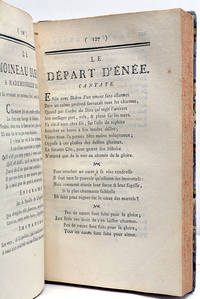
93217A Lausanne chez Marc-Michel Martin 1775. VII avec un frontispice inclus dans la pagination et placé par erreur à la fin du premier cahier. 302 pages. 19x125 Cm. Demi-veau dos lisse orné de filets. Reliure de l'époque restaurée. Coins émoussés. Edition très rare du premier ouvrage du littérateur suisse Philippe Syrach Bridel dit "le doyen Bridel" qui fut le premier défenseur des caractères nationaux de la littérature suisse. Ce recueil de pièces tirées d'auteurs divers présente en effet plusieurs textes caractéristiques de son inspiration. Une partie importante de l'ouvrage est constituée de fables pp.227-272. Joli frontispice gravé représentant le poète sur les bords du lac Léman. Très bon exemplaire à part quelques rousseurs et taches éparses et des feuillets un peu brunis. A Lausanne, chez Marc-Michel Martin, 1775. unknown
97987Amsterdam Paris 1752. Titre gravé. 295 pages. 165x10 Cm. Plein veau marbré. Dos à nerfs orné. Triple filet doré encadrant les plats. Roman sentimental dont l'intrigue se déroule à Bordeaux et dans sa région avec notamment une scène de naufrage sur la Garonne. L'auteur était magistrat et premier président au Parlement de Dijon. Bel exemplaire bien relié à l'époque. Rares taches et rousseurs. Papier un peu bruni. Amsterdam (Paris), 1752. unknown
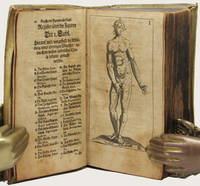
170434368Leipzig: Thomas Fritsch 1704. First German Edition. Illustrated with an engraved frontispiece of the author and 31 additional full-page engravings depicting various anatomical views. 8vo bound in the original contemporary vellum the spine with calligraphic titling by hand. viii 742 26 Register pp. A very good copy the binding still strong and well preserved the text with the usual mellowing and aging still crisp and very usable. FIRST GERMAN EDITION of this important work on anatomy partnered with the work of Philippi Verheyen Anmerckungen In Die Anatomiam Blancardi. Brieff An den weitberühmten Hrn. Friedrich Ruyschium.<br> 'Verheyen was a prolific writer including several books and manuscripts. His main work published originally in Latin the “Corporis Humani Anatomiae†was translated into multiple languages as here. This book became one of the most used anatomy books of the time.<br> The following excerpt of his book "Corporis Humani Anatomiae Liber Primus" reads : " . QuintusAuricularis quia cum minimum sit auribus expurgandis est aptissimus" translates as".the fifth finger called Auricularis because how small it is is most suitable to clean the ears". Incredibly anatomists at that time called the fifth digit "digitus auricularis".<br> Verheyen is credited with the creation of the eponym the “Achilles tendon†which denominates the common tendon for the gastrocnemius and soleus muscle although at the time he called it the “Chorda Achillisâ€. He also described the kidneys in detail especially the arterial “stars†found on the surface of the kidney which are today known as the “Stars of Verheyen†'. E. A. Miranda 2014 M.T.D. Thomas Fritsch hardcover
2007165606Paris: Editions du Regard 2007. Softcover. First French Edition. Text in English and French.<br /> <br /> About Fine in a Near Fine dust jacket. Editions du Regard unknown
198838570Paris: Souvenirs du Futur 1988. First Edition. Oversize folio 46cm.; white paper-covered clamshell box embossed thermoformed plastic plate mounted to upper cover six leaves laid in as issued to which are mounted thermoformed plates on rectos and versos with the exception of the last leaf on whose verso is printed the colophon. Clamshell box a bit dust-soiled else Near Fine. Lacking the cardboard shipping box.<br /> <br /> Quite possibly the only "comic book" in its class Le Grand Rêve Americain The Great American Dream adapts technology developed by Philippe Schléret and Véronique Hauss using molded plastic to create brilliantly colored 3D images. The work exuberantly lampoons Pop Art American culture and early underground comic books. Of all who have ever encountered the work and written of it seemingly none have failed to mention the heavy use of oversized female breasts that jut out from nearly every panel. Indeed OCLC record no. 712159856 lists "Large-breasted women" as one of the subjects. Other tropes not to be ignored include fancy sports cars gangsters and fastfood joints. OCLC notes 8 holdings. Souvenirs du Futur unknown
1692BS44GLTBN504Paris: Claude Barbin 1692. Hardback later mottled calf gilt title to spine label. 24.5cm x 19cm. Engraved portrait of Stanislaus Jablonowski by Picart one folding map 3 engraved plates engraved headpieces all by Vallet historiated initials. 1st edition 1692. Binding is slightly rubbed and worn with a few very small worm holes not going all the way through. Some dampstaining to front free end-paper and to inner lower margin of last few pages of the Table at rear but otherwise contents is generally clean. Scarce. bs44. 1st Edition. Hard Cover. Good. Claude Barbin Hardcover
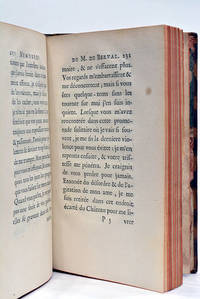
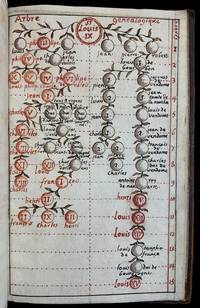
17304557N/A: N/A 1730. A lovely manuscript copy of this selection of Royal ordinances attributed to Andre Barrigue de Montvalon. This work existed only in copied manuscript form from 1724 to 1752 when it was finally published. Our copy is an early manuscript. Attractive manuscript title with a coat of arms beneath. It appears to show the arms of a Marquis. The work contains the Royal Laws along with the commentary of Philippe Bornier. The author is quite critical of Bornier's work and corrects his errors and dating. As stated in the preface content in red ink refers to Bornier's work. Dates of ordinances are indicated in side notes. There are also two tables. One shows them in chronological order. The other in alphabetical. Text is throughout in a neat French secretarial hand. This work is almost identical to a 1728 version found in the Bibliotheque de Droit Schuman in Aix-en-Provence and a slightly earlier 1724 edition currently on sale in the USA. Our copy is slightly enlarged as BOUND IN is a lovely genealogical tree of the French Royal family and 8 pages 4 leaves of a red and black list of the kings and their significant dates. Condition. The full leather period binding is in good strong condition with just a little rubbing and slight loss to the head of the spine. Attractive gilt decoration and titles to spine. Marbled end papers. Internally the pages are in good clean condition with just a touch of movement to the binding. The final gathers with the genealogical details are slightly cracked to the binding and "sit proud" of the rest of the text block. Overall in excellent condition. Collation: 236 7 1 8 1 ff. / 472 ordinances & indexes 14 blank 2 ruled only 16 genealogies 1 1 blank pages. 170 by 110mm 6¾ by 4¼ inches. Conforms to Worldcat OCLC Number: 18455885. Barrigue de Montvalon was a legal advisor to the Parlement of Provence. He was sent to defend the King physically when a disputed broke out between the parlement and the court at Aixes. He was a great supporter of the Jesuits. Barrigue lived to the age of 101. P. Girard noting his devotion said of him that he "knew only the Palace and retirement. A long life is the reward of good morals". Bornier was an Advisor to the King serving as a counselor to the king and lieutenant principal at the présidial court of the city. . Belle copie manuscrite de cette sélection d'ordonnances royales attribuée à André Barrigue de Montvalon. Cet ouvrage n'a existé que sous forme de manuscrit copié de 1724 à 1752 date à laquelle il fut finalement publié. Notre exemplaire est un manuscrit ancien. Titre manuscrit attrayant avec des armoiries en dessous. Il semble qu'il s'agisse des armoiries d'un marquis. L'ouvrage contient les lois royales ainsi que le commentaire de Philippe Bornier. L'auteur est assez critique à l'égard du travail de Bornier dont il corrige les erreurs et les datations. Comme indiqué dans la préface le contenu à l'encre rouge se réfère à l'ouvrage de Bornier. Les dates des ordonnances sont indiquées dans les notes annexes. Il y a également deux tableaux. L'un les présente dans l'ordre chronologique. L'autre par ordre alphabétique. Le texte est rédigé d'une main soignée de secrétaire français. Cet ouvrage est presque identique à une version de 1728 trouvée à la Bibliothèque de Droit Schuman à Aix-en-Provence et à une édition légèrement antérieure 1724 actuellement en vente aux Etats-Unis. Notre exemplaire est légèrement plus grand car il contient un bel arbre généalogique de la famille royale française et 8 pages 4 feuilles d'une liste rouge et noire des rois et de leurs dates significatives. Condition. La reliure d'époque en plein cuir est en bon état solide avec juste un peu de frottement et une légère perte à la tête de la colonne vertébrale. La décoration et les titres dorés au dos sont attrayants. Papiers de fin marbrés. L'intérieur des pages est en bon état propre avec juste un peu de mouvement à la reliure. Les derniers feuillets avec les détails généalogiques sont légèrement fendus à la reliure et se détachent du reste du bloc de texte. Dans l'ensemble l'ouvrage est en excellent état. Collation : 236 7 1 8 1 ff. / 472 ordonnances et index 14 vierges 2 réglées seulement 16 généalogies 1 1 vierge pages. 170 par 110mm 6¾ par 4¼ pouces. Conforme au numéro Worldcat OCLC : 18455885. Barrigue de Montvalon était conseiller juridique au Parlement de Provence. Il fut envoyé pour défendre physiquement le roi lorsqu'un différend éclata entre le parlement et la cour d'Aixes. Il était un grand partisan des Jésuites. Barrigue vécut jusqu'à l'âge de 101 ans. P. Girard notant son dévouement dit de lui qu'il "ne connaissait que le Palais et la retraite. Une longue vie est la récompense des bonnes mœurs". Bornier était conseiller du roi servant comme conseiller du roi et lieutenant principal à la cour présidiale de la ville. N/A hardcover
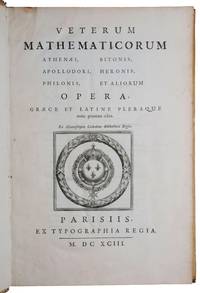
16936467Paris: Typographia Regia 1693. First edition. <p>First edition a very fine copy of this collection of early Greek writings on technology especially military technology and hydrostatics. It contains several treatises on the mechanics and siege operations or poliorcetica of the Hellenistic period the period between Alexander and Augustus including the construction and management of projectile engines.</p>. DIBNER 84: ANCIENT GREEK TECHNOLOGY. <p>First edition of this collection of early Greek writings on technology especially military technology and hydrostatics. It contains several treatises on the mechanics and siege operations or poliorcetica used in the Hellenistic period the period between Alexander and Augustus including the construction and management of their projectile engines. The first six works in the volume comprise the writings on the subject of military engines that were compiled by Athenaeus Apollodorus Biton Heron and Philon. These works include the first edition in both Greek and Latin of Biton's Construction of War Machines and Artillery of extant part of the Mechanike Syntaxis attributed to Philon of Byzantium and of the Poliorcetica of Apollodorus of Damascus. These are followed by the Greek and Latin texts of Hero of Alexandria's works on hydrostatics the Pneumatica and Automata which include what some regard as the first description of a steam-engine; this is the first printing of the Greek text of these works. Thévenot the King's librarian to Louis XIV prepared the present work from a rather defective secondary manuscript Codex Parisinus 2435. After Thévenot's death in 1692 it was revised by the mathematician La Hire with insightful annotations by Boivin an official in the King's library. It is one of three early publications of the French Academy of Sciences grouped together as Dibner 84. "Printed at the royal press in small editions they were intended as gifts for the King and Academy. In size binding and beauty of the plates they are among the most sumptuous books in science" Dibner. This is a rare book on the market only eight copies having appeared at auction in the last 40 years. The Evelyn copy was sold at Christie's in 1977.</p> <br /> <p>To gain access to the walls of a site under siege a siege tower or ram was brought into position and used to launch an attack onto the walkway aided by missile fire from the higher levels of the tower. Simultaneous attacks with scaling ladders took place. A siege tower is a specialized siege engine constructed to protect assailants and the ladders used when approaching the defensive walls of a fortification. The tower was usually rectangular with four wheels and a height roughly equal to that of the wall; it was sometimes higher to allow archers to stand on the top and fire into the fortification. The tower was made chiefly of wood but sometimes there were metal components as well. They were unwieldy to manoeuvre and slow to assemble and consequently were usually constructed at the siege site. Sometimes siege towers themselves incorporated other devices including artillery rams and dropbridges. Two main types of artillery equipment were used in this period: bolt-throwers ballistae: used for picking off prominent individuals and stone-throwers scorpiones onagri. Stone throwers could cause structural damage but were generally confined to firing at towers gates or siege machinery. Artillery might use incendiary ammunition when firing at gates or equipment.</p> <br /> <p>In common with much Byzantine literature poliorcetica draw heavily on earlier classical material. Since these were composed before the development of heavy artillery the poliorcetica are not so much concerned with large machines but rather with describing techniques for bringing men close to fortifications and then ways of undermining them. They also suggest various psychological tricks which might be used to outwit the enemy. Such ancient works on military machines were a source of fascination to the Italians of the late 15th and 16th centuries not only because of their historic interest but also as a source for modern inventions to be used in contemporary warfare and several of these works were first published in Renaissance Italy.</p> <br /> <p>The present volume begins with the De Machinis of Athenaeus a Cilician ex-statesman living in Rome in the 20s B.C. and a contemporary of the architect-engineer Vitruvius who like Vitruvius worked under the patronage of the Emperor Augustus Vitruvius devoted Book 10 of his De Architectura to machines. In addition to describing individual siege engines and theorizing on tactics Athenaeus draws on actual instances from history of the use of these machines in order to make various points and elucidate his text.</p> <br /> <p>The author of the next text is Apollodorus of Damascus who was a Roman architect and engineer of the late 1st to early 2nd century A.D. As Emperor Trajan's architect and military engineer he was responsible for Trajan's forum and possibly Trajan's column and produced designs for new siege machines. In his treatise Poliorcetica he describes a system of banks and ditches and also sheds that would be needed to protect the legionaries during undermining work or to carry battering rams against a tower gate or wall. Next he describes the construction of a siege tower followed by a system of interlocking ladders. He concludes his treatise with a description of a battlemented raft for river assaults. Although some of the elaborations are considered somewhat unrealistic − for example the addition of a torsion-powered truncheon to the end of a battering ram − and some of these are believed to have been added by a later editor the core of Apollodorus' text is believed to be authentic and to accurately describe highly effective machinery. Apollodorus dedicated Poliorcetica to the Emperor Hadrian perhaps an attempt to gain forgiveness for an earlier insult. On that occasion Trajan was discussing with Apollodorus the buildings which the great architect had built in Rome. Hadrian's assessment only demonstrated his ignorance which was bluntly pointed out by Apollodorus. Hadrian never forgot the insult and when he came to power banished Apollodorus accused him of several crimes and had him put to death.</p> <br /> <p>The third text in the volume is the Mechanike Syntaxis attributed to Philon of Byzantium who is believed to have been born about 280 B.C. in Byzantium and to have died around 220 B.C. Only the fourth and fifth books of this work have come down to us. Although there are few references to him in literature he is mentioned by Vitruvius. Amongst other weapons of siegecraft he describes the catapult recently invented by Ctesibius fl. 285-222 BC a Greek or Egyptian inventor and mathematician and probably the first head of the Museum at Alexandria. From this Philon's treatise can be dated fairly accurately to around 250 B.C. He describes journeys he made to Rhodes and to Alexandria to study catapults and it seems he may have earned his living advising military rulers.</p> <br /> <p>"The fourth book is headed κ τν Φιλνο βελοποιικν and the general subject is the manufacture of missiles. He mentions in it an invention of his own which he denominates ξυβλη p. 56. In the fifth book we are shocked to find that while recommending a besieging army to devastate the open country on the approach of an enemy he advises them to poison the springs and the grain which they cannot dispose of p. 103; and what renders this the worse he mentions his having treated of poisons in his book on the preparations that should be made for a war. What principally attracted attention to this work in modern times is his notice of the invention of Ctesibius p. 77. &c. The instrument described by him named εÏτονο acted on the property of air when condensed and is evidently in principle the same with the modern air-gun" A Dictionary of Greek and Roman Biography and Mythology<br /> William Smith ed. </p> <br /> <p>Philon's work is followed by the brief treatise of Biton of Pergamon 3rd or 2nd century B.C. about whom little is known; it is the only extant work to give a full description of advanced tension catapults. Biton's handbook describes four tension bow catapults a helepolis city-taker = siege tower and a sambuca mechanical scaling ladder. The bow catapults consisted of two stone throwers small and large and two bolt shooters a medium "belly bow" and mountain "belly bow". The latter took their name from the concave rest at their rear end against which the archer braced his stomach while drawing the bow. The work is dedicated to a King Attalus and was therefore composed between about 230 BC when Attalus I assumed the title of King and 133 BC death of Attalus III. As Biton mentions older types of catapults but not the torsion catapult that was otherwise well attested from the end of the 4th cent. BC the work probably belongs to the early years of the reign of Attalus I King of Pergamum 241-197 B.C. We do not know if Attalus employed the devices Biton described but they were definitely used in numerous later sieges and naval battles.</p> <br /> <p>The final two texts of siegecraft in the volume the Belopoeica and the Cheiroballistra are both attributed to Heron of Alexandria ca. 10-75 AD. Heron possibly taught at the Museum at Alexandria since many of his writings have the appearance of student lecture notes. The Belopoeica "On arrow making" describes the hand-held "belly bow" also discussed by Biton. The Cheiroballistra describes a small hand-held catapult. Some of Heron's designs derived from the works of Ctesibius none of whose works survive although they are mentioned by Vitruvius Athenaeus and Philo of Byzantium as well as Heron. In 1616 Bernardino Baldi 1553-1617 published a Latin translation of Heron's Belopoeica along with Heron's Greek text and a biography of Heron also written in Latin. Some of Baldi's commentary is appended to the present work.</p> <br /> <p>The volume concludes with the Pneumatica and Automata of Hero or Heron of Alexandria fl. 62 CE. "The Pneumatica in two books describes a menagerie of mechanical devices or "toys": singing birds puppets coin-operated machines a fire engine a water organ and his most famous invention the aeolipile the first steam-powered engine. This last device consists of a sphere mounted on a boiler by an axial shaft with two canted nozzles that produce a rotary motion as steam escapes" Britannica. "The introduction treats the occurrence of a vacuum in nature and the pressure of air and water . Some of the theory is right some is wrong for instance the horror vacui of nature but it was the best theoretical explanation to be had at the time . The first chapters most of them taken from Philo's Pneumatics describe experiments to show that air is a body and that it will keep water out of a vessel unless it can find an outlet and will keep water in if it cannot enter. Hero goes on to siphons . With very few exceptions it is evident that the chapters were written by Hero himself and without exception they are very clear: each instrument can be reconstructed from the description and the figure. While there is no order at all in the general arrangement of the chapters we find here and there a short series of related chapters in which it is clear that Hero is searching for a better solution to a mechanical problem. This shows unmistakably that he was an inventor; it is therefore probable that he himself invented the dioptra the screw-cutter and the odometer as well as several pneumatic apparatuses" DSB. The first appearance in print of Pneumatica was a Latin paraphrase in Giorgio Valla's De expetendis et fugiendis rebus 1501; the complete text was first published in Latin by Federico Commandino 1509-75 in 1575. The excellence of Commandino's translation persuaded the editors that it was unnecessary to include a further Latin translation in the present work and therefore only the Greek text of Pneumatica appears. Some of the commentary on Pneumatica from the 1589 Italian translation by Giovanni Battista Aleotti 1546-1636 is appended to the present work.</p> <br /> <p>"The Automata or Automatic Theater describes two sorts of puppet shows one moving and the other stationary; both of them perform without being touched by human hands. The former moves before the audience by itself and shows a temple in which a fire is lit on an altar and the god Dionysus pours out a libation while bacchantes dance about him to the sound of trumpets and drums. After the performance the theater withdraws. The stationary theater opens and shuts its doors on the performance of the myth of Nauplius. The shipwrights work; the ships are launched and cross a sea in which dolphins leap; Nauplius lights the false beacon to lead them astray; the ship is wrecked; and Athena destroys the defiant Ajax with thunder and lightning. The driving power in both cases was a heavy lead weight resting on a heap of millet grains which escaped through a hole. The weight was attached by a rope to an axle and the turning of this axle brought about all the movements by means of strings and drums. Strings and drums constituted practically all the machinery; no springs or cogwheels were used. It represents a marvel of ingenuity with very scant mechanical means" DSB. The Automata was first published in Italian by Baldi in 1589.</p> <br /> <p>"The design of this collection was formed by Thévenot 1620-92 deputy librarian of the Royal library in the reign of Louis XIV and after his death it was carried out by De la Hire 1640-1718. Thévenot's plan was to publish an accurate transcript of the MSS. of the several authors. The inevitable obscurity arising from the numerous corruptions which had crept into the manuscripts was to be remedied by an appendix of notes and a Latin translation. But for the Pneumatics of Hero it seemed sufficient to adopt the already well-known translation of Commandine; and in consequence of the eight MSS. of this treatise existing in the Royal Library that one was chosen which most nearly agreed with the Latin version" The Pneumatics of Hero of Alexandria translated and edited by Bennet Woodcroft 1851 preface.</p> <br /> <p>Brunet V 1163; Dibner Heralds 84; Norman 2148; Schweiger I 358. For a detailed account of the works contained in the present volume see Marsden Greek and Roman Artillery: Historical Development 1969.</p> <br/> <br/> Folio 432 x 288 mm pp. xvi including half-title 279 290-365 9 index & colophon occasional mostly light browning. Text in double columns Greek or parallel Greek and Latin many engraved diagrams and illustrations in text engraved head- and tail-pieces. Contemporary blind-stamped vellum. A very fine copy. Typographia Regia unknown
16934930Paris: Typographia Regia 1693. First edition. <p>First edition the Stanhope copy of this collection of early Greek writings on technology especially military technology and hydrostatics. It contains several treatises on the mechanics and siege operations or poliorcetica of the Hellenistic period the period between Alexander and Augustus including the construction and management of projectile engines.</p>. DIBNER 84: ANCIENT GREEK TECHNOLOGY. <p>First edition the Stanhope copy of this collection of early Greek writings on technology especially military technology and hydrostatics. It contains several treatises on the mechanics and siege operations or poliorcetica used in the Hellenistic period the period between Alexander and Augustus including the construction and management of their projectile engines. The first six works in the volume comprise the writings on the subject of military engines that were compiled by Athenaeus Apollodorus Biton Heron and Philon. These works include the first edition in both Greek and Latin of Biton's Construction of War Machines and Artillery of extant part of the Mechanike Syntaxis attributed to Philon of Byzantium and of the Poliorcetica of Apollodorus of Damascus. These are followed by the Greek and Latin texts of Hero of Alexandria's works on hydrostatics the Pneumatica and Automata which include what some regard as the first description of a steam-engine; this is the first printing of the Greek text of these works. Thévenot the King's librarian to Louis XIV prepared the present work from a rather defective secondary manuscript Codex Parisinus 2435. After Thévenot's death in 1692 it was revised by the mathematician La Hire with insightful annotations by Boivin an official in the King's library. It is one of three early publications of the French Academy of Sciences grouped together as Dibner 84. "Printed at the royal press in small editions they were intended as gifts for the King and Academy. In size binding and beauty of the plates they are among the most sumptuous books in science" Dibner. This is a rare book on the market only eight copies having appeared at auction in the last 40 years. The Evelyn copy was sold at Christie's in 1977.</p> <br /> <p>Provenance: Philip Stanhope 2nd Earl Stanhope 1714-86 bookplate on front paste-down. Stanhope was a Fellow of the Royal Society from 1735 and had a lifelong interest in mathematics. A student of Abraham de Moivre Stanhope made significant contributions to probability theory. He was also a patron of various mathematicians notably Thomas Bayes; Stanhope was responsible for Bayes's election to the Royal Society and probably also for Bayes taking up the study of probability Bellhouse pp. 190 & 201. </p> <br /> <p>To gain access to the walls of a site under siege a siege tower or ram was brought into position and used to launch an attack onto the walkway aided by missile fire from the higher levels of the tower. Simultaneous attacks with scaling ladders took place. A siege tower is a specialized siege engine constructed to protect assailants and the ladders used when approaching the defensive walls of a fortification. The tower was usually rectangular with four wheels and a height roughly equal to that of the wall; it was sometimes higher to allow archers to stand on the top and fire into the fortification. The tower was made chiefly of wood but sometimes there were metal components as well. They were unwieldy to manoeuvre and slow to assemble and consequently were usually constructed at the siege site. Sometimes siege towers themselves incorporated other devices including artillery rams and dropbridges. Two main types of artillery equipment were used in this period: bolt-throwers ballistae: used for picking off prominent individuals and stone-throwers scorpiones onagri. Stone throwers could cause structural damage but were generally confined to firing at towers gates or siege machinery. Artillery might use incendiary ammunition when firing at gates or equipment.</p> <br /> <p>In common with much Byzantine literature poliorcetica draw heavily on earlier classical material. Since these were composed before the development of heavy artillery the poliorcetica are not so much concerned with large machines but rather with describing techniques for bringing men close to fortifications and then ways of undermining them. They also suggest various psychological tricks which might be used to outwit the enemy. Such ancient works on military machines were a source of fascination to the Italians of the late 15th and 16th centuries not only because of their historic interest but also as a source for modern inventions to be used in contemporary warfare and several of these works were first published in Renaissance Italy.</p> <br /> <p>The present volume begins with the De Machinis of Athenaeus a Cilician ex-statesman living in Rome in the 20s B.C. and a contemporary of the architect-engineer Vitruvius who like Vitruvius worked under the patronage of the Emperor Augustus Vitruvius devoted Book 10 of his De Architectura to machines. In addition to describing individual siege engines and theorizing on tactics Athenaeus draws on actual instances from history of the use of these machines in order to make various points and elucidate his text.</p> <br /> <p>The author of the next text is Apollodorus of Damascus who was a Roman architect and engineer of the late 1st to early 2nd century A.D. As Emperor Trajan's architect and military engineer he was responsible for Trajan's forum and possibly Trajan's column and produced designs for new siege machines. In his treatise Poliorcetica he describes a system of banks and ditches and also sheds that would be needed to protect the legionaries during undermining work or to carry battering rams against a tower gate or wall. Next he describes the construction of a siege tower followed by a system of interlocking ladders. He concludes his treatise with a description of a battlemented raft for river assaults. Although some of the elaborations are considered somewhat unrealistic − for example the addition of a torsion-powered truncheon to the end of a battering ram − and some of these are believed to have been added by a later editor the core of Apollodorus' text is believed to be authentic and to accurately describe highly effective machinery. Apollodorus dedicated Poliorcetica to the Emperor Hadrian perhaps an attempt to gain forgiveness for an earlier insult. On that occasion Trajan was discussing with Apollodorus the buildings which the great architect had built in Rome. Hadrian's assessment only demonstrated his ignorance which was bluntly pointed out by Apollodorus. Hadrian never forgot the insult and when he came to power banished Apollodorus accused his of several crimes and had him put to death.</p> <br /> <p>The third text in the volume is the Mechanike Syntaxis attributed to Philon of Byzantium who is believed to have been born about 280 B.C. in Byzantium and to have died around 220 B.C. Only the fourth and fifth books of this work have come down to us. Although there are few references to him in literature he is mentioned by Vitruvius. Amongst other weapons of siegecraft he describes the catapult recently invented by Ctesibius fl. 285-222 BC a Greek or Egyptian inventor and mathematician and probably the first head of the Museum at Alexandria. From this Philon's treatise can be dated fairly accurately to around 250 B.C. He describes journeys he made to Rhodes and to Alexandria to study catapults and it seems he may have earned his living advising military rulers.</p> <br /> <p>"The fourth book is headed κ τν Φιλνο βελοποιικν and the general subject is the manufacture of missiles. He mentions in it an invention of his own which he denominates ξυβλη p. 56. In the fifth book we are shocked to find that while recommending a besieging army to devastate the open country on the approach of an enemy he advises them to poison the springs and the grain which they cannot dispose of p. 103; and what renders this the worse he mentions his having treated of poisons in his book on the preparations that should be made for a war. What principally attracted attention to this work in modern times is his notice of the invention of Ctesibius p. 77. &c. The instrument described by him named εÏτονο acted on the property of air when condensed and is evidently in principle the same with the modern air-gun" A Dictionary of Greek and Roman Biography and Mythology<br /> William Smith ed. </p> <br /> <p>Philon's work is followed by the brief treatise of Biton of Pergamon 3rd or 2nd century B.C. about whom little is known; it is the only extant work to give a full description of advanced tension catapults. Biton's handbook describes four tension bow catapults a helepolis city-taker = siege tower and a sambuca mechanical scaling ladder. The bow catapults consisted of two stone throwers small and large and two bolt shooters a medium "belly bow" and mountain "belly bow". The latter took their name from the concave rest at their rear end against which the archer braced his stomach while drawing the bow. The work is dedicated to a King Attalus and was therefore composed between about 230 BC when Attalus I assumed the title of King and 133 BC death of Attalus III. As Biton mentions older types of catapults but not the torsion catapult that was otherwise well attested from the end of the 4th cent. BC the work probably belongs to the early years of the reign of Attalus I King of Pergamum 241-197 B.C. We do not know if Attalus employed the devices Biton described but they were definitely used in numerous later sieges and naval battles.</p> <br /> <p>The final two texts of siegecraft in the volume the Belopoeica and the Cheiroballistra are both attributed to Heron of Alexandria ca. 10-75 AD. Heron possibly taught at the Museum at Alexandria since many of his writings have the appearance of student lecture notes. The Belopoeica "On arrow making" describes the hand-held "belly bow" also discussed by Biton. The Cheiroballistra describes a small hand-held catapult. Some of Heron's designs derived from the works of Ctesibius none of whose works survive although they are mentioned by Vitruvius Athenaeus and Philo of Byzantium as well as Heron. In 1616 Bernardino Baldi 1553-1617 published a Latin translation of Heron's Belopoeica along with Heron's Greek text and a biography of Heron also written in Latin. Some of Baldi's commentary is appended to the present work.</p> <br /> <p>The volume concludes with the Pneumatica and Automata of Hero or Heron of Alexandria fl. 62 CE. "The Pneumatica in two books describes a menagerie of mechanical devices or "toys": singing birds puppets coin-operated machines a fire engine a water organ and his most famous invention the aeolipile the first steam-powered engine. This last device consists of a sphere mounted on a boiler by an axial shaft with two canted nozzles that produce a rotary motion as steam escapes" Britannica. "The introduction treats the occurrence of a vacuum in nature and the pressure of air and water . Some of the theory is right some is wrong for instance the horror vacui of nature but it was the best theoretical explanation to be had at the time . The first chapters most of them taken from Philo's Pneumatics describe experiments to show that air is a body and that it will keep water out of a vessel unless it can find an outlet and will keep water in if it cannot enter. Hero goes on to siphons . With very few exceptions it is evident that the chapters were written by Hero himself and without exception they are very clear: each instrument can be reconstructed from the description and the figure. While there is no order at all in the general arrangement of the chapters we find here and there a short series of related chapters in which it is clear that Hero is searching for a better solution to a mechanical problem. This shows unmistakably that he was an inventor; it is therefore probable that he himself invented the dioptra the screw-cutter and the odometer as well as several pneumatic apparatuses" DSB. The first appearance in print of Pneumatica was a Latin paraphrase in Giorgio Valla's De expetendis et fugiendis rebus 1501; the complete text was first published in Latin by Federico Commandino 1509-75 in 1575. The excellence of Commandino's translation persuaded the editors that it was unnecessary to include a further Latin translation in the present work and therefore only the Greek text of Pneumatica appears. Some of the commentary on Pneumatica from the 1589 Italian translation by Giovanni Battista Aleotti 1546-1636 is appended to the present work.</p> <br /> <p>"The Automata or Automatic Theater describes two sorts of puppet shows one moving and the other stationary; both of them perform without being touched by human hands. The former moves before the audience by itself and shows a temple in which a fire is lit on an altar and the god Dionysus pours out a libation while bacchantes dance about him to the sound of trumpets and drums. After the performance the theater withdraws. The stationary theater opens and shuts its doors on the performance of the myth of Nauplius. The shipwrights work; the ships are launched and cross a sea in which dolphins leap; Nauplius lights the false beacon to lead them astray; the ship is wrecked; and Athena destroys the defiant Ajax with thunder and lightning. The driving power in both cases was a heavy lead weight resting on a heap of millet grains which escaped through a hole. The weight was attached by a rope to an axle and the turning of this axle brought about all the movements by means of strings and drums. Strings and drums constituted practically all the machinery; no springs or cogwheels were used. It represents a marvel of ingenuity with very scant mechanical means" DSB. The Automata was first published in Italian by Baldi in 1589.</p> <br /> <p>"The design of this collection was formed by Thévenot 1620-92 deputy librarian of the Royal library in the reign of Louis XIV and after his death it was carried out by De la Hire 1640-1718. Thévenot's plan was to publish an accurate transcript of the MSS. of the several authors. The inevitable obscurity arising from the numerous corruptions which had crept into the manuscripts was to be remedied by an appendix of notes and a Latin translation. But for the Pneumatics of Hero it seemed sufficient to adopt the already well-known translation of Commandine; and in consequence of the eight MSS. of this treatise existing in the Royal Library that one was chosen which most nearly agreed with the Latin version" The Pneumatics of Hero of Alexandria translated and edited by Bennet Woodcroft 1851 preface.</p> <br /> <p>Brunet V 1163; Dibner Heralds 84; Norman 2148; Schweiger I 358. For a detailed account of the works contained in the present volume see Marsden Greek and Roman Artillery: Historical Development 1969.</p> <br/> <br/> Folio 432 x 284mm pp. xvi including half-title 279 290-365 9 index & colophon occasional mostly light browning. Text in double columns Greek or parallel Greek and Latin many engraved diagrams and illustrations in text engraved head- and tail-pieces. Eighteenth-century mottled calf spine richly gilt in compartments with red lettering-piece. Bookplate of Philip Earl Stanhope on front paste-down. This is a very large copy 10mm taller than the Norman copy. Typographia Regia unknown
19762090502128600779Shueisha 1976. Soft Cover. Fine. Number of pages: 351p Portrait size: 20cm Shueisha paperback
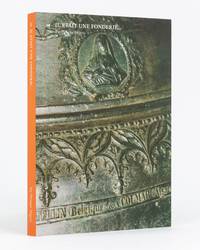
2004111774Stavelot: Chauveheid s.a. 2004. First Edition. Paperback. Fine. Stavelot Chauveheid s.a. 2004. Small quarto i 159 pages with numerous illustrations many in colour. Colour-pictorial card covers with flaps; with the contemporary ownership stamp of Bagot Bellfoundries Adelaide; a fine copy. Text in French. Chauveheid s.a. paperback
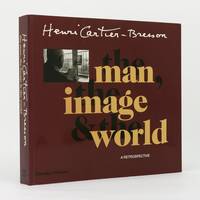
2006146173London: Thames & Hudson 2006. Paperback. Very Good. London Thames & Hudson 2006 first paperback edition/ 2003. Oblong quarto 231 pages with 'over 600 illustrations in colour and duotone'. Card covers with flaps; covers lightly rubbed; edges a little marked; an excellent copy. Thames & Hudson paperback
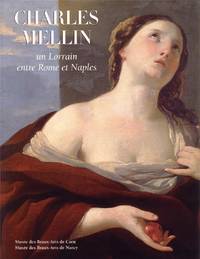
2007PMV513405QParis Caen Nancy: Somogy ; Musée des beaux-arts de Caen ; Musée des beaux-arts de Nancy 2007. Trade paperback. Good/Not issued. 248 x 280 x 25 cm. Paperback • Nombreuses illustrations en noir et en couleurs couverture illustrée en couleurs • <b><i>French text original</i></b>. Somogy ; Musée des beaux-arts de Caen ; Musée des beaux-arts de Nancy paperback
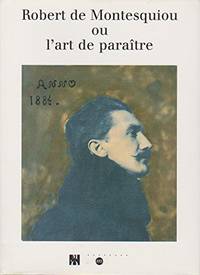
2008PMV416202AParis: Bibliothèque nationale de France 2008. Trade paperback. Very good/Not issued. 221 x 271 x 17 cm. Paperback • Illustrations en noir et en couleurs couverture illustrée • <b><i>French text original</i></b> • Printed 2008 • No inscriptions. Bibliothèque nationale de France paperback
2007PMV411305EParis Rome: Hazan ; Académie de France à Rome-Villa Medici 2007. Trade paperback. Good/Not issued. 245 x 285 x 15 cm. Paperback • Illustrations en noir et en couleurs couverture illustrée en couleurs • <b><i>French Italian text original</i></b>. Hazan ; Académie de France à Rome-Villa Medici paperback
2007PM231401MParis ; Colmar: Somogy ; Musée d'Unterlinden 2007. Trade paperback. Good/Not issued. 245 x 320 x 22 cm. Paperback • Illustrations en noir et en couleurs couverture illustrée en couleurs • <b><i>French text original</i></b>. Somogy ; Musée d'Unterlinden paperback
2006PMV332506ABrest: Musée des beaux-arts de Brest 2006. Trade paperback. Very good/Not issued. 27 cm. Paperback • Illustrations en noir et en couleurs couverture illustrée en couleurs • <b><i>French text original</i></b> • Printed 2006 • No inscriptions. Musée des beaux-arts de Brest paperback
1998PMV213302EParis: Réunion des musées nationaux 1998. Trade paperback. Good/Not issued. 237 x 294 x 13 cm. Paperback • Illustrations en noir et en couleurs couverture illustrée en couleurs • <b><i>French text original</i></b>. Réunion des musées nationaux paperback
1999PMV332201AParis: Réunion des musées nationaux 1999. Hardcover. Very good/Very good. 23 cm. Hardcover • Illustrations en noir et en couleurs jaquette illustrée en couleurs • <b><i>French text original</i></b> • Printed 1999 • No inscriptions. Réunion des musées nationaux hardcover
2002PMV608203QArles: Actes Sud / Fondation Vincent Van Gogh 2002. Hardcover. Good/Not issued. 227 x 287 x 14 cm. Hardcover • Illustrations en noir et en couleurs couverture illustrée en couleurs • <b><i>French text original</i></b>. Actes Sud / Fondation Vincent Van Gogh hardcover
2013PMV501502EParis Collioure: Somogy ; Musée d'art moderne Collioure 2013. Hardcover. Good/Not issued. 228 x 288 x 16 cm. Hardcover • Nombreuses illustrations en noir et en couleurs fac-similés couverture illustrée en couleurs • <b><i>French text original</i></b> • Printed 2013. Somogy ; Musée d'art moderne (Collioure) hardcover
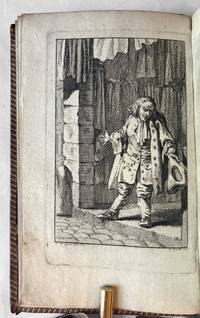
17464391The Hague i.e. Paris: s.n. 1746. 8vo 168 x 101 mm. 2 parts separately titled and paginated: 3-vi-xxiv 182 pages 1 blank leaf; 2 leaves 128 pages. Engraved frontispiece by Fessard after Cochin fils apparently included in the pagination typographic title ornaments head- and tailpieces. An attractive copy stain to fols. A2-3 in second part 2 or 3 minor marginal tears some spotting. Contemporary red morocco triple gilt fillet on sides smooth spine sparingly gold-tooled and lettered board edges gilt gilt edges scuffing to lower board edges and extremities of spine corners a bit bumped. Provenance: early purchase note on lower flyleaf; John Wodehouse 3rd Earl of Kimberley 1883-1941 bookplate; Leonard Forrer 1869-1953 his bookshop ticket of L. S. Forrer Ltd. Numismatic Booksellers London; Charles Van der Elst 1904-1982 bookplate.<br /> <br /> Only Edition of an extended literary joke by the brilliant antiquarian engraver art patron and connoisseur the Comte de Caylus. He exercised his stylistic muscles in this peculiar collection of two dozen literary pieces revolving around the word manteau: in part 1 racy anecdotes short stories fairy tales and a chivalric tale written in pseudo-archaic French; and in part 2 tongue-in-cheek erudite essays in several styles — the religious history the antiquarian disquisition the etymological or bibliographical analysis — all laced with fictional and a few real references including imaginary medieval manuscripts.<br /> <br /> A glance at the entry for manteau in the online Trésor de la Langue Française gives an idea of the semantic opportunities offered by this word whose appearances in many idiomatic expressions are exhaustively exploited by Caylus. In part 1 appear the manteau de fourrure fur coat the manteau de lit a short bed-jacket into which a jealous husband is metamorphosed by his fairy mother-in-law to teach him a lesson the long and short coat the chimney mantel same word in French and a portrait of a remarkable old man presented as the fictional originator of the term “sous le manteau†clandestine or clandestinely.<br /> <br /> In part 2 which its title notes with a wink “one doesn’t need to read†the author delves into the Roman pallium a cloak the coats of saints and clerics those both heraldic and actual of Dukes and Peers and the order of the Blancs-Manteaux. Completing the picture are a florilegium of dictionary extracts and a satirical etymological comparison of the French manteau with other languages containing sentences like: “As for the letter L which is found at the end of words like Mantel and Mantello one can very well understand it to be a diminutive of the Arabic word Allah meaning God†p. 103. <br /> <br /> The self-imposition of arbitrary constraints onto one’s writing while an ancient practice viz. poetic meter have been associated more recently with a French literary movement from the 1960s known as Oulipo short for Ouvroir de littérature potentielle â€workship of potential literature†which included the great French authors Raymond Queneau and Georges Perec whose wry humor and doggedness in pursuing the conceit to the end Caylus foreshadowed. <br /> <br /> Cochin’s frontispiece shows a rather shifty-looking merchant in the doorway of his shop filled with coats. <br /> <br /> OCLC locates 4 copies in North American libraries. Cohen-De Ricci 210; Gay-Lemonnyer 3:23; Barbier III: 34 a 1775 edition not seen elsewhere. s.n. unknown