162 résultats
1758R320055540SHELTE HENRI. 1758. In-18. Relié plein cuir. Etat d'usage, Plats abîmés, Dos frotté, Intérieur frais. 398 pages - Contre-plats et tranches jaspés - Coins émoussés - Plats frottés - epidermures - coiffe en pied abimée.. . . . Classification Dewey : 880-Littératures helléniques. Littérature grecque
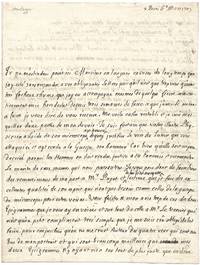
1705Boileau1<p><strong>BOILEAU DESPRÉAUX Nicolas 1636-1711</strong></p><p>Autograph letter signed " Despreaux " to Claude Brossette<br />Paris 6 March 1705 3 p. small in-4° in black ink on laid paper<br />Reinforced central fold small tears on margins without gravity<br />Several words crossed out by Boileau</p><p><strong>A long spiritual letter from the poet enriched with an epigram and a verse from <em>Le Cid</em> – Boileau elaborates in detail on his <em>Odes</em> and <em>Epigrams</em> the quintessence of the spirit of the Grand Siècle</strong></p><p><strong><em>" You say nothing about the four verses I wrote for the other infamous engraving I mentioned to you. Do you think they are bad Yet they have pleased everyone to whom I recited them "</em></strong></p><p><strong><u>Remarkable rediscovery of one of the rare letters to Brossette still in private hands believed to have been 'lost since 1858' Pléiade</u></strong></p><p><em>" Je ne m'estendrai point ici Monsieur en longues excuses du long temps que j'ay esté sans respondre a vos obligeantes Lettres puis qu'il n'est que trop vrai qu'un très facheux rhume que j'ay eu accompagné mesme de quelques fievre m'a entièrement mis hors d'estat depuis trois semaines de faire ce que j'aime le mieux a faire</em><em> je veux dire de vous réscrire. Me voila enfin restabli et je vais macquitter d'une partie de mon devoir. <strong>Je suis fort aise que votre illustre Physicien a l'aide de son microscope ayt trouvé de quoy justifier le vers du Lutrin que vous attaquiés et ayt rendu a la Guespe son honneur</strong></em>. <em>Car bien qu'elle soit un peu decriée parmi les Hommes on doit rendre justice a ses Ennemis et reconnoistre Le merite de ceux mesmes qui nous persecutent.</em> <em>Je vous prie donc de faire bien des remercimens de ma part a Mr Puget et de lui bien marquer lestime que je fais des excellentes qualités de son esprit qui n'ont pas besoin comm</em>e<em> celles de la guespe de microscope poue estre veües</em>¹.<strong><em>Vous faictes a mon avis trop de cas des deux Epigrammes que je vous ay envoiées et sur tout de celle a Mr Le Verrier qui n'est qu'un petit compliment très simple que je me suis crû obligé de lui faire pour empescher qu'on ne me crûst Auteur</em></strong>² <strong><em>des quatre vers qui sont au bas de mon portrait et qui sont beaucoup meilleurs que mes deux Epigrammes n'y ayant rien sur tout de plus juste que ces deux vers</em></strong><br /><em>J'ay sceu dans mes Escrits docte enjoués sublimes </em><br /><em>Rassembler en moi Perse Horace et Juvenal</em><br /><em>Supposé que cela fust vrai Docte respondant admirablement a Perse</em> <em>enjoué a Horace et sublime a Juvenal. Il les avoit faicts d'abord indirects et de la maniere dont vous me faictes voir que vous avés pretendu les rajuster mais cela les rendoit froids et c'est par le conseil de gens tres habiles qu'il les mit en stile directe</em> <em>la prosopopée ayant une grace qui les anime et une fanfaronnade mesme pour ainsi dire qui a son agrement. <strong>Vous ne me dites rien des quatre vers que j'ay faicts pour Lautre infame gravûre dont je vous ay parlé. Est-ce que vous les trouvés mauvais</strong></em>³ <strong><em>Ils ont pourtant réjoui tous ceux a qui je les ay dits</em></strong><em>. Mais pour vous satisfaire sur l'histoire que vous me demandez de l'Epigramme de Lubin</em> <em>Je vous dirai que Lubin est un de mes parens qui est mort il y a plus de vingt ans et qui avoit la folie que j'y attaque. Il estoit Secretaire du Roy et s'appelloit Mr Targas.</em>ⴠ<em>Javois dit lui vivant le mot dont j'ay composé le sel de mon Epigramme qui ma esté faicte quenviron depuis deux mois chés moi a Auteuil ou couchoit l'Abbé de Chasteauneuf.</em>ⵠ<em>Je m'estois ressouvenu le soir en conversant avec lui du mot dont il est question. Il l'avoit trouvé fort plaisant et sur cela <strong>nous estions convenus l'un et lautre qu'avant tout pour faire une bonne Epigramme il falloit dire en conversation le mot quon y vouloit mettre a la fin et voir s'il frapperoit</strong>. Celui ci donc l'ayant frappé je le lui rapportai le lendemain au matin construit en Epigramme telle que je vous lay envoiée. Voilà l'histoire. Le monument antique que vous m'avés faict tenir est fort beau et fort vrai</em>.ⶠ<em>Mon dessein estoit de le porter moi mesme a l'Academie des inscriptions mai j'ay sceu qu'il y avoit deja longtemps qu'il y estoit et que les Academiciens mesme sestoient deja fort exercés sur cette excellente relique de l'Antiquité. Je ne scay pas pourquoi vous me faictes une querelle d'Allemand sur la preeminence qu'a eu autrefois Lyon au dessus de Paris</em>.ⷠ<strong><em>Est ce que Paris a jamais nié que du temps de Cesar non seulement Lyon mais Marseille Sens Melun ne fussent beaucoup plus considérables que Paris et qu'est ce que de cela Lyon scauroit conclure contre Paris sinon ce vers du Cid</em></strong>⸠<strong><em><u>Vous estes aujourd'hui ce qu'autrefois je fus</u>.</em></strong><em> Je vous conjure de bien marquer Mr de Mezzabarba</em>⹠<em>dans les lettres que vous lui escrivés le cas que je fais de sa personne et de son merite. Je ne scay si vous avés veû la traduction qu'il a faite de mon Ode sur Namur. Je ne vous dirai pas qu'il y est plus moi mesme que moi mesme mais je vous dirai hardiment que bien de j'aye sur tout songé a y prendre l'esprit de Pindare</em>. <em>Mr de Mezzabarba y est beaucoup plus Pindare que moi. Si vous n'avés point encore receû de lettre de Mr Le Verrier cela ne vient que de ma faute et du peu de soin que j'ay eu de le faire ressouvenir comme je devois de vous rescrire mais je vais disner aujourd'hui ches lui et je reparerai ma negligence</em>. <em>Vous pouvés vous asseurer d'avoir au premier jour un compliment de sa facon. Adieu mon illustre Monsieur croiés que c'est tres sincerement que je suis</em><br /><em>Vostre très humble et tres obeissant serviteur</em><br /><em>Despreaux</em></p><p><em>Monsieur</em><br /><em>Soufrés que je fasse ici en particulier et hors d'œuvre mon compliment a Mr Perichon "</em></p><p>1 – The said "Wasp" makes its appearance in <em>Le Lutrin</em> Boileau's mock-epic which he published between 1672 and 1674. The passage to which the poet alludes is:<br /><em>" Tel qu'on voit un Taureau qu'une Guespe en furie </em><br /><em>A piqué dans les flancs au dépens de sa vie " </em>Pléiade p. 193 v. 7 & 8<br />Boileau had already responded two years earlier to his correspondent's criticism of this very passage in a letter he sent on May 26 1703: <em>"I well remember however that you strongly attacked what I say in my Lutrin about the Wasp which dies from the very sting with which it wounds its enemy."</em></p><p>2- <em>"</em> <em>Au joug de la Raison asservissant la Rime</em><br /><em>Et mesme en imitant toujours original</em><br /><em>J'ay sceu dans mes Escrits docte enjoués sublimes </em><br /><em>Rassembler en moi Perse Horace et Juvenal</em> <em>"</em> Pléiade p. 272<br />Brossette recounts that an engraver wishing to place a few verses beneath a portrait of Boileau asked the poet to compose them himself. To this Boileau replied: <em>"I am neither vain enough to speak well of myself nor foolish enough to speak ill of myself."</em> Even if he tries in vain to deny it Boileau is indeed the author of the epigram pretending to find himself too highly praised. He even complains about it in Poem no. XII <em>Pléiade</em> p. 245.</p><p>3- <em>"The other infamous engraving"</em> is a portrait of Boileau by an artist whose name he did not know. Plainly very displeased the poet lashes out in his earlier letter of January 12 1705 in these terms: <em>"</em>it<em> resembles me less than the Great Mogul."</em> The four lines to which he here alludes are found in that same letter:<br /><em>" Du celebre Boileau tu vois ici l'image.</em><br /><em>Quoi c'est là diras tu ce Critique achevé </em><br /><em>D'où vient le noir chagrin qu'on lit sur son visage </em><br /><em>C'est de ce voir si mal gravé. "</em></p><p>4- Pierre Targas married a cousin of Boileau Élisabeth Colin in 1647. Boileau made him the dedicatee of his Epigram LXVII <em>"The Lover of Clocks"</em> which he composed in December 1704.</p><p>5- François de Castagner Abbé de Chateauneuf 1645–1709 was Voltaire's godfather.</p><p>6- In his letter of February 12 Brossette enclosed an inscription "engraved on an ancient altar in the form of a pedestal which had been discovered in recent days in Lyon on the hill of Fourvière by peasants digging in the ground.</p><p>7- Boileau's reaction to the latest letter sent by Brossette who writes to him: <em>"You see Sir that in those times our Lyon was already a considerable city adorned with the title of colony and municipium and admitted to the honors and privileges of the Roman people whereas your Lutetia perhaps did not yet even dare aspire to the name of city."</em></p><p>8- <em>The Cid</em> Act I Scene 2 Don Diègue to the Count:<br /><em>" Je le sais vous servez bien le roi :</em><br /><em>Je vous ai vu combattre et commander sous moi.</em><br /><em>Quand l'âge dans mes nerfs a fait couler sa glace</em><br /><em>Votre rare valeur a bien rempli ma place ;</em><br /><em>Enfin pour épargner les discours superflus</em><br /><em>Vous êtes aujourd'hui ce qu'autrefois je fus. "</em></p><p>9- This is the translation of Boileau's ode <em>On the Capture of Namur</em>.</p><p>A lawyer from Lyon Claude Brossette 1671–1743 met the poet during a stay in Paris in 1698. Admirer of Boileau's poetry he was authorized by the poet to consider publishing his works with commentary. The edition rich in notes did not appear until 1716 five years after the poet's death. Brossette also left a <em>Journal</em> published by Laverdet in 1858 in which his relationship with Boileau is recounted.<br />Of the seventy-five letters from Boileau to Brossette that have been catalogued more than half are now held in the collections of the Historical Library of the City of Paris.</p><p><strong><u>Boileau's letters to Brossette considered among the finest in the poet's correspondence are exceedingly rare on the open market</u></strong></p><p><u>Provenance:</u><br />Private collection</p><p><u>Bibliography:</u><br /><em>Correspondance entre Boileau Despréaux et Brossette</em> éd. Auguste Laverdet J. Techener 1858 n°CVIII / <em>Œuvres poétiques</em> t<em>. </em>2 Imprimerie générale Paris 1872 p. 178 /<em> Bibliographie générale </em>éd. Émile Magne Giraud-Badin Paris 1929 p. 11 <em>/ Œuvres complètes</em> éd. Françoise Escal Pléiade pp. 694-696 – n°XLVIII / <em>Littérature classiques Juvénal en France au XVI</em><em>ᵉ</em><em> et au XVII</em><em>ᵉ</em><em> siècle</em> Pascal Debailly printemps 1995 p. 45<br />The transcription in the <em>Pléiade</em> based on Laverdet's edition contains errors in several places. Here we restore Boileau's original spelling as it stands.</p>
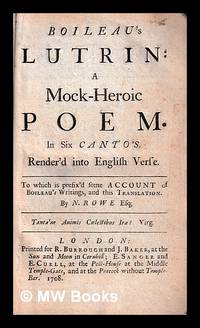
1708442173London : Printed for E. Sanger and E. Curll 1708. First Edition. Disbound. Very good paperback copy disbound as issued; edges slightly dust-dulled and nicked. Remains particularly well-preserved overall. Physical description; 22 122 pages plate. Subjects; Rowe Nicholas 1674-1718. Ozell John -1743. Boileau Despreaux Nicolas 1636-1711. Ozell Mr. John d. 1743. French poetry Translations into English ; Early works to 1800. French poetry Translations into English. London : Printed for E. Sanger and E. Curll unknown
1730(LCPCHIS-0015)("Le roi leur dit, il y a quatre jours: <je suis fâché que vous ne soyez point venus à cette dernière campagne; vous auriez vu la guerre, et votre voyage n'eût été long>. Racine lui répondit: <Sire, nous sommes deux bourgeois qui n'avons que des habits de ville; nous en commandâmes de campagne; mais les places que vous attaquiez furent plus tôt prises que nos habits ne furent faits>. Cela fut reçu agréablement") RACINE Jean (La Ferté-Milon, 1639 - Paris, 1699) - BOILEAU Nicolas (Paris, 1636 - Paris, 1711) "CAMPAGNE DE LOUIS XIV. AVEC LA COMPARAISON DE FRANCOIS I. AVEC CHARLES-QUINT". 1730, Paris, Mesnier. 1 vol. in-12° (157x95 mm) (dimensions pages 153x87 mm) (1) f., VIII, 266 pp., (1) f. Reliure en basane granitée strictement de l'époque. Dos à cinq nerfs orné, avec pièce de titre en maroquin rouge. Tranches rouges. Edition Originale, très rare. Infime manque à la coiffe inférieure et un coin émoussé au second plat ; ancienne mouillure à l'angle supérieur du premier feuillet de garde, mais intérieur très frais ; une ancienne note manuscrite au dernier feuillet de garde, avec petit manque ; malgré les défauts signalés, très bel exemplaire. L'ouvrage est un éloge adressé au Roi Louis XIV. Proche du Roi (il le suit aux sièges de Gand et d'Ypres en 1678, en Alsace en 1683, à Luxembourg en 1687 et en Flandre en 1691, 1692 et 1693) et fréquentant la cour, l'auteur dresse un tableau précis des conquêtes de Louis XIV. Cependant, sous couvert des louanges adressées par l'écrivain au Roi on peut déceler quelques réserves de l'auteur quant au règne de Louis XIV. Publié sous le nom de Pélisson, il faut attendre une nouvelle édition en 1784 sous le titre "Eloge historique du roi Loi XIV sur ses conquêtes depuis 1672 jusqu'en 1678" pour qu'apparaisse l'attribution correcte du texte de Racine et Boileau. Dans le présent volume la partie qui concerne ces deux auteurs occupe les quatre-vingt seize premières pages. "La Campagne de Louis XIV, malgré l'attribution du titre est l'oeuvre de Jean Racine et de Boileau. La comparaison serait de Varillas" (Guibert). Provenance: Note manoscritte signée Joannes Baptista Salomon de Segonzae (1733). Seuls cinq exemplaires sont répertoriés dans les institutions publiques internationales. D'après la Librairie A. Sourget deux seuls exemplaires sont passés sur le marché international en plus de 40 ans: un ex. en maroquin bleu armorié de Mercier (Libr. Sourget cat. XXXIX/2010 n. 122, 7.500,00 Euros) et un ex. en vélin moucheté de l'époque (Libr. A. Sourget cat. 10/2016 n. 36, 3.500,00 Euros). (Tchémerzine, V, 369; Barbier, I, 484; Guibert, 285-289) (LCPCHIS-0015) (1.500,00 €)
176728488Amsterdam J.H. Schneider 1767 Fort In-8 378 pp et relié avec "l' esprit de Madame Necker " X - 1 ff -352 pp mors légèrement fendu en queue, traces d'humidité au titre, traces de frottements pour le papier de couvrure
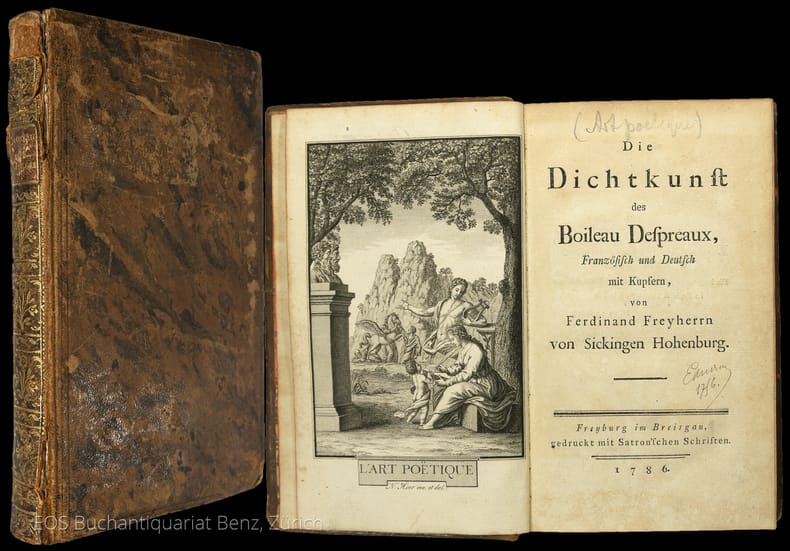
17867607CB1786. Freyburg i. B. Satron'sche Schriften 1786. 8°. 190 S. Mit Frontisp. und 1 Kupfertafel mit Porträt. Lederband mit Rückenvergoldung Deutsch-französische Parallelausgabe. Nicolas Boileau Despréaux 16361711 franz. Dichter und Kunsttheoretiker. Die Dichtkunst mit dem franz. Originaltitel «L'art poétique» ein Lehrgedicht entstand zwischen 1669 und 1674 und wurde 1674 erstmals in Paris gedruckt. Das Papier durchgehend etwas gebräunt. Mit handschr. Namenszug auf dem ersten Blatt. Der Einband berieben und bestossen die Gelenke angeplatzt. unknown
17867607CBFreyburg i. B., Satron'sche Schriften, 1786. 8°. 190 S. Mit Frontisp. und 1 Kupfertafel mit Porträt. Lederband mit Rückenvergoldung
178715582Valencia: Joseph y Tomas de Orga 1787. First Edition Thus. Octavo; 90 pp. Illustrated with a Prologue and Translator's Notes. of which 60 pages are prologue plus Index at rear. Near Fine copy in orginal pigskin lettered at spine. A scarce early work of Despreau's poetry. The poetic art of Nicolas Boileau Despreau translated from French verse into Spanish by Don Juan Bautista Madramany y Carbonell illustrated with a prologue. Nicolas Boileau-Despréaux 1636 – 1711 often known simply as Boileau was a French poet and critic. He did much to reform the prevailing form of French poetry in the same way that Blaise Pascal did to reform the prose. He was greatly influenced by Horace. - wiki. Joseph y Tomas de Orga unknown
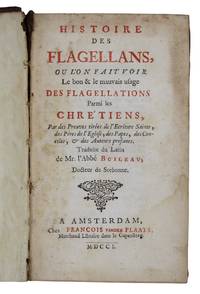
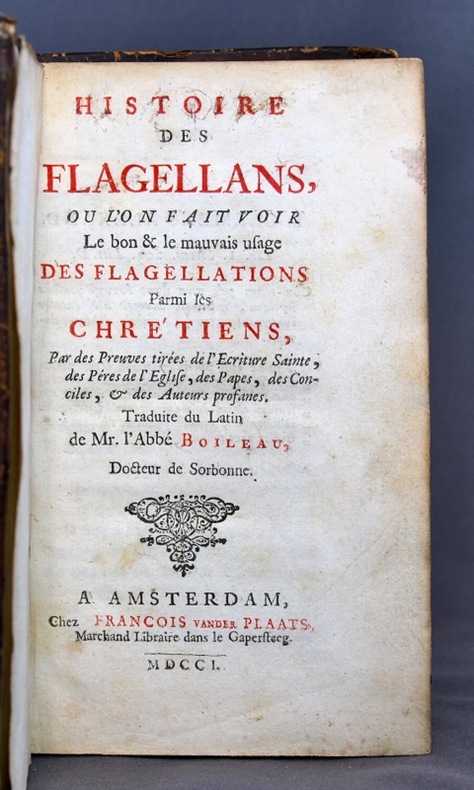
170136963Amsterdam: Chez François vander Plaats 1701. First edition in French. xvi 319 320-330 Table pp. Title in red and black. Error in pagination omitting page numbers 50-59. 1 vols. 12mo. Contemporary sprinkled calf gilt spine. Joints starting but sound otherwise very good. First edition in French. xvi 319 320-330 Table pp. Title in red and black. Error in pagination omitting page numbers 50-59. 1 vols. 12mo. A historical resumé of and an attack on the practice of self-flagellation written by Abbé Jacques Boileau 1635-1716 translated from his own Historia Flagellantium which appeared in the preceding year. An abridged version appeared in Cologne the same year as this Amsterdam possibly fictitious imprint. Boileau was the brother of the poet Nicolas Boileau. Chez François vander Plaats unknown
1701AQ29623Amsterdam: Chez Francois vander Plaats 1701. 16 319 i.e. 309pp 11. Title in red and black. Contemporary gilt-tooled calf. Extremities worn joints split loss to spine caps. Hinges exposed armorial bookplate of Algernon Capell to FEP initial gathering damp-stained scattered spotting. The first edition in French of Roman Catholic theologian Jacque Boileau's 1635-1716 history and criticism of the practice of self-flagellation within the Christian church. Algernon Capell second Earl of Essex 1670-1710 Gentleman of the Bedchamber to King William III 1691-1702 and Colonel of the 4th Dragoons 1693-1710. . First edition in French. 12mo. Chez Francois vander Plaats unknown
1732951553Amsterdam: Henry du Sauzet 1732. leather_bound. Sehr gut. xxxii 306 10 Seiten incl. Index. Handgefertigter brauner gesprenkelter und geglätteter Kalbledereinband der Zeit auf fünf echten Bünden mit reicher Rückenvergoldung; auf dem zweiten Feld ein rotes Maroquinschildchen mit dem Titel. Duodecimo 162 x 95 mm. Kaum berieben kleine Fehlstelle am oberen Kapital Vordergelenk unten ca. 20 mm angeplatzt. Innen sauber und frisch. Schönes dekoratives Exemplar. Der Einband mit Stehkantenvergoldung. Handgestochene Kapitale blaues Lesebändchen. Schnitt rot gefärbt. Vorsätze aus Marmorpapier. "Cette histoire des Flagellants surtout la trad. fr. de 1701 offre des détails tellement indécents qu'on serait même surpris de les trouver dans un traité de chirurgie. L'abbé Boileau . a décrit sans gêne les indécences des discipline à nu entre gens du même sexe et souvent de sexe différent et leurs inconvénients pour la santé et les moeurs" Bibl. clérico-gal. p. 25. Das Buch "Gehört zu den Seltenheiten der älteren Flagellanten-Literatur und bietet inhaltlich viele curiöse Facta und interessante psychologische Fingerzeige. Enthält auch Schilderungen über die Gräueltaten in Klöstern" Hayn/Gotendorf II 281. Provenienz: Besitzeintrag auf vorderen fliegenden Blatt verso oben: "Deferrey Dechato i Menot" . - Contemporary calf five raised bands spine gilt in compartments. An attractive copy. - Gay/L. II543 éd. fr. 1701 - Rose 554 Ausg. 1701 - Hayn/Gotendorf II281 - Laporte: Bibliographie clérico galante 25. - RFM. - Weitere Bilder auf Anfrage oder auf unserer Homepage. Wegen Urlaub kann Ihre Bestellung / Anfrage erst nach dem 21.06.2026 bearbeitet werden. - Because of holidays your order / question can be handled only after 06/21/2026. Henry du Sauzet hardcover
1701345508Amsterdam: Chez Francois Vander Plaats 1701. First edition in French. xvi 319 320-330 Table pp. Title in red and black. Error in pagination omitting page numbers 50-59. 1 vols. 12mo. Contemporary calf spine gilt. Lightly rubbed else very good. First edition in French. xvi 319 320-330 Table pp. Title in red and black. Error in pagination omitting page numbers 50-59. 1 vols. 12mo. A historical resumé of and an attack on the practice of self-flagellation written by Abbé Jacques Boileau 1635-1716 translated from his own Historia Flagellantium which appeared in the preceding year. An abridged version appeared in Cologne the same year as this Amsterdam possibly fictitious imprint. Boileau was the brother of the poet Nicolas Boileau. Chez Francois Vander Plaats unknown
1701505971Francois vander Plaats 1701. First Edition. Leather. VERY GOOD. First French Edition translated from the Latin. 16 319 11 pp. 12mo 4x6.5' contemporary calf with raised bands over 6 ornately tooled panels gilt rolled board edges text edges speckled in red. Title page in red and black. A neat leather repair to the top of spine and front board flushly mated over a 2' gash lashing with a small piece of the top panel retained; small chip to tail edge original bands both present; light rubbing to extremities some typical foxing shallow fore edge stain between pp. 200-250 contemporary owner's inscription to both endpapers bookseller's ticket to FFEP tipping in printed catalog description; otherwise a neat copy with tight square binding. Boileau was a French Roman Catholic theologian born in Paris 1635. In 1662 he took his degree as doctor of theology was in 1671 dean and grand-vicar at Sens in 1694 canon at Sainte Chapelle and later dean of the Sorbonne. McClintock & Strong. Boileau's History of Flagellation was first printed in Latin the year prior 1700. It traces the practice of self-flagellation in ascetic political and erotic applications with references to scripture church fathers councils as well as secular literature differentiating what he regards as the proper from the perverse use of the practice. Francois vander Plaats unknown
1701262722Amsterdam: Francois vander Plaats 1701. hardcover. 12mo 16 310 10 pages rubricated title small early signature on title page full mottled calf marbled edges gilt spine chipped at base of spine. Amsterdam: Francois vander Plaats 1701. Very good .<br/> <br/> Francois vander Plaats unknown
1701168617A Amsterdam : chez Franc¸ois vander Plaats . MDCCI 1701 1701. First Edition. Hardback. Very good copy in the original calf-backed marble boards. Professionally and period sympathetically re-backed with rtaised bands and the title blocked direct in gilt; very impressively finished. Remains particularly well-preserved overall; tight bright clean and strong.; 8vo 8"" - 9"" tall; 319 pages; Historia flagellantium. French . Physical desc.: 16 319 i.e. 309 11 p. ; 16 cm. 12mo. Signatures: 8 A-N¹² O4. Notes: Title in red and black. Error in paging: nos. 49-58 omitted. Includes index. Subject: Flagellants - History. Flagellation - Early works to 1800. Language: French. A Amsterdam : chez Franc¸ois vander Plaats, ..., MDCCI [1701] hardcover
173269141à Amsterdam: Chez Henry Du Sauzet 1732. Fine. Chez Henry Du Sauzet à Amsterdam 1732 9.50 x 16.80 cm relié Statement of second edition revised and corrected. Title page in red and black. The first edition appeared in Latin in 1700. Full brown speckled calf binding. Spine with raised bands decorated. Red morocco title label. Tail headcap worn. Upper joint cracked at tail. One corner bumped. Very fresh copy. 18th-century engraved armorial bookplate of Mr. Varenne. The first flagellants appeared in the 11th century and the movement gained renewed vigor during the Black Death in Europe thus reaching its peak during the 14th century. This movement was quickly condemned by the church as heretical and millenarian. The movement quickly became anarchic and a threat to order both of the church and of society. The pope handed them over to the inquisition in 1349 and the King of France Philip V banned flagellants under penalty of death. Chez Henry Du Sauzet hardcover
173269141Chez Henry Du Sauzet | à Amsterdam 1732 | 9.50 x 16.80 cm | relié
1701262722Amsterdam: Francois vander Plaats 1701. hardcover. 12mo 16 310 10 pages rubricated title small early signature on title page full mottled calf marbled edges gilt spine chipped at base of spine. Amsterdam: Francois vander Plaats 1701. Very good .<br/><br/> Francois vander Plaats unknown books
173240413Amsterdam: Chez Henry du Sauzet 1732. 12mo 17.5 cm 6.89". xxxii 306 10 index pp. <br><br>This disapproving account of voluntary flagellation appears here in its revised and corrected second French edition following the first of 1701 and the original Latin of 1700. Boileau was one of the earliest authors to connect the ancient religious practice directly to erotic motivations and concludes with a medical assessment of such deviancy including a final proverb: "Le foüet est pour le Cheval le mords pour l'Asne & la verge pour le dos de l'Insensé."<br>Â Â Â Â Although some sources claim Boileau translated his own text into French the BNF considers that a false attribution and credits Abbé François Granet with both editing and translating the text. This version by Dutch printer du Sauzet features a title-page printed in red and black and simple but elegant typesetting.<br>Â Â Â Â Binding: Contemporary calf spine with gilt-stamped title and date gilt-ruled raised bands and gilt-stamped compartment decorations; covers framed in triple gilt fillets turn-ins with a gilt roll. Handsome marbled endpapers and all edges gilt. => Signed binding with front free endpaper stamped "Koehler."<br>Â Â Â Â Provenance: Front free endpaper with garter-design ex-libris rubber-stamp of G. Manessier. Later in the residue of the stock of the F. Thomas Heller bookselling firm est. ca. 1928. Bound as above leather scuffed and rubbed. Small area of worming to outer margins of some leaves not touching text. Pages gently age-toned otherwise clean. => A pleasing elegant little volume. Chez Henry du Sauzet hardcover books
170136963Amsterdam: Chez François vander Plaats 1701. First edition in French. xvi 319 320-330 Table pp. Title in red and black. Error in pagination omitting page numbers 50-59. 1 vols. 12mo. Contemporary sprinkled calf gilt spine. Joints starting but sound otherwise very good. First edition in French. xvi 319 320-330 Table pp. Title in red and black. Error in pagination omitting page numbers 50-59. 1 vols. 12mo. The Ecstasy of Pain. A historical resumé of and an attack on the practice of self-flagellation written by Abbé Jacques Boileau 1635-1716 translated from his own Historia Flagellantium which appeared in the preceding year. An abridged version appeared in Cologne the same year as this Amsterdam possibly fictitious imprint. Boileau was the brother of the poet Nicolas Boileau. Chez François vander Plaats unknown books
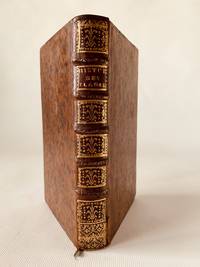
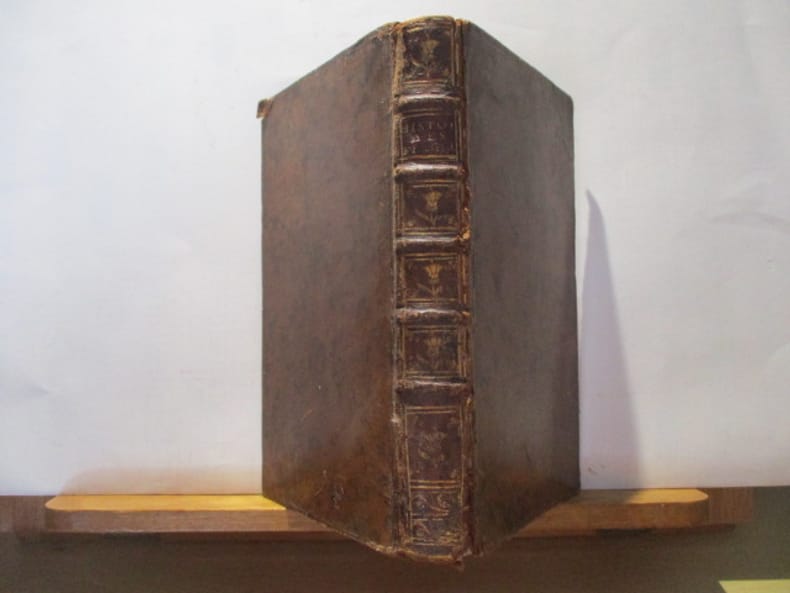
17017608Amsterdam, Chez François Vander Plaats, 1701. In-12 de [2]-7-[2]-319-[10 de table] pages, plein veau brun, dos à 5 nerfs orné d'encadrements, fleurons et titres dorés, Mors fendus, coiffes manquantes.
170191601701 A Amsterdam, chez François van der Plaats, marchand libraire dans le Gapersteeg, 1701. Un volume in-12° (98 x 165 mm) de [16]+311+[11] pages. Reliure de lépoque en plein veau, dos à nerfs orné, pièce de titre en maroquin rouge, tranches mouchetées de rouge et de gris. Petite fente au haut et en bas de la charnière supérieure.
1701485941701 Amsterdam, Chez François vander Plats - 1701 - Ed. Originale - In-12 Reliure frottée, plein veau de l'époque, dos à nerfs orné de caissons fleuronnés - pièce de titre rouge - tranches rouges - 319 pages + Table - quelques rousseurs aux premières pages - Ex-libris armoirié Jacques Passavent - BON EXEMPLAIRE. - envoi rapide et soigné - Réf. 48594
1780RO80015366NYON. 1780. In-12. Relié plein cuir. Etat passable, Couv. légèrement passée, Mors fendus, Intérieur frais. 125 pages. Gravure en frontispice noir et blanc hors-texte. Quelques planches de gravures en noir et blanc hors-texte. Relié plein cuir marron. Tranches rouges. Titre et caissons décorés, dorés sur le dos. Coins frottés. Ouvrage déboité. texte en latin. Quelques manques de cuir sur les mors.. . . . Classification Dewey : 870-Littératures des langues italiques. Littérature latine
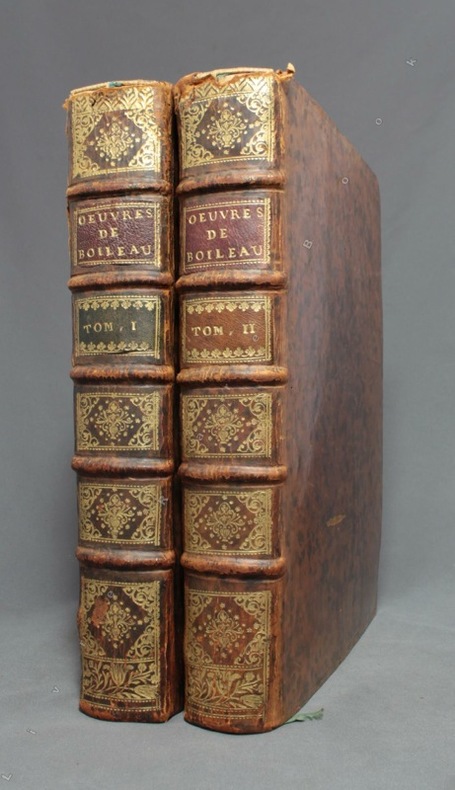
17409778A Paris, Chez la Veuve Alix, 1740. 2 volumes grand in-4 de [4]-LXX (préface, éloges, Bolaeana, table)-470 et [10]-VIII-567 pages, plein veau moucheté, dos à 5 nerfs ornés de roulettes, fleurons, encadrements et titre dorés, étiquettes de titre bordeaux, de tomaison verte et brune, triple filet à froid encadrant les plats, roulette dorée sur les coupes, tranches rouges. Les coiffes supérieures manquent, quelque galeries de vers au premier plat du tome 2, reliure un peu frottée, rares rousseurs.