Andre BRETON - (Albert CAMUS)Biblio.com
829 résultats
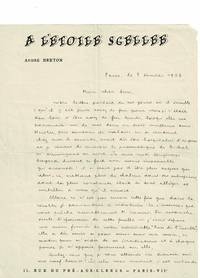
195375729Paris 1953. Fine. Paris 8 janvier 1953 21 x 27 cm 1 pages et quelques lignes sur un feuillet Unpublished handwritten signed letter from André Breton addressed to critic Charles Estienne; one page and a few lines in black ink on a paper from the à l'étoile scellée gallery. Two transverse folds from having been sent a small corner missing in the upper right margin. Very beautiful letter giving an account of the death of one of André Breton's dearest friends and of his quarrel with Albert Camus. Breton tells his friend about the death of the Surrealist Czech artist Jindich Heisler: Your letter spoke of those days where it seemed that there was only just enough fire to live: on Monday there was far from enough fire when it reached me: one of my two or three best friends Heisler taken suddenly unwell on his way to mine on Saturday had to be hospitalised urgently and I had just received the pneumatic from Bichat telling me of his death. The event no less inconceivable than accomplished left me distraught for a long time: there was no-one more exquisite than he putting more warmth into everything he did the most constant of which was to lighten and embellish those whom he loved. The two poets were indeed very close: Heisler participated alongside Breton in the launch of Néon in 1948 and supported him during a period of depression accompanying him with other friends to the Île de Sein. The beginning of 1953 was overshadowed by the death of Jindich Heisler 4 January. Loyal among the faithful he lived entirely for Surrealism according to Breton who pays tribute to his activity as a leader: This is how he was between 1948 and 1950 the soul of Néon and until his last moments the greatest bearer of projects that as if by magic his talent gave him the means to achieve. Henri Béhar André Breton In this letter laden with pain Breton suddenly makes reference to L'Homme révolté by Albert Camus published two years earlier: Come on it is not yet the time in the rebellion that I will succeed in introducing the measure that M. Camus kindly preaches to us. The two writers met in New York at the end of March 1946 when Camus was invited to the United States for a conference tour as a representative of Combat. The two agree on the best way to preserve the testimony of certain men free from ideological distortions. They dream of a kind of pact by which people of their calibre would commit to not join any political party to fight against the death penalty to never claim any credit whatsoever. ibid. With other intellectuals they founded the Rassemblement démocratique révolutionnaire RDR in 1948; but the idyll ended a couple of years later in the autumn of 1951 when Camus published Lautréamont et la banalité an extract from his Homme révolté which was published later. Breton was extremely hurt and responded to him in an article entitled Sucre jaune in Arts: This article . testifies to the part of Camus for the first time for an indefensible moral and intellectual position. . He only wants to see a guilty adolescent in Lautréamont whom he - in his capacity as an adult - must discipline. He goes as far as to find him in the second part of his work: Poésies a deserved punishment. According to Camus Poésies would be but a mass of laborious banalities . It could still be worse if the destitution of these views did not intend to promote the most suspect thesis in the world which is that absolute revolt can generate only the taste for intellectual enslavement. This is a completely gratuitous ultra-defeatist statement which must incur even more contempt than its false demonstration. Thus two years later Breton still holds out against Camus' crime of lese-majesty towards that which Breton constructed as the father of surrealism but even more this allusion to Camus' pacifist philosophy bearing witness to the incompatibility between a thought of moderation and a poetry of revol unknown
19957631ABFrankfurt/M, Knecht, 1995. Gr.8° (23 x 15 cm). 175 (1) S. Grüner Original-Leinenband mit grünem typographisch gestaltetem OUmschlag.
1958004703New York: Partisan Review 1958 First appearance of "The Renegade" in English translated by Justin O'Brien. 13 pp. in 160 pp. literary magazine. Covers soiled shelfworn. Very good condition. Partisan Review paperback
19921192026Leipzig : Reclam, 1992. 319 S. : Illustr. ; 18 cm; kart.
1972Q-0394472624Knopf 1972-05-12. Hardcover. New. In shrink wrap. Looks like an interesting title! Knopf hardcover
197234800New York: Alfred A. Knopf 1972. First American Edition. 8vo publisher’s original white linen lettered in gILT on the spine and upper cover in the original pictorially illustrated dustjacket. 192 pp. A very fine copy. FIRST EDITION. Albert Camus’s first novel written in French in the 1930’s and published in English for the first time here. <br> “In many interesting ways A Happy Death foreshadows The Stranger. But its most striking difference - beyond its differences of plot and intention - is that here Camus reveals more of himself than in his later more mythic fiction. He seems very close to his protagonist. Through the young Patrice one feels in touch with the young Camus - his joy in the sea sun and open skies of his native Algeria his relationships with women his need of them and his detachment from them the intense alienation he experienced as a traveler in Central Europe his sense of the ways in which poverty can nourish or destroy. And it is from his own early intimations of death movingly evoked that this novel draws the concern - how is one to live in order to have a happy death the right death -which is at the root of its drama.â€-Publisher Alfred A. Knopf unknown
1995Q-0679764003Vintage 1995-08-29. Paperback. New. In shrink wrap. Looks like an interesting title! Vintage paperback
1908055877London : Longmans Green & Co. 1908. New Impression . Hardcover. Near Fine. Small Octavo. LONDON. 1908 1909. 2 Volumes. Hardback. Matching volumes; dark-blue smooth cloth; gilt lettered spines; ornate gilt decorated and lettered covers. All edges gilt. Neat owner name to the fly-leaf of each volume; Lucy Wordsworth 1916. No internal markings. xi 312 xix 349 pages. Sm.8vo. Will be well-packed for posting/shipping. Rosley Books for Antiquarian books CHS Cumberland Everyman GKC Inklings Keswick Literature MacDonald Rarities Theology and History. . SCARCE. <br/> <br/> Longmans, Green & Co., hardcover
195870266Gallimard 1958. Paperback. Collectable very good. Almost like new. Tan softcover Gallimard 1958 no additional printings stated cover price 750 NF 212pp pages uncut. Cover lightly soiled by use else book is like new. We are a small family business with over 25 years experience providing fine new and pre-owned books online. You can expect professional service and individual attention to your order daily shipments and sturdy packaging. Gallimard, paperback
195363678Paris: Gallimard 1953. Fine. Gallimard Paris 1953 12 x 19 cm relié First edition an advance service de presse copy. A few reading notes in the margin. Bradel binding in half morocco covers preserved top edge gilt binding signed by P. Goy & C. Vilaine. Autograph inscription signed by Albert Camus to Gilbert Sigaux : ""AVec l'affectueuse pensée de son vieux camarade."" Gallimard unknown
195852286Paris: Gallimard 1958. Fine. Gallimard Paris 1958 13 x 20 cm relié First edition one of 25 numbered copies on Hollande this one of 5 lettered hors commerce the tirage de tête. Half red morocco over marbled paper boards by Goy & Vilaine spine in six compartments endpapers and pastedowns of red paper covers and spine preserved top edge gil . A very good coop well-margined in a nice binding. Gallimard hardcover
195345741Paris: Gallimard 1953. Fine. Gallimard Paris 1953 12 x 19 cm broché First edition on ordinary paper. Autograph inscription from Albert Camus to J.P. Loiseau : "". pour le remercier encore.to thank him once more."" Spine lightly sunned. Gallimard unknown
195346393Paris: Gallimard 1953. Fine. Gallimard Paris 1953 12 x 19 cm broché First edition an advance service de presse copy. Autograph inscription from Albert Camus to Constant Burniaux. Gallimard unknown
195347737Paris: Gallimard 1953. Fine. Gallimard Paris 1953 12 x 19 cm broché First edition on ordinary paper. Handsome fine autograph inscription signed by Albert Camus : ""à Albert Béguin qui trouvera ici les raisons de mes désaccords avec Esprit avec mon bien cordial souvenir.to Albert Bégiun who will find here the reasons for my disagreements with the Spirit in friendly remembrance "" A little light spotting primarily to upper cover and ffep. Retaining its advertising notice entitled ""Lettres sur la révolte"". Gallimard unknown
195048392Paris: Gallimard 1950. Fine. Gallimard Paris 1950 12 x 19 cm broché sous chemise et étui First edition one of 23 numbered copies on Hollande paper the tirage de tête A fine unsophisticated copy. Gallimard unknown
195349565Paris: Gallimard 1953. Fine. Gallimard Paris 1953 12 x 19 cm broché First edition an advance service de presse copy. Autograph inscription from Albert Camus to Raymond Peju. Spine lightly but insignificantly sunned. Gallimard unknown
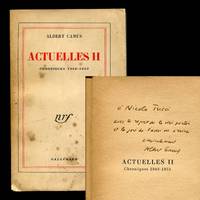
1953218376Parigi: Gallimard 1953. Brossura wrappers. Buono Good. Dedica e firma autografe dell'Autore a Niccolò Tucci Inscribed and signed by the Author to Niccolò Tucci. . 16mo. pp. 186. Dedica e firma autografe dell'Autore a Niccolò Tucci Inscribed and signed by the Author to Niccolò Tucci. Buono Good. Copertine fiorite e macchiate Stains and yellowings to covers. Prima edizione su carta corrente First Edition. Gallimard, unknown
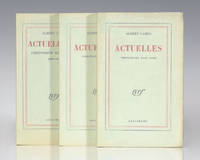
1950137591Paris: Gallimard 1950-1958. First editions of all three volumes in Camus's collected articles and commentaries. Octavo original wrappers as issued. Each volume is fine condition. A rare complete set in exceptional condition. Published separately in three volumes between 1950 and 1958 Camus' Actuelles bring together articles and excerpts from his most important texts presented chronologically. The first volume Actuelles consists mainly of articles published in the journal Combat including his important work Morale et Politique. This second volume brings together texts written from 1948 to 1953 primarily Camus' responses to the controversies which followed the publication of L'Homme révolté. Actuelles III or his Algerian Chronicles bring together Camus' stories about his native country from his first articles in 1939 when few people were interested in this country until 1959 shortly before his death. Gallimard unknown