Andre BRETON - (Albert CAMUS)Biblio.com
1 673 résultats
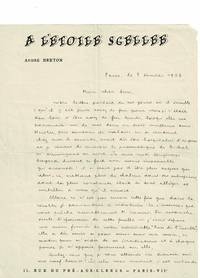
195375729Paris 1953. Fine. Paris 8 janvier 1953 21 x 27 cm 1 pages et quelques lignes sur un feuillet Unpublished handwritten signed letter from André Breton addressed to critic Charles Estienne; one page and a few lines in black ink on a paper from the à l'étoile scellée gallery. Two transverse folds from having been sent a small corner missing in the upper right margin. Very beautiful letter giving an account of the death of one of André Breton's dearest friends and of his quarrel with Albert Camus. Breton tells his friend about the death of the Surrealist Czech artist Jindich Heisler: Your letter spoke of those days where it seemed that there was only just enough fire to live: on Monday there was far from enough fire when it reached me: one of my two or three best friends Heisler taken suddenly unwell on his way to mine on Saturday had to be hospitalised urgently and I had just received the pneumatic from Bichat telling me of his death. The event no less inconceivable than accomplished left me distraught for a long time: there was no-one more exquisite than he putting more warmth into everything he did the most constant of which was to lighten and embellish those whom he loved. The two poets were indeed very close: Heisler participated alongside Breton in the launch of Néon in 1948 and supported him during a period of depression accompanying him with other friends to the Île de Sein. The beginning of 1953 was overshadowed by the death of Jindich Heisler 4 January. Loyal among the faithful he lived entirely for Surrealism according to Breton who pays tribute to his activity as a leader: This is how he was between 1948 and 1950 the soul of Néon and until his last moments the greatest bearer of projects that as if by magic his talent gave him the means to achieve. Henri Béhar André Breton In this letter laden with pain Breton suddenly makes reference to L'Homme révolté by Albert Camus published two years earlier: Come on it is not yet the time in the rebellion that I will succeed in introducing the measure that M. Camus kindly preaches to us. The two writers met in New York at the end of March 1946 when Camus was invited to the United States for a conference tour as a representative of Combat. The two agree on the best way to preserve the testimony of certain men free from ideological distortions. They dream of a kind of pact by which people of their calibre would commit to not join any political party to fight against the death penalty to never claim any credit whatsoever. ibid. With other intellectuals they founded the Rassemblement démocratique révolutionnaire RDR in 1948; but the idyll ended a couple of years later in the autumn of 1951 when Camus published Lautréamont et la banalité an extract from his Homme révolté which was published later. Breton was extremely hurt and responded to him in an article entitled Sucre jaune in Arts: This article . testifies to the part of Camus for the first time for an indefensible moral and intellectual position. . He only wants to see a guilty adolescent in Lautréamont whom he - in his capacity as an adult - must discipline. He goes as far as to find him in the second part of his work: Poésies a deserved punishment. According to Camus Poésies would be but a mass of laborious banalities . It could still be worse if the destitution of these views did not intend to promote the most suspect thesis in the world which is that absolute revolt can generate only the taste for intellectual enslavement. This is a completely gratuitous ultra-defeatist statement which must incur even more contempt than its false demonstration. Thus two years later Breton still holds out against Camus' crime of lese-majesty towards that which Breton constructed as the father of surrealism but even more this allusion to Camus' pacifist philosophy bearing witness to the incompatibility between a thought of moderation and a poetry of revol unknown
1958004703New York: Partisan Review 1958 First appearance of "The Renegade" in English translated by Justin O'Brien. 13 pp. in 160 pp. literary magazine. Covers soiled shelfworn. Very good condition. Partisan Review paperback
9788532640000VOZES. new. � um livro para quem quer estabelecer um primeiro contato com a filosofia ou para aquele que deseja sistematizar seu conhecimento pois permite um acesso facilitado ao pensamento de grandes fil�sofos e de suas respectivas obras. Com uma estrutura clara e objetiva os autores selecionaram as 100 obras que marcaram a reflex�o filos�fica desde a Antiguidade destacando os aspectos mais importantes de cada uma seu contexto hist�rico e filos�fico as problem�ticas essenciais teses desenvolvidas e conceitos chaves. VOZES unknown
0140180168.Gpaperback. Good. Access codes and supplements are not guaranteed with used items. May be an ex-library book. paperback
A9781945234453Paperback / softback. New. Es 2666 de Roberto Bolano una novela total Pueden coexistir fragmentos y totalidades en un mismo libro Hay una columna vertebral que estructure la multitud de espacios personajes y temas representados en 2666 Estas y otras preguntas son el objeto de estudio del presente libro. paperback
34711380like new. unknown
1945234458.Gpaperback. Good. Access codes and supplements are not guaranteed with used items. May be an ex-library book. paperback
2738107648.Gpaperback. Good. Access codes and supplements are not guaranteed with used items. May be an ex-library book. paperback
0140180141.Gpaperback. Good. Access codes and supplements are not guaranteed with used items. May be an ex-library book. paperback
1972Q-0394472624Knopf 1972-05-12. Hardcover. New. In shrink wrap. Looks like an interesting title! Knopf hardcover
0140036989.Gpaperback. Good. Access codes and supplements are not guaranteed with used items. May be an ex-library book. paperback
197234800New York: Alfred A. Knopf 1972. First American Edition. 8vo publisher’s original white linen lettered in gILT on the spine and upper cover in the original pictorially illustrated dustjacket. 192 pp. A very fine copy. FIRST EDITION. Albert Camus’s first novel written in French in the 1930’s and published in English for the first time here. <br> “In many interesting ways A Happy Death foreshadows The Stranger. But its most striking difference - beyond its differences of plot and intention - is that here Camus reveals more of himself than in his later more mythic fiction. He seems very close to his protagonist. Through the young Patrice one feels in touch with the young Camus - his joy in the sea sun and open skies of his native Algeria his relationships with women his need of them and his detachment from them the intense alienation he experienced as a traveler in Central Europe his sense of the ways in which poverty can nourish or destroy. And it is from his own early intimations of death movingly evoked that this novel draws the concern - how is one to live in order to have a happy death the right death -which is at the root of its drama.â€-Publisher Alfred A. Knopf unknown
0241020999.Ghardcover. Good. Access codes and supplements are not guaranteed with used items. May be an ex-library book. hardcover
1995Q-0679764003Vintage 1995-08-29. Paperback. New. In shrink wrap. Looks like an interesting title! Vintage paperback
2006Q-0141186585Penguin Books Limited UK 2006-07-06. Paperback. New. In shrink wrap. Looks like an interesting title! Penguin Books, Limited (UK) paperback
1908055877London : Longmans Green & Co. 1908. New Impression . Hardcover. Near Fine. Small Octavo. LONDON. 1908 1909. 2 Volumes. Hardback. Matching volumes; dark-blue smooth cloth; gilt lettered spines; ornate gilt decorated and lettered covers. All edges gilt. Neat owner name to the fly-leaf of each volume; Lucy Wordsworth 1916. No internal markings. xi 312 xix 349 pages. Sm.8vo. Will be well-packed for posting/shipping. Rosley Books for Antiquarian books CHS Cumberland Everyman GKC Inklings Keswick Literature MacDonald Rarities Theology and History. . SCARCE. <br/> <br/> Longmans, Green & Co., hardcover
1020354925.Ghardcover. Good. Access codes and supplements are not guaranteed with used items. May be an ex-library book. hardcover
1020198443.Ghardcover. Good. Access codes and supplements are not guaranteed with used items. May be an ex-library book. hardcover
1166458113.Gpaperback. Good. Access codes and supplements are not guaranteed with used items. May be an ex-library book. paperback
112013403X.Gpaperback. Good. Access codes and supplements are not guaranteed with used items. May be an ex-library book. paperback
1868773211868. E.& F. N. Spon London. 1868. Third Edition reprinted from the Second. Hardback NO WRAPPER. Green textured and blind decorated cloth gilt. Illustrated with 18 plates at rear. Boards are a little worn and rubbed with some slight fraying to head of spine. Large closed tear to front free endpaper near spine and minor signs of age browning to o/w clean and sound contents. hardcover
1806782221806. J. Taylor. London. 1806. First English Edition. Rebound in quarter black Morrocco burgundy boards with reinforced hinges. Fifteen foldout plates to rear. Some pencil annotation and light foxing to front free endpapers o/w a really lovely copy. hardcover
1806N3738aLondon: J. Taylor 1806. First English Edition . Modern Half Leather. Very Good/Fair. 8vo . 144pp15 folding plates with many illustrations. Bound with A CATALOGUE OF MODERN BOOKS ON ARCHITECTURE THEORETICAL PRACTICAL AND ORNAMENTAL. ON SALE AT J. TAYLOR'S ARCHITECTURAL LIBRARY HIGH HOLBORN LONDON 20pp. Edges with minimal foxing title page with some darkening. A very good copy of this RARE FIRST EDITION ITEM. <br/> <br/> J. Taylor hardcover
0656432624.Ghardcover. Good. Access codes and supplements are not guaranteed with used items. May be an ex-library book. hardcover