CARLYLE, ThomasBiblio.com
327 résultats
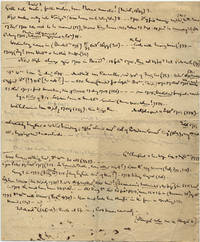
1837174294London: James Fraser 1837. Moulding "popular conceptions of the French Revolution down to the present day" First edition bound for presentation and inscribed by the author to his mother-in-law on the title page of the first volume: "To Mrs. John Welsh. Liverpool. T.C. London June 1837". A leaf of the original manuscript closely written across two sides is bound in facing the title. Presentation copies of Carlyle's magnum opus are extremely scarce. The History was published in May 1837. Grace Welsh 1782-1842 the mother of Jane Welsh Carlyle 1801-1866 is recorded as visiting the couple in London at the end of May whereupon Thomas removed himself to rural Scotland. Grace had not approved of her daughter's choice to marry Carlyle in October 1826. In Jane's own words writing to him without her mother's knowledge made her "as nervous as if I were committing a murder" ODNB. Grace leased the pair a modest home in Edinburgh shortly after their marriage but relations between mother and daughter remained fraught throughout their lives. While writing the History Carlyle observed of one maternal visit that "Jane and her mother cannot live together" quoted in Ireland p. 151. The manuscript leaf preserves the text for pages 58-62 of Volume III discussing the aftermath of the September Massacres of 1792. It runs to 45 lines and contains several corrections and crossed-through sections including some two and a half lines not printed on page 59. The final manuscript of the History was largely destroyed after publication only fragments remaining. This copy remained in the Welsh family until 1938 when it was sold at Sotheby's after the death of Mary Chrystal the granddaughter of Jane Welsh's uncle. Carlyle's History remains one of the most authoritative accounts of the early Revolution. The work established his reputation as an intellectual and influenced many of his contemporaries - including Dickens whose Tale of Two Cities drew heavily from it. "The book at once captured the English-speaking world and has outside France moulded popular conceptions of the French Revolution down to the present day" PMM. 3 vols octavo 182 x 115 mm. All vols bound without half-titles vol. II bound without leaf of publisher's advertisements at rear. Bound for presentation in contemporary full purple morocco spines lettered and decorated in gilt covers with decorative border and central ornament in blind turn-ins in gilt light yellow coated endpapers edges gilt. Housed in custom red morocco book-form case. Neat contemporary note to p. 318 of vol. III "see 328". Margins of manuscript leaf slightly trimmed vol. III sig. P4 bound after P8. Aside from light rubbing to extremities and very minor sunning to spines bindings bright and fresh slight superficial split to front inner hinge of vol. I and in a few places to the text block but all holding firm scattered light foxing. A highly attractive copy. Dyer p. 85; Printing and the Mind of Man 304; Tarr A8.1. Annie Elizabeth Ireland Life of Jane Welsh Carlyle 1891. unknown
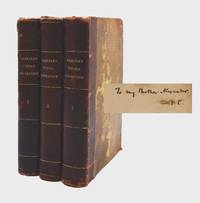
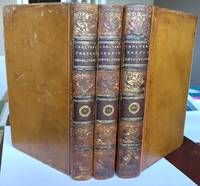
1837372411London: James Fraser 1837. First Edition with half-titles. vii 1 404; vii 1 422 2; vii 1 448pp. 3 vols. 8vo. Contemporay three-quarters morocco with gilt bands and title to spine and marbled paper boards. General edgewear and rubbing to boards spine and corners generally sound; tear to half-title and bump to contents pages in vol. 3 overall occasional spotting and foxing to endpapers. Letters with old folds staining some loss both silked. In matching custom clamshell box and folder. First Edition with half-titles. vii 1 404; vii 1 422 2; vii 1 448pp. 3 vols. 8vo. Inscribed in the first volume: "To my brother Alexander. T.C." With 2 ALS laid in from Thomas to his brother Alex as well as a note laid-in in pencil: "Published 1837 / autographed to Grandfather / HCJ 1950." <br /> <br /> Carlyle and his brother Alexander were the eldest of nine children and their correspondence goes from when Carlyle was in Edinburgh trying to get his footing as a writer until Alexander died on his farm in Canada in 1876. They were "remarkably close" and Thomas wrote to Alexander with "an open and copious expression of feeling and in this regard are distinguished from the letters Carlyle wrote to Goethe Emerson Mill Sterling and Browing.He showed his love for Alexander in many of the letters he wrote either to or about him by the frequency with which he wrote and the moral and financial support he gave to him by accepting support from him in return and by graphically bringing to him the sophisticated worlds from which Alexander was isolated" Marrs p. viii.<br /> <br /> One of Carlyle's dreams was to live on a self-sustaining farm where he could work in peace. He moved to such a farm in Hoddam Hill in May 1825 which his father leased for him and Alexander moved away from the family farm to work the land with a helper. The plans for the farm are discussed in the second letter sent February 1825. Disagreements with the landlord caused them to give up the plot but Carlyle would remember it fondly the rest of his life. Alexander eventually moved to Canada to live on his own farm.<br /> <br /> The first letter of 24th of May 1823 tells an animated and detail rich story about traveling to Kinnaird the Buller house near Dunkeld where he was to work as tutor to the two adolescent sons. He talks sitting next to a Dr. Fyfe one of Jane Welsh's "more ardent and enterprising suitors" Marrs p. 146 as well as his impressions of first arriving in Dunkeld "among people of such a fashionable turn" and the house where he was to stay. At the time he was deeply involved in his Life of Schiller articles for Taylor's London Magazine completing the first of three articles in April and had begun translating Goethe's Apprenticeship of Wilhelm Meister for Edinburgh publisher Boyd: "The family received me hospitly and shewed me into my quarters where I spent two hours in unpacking and arranging my goods. I have not dined and having all put to rights I am scribbling to Alick.I shall be quite comfortable here.I shall be as quiet as in the middle of Sahara; shall bolt my door and study and read and smoke according to my own pleasure." <br /> <br /> The second letter dated February 14 1824 sic. but postmarked February 17 1825 discusses his plans: "I must settle some place of abode for myself some scheme of existing in conformity to my medical prescriptions and also of proceeding with my literary employments. The farm is still my favourite or rather only steady project. A reasonable house is all that I want; with land that would pay you for working it." He talks also of learning Spanish and describes his dreams of accomplishment and reputation: "Literary fame is a thing which I covet little; but I desire to be working honestly in my day and generation in this business which has now become my trade. I make no grain of doubt that in time I shall penetrate the fence that keeps me back and find the place which is due to me among my fellow men. Some hundreds of stupider people are at this very time doing duty with acceptance in the literature of the time. We shall see; I am not at all in a hurry; the time will come."<br /> <br /> It was this book written a decade later that established Carlyle's reputation as an important intellectual: "a prose epic teeming with colourful scenes of dramatic events and imaginative portraits of the leading revolutionaries. The book at once captured the English-speaking world and has outside France moulded popular conception of the French Revolution down to the present day" PMM In his letter to Alexander in Canada written 23 April 1837 he references the completion of "The Book" "it is all in type my share of it finished.I suppose it will be out as a Book in not many days. You shall have a Copy of it by the earliest chance after that; and good appetite I shall wish you with it. It is I think the most radical Book that has been written in these late centuries.and will give pleasure and displeasure one may expect to almost all classes of persons. Let it take its fate: the great indisputable blessin is that I have done with it forever and a day" Marrs p. 421. PMM 304; Marrs ed. The Letters of Thomas Carlyle to his Brother Alexander p. 142-147 p. 191-195 James Fraser unknown
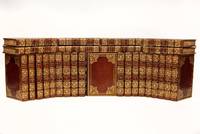
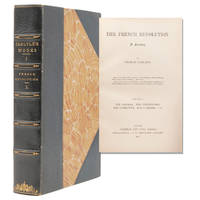
18963445London: Chapman and Hall Limited 1896. The Centenary Edition Large Paper Edition Limited Edition. Leather Bound. Very Good. The Centenary Edition Large Paper Edition Limited Edition. Leather Bound. 30 vol. Thomas Carlyle The Works of Thomas Carlyle. <br /> The Centenary Edition Large Paper Edition Limited Edition limited to 300 sets of which this is no. 274. Illustrated frontispiece of Louis XVI of France. Illustrated throughout. Top edges gilt raised bands on spine. Bound in full brown Morocco leather with elaborate gilt floral embellishments on front and back covers and beautiful gilt floral embellishments on spine panels. Beautiful leather and silk doublures on inner covers. Published London: Chapman and Hall Limited 1896.<br /> H: 8 7/8" W: 6 1/4" D: 1 1/2 Chapman and Hall Limited unknown
1880135178London: Chapman and Hall 1880. hardcover. very good. 34 volumes 30 original 1 volume Index 3 volumes of Carlyle's Translations from the German. Frontispiece illustrations in some volumes. 8vo handsomely bound in 3/4 tan polished calf; ornately gilt-decorated spines with raised bands; burgundy and black leather labels marbled edges. London: Chapman and Hall no date circa 1880. A very good set. The Library Edition.<br/> <br/> Chapman and Hall unknown
1837219681London: James Fraser 1837. First edition. 8vos. Red crushed morocco. teg marbled endpapers french fillet border front panels raised bands spine gilt in compartments with floral centerpieces inside floral spray borders lavish inner dentelles. A Club Bindery production and stamped by them on the inside lower front dentelle. A few surface nicks to boards some marginal foxing a uniformly fine set. Red morocco ex libris bookplate of important American collector and founder of the Grolier Club Robert Hoe 1839-1911 front pastedown of each volume. A handsome set in custom cut mylar covers. James Fraser unknown
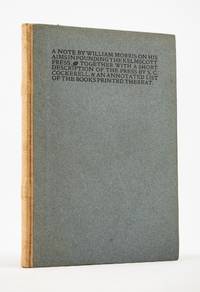
1898ST20842Hammersmith: Kelmscott Press 1898. ONE OF 525 COPIES on paper and 12 on vellum. 210 x 150 mm. 8 1/4 x 5 3/4". 4 p.l. including two blanks 70 pp. 1 leaf colophon. <br/> Original holland-backed blue paper boards. WOODCUT ILLUSTRATION BY EDWARD BURNE-JONES of "Pysche Borne off by Zephyrus" ENGRAVED BY WILLIAM MORRIS elaborate borders around this and first page of text designed and cut by Morris large decorative woodcut initials device on last page of text and one full-page woodcut of ornaments used in the Kelmscott edition of "Love is Enough." Printed in red and black in Golden Troy and Chaucer types. With errata slip laid in at title page. Front pastedown with Arts & Crafts-style bookplate of Edmund Bulkley dated 1893; a list of the Kelmscott books in E. W. Buckley's collection listed by the number assigned to them in this book recorded in pencil on a translucent piece of paper laid in here. Morris & Cockerell 53; Peterson A-53; Ransom 53; Tomkinson p. 121. Some wear to lower corners just a hint of soil to covers otherwise a very fine copy--exceptionally fresh clean and bright internally.<br/> <br/> Owned by two collectors with a special interest in Morris this is a very pleasing copy of one of the key Kelmscott Press books and the last one to be issued by the press. Morris tells us here about his admiration for 15th century printed books saying that "they were always beautiful by force of the mere typography even without the added ornament with which many of them are so lavishly supplied." And he says that "it was the essence of his undertaking to produce books which it would be a pleasure to look upon as pieces of printing and arrangement of type." This is the most important contemporaneous source of comment on the founding operation and publications of the Kelmscott Press. Peterson quotes Newdigate who says that this is "one of the three books that every student of English book-production ought to read." The original owner here was American private press collector Edmund Bulkley who according to the list laid in at the rear of this volume owned 42 Kelmscott books. Evidently prepared after Bulkley's death the list also marks with a "0" the books sold before 1950 and notes at the end the books including this volume that remained in the possession of "M A B B." this might refer to a relation possibly art collector M. A. B. Bulkley who bequeathed a Pre-Raphaelite-style painting to the Fitzwilliam Museum in 1996. Bulkley's distinctive bookplate perhaps created by one of the private presses is found in a number of press books which when listed at auction are in notably fine condition. In 1883 Morris & Company took out a full-page ad in the Official Catalogue of the Boston Foreign Exhibition announcing the appointment of Elliott & Bulkley of 42 East 14th Street New York City as U.S. agents for the sale of Morris & Co. "Decorative Manufactures" including wallpaper fabrics and "the celebrated Hammersmith carpets made only by Morris & Company." It is tempting to speculate that Edmund Bulkley was associated with this firm and became aware of the Kelmscott Press via this connection with Morris & Company. Although without additional signs of ownership our book was later sold as part of the library of Clive Wilmer 1945-2025 English poet and scholar of John Ruskin and William Morris. He wrote and lectured extensively on both men and from 2009 to 2019 served as Master of The Guild of St. George a charity for arts crafts and the rural economy founded by Ruskin in 1871. The Ruskin Society of North America presented him with a Lifetime Achievement Award in 2023. Copies of this work appear with some regularity in the marketplace but specimens in attractive condition are becoming increasingly difficult to find. Kelmscott Press unknown
1880179594London: Chapman and Hall 1880. hardcover. very good. 34 volumes 30 original 1 volume Index 3 volumes of Carlyle's Translations from the German. Frontispiece illustrations in some volumes. 8vo handsomely bound in 3/4 tan polished calf; gilt-decorated spines with raised bands and red and black leather labels marbled boards and edges three volumes slightly chipped. London: Chapman and Hall no date circa 1880. A very good set. The Library Edition.<br/> <br/> Chapman and Hall unknown
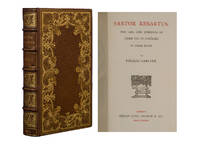
18896403London: Kegan Paul Trench & Co 1889. Fine. Sixteenmo 6 3/16 x 3 5/8 inches; 157 x 93 mm. vi 306 1 imprint 5 blank pp. Portrait frontispiece with tissue guard. Title-page printed in red and black. Bound ca. 1920 by Rivière & Son stamp signed in gilt on lower turn-in. Full antelope crushed levant morocco covers decoratively ruled in gilt surrounding a very elaborate floral design in pointillé spine with five raised bands similarly decorated and lettered in gilt in compartments gilt-ruled board edges full dark blue morocco liners elaborately decorated in gilt blue watered silk end-leaves top edge gilt. A wonderful example of the art of 'pointillé'.<br /> <br /> The Scottish author critic and thinker Thomas Carlyle 1795-1881 was a major influence on Victorian society. His novel Sartor Resartus translated as The Tailor Re-tailored among other variations is a satirical look at the work of a fictional philosopher Diogenes Teufelsdröckh. Intriguing in its form the book is structured from the prospective of a skeptical English reviewer consumed by Teufelsdröckh's book Clothes Their Origin and Influence. In crafting Sartor Resartus Carlyle drew on a range of literary influences: Goethe Hegel Sterne and Switft. Carlyle's complicated text not only critiques academic writing and materialism but offers meditations on the meanings of symbols and the search for truth. Although first started as an essay the project eventually developed into a novel which was first published serially in Fraser's Magazine 1833-34. Fine. Kegan Paul, Trench & Co unknown
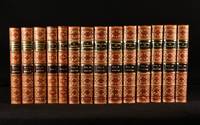
18743586London: Chapman and Hall 1874. First Thus. Near Fine. Library Edition. Thirty-four octavo volumes 207 x 133 mm uniformly bound by Morrell ca. 1930 in three-quarter crushed brown levant morocco over brown cloth ruled in gilt. Occupying approximately 51 1/2 inches 131 cm. of shelf space. Spines with five raised bands decoratively gilt lettered and tooled in compartments. Two volumes professionally repaired at top of spines. Engraved frontispieces and plates. The Library edition originally issued in 30 volumes 1869-71 with three additional volumes translations from the German added in 1871 and also a thirty-fourth volume as General Index . A near fine set. <br /> <br /> "In literature Carlyle was the pioneer who explored and made known the work of modern Germany. His literary judgments were penetrating and when he had a congenial subject just; and on men like Voltaire Burns and Johnson he gave verdicts that approached finality. At a historian he is in the highest rank. Bating certain unimportant errors of detail he illumined the past with astonishing insight and made his personages actual and his scenes dramatic. His style is an extraordinary farrago leaping not flowing coining strange words and performing extravagant evolutions; yet cumulatively it impresses as a great style suffused with humor irony and passion; impossible to imitate utterly personal burning and convincing" British Authors of the Nineteenth Century. Beautifully bound by W. T. Morrell on London established c. 1861 as successor to the firm begun by Francis Bedford who in turn had assumed control of the esteemed bindery of Charles Lewis. Sarah T. Prideaux in Modern Bookbindings states that Morrell had a very large business that supplied "all the booksellers with bindings designed by his men" bindings that were "remarkable for their variety and merit." Near Fine. Chapman and Hall unknown
1850165074London: Chapman and Hall 1850. Inscribed to his "glorious queen" First edition in book form a major presentation copy to one of the key figures in Carlyle's life inscribed by the author on the front free endpaper to the literary hostess Harriet Mary Baring Baroness Ashburton: "The Lady Ashburton: 25 Dec 1850: - T.C.". Of aristocratic lineage Ashburton 1805-1857 married into the Baring banking dynasty and "established one of the foremost literary salons in the country gathering around her such men of letters as Richard Monckton Milnes A. H. Clough Charles Buller Sydney Smith William Makepeace Thackeray and pre-eminently Thomas Carlyle. To Carlyle she was a 'glorious Queen' the 'lamp of my dark path'" ODNB Lady Ashburton. Carlyle first met Ashburton in late 1839 and maintained a correspondence for many years. She was a major intellectual stimulus to him and he frequently visited her grand residences Bath House in Piccadilly and The Grange in Hampshire. The relationship was surely non-romantic but caused much misery to Carlyle's wife Jane who felt increasingly spurned by Carlyle as he turned to Ashburton for company and intellectual fulfilment. "Jane's resentment was understandable since the attraction struck at her union with Carlyle by robbing her of the 'genius' who had come to dominate any society in which they found themselves and on whose achievements she had staked so much. Lady Harriet enjoyed her role as literary lion tamer and felt an affection for her greatest capture; and bizarre as it may seem Carlyle was bemused by her and delighted in an almost rapturous correspondence. Between the three of them there were times of steady friendship punctuated by jealous outbreaks when Lady Harriet's letters were clearly unwelcome at Cheyne Row. It dragged on because Jane Carlyle generally fought down her feelings while Carlyle was unwilling to give up his circle of acquaintances with the Ashburtons including many of his closest friends" ODNB Jane Carlyle. Latter-Day Pamphlets presented Carlyle's views on various political and social questions in the aftermath of the revolutions of 1848 and his visit to Ireland during the Great Famine. It marked the culmination of years of increasingly controversial public statements constituting "a shriek of satiric and Swiftian despair" ODNB Thomas Carlyle against modernity democracy and materialism. The work was first issued as eight pamphlets from February to August 1850 and published in book form in the month of completion. Given the date of inscription Carlyle evidently presented the volume as a Christmas gift. Lady Ashburton did not keep the volume long and appears not to have read it as it remains largely unopened. She soon re-presented the volume inscribing below Carlyle's inscription "General Radowitz from H. M. Ashburton The Grange Jan. 11th 1851". The Prussian general and statesman Joseph Maria von Radowitz 1797-1853 who was then in England and dined with the queen later that month was a prominent proponent of German unification under Prussian leadership and a close adviser of Crown Prince Frederick William. Lady Ashburton later tried to arrange a meeting with Carlyle and Radowitz while the former was in Germany but Radowitz did not attempt it. Carlyle wrote somewhat petulantly "I expected some movement from Radowitz. in these parts; but there has nothing whatever of the kind taken place: which on the whole has been a convenience to me rather than otherwise; Radowitz except as a sight and not much as that being completely nothing to me or even less in this pressure of persons" letter from Carlyle to Jane 8 October 1852 accessible on Carlyle Letters Online. Octavo. Dark green fine diaper grain cloth binding A binder's ticket of Bone & Son to rear pastedown spine lettered in gilt spine and covers with blind floral blocking yellow endpapers. Housed in custom red quarter morocco box. Bookplate to front pastedown of H. & C. Michaelis dated 1902. Loss at head of spine and split at head of joints still all holding front inner hinge neatly repaired rear inner hinge splitting. A presentable copy with the contents almost entirely unopened. Tarr A21.1.c hardcover
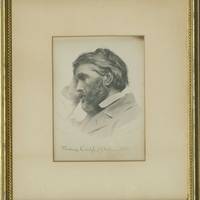
186582811865. <p>Engraving of a photograph of the great writer and historian by Elliott and Fry taken approximately 1854. Signed and dated by Carlyle in 1865 as he finished his great work on Frederick the Great.</p><p>Signed images of Thomas Carlyle are very uncommon this being the first we have carried.</p> unknown
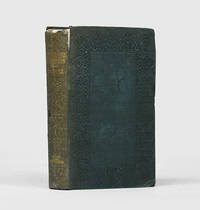
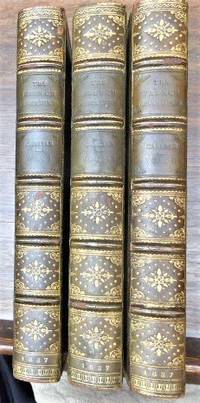
1837015441London: James Fraser 1837. THREE VOLUMES uniformly bound. Inner dentelles red endpapers. A SIGNED BINDING by Riviere and Sons. French fillet borders with corner rondelles. Spine decorated in gilt. Gilt lettering has faded but can still be read. Top corners just a bit worn several lightly bumped. Please see photos. All three half-titles are present. Volume 1 is subtitled "The Bastille" Volume 2 "The Constitution' and Volume 3 "The Guillotine". One of the greatest treatises written on the french Revolution. See "Printing and the Mind of Man" #304. Thomas Carlyle 1795-1881 was a Scottish historian essayist philosopher in the Victorian era. . First Edition. Lime Green Morocco. Light Corner and Edge Wear/No Dust Jacket. Crown Octavo. James Fraser Hardcover
1884318714Boston: Dana Estes and Charles Lauriat 1884. Edition de luxe number 276 of 315 sets. 20 vols. 8vo. Bound in three quarters purple morocco spines gilt by the Harcourt Bindery Boston the spines tooled and lettered in gilt top edge gilt. Some minor fading to spines. Edition de luxe number 276 of 315 sets. 20 vols. 8vo. Dana Estes and Charles Lauriat unknown
1885229257London: Chapman and Hall 1885. The Ashburton Edition. Engraved frontispiece portrait to volume I numerous plates throughout the set. 17 vols. 8vo. Bound in three quarters blue morocco and marbled boards gilt spines raised bands t.e.g. Fine handsome set. The Ashburton Edition". Engraved frontispiece portrait to volume I numerous plates throughout the set. 17 vols. 8vo. Chapman and Hall unknown
189829561London: Chapman and Hall Limited. As New. 1898. Hardcover. FREE UPGRADE to Courier/Priority Shipping Upon Request - IN STOCK AND IMMEDIATELY AVAILABLE FOR SHIPMENT - AS NEW THE TEXT BLOCK IS PRISTINE CLEAN UNMARKED AND IN EXCELLENT CONDITION - - -- with a bonus offer-- . Chapman and Hall Limited hardcover
184314155Boston MA: Charles C. Little and James Brown. As New. 1843. Hardcover. FREE UPGRADE to Courier/Priority Shipping Upon Request - IN STOCK AND IMMEDIATELY AVAILABLE FOR SHIPMENT - AS NEW THE TEXT BLOCK IS PRISTINE CLEAN UNMARKED AND IN EXCELLENT CONDITION - -- with a bonus offer-- . Charles C. Little and James Brown hardcover
18530145161853. Manuscript. Light creases from folding; writing dark and clear. About Fine and uncommon. HOLOGRAPH MANUSCRIPT completely in Carlyle's hand but not signed of @250 words on the verso of a letter 8" x 9-7/8" addressed to the writer notifying him of his election to the Atheneum. Mostly in ink with additions in pencil the notes appear to be historical and biographical research in preparation for the writing of his biography of Frederick the Great. The notes spill over to the bottom of the letter. <br/><br/> unknown
1857763A61London: Chapman and Hall; Longman Brown Green Longmans and Roberts 1857-1869. First edition. Leather. Near Fine. 7.5" by 5". None. A lovely matching set bound in half leather comprising various historical or biographical volumes on General Oliver Cromwell Thomas Uwins the French Revolution and Frederick the Great. A lovely matching set bound in half morocco and cloth with marbled edges and endpaper.Including three volumes Oliver Cromwell's Letters and Speeches: With Elucidations by Thomas Carlyle. The second edition of this work with a foreword on the edition to volume one. Including the letters and speeches of Oliver Cromwell noted English general and statesman who led the armies of the Parliament of England against King Charles I during the English Civil War. He acted simultaneously as head of state and head of government of the new republican commonwealth. Two volumes A Memoir of Thomas Uwins With Letters to his Brother During Seven Years Spent in Italy and Correspondence with the Late Sir Thomas Lawrence Sir Charles L. Eastlake. A E Chalon and other DIstinguished Persons by Mrs Uwins. The first edition of this work. A fascinating memoir of the British painter and letters exchanged with important people of the time. Two volumes on The French Revolution: A History in Three Parts: I. The Bastille; II. The Constitution; III. The Guillotine. A thorough and interesting later edition of these volumes on the history of the French Revolution by Thomas Carlyle. These were inspiration for Charles Dickens' novel A Tale of Two Cities.Seven volumes A History of Friedrich II of Prussia Called Frederick the Great. A later print complete with sic in text maps and fourteen folding maps. A complete set on the history of Frederick the Great self-proclaimed King of Prussia from 1740 until his death being the longer reigning monarch of the Hohenzollern. Under his rule Prussia became a military power in Europe. Bound in half morocco binding and cloth over boards with marbled edges and endpapers and five raised bands. Externally lovely with only minor rubbing to head and tail of spine and extremities. Internally firmly bound. Minor faint spotting to the endpapers otherwise pages are bright and clean. Collated. Complete with various maps fourteen of which folding maps to Frederick the Great's volumes. Near Fine Chapman and Hall; Longman, Brown , Green, Longmans, and Roberts hardcover
1827161555Edinburgh: William Tait and Charles Tait 1827. Establishing German romantic literature in Britain First edition of Carlyle's translation "one of the key books in the transmission of the German Romantics to England" Wolff. Carlyle's collection of previously untranslated German Romantic novellas "was intended to build on the success of Thomas Carlyle's translation of Goethe's Wilhelm Meister's Apprenticeship 1824 and to continue his efforts to promote German culture as a necessary alternative to British empiricism. Carlyle sought to separate the cream of German avant-garde literature from the works of inferior writers that had flooded the literary marketplace in Britain and produced a distorted image of German culture. And he wished to establish German literature as an alternative source of cultural leadership for his age. In addition to garnering high praise for its editor and translator these translations announced Carlyle's ambition to serve as an agent of cultural interaction. A deeply influential episode in the development of Carlyle's literary style and aesthetic sensibility Carlyle's engagement with Hoffmann Tieck and Jean Paul can be seen in the stylistic innovations of such works as Sartor Resartus The French Revolution and Frederick the Great. German Romance also laid the groundwork for Carlyle's extraordinary burst of critical activity during the late 1820s. Carlyle's translations of the German Romantics remained the standard well into the twentieth century and many have never been superseded" Cumming p. 189. 4 vols bound in 2 octavo 185 x 114 mm. Bound without terminal blank in vol. III else complete with half-titles and 4 engraved frontispieces. Later 19th-century half calf twin green and red morocco labels purple cloth sides red speckled edges. Neat early ownership signature to front pastedown. Slight paper residue to half-title of vol. I pp. 85/6 with closed tear not affecting text paper repair at head of pp. 261/2 not affecting text some foxing soiling to vol. IV pp. 307-13. A very good copy. Tarr A4.1; Wolff 1131. Mark Cumming The Carlyle Encyclopedia 2004. hardcover
1837001679London: James Fraser 1837. 1st Edition . Hardcover. Very Good/No Jackets. 8vo - over 7¾ - 9¾" tall. The first edition of this classic work on the French Revolution. A very good set in leather rebacked with original spines laid down and new labels corners bumped and boards show some minor wear. Collated to Dyer Page 85 although volume II lacks the advert leaf. All half titles present. Printing and the Mind of Man #304. Volume I inscribed "T. C. Arnold fr. JRB. May 30/1840." Volume III inscribed "C. T. Arnold. Oxford. 1840. Rugby. 1841" in a different hand - see photos. Volume I has some minor pencil annotation to rear endpaper. <br/> <br/>The first edition of this classic work on the French Revolution. James Fraser hardcover
18822210532New York: Edition De Luxe 1882. Limited Edition . Hardcover. Good-. 8vo - over 7¾ - 9¾" tall. See photos for condition details. Hardcover original 19th century publication limited to just 50 copies. Full title reads as follows: "The Trial of Carlyle W. Harris A transcript in narrative form from the Official Stenographer's Minutes taken at the trial before Recorder Smyth in the Court of General Sessions of the Peace January Term 1882". Published by Edition De Luxe and limited to 50 copies. Brown cloth exterior shows moderate to heavy wear/bumps to edges and corners boards are soiled and spine is lumpy with remnants of a paper label at the top. Interior pages are tone due to age and scattered foxing and spotting is present. No signatures or bookplates though scattered pages have minor penciling mainly check marks the one page showed a word written. These are very lightly done in pencil and could easily be erased if desired. Front hinge is good but rear hinge is cracked. Other areas in the book show some pulling to the binding. The book contains numerous illustrations as well as a large foldout drawing showing the court scene. Page edges are uncut with rough edges some pages have chips and small tears because of this. An extremely rare publication with last known copy coming up for auction in 1908 under the George M. Williamson Collection: Catalogue of the Extremely Choice Collection of First Editions of English and American Authors and Association Books. <br/> <br/> Edition De Luxe hardcover
1845D19665London: Chapman & Hall 1845. Hardcover. Very Good. Second Edition." With a presentation inscription from Carlyle on the front free endpaper: "To Samuel Rogers Esq. with many kind regards T.C. Chelsea 13 July 1845." Backstrip restored; hinges repaired. In a morocco-backed folding case. Another of the younger generation who met Rogers about 1838 was Thomas Carlyle; and the gruff Scotsman's impressions hackneyed as they are must be quoted: "Old Rogers with his pale head white bare and cold as snow. those large blue eyes cruel sorrowful and that sardonic shelf chin." It is evident that Carlyle rebel as he was was impressed with the "grim old dilettante full of sardonic sense"; and when we remember how unresponsive was Carlyle to mere reputations and how hopelessly unfair even to greatness that did not agree with him his tribute is remarkable. There must have been a force of character trained and controlled to make this wild prophet of a new age write so definitely of an old poet to the fellow-prophet in America Ralph Waldo Emerson. <br/><br/> Chapman & Hall hardcover
1871409153London: Bell and Daldy Printed at the Chiswick Press 1871. From the Bart Auerbach Collection. Spines a touch darkened some very slight wear. Small hole in the front free endpaper of vol. 2 probably the result of moving Carlyle's bookplate from that spot where it was mistakenly placed to the inside front cover; nevertheless an agreeable copy. 2 volumes 8vo. Original dark brown cloth blocked in black and gilt. First edition. The dedication copy to Carlyle with his bookplate in each volume and with an autograph letter signed from Helps to him in the original envelope which is tipped onto the front free endpaper of vol. 1. The letter 3 pages 8vo on Privy Council Office stationery Helps was Clerk dated 3 April 1871 reads: "My dear Carlyle I send herewith a copy of a book which I have taken the liberty of dedicating to you. You must therefore receive it very kindly and be blind or at least blind as you can to its many faults. If one cannot rely upon one's Dedicatee as a partial friend I hate your impartial people and do not believe in them whom can one rely upon Yours always Arthur Helps."<br /> <br /> The printed dedication is in the form of a 6 ½-page dedicatory letter: "Dedication. / My Dear Carlyle I dedicate this Life of Cortes to you. And I cannot content myself by making a simple dedication but must write a letter.I dedicate this work to you because I desire an occasion to record my gratitude for all your kindness to me in times past. I have also an author's as well as a friend's reasons for this dedication." Sir Arthur Helps 1813-1875 had been associated with Carlyle on the founding committee for the London Library. With Carlyle's bookplate. BA. Bell and Daldy [Printed at the Chiswick Press] unknown
189554806Boston: Dana Estes & Company 1895. Centennial Memorial Edition limited. Hardcover. Near fine to fine condition. 493/1000. Original three quarter brown leather over decorative boards with gilt ruling on covers gilt lettering tooling and ruling on spines; raised bands. Top edges gilt. Decorative endpapers. Frontispieces in b/w or color with printed tissue guards. Title page with portrait vignette printed in red and black. Illustrated edition.<br /> <br /> The French Revolution A History 3 Vols. Friedrich II. of Prussia Called Frederick The Great 7 Vols. Oliver Cromwell's Letters and Speeches With Elucidations 3 Vols. Sartor Resartus. The Life and Opinions of Herr Teufelsdröckh. Heroes and Hero-Worship 1 Vol. Critical and Miscellaneous Essays 4 Vols. Past and Present. The Portrait of John Knox. Miscellanies 1 Vol. The Life of John Sterling. Latter-Day Pamphlets 1 Vol. Life of Friedrich Schiller. Comprehending An Examination of His Works 1. Vol. Wilhelm Meister's Apprenticeship and Travels 2 Vols. German Romance. My Irish Journey 2 Vols. Last Words 1 Vol. Minor wear along bottom edges of bindings. Dana Estes & Company hardcover
182457936E-252: Oliver & Boyd. Good. 1824. First Edition; First Printing. Leather. Leather. 8vo. Oliver & Boyd Edinburgh UK. 1824. 3 Volumes. 324 351 294 pgs. First Edition/First Printing. Bound in 3/4 green morocco leather and marbled paper covered boards with raised bands and gilt titles present to the spine. Boards have wear present to the extremities of the boards boards are scuffed and worn. Previous owner's name present to the reverse of the front board catalog description tipped into the reverse of the rear board of the first volume. Foxing present. Text is clean and free of marks. Binding tight and solid. Wilhelm Meister's Apprenticeship a novel of self-realization greatly admired by the Romantics has been called the first Bildungsroman and has had a tremendous influence on the history of the German novel. Wilhelm Meister's Apprenticeship a novel of self-realization greatly admired by the Romantics has been called the first Bildungsroman and has had a tremendous influence on the history of the German novel. The story centers on Wilhelm a young man living in the mid-1700s who strives to break free from the restrictive world of economics and seeks fulfillment as an actor and playwright. EB; 8vo 8" - 9" tall . Oliver & Boyd hardcover