SUARES (André);CLAUDEL (Paul);Livre Rare Book

3 729 résultats
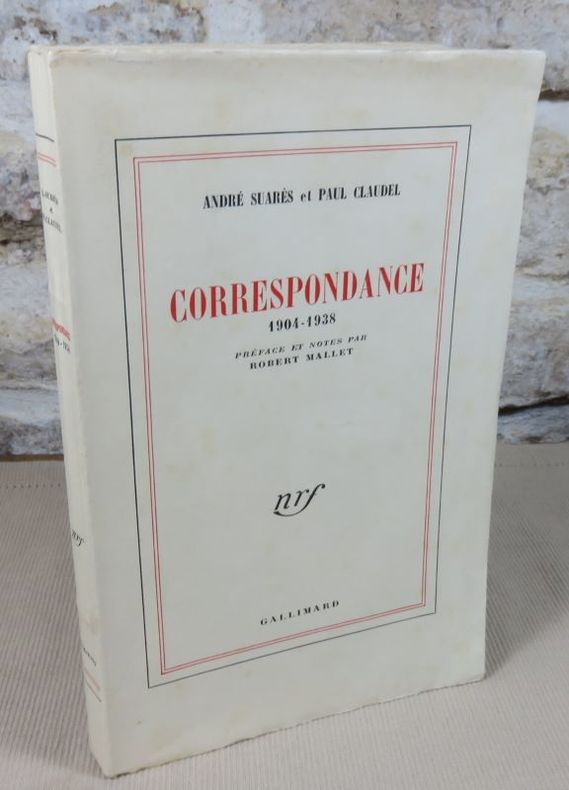
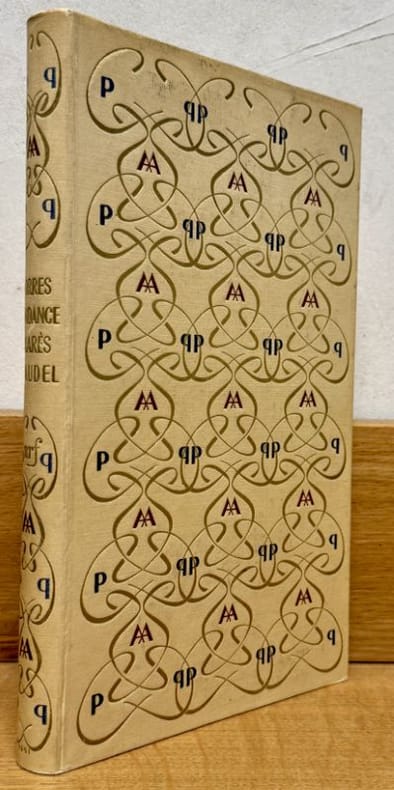
195115628Gallimard Paris 1951 1 vol. In-8 de 270 pp., cartonnage d'après la maquette originale de Paul Bonet.
195152606Paris Gallimard 1951 In-8, broch, couverture imprime.Edition originale, orne de 2 photographies reprsentant Andr Suars et Paul Claudel. Un des 362 exemplaires numrots sur vlin Lafuma-Navarre. Non coup.
195134424Paris Gallimard 1951 In-8, broch, couverture imprime.Edition originale, orne de 2 photographies reprsentant Andr Suars et Paul Claudel. Un des 362 exemplaires numrots sur vlin pur fil Lafuma. Neuf, non coup.
195134423Paris Gallimard 1951 In-8, broch, couverture imprime.Edition originale, orne de 2 photographies reprsentant Andr Suars et Paul Claudel. Un des 46 premiers exemplaires numrots sur hollande. Neuf, non coup.
195155398Paris Gallimard 1951 In-8, cartonnage de l'diteur orn sur les plats et le dos de compositions en couleurs dessines par Paul Bonet.Edition originale. Un des 1.050 exemplaires numrots sur vlin Labeur et relis d'aprs une maquette de Paul Bonet.
195131032Paris Gallimard 1951 In-8, cartonnage de l'diteur orn sur les plats et le dos de compositions en couleurs dessines par Paul Bonet.Edition originale. Un des 1.050 exemplaires numrots sur vlin Labeur et relis d'aprs une maquette de Paul Bonet.
195148261951 Paris, Editions Gallimard, 1951, 1 Volume broché, 230 x 145 mm. 270 pp. Edition originale numérotée, sur vélin pur fil, Frontispices, Fac-similés, hors texte.bon état.
5363N.R.F. 1951. Grand in-8° broché. 270 pages. E.O.
27943Broché, 23X14 cm, 1951, 270 pages, portrait en frontispice, édition originale un des 362 exemplaires numérotés sur vélin pur fil Lafuma-Navarre, (la blanche) nrf Gallimard. Bon exemplaire non coupé.
195190537Paris Gallimard 1951 1 vol. relié in-8, cartonnage éditeur d'après la maquette de Paul Bonet, 270 pp., 2 portraits en frontispice, fac-similés et index. Édition originale. Exemplaire numéroté sur vélin labeur (Huret, 513). En assez belle condition.
195190537Paris Gallimard 1951 1 vol. relié in-8, cartonnage éditeur d'après la maquette de Paul Bonet, 270 pp., 2 portraits en frontispice, fac-similés et index. Édition originale. Exemplaire numéroté sur vélin labeur (Huret, 513). En assez belle condition.
1951140611951 Paris, Gallimard, 1951, in 8 carré, cart. d'éditeur d'après la maquette de Paul BONET, bon ex.
8657P., Gallimard, NRF, 1951, in 8° broché, 270 pages ; index des noms et index des titres in-fine.
38171P., NRF, Gallimard, 1951, in 8° broché, 270 pages ; non coupé ; 2 portraits.
33221Préface et notes par Robert Mallet - Paris : Gallimard, 1951 - in-8 broché, 270 pages - édition originale numérotée : 1/362 exemplaires sur vélin pur fil - bon état -
195112287Gallimard 1951 In-8 broché, 270 pp. Index. Portrait frontispice. Bon exemplaire.
195128382Paris, Gallimard, (11 avril) 1951. 1 vol. (145 x 230 mm) de 270 p. Broché, non coupé. Edition originale. Un des 362 exemplaires sur pur fil (n° 188).
617010Gallimard NRF Paris 1951 In-8 ( 185 X 120 mm ) de 270 pages, demi-maroquin chocolat à coins, dos à nerfs janséniste avec date dorée en queue, tête dorée, couvertures et dos conservés ( Reliure signée de ALIX ). Edition originale, 1 des 30 hors-commerce numérotés en chiffres romains sur Alfama Marais ( N°IV ). Mors et coiffes frottés, bon exemplaire.
194447005New York: Albert Carman printer 1944. Limited Edition. Portfolio. Pale salmon colored cloth elephant folio good with edge-wear and paint speckles. Special Artist's Presentation Edition singed by the artist. This being number 49 of 250 copies. 52 lithos plus the limitation page forward commentary and contents. each litho. is 17" X 12.5" with deckled edges the plates remain in very good condition with a one inch gutter all around bright and frame-able. An ex-libris copy from the Lyman Allyn Art Museum in New London CT with library stamps. Albert Carman, printer hardcover
500295661Grasset Sans date.
20087678Ggp Media Gmbh 2008 poche. 2008. Broché. Traduit de Sénès Florence - Illustrations de Jankovics györgy
2008100055442Ggp Media Gmbh 2008 poche. 2008. Broché. Traduit de Sénès Florence - Illustrations de Jankovics györgy
19732488NEA In-8 Couverture souple Dakar 1973
191475520Paris: Georges Cres Coll. coréenne composée sous la direction de Victor Segalen 1914. One of 750 numbered copies. Two octavo volumes paginated continuously. 226 pp. with text printed in two columns and with 61 large opening letters printed in red and black and meant to imitate a Chinese seal. Pages are all french-fold to simulate a Chinese book. String-tied wrappers. Housed in the original folding case with ivory clasps. A bit of wrinkling to the overlay leaf but the entire production by Victor Segalen is quite impressive.Connaissance de L'Est Knowledge of the East first published in 1900 is a collection of prose poems by Paul Claudel almost all composed in China between July 1895 and October 1899 when Claudel was appointed alternate consul in Shanghai. The poems in this collection are grouped into two unequal parts. Published in 1900 at the Mercure de France then in an expanded edition in 1907 the purpose of the book was to allow the newcomer to get to know this eastern country where he had just settled. Hence these texts on what we would today call Chinese culture: gardens theatre ideograms… Hence also the descriptions of exotic trees animals or landscapes. In August of 1913 Claudel gave Victor Segalen whom he had met in Beijing permission to republish his prose poems. The pages of this reissue were printed on one side folded in half and sewn in the oriental fashion. The two volumes were presented in a box covered with blue silk and equipped with tabs.Victor Segalen though largely forgotten today was a real force in his age. "French writer Victor Segalen was born in Brest on January 14 1878. After solid classical studies with the Jesuits he studied medicine in Brest Rennes and Bordeaux and became a naval doctor in 1902. His thesis entitled Les Cliniciens ès lettres in which he studied the medical documentation of certain naturalist writers. He detached a chapter from it: Les Synesthesias et l'école symboliste a vigorous plea in favor of the symbolists was published in the Mercure de France of April 1902.Meeting Joris-Karl Huysmans in 1899 and later Remy de Gourmont gave him access to the environment of the Mercure de France. His first post on the sloop "La Durance" in Tahiti from January 1903 convinced him from the outset that Polynesian civilization was threatened with death by European influence and by the carelessness of its peoples. Seeing the paintings and reading the writings of Paul Gauguin who had died recently in Hiva-Oa made him understand from the inside what the sensual and joyful life of the Polynesians had once been like. An article published in the Mercure de France in June 1904 Gauguin and much later a Tribute to Gauguin in 1918 testify to his admiration. Back in France in February 1905 he published Les Immémoriaux in 1907 under the pseudonym of Max-Anély. In this carefully documented book under a romantic and poetic fabrication Segalen showed how under political and religious pressure from Europe the Polynesians "the Immemorial" had come to forget their sacred words their gods their sensual search for happiness. It was Segalen's way of putting his ideas on exoticism into practice by letting Maori reciters speak pretending to adopt their values. In this he showed himself to be a precursor of modern ethnologists. The book moreover is the expression of his violent revolt against his rigorous moral and religious education. It had begun in Bordeaux but the Tahitian facilities the influence of Nietzsche and the example of Gauguin ranked among the "outlaws" with Rimbaud on whom he published a study Le Double Rimbaud had him singularly reinforced.His passion for music very much fostered by his family and his admiration for Debussy led him to meet the Master to whom he unsuccessfully offered the libretto of Siddhartha inspired by the tenets of Buddhism. However Debussy suggested that he write an Orpheus instead. They worked on it together but Orphée-Roi will only appeared in 1921 after the death of the musician and the poet. It is with China that Segalen according to Jouve quoting Rimbaud "finds the place and the formula". Appointed student interpreter for the navy he arrived in Beijing in June 1909 met Paul Claudel in Tien-Tsin for whom he felt more literary admiration than religious sympathy and undertook a great expedition to central China and Japan which lasted nine months. This lengthy stay in Asia gave rise the great works of Segalen as poet. Steles 1912 and 1914 a collection of forty-eight poems — sixty-four in the second edition — is externally and internally presented in Chinese style. But exoticism here only serves as an alibi. Neither translations nor adaptations these poems actually express the secret universe of the poet his opinions his feelings his travel experiences. By the detour of China by what he calls allegory they suggest notions too pure to fall under the cut of words. The unspeakable the invisible the unheard of haunt the stelae of the "Middle" in particular.With Paintings 1916 leaving behind the dense and concentrated style of lapidary inscriptions Victor Segalen opted to describe or recreate through spoken language Taoist paintings a long roll of silk portraits of decadent emperors. These are prose poems to be put on the same level as Rimbaud's Illuminations and Claudel's Conférence de l'Est. This poet was also a sinologist and an archaeologist. The official archaeological mission formed by Victor Segalen Gilbert de Voisins and Jean Lartigue discovered in 1914 the oldest Chinese monumental statue and identified the burial site of Emperor Ts'in Che-Houang whose exploration was to be sixty years later. the greatest discovery of the century. Georges Cres, Coll. coréenne composée sous la direction de Victor Segalen unknown
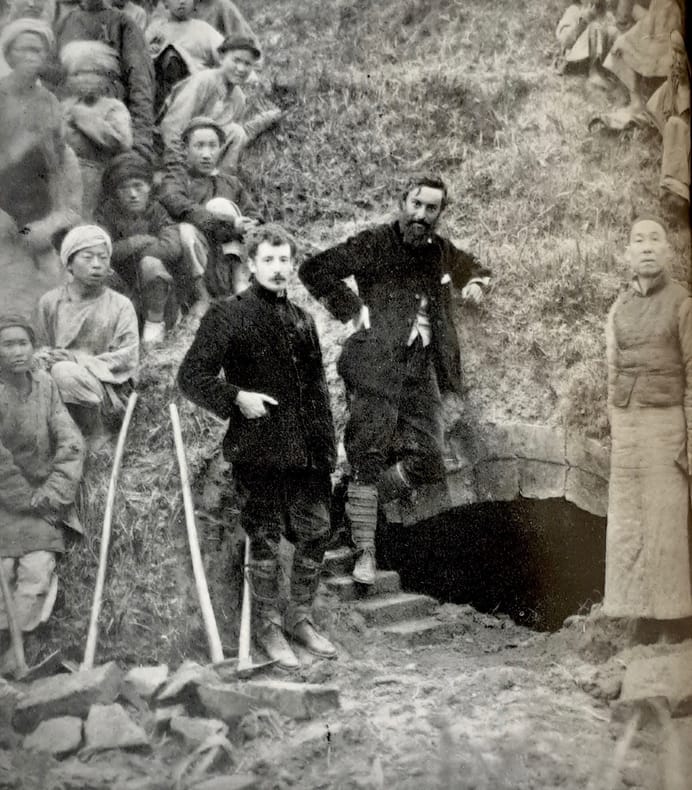
46856Marseille, directeur: Jean Ballard. Un volume de 180 pages avec cinq planches hors texte de photographies. Au sommaire, Départs avec Victor Segalen (140 pages).