5 253 résultats
1984160345-1Braunschweig, Literar. Vereinigung 1984. 68 S. Mit 2 Abb. Original-Pappband
11 volumi legati in cinque in-16° di pp. che variano d 180 a 280, legature in mezza tela coeva con titolo ai dorsi. Ben conservati.
1983ABE-1709128815604FORMAT 21,5 CM X 27 CM-84 PAGES-AFRIQUE NOIRE; LEOPOLD SEDAR SENGHOR, AMADOU HAMPATE BA, MONGO BETI, OLYMPE BHELY QUENUM, BIRAGO DIOP, HENRI LOPES, OUSMANE SEMBENE, L'HISTOIRE DE L'AFRIQUE REVUE ET CORRIGEE PAR LES AFRICAINS. 33P-LOUFOQUE RICHARD BRAUTIGAN ? 2P-CARLO EMILIO GADDA, UN FAMEUX PASTIS, 2P-CRITIQUE DE "LA BRULURE" DE JEAN DAVRAY LUNEAU ASCOT, 1P-CRITIQUE DE "FONDATION FOUDROYEE" D'ISAAC ASIMOV, 1P-ENTRETIEN DE GORE VIDAL, 5P-ROBERT BOULANGER, UN GUIDE BLEU, 1P-
1985ABE-1884472841392 PAGES-21,5 CM X 27 CM-EN COUVERTURE FRANCOIS MAURIAC PAR MORETTI-DOSSIER MAURIAC, 41 PAGES-LES AMOURS DE H.G. WELLS, PAR SIMONE AROUS-BUENOS-AIRES LA MAUDITE, PAR JEAN-MARIE SAINT-LU, CRITIQUE POUR "LE JOUET ENRAGE" DE RPBERTO ARLT, 2P, PHOTO-LE TEMPS RETROUVE, PAR JEAN-DIDIER WOLFROMM, CRITIQUE POUR "QUARTIER PERDU" DE PATRICK MODIANO, PHOTO, CRITIQUE POUR "MECHANT" DE JEAN-MARC ROBERTS, PHOTO-SHERLOCK HOLMES REINVENTE, CRITIQUE POUR "L'HORREUR DU WEST END" DE NICHOLAS MEYER-ENTRETIEN: DORIS LESSING EN PARTICULIER, PROPOS RECUEILLIS PAR FRANCOIS-OLIVIER ROUSSEAU, 6P, 3 PHOTOS-UNE BELLE MENTEUSE, CRITIQUE DE ALAIN GARRIC POUR "ADIEU VOLODIA" DE SIMONE SIGNORET, 1P, PHOTO
1964015708Copenhague & Paris Hengelo - Jacqueline de Jong 1964 In-4 Broché, couverture illustrée Edition originale
19721319087Hannover, Landeshauptstadt Hannover, 1972. 2 Bl., 86 S., 1 Bl. Kart. m. eingebund. OUmschl. (Sign. a. Fuß, Stempel verso Titel).
18461237589Stuttgart, Verlag des Herausgebers (J. Scheible), 1846. 2 Bl., S. (505) - 982 S., 32 Tafeln in Holzschnitt m. 96 Darstellungen. (Das Kloster IV, 2. Abteilung = Zelle 14 - 16). Späterer Pgtbd m. goldgeprägtem Rsch. (etwas begriffen u. berieben, stellenw. braunfleckig).
197967309AB(Kamenz, 1979). 8°. 53 S. Original-Broschur.
176728757Bln., Voss, 1767. Two nice, cont., uniform full calf w. five raised bands on backs, coloured title- and tome-labels and richly gilt backs. Traces of use, especially to the bands. Some gilding and part of title-label on vol. one worn off. Internally a bit of soiling, but a good copy on good paper. Old owner's name on t-p. (M. Harboe). Woodcut title-pages and vignettes.
178621975Carlsruhe, chr. gottlieb schmieder, 1786. Cont. hcalf. Gilt back. Hinges weakening, top of spine with loss of leather. Top of margins on the first leaves faintly dampstained.
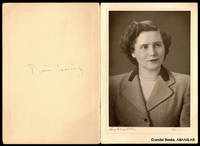
1952100175<p>London:: Hay Wrightson. 1952. Photograph. 4.25" x 6" original photograph SIGNED by Doris Lessing and by Hay Wrightson the photographer. Includes a typed note to the recipient dated 1952 and with her London address also SIGNED by Lessing and the original mailing envelope addressed in Lessing's hand. .</p> Hay Wrightson,
198270013Michael Joseph 1982. Third Impression of Revised Edition. Hardcover. Very Good Condition/Very Good. Size: Octavo standard book size. A large D to the back endaperSome residue from sellotape to bottom flap of dust wrapperand front endpaper. Internally fine. Quantity Available: 1. Shipped Weight: Under 1 kilo. Category: Fiction; Inventory No: 70013. . Michael Joseph hardcover
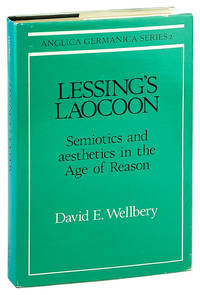
177817984Nürnberg 1778-79. 8vo. Samt skinnryggbd. med opphøyde ryggbånd og ryggforgylling. Med titelfelt i brunrødt skinn. 2 bl. 2 268 2 ; 8 248 2 bl. s. Med 3 foldekart.8vo. Bound together in a contemporary half calf binding spine richly gilt and with coloured label. 2 blank 2 268 2 ; 8 248 2 blank pp. 3 folding maps. in Verlag der Johann Georg Lochnerischen Buchhandlung Tysk. <br/><br/><em>Hjørnene støtt ryggen noe skrapet. Navn på første bl. bl.Liten del revet bort av side to i del II uten teksttap. Et fint eks.Corners bumped spine rubbed. Name on first blank page. Small strip torn off the second page of vol. 2 no loss of text. Otherwise a clean and crisp copy. Gotthold Ephraim Lessing 1729-1781 German dramatist and critic. He studied theology but was soon influenced by the popular rationalism of the Enlightment. He has no special claim to be ranked as a philosopher of originality and distinction but with the regard to the diffusion of certain ideas and attitudes among educated minds his historical influence is pre-eminent. Encyclopedia of Philosophy vol. 4 pp. 443-46. </em> unknown
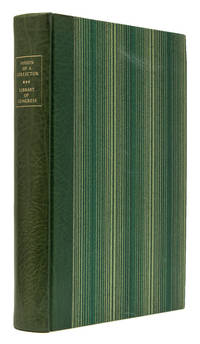
5131Engraved frontis. port. of Rosenwald. 4to orig. green morocco-backed decorated boards. Washington: Library of Congress 1991.<p> One of 300 deluxe copies specially bound and with the engraved portrait finely printed by W. Thomas Taylor. A really excellent collection of essays. Fine. unknown
199120957Washington: Library of Congress 1991. First edition. Hardcover. Faint blemish to front cover cloth seems to be in the weave of the fabric else fine. xxxv 427 pp. illustrated small 4to dark green raw silk over boads printed paper spine label. A collection of 100 essays each on a specific book from the Rosenwald Collections. Library of Congress hardcover
1991245369Washington D.C.: Library of Congress 1991. One of 300 special copies of the first edition. With an original signed frontispiece etching of Rosenwald by Tony Rosati. Illustrated. 427 3 pp. Designed and printed letterpress by W. Thomas Taylor in Austin Texas. 1 vols. 4to. Green morocco spine and decorated boards. Fine. One of 300 special copies of the first edition. With an original signed frontispiece etching of Rosenwald by Tony Rosati. Illustrated. 427 3 pp. Designed and printed letterpress by W. Thomas Taylor in Austin Texas. 1 vols. 4to. Library of Congress unknown
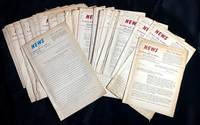
195142943New York American Council for Judaism 1951. 1st edition. Original stapled pages. "News" is 8.5"x11" and generally 4 single sided leaves. Press releases are legal size 8.5"x14" 2-4 single sided leaves each. Approximately 160 leaves total. <br> News is subtitled "Highlights of the Yiddish and Hebrew Press. A weekly Digest prepared by the Publicity and Research Departments American Council for Judaism." Maurice Spector is listed as Publicity Directory though the OCLC listing indicates Bill Gottlieb as editor perhaps for earlier or later issues <br> Each issue of the NEWS is headed with the warning "This is not for release - for your information only." <br> <br> Some headlines from the NEWS often quoting the Zionist press when it shines poorly on Zionism include: <br> -Nationalist-Zionist Education Endangers Judaism<br> - To the Rescue of Yiddish<br> - The Sin of the Histadrut<br> - Treatment of the Arab Minority in Israel<br> - And Now it is Israel's Turn to Use the Hostage Weapon.<br> - The Religious Bloc is Powerful for Reasons that aren't Religious<br> - We Want Peace Unity Discipline-But on our Own Terms.<br> - Israel's Election Campaign Opens.Here in America<br> <br> Some headlines from the press releases include: American council for Judaism Calls NCRAC Action Partisan: <br> -Declares Zionism and Jewish Nationalism Responsible for Creating 'Dual Loyalties' Issue<br> - Carroll Binder Warns Minority Pressure Blocs Endanger U.S. National Interests<br> - President Truman Say American Council for Judaism Deeply Rooted in U.S. Traditions of Individual Rights<br> - Zionist Pressure Seek Change of Judaism Values from Universal Religion to Status of Tribal Cult Rabbi Charges<br> - Dorothy Thompson Warns Zionism's Viewing All Jews as Members of a Jewish Nation" Seeking Privileged Minority Status in U.S. Gives Aid to Antisemitism<br> - Cause of DP's Pleaded at American Council for Judaism's Annual Meeting: Leading Social Workers Charges Pro-Israel Pressures Deprived Many Thousands of Sanctuary<br> - U. S. Culture Infiltration Seen as world Zionism Aim<br> - Israel has No Rights Authority Over Lives of U.S. Jews Rosenwald Says: Assumptions in Ben-Gurion's Knesset Speech Rejected by Head of American Council for Judaism<br> <br> "The American Council for Judaism ACJ is an organization of American Jews committed to the proposition that Jews are not a national but a religious group adhering to the original stated principles of Reform Judaism as articulated in the 1885 Pittsburgh Platform. In particular it is notable for its historical opposition to Zionism. Although it has since moderated its stance on the issue it still advocates that American Jews distance themselves from Israel politically and does not view Israel as a universal Jewish homeland.<br> The rabbis of Reform Judaism had opposed Zionism prior to World War I supporting freedom democracy and equal rights for Jews in the countries where they lived. The influential American Jewish Committee was also anti-Zionist until 1918 when it shifted to a non-Zionist platform until the 1967 Six-Day War. The Central Conference of American Rabbis of the Reform movement declared itself officially neutral on Zionism in 1937.<br> In 1942 a split within the Reform movement occurred due to the passage of a resolution by some rabbis endorsing the raising of a 'Jewish Army' in Palestine to fight alongside the Allies of World War II. The American and British general staffs opposed placing Jews in segregated armed forces.The founders of the American Council for Judaism regarded the potential segregation of Jews to be a highly regressive and harmful measure.<br> The ACJ was founded in June 1942 by a group of leading Reform rabbis including six former presidents of the Central Conference of American Rabbis and the president of the Hebrew Union College as well as laymen who opposed the creation of a religiously segregated Jewish Army to fight alongside the Allies and the new political direction of some in their movement including but not limited to on the issue of Zionism as redefined by the Biltmore Program in May 1942.The leading rabbis included Louis Wolsey Morris Lazaron Abraham Cronbach David Philipson and Henry Cohen but their most vocal representative for a time became Elmer Berger who became the council's Executive Director.<br> The ACJ described itself as anti-nationalist and followed a universalist interpretation of Jewish history and destiny. According to its statement of principles the ACJ supported the 'rehabilitation' of Palestine and did not support political Zionism. It also declared that 'Jewish nationalism tends to confuse our fellowmen about our place and function in society and diverts our own attention from our historic role to live as a religious community wherever we may dwell.' The ACJ's leaders felt that they represented the views of a majority of American Jews and began a large membership drive. By 1946 it had numerous local chapters throughout the United States and regional offices in Richmond Chicago Dallas and San Francisco.<br> During World War II the council was active in opposing Zionism. In 1944 it protested the formation of the Jewish Brigade by the British Army which was composed of Palestinian Jews led by British-Jewish officers.it stated that.'Americans of the Jewish faith are and always have been in the American armed forces. The flag of Americans of the Jewish faith is the Stars and Stripes.'<br> While protesting the White Paper of 1939 which imposed strict limits on Jewish immigration to Palestine and land purchases in the country it also opposed 'Zionist nationalism' and urged American Jews to 'organize in strength out of deep concern for oppressed Jews everywhere behind a non-nationalistic program to deal with the total Jewish problem.' <br> It declared that 'Beyond the abrogation of the White Paper lies the need for a basic solution. That solution we believe can come only when there is world wide recognition of the rights of Jews to full equality. It can come in Palestine only when the pretensions to Jewish Statehood are abandoned and we seek instead freedom of migration opportunity based on incontestable rights and not on special privilege.<br> We look forward to the ultimate establishment of a democratic autonomous government in Palestine wherein Jews Moslems and Christians shall be justly represented; every man enjoying equal rights and sharing equal responsibilities; a democratic government in which our fellow Jews shall be free Palestinians whose religion is Judaism even as we are Americans whose religion is Judaism.'<br> Following World War II with the question of Palestine's future being considered the ACJ continued to support a joint Jewish-Arab state rather than a Jewish state in Palestine and opposed dispossessing the Arabs who were then living in Palestine.<br> The presidency of the ACJ was accepted by the well-known philanthropist Lessing J. Rosenwald who took the lead in urging the creation of a unitary democratic state in Mandatory Palestine in American policy-making circles. Rosenwald testified before the Anglo-American Committee of Inquiry in 1946 urged the creation of a unitary Jewish-Arab state in Palestine and allowing Jewish immigration to Palestine to continue only upon 'renunciation of the claim that Jews possess unlimited national right to the land and that the country shall take the form of a racial or theocratic state' and said that the United States and other UN member states should allow more Jewish immigration to solve the European-Jewish refugee problem.<br> It later endorsed the Committee of Inquiry's recommendations including that Palestine become neither a Jewish or Arab state and the admittance of 100000 Jewish refugees into Palestine. In addition it opposed the establishment of a Jewish state anywhere else in the world not just in Palestine. The ACJ's official position was that European Jews should be rehabilitated by restoring their civil political and economic security. <br> During the Jewish insurgency in Palestine a campaign against the British by Jewish underground groups in Palestine the Haganah Irgun and Lehi the ACJ opposed what it viewed as Jewish terrorism. Following the King David Hotel bombing it issued a statement calling for American Jews to 'repudiate the perpetrators of those outrages and those leaders of Jews in and out of Palestine whose incitement is equally responsible.' In a statement Lessing Rosenwald called for the American Jewish community to condition any further assistance to the Yishuv Palestinian Jewry on the end of violence.<br> After the State of Israel declared independence in 1948 the ACJ continued its anti-Zionist campaign.<br> Its position was that to American Jews Israel was not the state or homeland of the Jewish people but merely a foreign country. In December 1948 Lessing Rosenwald urged that the US condition friendship with Israel on Israel building an inclusive Israeli nationalism confined to its own borders and inclusive of its Muslim and Christian citizens rather than Jewish nationalism.<br> The ACJ switched its focus to battling what it viewed as its primary foe-the political influence of Zionism upon American Jewry. In addition to supporting a network of religious schools committed to Classical Reform Judaism the Council fought American-Jewish fundraising for Israel and agitated against the merging of Zionist fund-raising organizations with local Jewish community boards provided financial aid to Jews emigrating from Israel and to Palestinian refugees and enjoyed friendly relations with the Eisenhower State Department under John Foster Dulles. <br> The ACJ also vocally supported the efforts of William Fulbright to have the lobbyists for Israel in the United States legally registered as foreign agents. In 1955 the ACJ's head Elmer Berger advocated the complete assimilation of Jews into American life by switching the Jewish Sabbath from Saturday to Sunday creating a new menorah to 'reflect the appreciation of American Jews of the freedom of life in the United States' and for the interpretation of the holiday of Sukkot 'to be broadened to take on meaning to all citizens of an industrial society.'<br> In 1957 the Union of American Hebrew Congregations now known as the Union for Reform Judaism denounced the American Council for Judaism. In a statement the UAHC alleged that the ACJ misrepresented classical Reform Judaism undermined the unity of the Reform movement questioned the national loyalty of Jews who supported Zionism aided antisemites and 'played directly into the hands of Arab propagandists'.<br> Jewish intellectuals who at one time or another passed through the Council included David Riesman Hans Kohn Erich Fromm Hannah Arendt Will Herberg Morrie Ryskind Frank Chodorov and Murray Rothbard. Among the notable gentile friends of the council were Dorothy Thompson Norman Thomas Freda Utley Arnold J. Toynbee and Dwight Macdonald. The ACJ was particularly influential in San Francisco Philadelphia Houston Chicago Baltimore Washington D.C. Atlanta and Dallas" Wikipedia.<br> SUBJECTS: Zionism and Judaism -- Periodicals. Jews -- United States -- Sionisme -- Aspect religieux -- Judai¨sme -- Pe´riodiques. Juifs -- E´tats-Unis. OCLC: 12373966. OCLC lists only 3 holdings worldwide HUC UTexas Wisc Hist all in the midwest and none at any Ivy League institution.<br> Toning to edges pencilled institutional numbers to cover corner margins some original corner staples removed paper strong Good Condition solid. Rare and important especially as much of Liberal Progressive and Secular American Jewry rethinks its relationship to Israel and Zionism in light of the present Israel-Gaza war. B Zion2-3-5-'l. New York, American Council for Judaism unknown
1313712434.Gpaperback. Good. Access codes and supplements are not guaranteed with used items. May be an ex-library book. paperback
201414278Paris, Terrail, 1992 ; in-4, 223 pp., br.
202003776Paris, Albin Michel, 1995 ; in-8, 489 pp., br. 1er vol.
202003777Paris, Albin Michel, 1998 ; in-8, 468 pp., br. (1949-1962).
197027896North Hills PA: Printed for the Philobiblion Club Bird & Bull Press 1970. First Thus. Limited to 250 copies of which this is no. 50. Slim quarto 30.5cm.; original brown cloth-backed marbled boards spine lettered in black; 13pp.; 4 mounted facsimile plates; staplebound facsimile catalogue laid into chemise mounted inside rear cover. Fine. Facsimile of the hoax auction catalogue issued in 1840 organized by Belgian bibliophile Renier Chalon. Printed for the Philobiblion Club, Bird & Bull Press unknown
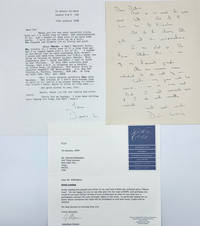
53906The late Patrick Eddington was a Utah artist and former high school art teacher who had as a goal the desire to create “The Cat Project†where literary and visual artists from around the world were asked to produce original works about cats which would be included in a traveling exhibition and book unfortunately never realized. Doris Lessing 1919-2013 born in what was then Persia now Iran spent her childhood years in southern Africa. The author of nearly 50 books she received the 2007 Nobel Prize in Literature becoming only the eleventh woman to receive literature’s most prestigious award in its 106-year history. Her works are often viewed as in-depth studies of twentieth-century living conditions behavioral patterns and historical progressions. Her masterwork is considered to be The Golden Notebook a postmodern feminist work published in 1962. Interestingly Lessing who was a devoted cat lover throughout her life is also the author of a book which conjures up the subtleties of feline existence On Cats. With regards to this small archive it is significant that this rather busy Nobel-Prize winning author would provide Eddington a high school art instructor and small press printer with a piece of original prose regarding cats supplied specifically for him at a relatively low cost.<br /> <br /> <br /> <br /> Included in the archive are the following:<br /> <br /> <br /> TLS. Letter 8†x 10†from Doris Lessing to Patrick Eddington sent from London and dated 17th January 1986. A letter in which Lessing discusses her feelings with regards to one of her earlier works “A Small Personal Voice.†Eddington had recommended it to a friend and Lessing claims “The trouble is I wrote some of it a long time ago and I no longer agree with a lot of it. I wonder if she would like to read something more recent I wrote and read five lectures for C.B.C. under the title of Prisons We Choose to Live Inside. This represents what I think now not what I used to think in the ‘fifties.’†Signed “Yours Doris L.†at the foot.<br /> <br /> <br /> <br /> ALS. Letter on a sheet of paper 7†x 9†written by Doris Lessing to Patrick Eddington. Not dated. In the brief letter Lessing thanks Eddington for the book by Barbara Kingsolver and writes “I am glad u sic like Brian Aldiss. He is one of my favorite people.†She closes the letter assuring Patrick that if she writes something suitable regarding the subject of cats she will remember him.<br /> <br /> <br /> TLS. Brief letter 8 ¼†x 11 ¼†from Doris Lessing sent from London and dated January 6 2000 addressed to Patrick. Lessing opens with “OK I’ve done a short piece. It is not a question of being paid but of time- am as usual in the middle of something. I don’t need a thousand dollars… Perhaps 500 I don’t need a Navajo rug….†Signed by Lessing.<br /> <br /> <br /> <br /> Typed letter 8 ¼†by 7 ¾†from Lessing’s literary agent Jonathan Clowes to Patrick Eddington dated 10 January 2000 written in reference to the piece written by Doris Lessing titled “About Cats.†Clowes writes “We are happy for you to use this piece for the sum of $500 and perhaps you could let us have further details of your publication so that we can send you a permission contract for non-exclusive rights in the work. In particular please let us know which territories the book will be published in and how many copies will be printed.†Signed by the literary agent at the foot.<br /> <br /> <br /> <br /> Typed manuscript signed 8 ¼†x 11 ½â€. “About Cats†by Doris Lessing. The original piece that Lessing sent to Patrick Eddington titled “About Cats†containing periodic manuscript corrections made by the author. Cat lovers will immediately recognize this as a keenly insightful succinct piece regarding the precious feline’s nature. Within the work the author muses “People who do not observe their cats but only rely on ‘received’ wisdom miss out. A cat gives back what you put into it returning affection and attention but withdrawing in dignified silence if ignored. No creature is more sensitive to slights and taunts and even teasing. Too much and they will take themselves off in search of a more sympathetic home. And yet one may not generalize: people who have had more than one child know that every baby is born different and similarly in a litter of kittens each one will be an individual. Like humans they are coarsegrained and sensitive stupid and clever clinging and standoffish. They may be talkative and silent show-offs and modest introverts.â€. unknown
198426746Cambridge: Cambridge University Press 1984. Very Good/Very Good. Cambridge: Cambridge University Press 1984. First Edition. Octavo; publisher's boards in green printed dust jacket; ix1275pp. Moderate shelf wear to jacket extremities spine a shade sunned corners bumped textblock uniformly toned contemporary ownership signature to front free endpaper else Very Good and sound. Cambridge University Press unknown
202303751Paris, Hatier, 1969 ; in-4, 277 pp., cartonnage de l'éditeur. Avec jaquette sous boitage carton.