4 979 résultats
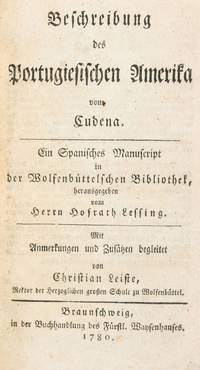
17803823Braunschweig: in der Buchhandlung des Fürstl. Waysenhauses 1780. First edition. The original Spanish text is reproduced throughout with facing German translation. Later morocco covers panelled in blind and gilt spine lettered in gilt. Outer margin of the final leaf skilfully restored. Overall in very good condition. First edition. The original Spanish text is reproduced throughout with facing German translation. Later morocco covers panelled in blind and gilt spine lettered in gilt. 160 pp. <p><br /> A rare pre-Humboldt German Braziliana; the first publication of a 1634 survey of Portuguese America's geography commerce and colonial administration issued by Lessing.<br /> <p><p><br /> One of the most significant German publications on Brazil of the eighteenth century containing the first appearance in print of a manuscript survey of Portuguese America written in 1634 by Pedro Cadena de Vilhasanti. The manuscript was discovered in the ducal library at Wolfenbüttel by Gotthold Ephraim Lessing who published it together with a German translation and an extensive commentary by Christian Leiste. At a time when reliable German-language information on South America remained scarce the volume became one of the principal German sources on Brazil before the appearance of Humboldt's works.<br /> <p><p><br /> The author Pedro Cadena de Vilhasanti served as provedor-mor of the Royal Treasury in Brazil and is best known for his Relação diária do cerco da Bahia de 1638 one of the principal contemporary accounts of the Dutch siege of Salvador first published only in the twentieth century. Written for the Count-Duke of Olivares chief minister of the Spanish monarchy the present work reflects Cadena's direct experience of colonial administration and constitutes a detailed administrative economic and geographical survey of Portuguese Brazil during the period of Dutch expansion in northeastern South America. Proceeding systematically along the coast from the mouth of the Amazon southwards he describes the principal captaincies including Maranhão Pará Rio Grande Paraíba and Pernambuco recording settlements fortifications ports rivers and administrative divisions while providing extensive information on trade taxation sugar production shipbuilding resources and strategic infrastructure. Particular attention is given to exports of sugar tobacco cotton brazilwood and other commodities the revenues they generated the number of sugar mills in operation navigational conditions and the availability of timber suitable for the construction of large ocean-going vessels. The work preserves an unusually detailed snapshot of the economic and administrative structure of Portuguese Brazil in the early seventeenth century and offers a rare contemporary assessment of the colony's strategic and commercial value.<br /> <p><p><br /> The publication originated in Lessing's investigation into the origin of the name of the Amazon Marañón River. Misinterpreting the phrase "Marañón y Gran Pará" as referring to a Spanish captain rather than to a geographical designation he believed the manuscript provided evidence for the origin of the river's name and therefore arranged for its publication prefacing it with a substantial introduction. Although this interpretation was later shown to be mistaken Leiste sought to support Lessing's reading of "Marañón y Gran Pará" before ultimately supplementing the manuscript with additional material drawn from more authoritative sources particularly Dutch works on Brazil thereby providing a broader account of the colony's geography and history. His commentary reflects the growing German scholarly interest in South America during the late eighteenth century.<br /> <p><p><br /> Borba de Moraes regarded the volume as one of the most significant German publications on Brazil of the eighteenth century noting the scarcity of original German works on the subject during that period. The edition attracted sufficient attention to be reprinted with corrections and additional commentary in C. G. von Murr's Reisen einiger Missionarien der Gesellschaft Jesu in Amerika 1785.<br /> <p><p><br /> References: Borba de Moraes Bibliographia Brasiliana I pp. 141-142; Sabin 17830<br /> <p>. in der Buchhandlung des Fürstl. Waysenhauses unknown
198553201FISCHER SAMUEL 1985. 1. softcover. Canopus im Argos: Archive Sirmkovrilo! »Ich würde mich sehr freuen wenn Rezensenten und Leser den Zyklus Canopus im Argos: Archive als eine Art Rahmen sehen könnten der mir erlaubt die eine oder andere wie ich hoffe unterhaltsame Geschichte zu erzählen mir und anderen Fragen zu stellen Gedanken und soziologische Möglichkeiten zu erforschen.« Doris Lessing FISCHER, SAMUEL paperback
1832951948Weimar. 1832-1833. Folio. 318 x 201 mm. (Einband berieben, Ecken etwas bestoßen, Rücken ausgeblichen; wenige Seiten papierbedingt minimal fleckig, im Ganzen recht gut erhalten) [7 Warenabbildungen] [152] einseitig bedruckte Blätter, und ein kleineres Blatt mit Programmänderung zum 07. Mai 1833. Handgefertigter flaschengrüner Pappeinband der Zeit (330 x 214 x 32 mm) mit handgeschriebenem Rückenschild. Moderne hellbraune Ganzleinwandkassette (358 x 22
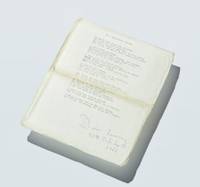
1995Typewritten poem signed by the author. Dated 30 October 1961. Folded. Edges slightly creased. In very good condition. // A szerzÅ‘ által golyóstollal aláÃrt 1961. október 30-ai keltezéssel ellátott vers gépirata. 1 p. 204 × 253 mm. Félbehajtva. Szélein kissé töredezett. Nagyon jó állapotban. Typewritten poem signed by the author. Dated 30 October 1961. Folded. 1 p. 204 × 253 mm. <p><br /> The Nobel Prize winner writer Doris Lessing’s poem sent to her “Hungarian Friend†Iván Boldizsár.<br /> <p><p><br /> The poem dated 1961 was sent to Iván Boldizsár a Hungarian novelist writer and editor. Some lines such as “In April they open the prisons†refer to the envisaged amnesty for those who have been arrested after the Hungarian Revolution of 1956.<br /> <p><p><br /> Doris Lessing was awarded to Nobel Prize in Literature in 2007. She is known as the pioneer of feminist writing and the fight against colonialism.<br /> <p><p><br /> A Nobel-dÃjas Ãró Doris Lessing verse melyet Boldizsár Ivánnak küldött.<br /> <p><p><br /> Az 1961-es költemény egyes sorai – pl. „In April they open the prisons†– az 1956-os forradalom után bebörtönzöttek számára kilátásba helyezett amnesztiára utalnak. <br /> <p><p><br /> Doris Lessing a nÅ‘i Ãrás és a gyarmati rendszer elleni harc úttörÅ‘jeként számon tartott irónÅ‘ 2007-ben nyerte el az irodalmi Nobel-dÃjat.<br /> <p>. unknown
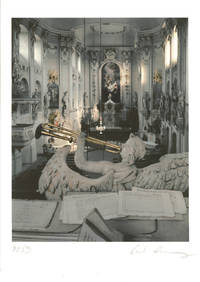
1875-20Wien ca. 2000. 10 farb. Photographien. Orig.-Gicléedrucke auf Büttenpapier. 32 x 40 cm. Blattgr. Mit Deckbl. u. 7 Textbbll. auf Pergaminpapier. in OLn.-Kassette. In tadellosem Zustand. Vom Künstler eigenhänd. signiert u. numeriert. - Als Evokationen bezeichnet der Fotograf Erich Lessing seine erzählenden Farbserien welche die Lebensstationen bekannter Künstler und Wissenschafter darstellen. Er bringt Orte des Geschehens und echte Dokumente in Verbindung. Es sind "Historienbilder" mit echten Versatzstücken die das Leben von Musikern Dichtern und Wissenschaftern greifbar nahe bringen sollen. Die Herstellung von Giclée-Drucken oder Iris Fine Art Prints ist ein in den USA entwickeltes digitales Ausgabeverfahren das auf einer hoch entwickelten Tintenstrahldruckertechnologie beruht. Das Besondere an diesem Druckverfahren ist dass es einen mit freiem Auge nicht erkennbaren Druckpunkteaufbau hat. Diese extrem feine Auflösung ist Voraussetzung für die detailgenaue und brillante Wiedergabe von Bildern. Die Druckqualität der digitalen Technik ist heute so hervorragend dass Giclée-Drucke bereits in Museen und Galerien hängen und renommierte internationale Künstler wie Chuck Close Jim Dine David Hockney oder Robert Rauschenberg diese Technik verwenden. - Erich Lessing 1923-2018 flüchtete 1939 nach Palästina kehrte 1947 nach Österreich zurück und wurde Photoreporter bei der amerikanischen Nachrichtenagentur Associated Press. Später arbeitete er als freier Photograph für Zeitschriften wie die New York Times. Seit 1951 war Lessing Mitglied von Magnum Photos der internationalen Photographen-Kooperative. Die einzelnen vorhandenen Tafeln: 1. Ein Ausflug der Schubertianer in den Wienerwald. - Schubert's friends the "Schubertianer" during an excursion to the Vienna Woods. - 2. Zimmer in Mozarts Geburtshaus in der Getreidegasse in Salzburg die Violinschule von Vater Leopold auf dem Notenständer Mozarts Kindergeige nur 51 cm lang auf dem Klavierstuhl im Vordergrund. - Mozart's birthplace in Salzburg Getreidegasse his small child's violin his father's School for Violin on the music stand. - 3. Frederic Chopin. Ein Zimmer in der Kartause von Valdemosa in der Chopin und George Sand in der Hoffnung auf Sonne einen verregneten Winter verbrachten. - Room in the Carthusian Monastery in Valdemosa Mallorca where George Sand and her lover Chopin spent a rainy winter. - 4. George Sand und Frederic Chopin. Speisezimmer in Nohant dem Landgut George Sands. - Dining room in George Sand's manor in Nohant France. - 5. Josef Haydn. Saal im Schloß der Fürsten Esterhazy in Eisenstadt. - Hall in the palace of the Princes Esterhazy in Eisenstadt where Haydn's symphonies and operas were performed. - 6. Anton Bruckner. Todesanzeige und Totenmaske. - Obtiuary notice and deathmask of Anton Bruckner 11 Oct. 1896. - 7. Ludwig van Beethoven. Heiligenstädter Testament. - 8. Schloß Esterhazy Eingang. - 9. W. A. Mozart. Waisenhauskirche in Wien in welcher der 12-jährige Mozart 1768 eine von ihm komponierten Messe dirigierte. - 10. Hector Berlioz. Arbeitszimmer in seinem Haus im Tad der Chevreuse bei Paris. [Wien, ca. 2000]. unknown
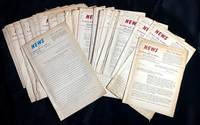
195142943New York American Council for Judaism 1951. 1st edition. Original stapled pages. "News" is 8.5"x11" and generally 4 single sided leaves. Press releases are legal size 8.5"x14" 2-4 single sided leaves each. Approximately 160 leaves total. <br> News is subtitled "Highlights of the Yiddish and Hebrew Press. A weekly Digest prepared by the Publicity and Research Departments American Council for Judaism." Maurice Spector is listed as Publicity Directory though the OCLC listing indicates Bill Gottlieb as editor perhaps for earlier or later issues <br> Each issue of the NEWS is headed with the warning "This is not for release - for your information only." <br> <br> Some headlines from the NEWS often quoting the Zionist press when it shines poorly on Zionism include: <br> -Nationalist-Zionist Education Endangers Judaism<br> - To the Rescue of Yiddish<br> - The Sin of the Histadrut<br> - Treatment of the Arab Minority in Israel<br> - And Now it is Israel's Turn to Use the Hostage Weapon.<br> - The Religious Bloc is Powerful for Reasons that aren't Religious<br> - We Want Peace Unity Discipline-But on our Own Terms.<br> - Israel's Election Campaign Opens.Here in America<br> <br> Some headlines from the press releases include: American council for Judaism Calls NCRAC Action Partisan: <br> -Declares Zionism and Jewish Nationalism Responsible for Creating 'Dual Loyalties' Issue<br> - Carroll Binder Warns Minority Pressure Blocs Endanger U.S. National Interests<br> - President Truman Say American Council for Judaism Deeply Rooted in U.S. Traditions of Individual Rights<br> - Zionist Pressure Seek Change of Judaism Values from Universal Religion to Status of Tribal Cult Rabbi Charges<br> - Dorothy Thompson Warns Zionism's Viewing All Jews as Members of a Jewish Nation" Seeking Privileged Minority Status in U.S. Gives Aid to Antisemitism<br> - Cause of DP's Pleaded at American Council for Judaism's Annual Meeting: Leading Social Workers Charges Pro-Israel Pressures Deprived Many Thousands of Sanctuary<br> - U. S. Culture Infiltration Seen as world Zionism Aim<br> - Israel has No Rights Authority Over Lives of U.S. Jews Rosenwald Says: Assumptions in Ben-Gurion's Knesset Speech Rejected by Head of American Council for Judaism<br> <br> "The American Council for Judaism ACJ is an organization of American Jews committed to the proposition that Jews are not a national but a religious group adhering to the original stated principles of Reform Judaism as articulated in the 1885 Pittsburgh Platform. In particular it is notable for its historical opposition to Zionism. Although it has since moderated its stance on the issue it still advocates that American Jews distance themselves from Israel politically and does not view Israel as a universal Jewish homeland.<br> The rabbis of Reform Judaism had opposed Zionism prior to World War I supporting freedom democracy and equal rights for Jews in the countries where they lived. The influential American Jewish Committee was also anti-Zionist until 1918 when it shifted to a non-Zionist platform until the 1967 Six-Day War. The Central Conference of American Rabbis of the Reform movement declared itself officially neutral on Zionism in 1937.<br> In 1942 a split within the Reform movement occurred due to the passage of a resolution by some rabbis endorsing the raising of a 'Jewish Army' in Palestine to fight alongside the Allies of World War II. The American and British general staffs opposed placing Jews in segregated armed forces.The founders of the American Council for Judaism regarded the potential segregation of Jews to be a highly regressive and harmful measure.<br> The ACJ was founded in June 1942 by a group of leading Reform rabbis including six former presidents of the Central Conference of American Rabbis and the president of the Hebrew Union College as well as laymen who opposed the creation of a religiously segregated Jewish Army to fight alongside the Allies and the new political direction of some in their movement including but not limited to on the issue of Zionism as redefined by the Biltmore Program in May 1942.The leading rabbis included Louis Wolsey Morris Lazaron Abraham Cronbach David Philipson and Henry Cohen but their most vocal representative for a time became Elmer Berger who became the council's Executive Director.<br> The ACJ described itself as anti-nationalist and followed a universalist interpretation of Jewish history and destiny. According to its statement of principles the ACJ supported the 'rehabilitation' of Palestine and did not support political Zionism. It also declared that 'Jewish nationalism tends to confuse our fellowmen about our place and function in society and diverts our own attention from our historic role to live as a religious community wherever we may dwell.' The ACJ's leaders felt that they represented the views of a majority of American Jews and began a large membership drive. By 1946 it had numerous local chapters throughout the United States and regional offices in Richmond Chicago Dallas and San Francisco.<br> During World War II the council was active in opposing Zionism. In 1944 it protested the formation of the Jewish Brigade by the British Army which was composed of Palestinian Jews led by British-Jewish officers.it stated that.'Americans of the Jewish faith are and always have been in the American armed forces. The flag of Americans of the Jewish faith is the Stars and Stripes.'<br> While protesting the White Paper of 1939 which imposed strict limits on Jewish immigration to Palestine and land purchases in the country it also opposed 'Zionist nationalism' and urged American Jews to 'organize in strength out of deep concern for oppressed Jews everywhere behind a non-nationalistic program to deal with the total Jewish problem.' <br> It declared that 'Beyond the abrogation of the White Paper lies the need for a basic solution. That solution we believe can come only when there is world wide recognition of the rights of Jews to full equality. It can come in Palestine only when the pretensions to Jewish Statehood are abandoned and we seek instead freedom of migration opportunity based on incontestable rights and not on special privilege.<br> We look forward to the ultimate establishment of a democratic autonomous government in Palestine wherein Jews Moslems and Christians shall be justly represented; every man enjoying equal rights and sharing equal responsibilities; a democratic government in which our fellow Jews shall be free Palestinians whose religion is Judaism even as we are Americans whose religion is Judaism.'<br> Following World War II with the question of Palestine's future being considered the ACJ continued to support a joint Jewish-Arab state rather than a Jewish state in Palestine and opposed dispossessing the Arabs who were then living in Palestine.<br> The presidency of the ACJ was accepted by the well-known philanthropist Lessing J. Rosenwald who took the lead in urging the creation of a unitary democratic state in Mandatory Palestine in American policy-making circles. Rosenwald testified before the Anglo-American Committee of Inquiry in 1946 urged the creation of a unitary Jewish-Arab state in Palestine and allowing Jewish immigration to Palestine to continue only upon 'renunciation of the claim that Jews possess unlimited national right to the land and that the country shall take the form of a racial or theocratic state' and said that the United States and other UN member states should allow more Jewish immigration to solve the European-Jewish refugee problem.<br> It later endorsed the Committee of Inquiry's recommendations including that Palestine become neither a Jewish or Arab state and the admittance of 100000 Jewish refugees into Palestine. In addition it opposed the establishment of a Jewish state anywhere else in the world not just in Palestine. The ACJ's official position was that European Jews should be rehabilitated by restoring their civil political and economic security. <br> During the Jewish insurgency in Palestine a campaign against the British by Jewish underground groups in Palestine the Haganah Irgun and Lehi the ACJ opposed what it viewed as Jewish terrorism. Following the King David Hotel bombing it issued a statement calling for American Jews to 'repudiate the perpetrators of those outrages and those leaders of Jews in and out of Palestine whose incitement is equally responsible.' In a statement Lessing Rosenwald called for the American Jewish community to condition any further assistance to the Yishuv Palestinian Jewry on the end of violence.<br> After the State of Israel declared independence in 1948 the ACJ continued its anti-Zionist campaign.<br> Its position was that to American Jews Israel was not the state or homeland of the Jewish people but merely a foreign country. In December 1948 Lessing Rosenwald urged that the US condition friendship with Israel on Israel building an inclusive Israeli nationalism confined to its own borders and inclusive of its Muslim and Christian citizens rather than Jewish nationalism.<br> The ACJ switched its focus to battling what it viewed as its primary foe-the political influence of Zionism upon American Jewry. In addition to supporting a network of religious schools committed to Classical Reform Judaism the Council fought American-Jewish fundraising for Israel and agitated against the merging of Zionist fund-raising organizations with local Jewish community boards provided financial aid to Jews emigrating from Israel and to Palestinian refugees and enjoyed friendly relations with the Eisenhower State Department under John Foster Dulles. <br> The ACJ also vocally supported the efforts of William Fulbright to have the lobbyists for Israel in the United States legally registered as foreign agents. In 1955 the ACJ's head Elmer Berger advocated the complete assimilation of Jews into American life by switching the Jewish Sabbath from Saturday to Sunday creating a new menorah to 'reflect the appreciation of American Jews of the freedom of life in the United States' and for the interpretation of the holiday of Sukkot 'to be broadened to take on meaning to all citizens of an industrial society.'<br> In 1957 the Union of American Hebrew Congregations now known as the Union for Reform Judaism denounced the American Council for Judaism. In a statement the UAHC alleged that the ACJ misrepresented classical Reform Judaism undermined the unity of the Reform movement questioned the national loyalty of Jews who supported Zionism aided antisemites and 'played directly into the hands of Arab propagandists'.<br> Jewish intellectuals who at one time or another passed through the Council included David Riesman Hans Kohn Erich Fromm Hannah Arendt Will Herberg Morrie Ryskind Frank Chodorov and Murray Rothbard. Among the notable gentile friends of the council were Dorothy Thompson Norman Thomas Freda Utley Arnold J. Toynbee and Dwight Macdonald. The ACJ was particularly influential in San Francisco Philadelphia Houston Chicago Baltimore Washington D.C. Atlanta and Dallas" Wikipedia.<br> SUBJECTS: Zionism and Judaism -- Periodicals. Jews -- United States -- Sionisme -- Aspect religieux -- Judai¨sme -- Pe´riodiques. Juifs -- E´tats-Unis. OCLC: 12373966. OCLC lists only 3 holdings worldwide HUC UTexas Wisc Hist all in the midwest and none at any Ivy League institution.<br> Toning to edges pencilled institutional numbers to cover corner margins some original corner staples removed paper strong Good Condition solid. Rare and important especially as much of Liberal Progressive and Secular American Jewry rethinks its relationship to Israel and Zionism in light of the present Israel-Gaza war. B Zion2-3-5-'l. New York, American Council for Judaism unknown
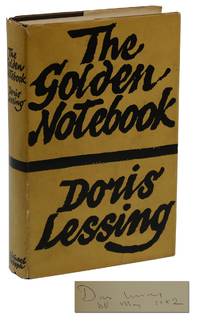
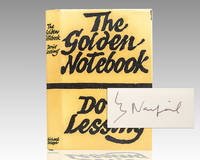
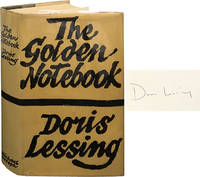
1962140941022London: Michael Joseph 1962. First Edition. Near Fine/Very Good. First edition first printing. Signed and dated by Doris Lessing on the title page. In publisher's original black cloth-affect boards with titles stamped in gilt on the spine. Near Fine with light sunning to cover former owner name to front paste down hinge at title page lightly exposed and sporadic marking throughout text and to rear free endpaper. In a Very Good unclipped dust jacket with toning edge wear and soiling. The Nobel Prize-winning author's best-known novel. Michael Joseph unknown
1962149113London: Michael Joseph 1962. First edition of the Nobel Prize-winning author's magnum opus. Octavo original cloth. From the library of fellow Nobel Prize-winning author V.S. Naipaul on the front free endpaper. V.S. Naipaul 1932–2018 was a Trinidad-born novelist and essayist whose works including A House for Mr Biswas 1961 In a Free State 1971 and A Bend in the River 1979 probe the complexities of postcolonial identity exile and cultural dislocation with a style noted for its clarity and irony. Widely recognized for both his fiction and travel writing he received numerous honors most notably the Booker Prize in 1971 and the Nobel Prize in Literature in 2001 cementing his reputation as one of the most significant literary voices of the late twentieth century. Near fine in a very good dust jacket. Jacket design by William Belcher. An exceptional association. "The Golden Notebook is Doris Lessings most important work and has left its mark upon the ideas and feelings of a whole generation of women" Elizabeth Hardwick New York Times Book Review. Michael Joseph hardcover
19626311London: Michael Joseph 1962. First Edition. Hardcover. Fine/Near Fine. Signed by Lessing on the title page housed in a custom clamshell case. Fine in a Near Fine jacket unclipped 30s net lightly toned and rubbed at the surface and edges a small closed tear at the bottom edge. Brown buckram with gilt lettering on the spine. Square and firmly bound clean internally. Lessing's magnum opus about writer Anna Wulf and her writing notebooks an exploration of contemporary social and political issues. Michael Joseph hardcover
STLN0055Berlin Vossische Buchhdlg. 1771-1825. Lessing Gotthold Ephraim Sämmtliche schriften 8°. Insgesamt etwa 12500 Seiten. Mit 3 Kupferstichen-Tafeln u. 1 gef. Schrifttafel. Braune Pappbände d. Zt. m. goldgepr. Rückentitel auf roten Schildchen. Bibl.-Ex; vord. Spiegel u. Titelbll. gestemp. hs. Bibl.-Etik. auf Vorderdeckel insgesamt guter u. sauberer Erhaltungszustand Einbände teilweise gering berieben Ecken vereinzelt bestoßen Text Tlw. stockfl. oder gebräunt jedoch ohne wesentliche Gebrauchsspuren. Berlin, Vossische Buchhdlg. 1771-1825 unknown
1825STLN0055Berlin, Vossische Buchhdlg. 1771-1825. 8°. Insgesamt etwa 12500 Seiten. Mit 3 Kupferstichen-Tafeln u. 1 gef. Schrifttafel. Braune Pappbände d. Zt. m. goldgepr. Rückentitel auf roten Schildchen. Bibl.-Ex; vord. Spiegel u. Titelbll. gestemp., hs. Bibl.-Etik. auf Vorderdeckel, insgesamt guter u. sauberer Erhaltungszustand, Einbände teilweise gering berieben, Ecken vereinzelt bestoßen, Text Tlw. stockfl. oder gebräunt, jedoch ohne wesentliche Gebrauchsspuren.
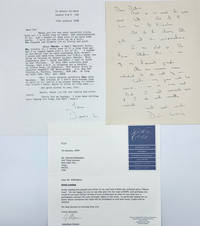
53906The late Patrick Eddington was a Utah artist and former high school art teacher who had as a goal the desire to create “The Cat Project†where literary and visual artists from around the world were asked to produce original works about cats which would be included in a traveling exhibition and book unfortunately never realized. Doris Lessing 1919-2013 born in what was then Persia now Iran spent her childhood years in southern Africa. The author of nearly 50 books she received the 2007 Nobel Prize in Literature becoming only the eleventh woman to receive literature’s most prestigious award in its 106-year history. Her works are often viewed as in-depth studies of twentieth-century living conditions behavioral patterns and historical progressions. Her masterwork is considered to be The Golden Notebook a postmodern feminist work published in 1962. Interestingly Lessing who was a devoted cat lover throughout her life is also the author of a book which conjures up the subtleties of feline existence On Cats. With regards to this small archive it is significant that this rather busy Nobel-Prize winning author would provide Eddington a high school art instructor and small press printer with a piece of original prose regarding cats supplied specifically for him at a relatively low cost.<br /> <br /> <br /> <br /> Included in the archive are the following:<br /> <br /> <br /> TLS. Letter 8†x 10†from Doris Lessing to Patrick Eddington sent from London and dated 17th January 1986. A letter in which Lessing discusses her feelings with regards to one of her earlier works “A Small Personal Voice.†Eddington had recommended it to a friend and Lessing claims “The trouble is I wrote some of it a long time ago and I no longer agree with a lot of it. I wonder if she would like to read something more recent I wrote and read five lectures for C.B.C. under the title of Prisons We Choose to Live Inside. This represents what I think now not what I used to think in the ‘fifties.’†Signed “Yours Doris L.†at the foot.<br /> <br /> <br /> <br /> ALS. Letter on a sheet of paper 7†x 9†written by Doris Lessing to Patrick Eddington. Not dated. In the brief letter Lessing thanks Eddington for the book by Barbara Kingsolver and writes “I am glad u sic like Brian Aldiss. He is one of my favorite people.†She closes the letter assuring Patrick that if she writes something suitable regarding the subject of cats she will remember him.<br /> <br /> <br /> TLS. Brief letter 8 ¼†x 11 ¼†from Doris Lessing sent from London and dated January 6 2000 addressed to Patrick. Lessing opens with “OK I’ve done a short piece. It is not a question of being paid but of time- am as usual in the middle of something. I don’t need a thousand dollars… Perhaps 500 I don’t need a Navajo rug….†Signed by Lessing.<br /> <br /> <br /> <br /> Typed letter 8 ¼†by 7 ¾†from Lessing’s literary agent Jonathan Clowes to Patrick Eddington dated 10 January 2000 written in reference to the piece written by Doris Lessing titled “About Cats.†Clowes writes “We are happy for you to use this piece for the sum of $500 and perhaps you could let us have further details of your publication so that we can send you a permission contract for non-exclusive rights in the work. In particular please let us know which territories the book will be published in and how many copies will be printed.†Signed by the literary agent at the foot.<br /> <br /> <br /> <br /> Typed manuscript signed 8 ¼†x 11 ½â€. “About Cats†by Doris Lessing. The original piece that Lessing sent to Patrick Eddington titled “About Cats†containing periodic manuscript corrections made by the author. Cat lovers will immediately recognize this as a keenly insightful succinct piece regarding the precious feline’s nature. Within the work the author muses “People who do not observe their cats but only rely on ‘received’ wisdom miss out. A cat gives back what you put into it returning affection and attention but withdrawing in dignified silence if ignored. No creature is more sensitive to slights and taunts and even teasing. Too much and they will take themselves off in search of a more sympathetic home. And yet one may not generalize: people who have had more than one child know that every baby is born different and similarly in a litter of kittens each one will be an individual. Like humans they are coarsegrained and sensitive stupid and clever clinging and standoffish. They may be talkative and silent show-offs and modest introverts.â€. unknown
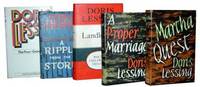
1952796London: Michael Joseph 1952-1969. First editions of the author's Children of Violence Series. Octavo 5 volumes. Original cloth. Each of the five volumes are signed by Doris Lessing. Near fine in very good to near fine dust jackets. Martha Quest the first book in the "Children of Violence" series follows a young girl coming of age in British colonial South Africa just before World War II. The following books chronicle her experience as she grows through marriage and then motherhood. In 2007 Doris Lessing won the Nobel Prize in Literature. At 87 she was the oldest winner of the prize at the time. "Oh Christ!" She told reporters outside her home as she was returning from the grocery store "I've won all the prizes in Europe every bloody one so I'm delighted to win them all. It's a royal flush. Michael Joseph hardcover
alb731f46d09eb002d7Lessing G. Nathan the Wise. In Russian (ask us if in doubt)/Lessing G. Natan mudryy. Short description: In Russian (ask us if in doubt).SPB Marx 1897 402s. We have thousands of titles and often several copies of each title may be available. Please feel free to contact us for a detailed description of the copies available. SKUalb731f46d09eb002d7
177953771n.p.: n.p. 1779. First edition. Hardcover. Good. Small octavo. Collation: pi2 A-Q8 R6 S4 = 140 leaves. 4 276pp. Half dark brown cloth over marbled boards which simulate tree calf lightly worn with some slight abrasions to covers. Text lightly toned with intermittent mild foxing. Final five leaves partially detached from block but holding to hinge else a good complete copy.<br /> <br /> First edition published by subscription in May 1779. This is a copy of the first issue with no attempt at correction on p.95: i.e. "Ein reichre Mann" line 11 is followed by "Der reichre Jude war line 13. A towering figure of the eighteenth-century German Enlightenment Gotthold Ephraim Lessing 1729-1781 produced two works one at the beginning of his literary career and one at the end each of which featured a Jew as a principal character. The one-act comedy Die Juden 1749 was one of Lessing's earliest literary ventures and was "the first time a Jew was presented on a the German stage in a reasonably objective manner" EJ. His last play Nathan the Wise 1779 is much better known and once again contains a plea for toleration. Lessing's inspiration for Nathan was his friend the Jewish philosopher Moses Mendelssohn. Nathan is here made the spokesperson for brotherhood tolerance and the love of humanity indeed all the noble aspirations of the Enlightenment. The play is set during the time of the Third Crusade ca. 1192 during an armistace in Jerusalem. "Based on the parable of the three rings adapted from Boccaccio's Decameron the play presents Judaism represented by Nathan Christianity a Templar knight and Islam Saladin the Turkish Sultan as three sons of a benevolent father who has given each an identical ring although each one claims that his ring alone is authentic" EJ. While the vision here presented of inter-religious amity was ridiculed by the likes of Julius von Voss Der travestierte Nathan der Weise 1804 and attacked by various anti-Semites Lessing's ideals found much support among German Jews such as Gabriel Riesser I. H. Ritter Berthold Auerback Emil Lehmann and Johann Jacoby. Indeed Lessing's "ideological and stylistic influence on the Haskalah was as decisive as that of Friedrich Schiller" EJ.<br /> <br /> "Lessing was born in Saxony the son of a pastor and after a brilliant career at school entered the University of Leipzig as a theology student. Here however the two interests literature and the theatre which were to dominate his life first discovered themselves. Yet perhaps Lessing is best judged by the sum of his achievement. He was one of the principal figures in the Aufklärung the emancipation of German literature from the narrow classicism of the French school. It was he more than any other who laid the foundation of the intellectual primacy of German writers and thinkers in the nineteenth century. Without attching himself to any special philosophical school he consistently opposed error and dogmatism and in art in poetry in drama and in religion he provided new stimulation." PMM pp. 128-129. References: J. Carter & P. H. Muir eds. Printing and the Mind of Man pp.128-129. K. Lachmann Gotthold Ephraim Lessings sämtliche Schriften 1919 vol. 22 part 2 pp. 458-459: this ed. noted as "subskriptionsausg. Mai 1779". VD18 11831499. [n.p.] hardcover
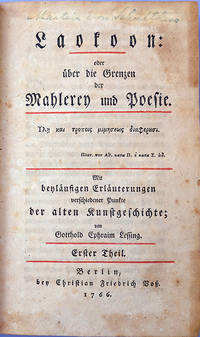
1766680Berlin: Christian Friedrich Voss 1766. First Edition. Hardcover. Very good. A Classic of Art HistoryPMM 213 <br /> <br />LESSING Gotthold Ephraim LAOKOON : oder uber die grenzen der mahleren und poesie. mit beylaufigen erlauterungen verschiedener punkte der alten kunstgeschichte Christian Friedrich Voss Berlin 1766 298pp. 8vo. FIRST EDITION. <br /> <br />Lessings most famous work outside Germany and a classic of art history. In Laokoon Lessing claims that certain arts have certain limits. The rules of poetry are not the same as those of sculpture or painting each has its unique sphere. "Laokoon is perhaps Lessing's best-known work outside Germany and it has had a world-wide influence . It contains the first clear statement of the truth which is now considered axiomatic that every art is subject to limitations and can achieve greatness only by a clear understanding of and self-restriction to its proper function. The most telling passages and those which have borne most fruit are those on poetry . In the words of Macaulay he was 'beyond all dispute the first critic of Europe'" PMM 213. <br /> <br />CONDITION: Original boards seems to be re-backed though certainly not modern with renewed end-papers. Hand-scripted lettering to spine. Former owners name scripted in contemporary hand to rear paste down. Internally clean. Very good. <br /> <br/><br/>PHOTOS AVAILABLE UPON REQUEST Christian Friedrich Voss hardcover
176642808Berlin: Voss 1766. <p>"Opened up a New Prospect in the Appreciation of Greek Literature" Printing and the Mind of Man</p> <p>Lessing Gotthold Ephraim 1729-81. Laokoon: Oder über die Grenzen der Mahlerey und Poesie. Erster Theil all published. 8vo. 8 298pp. Berlin: Christian Friedrich Voss 1766. 196 x 122 mm. Half sheep gilt spine ca. 1766 light rubbing and edgewear. Minor foxing and toning but very good. Former owners' signatures on front endpaper and title. </p> <p> First Edition. The German philosopher and critic Gotthold Lessing was one of the most outstanding representatives of the Enlightenment era; "it was he more than any other who laid the foundations of the intellectual primacy of German writers and thinkers in the nineteenth century" Printing and the Mind of Man 213. His Laokoon probably his best-known work had an enormous influence on the development of art and literary criticism:</p> <p> "Laokoon takes its name from the famous statue discovered at Rome in the sixteenth century. It analyzes the differences between the sculptor's treatment of Laocoon wrestling with the serpents and Virgil's treatment of the same theme and from there does on to discuss the limits and limitations of all the arts. It contains the first clear statement of the truth which is now considered axiomatic that every art is subject to limitations and can achieve greatness only by a clear understanding of a self-restriction to its proper function. The most telling passages and those which have borne most fruit are those on poetry . . . Lessing's exposition of the themes of Homer and Sophocles is especially effective and he opened up a new prospect in the appreciation of Greek literature" Printing and the Mind of Man.</p> . Voss unknown
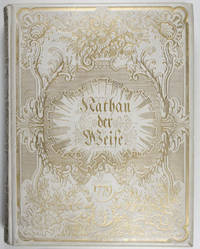
18818283Leipzig: W. Druglin 1881. First. Hardcover. vg. Small folio. 354 pp. All edges gilt. Cream colored parchment paper richly decorated in gold on front and rear boards. Bevelled edges. Minor bumping to corners and rubbing to head and tail of spine. Slight foxing to pp. 97 and 97 rest of text clean. Decorative thick marbled enpapers. Text in German Gothic script. Following the third revised and corrected edition this edition was published in honor of the hundredth anniversary of the original printing. Overall very good. W. Druglin hardcover
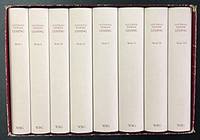
L3 box41 v3eThis is Eight Volume Set in German new books red cloth hardcover bound with dust jacket case is not included. The pictures only show 1 volume the other 7 volumes are the same appearance. The details as below:<br /><br />Gotthold Ephraim Lessing: Werke in 8 Banden.<br /><br />In Zusammenarbeit mit Karl Eibl Helmut Gobel Karl S. Guthke Albert von Schirnding und Jorg Schonert herausgegeben von Herbert G. Gopfert<br /><br />Textredaktion dieses Bandes: Sibylle von Steinsdorff<br /><br />Lizenzausgabe 1996 fur die Wissenschaftliche Buchgesellschaft<br /><br />Bestellnummer 13317-X<br /><br />Alle Rechete vorbehalten @ 1970 Carl Hanser Verlag Munchen<br /><br />Gesetzt aus der Sabon-Antiqua<br /><br />Druck und Bindung: Friedrich Pustet Regensburg<br /><br />Printed in Germany<br /><br />Band I: Gedichte . Fabeln . Lustspiele.<br /><br />Band II: Trauerspiele . Nathan der Weise . Dramatische Fragmente.<br /><br />Band III: Rezensionen 1747-1755 . >>Briefe<< . Aus den Beitragen zur Historie und Aufnahme des Theaters Vorrede. Plautus. Werenfels . Vorreden zu Voltaire zu Mylius zu eigenen Schriften . Ein Vade mecum fur den Hrn. Sam. Gotth. Lange . Rettungen des Horaz . Pope ein Metaphysiker! Gluckwunschungsrede 1743 . Gedanken uber die Herrnhuter.<br /><br />Band IV: Aus der Theatralischen Bibliothek . Vorreden zu Thomson und Diderot . Briefwechsel mit Mendelssohn und Nicolai . Sophokles . Aischylos . Euripides . Hamburgische Dramaturgie.<br /><br />Band V: Rezensionen und Anzeigen 1757-1770 . Briefe die neueste Literatur betreffend . Abhandlungen uber die Fabel . Zerstreute Anmerkungen uber das Epigramm . Uber die Fabeln der Minnesinger . Die Nachtigall . Fragmente . Kollektaneen u. a.<br /><br />Band VI: Laokoon samt NachlaB . Briefe antiquarischen Inhalts samt NachlaB . Wie die Alten den Tod gebildet . Ehemalige Fenstergemalde im Kloster Hirschau . Vom Alter der Olmalerei . Uber die Ahnenbilder der alten Romer . Tagebuch der italienischen Reise . Aus den Kollektaneen u. a.<br /><br />Band VII: Theologiekritische Schriften einschlieBlich des Reimarus-Komplexes.<br /><br />Band VIII: Der Goeze-Streit samt den >>Freiwilligen Beitragen<< von Goeze . Philosophische Schriften im Anhang: F.H. Jacobi uber seine Gesprache mit Lessing . Personenregister . Register der Hinweise auf eigene Werke Lessings. Wissenschaftliche Buchgesellschaft hardcover
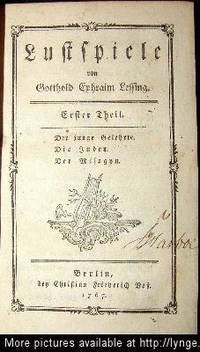
176728757Bln., Voss, 1767. Two nice, cont., uniform full calf w. five raised bands on backs, coloured title- and tome-labels and richly gilt backs. Traces of use, especially to the bands. Some gilding and part of title-label on vol. one worn off. Internally a bit of soiling, but a good copy on good paper. Old owner's name on t-p. (M. Harboe). Woodcut title-pages and vignettes.
176728757Bln. Voss 1767. Two nice cont. uniform full calf w. five raised bands on backs coloured title- and tome-labels and richly gilt backs. Traces of use especially to the bands. Some gilding and part of title-label on vol. one worn off. Internally a bit of soiling but a good copy on good paper. Old owner's name on t-p. M. Harboe. Woodcut title-pages and vignettes. <br/><br/><em>First edition of Lessing's first collection of "Lustspiele" containing the first printing of "Minna von Barnhelm".Lessing 1729-1781 is the most important literary writer of the Age of German Enlightenment; with him this period is fulfilled as well as overcome."Minna von Barnhelm" is one of Lessing's most important and successfull works and is considered one of the absolute best of his plays. "Es war die erste deutsche Dramatische Dichtung welche nicht gemacht sondern erlebt war." Hettner Geschichte der deutschen Literatur im 18. Jahrh. II: 310. Lessing himself wrote in a letter that should "Minna of Barnhelm" not turn out to be the very best of his plays he would be very disappointed and never have anything to do with the theatre again. " "Minna von Barnhelm" ist unbedingt die vollendeste dichterische Leistung Lessings." Hettner II: 310. Goethe also considered this work a masterpiece; he found it the most sincere thing to have come out of the Seven Years War and a work of immense importance and impact. With this work we find the genres of drama and comedy fulfilled."Nach ein paar Wanderjahren kehrte er nach Berlin zurück wo 1766 un 1767 zwei seiner Meisterwerke erschienen: der "Laokoon" und das Lustspiel "Minna von Barnhelm". Bücher die die Welt verändern # 213. See PMM 213.Has belonged to Th.E. Petersen and M. Harboe. </em> hardcover
196282247Print Council of American. As New. 1962. Paperback. FREE UPGRADE to Courier/Priority Shipping Upon Request - IN STOCK AND IMMEDIATELY AVAILABLE FOR SHIPMENT - AS NEW THE TEXT BLOCK IS PRISTINE CLEAN UNMARKED AND IN EXCELLENT CONDITION - - Corresponds to ASIN: B0028HWNT4. 72 pages 55 plates lg. 4to. -- with a bonus offer-- . Print Council of American paperback
196282246Print Council of American. As New. 1962. Paperback. FREE UPGRADE to Courier/Priority Shipping Upon Request - IN STOCK AND IMMEDIATELY AVAILABLE FOR SHIPMENT - AS NEW THE TEXT BLOCK IS PRISTINE CLEAN UNMARKED AND IN EXCELLENT CONDITION - - Corresponds to ASIN: B001881J7G. 72 pages 55 plates lg. 4to. -- with a bonus offer-- . Print Council of American paperback
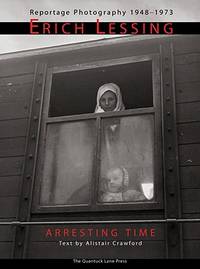
200482482Quantuck Lane. New. 2004. Hardcover. 1593720203 . FREE UPGRADE to Courier/Priority Shipping Upon Request - IN STOCK AND IMMEDIATELY AVAILABLE FOR SHIPMENT - Flawless copy brand new pristine never opened -- Corresponds to ISBN: 1593720203. 456 pages 400 photos. -- with a bonus offer-- . Quantuck Lane hardcover
196584255National Gallery of Arts. As New. 1965. Paperback. FREE UPGRADE to Courier/Priority Shipping Upon Request - IN STOCK AND IMMEDIATELY AVAILABLE FOR SHIPMENT - AS NEW THE TEXT BLOCK IS PRISTINE CLEAN UNMARKED AND IN EXCELLENT CONDITION - - 148 pages 365 illustrations 4to. -- with a bonus offer-- . National Gallery of Arts paperback