59 résultats
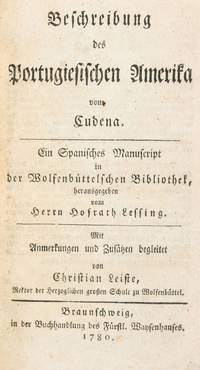
17803823Braunschweig: in der Buchhandlung des Fürstl. Waysenhauses 1780. First edition. The original Spanish text is reproduced throughout with facing German translation. Later morocco covers panelled in blind and gilt spine lettered in gilt. Outer margin of the final leaf skilfully restored. Overall in very good condition. First edition. The original Spanish text is reproduced throughout with facing German translation. Later morocco covers panelled in blind and gilt spine lettered in gilt. 160 pp. <p><br /> A rare pre-Humboldt German Braziliana; the first publication of a 1634 survey of Portuguese America's geography commerce and colonial administration issued by Lessing.<br /> <p><p><br /> One of the most significant German publications on Brazil of the eighteenth century containing the first appearance in print of a manuscript survey of Portuguese America written in 1634 by Pedro Cadena de Vilhasanti. The manuscript was discovered in the ducal library at Wolfenbüttel by Gotthold Ephraim Lessing who published it together with a German translation and an extensive commentary by Christian Leiste. At a time when reliable German-language information on South America remained scarce the volume became one of the principal German sources on Brazil before the appearance of Humboldt's works.<br /> <p><p><br /> The author Pedro Cadena de Vilhasanti served as provedor-mor of the Royal Treasury in Brazil and is best known for his Relação diária do cerco da Bahia de 1638 one of the principal contemporary accounts of the Dutch siege of Salvador first published only in the twentieth century. Written for the Count-Duke of Olivares chief minister of the Spanish monarchy the present work reflects Cadena's direct experience of colonial administration and constitutes a detailed administrative economic and geographical survey of Portuguese Brazil during the period of Dutch expansion in northeastern South America. Proceeding systematically along the coast from the mouth of the Amazon southwards he describes the principal captaincies including Maranhão Pará Rio Grande Paraíba and Pernambuco recording settlements fortifications ports rivers and administrative divisions while providing extensive information on trade taxation sugar production shipbuilding resources and strategic infrastructure. Particular attention is given to exports of sugar tobacco cotton brazilwood and other commodities the revenues they generated the number of sugar mills in operation navigational conditions and the availability of timber suitable for the construction of large ocean-going vessels. The work preserves an unusually detailed snapshot of the economic and administrative structure of Portuguese Brazil in the early seventeenth century and offers a rare contemporary assessment of the colony's strategic and commercial value.<br /> <p><p><br /> The publication originated in Lessing's investigation into the origin of the name of the Amazon Marañón River. Misinterpreting the phrase "Marañón y Gran Pará" as referring to a Spanish captain rather than to a geographical designation he believed the manuscript provided evidence for the origin of the river's name and therefore arranged for its publication prefacing it with a substantial introduction. Although this interpretation was later shown to be mistaken Leiste sought to support Lessing's reading of "Marañón y Gran Pará" before ultimately supplementing the manuscript with additional material drawn from more authoritative sources particularly Dutch works on Brazil thereby providing a broader account of the colony's geography and history. His commentary reflects the growing German scholarly interest in South America during the late eighteenth century.<br /> <p><p><br /> Borba de Moraes regarded the volume as one of the most significant German publications on Brazil of the eighteenth century noting the scarcity of original German works on the subject during that period. The edition attracted sufficient attention to be reprinted with corrections and additional commentary in C. G. von Murr's Reisen einiger Missionarien der Gesellschaft Jesu in Amerika 1785.<br /> <p><p><br /> References: Borba de Moraes Bibliographia Brasiliana I pp. 141-142; Sabin 17830<br /> <p>. in der Buchhandlung des Fürstl. Waysenhauses unknown
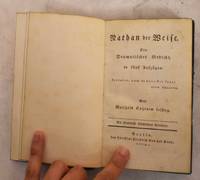
177953771n.p.: n.p. 1779. First edition. Hardcover. Good. Small octavo. Collation: pi2 A-Q8 R6 S4 = 140 leaves. 4 276pp. Half dark brown cloth over marbled boards which simulate tree calf lightly worn with some slight abrasions to covers. Text lightly toned with intermittent mild foxing. Final five leaves partially detached from block but holding to hinge else a good complete copy.<br /> <br /> First edition published by subscription in May 1779. This is a copy of the first issue with no attempt at correction on p.95: i.e. "Ein reichre Mann" line 11 is followed by "Der reichre Jude war line 13. A towering figure of the eighteenth-century German Enlightenment Gotthold Ephraim Lessing 1729-1781 produced two works one at the beginning of his literary career and one at the end each of which featured a Jew as a principal character. The one-act comedy Die Juden 1749 was one of Lessing's earliest literary ventures and was "the first time a Jew was presented on a the German stage in a reasonably objective manner" EJ. His last play Nathan the Wise 1779 is much better known and once again contains a plea for toleration. Lessing's inspiration for Nathan was his friend the Jewish philosopher Moses Mendelssohn. Nathan is here made the spokesperson for brotherhood tolerance and the love of humanity indeed all the noble aspirations of the Enlightenment. The play is set during the time of the Third Crusade ca. 1192 during an armistace in Jerusalem. "Based on the parable of the three rings adapted from Boccaccio's Decameron the play presents Judaism represented by Nathan Christianity a Templar knight and Islam Saladin the Turkish Sultan as three sons of a benevolent father who has given each an identical ring although each one claims that his ring alone is authentic" EJ. While the vision here presented of inter-religious amity was ridiculed by the likes of Julius von Voss Der travestierte Nathan der Weise 1804 and attacked by various anti-Semites Lessing's ideals found much support among German Jews such as Gabriel Riesser I. H. Ritter Berthold Auerback Emil Lehmann and Johann Jacoby. Indeed Lessing's "ideological and stylistic influence on the Haskalah was as decisive as that of Friedrich Schiller" EJ.<br /> <br /> "Lessing was born in Saxony the son of a pastor and after a brilliant career at school entered the University of Leipzig as a theology student. Here however the two interests literature and the theatre which were to dominate his life first discovered themselves. Yet perhaps Lessing is best judged by the sum of his achievement. He was one of the principal figures in the Aufklärung the emancipation of German literature from the narrow classicism of the French school. It was he more than any other who laid the foundation of the intellectual primacy of German writers and thinkers in the nineteenth century. Without attching himself to any special philosophical school he consistently opposed error and dogmatism and in art in poetry in drama and in religion he provided new stimulation." PMM pp. 128-129. References: J. Carter & P. H. Muir eds. Printing and the Mind of Man pp.128-129. K. Lachmann Gotthold Ephraim Lessings sämtliche Schriften 1919 vol. 22 part 2 pp. 458-459: this ed. noted as "subskriptionsausg. Mai 1779". VD18 11831499. [n.p.] hardcover
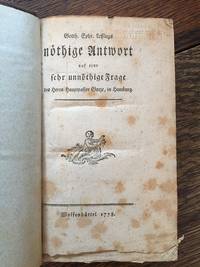
177833323Braunschweig: Waisenhausbuchhandlung 1778. Small 8vo 17.5 cm; 7". 11 numbers in one volume each 16 pp. <br><br>Lessing was one of the fathers of German Idealism during the Enlightenment and among other things is remembered for having provided the foundation of a modern philosophy of religion" Yasukata Lessing's Philosophy of Religion and the German Enlightenment p. 89. Johann Melchior Goeze 171786 a contemporary of Lessing was a spiritual leader of the Lutheran Church in Germany and familiar with literature; he took up writing histories and apologetics and because of their differing views on religion and ideals of the Enlightenment he and Lessing entered into a debate.<br>Â Â Â Â While the two are said to have remained cordial the debate was so "bitter" that the Duke of Brunswick Lessing's supporter "intervened silencing Lessing" Oxford Companion to German Literature 2nd ed. p. 554!<br>Â Â Â Â Printed here are Lessing's portions of the eleven exchanges in that debate. <br>Â Â Â Â <br>Â Â Â Â Goedeke IV 447; Holzmann 2383. Recent boards covered in brown paper specked with black in the style of the era; age-toning and some dampstaining not beyond "typical." Overall a good copy of a complete set of Lessing's eleven arguments. [Waisenhausbuchhandlung] hardcover books
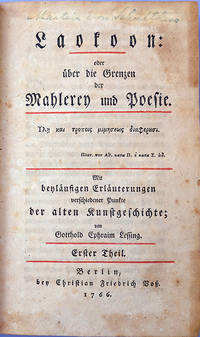
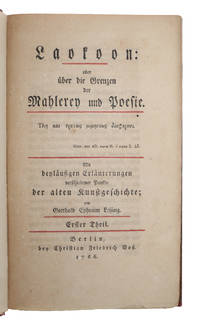
176642808Berlin: Voss 1766. <p>"Opened up a New Prospect in the Appreciation of Greek Literature" Printing and the Mind of Man</p> <p>Lessing Gotthold Ephraim 1729-81. Laokoon: Oder über die Grenzen der Mahlerey und Poesie. Erster Theil all published. 8vo. 8 298pp. Berlin: Christian Friedrich Voss 1766. 196 x 122 mm. Half sheep gilt spine ca. 1766 light rubbing and edgewear. Minor foxing and toning but very good. Former owners' signatures on front endpaper and title. </p> <p> First Edition. The German philosopher and critic Gotthold Lessing was one of the most outstanding representatives of the Enlightenment era; "it was he more than any other who laid the foundations of the intellectual primacy of German writers and thinkers in the nineteenth century" Printing and the Mind of Man 213. His Laokoon probably his best-known work had an enormous influence on the development of art and literary criticism:</p> <p> "Laokoon takes its name from the famous statue discovered at Rome in the sixteenth century. It analyzes the differences between the sculptor's treatment of Laocoon wrestling with the serpents and Virgil's treatment of the same theme and from there does on to discuss the limits and limitations of all the arts. It contains the first clear statement of the truth which is now considered axiomatic that every art is subject to limitations and can achieve greatness only by a clear understanding of a self-restriction to its proper function. The most telling passages and those which have borne most fruit are those on poetry . . . Lessing's exposition of the themes of Homer and Sophocles is especially effective and he opened up a new prospect in the appreciation of Greek literature" Printing and the Mind of Man.</p> . Voss unknown books
1766680Berlin: Christian Friedrich Voss 1766. First Edition. Hardcover. Very good. A Classic of Art HistoryPMM 213 <br /> <br />LESSING Gotthold Ephraim LAOKOON : oder uber die grenzen der mahleren und poesie. mit beylaufigen erlauterungen verschiedener punkte der alten kunstgeschichte Christian Friedrich Voss Berlin 1766 298pp. 8vo. FIRST EDITION. <br /> <br />Lessings most famous work outside Germany and a classic of art history. In Laokoon Lessing claims that certain arts have certain limits. The rules of poetry are not the same as those of sculpture or painting each has its unique sphere. "Laokoon is perhaps Lessing's best-known work outside Germany and it has had a world-wide influence . It contains the first clear statement of the truth which is now considered axiomatic that every art is subject to limitations and can achieve greatness only by a clear understanding of and self-restriction to its proper function. The most telling passages and those which have borne most fruit are those on poetry . In the words of Macaulay he was 'beyond all dispute the first critic of Europe'" PMM 213. <br /> <br />CONDITION: Original boards seems to be re-backed though certainly not modern with renewed end-papers. Hand-scripted lettering to spine. Former owners name scripted in contemporary hand to rear paste down. Internally clean. Very good. <br /> <br/><br/>PHOTOS AVAILABLE UPON REQUEST Christian Friedrich Voss hardcover
176642808Berlin: Voss 1766. <p>"Opened up a New Prospect in the Appreciation of Greek Literature" Printing and the Mind of Man</p> <p>Lessing Gotthold Ephraim 1729-81. Laokoon: Oder über die Grenzen der Mahlerey und Poesie. Erster Theil all published. 8vo. 8 298pp. Berlin: Christian Friedrich Voss 1766. 196 x 122 mm. Half sheep gilt spine ca. 1766 light rubbing and edgewear. Minor foxing and toning but very good. Former owners' signatures on front endpaper and title. </p> <p> First Edition. The German philosopher and critic Gotthold Lessing was one of the most outstanding representatives of the Enlightenment era; "it was he more than any other who laid the foundations of the intellectual primacy of German writers and thinkers in the nineteenth century" Printing and the Mind of Man 213. His Laokoon probably his best-known work had an enormous influence on the development of art and literary criticism:</p> <p> "Laokoon takes its name from the famous statue discovered at Rome in the sixteenth century. It analyzes the differences between the sculptor's treatment of Laocoon wrestling with the serpents and Virgil's treatment of the same theme and from there does on to discuss the limits and limitations of all the arts. It contains the first clear statement of the truth which is now considered axiomatic that every art is subject to limitations and can achieve greatness only by a clear understanding of a self-restriction to its proper function. The most telling passages and those which have borne most fruit are those on poetry . . . Lessing's exposition of the themes of Homer and Sophocles is especially effective and he opened up a new prospect in the appreciation of Greek literature" Printing and the Mind of Man.</p> . Voss unknown
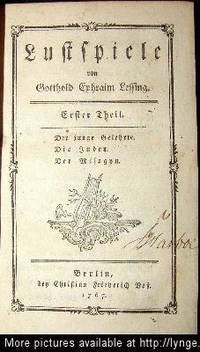
176728757Bln., Voss, 1767. Two nice, cont., uniform full calf w. five raised bands on backs, coloured title- and tome-labels and richly gilt backs. Traces of use, especially to the bands. Some gilding and part of title-label on vol. one worn off. Internally a bit of soiling, but a good copy on good paper. Old owner's name on t-p. (M. Harboe). Woodcut title-pages and vignettes.
176728757Bln. Voss 1767. Two nice cont. uniform full calf w. five raised bands on backs coloured title- and tome-labels and richly gilt backs. Traces of use especially to the bands. Some gilding and part of title-label on vol. one worn off. Internally a bit of soiling but a good copy on good paper. Old owner's name on t-p. M. Harboe. Woodcut title-pages and vignettes. <br/><br/><em>First edition of Lessing's first collection of "Lustspiele" containing the first printing of "Minna von Barnhelm".Lessing 1729-1781 is the most important literary writer of the Age of German Enlightenment; with him this period is fulfilled as well as overcome."Minna von Barnhelm" is one of Lessing's most important and successfull works and is considered one of the absolute best of his plays. "Es war die erste deutsche Dramatische Dichtung welche nicht gemacht sondern erlebt war." Hettner Geschichte der deutschen Literatur im 18. Jahrh. II: 310. Lessing himself wrote in a letter that should "Minna of Barnhelm" not turn out to be the very best of his plays he would be very disappointed and never have anything to do with the theatre again. " "Minna von Barnhelm" ist unbedingt die vollendeste dichterische Leistung Lessings." Hettner II: 310. Goethe also considered this work a masterpiece; he found it the most sincere thing to have come out of the Seven Years War and a work of immense importance and impact. With this work we find the genres of drama and comedy fulfilled."Nach ein paar Wanderjahren kehrte er nach Berlin zurück wo 1766 un 1767 zwei seiner Meisterwerke erschienen: der "Laokoon" und das Lustspiel "Minna von Barnhelm". Bücher die die Welt verändern # 213. See PMM 213.Has belonged to Th.E. Petersen and M. Harboe. </em> hardcover
176662761Berlin, Christian Friedrich Voss, 1766. 8vo. An excellent copy in a late 19th century red half calf with five raised bands and gilt lettering to spine. Fore- and lower edge uncut. Upper edge coloured in red. Spine with a few scratches and a bit of wear. End-papers with annotations in pencil and remains of a removed book-plate. Internally in very nice condition, with light occassional brownspotting. (8), 298 pp.
176662761Berlin Christian Friedrich Voss 1766. 8vo. An excellent copy in a late 19th century red half calf with five raised bands and gilt lettering to spine. Fore- and lower edge uncut. Upper edge coloured in red. Spine with a few scratches and a bit of wear. End-papers with annotations in pencil and remains of a removed book-plate. Internally in very nice condition with light occassional brownspotting. 8 298 pp. <br/><br/><em>First edition of Lessing’s landmark work in the history of art theory. In Laokoon Lessing argues that each art form operates within its own distinct boundaries that the principles of poetry cannot be applied to sculpture or painting and vice versa. Lessing’s Laokoon was written as a response to Johann Winckelmann's â€Geschichte der Kunst des Alterthums†1764. Lessing challenges Winckelmann’s interpretation of the famous Laocoon statue arguing that Winckelmann portrays the figure’s suffering as too noble and composed - an expression suitable for poetry but not for sculpture whose medium cannot convey inner emotion in the same way. “Laokoon is perhaps Lessing’s best known work outside Germany and it has had a world-wide influence. It takes its name from the famous statue discovered at Rome in the sixteenth century. It analyses the differences between the sculptor’s treatment of Laocoon wrestling with the serpents and Virgil’s treatment of the same theme and from there goes on to discuss the limits and limitations of all the arts. It contains the first clear statement of the truth which is now considered axiomatic that every art is subject to limitations and can achieve greatness only by a clear understanding of and self-restriction to its proper function. The most telling passages and those which have borne most fruit are those on poetry. Lessing knew more about this than about painting and sculpture for which he was entirely dependent on Winckelmann 210. His exposition of the themes of Homer and Sophocles is especially effective and he opened up a new prospect in the appreciation of Greek literature. Yet perhaps Lessing is best judged by the sum of his achievement. He was one of the principal figures in the Aufklärung the emancipation of German literature from the narrow classicism of the French school. It was he more than any other who laid the foundations of the intellectual primacy of German writers and thinkers in the nineteenth century a debt which they were not slow to acknowledge. Without attaching himself to any special philosophical school he consistently opposed error and dogmatism and in art in poetry in drama and in religion he provided new stimulation. In the words of Macaulay he was ‘beyond all dispute the first critic of Europe’.†PMM 213 PMM 213 </em> hardcover
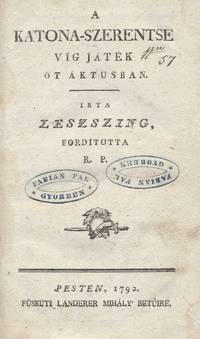
17921114Pesten Pest: Füskúti Landerer Mihály’ betűire 1792. First Hungarian edition. Woodcut device on title page and tail piece at end. In somewhat later green cloth with red title vignette on spine. Old double ownership stamp on title page and note in ink. Notes in ink on front endpaper. A light water stain to upper corner that effects the rear of the book. Overall in fine condition. First Hungarian edition. Woodcut device on title page and tail piece at end. In somewhat later green cloth with red title vignette on spine. 8 120 p. First Hungarian edition of Lessing’s 1767 comedy “Minna von Barnhelm oder das Soldatenglück†Minna von Barnhelm or the Soldiers' Happiness.It was premiered in the same year in Hungary as the first Lessing play on stage in the country. Füskúti Landerer Mihály’ betűire unknown
1778H645Wolfenbüttel i.e. Hamburg Braunschweig: Buchhandlung des Fürstl. Waisenhauses various - many without publisher information 1778. Hardcover. Good. Published 1777-1778. Octavo brown library cloth gilt stamped on spine various publications each with its own title page various paginations totalling about 500 pp. Good copy institutional marks including bookplate and due slip on endpapers small embossed blindstamp on first title page once or twice to text otherwise good clean copy. The central publications of the controversy that erupted when Lessing published 'fragments' of the work of Hermann Samuel Reimarus that attacked Lutheran orthodoxy and argued for a rational deism rejecting the theology of revelation. This led to an exchange of polemical pamphlets between Lessing and the principle defender of Lutheranism Johann Melchior Goeze a pastor from Hamburg. These culminated in Lessing's 11 'Anti-Goeze' tracts that contain the seeds of his thoughts regarding religion that became the foundation of 'Nathan the Wise.' The so-called Fragmentes Dispute is considered the most important theological controversy of the 18th century pitting Lessing's Enlightenment philosophy against Lutheran orthodoxy. Buchhandlung des Fürstl. Waisenhauses, various - many without publisher information hardcover
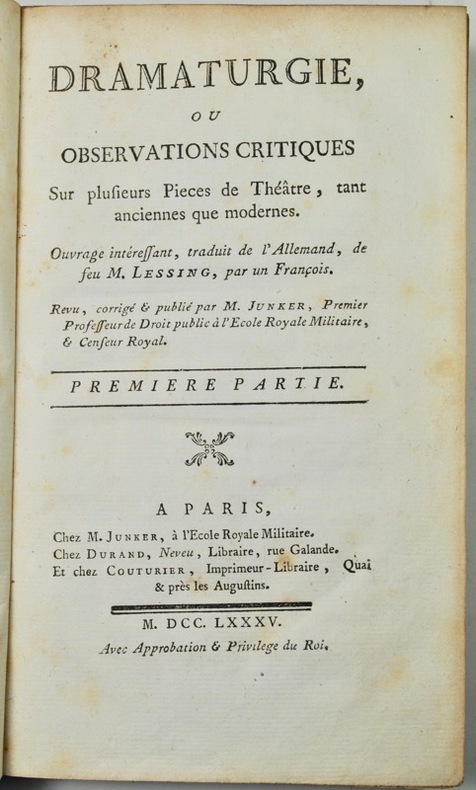
17854312A Paris, chez Junker, Durand, Couturier, 1785. 2 tomes en 1 vol. in-8 de (6)-300-(2) pp. ; (4)-267-(1) pp., demi-basane verte à petits coins de vélin, dos lisse orné (reliure de l'époque).
1779191197Berlin Germany: Christian Friedrich Voss 1779. Hardcover. VG rubbed leather to edges spine edges & corners. lower spine edges each have small tears. remains tightly bound. black leather boards w/ gilt trim & inlaid green marbled paper. leather & gilt spine w/ five raised bands & six gilt compartments. green marbled pastedowns & endpapers. all edges green. 240 pgs. A handsome edition. Foxing to opening and closing pages otherwise foxing appears fairly minimal throught with instances of specks and blotches. Pages remain bright with faint to light tanning text dark and detailed. Text in German. Christian Friedrich Voss hardcover
175421217Berlin: Voss 1754-1758. hardcover. stark abgenutzt. Ganzleder der Zeit erster Band resp. Pappband der Zeit bestossen und beschabt Rücken rissig Rückenschilder mit kleinen Fehlstellen Spuren eines entfernten Exlibris in Band 1 anfangs Einträge von alter Hand und ein kleiner alter Besitzstempel Druckfehlerverbesserungen in Bleistift nur wenig gebräunt und. Erste Ausgaben. Band 4 ist abweichend von der Angabe auf dem Titel erst 1959 erschienen. Mit dem handschriftlichen Besitzeintrag "Dr. B. Boisserée München 13.1.1841". Enthält im ersten Band den Brief von Moses Mendelssohn_über die Besprechung von Lessings Lustspiel 'Die Juden' durch J. D. Michaelis. Die ersten Bögen von Band 1 lt. Muncker im Druck 'b'. Der letzte Band - datiert 1758 - erschien tatsächlich erst zur Oster-Buch-Messe 1759. - Redlich p. 692 694 und 697 jew. ohne Hinweis auf die Inhaltsverzeichnisse am Ende. - Muncker p. 361f. 363f. 369 und 379 f. - Seifert 1181 danach stammen die noch von Muncker Lessing zugeschriebenen Übersetzungen von Riccoboni Trissino und Rucellai wahrscheinlich von J. T.Köhler - Meyer 382 b für Mendelssohn. Wegen Urlaub kann Ihre Bestellung / Anfrage erst nach dem 21.06.2026 bearbeitet werden. - Because of holidays your order / question can be handled only after 06/21/2026. Voss hardcover
17853454A Paris, Junker, Durand, Couturier, 1785. 2 vol. in-8 de (6)-300-(2) pp. ; (4)-267-(1) pp., basane brune, dos lisse orné, pièces de titre et de tomaison en maroquin brun (reliure de l'époque).
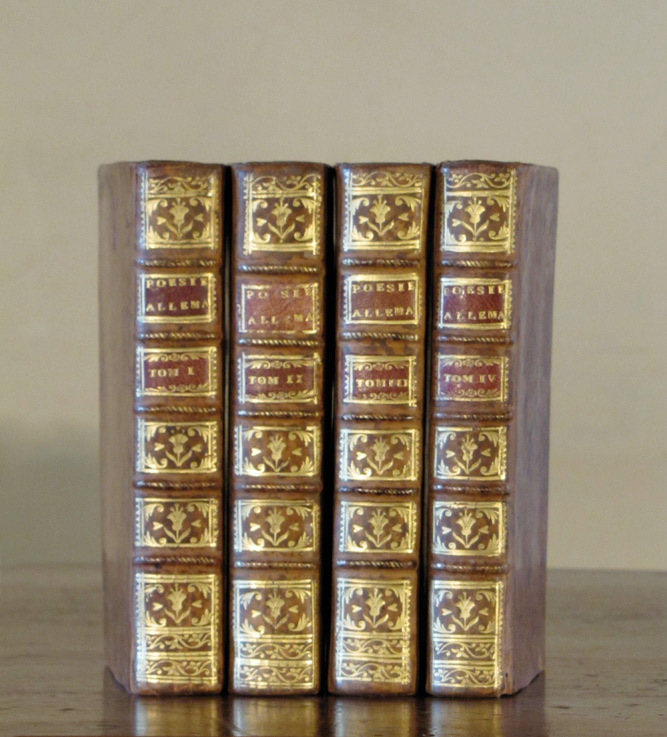
176613066Paris, Humblot (Imprimerie de Quillaux), 1766 ; 4 tomes, in-12 ; plein veau fauve marbré, dos à nerfs décoré et doré, pièces de titre et de tomaison grenat, filet sur les coupes, tranches rouges cirées (reliure de l'époque) ; XLIV, 408, IX, (3) ; XVI, 455 ; (4), II, 400 ; (4), 399 pp., frontispice allégorique de Ch. Eisen gravé par De Longueil et 4 vignettes de titre par Watelet.
1766601714 vol. in-12 reliure de l'époque plein veau marbré, dos lisses ornés, toutes tranches marbrées,Chez Humblot, Paris, 1766, frontispice, xliv-408-ix pp. et 1 f. non chiffré ; xvi-455 pp. ; 2 ff., 400-ii pp. ; 2 ff., 399 pp.
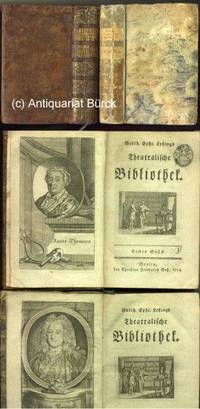
17587653Berlin: Christian Friedrich Voss 1758. First edition. Boards. Very Good -. 8vo. 4 volumes. Engraved portraits in Volumes 1 & 3 as published. Each of the 4 title pages with an engraved illustration. Orig. drab boards somewhat soiled and extremities rubbed. Remnants of paper labels on spines. The first edition. The set is usually 4 volumes bound in 2. It is unusual to find the 4 individual volumes here in their original state as published. Christian Friedrich Voss hardcover books
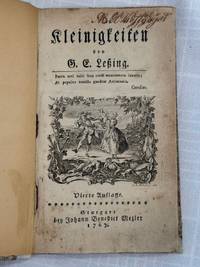
176937043Stutgart: Johann Benedict Mezler 1769. Fourth edition. Very good condition; Only modest wear; Pages are clean with a touch of soiling. Staple bound and housed in 1/4 velum with marble paper over boards; 100 pages plus Contents; Fore anf foot edges untrimmed. Johann Benedict Mezler unknown
178459870Berlin. 1784. 8vo. Samtidig rødt kartonasjebind. 2 298 s.8vo. Contemporary boards. 2 298 pp. Bey Arnold Wever Tysk. <br/><br/><em>Bindet med noe slitasje de første 20 sidene noe plettet siste sidene med svak fuktskjold.Binding somewhat rubbed and peeling foxing to first 20 pp. dampstain to the last 10 or so.Herman Samuel Reimarus 1694-1768 German philosopher and theologian. He began writing very late in life. Lessing published quite a few of his writings. </em> hardcover
177715205Cont. hcalf, raised bands, gilt. Titlelabel gilt. Engraved frontisp., engraved titlevign. XII,254 pp. On good paper, clean.
177715205Cont. hcalf raised bands gilt. Titlelabel gilt. Engraved frontisp. engraved titlevign. XII254 pp. On good paper clean. hardcover
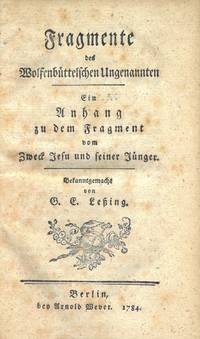
1787H244Berlin: Arnold Wever 1787. Hardcover. Very Good. In English: On the Purpose of Jesus and His Disciples Another Fragment of the anonymous Wolfenbüttel author 1784; Fragments of the anonymous Wolfenbüttel author an Appendix to the Fragment On the Purpose of Jesus and His Disciples 1784; Remaining Still Unpublished Works of the Wolfenbüttel Fragmentist. A Posthumous Paper by Gotthold Ephraim Lessing. Edited by C. A. E. Schmidt pseudonym for Johann Andreas Riem 1787. First volume is a “neue Auflage†second volume is a first printing third volume probably also a first printing; it does not list a publisher but most scholars think it was Wever who published this volume as well. 8vo old half vellum and patterned paper-covered boards 276 298 410 pp. Very good light soil and rubbing to binding minor ex-library marks with bookplates to pastedown blindstamp to title pages. Lessing died in 1781; these posthumously published 'fragments' are an outgrowth of the Wolfenbüttel controversy 1774–1778 which arose when Lessing serving as librarian at the ducal library in Wolfenbüttel published fragments from the late Hermann Samuel Reimarus’s unpublished manuscripts criticizing revealed religion and biblical miracles. Lessing issued these as the Wolfenbüttel Fragments arguing that open theological debate was vital for truth. The fragments’ rationalist deistic arguments—denying revelation and the divinity of Christ—provoked fierce opposition from Lutheran authorities particularly Pastor Johann Melchior Goeze of Hamburg. The dispute escalated into public pamphlet battles over faith reason and the limits of theological inquiry ending when the Duke forbade Lessing to write on religion. The controversy became a key moment in the German Enlightenment’s challenge to orthodox theology. These appear to be Lessing’s last word on the subject with an essay and notes by him plus further material from Reimarus’s manuscripts issued from beyond the grave. Arnold Wever hardcover
177758806BBBerlin, bey Christian Friedrich Voss. 1777. Klein-8°. Frontispiz, Titel, XII, 254 S. Kalblederband der Zeit mit blindgeprägter Deckelfiletierung, goldgeprägtem Rückenschild, wenig Rückenvergoldung und Besitzermonogramm am unteren Kapital.