31 résultats
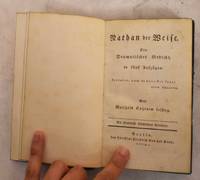
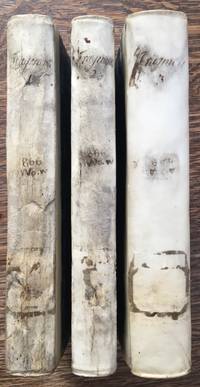
1787H244Berlin: Arnold Wever 1787. Hardcover. Very Good. In English: On the Purpose of Jesus and His Disciples Another Fragment of the anonymous Wolfenbüttel author 1784; Fragments of the anonymous Wolfenbüttel author an Appendix to the Fragment On the Purpose of Jesus and His Disciples 1784; Remaining Still Unpublished Works of the Wolfenbüttel Fragmentist. A Posthumous Paper by Gotthold Ephraim Lessing. Edited by C. A. E. Schmidt pseudonym for Johann Andreas Riem 1787. First volume is a “neue Auflage†second volume is a first printing third volume probably also a first printing; it does not list a publisher but most scholars think it was Wever who published this volume as well. 8vo old half vellum and patterned paper-covered boards 276 298 410 pp. Very good light soil and rubbing to binding minor ex-library marks with bookplates to pastedown blindstamp to title pages. Lessing died in 1781; these posthumously published 'fragments' are an outgrowth of the Wolfenbüttel controversy 1774–1778 which arose when Lessing serving as librarian at the ducal library in Wolfenbüttel published fragments from the late Hermann Samuel Reimarus’s unpublished manuscripts criticizing revealed religion and biblical miracles. Lessing issued these as the Wolfenbüttel Fragments arguing that open theological debate was vital for truth. The fragments’ rationalist deistic arguments—denying revelation and the divinity of Christ—provoked fierce opposition from Lutheran authorities particularly Pastor Johann Melchior Goeze of Hamburg. The dispute escalated into public pamphlet battles over faith reason and the limits of theological inquiry ending when the Duke forbade Lessing to write on religion. The controversy became a key moment in the German Enlightenment’s challenge to orthodox theology. These appear to be Lessing’s last word on the subject with an essay and notes by him plus further material from Reimarus’s manuscripts issued from beyond the grave. Arnold Wever hardcover
1779191197Berlin Germany: Christian Friedrich Voss 1779. Hardcover. VG rubbed leather to edges spine edges & corners. lower spine edges each have small tears. remains tightly bound. black leather boards w/ gilt trim & inlaid green marbled paper. leather & gilt spine w/ five raised bands & six gilt compartments. green marbled pastedowns & endpapers. all edges green. 240 pgs. A handsome edition. Foxing to opening and closing pages otherwise foxing appears fairly minimal throught with instances of specks and blotches. Pages remain bright with faint to light tanning text dark and detailed. Text in German. Christian Friedrich Voss hardcover
1766680Berlin: Christian Friedrich Voss 1766. First Edition. Hardcover. Very good. A Classic of Art HistoryPMM 213 <br /> <br />LESSING Gotthold Ephraim LAOKOON : oder uber die grenzen der mahleren und poesie. mit beylaufigen erlauterungen verschiedener punkte der alten kunstgeschichte Christian Friedrich Voss Berlin 1766 298pp. 8vo. FIRST EDITION. <br /> <br />Lessings most famous work outside Germany and a classic of art history. In Laokoon Lessing claims that certain arts have certain limits. The rules of poetry are not the same as those of sculpture or painting each has its unique sphere. "Laokoon is perhaps Lessing's best-known work outside Germany and it has had a world-wide influence . It contains the first clear statement of the truth which is now considered axiomatic that every art is subject to limitations and can achieve greatness only by a clear understanding of and self-restriction to its proper function. The most telling passages and those which have borne most fruit are those on poetry . In the words of Macaulay he was 'beyond all dispute the first critic of Europe'" PMM 213. <br /> <br />CONDITION: Original boards seems to be re-backed though certainly not modern with renewed end-papers. Hand-scripted lettering to spine. Former owners name scripted in contemporary hand to rear paste down. Internally clean. Very good. <br /> <br/><br/>PHOTOS AVAILABLE UPON REQUEST Christian Friedrich Voss hardcover
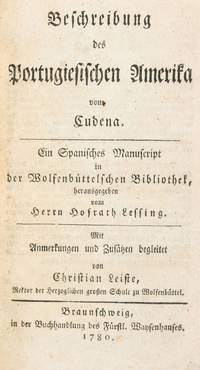
17803823Braunschweig: in der Buchhandlung des Fürstl. Waysenhauses 1780. First edition. The original Spanish text is reproduced throughout with facing German translation. Later morocco covers panelled in blind and gilt spine lettered in gilt. Outer margin of the final leaf skilfully restored. Overall in very good condition. First edition. The original Spanish text is reproduced throughout with facing German translation. Later morocco covers panelled in blind and gilt spine lettered in gilt. 160 pp. <p><br /> A rare pre-Humboldt German Braziliana; the first publication of a 1634 survey of Portuguese America's geography commerce and colonial administration issued by Lessing.<br /> <p><p><br /> One of the most significant German publications on Brazil of the eighteenth century containing the first appearance in print of a manuscript survey of Portuguese America written in 1634 by Pedro Cadena de Vilhasanti. The manuscript was discovered in the ducal library at Wolfenbüttel by Gotthold Ephraim Lessing who published it together with a German translation and an extensive commentary by Christian Leiste. At a time when reliable German-language information on South America remained scarce the volume became one of the principal German sources on Brazil before the appearance of Humboldt's works.<br /> <p><p><br /> The author Pedro Cadena de Vilhasanti served as provedor-mor of the Royal Treasury in Brazil and is best known for his Relação diária do cerco da Bahia de 1638 one of the principal contemporary accounts of the Dutch siege of Salvador first published only in the twentieth century. Written for the Count-Duke of Olivares chief minister of the Spanish monarchy the present work reflects Cadena's direct experience of colonial administration and constitutes a detailed administrative economic and geographical survey of Portuguese Brazil during the period of Dutch expansion in northeastern South America. Proceeding systematically along the coast from the mouth of the Amazon southwards he describes the principal captaincies including Maranhão Pará Rio Grande Paraíba and Pernambuco recording settlements fortifications ports rivers and administrative divisions while providing extensive information on trade taxation sugar production shipbuilding resources and strategic infrastructure. Particular attention is given to exports of sugar tobacco cotton brazilwood and other commodities the revenues they generated the number of sugar mills in operation navigational conditions and the availability of timber suitable for the construction of large ocean-going vessels. The work preserves an unusually detailed snapshot of the economic and administrative structure of Portuguese Brazil in the early seventeenth century and offers a rare contemporary assessment of the colony's strategic and commercial value.<br /> <p><p><br /> The publication originated in Lessing's investigation into the origin of the name of the Amazon Marañón River. Misinterpreting the phrase "Marañón y Gran Pará" as referring to a Spanish captain rather than to a geographical designation he believed the manuscript provided evidence for the origin of the river's name and therefore arranged for its publication prefacing it with a substantial introduction. Although this interpretation was later shown to be mistaken Leiste sought to support Lessing's reading of "Marañón y Gran Pará" before ultimately supplementing the manuscript with additional material drawn from more authoritative sources particularly Dutch works on Brazil thereby providing a broader account of the colony's geography and history. His commentary reflects the growing German scholarly interest in South America during the late eighteenth century.<br /> <p><p><br /> Borba de Moraes regarded the volume as one of the most significant German publications on Brazil of the eighteenth century noting the scarcity of original German works on the subject during that period. The edition attracted sufficient attention to be reprinted with corrections and additional commentary in C. G. von Murr's Reisen einiger Missionarien der Gesellschaft Jesu in Amerika 1785.<br /> <p><p><br /> References: Borba de Moraes Bibliographia Brasiliana I pp. 141-142; Sabin 17830<br /> <p>. in der Buchhandlung des Fürstl. Waysenhauses unknown
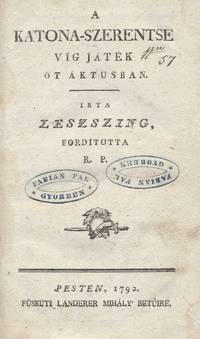
17921114Pesten Pest: Füskúti Landerer Mihály’ betűire 1792. First Hungarian edition. Woodcut device on title page and tail piece at end. In somewhat later green cloth with red title vignette on spine. Old double ownership stamp on title page and note in ink. Notes in ink on front endpaper. A light water stain to upper corner that effects the rear of the book. Overall in fine condition. First Hungarian edition. Woodcut device on title page and tail piece at end. In somewhat later green cloth with red title vignette on spine. 8 120 p. First Hungarian edition of Lessing’s 1767 comedy “Minna von Barnhelm oder das Soldatenglück†Minna von Barnhelm or the Soldiers' Happiness.It was premiered in the same year in Hungary as the first Lessing play on stage in the country. Füskúti Landerer Mihály’ betűire unknown
177817984Nürnberg 1778-79. 8vo. Samt skinnryggbd. med opphøyde ryggbånd og ryggforgylling. Med titelfelt i brunrødt skinn. 2 bl. 2 268 2 ; 8 248 2 bl. s. Med 3 foldekart.8vo. Bound together in a contemporary half calf binding spine richly gilt and with coloured label. 2 blank 2 268 2 ; 8 248 2 blank pp. 3 folding maps. in Verlag der Johann Georg Lochnerischen Buchhandlung Tysk. <br/><br/><em>Hjørnene støtt ryggen noe skrapet. Navn på første bl. bl.Liten del revet bort av side to i del II uten teksttap. Et fint eks.Corners bumped spine rubbed. Name on first blank page. Small strip torn off the second page of vol. 2 no loss of text. Otherwise a clean and crisp copy. Gotthold Ephraim Lessing 1729-1781 German dramatist and critic. He studied theology but was soon influenced by the popular rationalism of the Enlightment. He has no special claim to be ranked as a philosopher of originality and distinction but with the regard to the diffusion of certain ideas and attitudes among educated minds his historical influence is pre-eminent. Encyclopedia of Philosophy vol. 4 pp. 443-46. </em> unknown