59 résultats
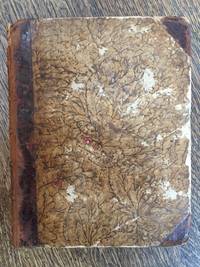
17862110130464xbvkWien, zu finden bey Friedrich August Hartmann, und beym Logenmeister beyder K. K. Theater, 1786. 88 / 243 / 40 / 48 Seiten. - Dunkler Original-Pappeinband der Zeit mit goldgeprägtem Titel auf verziertem orangefarbenem Rückenschild, Papierschnitt rundum rot gesprenkelt; 8vo.(ca. 18 x 11 x 3 cm).
17861231649München, J. B. Strobl, 1786. 1 Bl., 368 S., 6 Bl. Mit 25 (statt 26) Kupfertafeln. Ppbd d. Zeit mit Rückenschild u. allseitigem Goldschnitt (Kanten beschabt, Gelenke gelockert, Titel u. letztes Bl. im Bund hinterlegt, 1 Tafel (= Titelkupfer?) fehlt, etwas braun- u. fingerfleckig).
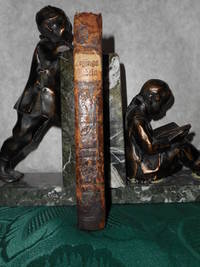
17874617o. O., o. V., 1787. (2) 410 S., Pappband der Zeit mit geprägtem Rückentitel und marmoriertem Schnitt. Zustand -2, Ecken, Kanten stark u. Buchblock oben etwas bestoßen.
179532468ABerlin:, In der Vossischen Buchhandlung., 1795. Kl.8°. (ca. 15,7 x 10,2 cm). XXVIII,404 S. Einfacher Pappband der Zeit. Grauschnitt. 3. Band (von 3 Bänden). Rücken fehlt, Buchblöock gut und fest. Innen mehrer Anstreichungen unterschiedler Zeit, unterschiedlicher Vorbesitzer, teils in Kyrillisch. Sonst wohlerhalten.
17941537-22Berlin/Stettin, Friedrich Nicolai 1794. 8°. XVIII, 520 S. Mod. HLdr. mit goldgeprägtem Rückenschildchen u. Rückengoldprägung. Rotschnitt. Spiegel mit Exlibris, Titelbl. mit altem, verblassten Rundstempel. Vereinzelt etwas gebräunt. Sonst gut erhalten. - (Sonderausgabe des Theil 27 von: "Gotthold Ephraim Lessings sämmtliche Schriften") [2 Warenabbildungen]
178560688Hallersche Buchhandlung Bern 1785 1785. priv. Pappband 2 Bände 496 664s. Fraktur. kl. Stempel a. d. Titelblatt sonst guter Zustand. AZC93. HC Hallersche Buchhandlung, Bern 1785, hardcover
1770H443Braunschweig / Berlin: Buchhandlung des Waisenhauses / Christian Friedrich Voss 1770. First printing. Hardcover. Fair. First printings of two books bound together. 8vo 8 x 6.25 inches early or original half leather and patterned boards. Fair copy with ex-library marks wear and rubbing to binding rear board just about detached inch loss of leather to head of spine. Text of first volume tanned but free of marks but for embossed library stamp on title page of first volume second volume somewhat brighter. 8 189 1 pp; 8 87 1 pp 5 engraved plates plus elaborate engraved vignette on title page and engraved pictorial vignette as headpiece to p. 1 of text of second volume. Berengarius Turonensis is mainly in German with portions in German: Lessing examines the 11th-century theologian Berengar of Tours who challenged the orthodox doctrine of the real presence in the Eucharist. Lessing uses Berengar’s case to explore the limits of church authority and the tension between faith and reason essentially presenting Berengar as an early rational critic of dogma and a symbol of intellectual freedom within theology. “Wie die Alten den Tod gebildet†“How the Ancients Represented Death†1769 is an essay on classical art and symbolism. Lessing argues that the Greeks did not depict Death as a terrifying skeleton or monster but rather as a gentle sleeping youth—sometimes holding a torch turned downward—reflecting their view of death as peaceful rest rather than horror. The essay contrasts ancient serenity with modern fear and serves as a key example of Lessing’s aesthetic humanism. Both are rare in the trade and seldom come up for auction. Buchhandlung des Waisenhauses / Christian Friedrich Voss hardcover
177715205Cont. hcalf raised bands gilt. Titlelabel gilt. Engraved frontisp. engraved titlevign. XII254 pp. On good paper clean. hardcover
1759114490Berlin: Christian Friedrich Voß. Good with no dust jacket. 1759. Presumed First Edition. Hardcover. Quarter Leather spine only with grey marbled paper covered boards. Probably a later 18th/early 19th century rebind but retaining most of the original spine . Loss to the top of the spine and repaired to the bottom. Bumped corners. Title label in gothic lettering to spine. Copper engraved Frontispiece and Vignette engraving on the title page. A former owners name in old ink has been erased from the title but some traces remain. Pagination runs as follows : - Blank endpaper; Frontispiece and title page; blank reverse. I- XII 1-248pp then 250 followed by 249 = Pages in right order - pagination reversed. I presume therefore this is a 1st Edition 1st printing . Page fore-edges marbled but marbling very faded as it is on the paper to the boards. Internally very tight but with some light thumbing/marks and spotting/patching here and there - but overall quite clean and all legible. One small hole to the blank fore-edge of page 20 o/w NO major faults. Complete. The vignette and the allegorical frontispiece are by J. W. Meil. GERMAN Text throughout. See Images. ; 16mo 6" - 7" tall . Christian Friedrich Voß hardcover
179532468A1795. 3. Band von 3 Bänden. Berlin: In der Vossischen Buchhandlung. 1795. Kl.8°. ca. 157 x 102 cm. XXVIII404 S. Einfacher Pappband der Zeit. Grauschnitt. Rücken fehlt Buchblöock gut und fest. Innen mehrer Anstreichungen unterschiedler Zeit unterschiedlicher Vorbesitzer teils in Kyrillisch. Sonst wohlerhalten. Erstausgabe. - Dritter Theil der dreibändigen Erstausgabe die in der Zeit von 1793 bis 1795 erschien. - WG 2.94. - Hirschberg 302. - unknown
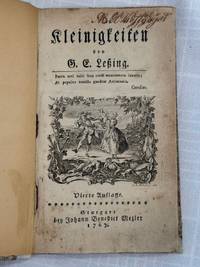
176937043Stutgart: Johann Benedict Mezler 1769. Fourth edition. Very good condition; Only modest wear; Pages are clean with a touch of soiling. Staple bound and housed in 1/4 velum with marble paper over boards; 100 pages plus Contents; Fore anf foot edges untrimmed. Johann Benedict Mezler unknown
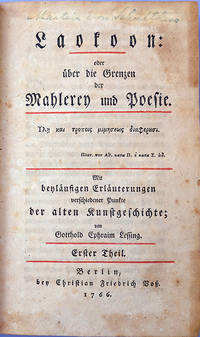
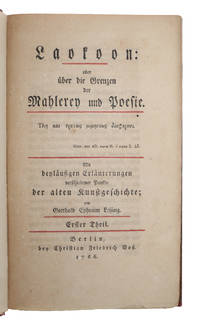
176642808Berlin: Voss 1766. <p>"Opened up a New Prospect in the Appreciation of Greek Literature" Printing and the Mind of Man</p> <p>Lessing Gotthold Ephraim 1729-81. Laokoon: Oder über die Grenzen der Mahlerey und Poesie. Erster Theil all published. 8vo. 8 298pp. Berlin: Christian Friedrich Voss 1766. 196 x 122 mm. Half sheep gilt spine ca. 1766 light rubbing and edgewear. Minor foxing and toning but very good. Former owners' signatures on front endpaper and title. </p> <p> First Edition. The German philosopher and critic Gotthold Lessing was one of the most outstanding representatives of the Enlightenment era; "it was he more than any other who laid the foundations of the intellectual primacy of German writers and thinkers in the nineteenth century" Printing and the Mind of Man 213. His Laokoon probably his best-known work had an enormous influence on the development of art and literary criticism:</p> <p> "Laokoon takes its name from the famous statue discovered at Rome in the sixteenth century. It analyzes the differences between the sculptor's treatment of Laocoon wrestling with the serpents and Virgil's treatment of the same theme and from there does on to discuss the limits and limitations of all the arts. It contains the first clear statement of the truth which is now considered axiomatic that every art is subject to limitations and can achieve greatness only by a clear understanding of a self-restriction to its proper function. The most telling passages and those which have borne most fruit are those on poetry . . . Lessing's exposition of the themes of Homer and Sophocles is especially effective and he opened up a new prospect in the appreciation of Greek literature" Printing and the Mind of Man.</p> . Voss unknown
176662761Berlin Christian Friedrich Voss 1766. 8vo. An excellent copy in a late 19th century red half calf with five raised bands and gilt lettering to spine. Fore- and lower edge uncut. Upper edge coloured in red. Spine with a few scratches and a bit of wear. End-papers with annotations in pencil and remains of a removed book-plate. Internally in very nice condition with light occassional brownspotting. 8 298 pp. <br/><br/><em>First edition of Lessing’s landmark work in the history of art theory. In Laokoon Lessing argues that each art form operates within its own distinct boundaries that the principles of poetry cannot be applied to sculpture or painting and vice versa. Lessing’s Laokoon was written as a response to Johann Winckelmann's â€Geschichte der Kunst des Alterthums†1764. Lessing challenges Winckelmann’s interpretation of the famous Laocoon statue arguing that Winckelmann portrays the figure’s suffering as too noble and composed - an expression suitable for poetry but not for sculpture whose medium cannot convey inner emotion in the same way. “Laokoon is perhaps Lessing’s best known work outside Germany and it has had a world-wide influence. It takes its name from the famous statue discovered at Rome in the sixteenth century. It analyses the differences between the sculptor’s treatment of Laocoon wrestling with the serpents and Virgil’s treatment of the same theme and from there goes on to discuss the limits and limitations of all the arts. It contains the first clear statement of the truth which is now considered axiomatic that every art is subject to limitations and can achieve greatness only by a clear understanding of and self-restriction to its proper function. The most telling passages and those which have borne most fruit are those on poetry. Lessing knew more about this than about painting and sculpture for which he was entirely dependent on Winckelmann 210. His exposition of the themes of Homer and Sophocles is especially effective and he opened up a new prospect in the appreciation of Greek literature. Yet perhaps Lessing is best judged by the sum of his achievement. He was one of the principal figures in the Aufklärung the emancipation of German literature from the narrow classicism of the French school. It was he more than any other who laid the foundations of the intellectual primacy of German writers and thinkers in the nineteenth century a debt which they were not slow to acknowledge. Without attaching himself to any special philosophical school he consistently opposed error and dogmatism and in art in poetry in drama and in religion he provided new stimulation. In the words of Macaulay he was ‘beyond all dispute the first critic of Europe’.†PMM 213 PMM 213 </em> hardcover
178860698C. F. Voß und Sohn Berlin 1788 1788. priv. Pappband. 380s. Fraktur guter Zustand. AZC94. HC C. F. Voß und Sohn, Berlin 1788, hardcover
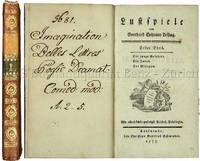
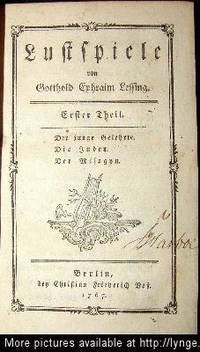
17774583BB1777. 2 Bde. Carlsruhe Christian Gottlieb Schmieder 1777. 8°. 2 299 S.; 2 484 S. Pappbde. d. Zt. mit goldgepr. mont. Rückenschildern Vergoldung oxidiert berieben u. bestossen. Erster Theil Bd. 1: Der junge Gelehrte. Die Juden. Der Misogyn. Zweiter Theil Bd. 2: Der Freygeist. Der Schatz. Minna von Bernhelm. Damon. Die alte Jungfer. - Mit mont. Kupferstich-Vignette u. 2 Namenszügen von alter Hand auf den festen Vorsätzen. Bd. 2: Mit Wurmfrass in unterer Ecke über 10 Seiten. Fliegende Vorsätze fehlen. Durchgehend stockfleckig u. leicht gebräunt. unknown
17773236DB1777. 2 Bde. Karlsruhe Christian Gottlieb Schnieder 1777. 8°. 2 299 S.; 2 484 S. Halblederbände der Zeit mit Rückensch. und reicher Rückenvergoldung. Karlsruher Nachdruck dieser erstmals 1767 bei Voss in Berlin erschienenen gesammelten Lustspielen mit den Werken "Der junge Gelehrte" "Die Juden" "Der Misogyn" "Der Freygeist" "Der Schatz" und "Minna von Barnhelm oder das Soldatenstück" "Damon" "Die alte Jungfer". - Mit Exlibris auf dem festen Vorsatz. Mit altem handschr. Eintrag auf dem ersten weissen Blatt. Im Schnitt gebräunt. Zu Beginn und am Schluss etwas stockfleckig. Einbände berieben. unknown
176728757Bln. Voss 1767. Two nice cont. uniform full calf w. five raised bands on backs coloured title- and tome-labels and richly gilt backs. Traces of use especially to the bands. Some gilding and part of title-label on vol. one worn off. Internally a bit of soiling but a good copy on good paper. Old owner's name on t-p. M. Harboe. Woodcut title-pages and vignettes. <br/><br/><em>First edition of Lessing's first collection of "Lustspiele" containing the first printing of "Minna von Barnhelm".Lessing 1729-1781 is the most important literary writer of the Age of German Enlightenment; with him this period is fulfilled as well as overcome."Minna von Barnhelm" is one of Lessing's most important and successfull works and is considered one of the absolute best of his plays. "Es war die erste deutsche Dramatische Dichtung welche nicht gemacht sondern erlebt war." Hettner Geschichte der deutschen Literatur im 18. Jahrh. II: 310. Lessing himself wrote in a letter that should "Minna of Barnhelm" not turn out to be the very best of his plays he would be very disappointed and never have anything to do with the theatre again. " "Minna von Barnhelm" ist unbedingt die vollendeste dichterische Leistung Lessings." Hettner II: 310. Goethe also considered this work a masterpiece; he found it the most sincere thing to have come out of the Seven Years War and a work of immense importance and impact. With this work we find the genres of drama and comedy fulfilled."Nach ein paar Wanderjahren kehrte er nach Berlin zurück wo 1766 un 1767 zwei seiner Meisterwerke erschienen: der "Laokoon" und das Lustspiel "Minna von Barnhelm". Bücher die die Welt verändern # 213. See PMM 213.Has belonged to Th.E. Petersen and M. Harboe. </em> hardcover
177953771n.p.: n.p. 1779. First edition. Hardcover. Good. Small octavo. Collation: pi2 A-Q8 R6 S4 = 140 leaves. 4 276pp. Half dark brown cloth over marbled boards which simulate tree calf lightly worn with some slight abrasions to covers. Text lightly toned with intermittent mild foxing. Final five leaves partially detached from block but holding to hinge else a good complete copy.<br /> <br /> First edition published by subscription in May 1779. This is a copy of the first issue with no attempt at correction on p.95: i.e. "Ein reichre Mann" line 11 is followed by "Der reichre Jude war line 13. A towering figure of the eighteenth-century German Enlightenment Gotthold Ephraim Lessing 1729-1781 produced two works one at the beginning of his literary career and one at the end each of which featured a Jew as a principal character. The one-act comedy Die Juden 1749 was one of Lessing's earliest literary ventures and was "the first time a Jew was presented on a the German stage in a reasonably objective manner" EJ. His last play Nathan the Wise 1779 is much better known and once again contains a plea for toleration. Lessing's inspiration for Nathan was his friend the Jewish philosopher Moses Mendelssohn. Nathan is here made the spokesperson for brotherhood tolerance and the love of humanity indeed all the noble aspirations of the Enlightenment. The play is set during the time of the Third Crusade ca. 1192 during an armistace in Jerusalem. "Based on the parable of the three rings adapted from Boccaccio's Decameron the play presents Judaism represented by Nathan Christianity a Templar knight and Islam Saladin the Turkish Sultan as three sons of a benevolent father who has given each an identical ring although each one claims that his ring alone is authentic" EJ. While the vision here presented of inter-religious amity was ridiculed by the likes of Julius von Voss Der travestierte Nathan der Weise 1804 and attacked by various anti-Semites Lessing's ideals found much support among German Jews such as Gabriel Riesser I. H. Ritter Berthold Auerback Emil Lehmann and Johann Jacoby. Indeed Lessing's "ideological and stylistic influence on the Haskalah was as decisive as that of Friedrich Schiller" EJ.<br /> <br /> "Lessing was born in Saxony the son of a pastor and after a brilliant career at school entered the University of Leipzig as a theology student. Here however the two interests literature and the theatre which were to dominate his life first discovered themselves. Yet perhaps Lessing is best judged by the sum of his achievement. He was one of the principal figures in the Aufklärung the emancipation of German literature from the narrow classicism of the French school. It was he more than any other who laid the foundation of the intellectual primacy of German writers and thinkers in the nineteenth century. Without attching himself to any special philosophical school he consistently opposed error and dogmatism and in art in poetry in drama and in religion he provided new stimulation." PMM pp. 128-129. References: J. Carter & P. H. Muir eds. Printing and the Mind of Man pp.128-129. K. Lachmann Gotthold Ephraim Lessings sämtliche Schriften 1919 vol. 22 part 2 pp. 458-459: this ed. noted as "subskriptionsausg. Mai 1779". VD18 11831499. [n.p.] hardcover
1791273399Ohne Ort und Drucker 1791. Third Edition. Boards. Good. 269 pp.writing in pen on fep tears and wear to spine and wear along outer hinges along spineslight browning age related to pages Important play that was highly influential during the Enlightenment period stressing tolerance among Christians Jews and Moslems. Ohne Ort und Drucker hardcover
1779176516Berlin: Voss 1779. Hardcover. VG pages tanned as expected with age but pages are readable. Original paper wraps are rebound in full green leather boards gilt lettering on spine with four raised bands untrimmed pages 253 pp. Written in German. Nathan The Wise a dramatic poem in five acts. Voss hardcover
1779034334Berlin: Voss 1779. Book. Good. Vellum. Second Edition. 2nd edition Nicely bound in vellum.Top inch of spine missing otherwise vellum binding and pages in very nice condition. Our rating system: 1.Fine; 2. Near fine; 3. Very good; 4. Good; 5. Fair. Voss Hardcover
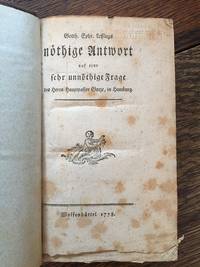
1778H645Wolfenbüttel i.e. Hamburg Braunschweig: Buchhandlung des Fürstl. Waisenhauses various - many without publisher information 1778. Hardcover. Good. Published 1777-1778. Octavo brown library cloth gilt stamped on spine various publications each with its own title page various paginations totalling about 500 pp. Good copy institutional marks including bookplate and due slip on endpapers small embossed blindstamp on first title page once or twice to text otherwise good clean copy. The central publications of the controversy that erupted when Lessing published 'fragments' of the work of Hermann Samuel Reimarus that attacked Lutheran orthodoxy and argued for a rational deism rejecting the theology of revelation. This led to an exchange of polemical pamphlets between Lessing and the principle defender of Lutheranism Johann Melchior Goeze a pastor from Hamburg. These culminated in Lessing's 11 'Anti-Goeze' tracts that contain the seeds of his thoughts regarding religion that became the foundation of 'Nathan the Wise.' The so-called Fragmentes Dispute is considered the most important theological controversy of the 18th century pitting Lessing's Enlightenment philosophy against Lutheran orthodoxy. Buchhandlung des Fürstl. Waisenhauses, various - many without publisher information hardcover
17765145CB1776. Reuttlingen Joh. Georg Fleischhauer 1776. 8°. 214 S. 3 Bl. Inhalt. Mit Holzschnitt-Vignetten. Interimspappband d. Zt. mit hs. Rückentitel. = "Sammlung der poetischen und prosaischen Schriften der schönen Geister in Teutschland". Goedeke IV/1 350 45. - Enthält Lessings 1729-1781 Lieder erstes und zweytes Buch Oden Fabeln Sinngedichte und Fragmente. Beigebunden: Kleist Ewald Christian von: Sämtliche Werke. Erster und Zweyter Theil. Carlsruhe Christian Gottl. Schmieder 1776. XVI S. 1 Bl. 118 S.; 150 S. Nicht bei Goedeke. - Ewald von Kleists 1715-1759 Werke erster und zweyter Theil mit dem bekannten Gedicht "Der Frühling" das am Schluss auch in einer italienischen Version abgedruckt ist "La Primavera in versi sciolti". - Auf letztem fliegenden Blatt alter handschr. Text mit der Überschrift "Almanach der Philosophie auf 1783 p. 20. Kleist". Monogram auf vorderem Spiegel Einband etwas fleckig und berieben. unknown
17876593Bern: in der Hallerschen Buchandlung 1787. Soft cover. Good. 8vo 152 x 95mm. 60pp. Modern wrappers margins trimmed close occasional spots lightly browned; front wrap loose but present. A satire on the Berlin academy written jointly by Lessing and Moses Mendelssohn criticizing the philosophical system of Alexander Popeís Essay on Man 1733-1734. Lessing German writer critic and dramatist was one of the most outstanding representatives of the Enlightenment era. His plays and theoretical writings often witty and ironic substantially influenced the development of German literature. In 1755 the collaborative work of Lessing and his friend philosopher Moses Mendelssohn anonymously appeared in the form of this provocative treatise Pope ein Metaphysiker! Pope as a Metaphysician. The controversial treatise dissected the subject of a contest at the Prussian Royal Academy. The two friends wrote it to confirm that there cannot be a true comparison between a poetic and a philosophic conception. <br/><br/> Bern: in der Hallerschen Buchandlung paperback
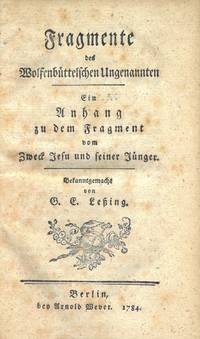
178459870Berlin. 1784. 8vo. Samtidig rødt kartonasjebind. 2 298 s.8vo. Contemporary boards. 2 298 pp. Bey Arnold Wever Tysk. <br/><br/><em>Bindet med noe slitasje de første 20 sidene noe plettet siste sidene med svak fuktskjold.Binding somewhat rubbed and peeling foxing to first 20 pp. dampstain to the last 10 or so.Herman Samuel Reimarus 1694-1768 German philosopher and theologian. He began writing very late in life. Lessing published quite a few of his writings. </em> hardcover