[ROMAN MISSAL].Biblio.com
374 résultats
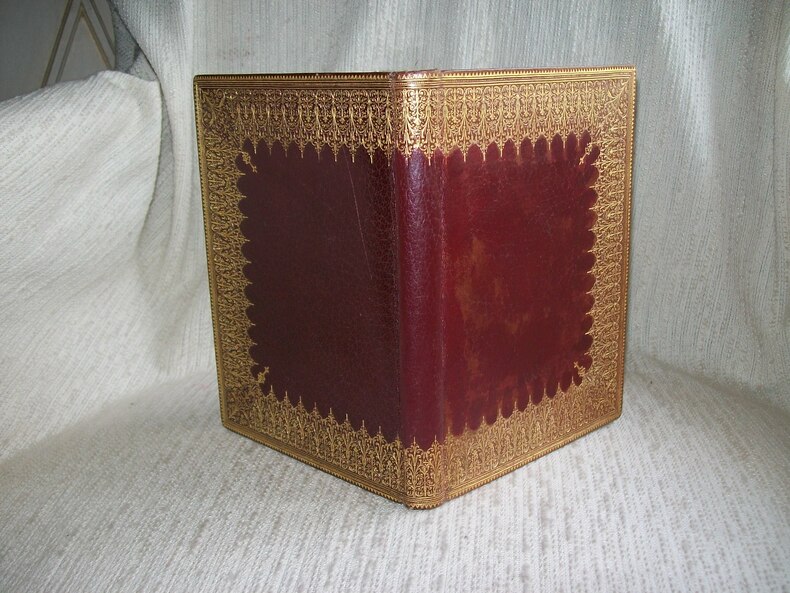
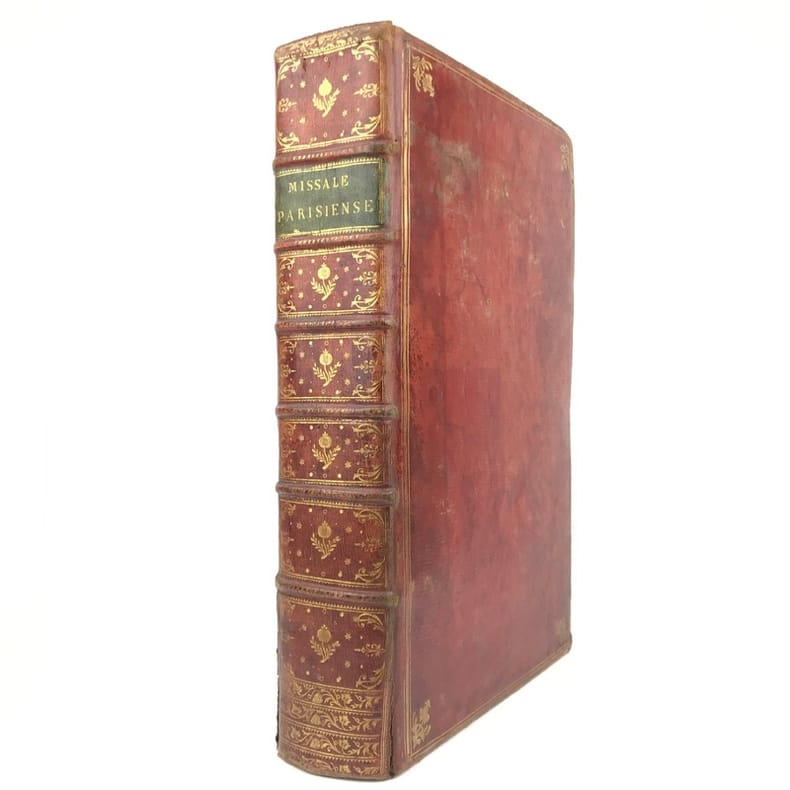
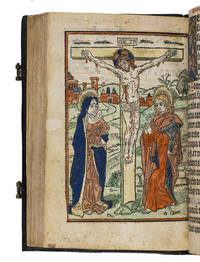
1506ABC_47741Paris: Thielman Kerver 1506. Gold- and blind-tooled black goatskin morocco 1st half of the 18th century sewn on 4 supports each board with a frame of blind triple fillets the front board also with the date ANNODOMINI1506 in gold in a gold-tooled frame with a saw-tooth edge and a flower in each corner: to make lining numerals the finisher used a J for 1 and an O for 0 and the spine-title MISSALEROMANUM in gold in the 2nd of 5 compartments gilt edges 2 brass hook fastenings with pin catch-plates marbled endpapers so-called Dutch combed pattern - teeth about 6.5 mm apart in red blue orange white and green more subtly curled than Wolfe 34 & 35 and the remains of a tab on the fore-edge of n2 marking the beginning of the Canon. 8vo. Printed in red and black throughout in 2 columns except for the preliminaries and Canon in 1 column with on the title page the first 1497 version of Kervers finely executed armorial device Renouard 499: a shield with T K above a mark with a cross supported by unicorns the shield hanging on a tree surrounded by many flowers 103 x 73 mm with a criblée background and with THIELMAN KERVER in a scroll in the foot; a crucifixion woodcut 120 x 82 mm; hundreds of impressions of at least 28 finely executed lombardic initials 4 series with decorations on a criblée background a 39 mm T with a crucifixion scene; two 28 mm: an R with a heron standing on one leg with an eel or snake in its mouth and an S with floral decorations; three 21 mm with floral and vine decoration; and at least twenty-two 13 mm with floral and vine decoration forming a complete 23-letter alphabet except for K X Y and Z plus alternate blocks for at least C O and S and a couple simple woodcut lombardic initials; as well as dozens of at least mostly 4-line spaces left for manuscript initials about half with printed guide letters filled in with manuscript lombardic initials in blue some with white or white and red decoration except for 3 lombardic initials in red; 3 sizes of cast lombardic initials 11 6 and 3 mm printed in red; a two-impression plainchant music type 10 mm 4-line staff in red with square-head notes and c-clef in black and two small typographic ornaments apparently designed for printing in red and black. The maltese crosses pilcros paragraph marks and Vx and Rx signs are printed in red and the capitals are rubricated throughout. The main text is set in a rotunda gothic type 66 mm/20 lines and the Canon n5r-o2v and the first line of the title in a textura gothic 112 mm/20 lines. The woodcut crucifixion on n4v facing the opening of the Canon Kervers device and the criblée initials are all coloured by a contemporary hand. The rare first missal for the Roman rite to be printed or published by the great Paris printing and publishing family Kerver best known for their luxurious liturgical and devotional printing especially their books of hours. There appears to be no copy in any French library. Kervers first missal in 1501 was made for the Paris rite. Kervers early missals including the present one are extremely rare the USTC recording no more than five copies of any edition printed before 1520. Caerr p. 73 notes that Kervers present first publishers device is universally recognised as a master-piece. It has been suggested that Kervers criblée blocks were metal cuts rather than woodcuts. The crucifixion scene facing the opening of the Canon is a more traditional woodcut. Caerr p. 51 suggests Kerver reached the pinnacle of his success in his stylistic evolution in or around 1506 fully incorporating Renaissance tastes in the period 1505-1514 and perfecting the criblée technique used for his present publishers device and initials. The present edition is also a very early example of the use of abstract typographic ornaments. The preliminaries include a calendar of feast days and most of its less common Saints days printed in red suggest a Franciscan connection.Thielman Kerver Koblenz ca. 1460/70-Paris 1522 appears in Paris imprints as a bookseller and publisher working with various printers and co-publishers from 1497 beginning with books of hours which always remained his greatest speciality. He added his own printing office in 1498 though he continued to work with others and expanded into a wide variety of genres. He also added other kinds of liturgical books including breviaries from 1499 a psalter in 1500/01 and missals from 1501 apparently publishing about 16 missals to his death in 1522 first using the present form of the title in the present edition. He was sworn in as official bookseller to the University in Paris in 1501 and soon after also printer hence the In alma Parisiorum Academia in the present title and colophon. Kervers widow continued the firm from 1522 to her death in 1557 their son Jacques continued it to his death in 1583 and its materials were sold in 1586.The fact that both the wording of the title and the exact date differ between the title page and the colophon the latter is 40 days later has led nearly every reference work from Weale in 1886 to the present USTC to turn one 1506 edition into two most describing a folio edition by Kerver a ghost and an anonymous 8vo edition supposedly with no copy known. David Shaw provided an accurate description on-line based on the British Library copy.With an inscription in the head margin of the title page partly shaved and difficult to read; the engraved publishers device of the Antwerp printer and publisher Jean Baptiste III Verdussen 1698-1773 on the front and back pastedown serving as his bookplate see above. Also with an 1831 owners inscription of S. De Ram on a free endleaf facing the title page. The rubricator or an early owner has added several notes in red in the calendar. Further with an occasional early marginal manuscript note some shaved. Four words in the Canon have been deliberately erased as an editorial revision. With an 8 cm tear into one leaf the running heads of a few others shaved the title-page slightly soiled a 3 mm hole in leaf 232 E4 affecting 2 or 3 words some tiny marginal wormholes in a few leaves and some water stains in the endpapers otherwise in very good condition. The binding shows a few small defects one slightly affecting the gold lettering on the front board but is also generally very good. A rare and beautifully produced missal and the second major display of Kervers stunning criblée initials all coloured by a contemporary hand as are the woodcut and Kerver's device.l Thierry Caerr Imprimerie et réussite sociale à Paris .: Thielman Kerver . 2000 2 vols. www.enssib.fr/bibliotheque-numerique 117 4 copies erroneously described as a folio; Catalogue . bibliothèque de feu . Jean de Meyer Ghent 2-5 November 1869 lot 33 8vo 23 March 1506 not mentioning Kerver but with alma Parisiorum Academia; Pettegree French books 68270 not noting Kervers name & 68271 erroneously described as a folio 1 of the same 4 copies; Frank Isaac reworked by David Shaw frenchpostincunables.djshaw.co.uk IS000343; USTC 68270 not noting Kervers name & 180236 erroneously described as a folio same copy as Pettegree; Catalogue . de la bibliothèque de M. Jean François van de Velde Ghent 1831 lot 1360 with an extra woodcut inserted facing leaf 58; Catalogus librorum Joannis Baptistae Verdussen Antwerp widow of Hieronymous Verdussen 15 July 1776 liturgy lot 45 the present copy; Weale & Bohatta Bibliographia liturgica 1928 982 23 March 1506 2 copies & 985 11 February 1506 not noting Kervers name no copy located both on p. 147 in the 1886 ed.; WorldCat 152428895 315474570 843131050 843131052 906577964 1063178422 5 copies plus 2 ghosts; not in Adams no Kerver missal before 1515; Davis Fairfax Murray French no Kerver missal; Mortimer Harvard French no Kerver missal before 1574; SUDOC; catalogue.bnf.fr. Thielman Kerver, unknown
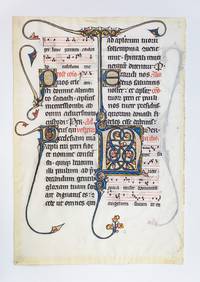
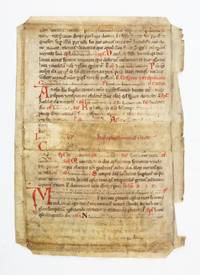
ST20214Northern France perhaps Beauvais or Amiens late 13th or early 14th century. 286 x 199 mm. 11 1/4 x 7 3/4". Double column containing a mixture of staves and text approximately 21 lines in an excellent formal gothic book hand. <br/> Attractively matted. Rubrics in red chant text containing black penwork initials with red and yellow geometric elaboration BEAUTIFULLY ILLUMINATED with five two-line initials painted blue or pink with white tracery on a ground in the contrasting color two of the initials filled with grotesques and swirling vines and two with the filler design traced out but never completed each initial with blue and pink extensions terminating in orange leaves or spiky shapes; the verso featuring AN IMPRESSIVE SIX-LINE "N" 58 x 50 mm. in the same style filled with an intricate knotwork design and orange leaves with long extensions including a horizontal extension across the upper margin. Margins with light offsetting of the designs from the facing leaf; remnants of mounting tape on recto corners and bottom edge; verso apparently with a barely visible Medieval "14" in lower margin. An area measuring 5 mm. at edges just faintly yellowed from mat burn but IN FINE CONDITION the vellum otherwise quite bright the paint rich and the gold brightly glittering.<br/> <br/> This sumptuously decorated leaf--which is beautifully preserved and contains a particularly large and handsome initial--comes from the last volume of a three-volume Missal presented to Beauvais Cathedral by Canon Robert de Hangest d. 1356. The Missal remained at the cathedral at least through the 17th century when it is noted in an inventory but was removed from the church at some point likely in the aftermath of the French Revolution. The parent volume eventually entered the collection of Henri-Auguste Brölemann 1775-1854 of Lyon who passed it to his grand-daughter Etienne Mallet who then sold it at Sotheby's in 1926. It was then acquired for the collection of William Hearst where it remained for the next 25 years. In 1941 it was again sold at auction and subsequently dismembered. Though long thought to have been the work of famed biblioclast Otto Ege recent scholarship suggests that it was actually Phillip Duschnes who was responsible for breaking up the book keeping some leaves for himself and selling others on to his colleague Ege for inclusion in his portfolios of "Fifty Original Leaves from Medieval Manuscripts." The Beauvais Missal has been a subject of interest for many notable scholars chief among them being Christopher de Hamel--see: "Otto Ege and the Beauvais Missal" in "Gilding the Lilly: A Hundred Medieval and Illuminated Manuscripts in the Lilly Library" and it is currently the focus of a major effort to "reconstruct" the manuscript digitally--a project spearheaded by Lisa Fagin Davis. Other leaves from the parent volume are in the collections of the Morgan Library the Metropolitan Museum of Art the Cleveland Museum of Art and the Houghton Library at Harvard among many others. Although there is some dispute among art historians the illumination has been tentatively attributed to the artist of the Hours of Yolande of Soissons produced in Amiens ca. 1280 and now held by the Morgan Library MS M.729. It is worth noting that the town of Hangest home to the original owner is only 10 miles from Amiens and is a likely place of origin for the Missal. The present leaf contains a text for a major feast day and thus contains a large and extravagantly decorated initial for its opening "'Nunc scio vere." It is not too much to say that the decoration here is masterful but curiously--and of special interest to us from a modern perspective--the illuminators seem to have forgotten to put the finishing touches on the two smaller initials above which still contain sketches of the preliminary design. unknown
16002945Paris: the Associated Booksellers to the Church 1600. <p>Folio 362 x 245 mm. Collation: ã6 ê6 î4 i4 blank õ6 Å©6 ãã6 êê4; A-Z Aa-Yy6. 38 228 42 leaves. Double column printed in red and black double rule page-borders throughout. 57 pages with printed music staves red-printed. Woodcut title illustration of Saints Peter and Paul seven full-page woodcuts the first in two blocks: a woodcut border and small Annunciation cut five small woodcut vignettes including two repeats and approximately 368 historiated initials in various sizes and from various series. Small tear to corner of title-leaf occasional foxing very occasional offsetting of red ink small stains in gutters in quire O finger-soiling in Canon quire X small rust-hole in f. 212 NN2 affecting 3 letters last few leaves with narrow marginal dampstain and slight creasing to upper fore-corners. Bound in contemporary French gold-tooled and -stamped light brown goatskin covers paneled with double fillets inner panel with fleurons at outer corners inner corners with large stamp of leafy branches emerging from a small medallion with winged cherub’s head large central oval medallion of the Crucifixion on upper cover and Annunciation on lower cover smooth spine with recessed cords decorated with overall double fillet panel with tiny fleurons at corners gilt edges plain endpapers remains of numerous fore-edge tabs in paper pale green or pink silk and black silk for the Mass for the Dead. Corners bumped slight wear front cover slightly rubbed a few small holes to lower cover foxing to endpapers. Provenance: contemporary inscription in French on front flyleaf listing “Messes pour tous les iours de la sepmaine†Masses for every day of the week; loosely inserted armorial papercut unidentified arms lion rampant on a chief three roses.<br /> <br /> Unrecorded issue of an imposing post-Tridentine Missal in a fine Parisian gold-tooled binding. The woodcut illustrations of this copy differ from the other known copies of this edition which are illustrated with engravings. The binding tools appear on other books published by the same publishing consortium and have been associated with religious lay confraternities founded by Henri III in the 1580s.<br /> <br /> This exceptional copy is of interest for the history of publishing printing illustration and binding; it raises questions about the very concept of an edition about the transmission of images and about the relations between printer-publishers bookbinders and book buyers in the hand-press period. <br /> <br /> In 1570 with the papal bull “Quo primum†Pope Pius V imposed uniformity on the rites of Mass previously a hodge-podge of different local traditions. That bull was printed in all subsequent missals; it is accompanied here by papal and royal privileges which supply crucial information concerning the publishing history of this edition. Jacques Kerver was the first French libraire to obtain a privilege for the publication of liturgical works. When he died in 1583 the privilege passed to his widow who ceded it to a consortium of booksellers: Sebastian Nivelle Guillaume Chaudière Guillaume de la Noue Michel Sonnius and Thomas Brumen cf. Renouard Imprimeurs et libraires parisiens du XVIe siècle IV 22. That privilege expired on 22 December 1595. This edition includes Papal and Royal renewals of the Kerver privilege for the printing of “sacred books†Missals Breviaries and Offices of the Virgin granted respectively by Clement VIII and Henri IV both on 4 April 1596. For Thomas Brumen who had died in 1588 the Royal privilege substitutes his son-in-law and heir Jean Corbon II and adds the names of Claude Chapelet identified as bookseller to the Academy and Jamet Mettayer and Pierre L’Huillier respectively Royal printer and Royal bookseller Mettayer was also the official printer for the Royal confraternities.<br /> <br /> The preliminary matter further includes the reformed Gregorian Paschal calendar for the years 1582 to 1700 a table of moveable feasts for 1589 to 1621 the Rubricae generalis missae the Ritus servandus in celebratione Missae and an index of Saints’ names. The second part of the Missal separately paginated contains the Commune Sanctorum. The subjects of the full-page illustrations are: the Annunciation: a small cut within an historiated woodcut border in twelve compartments showing four scenes from the life of the Virgin alternating with angels and the four Evangelists fol. êê4v; the Nativity B4v Crucifixion T6v opening the Canon Resurrection X4v Pentecost AA1v Last Supper BB3r and Last Judgment PP2v. These monumental woodcuts influenced by Italian and Flemish mannerism derive from various engraved sources including at least one engraving the Resurrection used by Jamet Mettayer in an Office of the Virgin published in 1586.<br /> <br /> The five smaller woodcuts printed from three blocks include a Crucifixion showing Longinus piercing the side of Jesus repeated twice the Last Supper and a smaller primitive Crucifixion cut. Noteworthy are the many historiated initials. Ruth Mortimer describing an edition by Kerver from 1574 noted that the elaborate historiated initials containing “figures of the saints the Evangelists and . New Testament scenes may be attributed to the same artists who worked on the illustrations. The blocks are so detailed as to give the impression of additional illustrations rather than initials.†As in previous editions the initials were chosen carefully here to match the text: for example the four Rs opening the word Requiem in the Mass for the Dead incorporate a skeleton and funeral scenes.<br /> <br /> The full-page woodcuts had appeared previously in the Kerver-consortium’s 1588 edition cf. an illuminated copy offered by Breslauer in 1981 cat. 104/II no. 192. Only a few copies of these repeatedly printed Paris post-Tridentine Missals survive in public collections and precise descriptions are few. The most thorough description is that by Ruth Mortimer of the Harvard copy of the 1574 Kerver edition. Both that edition and the 1583 edition of which there is a copy at the Newberry Library are illustrated with only two full-page woodcuts including the canon cut of the Crucifixion used here and numerous smaller woodcuts. The title of the 1574 edition bears the same Peter and Paul cut while the 1583 edition has Kerver’s device.<br /> <br /> The present copy represents a previously unrecorded variant issue of the 1600 edition. I have located two other copies of the edition at the Austrian National Library digitized and with Sokol Books catalogue 65/64; they are illustrated with engravings instead of woodcuts all but one of which differ iconographically from the woodcuts in our copy. The exception is the aforementioned Resurrection woodcut which is copied in reverse from the engraving. The typesetting other than the title appears to be identical but rather than a letterpress title-page and seven woodcut full-page illustrations the other copies have an engraved title and seven full-page engravings. Another variant setting occurs in quires M and N: both issues have the small Longinus woodcut on M1v but the spaces here filled by 3 small woodcuts one used twice are left blank in those copies.<br /> <br /> The existence of multiple editions of these post-Tridentine Paris Missals has been documented; Mortimer for example noted that in 1574 Kerver printed two folio editions as well as quarto and octavo editions. From the early 1570s to the end of the century these liturgical books now rare were churned off the presses to meet the needs of priests and clerics throughout France and beyond several copies of the Kerver or Kerver-consortium editions survive in Spanish and Italian libraries. Under these circumstances the existence of multiple editions and variant issues is not surprising though the outright replacement of engravings with woodcuts or vice-versa seems unusual.  <br /> <br /> The attractive Parisian binding shows signs of hasty finishing: the cornerpieces using a popular cherub’s head and leafy branch motif are single stamps and those on the upper cover are unevenly placed so that three of them overlap the double fillet panel. It is however a luxury binding of high-quality goatskin and its decoration is charged with meaning which remains to be completely teased out. Several variants of the Crucifixion and Annunciation medallions were used on the bindings of a number of devotional books published by the present publishing consortium or by its individual members. A few of those bindings bear a motto Spes mea Deus used by members of the Confraternity of Penitents of the Annunciation founded by Henri III in 1583. Possibly by extension the Crucifixion stamp itself has been associated with the confraternity and with the three other “congregations†established by that devout monarch in 1583-85. The same large Crucifixion and Annunciation medallion stamps were used in a similar center- and cornerpiece design on the aforementioned Breslauer copy of the 1588 edition of this Missal and in a dated binding from 1599 covering a 1508 Verard book of hours in the British Library shelfmark c29f16 reproduced in the BL Database of Bookbindings. In both cases the corner feuillage stamps are different but the central medallions appear to be identical to those on this binding.<br /> <br /> Similar but not identical stamps besides those cited in the sources below are found on: a copy of Mettayer’s 1586 Pseaultier de David recently offered by the Paris booksellers Laurent Coulet and Ariane Adeline in their catalogue “1586: Jamet Mettayer et les Confréries de Pénitentsâ€; an Officium beatae Mariae Virginis Paris: apud Societatem Typographicum 1586 using both the Annunciation and Crucifixion medallions set within a fanfare design Bibliothèque Sainte Geneviève Réserve 8 Z 6685 INV 9940; and an Office de La Vierge published by Mettayer in 1586 BnF Réserve B. 1654 Lacombe 486. A book of hours for the use of Amiens Paris: for Guillaume de La Noue 1589 bound with several devotional tracts BnF Réserve B-27949; Lacombe 492 has a different Annunciation stamp but apparently the same Crucifixion stamp. Coulet and Adeline established a typology of 9 different Crucifixion stamps or 8 stamps and one variant the one used here being no. 8. <br /> <br /> Given these facts the possibility cannot be excluded that the publishers were involved in commissioning the bindings of this copy and of the other “Crucifixion medallion†bindings found on their imprints.<br /> <br /> USTC 137500 Austrian National Library only variant issue - not in their OPAC. Cf. Harvard/Mortimer French 378 8 June 1574 edition. Not in Weale-Bohatta or Amiet. On the binding cf. Hobson & Culot Italian and French 16th-century Bookbindings 1991 62; Claude La Charité “Henri III Le miroir des religieux 1585 de Louis de Blois et `la troisiesme couronne à frere Henri de Valois’†Revue de Bibliothèques et Archives du Québec no. 2 2010 online; Needham Twelve Centuries of Bookbindings 1979 82.</p> the Associated Booksellers to the Church unknown
1770047085Angelopoli Puebla: Typis Seminarii Palafoxiani 1770. First Edition. Hardcover Full Leather. Very Good Condition. José de Nava. Contemporary full calf wear at edges surface scrapes to leather old paper spine label and private library label to spine paste paper endpapers stamp from library of Rev. L. Kenzel and a printed in Germany stamp to verso of title. SLight browning to page edges some offsetting and acidification from the ink used in the musical notation and engravings; generally a bright fresh copy internally. 8 1-137; Frontispiece 1-198 pages 133-135 incorrectly numbered 233-235 pp. Sabin 49459 Palau V195.<br /> <br /> A high point of Mexican printing. Finely printed in Puebla with 3 very fine engravings by de Nava. The Mozarabic rites were used by the Visigothic and Mozarabic Christians of medieval Spain until replaced in the the 11th century. They were reauthorized for use in Toledo in the 15th century where they continue in some form to be used. Size: Folio. Illustrator: José de Nava. Quantity Available: 1. Shipped Weight: 1-2 kilos. Category: Religion & Theology; Antiquarian & Rare. Inventory No: 047085. Typis Seminarii Palafoxiani hardcover
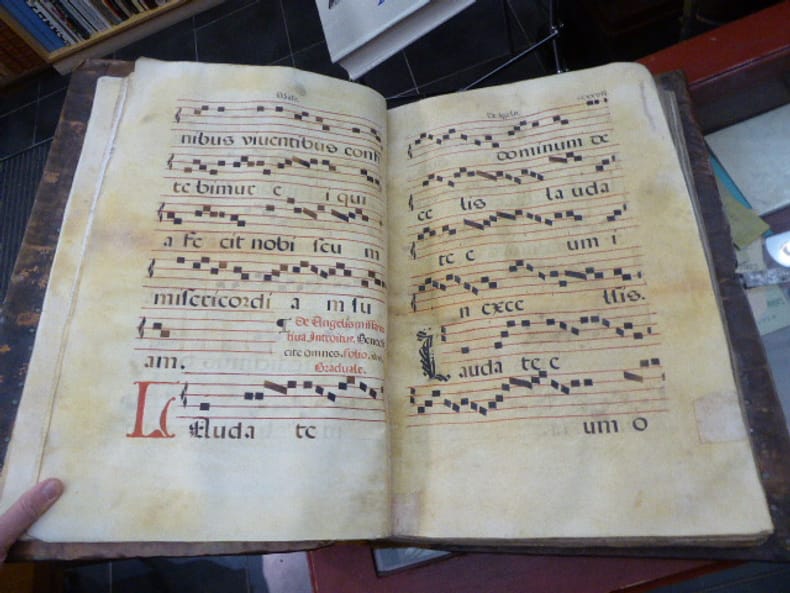
473730S.N. S.L. S.D. (XVIe) IMPORTANT ET EXCEPTIONNEL ANTIPHONAIRE in folio ( 635 X 445 mm ) de 244 pages, pleine basane fauve, dos à nerfs janséniste, plats sur ais de bois avec renforts de cuivre cloutés sur les coupes, fermeture par par serrure carrée à clef fixée au premier plat avec un moraillon ( poignée à charnière ) dont l'auberon ( extrémité inférieure de la poignée ) vient s'engager dans le pène de la serrure, clef forgée. 172 feuillets de parchemin ( 595 X 400 mm ) manuscrits recto-verso, lettrage en rouge, notation musicale carrée en noir sur des portées à 5 lignes rouges. Quelques feuillets ont été restaurés en marge, 3 ont été découpés, la reliure a été habilement restaurée par le Centre de Conservation du Livre d'Arles, la couvrure est donc récente, la serrure et les feuillets sont bien d'époque XVIe siècle. Poids: 18 kg.
1737ABC_50448Antwerp: ex architypographia Plantiniana = Joannes Jacobus Moretus 1737. Contemporary elaborately gold-tooled red morocco with remnants of brass catch and anchorplates along the fore edge gilt and gauffered edges with intricately made tabs along the fore edge gold-tooled board edges marbled endpapers. Folio. With 20 full-page engraved plates by Cornelius Galle 10 engraved frames surrounding the text and vocal music printed on pp. 153-155 196-197 199-207 220-233 235-237 240-272 286-288 290-292 and xvii. The text is printed in red and black with historiated initials hand-coloured in red an engraved vignette on the title page of each work and several woodcut tailpieces throughout of which 3 printed in red. 2 works in 1 volume. With: 2 SPANISH MISSAL. Missae propriae sanctorum Hispanorum qui generaliter in Hispania celebrantur. ex apostolica concessione & auctoritate S. Pii V. Gregorii XIII. Sixti. V. Clementis VIII. & Urbani. VIII. aliorumque summorum pontificum. Antwerp ex architypographia Plantiniana = Joannes Jacobus Moretus 1737. Plantin edition of the revised Roman Missal produced in line with the Council of Trents directives. This imposing folio exemplifies the Tridentine tradition established after the council 1545-1563 when the Roman Church responding to the Reformation sought to standardise the liturgy. In 1570 Pope Pius V 1504-1572 promulgated the reformed Missale Romanum establishing the text and ceremonial form of the Mass that would govern the Latin Church for centuries. Subsequent revisions under Clemens VIII 1536-1605 and Urban VIII 1568-1644 refined but did not alter its essential structure.From 1571 until the mid-18th century the press founded by Christophe Plantin 1520-1589 held a significant monopoly on the production and sale of authorised liturgical work for the Spanish Netherlands and effectively much of the Spanish Empire. The present Missale Romanum has been bound together with the Missae propriae sanctorum Hispanorum 1737 a collection of masses for Spanish saints. It contains the specific texts and music intended for the celebration of these saints reflecting its use in Iberian or Spanish-influenced territories. The beautiful red morocco binding richly gilt in the rococo manner was also most likely bound in Spain or Portugal.The front joint is slightly weakened but the structural integrity of the work is still intact a hole at the head and foot of the spine the edges and corners of the boards are slightly scuffed the boards are somewhat stained lacking the clasps. The leaves are somewhat browned with occasional foxing a few pages retaining traces of yellow wax. Otherwise in good condition.l Imhof Plantins 1574 Missale Romanum in octavo in: De Gulden Passer 73 1995 pp. 67-82; STCV 12923535; Ad 2; WorldCat 804759478 0 copies; not in STCV. ex architypographia Plantiniana [= Joannes Jacobus Moretus], unknown
1587ABC_48453Antwerp: Christoffel Plantin 1587. Contemporary elaborately blind-tooled pigskin over bevelled wooden boards sewn on 4 double supports with the corresponding raised bands on the spine the manuscript title in the first compartment and the original manuscript shelf mark label "H.36" of the Monastery of Buxheim in the fifth compartment both boards with an ornamental roll and a roll with the portraits of Salvater sic! Maria S. Bruno and S. Johannes in a panel design two original brass clasps and catches ornamented with a small star leather tabs and six original bookmarkers plaited into a big knot. 8vo. With a woodcut vignette with Peter and Paul by Peeter van der Borcht on the title page 6 full-page woodcuts ca. 112 x 75 mm by Antoon van Leest after Peeter van der Borcht 6 half-page square woodcuts 55 x 55 mm in border one signed by Antoon van Leest one woodcut 90 x 76 mm by Antoon van Leest after Peeter van der Borcht and 2 smaller oval woodcuts. The work is printed in red and black. Plantin edition of the revised Roman Missal following the directives of the Council of Trent first published in Rome in 1570 by order of pope Pius V 1504-1572 and later approved by Clemens VIII 1536-1605 and Urbanus VIII 1568-1644. The work was quite popular as Plantin published a new missal nearly every year from 1571 onwards. All editions were printed in different sizes and in two issues one with woodcut illustrations and one with engravings. The present copy is the octavo edition with woodcut illustrations and comes from the library of the famous Carthusian monastery of Buxheim Maria Saal near Memmingen Bavaria.The monstery of Buxheim was founded in 1402 and dissolved after the secularisation in 1803. The rich library was auctioned in 1883 by Förster and in 1884 by Ludwig Rosenthal in Munich. The Museum of the Charterhouse Buxheim today is actively studying the history of the library and the present location of its books and manuscripts. The present copy is bound in contemporary pigskin which was likely bound for the monastery itself as the rolls depict Saint Bruno who was the founder of the Carthusian order. The Missal is therefore probably bound in a South-German bindery in the surroundings of the monastery.With an ownership annotation on the title page "Cartusiae Buxheim". The binding is somewhat rubbed and soiled. The leaves are lightly browned some of the leaves are slightly stained especially around the leather tabs. Otherwise in good condition.l Belg. Typ. 6335; Imhof Plantins 1574 Missale Romanum in octavo in: De Gulden Passer 73 1995 pp. 67-82; Nagler I 1459; USTC 406791; Voet 1701 A; Weale-Bohatta no. 1269; not in Haebler. Christoffel Plantin, hardcover
1726311716Venice 1726. Printed in red & black; Engravings including initial letters & title page vignette depicting St Peters and a papal crown by Sister Isabella Piccini. Short thick folio red velvet worn over boards With silver escutcheons & corner pieces on back & front covers. Venetiis: Typographia Balleoniana 1726<br/> <br/> unknown
1860GITj813Sans lieu ni date ni nom d'artiste vers 1860. In-8 papier fort monté sur onglet 5 feuillets blancs 38 feuillets non chiffrés (soit 76pp, la dernière ornée sans texte) 29 feuillets blancs. Plein maroquin grenat, dos lisse muet, encadrement courant sur le dos et les plats composé de filets guillochés, perlés et continus servant de base à une très large dentelle finement dorée, coupes filetées, grande dentelle dorée sur bordure intérieure, contreplats doublés de moire violet profond, tranches dorées frappées de fleurons, ainsi que des nom et prénoms "Thérèse, Madeleine, Gautier", reliure de l'époque. Le texte, en français, est entièrement calligraphié en beaux caractères gothiques, occupant environ 6cm en largeur et 9cm en hauteur, inscrits dans un encadrement richement orné d'environ 9cm (largeur) sur 12cm (hauteur). Quelques lettrines dorées (volutes, animaux, végétaux), majuscules dorées, certaines sur fond rouge, bleu ciel, vert. Les mots "Dieu", "Jésus", "Seigneur" sont en rouge. Les frises d'encadrement sur fond blanc, bleu nuit, vert, vieux rose, gris-bleu, bleu ciel, grenat, argent et or présentent un décor différent pour chaque page, très joliment et finement composé dans le goût des manuscrits enluminés médiévaux où, parmi des entrelacs de volutes et de végétaux, foisonnent petit peuple d'anges, dragons, bestiaire fantastique, ainsi que Dames parées, Chevalier à bannière, fleurs, animaux, papillons, insectes. Quelques autres décors sont à remarquer: chapelet, barque longeant une côte, paysage nocturne au bord d'un lac et la très romantique évocation d'une tombe sous le Lune, abritée par un saule. On admirera enfin de magnifiques guirlandes de fleurs (certaines sur fond doré) telles que roses, lilas, arum, fuchsia. Sans oublier une grande vignette au centre d'un fin décor de colonnettes dorées, représentant un ange à bannière grenat s'apprêtant à faire tinter une cloche céleste (lettres dorées du texte de la bannière un peu ternies). Nous joignons un signet de soie rouge vif à franges (18cm X 4cm) très gracieusement brodé de fleurettes et de 3 papillons multicolores. MAGNIFIQUE MISSEL MANUSCRIT AUX RICHES ENLUMINURES D'UNE GRANDE FINESSE AYANT CONSERVE TOUTES LEURS FRAICHES COULEURS DANS UNE RELIURE LUXUEUSE, DECORATIVE ET EN BEL ETAT.
1986wx269Belser Verlag Relié 1986 In-folio (33,7 x 47,5 cm), reliure pleine peau, dos à nerfs, fermoirs en laiton, fers dorés et filets estampés à froid aux plats, exemplaire numéroté (ici le numéro 104), fac-similé du Missel de Noël d'Alexandre VI, Borg. lat. 425, l'un des plus importants manuscrits liturgiques réalisés au XVe siècle en l'honneur du pape Alexandre VI, reproduction rehaussées à l'or ; quelques incidents et frottements aux plats, bord supérieur du premier plat un peu décoloré suite à une mouillure, traces d'humidité sur les deux premiers feuillets, deux épidermures papier sur les deux derniers feuillets où les pages ont adhéré entre elles, par ailleurs bon état général. Livraison a domicile (La Poste) ou en Mondial Relay sur simple demande.
91756aafAuguste Vindelicorum & Graecii (Augsburg): Philipp, Martin und Johann Veith Erben, 1721, in-4to, 6 Bl. (Schmutztitel, Titelblatt mit gest. Vignette, Dedicatio, Licentia) + 28 n.n. Bl. + 644 S. + CXXIII (commune sanctorum... ) + 6 n.n. S., mit 11 ganzs. Kupfertafeln (Gottlieb Wolfgang & Georg Wilh. Salomus Müller sc.) und über 40 S. mit Musiknoten in rot u. schwarz + 10 Bl. ( Proprium Festorum Typis Haeredum Höllerianorum, 1722), Sehr schönes, in rotes maroquin gebundenes Exemplar mit 2 Schliessen (davon 1 im Original) / magnifique reliure en maroquin rouge, dos à cinq nerfs, riche décor aux plats et au dos, tranches dorées, 2 fermoirs (dont 1 originale).
1879001870Paris Maçia 1879
1784AQ14409Olispone i.e. Lisbon: Typographia regia et privilegio 1784. 30 672pp cxlvi 10 58. Several engraved devotional images within pagination. Contemporary red morocco richly gilt marbled endpapers and gilt gauffered edges yellow metal clasps. Rubbed small incision to lower joint paper label to upper board. Tears to FFEP occasional marginal loss/tearing some occasional marking. A handsomely bound Portuguese-printed Roman missal which despite later confusion in an inscription to a blank fly-leaf earlier manuscript letters inserted suggest that this was seized from the flagship of the usurper Dom Miguel the 80-gun Don Juan during the 1833 Battle of Cape St. Vincent passing through the hands of several clergymen before being presented to Grayfriar's Oxford. . Folio. Typographia regia, et privilegio unknown
1673134<p>Extremely Rare Venetian Missal in a fine contemporary leather binding.</p><p>No copy of this edition recorded on WorldCat</p><p>Roman Church.<em> Missale Romanum ex Decreto Sacrosancti Concilii Tridentini Restitutum Pii V Pontificis Maximi Iussu Editum Clementis VIII Urbani VIII Alexandri VII Clementis IX et SS D.N. Clemente Papa X Novissime Suis Locis. </em>Venetiis Venezia apud Cieras MDCLXXIII 1673.</p><p>Folio 384 x 258 mm full black leather binding single ruler with floral decoration on boards charming metal plaque in the centre of the front board depicting two winged cherubs; spine with seven raised bands pp. 40 422 4 423-527 1 CXX 6 CXXI-CXXIII i.e. CIII 1. Original clasps preserved. Title page in red and black ink with a beautiful engraved vignette at f. a¹ <em>Commune sanctorum</em>. Signature: ¹Ⱐ2⸠3² A-2K⸠a-e⸠f-gâ¶</p><p>1 full-page engravings: Annunciation signed by the Sienese Engraver Giovanni Maria Ferri and four by Giacomo Piccini father of Sister Isabella. Several historiated initials. Pages of music engraved within the text in red ink.</p><p>Apparently the only existing copy of this edition of the Missale Romanum.</p><p>After the Council of Trent 1545-1563 liturgical norms underwent significant changes with the aim of unifying and strengthening the practice of the Catholic faith in response to the divisive tendencies of the Protestant Reformation.</p><p>Among the key reforms was a revision of sacred texts particularly the <em>Roman Missal</em> which was standardized and promulgated by Pope Pius V in 1570 through the bull <em>Quo Primum Tempore</em>. This new missal known as the <em>Tridentine Missal</em> standardized liturgical rites across the Latin Church eliminating local variations that had developed over the centuries except those with at least 200 years of tradition. Latin was retained as the official liturgical language and the gestures prayers and readings were clearly defined establishing a strict canon.</p><p>This liturgical reform endured for centuries until a new wave of changes introduced by the Second Vatican Council in 1962 which led to the creation of an updated Roman Missal with greater openness to vernacular languages and more active participation of the faithful.</p><p>Imprimatur: "We Brother Bassanus Galliciolus of Brescia of the Order of Preachers Master of Sacred Theology and General Inquisitor against heretical depravity in the City of Venice and throughout its Most Serene Dominion specially delegated by the Holy Apostolic Office.</p><p>We have compared the Roman Missal recently printed by Mr. Bonifacio Ciera with another already duly approved and since it is found to agree with it in all respects as well as with the Decrees of the Sacred Congregation of Rites and of the Supreme Pontiffs we therefore grant permission for it to be published.</p><p>And in testimony thereof etc.</p><p>Given at Venice from the offices of the Holy Inquisition on the 1st of January 1673.</p><p>Thus it is Brother Bassanus as above by his own hand."</p><p>Conditions: Few small wormholes along the text light marks of use. Overall a good copy.</p><p>Provenance: Paper <em>Ex libris</em> " Luigi Carpaneto " on front pastedown.</p><p>Wider description and more images:</p><p>https://tinyurl.com/1673Missal-PDF</p> apud Cieras
1896AQ28784Mechliniae i.s. Mechelen: H. Dessain 1896. xli 502 60 24pp 2. With a half tile. Printed in red and black. Elaborately bound in contemporary richly gilt-tooled red morocco device of seated christ proffering book with Greek letters alpha and omega within ornate border to both boards A.E.G. with eight divisional red moire cloth tabs one partially perished gilt dentelles decorated endpapers. Slightest of rubbing to extremities. Internally immaculate. An exquisitely bound late nineteenth-century Continental edition of the Roman Missal. The Roman Missal with origins in the high middle ages is the liturgical book from which the text and rubrics for the celebration of Catholic Mass with both prayers and music. One of the major advances of the Council of Trent the Catholic counter to the Protestant Reformation was to standardise the Missal. Pope Pius V acting on the concilliar deciion formalised this in his Quo Primum on 14 July 1570 - insisting that the standard form of the Missal was used throughout the Church except where a local missal could be proved to be of two centuries antiquity. Perhaps one of the most controversial Counter-Reformation decisions made at Trent the use of a standard Missal prevented the celebration of the Mass in vernacular languages and signified a further strengthening of Papal authority: particularly as all printed editions were prefaced by the Pope's order of standardisation. The Missal of Pius V was further edited by Clement VIII in 1604 and later by Urban VIII in 1634. . Large 8vo. H. Dessain hardcover
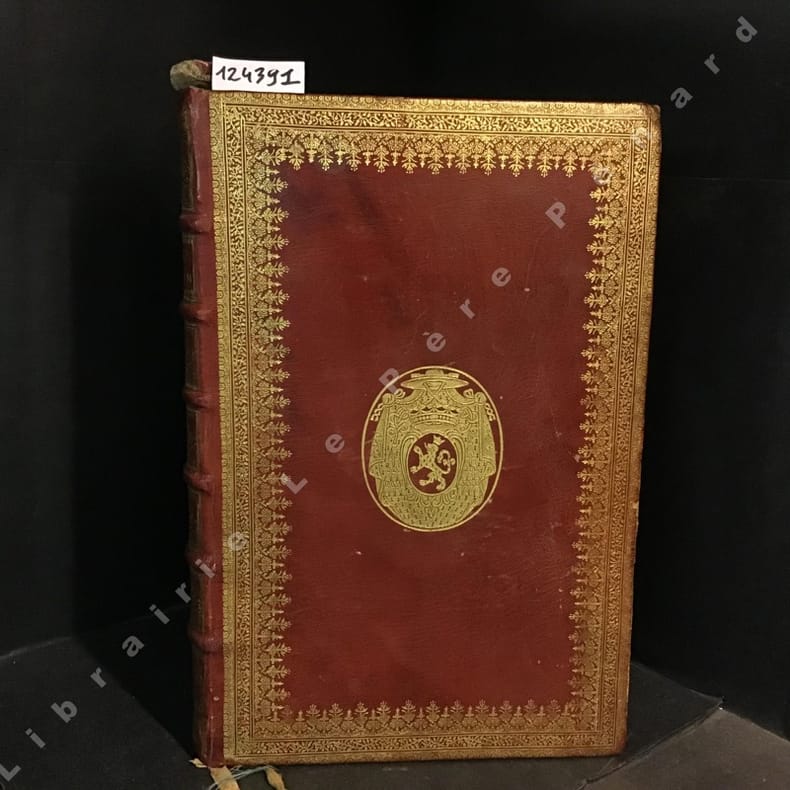
117475Parisiis (Paris), Apud Rolinum Thierry & Eustachium Foucault 1615, 365x230mm, reliure plein veau marbré de l’époque avec ornementations et fleur de Lys dorés (dorrure passée) au dos à six nerfs. Plat encadrements et ornementations dorés avec au centre un écu avec au sommet une chapeau de cardinal et une devise latine inscrite sur un ruban : Non secundun factum (non selon l’apparence). Livre provenant de D. Nicolai Goubile, Decani Cameracén. Plat frotté. Charnière craquelées. Intérieur propre. Bel exemplaire.
1700002263Paris: Par la Compagnie des Libraires affociez au Livre de la Semaine Sainte 1700 1700. WITH THE GILT ARMS OF PHILIPPE II DUC D'ORLEANS. 1 vol. 752pp. 7-11/16" x 5-1/4" 4 full page engraved plates bound in contemporary full red morocco over cords gilt spine panels with double "PP" covers ruled in gilt gilt double "PP" corner pieces gilt crest of Philippe II to the center of both covers all edges gilt marbled pastedowns and endpapers internally clean and bright hinges fine head and foot of spine fine a VERY GOOD copy. Paris: Par la Compagnie des Libraires affociez au Livre de la Semaine Sainte, 1700 unknown
1777180481777 un volume, reliure plein maroquin rouge in-folio ( binding full morocco in-folio) (26 x 39,5 cm), RELIURE D'EPOQUE, dos à nerfs (spine with raised band), décoration or (gilt decoration) à filets, roulettes, entrelacs et rinceaux or (gilt lines and fillets), entre nerfs à compartiments à fleurons dans un encadrement à filets et roulettes " chainette" or, titre frappé or (gilt title), plats décorés d'un triple filet et roulettes "or" en encadrement (cover with triple gilt lines) avec un fleuron or à chaque angles, dos et plats légèrement épidermés, roulette or sur les coupes (gilt fillet on the cuts) et et dentelle sur les chasses (lace-like decoration on the turn-ins), toutes tranches lisses dorées (all edges gilt), pages de garde en papier peigné bleu (endpapers with white painting paper), etiquette Ex-Libris : "SEMINARIUM MOLINENSE" (Séminaire de Moulins), sans illustrations (no illustration) excepté une vignette gravée sur bois en noir "aux armes de l'Archevèque Charles-Gaspar-Guillaume de Vintimille" en bas de la page de titre (title page decorated with a vignette of title) et orné de bandeaux et de culs-de-lampe (illuminated of headpieces and tailpieces), (684 + CLIV) Pages, 1777 Parisiis : sumptibus bibliopolarum usuum parisiensium Editeur,
17771501777 Parisiis, sumptibus Bibliopolarum, 1777.
ST19350-013Germany early 13th century. 273 x 193 mm. 10 3/4 x 7 1/2". Single column 31 lines text in two sizes in a gothic hand. <br/> Rubrics in red several one- and two-line initials in red and two larger initials in red. A few lines with neumes later notations in the margins now quite faded. ◆Vellum a bit soiled and creased as expected fading to four or five lines where the spine was placed several notches along one edge other imperfections due to its reuse as binding scrap but still an excellent specimen that is almost entirely legible.<br/> <br/> Written in a neat and attractive hand this sizable leaf from a Missal remains mostly quite legible with all its rubrication intact despite having been used as part of a binding. A few lines also show musical notation from the earliest generation of neumes. They are described as "in campo aperto" which means literally "in an open field" because they and they alone occupy the space or "field" above the text. They are also described as adiastematic because they appear in a straight line whereas later diastematic neumes reflect changes in pitch by being placed in a higher or lower vertical position above the text. At the time the present leaf was written out the neumes here simply served as an "aide memoire" to the singer who had already learned the melody orally. unknown
16981243911698 Lutetiæ Parisiorum, Apud Johannem Baptistam Coignard, Regis Typographum (Chez Jean-Baptiste Coignard, Imprimeur du Roi, Paris) - M. DC. XCVIII. (1698) - Un volume In-folio (27x40cm), reliure plein maroquin rouge, dos à 6 nerfs avec titre et caissons ornés de fleurons en dorée, encadrement en dorée sur les plats, roulette dorée sur les tranches et les contreplats, coussinet de lecture et signet, onglets en tissus, toutes tranches dorées, reliure armoriée aux armes de Jacques-Nicolas Colbert (archevêque de Rouen) - A-M + 668 + civ pages - Très beaux ornements (vignettes, lettrines, culs-de-lampe, fleurons) et gravures hors-texte en N&B dans l'ouvrage - Texte en N&B et rouge en latin sur deux colonnes
176584155Antverpiae: Ex Architypographia Plantiniana 1765. 36 x 24.5 cm contemporary leather binding over boards with raised bands on spine ruled border blind-stamped on covers marbled endpapers title page in red and black 66 624 cxxviii 4 8 2 1 pages printed in red and black throughout engraved frontispiece and full-page engraved illustrations text in Latin. Binding lightly worn with rubbing and scuffing to covers and corners interior pages age-toned browned but clean and complete overall still in very good condition see picture. Issued by the famous Plantin-Moretus press in Antwerp one of the most celebrated printing houses in European history. This edition of the Roman Missal conforms to the Tridentine rite as mandated by the Council of Trent and subsequently revised under Popes Pius V Clement VIII and Urban VIII. Includes Proper of the Time Proper of Saints Common of Saints and chant notation; notable for its fine 9 engraved illustrations. Ex Architypographia Plantiniana hardcover
178310979Cadomus [Caen] Aegidius Le Roy 1783 Un volume in-folio plein chagrin rouge, dos à nerfs, croix dorées aux caissons, titre doré, frise dorée en encadrement sur les plats, crucifix en argent au centre du plat supérieur, quatre plaques à décor floral en argent aux angles de chaque plats, dentelle intérieure, tranches dorées, [titre], 4 pages, [12] pp., 40 pp., 215 pp., puis 213-236, 241-412, [2] ff. manuscrits, 413-451 pages, cv + 1 feuillet supplémentaire, 36 pp., [bl.], texte en latin sur deux colonnes dans encadrment de double filet, 12 gravures hors-texte à pleine page. Tâche discrète au premier plat, un mors fendu et deux petits manques à une plaque à décor floral, quelques rousseurs, néanmoins bel exemplaire.
50296aafAugustae Taurinorum (Torino), ex typis Binelli, (and) Benedicti Canonica cum ejusdem filio Joanne, 1882, in-4to, text on 2 col., 3 leaves + 32 p. + 496 p. + 1 leaf; 136 p. + 16 leaves + 3 lithogr. illustr. plates, some leaves somewhat stained or browned, tear in one leaf, several silk signets of different colours, 9 leaves with brown silk signet on edge, a few leaves loosening, bordeaux red morocco binding, spine on 5 bands gilt, covers with gilt floral frame and centre piece composed of two angels facing a monstrance surmounted by "IHS" emanating beams of light, with studs in each corner and center, somewhat stained and rubbed, corners partly bumped, bords scratched, remains of gilding on edges.
110180aafNanceii, (Nanci) Apud H. Haener, Regis & Ordinis Praemonftratensfis Typographum, M. DCC. LXXXVII. 1787, in-8vo, 1 f. ms. avec écriture musicale + VIII + 248 p., truffée de qqs feuilles ms. musicales , reliure en veau brun d’époque, dos à 5 nerfs avec titre et ornoments dorées, tranches rouges, bel exemplaire.