88 résultats
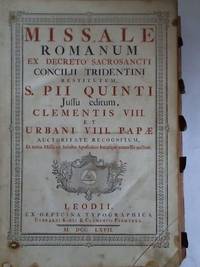
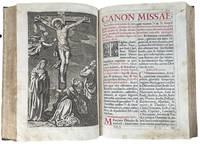
a29572Rome 1794 Exudebant Joachim et Michael Puccinelli Fratres. Restitutum Sancti PII V. Pontificis Maximi Jussu editum Clementis VIII. et Urbani VIII actoritate recogniutm; nunc denuo sub auspiciis Sancitissimi Domini nostri PII Sexti Pont. Max. Folio 26x38x4 cm. Hardcover. Title in red and black with 1/4 page vignette. Text in double columns. Two fullpage engravings. About 20 pages have lower blank corner cut off and cloth tabs have been added to 6 pages 2 tabs have since worn off. Rebound in early or mid 20thc to brown paper-covered boards with green cloth spine. Includes much black block letter music scoring. One text page has lower corner torn off just into text loss of about 4 lines of words and one bottom line of music is torn off on another page. Occasional spotting and foxing throughout. Binding very secure. near Good. . hardcover
19001Impression Darantière pour la librairie Leullier Paris 1900. in/16 9.5 x 6 cm reliure plein veau marbré plats à filets dorés et frise à froid dentelle intérieure moire verte sur les gardes doré trois tranches chaque feuillet comporte une enluminure imprimée et réhaussée à la main réhaut datés en fin d'ouvrage : 1922. Joli petit ouvrage précieux aux enluminures tout en nuances. unknown
2A8599Ex officina typographica Everardi Kints & Clementis Plomteux Lüttich 1767. 30 Blatt 652 CXXXVI S. 3 Blatt 4 S. 3 Blatt mit 5 Leder-Registerbändchen versehen Ledereinband der Zeit auf 5 Schmuckbünden mit goldgeprägtem Rückentitel sowie farbigem Schnitt quart teils etwas fleckig/kleinere Wasserränder/Buchblock mittig etwas verzogen/Einband bestoßen/Kapitale eingerissen/Schließer fehlen. - Messbuch der römisch-katholischen Kirche auf Latein / Beigebunden: Parvum Missale Coloniense Romano Substructum Et unà cum hoc Juxta Ritum Coloniensem Aequé ac Romano-Coloniensem Commodè utendum 1749 96 S. / Missae Propriae Dioecesis Paderbornensis. Accedunt Missae Novissime per Summos Pontifices Concessae. Auctoritate et Jussu Reverendissimi Ordinariatus 1835 44 S. - unknown
162351006Paris Lutetiae Parisiorum: Associated Booksellers to the Church Apud Societatum Typographicam Librorum Officij Ecclesiastici 1623. Hardcover. 12mo. Rebound in full brown velour over heavy boards likely late 19th century. 94pp 735pp 1p i-cxxxvj. Small title page engraving and single full-page engraving unnumbered p. 94. Overall very good. Binding a bit edgeworn and rubbed with a few spots but strong; text block tightly cropped as is typical but tight and quite nice with corner or edge chips on title page not affecting text unnumbered p. 33-34 slightly affecting several words and pp. 367-72 not affecting text; cloth fore-edge tabs marking leaf 363-64 and 365-66; old but neat archival paper gutter reinforcements to inner hinges; 19th c. bookplate on inner flyleaf of Wisconsin religious academy couple of pencilled 19th c. ownership signatures on facing leaf and miniscule Wisconsin convent inkstamp at bottom of title page and one text page. Fairly attractive quite handleable later printing of the Council of Trent's 1570 official issue as authorized by Pope Pius V and corrected by Pope Clement VIII in 1604 but preceding the further revisions authorized by Pope Urban VIII in 1634. The Roman Missal contains in two-column large typeface format with extensive varying-sized historiated initials numerous texts for the celebration of the most common liturgy and Mass of the Catholic Church with numerous hymns scattered throughout. Many portions throughout printed in red. Interestingly on display at Moseley Old Hall in Wolverhampton in central England is a copy of this same Paris 1623 prayer book believed to be the edition that a Father Huddleston possibly used to convert Charles II to Catholicism on his deathbed when the King summoned the Benedictine priest to his bedside at Whitehall Palace in London in 1685. Associated Booksellers to the Church [Apud Societatum Typographicam Librorum Officij Ecclesiastici] hardcover
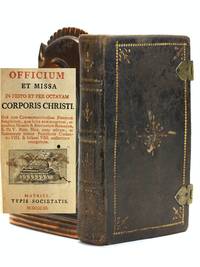
1803505666Typis Societatis 1803. Leather. VERY GOOD. Tall 12mo full brown calf with brass clasps intact; all edges gilt with neat single-line gauffering along the outer edges leather stamped in gilt with fleur-de-lis to panels and all 5 points of both covers ruled in simple single-line dots matching the gauffered edges. Printed in red and black. Missal text in Latin with Spanish afterword. Red and black title page with engraving of Lam and book with seven seals. Leather shows some light rubbing single wormhole through the center of the text; contemporary owner's inscription in Spanish to FFEP very clean and sound otherwise with tight binding fresh pages and bright gilt. A lovely copy. Typis Societatis unknown
1673134<p>Extremely Rare Venetian Missal in a fine contemporary leather binding.</p><p>No copy of this edition recorded on WorldCat</p><p>Roman Church.<em> Missale Romanum ex Decreto Sacrosancti Concilii Tridentini Restitutum Pii V Pontificis Maximi Iussu Editum Clementis VIII Urbani VIII Alexandri VII Clementis IX et SS D.N. Clemente Papa X Novissime Suis Locis. </em>Venetiis Venezia apud Cieras MDCLXXIII 1673.</p><p>Folio 384 x 258 mm full black leather binding single ruler with floral decoration on boards charming metal plaque in the centre of the front board depicting two winged cherubs; spine with seven raised bands pp. 40 422 4 423-527 1 CXX 6 CXXI-CXXIII i.e. CIII 1. Original clasps preserved. Title page in red and black ink with a beautiful engraved vignette at f. a¹ <em>Commune sanctorum</em>. Signature: ¹Ⱐ2⸠3² A-2K⸠a-e⸠f-gâ¶</p><p>1 full-page engravings: Annunciation signed by the Sienese Engraver Giovanni Maria Ferri and four by Giacomo Piccini father of Sister Isabella. Several historiated initials. Pages of music engraved within the text in red ink.</p><p>Apparently the only existing copy of this edition of the Missale Romanum.</p><p>After the Council of Trent 1545-1563 liturgical norms underwent significant changes with the aim of unifying and strengthening the practice of the Catholic faith in response to the divisive tendencies of the Protestant Reformation.</p><p>Among the key reforms was a revision of sacred texts particularly the <em>Roman Missal</em> which was standardized and promulgated by Pope Pius V in 1570 through the bull <em>Quo Primum Tempore</em>. This new missal known as the <em>Tridentine Missal</em> standardized liturgical rites across the Latin Church eliminating local variations that had developed over the centuries except those with at least 200 years of tradition. Latin was retained as the official liturgical language and the gestures prayers and readings were clearly defined establishing a strict canon.</p><p>This liturgical reform endured for centuries until a new wave of changes introduced by the Second Vatican Council in 1962 which led to the creation of an updated Roman Missal with greater openness to vernacular languages and more active participation of the faithful.</p><p>Imprimatur: "We Brother Bassanus Galliciolus of Brescia of the Order of Preachers Master of Sacred Theology and General Inquisitor against heretical depravity in the City of Venice and throughout its Most Serene Dominion specially delegated by the Holy Apostolic Office.</p><p>We have compared the Roman Missal recently printed by Mr. Bonifacio Ciera with another already duly approved and since it is found to agree with it in all respects as well as with the Decrees of the Sacred Congregation of Rites and of the Supreme Pontiffs we therefore grant permission for it to be published.</p><p>And in testimony thereof etc.</p><p>Given at Venice from the offices of the Holy Inquisition on the 1st of January 1673.</p><p>Thus it is Brother Bassanus as above by his own hand."</p><p>Conditions: Few small wormholes along the text light marks of use. Overall a good copy.</p><p>Provenance: Paper <em>Ex libris</em> " Luigi Carpaneto " on front pastedown.</p><p>Wider description and more images:</p><p>https://tinyurl.com/1673Missal-PDF</p> apud Cieras
1587ABC_48453Antwerp: Christoffel Plantin 1587. Contemporary elaborately blind-tooled pigskin over bevelled wooden boards sewn on 4 double supports with the corresponding raised bands on the spine the manuscript title in the first compartment and the original manuscript shelf mark label "H.36" of the Monastery of Buxheim in the fifth compartment both boards with an ornamental roll and a roll with the portraits of Salvater sic! Maria S. Bruno and S. Johannes in a panel design two original brass clasps and catches ornamented with a small star leather tabs and six original bookmarkers plaited into a big knot. 8vo. With a woodcut vignette with Peter and Paul by Peeter van der Borcht on the title page 6 full-page woodcuts ca. 112 x 75 mm by Antoon van Leest after Peeter van der Borcht 6 half-page square woodcuts 55 x 55 mm in border one signed by Antoon van Leest one woodcut 90 x 76 mm by Antoon van Leest after Peeter van der Borcht and 2 smaller oval woodcuts. The work is printed in red and black. Plantin edition of the revised Roman Missal following the directives of the Council of Trent first published in Rome in 1570 by order of pope Pius V 1504-1572 and later approved by Clemens VIII 1536-1605 and Urbanus VIII 1568-1644. The work was quite popular as Plantin published a new missal nearly every year from 1571 onwards. All editions were printed in different sizes and in two issues one with woodcut illustrations and one with engravings. The present copy is the octavo edition with woodcut illustrations and comes from the library of the famous Carthusian monastery of Buxheim Maria Saal near Memmingen Bavaria.The monstery of Buxheim was founded in 1402 and dissolved after the secularisation in 1803. The rich library was auctioned in 1883 by Förster and in 1884 by Ludwig Rosenthal in Munich. The Museum of the Charterhouse Buxheim today is actively studying the history of the library and the present location of its books and manuscripts. The present copy is bound in contemporary pigskin which was likely bound for the monastery itself as the rolls depict Saint Bruno who was the founder of the Carthusian order. The Missal is therefore probably bound in a South-German bindery in the surroundings of the monastery.With an ownership annotation on the title page "Cartusiae Buxheim". The binding is somewhat rubbed and soiled. The leaves are lightly browned some of the leaves are slightly stained especially around the leather tabs. Otherwise in good condition.l Belg. Typ. 6335; Imhof Plantins 1574 Missale Romanum in octavo in: De Gulden Passer 73 1995 pp. 67-82; Nagler I 1459; USTC 406791; Voet 1701 A; Weale-Bohatta no. 1269; not in Haebler. Christoffel Plantin, hardcover
1784AQ14409Olispone i.e. Lisbon: Typographia regia et privilegio 1784. 30 672pp cxlvi 10 58. Several engraved devotional images within pagination. Contemporary red morocco richly gilt marbled endpapers and gilt gauffered edges yellow metal clasps. Rubbed small incision to lower joint paper label to upper board. Tears to FFEP occasional marginal loss/tearing some occasional marking. A handsomely bound Portuguese-printed Roman missal which despite later confusion in an inscription to a blank fly-leaf earlier manuscript letters inserted suggest that this was seized from the flagship of the usurper Dom Miguel the 80-gun Don Juan during the 1833 Battle of Cape St. Vincent passing through the hands of several clergymen before being presented to Grayfriar's Oxford. . Folio. Typographia regia, et privilegio unknown
189254954Dijon:: Pellion et Marchet Freres 1892. full morocco gilt; a.e.g. Very slight rubbing to joints and corners; very attractive. 12mo. Frontispiece in color; decorative borders on every page. Pellion et Marchet Freres, unknown
1770047085Angelopoli Puebla: Typis Seminarii Palafoxiani 1770. First Edition. Hardcover Full Leather. Very Good Condition. José de Nava. Contemporary full calf wear at edges surface scrapes to leather old paper spine label and private library label to spine paste paper endpapers stamp from library of Rev. L. Kenzel and a printed in Germany stamp to verso of title. SLight browning to page edges some offsetting and acidification from the ink used in the musical notation and engravings; generally a bright fresh copy internally. 8 1-137; Frontispiece 1-198 pages 133-135 incorrectly numbered 233-235 pp. Sabin 49459 Palau V195.<br /> <br /> A high point of Mexican printing. Finely printed in Puebla with 3 very fine engravings by de Nava. The Mozarabic rites were used by the Visigothic and Mozarabic Christians of medieval Spain until replaced in the the 11th century. They were reauthorized for use in Toledo in the 15th century where they continue in some form to be used. Size: Folio. Illustrator: José de Nava. Quantity Available: 1. Shipped Weight: 1-2 kilos. Category: Religion & Theology; Antiquarian & Rare. Inventory No: 047085. Typis Seminarii Palafoxiani hardcover
1896AQ28784Mechliniae i.s. Mechelen: H. Dessain 1896. xli 502 60 24pp 2. With a half tile. Printed in red and black. Elaborately bound in contemporary richly gilt-tooled red morocco device of seated christ proffering book with Greek letters alpha and omega within ornate border to both boards A.E.G. with eight divisional red moire cloth tabs one partially perished gilt dentelles decorated endpapers. Slightest of rubbing to extremities. Internally immaculate. An exquisitely bound late nineteenth-century Continental edition of the Roman Missal. The Roman Missal with origins in the high middle ages is the liturgical book from which the text and rubrics for the celebration of Catholic Mass with both prayers and music. One of the major advances of the Council of Trent the Catholic counter to the Protestant Reformation was to standardise the Missal. Pope Pius V acting on the concilliar deciion formalised this in his Quo Primum on 14 July 1570 - insisting that the standard form of the Missal was used throughout the Church except where a local missal could be proved to be of two centuries antiquity. Perhaps one of the most controversial Counter-Reformation decisions made at Trent the use of a standard Missal prevented the celebration of the Mass in vernacular languages and signified a further strengthening of Papal authority: particularly as all printed editions were prefaced by the Pope's order of standardisation. The Missal of Pius V was further edited by Clement VIII in 1604 and later by Urban VIII in 1634. . Large 8vo. H. Dessain hardcover
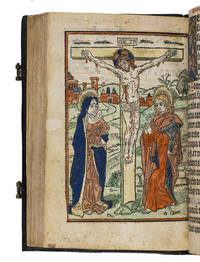
1506ABC_47741Paris: Thielman Kerver 1506. Gold- and blind-tooled black goatskin morocco 1st half of the 18th century sewn on 4 supports each board with a frame of blind triple fillets the front board also with the date ANNODOMINI1506 in gold in a gold-tooled frame with a saw-tooth edge and a flower in each corner: to make lining numerals the finisher used a J for 1 and an O for 0 and the spine-title MISSALEROMANUM in gold in the 2nd of 5 compartments gilt edges 2 brass hook fastenings with pin catch-plates marbled endpapers so-called Dutch combed pattern - teeth about 6.5 mm apart in red blue orange white and green more subtly curled than Wolfe 34 & 35 and the remains of a tab on the fore-edge of n2 marking the beginning of the Canon. 8vo. Printed in red and black throughout in 2 columns except for the preliminaries and Canon in 1 column with on the title page the first 1497 version of Kervers finely executed armorial device Renouard 499: a shield with T K above a mark with a cross supported by unicorns the shield hanging on a tree surrounded by many flowers 103 x 73 mm with a criblée background and with THIELMAN KERVER in a scroll in the foot; a crucifixion woodcut 120 x 82 mm; hundreds of impressions of at least 28 finely executed lombardic initials 4 series with decorations on a criblée background a 39 mm T with a crucifixion scene; two 28 mm: an R with a heron standing on one leg with an eel or snake in its mouth and an S with floral decorations; three 21 mm with floral and vine decoration; and at least twenty-two 13 mm with floral and vine decoration forming a complete 23-letter alphabet except for K X Y and Z plus alternate blocks for at least C O and S and a couple simple woodcut lombardic initials; as well as dozens of at least mostly 4-line spaces left for manuscript initials about half with printed guide letters filled in with manuscript lombardic initials in blue some with white or white and red decoration except for 3 lombardic initials in red; 3 sizes of cast lombardic initials 11 6 and 3 mm printed in red; a two-impression plainchant music type 10 mm 4-line staff in red with square-head notes and c-clef in black and two small typographic ornaments apparently designed for printing in red and black. The maltese crosses pilcros paragraph marks and Vx and Rx signs are printed in red and the capitals are rubricated throughout. The main text is set in a rotunda gothic type 66 mm/20 lines and the Canon n5r-o2v and the first line of the title in a textura gothic 112 mm/20 lines. The woodcut crucifixion on n4v facing the opening of the Canon Kervers device and the criblée initials are all coloured by a contemporary hand. The rare first missal for the Roman rite to be printed or published by the great Paris printing and publishing family Kerver best known for their luxurious liturgical and devotional printing especially their books of hours. There appears to be no copy in any French library. Kervers first missal in 1501 was made for the Paris rite. Kervers early missals including the present one are extremely rare the USTC recording no more than five copies of any edition printed before 1520. Caerr p. 73 notes that Kervers present first publishers device is universally recognised as a master-piece. It has been suggested that Kervers criblée blocks were metal cuts rather than woodcuts. The crucifixion scene facing the opening of the Canon is a more traditional woodcut. Caerr p. 51 suggests Kerver reached the pinnacle of his success in his stylistic evolution in or around 1506 fully incorporating Renaissance tastes in the period 1505-1514 and perfecting the criblée technique used for his present publishers device and initials. The present edition is also a very early example of the use of abstract typographic ornaments. The preliminaries include a calendar of feast days and most of its less common Saints days printed in red suggest a Franciscan connection.Thielman Kerver Koblenz ca. 1460/70-Paris 1522 appears in Paris imprints as a bookseller and publisher working with various printers and co-publishers from 1497 beginning with books of hours which always remained his greatest speciality. He added his own printing office in 1498 though he continued to work with others and expanded into a wide variety of genres. He also added other kinds of liturgical books including breviaries from 1499 a psalter in 1500/01 and missals from 1501 apparently publishing about 16 missals to his death in 1522 first using the present form of the title in the present edition. He was sworn in as official bookseller to the University in Paris in 1501 and soon after also printer hence the In alma Parisiorum Academia in the present title and colophon. Kervers widow continued the firm from 1522 to her death in 1557 their son Jacques continued it to his death in 1583 and its materials were sold in 1586.The fact that both the wording of the title and the exact date differ between the title page and the colophon the latter is 40 days later has led nearly every reference work from Weale in 1886 to the present USTC to turn one 1506 edition into two most describing a folio edition by Kerver a ghost and an anonymous 8vo edition supposedly with no copy known. David Shaw provided an accurate description on-line based on the British Library copy.With an inscription in the head margin of the title page partly shaved and difficult to read; the engraved publishers device of the Antwerp printer and publisher Jean Baptiste III Verdussen 1698-1773 on the front and back pastedown serving as his bookplate see above. Also with an 1831 owners inscription of S. De Ram on a free endleaf facing the title page. The rubricator or an early owner has added several notes in red in the calendar. Further with an occasional early marginal manuscript note some shaved. Four words in the Canon have been deliberately erased as an editorial revision. With an 8 cm tear into one leaf the running heads of a few others shaved the title-page slightly soiled a 3 mm hole in leaf 232 E4 affecting 2 or 3 words some tiny marginal wormholes in a few leaves and some water stains in the endpapers otherwise in very good condition. The binding shows a few small defects one slightly affecting the gold lettering on the front board but is also generally very good. A rare and beautifully produced missal and the second major display of Kervers stunning criblée initials all coloured by a contemporary hand as are the woodcut and Kerver's device.l Thierry Caerr Imprimerie et réussite sociale à Paris .: Thielman Kerver . 2000 2 vols. www.enssib.fr/bibliotheque-numerique 117 4 copies erroneously described as a folio; Catalogue . bibliothèque de feu . Jean de Meyer Ghent 2-5 November 1869 lot 33 8vo 23 March 1506 not mentioning Kerver but with alma Parisiorum Academia; Pettegree French books 68270 not noting Kervers name & 68271 erroneously described as a folio 1 of the same 4 copies; Frank Isaac reworked by David Shaw frenchpostincunables.djshaw.co.uk IS000343; USTC 68270 not noting Kervers name & 180236 erroneously described as a folio same copy as Pettegree; Catalogue . de la bibliothèque de M. Jean François van de Velde Ghent 1831 lot 1360 with an extra woodcut inserted facing leaf 58; Catalogus librorum Joannis Baptistae Verdussen Antwerp widow of Hieronymous Verdussen 15 July 1776 liturgy lot 45 the present copy; Weale & Bohatta Bibliographia liturgica 1928 982 23 March 1506 2 copies & 985 11 February 1506 not noting Kervers name no copy located both on p. 147 in the 1886 ed.; WorldCat 152428895 315474570 843131050 843131052 906577964 1063178422 5 copies plus 2 ghosts; not in Adams no Kerver missal before 1515; Davis Fairfax Murray French no Kerver missal; Mortimer Harvard French no Kerver missal before 1574; SUDOC; catalogue.bnf.fr. Thielman Kerver, unknown
1737ABC_50448Antwerp: ex architypographia Plantiniana = Joannes Jacobus Moretus 1737. Contemporary elaborately gold-tooled red morocco with remnants of brass catch and anchorplates along the fore edge gilt and gauffered edges with intricately made tabs along the fore edge gold-tooled board edges marbled endpapers. Folio. With 20 full-page engraved plates by Cornelius Galle 10 engraved frames surrounding the text and vocal music printed on pp. 153-155 196-197 199-207 220-233 235-237 240-272 286-288 290-292 and xvii. The text is printed in red and black with historiated initials hand-coloured in red an engraved vignette on the title page of each work and several woodcut tailpieces throughout of which 3 printed in red. 2 works in 1 volume. With: 2 SPANISH MISSAL. Missae propriae sanctorum Hispanorum qui generaliter in Hispania celebrantur. ex apostolica concessione & auctoritate S. Pii V. Gregorii XIII. Sixti. V. Clementis VIII. & Urbani. VIII. aliorumque summorum pontificum. Antwerp ex architypographia Plantiniana = Joannes Jacobus Moretus 1737. Plantin edition of the revised Roman Missal produced in line with the Council of Trents directives. This imposing folio exemplifies the Tridentine tradition established after the council 1545-1563 when the Roman Church responding to the Reformation sought to standardise the liturgy. In 1570 Pope Pius V 1504-1572 promulgated the reformed Missale Romanum establishing the text and ceremonial form of the Mass that would govern the Latin Church for centuries. Subsequent revisions under Clemens VIII 1536-1605 and Urban VIII 1568-1644 refined but did not alter its essential structure.From 1571 until the mid-18th century the press founded by Christophe Plantin 1520-1589 held a significant monopoly on the production and sale of authorised liturgical work for the Spanish Netherlands and effectively much of the Spanish Empire. The present Missale Romanum has been bound together with the Missae propriae sanctorum Hispanorum 1737 a collection of masses for Spanish saints. It contains the specific texts and music intended for the celebration of these saints reflecting its use in Iberian or Spanish-influenced territories. The beautiful red morocco binding richly gilt in the rococo manner was also most likely bound in Spain or Portugal.The front joint is slightly weakened but the structural integrity of the work is still intact a hole at the head and foot of the spine the edges and corners of the boards are slightly scuffed the boards are somewhat stained lacking the clasps. The leaves are somewhat browned with occasional foxing a few pages retaining traces of yellow wax. Otherwise in good condition.l Imhof Plantins 1574 Missale Romanum in octavo in: De Gulden Passer 73 1995 pp. 67-82; STCV 12923535; Ad 2; WorldCat 804759478 0 copies; not in STCV. ex architypographia Plantiniana [= Joannes Jacobus Moretus], unknown
0266297188.Gpaperback. Good. Access codes and supplements are not guaranteed with used items. May be an ex-library book. paperback
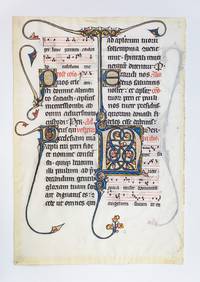
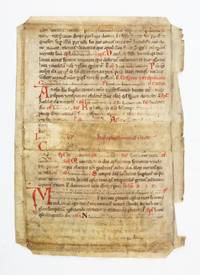
ST20214Northern France perhaps Beauvais or Amiens late 13th or early 14th century. 286 x 199 mm. 11 1/4 x 7 3/4". Double column containing a mixture of staves and text approximately 21 lines in an excellent formal gothic book hand. <br/> Attractively matted. Rubrics in red chant text containing black penwork initials with red and yellow geometric elaboration BEAUTIFULLY ILLUMINATED with five two-line initials painted blue or pink with white tracery on a ground in the contrasting color two of the initials filled with grotesques and swirling vines and two with the filler design traced out but never completed each initial with blue and pink extensions terminating in orange leaves or spiky shapes; the verso featuring AN IMPRESSIVE SIX-LINE "N" 58 x 50 mm. in the same style filled with an intricate knotwork design and orange leaves with long extensions including a horizontal extension across the upper margin. Margins with light offsetting of the designs from the facing leaf; remnants of mounting tape on recto corners and bottom edge; verso apparently with a barely visible Medieval "14" in lower margin. An area measuring 5 mm. at edges just faintly yellowed from mat burn but IN FINE CONDITION the vellum otherwise quite bright the paint rich and the gold brightly glittering.<br/> <br/> This sumptuously decorated leaf--which is beautifully preserved and contains a particularly large and handsome initial--comes from the last volume of a three-volume Missal presented to Beauvais Cathedral by Canon Robert de Hangest d. 1356. The Missal remained at the cathedral at least through the 17th century when it is noted in an inventory but was removed from the church at some point likely in the aftermath of the French Revolution. The parent volume eventually entered the collection of Henri-Auguste Brölemann 1775-1854 of Lyon who passed it to his grand-daughter Etienne Mallet who then sold it at Sotheby's in 1926. It was then acquired for the collection of William Hearst where it remained for the next 25 years. In 1941 it was again sold at auction and subsequently dismembered. Though long thought to have been the work of famed biblioclast Otto Ege recent scholarship suggests that it was actually Phillip Duschnes who was responsible for breaking up the book keeping some leaves for himself and selling others on to his colleague Ege for inclusion in his portfolios of "Fifty Original Leaves from Medieval Manuscripts." The Beauvais Missal has been a subject of interest for many notable scholars chief among them being Christopher de Hamel--see: "Otto Ege and the Beauvais Missal" in "Gilding the Lilly: A Hundred Medieval and Illuminated Manuscripts in the Lilly Library" and it is currently the focus of a major effort to "reconstruct" the manuscript digitally--a project spearheaded by Lisa Fagin Davis. Other leaves from the parent volume are in the collections of the Morgan Library the Metropolitan Museum of Art the Cleveland Museum of Art and the Houghton Library at Harvard among many others. Although there is some dispute among art historians the illumination has been tentatively attributed to the artist of the Hours of Yolande of Soissons produced in Amiens ca. 1280 and now held by the Morgan Library MS M.729. It is worth noting that the town of Hangest home to the original owner is only 10 miles from Amiens and is a likely place of origin for the Missal. The present leaf contains a text for a major feast day and thus contains a large and extravagantly decorated initial for its opening "'Nunc scio vere." It is not too much to say that the decoration here is masterful but curiously--and of special interest to us from a modern perspective--the illuminators seem to have forgotten to put the finishing touches on the two smaller initials above which still contain sketches of the preliminary design. unknown
1966317165New York: Benziger Brothers 1966. New edition. Hardcover. Very Good in boards. 6 silk ribbon page markers. Spine cocked. Foxing on text block edges. Benziger Brothers hardcover
ST19350-013Germany early 13th century. 273 x 193 mm. 10 3/4 x 7 1/2". Single column 31 lines text in two sizes in a gothic hand. <br/> Rubrics in red several one- and two-line initials in red and two larger initials in red. A few lines with neumes later notations in the margins now quite faded. ◆Vellum a bit soiled and creased as expected fading to four or five lines where the spine was placed several notches along one edge other imperfections due to its reuse as binding scrap but still an excellent specimen that is almost entirely legible.<br/> <br/> Written in a neat and attractive hand this sizable leaf from a Missal remains mostly quite legible with all its rubrication intact despite having been used as part of a binding. A few lines also show musical notation from the earliest generation of neumes. They are described as "in campo aperto" which means literally "in an open field" because they and they alone occupy the space or "field" above the text. They are also described as adiastematic because they appear in a straight line whereas later diastematic neumes reflect changes in pitch by being placed in a higher or lower vertical position above the text. At the time the present leaf was written out the neumes here simply served as an "aide memoire" to the singer who had already learned the melody orally. unknown
1986306857Sherwood Park: St John's Lutheran Church 1986. First edition. hardcover. very good/no dustjacket. 4to. pp.232 St John's Lutheran Church hardcover
0364888148.Ghardcover. Good. Access codes and supplements are not guaranteed with used items. May be an ex-library book. hardcover
37730346-nnew. unknown
37730346like new. unknown
0259077720.Gpaperback. Good. Access codes and supplements are not guaranteed with used items. May be an ex-library book. paperback
0331849003.Ghardcover. Good. Access codes and supplements are not guaranteed with used items. May be an ex-library book. hardcover
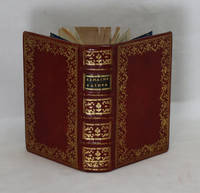
1772HW40 /6B<p>Maroon calf binding with black title plate gilt decoration and title on the spine. Gilt decoration on the boards.</p><ul><li><strong>We provide an in-depth photographic presentation of this item to stimulate your feeling and touch. More traditional book descriptions are immediately available</strong></li></ul><p>As the photographs depict this is a lovely and well preserved book both to its binding and contents. Just fantastic.</p><p><strong>Holy Week</strong> is for Christians the week before Easter and the last part of Lent . It is intended to commemorate the Passion of Christ. The Easter Triduum of the Passion and Resurrection of Christ begins on Thursday evening of this week and ends on the evening of Easter Sunday. These three days are the high point of the liturgical year because it was by his death that Christ destroyed death and it was by rising again that he restored life. Orthodox Christians call it <strong>Great Week . </strong>Romanian Orthodox Christians most often call it the <strong>Week of Sufferings</strong> . The services of Holy Week have the particularity of beginning with Compline and Matins and ending with Vespers whereas it is normally the Vespers service that begins the liturgical day. Holy Week consists of liturgical ceremonies that take place only once a year. The first of these is Palm Sunday .</p> Chez J Felix Faulcon. hardcover
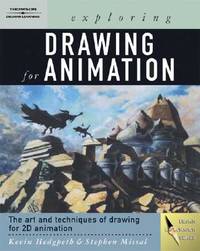
2003Q-1401824196Course Technology 2003-10-01. Paperback. New. In shrink wrap. Looks like an interesting title! Course Technology paperback