Livre Rare Book

97 résultats
174942104Paris, Vaneck, 1749. Titre et 20 gravures sur cuivre (12 x 7,5 cm) frappées par 4 ou 5 sur 5 feuilles (24 x 38 cm).[CHEVILLARD (Jacques)]. Methode facile pour apprandre le blason, ou l'on joint les armes accollees, des Princes, et Princesses Ducs, et Duchesses, et celles des Maisons des plus considerables de France, avec les Explications des ornements exterieurs. Paris, Vanheck, 1749. 71 gravures sur cuivre (12 x 7,5 cm) frappées par 3 ou 4 sur 18 feuilles (24 x 38 cm).Ensemble 2 suites reliées en 1 vol. in-folio, demi-chagrin prune à coins, dos fleurdelisé à nerfs, double filet doré d'encadrement sur les plats (reliure du XIXe siècle).
178341804Paris, Imprimerie Royale, 1783. In-8 (199 x 120 mm) de (4)-49 pp., maroquin rouge, titre en long sur le dos «ÉPREUVE DE LA NOUVELLE PRESSE DE L’IMPR. ROYALE» encadré d’un double filet doré, triple filet doré d’encadrement sur les plats armes royales serties de la mention « Imprimerie royale », roulette dorée sur les coupes, dentelle intérieure, doublures et gardes de moire bleue, tranches dorées (reliure de l’époque).
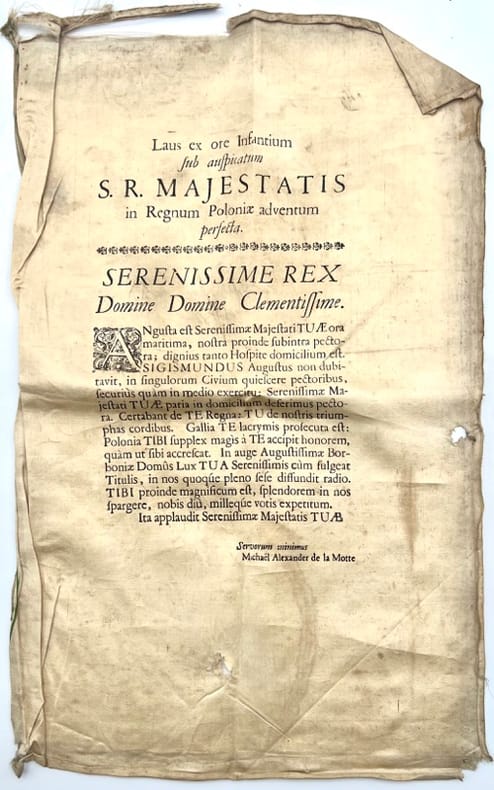
171444331S.l.n.d., , 1714-1734. Placard in-quarto sur soie (39 x 25 cm).
176739595Augsburg, Innsbruck, Joseph Wolff, 1767. 21 feuilles (43 x 36 cm) pliées en deux, imprimées recto verso.
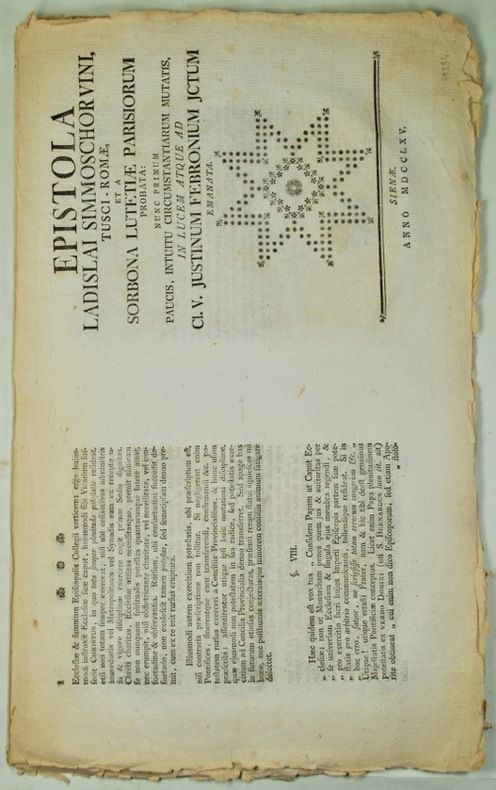
176539594Sienne, , 1765. 1 feuille (45 x 36 cm) pliée en deux et 1 feuillet (22 x 36 cm), les deux imprimés recto verso.
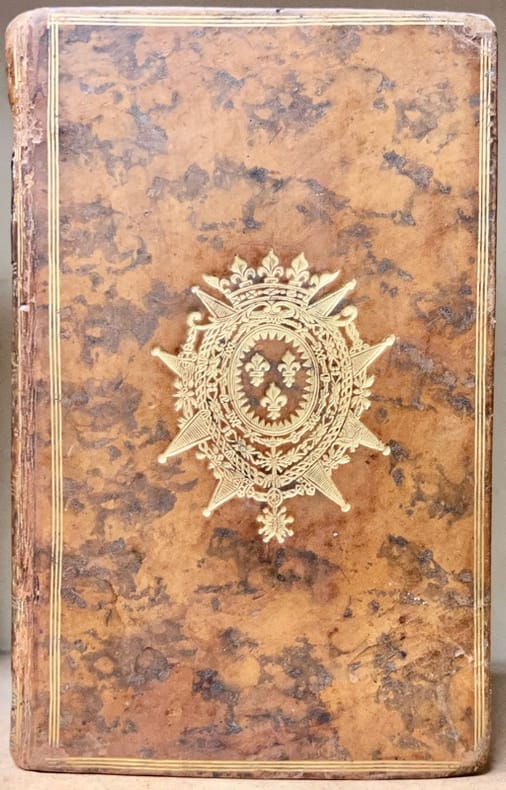
178216064A Paris, de l'Imprimerie de Monsieur, 1782. In-8 de 232 pp., veau marbré, dos lisse orné, pièce de titre en maroquin rouge, armes et triple filet doré d'encadrement sur les plats, tranches dorées (reliure de l'époque).
1794118160lyon destefanis 1794 A Commune-Affranchie [Lyon], Chez le citoyen Destefanis, l'an II [1794], 1 volume in-12 de 10x180 mm environ, 128 pages. Cartonnage au dos muet. Un ex libris imprimé du lyonnais Ferdinand Marie André Guérin sur le contreplat, quelques feuillets salis ou tachés surtout en fin de volume, 2 feuillets déchirés sans manque (p.63) ou très peu (p.85 sinon bon état.
171015877Lyon, Pierre Valfray, 1710. In-folio de 51-2-2-2-2-(4) pp., maroquin noir, décor à la Duseuil frappé à froid sur les plats, dos à nerfs muet, tranches rouges (reliure de l'époque).
179333710Sedan Imprimerie révolutionnaire de C. Bauduin 1793 in-8° édité vers 1793, 20 pp
170112371Lyon, Louis Pascal (Imprimerie L. Langlois), 1701 ; petit in-folio, cartonnage rigide de papier marbré rose, tranches marbrées (reliure moderne) ; (2), 52 pp., 1 planche dépliante hors-texte ("Machine du Feu d'artifice").
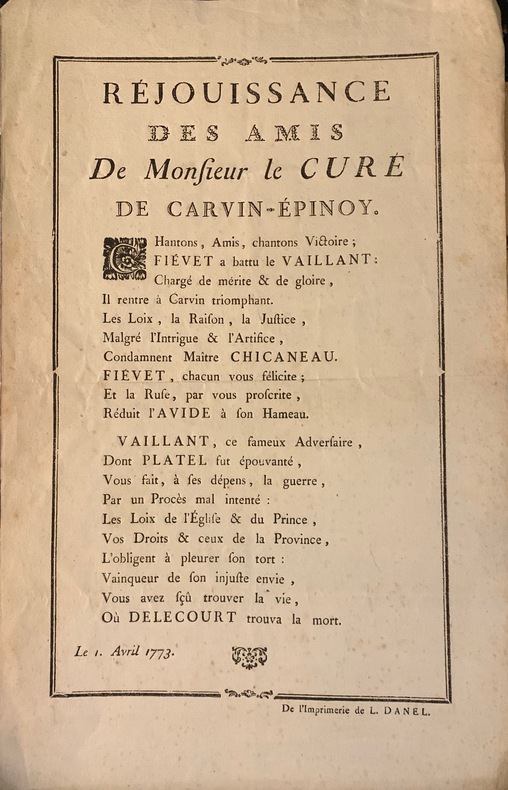
1773123141773 ( Lille), de l'imprimerie de L. Danel, sans date 1773; pièce in-4° de 20 vers rimés n datée du 1. avril 1773
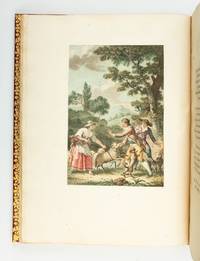
1793ST20474Paris: Defer de Maisonneuve 1793. First Edition with these Illustrations. 350 x 262 mm. 13 3/4 x 10 1/4". 125 pp. <br/> VERY PRETTY 19TH CENTURY CRIMSON MOROCCO ELEGANTLY GILT covers framed with floral tools raised bands spine panels filled with rows of flower-and-lozenge roll gilt lettering gilt turn-ins top edges gilt. FOUR FINE STIPPLE-ENGRAVED PLATES by Colibert and Cazenave after Monsiau PRINTED IN COLORS. A Large Paper Copy. Cohen-de Ricci 400; Furstenberg 122; Lewine p. 188; Maggs 1930 Catalogue of French Illustrated Books 84; Ray p. 145. Occasional minor foxing the margins of one plate foxed a bit more otherwise a fine copy clean and fresh internally with immense margins the plates with pleasing colors and the unworn binding bright with gilt.<br/> <br/> This is an especially tall copy of Florian's pastoral romance in imitation of Cervantes one of the grander French books to be printed in colors when the vogue for such productions took hold during the last years of the 18th century. Ours is one of six such books all printed after 1786 that Ray singles out for praise as "handsome and imposing volumes." A noted painter of both classical and modern subjects Monsiau 1754-1837 was also an illustrator whose "abundant and interesting work in this line" is underrated even though it has the merits of being simple natural lively and piquant. Ray Monsiau's obscurity says Ray may be owing to the fact that he most often worked as a secondary collaborator on major illustrated works; the present book is one of the few he did on his own and it is among his best. Publisher Defer de Maisonneuve did not originate the technique of stipple engraving on copper plates but he did perfect the process which allowed for gradual tonal changes in hues and intensities of color rather than the "stained glass" effect of separately printed patches of color. Given the turmoil of the period when this book was published it is quite likely that it did not have an especially decorative original binding and may have remained in publisher's boards as was often the case. Happily a later owner supplied a period-appropriate binding here that matches the opulence of the contents. While our copy has the engraver's name just visible beneath the plates perhaps disqualifying them as the "avant la lettre" versions used in the Large Paper Copies per Cohen-de Ricci the size of the margins here and the quality of the paper certainly argue for that designation. Defer de Maisonneuve unknown
1790ST14261Paris: Drouhin 1790. FIRST EDITION. 265 x 205 mm. 10 3/8 x 8". Two volumes. <br/> VERY ATTRACTIVE CONTEMPORARY MARBLED CALF GILT IN A NEOCLASSICAL DESIGN covers with a cresting palmette frame featuring ornate urn ornaments at corners flat spine divided into compartments by Greek key roll floral spray centerpieces one green and one black label marbled endpapers. With 55 PLATES OF COSTUMES designed by Philippe Chéry and engraved by Pierre-Michel Alix 50 of these PRINTED IN COLOR five in black and white a couple of these with color highlights applied by hand and with a color portrait of the author from the 1802 edition tipped in at front. Colas 717; Hiler p. 542; Lipperheide 3203; Cohen-de Ricci 227; Brunet IV 1135. One corner worn to board joints and extremities lightly rubbed but the bindings lustrous and generally very attractive. First volume slightly browned throughout second volume occasionally so volume II with two-inch marginal stain to upper gutter affecting four quires and six plates but not touching text or images two plates with pen marks in margins touching lettering but not image other trivial defects but still an excellent copy internally the colors especially clear and pleasing.<br/> <br/> This is an elegant production with the Neoclassical binding being the perfect complement to the color engravings of ancient Greek and Roman costumes that illustrate the present history of theatrical attire. In the two volumes here theater critic and historian Jean Charles Le Vacher de Charnois 1749-92 covers Classical tragedies and comedies as well as later interpretations of these dramas by playwrights including Racine. Le Vacher de Charnois intended a series of books encompassing as the title indicates theatrical costumes from all nations and from the ancient to the modern; however the French Revolution interrupted his scheme and as a monarchist he was imprisoned in 1792 for his writings in support of the aristocracy. It was long thought that he had died in the massacres at the Abbaye prison in September of that year but later research indicates that he may have been executed during the Reign of Terror in 1794. The artists who illustrated this work were at the opposite end of the political spectrum. Painter Philippe Chéry 1759-1838 studied with Jacques-Louis David and adopted his master's passionate support for the Revolution as well as his Neoclassical style. Engraver Pierre-Michel Alix 1762-1817 was a specialist in color printing best known for his portraits of leaders of the French Revolution and later of Napoleon and First Empire dignitaries. While the handsome binding here is unsigned the palmette roll on the covers is very similar but not identical to one used by Bozerian see Culot "Jean-Claude Bozerian" roll #44 and plate #XXIV. Perhaps our binder had trained in that atelier as the design and workmanship are certainly of that level. Drouhin unknown
1796ST12327Paris: P. Didot l'aîné 1796. ONE OF 100 COPIES. 330 x 235 mm. 13 x 9 1/4". 2 p.l. 165 1 pp. <br/> Original gray boards flat spine dark gray paper title label two-thirds of the leaves UNOPENED. Engraved printer's device on title page and SEVEN FINE COLOR-PRINTED ENGRAVINGS AFTER PEYRON BY CHAPUY AND LAVALLÉE SOME FINISHED BY HAND. Cohen-de Ricci 730; Brunet III 1860. ◆A couple of very small brown spots and just a hint of soiling as well as minor abrasions to covers corners somewhat mashed as expected isolated trivial foxing to text but A VERY FINE COPY clean and bright internally with vividly colored plates and in a surprisingly sturdy and generally well-preserved original temporary publisher's binding.<br/> <br/> This is the fine Levy copy of a strictly limited Large Paper edition of a handsomely illustrated work offered here in what seem to be the publisher's temporary boards mostly unopened and virtually untouched internally. Attractively printed with enormous margins the text of the first and by far the most important work here is a prose poem on love supposedly translated from the Greek by one of the great political philosophers of the Enlightenment Charles de Secondat Baron de Montesquieu 1689-1755. In its own day the work was popular largely because of its racy content; today it is considered as a more serious accomplishment by modern scholars who are inclined to see it as a philosophical fable. The colophon informs us that this limited edition was printed with a new type cut and cast by Firmin Didot "with such perfection that up to this moment none other can equal it." The dramatic and animated plates are strikingly different from the Eisen engravings in other editions of this work and are more modern in sensibility than the usual 18th century French engravings. The colophon notes that the plates were broken after the 100 copies of this edition were printed. Our copy was in the outstanding library of American bibliophile Jacques Levy 1905-80 a man of wide-ranging interests who assembled an eclectic collection over 40 years always with a discriminating eye toward visually pleasing and historically important bindings and illustration. In his sale Sotheby's described our binding as being publisher's boards and although the volume seems almost too well preserved to be original we are persuaded by the collector's reputation that this is the correct characterization. P. Didot l'aîné unknown
1789372509Nuremberg: Grattenauer 1789. First edition. 16 178 5 iindex pp. 1 vols. 4to. Near contemporary glazed brown calf spine gilt paste paper endleaves edges red. Some rubbing very good overall an attractive copy. First edition. 16 178 5 iindex pp. 1 vols. 4to. Important chroncile of the early printers of Nuremberg. Bigmore & Wyman II 114 Grattenauer unknown
174036937La Haye: La Veuve Le Vier et Pierre Paupie 1740. First edition. Engraved allegorical frontispiece by Schley. 2 parts in one volumes. 1 vols. 4to. Contemporary French mottled calf gilt spine marbled endpapers. Upper joint starting at bottom and apart from some minor toning this is a lovely unsophisticated copy in contemporary dress. First edition. Engraved allegorical frontispiece by Schley. 2 parts in one volumes. 1 vols. 4to. Printed by Prosper Marchand a Huguenot publisher and journalist who fled France in 1709 the work appeared at the 300th anniversary of the invention of printing. Marchand writes that he produced the book "a la sollicitation de quelques amis qui ont cru que le troisième jubile ou la troisième année séculaire de l'imprimerie reveilleroit infailliblement la curiosité du publique touchant l'origine de ce bel art at the request of some friends who believed that the third jubilee or the tercentenary of printing would infallibly wake the public curiosity concerning the origin of this beautiful art." The allegorical frontspiece by J.V. Schley show Minerva and Mercury descending from Heaven granting the gift of printing to Germany who in turn gives it to England Holland France and Italy. Bigmore & Wyman II p. 22 La Veuve Le Vier et Pierre Paupie unknown
176936938Leipzig; Wien: Johan Paul Krauss 1769. First Edition. With 24 folding plates. xxv 436 12 index & errata; xl 524 18 index & errata. 1 vols. 8vo. Contemporary three quarter red morocco and marbled boards spine label. Exterior worn tear at foot of spine internally tight and clean. A very good copy. First Edition. With 24 folding plates. xxv 436 12 index & errata; xl 524 18 index & errata. 1 vols. 8vo. Includes notices of Berlin artists graphic arts engravers early woodcuts & woodcut books history of printing and account of a journey through Lower Saxony Westphalia & and Holland. Part Two with striking images from early printed books such as the "Eagle of John" from Ars Memorandi includes "a dissertation on the earliest forms of wood-cutting as applied to the illustration . Heinecken conjectures that Gutenberg took the idea of printing from the playing-card makers who are said to have been the first engravers of historical subjects intermingled with texts. . Heinecken is of opinion that their first productions were taken from wooden blocks." Bigmore & Wyman. Bigmore & Wyman p.320 Johan Paul Krauss unknown
1799214620Brussels: Emmanuel Plon 1799. First edition. 2 engraved plates 5 text engravings. 1 vols. 8vo. Half morocco and marbled boards. Slight foxing. First edition. 2 engraved plates 5 text engravings. 1 vols. 8vo. Bigmore & Wyman I 418 "One of the monument of typographical bibliography" Emmanuel Plon unknown
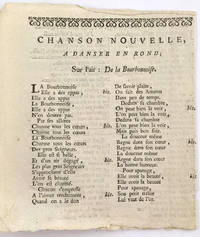
1769102012<p>Permis d'imprimer & distribuer; à Troyes le vingt-huit Février 1769 Truelle de Chambouzon. Leaflet 16 x 42 folded in three.</p><p>The present leaflet includes the texts of six new popular songs: Chanson nouvelle a danser en rond; sur l'air: De la Bourbonnoise - Chanson nouvelle sur la Boubonnoise sic Comme elle a mangé tout son gain en peu de temps; air de la greque - Chanson critique sur les perruques. Par la Joye; sur l'air : En revenant de S. Denis - Autre chanson: sur l'air; Ah! que la chasse est belle - Chanson nouvelle de la Pelerine qui a voyagé dans les Pays-Bas - Chanson nouvelle en forme de Coq-à-l'âne; sur l'air: La baraquette.</p>
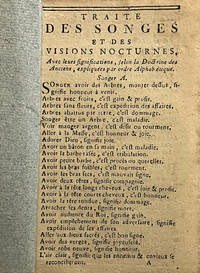
1800102606<p>No place no date but Caen Calopin c. 1800. 12mo. Size: 85 x 135 cm. 12 pp. Droptitle. Original blue paper wrapper. lower margin of a few pages cut a bit short.</p><p>This chapbook contains an alphabetical list of dreams and their interpretations. It is an adaptation of Vulson de la Colombière's treatise that was first published in 1660. The text is unchanged from the original but there is less. The present chapbook contains 12 pages and the original had nearly 100 pages. The last lines of the work contain the 27 most commonly pulled numbers of the lottery. Is there a connection with the dreams and the lottery They are often associated but the dreams descriptions of not have a number in this chapbook. c.f. R. Helot La bibliothèque bleue en Normandie 1928 p. 245; OCLC locates 2 copies: Newberry & BNF.</p> Calopin
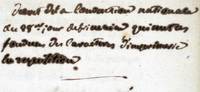
1793583991793. A Paris de l'Imprimerie Nationale Exécutive du Louvre An II 1793. 2pp one sheet folded in two. With contemporary note on last blank & signature at the end of the text. unknown
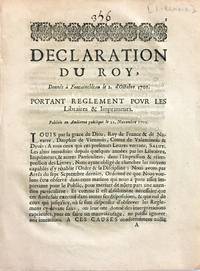
1701100900<p>Grenoble Alexandre Giroud 1701. 4to. 8pp. <br /><br />Reminder of the rules and regulations relevant to the printing trade given in VIII articles.</p>
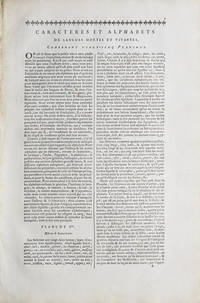
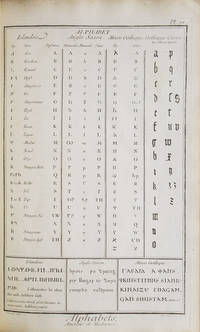
177241089Paris 1772. Pp. 1-17 18 blank; 25 copper-engraved plates Goussier or Des Hauterayes del. Niodot Sculp. 1 vols. Folio. Disbound. A very few spots in text leaves else fine. Pp. 1-17 18 blank; 25 copper-engraved plates Goussier or Des Hauterayes del. Niodot Sculp. 1 vols. Folio. An elegant and visually appealing selection of plates from the Récueil de Planches that extraordinary illustrated supplement to the magnificent Encyclopédie of Diderot and d'Alembert. The plates depict alphabets and characters of more than 40 languages from Assyrian and Hebrew to Chinese Tibetan Japanese and Bengali; the explanatory text gives a fully detailed account of the level of scholarship current in the mid to late eighteenth century. Printing and the Mind of Man describes the Encyclopedie as "a monument in the history of European thought; the acme of the age of reason; a prime motive force in undermining the ancien régime and in heralding the French Revolution; a permanent source for all aspects of eighteenth-century civilization." PMM 200; En français dans le texte 156 unknown
177536968Londres: Et se trouve a Paris chez D. C. Couturier père Imprimeur-Libraire aux Galeries du Louvre 1775. First edition in French. 45 1 errata pp. 1 vols. 8vo. Nineteenth-century quarter morocco and marbled boards. Minor rubbing else fine. First edition in French. 45 1 errata pp. 1 vols. 8vo. Bigmore & Wyman II p. 41 Et se trouve a Paris chez D. C. Couturier père, Imprimeur-Libraire, aux Galeries du Louvre unknown
177241090Paris 1772. Pp. 1-3 4 blank; 8 copper-engraved plates Goussier del. Prévost fecit.; 1-17 18 blank; 25 copper-engraved plates Goussier or Des Hauterayes del. Niodot Sculp. 1 vols. Folio. Removed. In later paper wrappers. Some soiling to margins adhesion of wrappers at gutter of first and last pages generally near fine. Pp. 1-3 4 blank; 8 copper-engraved plates Goussier del. Prévost fecit.; 1-17 18 blank; 25 copper-engraved plates Goussier or Des Hauterayes del. Niodot Sculp. 1 vols. Folio. An important selection of 33 printing-related plates from the Récueil de Planches that extraordinary illustrated supplement to the magnificent Encyclopédie of Diderot and d'Alembert. The plates depict the typefounding process and the alphabets and characters of more than 40 languages from Assyrian and Hebrew to Chinese Tibetan Japanese and Bengali; the explanatory text gives a concise account of the various arts and a more detailed account of linguistic scholarship current in the mid- to late eighteenth century. Printing and the Mind of Man describes the Encyclopedie as "a monument in the history of European thought; the acme of the age of reason; a prime motive force in undermining the ancien régime and in heralding the French Revolution; a permanent source for all aspects of eighteenth-century civilization." PMM 200; En français dans le texte 156 unknown