Thorp, Prescott H.MareMagnum

7 772 résultats
A clean, unmarked book with a tight binding. Full brown cloth boards with gilt magnifying glass, stamp tongs, and stamp decoration. 208 pages. Black and white photos and illustrations. Printed on heavy paperstock.
1999ABE-6982080182Viking London 1999 Superb copy of this examination of the origins of our modern world. An unread first printing inside a perfect complete protected jacket. No marks no owner names no damage no turned pages no bumped corners not an ex library copy; a first class collectable copy. Language: eng Language: eng 0.0 Language: eng 0.0 Language: eng 0.0 Language: eng. 1st Edition. Hardcover. Fine/Fine. Viking London hardcover
25.5X19.5 cm. 64 pages. Hardcover in dust jacket. Spine slightly stained. Else in good condition.
190p. 8vo. Original blue cloth binding. Essential reference to a collecting genre that deserves more attention. **PRICE JUST REDUCED! REF4
np. Color drawings throughout by Hilary Knight. Bookplate of Margaret Sarah Lewis, York, PA water color artist. 4to. Original full red pictorial glossy binding. First Printing. Very crisp copy. Fine books from earlier Christmas seasons make great gifts today. CHRISTMAS/W69
pp. ix, 16. Title page decorated with large red initial. Printed on Van Gelder hand-made paper. Inked ownership of J. F. Oller, 1924, on end paper and slip case. Square 12mo. Original stiff blue wraps, decorated and lettered in green. Original slip case. Fifth edition. Limited Edition of only 925 copies. Nice copy. PRESS/W39
Three Volumes. Portrait frontis. Foxed. Uncut. Top edges gold. 8vo. Original full cloth bindings, lettered and decorated in gold. Hardbound. Worn set. Francis Thompson (1859-1907) was an English poet and ascetic. After attending college, he moved to London to become a writer, became addicted to opium, and was a street vagrant for years. A married couple read his poetry and rescued him, publishing his first book Poems in 1893. Thompson lived as an unbalanced invalid in Wales and at Storrington, but wrote three books of poetry, with other works and essays, before dying of tuberculosis in 1907. SET/W50
pp. xxi, 650 + Frontis. Thick 8vo. Original full cloth binding. Dust jacket; yellowed st the spine and soiled. Hardbound. Very good. Based on the famous 2nd edition (1874), and newly edited by Marcus McCorison, this is really a wonderful book for any fan of early American Printing. From the DJ: "There are very few books of a historical nature which deserve republication after 160 years of existence. Isaiah Thomass History of Printing in America is one of them. His book is still the beginning point for most investigations into the history of American printing, for he provides the tantalizing clues from which his successors have built there own studies. Further, his personal knowledge of many of the people and events which he describes in a frank and unadorned manner makes excellent and often amusing reading. The History of Printing in America retains the essential beginnings which lead the reader into fascinating byways of American history and the craft which in such large measure perpetuated it." PA53
650pp. 24 cm. Hardcover Very good condition good
Numerous illustrations. Name Index. 113 pages.
18121Second Edition. John Hodges 13 Soho Square London W. 1884. 32pp. landscape 12mo 8.5 x 13.5 cm. Stitched in grey printed wraps. In fair condition on lightly-aged paper with front wrap detached and lightly marked. Wodehouse is named as author on front cover but not on title-page. Laid out in the form of a fourteen-page catechism of 28 points followed by 'Notes and Illustrations from Various Writers'. Pertinent as ever in its criticism of 'excessive inequality in the partition of wealth'. COPAC only lists three copies of the first edition of 1878. Of the eight copies of the second 1884 edition on COPAC six are listed as being printed by 'F. Verinder'. Second Edition. John Hodges, 13 Soho Square, London, W. 1884. paperback
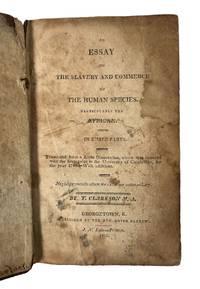
1816201491816. Slavery and Abolition Clarkson Thomas. An Essay on the Slavery and Commerce of the Human Species Particularly the African 1816 printing one of the foundational intellectual works of the Anglo-American abolitionist movement here issued in a rare Kentucky imprint juxtaposing transatlantic antislavery thought within the slaveholding territories of the American South. Originally published in the late eighteenth century Clarkson's treatise compiled moral economic and documentary evidence against the Atlantic slave trade and became instrumental in mobilizing British abolitionists contributing to the passage of the 1807 Act abolishing the British slave trade. This 1816 Georgetown Kentucky edition demonstrates the continued circulation and influence of British antislavery arguments in the early American republic particularly in a state deeply where slavery was deeply entrenched from the time of its founding. The appearance of this text in Kentucky underscores the gradual growth of abolitionist sentiment reform movements active in the region during the early nineteenth century.<br /> <br /> Clarkson Thomas. An Essay on the Slavery and Commerce of the Human Species Particularly the African. In Three Parts. Georgetown KY: J. N. Lytle for Rev. David Barrow 1816. Contemporary sheep binding. Measures approximately 4¼ x 7 inches. Provenance: signed by Helen Love Van Rensselaer. This edition was issued for Reverend David Barrow a prominent Kentucky Baptist minister known for his antislavery convictions reflecting local reform networks committed to circulating abolitionist literature despite prevailing proslavery sentiment. John Winston Coleman author of Slavery Times in Kentucky 1940 and a major collector of Kentucky slavery and abolition materials described this Clarkson imprint as "one of the rarest of Kentucky anti-slavery tracts" attesting to its scarcity within regional print history.<br /> <br /> This printing embodies the persistence of organized moral opposition to slavery prior to the Civil War. Clarkson an important figure in the British abolition movement provided reformers with a systematic critique of the slave trade's violence and corruption. The Kentucky edition reflects how transatlantic abolitionist discourse was adapted and disseminated within American slave societies contributing to early nineteenth-century debates that would intensify in the decades preceding the Civil War. Some staining and spotting throughout with minor marginal chipping; binding worn but intact. Overall good only. A significant and regionally scarce Southern imprint of a cornerstone abolitionist text. unknown
1959002039London: Dent 1959 1959 Full buckram binding with no jacket as issued but fitted with a clear sleeve. First Edition First Impression of this sought after volume issued in memory of the artist. Enclosed is the prospectus for the book and the V & A exhibition notice which coincided with the publication. A vigorous and prolific engraver Gibbings was hugely influential. This superlative work is a great example of book production and it is a fitting tribute to a great talent. Very heavy and will need insurance and extra postage depending on destination. 0.0 0.0 0.0. 1st Edition. Hardcover. Fine/Dust Jacket Included. London: Dent, 1959 hardcover
Royal folio (273 x 398 mm). Gothic type. 248 ff. (incl. final blank). 49 lines. 2 columns. Contemporary south German decoration: each of 4 books opening with an illuminated initial with extensions; rubricated throughout in red and blue. Modern calf, early index tabs. Editio princeps. Magnificent copy of the rare first edition of one of St. Thomas Aquinas's two masterpieces which systematized Latin theology. The printer is commonly referred to as "the printer of Henricus Ariminensis"; the ISTC suggests the Eichstädt printer Georg Reyser (active until 1503; cf. ADB 28, 368f.) known for his characteristic type, or, following Pellechet, Heinrich Eggestein. - "The combination of theology and philosophy which was the basis of scholasticism found its finest expression in [St. Thomas's] writings. Aquinas held that knowledge came from two sources: the truths of Christian faith and the truths of human reason. Each is a distinct source, but the revelation which comes from faith is the greater of the two, and its chief characteristic is that it consists of mysteries to be believed rather than understood" (PMM 30 for the editio princeps of the 'Summa Theologiae' published in 1485). The 'Summa de veritate catholicae fidei contra gentiles' (Treatise on the Truth of the Catholic Faith, against Unbelievers), written in Rome, 1261-64, was composed at the request of St. Raymond of Pennafort, who desired to have a philosophical exposition and defence of the Christian Faith, to be used against the Jews and Moors in Spain. It is a perfect model of patient and sound apologetics, showing that no demonstrated truth (science) is opposed to revealed truth (faith). It is worthy of remark that the Fathers of the Vatican Council, treating the necessity of revelation (Coast. "Dei Filius", c. 2), employed almost the very words used by St. Thomas in treating that subject in this work (I, cc. iv, V). - First leaf a little defective and repaired, minor marginal repairs in first 4 leaves, small stain at a few extreme upper margins, decoration just shaved. A stamp erased from fol. 4/10r. Hain 1385*. Goff T-190. GW M46563. BMC I 77. ISTC it00190000. CIBN T-162. Collijn, Uppsala 1420. IBP 5291. IDL 4382. IGI 9568. Madsen 3951. Aquilon 644. Michelitsch, Thomasschriften 60. Ohly (Gutenberg-Jahrbuch 1956) 6. Ohly-Sack 2729. Pellechet 986. Polain, Belgique 4761. Proctor 322. Rhodes, Oxford Colleges 1697. Sack, Freiburg 3437. Sajó-Soltész 3256. Schüling 816. Sheppard 233. Voulliéme, Berlin 2179. Walsh S-110B.
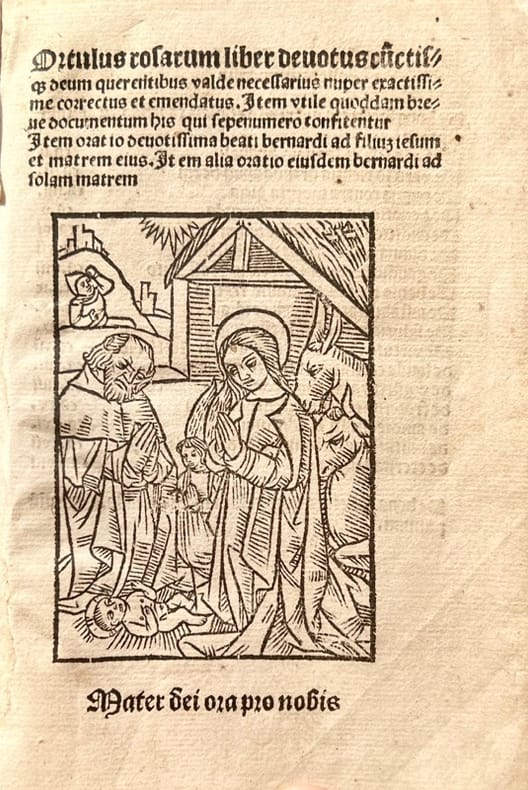
15691Paris, Enguilbert I, Jean I et Geoffroy I de Marnef (impr Philippe Pigouchet), 1491. In-8 gothique (143 x 100 mm) de (96) ff. (sig. a-m8), maroquin brun, dos à 5 nerfs, quadruple filet d'encadrement et fleurons aux angles à froid sur les plats, tranches dorées (reliure du XIXe siècle).
1956RO80059884CHEZ L'AUTEUR. Fév. 1956. In-4. Broché. Bon état, Couv. fraîche, Dos satisfaisant, Intérieur frais. 52 pages illustrées en noir et blanc et en couleurs, dans le texte et hors-texte. Dos à spirales.. . . . Classification Dewey : 686.2-Imprimerie
151210486Paris, Pierre Baquelier, 1512 ca. In-8 gothique (135 x 90 mm) de (20) ff. (sign. [a]8, b8, [c]4), cartonnage bleu à la Bradel, pièce de titre en long (reliure du XIXe siècle).
viii, 94, [2], [1]-120, [4]pp., with half-title. 3 works bound in one (the first named bound last), cont. mottled sheep, worn. The second edition of this poem on the different technical processes involved in printing. This edition was published by Claude Charles Thiboust, his father, Cluade Louis Thiboust, was the author of the poem, and had originally printed it in 1718. The family of Thilboust occupies a distinguished place in the list of French typographers, having started printing in Paris in the middle of the sixteenth century, with successive members of the family being appointed to be Printers to the University. This is followed by two editions of Doissen's poem on engraving. Bigmore & Wyman, III, p. 8; I, p. 183
26, [4]pp., one of 200 numbered copies, 4 folding plates, orig. printed wrappers, a fine copy.
1923010480Paris Editions André Imprimerie Artistique Lux 1923 In-2 en feuilles, couverture rempliée
67473, Brepols - Harvey Miller, 2025 paperback Size:210 x 270 mm Illustrations:10 b/w, 50 col., 2 tables b/w.Language :French. ISBN 9782503618425.
67531, Brepols - Harvey Miller, 2025 Paperback, Pages: 280 p. Size:210 x 270 mm, Illustrations:10 b/w, 50 col., 2 tables b/w. Language:French. ISBN 9782503618425.
1374055Paris: Jacques Haumont, 1945 in-8, 30 pages, 4 planches dépliantes d'après l'Encyclopédie de Diderot et D'Alembert. Couverture muette de papier marbré, couverture conservée, rousseurs, sinon bon état. Tirage limité à 200 ex. sur vergé blanc (n° 59).
ORD-10326Préface de Georges Lecomte. Paris. Au Bureau de l'Édition. 1921. 2 volumes in-8 (165 x 225mm) pleine toile bleue de l'éditeur, titres et ornements typographiques en noir sur les 2 plats et le dos, tranches rouges, portrait de l'auteur par Bernard Naudin en frontispice, XXV, 698, (2) pages (pagination continue), 517 illustrations dans le texte et 65 planches hors texte souvent en couleurs. Impression sur des papiers différents. Petits défauts aux couvertures, très bon état intérieur. Bel exemplaire de ce remarquable ouvrage imprimé entièrement avec les caractères dessinés par George AURIOL. On y joint le petit fascicule in-16 (110 x 135mm) couverture brune avec même décor, contenant le portrait de l'auteur et des appréciations de divers journaux et personnalités.
45550P., Au Bureau de l'Edition, 1921, in 8° broché, paginé 415 à 699 ; très nombreuses illustrations, in et hors-texte, en noir et en couleurs ; couverture fanée, renforcée au scotch invisible ; les première et dernière garde ont été collées à la couverture.