7 770 résultats
Folio (319 x 456 mm). 355 leaves and two folding sheets. Roman and italic types, occasional use of Greek and Hebrew types, printed shoulder notes. Woodcut pictorial title, author portrait, and printer’s device; 7 large, 186 mid-sized, and 22 small woodcut initials; more than 200 woodcut illustrations, including 3 full-page skeletons, 14 full-page muscle men, 5 large diagrams of veins and nerves, 10 mid-sized views of the abdomen, 2 mid-sized views of the thorax, 13 mid-sized views of the skull and brain, and numerous smaller views of bones, organs and anatomical parts. All woodcuts and initials up to page 165 in full contemporary hand colour. Contemporary blindstamped leather over wooden boards with bevelled edges, on five raised double bands, with two clasps. In custom-made solander box. A truly outstanding copy of one of the greatest and most appealing books in the history of science. Preserved in its original binding with the blindstamped initials of its first owner, the German physician Caspar Neefe (1514-79), and with his handwritten annotations throughout, the present copy is partly coloured by a contemporary artist (including the iconic woodcut used as title-page and all anatomical illustrations up to page 165). Caspar Neefe, who later served as personal physician to Duke Albert I of Saxony, acquired the precious volume only a year after its publication and obviously consulted it extensively throughout his career as a medical practitioner. - With the publication of "De humani corporis fabrica" (when he was only twenty-eight) Vesalius revolutionized both the science of anatomy and how it was taught. In his preface he describes his disappointing experiences as a student in Paris and Louvain, stating his intention to reform the teaching of anatomy by giving in this book a complete description of the structure of the human body, thereby drawing attention "to the falsity of Galen’s pronouncements". Vesalius also broke with tradition by performing dissections himself instead of leaving this task to assistants: the striking and dramatic title illustration shows him conducting such a dissection, his hand plunged into a female cadaver (striking in itself, as only the cadavers of executed criminals could be dissected legally and female criminals were rarely executed), surrounded by a seething mass of students. - The "Fabrica" is also revolutionary for "its unprecedented blending of scientific exposition, art and typography" (Norman). The woodcuts by artists of the school of Titian are both iconographically and artistically important. The series of fourteen muscle men show landscapes that, when assembled in reverse order, form a panorama of the Euganean Hills near Padua, a scenery well known to Vesalius while he was at work on the Fabrica. - Of the few copies of the first edition to have come to the market in recent decades, only two were in a contemporary binding. Apart from Vesalius's dedication copy to Emperor Charles V (Christie's New York, 18 March 1998, lot 213: $1,652,500), only a single other partly coloured copy was previously known, a list to which ours must now be added as the third known copy in contemporary colour. - Acquired in 2017; previously in a Tyrolean private medical collection, where the book rested for three generations (erased circular library stamp in the blank lower margin of the title-page). An outstanding copy hitherto unknown to scholarship (cf. the recent census published by Dániel Margócsy, University of Cambridge, below; further relevant correpondence with Dr Margócsy is available upon request). Occasional waterstaining to margins, the splendid binding a little rubbed and bumped, but altogether a wonderfully crisp, wide-margined copy of the first edition. Unquestionably the most desirable copy of a milestone in the history of science still in private hands, and likely the most important medical book obtainable for decades to come. PMM 71. VD 16, V 910. Durling 4577. Cushing VI.A.1. Eimas 281. Norman 2137. Wellcome 6560. Graesse VI.2, 289. Cf. D. Margócsy, M. Somos, S. N. Joffe: "Vesalius' Fabrica: A Report on the Worldwide Census of the 1543 and 1555 Editions", in: Social History of Medicine Vol. 30, No. 1, pp. 201–223. For Neefe cf. A. Lesser, Die albertinischen Leibärzte (Petersberg 2015), p. 71-74.
Folio (240 x 342 mm). 375 leaves (of 376, without initial blank). Double column, 49 lines plus headline, gothic type, 3- to 12-line initial spaces. Contemporary blind-tooled full leather over wooden boards; traces of brass clasps and catches. "La prima edizione commentata della Divina Commedia" (Mambelli), published only five years after the editio princeps (Foligno 1472). An exceptionally large and crisp copy, completely unsophisticated in its first binding. - This seventh edition altogether is the first to contain extensive commentary, "a heavyweight volume both literally and metaphorically, edited by Cristoforo Berardi of Pesaro. The text does not follow a single previous edition, and it seems likely that Berardi's independence (as a Pesarese) from northern Italy led him to use a manuscript". The editor also included supplementary information, such as Boccaccio's Life of Dante (its first appearance in print) and rubriche at the start of every cantica. "Berardi's edition thus marked a new approach to the presentation in print of the major literary works in the vernacular" (B. Richardson, Print Culture in Renaissance Italy, 1994, p. 37). - Binding somewhat stained and rubbed; covers re-attached with professional repairs to inner hinges; some traces of worming. Fore-edge has manuscript title "DANTES". First and last few leaves a little foxed and soiled. Provenance: duplicate of the Austrian National Library with their deaccession stamp to terminal blank PP12v ("Aus der National Bibliothek in Wien als Doublette ausgeschieden ..."). Pencil collation mark of B. Quaritch Ltd. on recto of the same leaf. Later sold by the Libreria Antiquaria Hoepli, Milan, with their description tipped in to terminal blank ("E' la prima edizione assoluta della Divina Commedia commentata [...] Bellissimo esemplare, integralmente originale"), their seller's bookplate to inside front cover and their certificate of authenticity, dated 31 October 1961, to inside lower cover. Bookplate of the Swiss art collector Albert Natural (1918-1959) to inside upper cover. - Rare: only three complete copies recorded at auction, all in considerably later bindings. According to Rarebookhub and ABPC, the present volume is the only incunabular edition of Dante's "Commedia" still preserved in its first binding to have appeared on the market since 1960. HC 5942. Goff D-27. GW 7964. Proctor 4414. Pellechet 4112. Stillwell D 21. Sheppard 3546. BMC V, 248. BSB-Ink D-8. Delisle 586. Mambelli, 7. Cf. PMM 8.
Folio (215 x 294 mm). 129 ff. (wants final blank). 48 lines, double-columned, gothic type. Rubricated, with lombardic initials in red and blue, occasional pen flourishes, paragraph marks at beginning of chapter headings, some capital strokes. 19th-c. white paper boards with printed paper spine label. Stored in custom-made full green morocco gilt clamshell box. First edition of the notorious "Hammer of Witches", which laid down procedures for finding out and convicting witches. Due to the innovation of the printing press, it contributed significantly to the early modern witch craze. "The most important and most sinister work on demonology ever written. It crystallized into a fiercely stringent code previous folklore about black magic with church dogma on heresy, and, if any one work could, opened the floodgates of the inquisitorial hysteria [... it was] the source, inspiration, and quarry for all subsequent treatises on witchcraft" (Robbins, Encyclopaedia of Witchcraft and Demonology). The book was published and republished in at least 13 editions up to 1520, then revived from the late 16th century, undergoing at least 16 editions between 1574 and 1669, as well as numerous editons in German, French and English. Complete copies of the first edition are rare, and only a few copies are found in American institutions. - Upper cover stained and soiled, first three pages of text with some soiling and staining, neat repair to final printed leaf. All in all, a remarkably fine, clean copy from the famous Donaueschingen library of the princes of Fürstenberg with their printed spine title and shelfmark "298" on the spine label (repeated in pencil on recto of f. 1). HC* 9238. Goff I-163. British Library IB.8581 (acquired in 1867 but not recorded in BMC). ISTC ii00163000. Coumont I4.2. Danet 16. Graesse III, 425.
Folio. 159, (1 blank) ff. Text set in two columns in a gothic rotunda type with the headings of different capitals ("CAP. ...") set in roman type. With spaces (left blank) for hand-drawn initials and with some woodcut initials throughout. With the woodcut printer's device of Octavianus Scotus at the end of the work. 18th-century brown goatskin, blind-tooled double fillet frame on both boards, gilt-ruled spine with red morocco spine label lettered in gold, gold-tooled board edges and inner dentelles, red edges, orange ribbon marker, marbled endpapers. Extremely rare second edition of Al-Razi's "Kitab al-Mansuri" (Book of Medicine dedicated to Mansur): a short general textbook on medicine in ten chapters, which he dedicated to the Samanid prince Abu Salih al-Mansur ibn Ishaq, governor of Ray, in 903. The work was rendered into Latin as "Liber ad Almansorem" by Gerard de Sabloneta, a 13th-century Italian who specialized in translating Arab medical texts and is said to have translated the work of the great Islamic scholar Ibn Sina (Avicenna, 980-1037) by order of Emperor Frederick II. The first Latin printed edition of "Al-Mansuri" was produced in Italy in 1481. This incunabular edition contains all ten books of the "Liber ad Almansorem", which were seldom printed together: usually only parts of the book were published, most frequently Book 9, which was a popular text under the Latin title "Liber nonus ad Almansorem", and numerous editions were printed in Renaissance Europe with commentaries by prominent physicians of the day, containing descriptions and treatments for a wide range of physical ailments, including epileptic fits, gall stones, ulcers, and toothaches. The ten books present here are considered one of the first medical textbooks printed, covering a range of medical subjects: (1) anatomy and physiology, (2) the tempers, (3) simple remedies, (4) health, (5) skin diseases, (6) diet, (7) surgery, (8) poisons, (9) diseases of the various organs, and (10) fevers. This edition also includes the author's famous treatise titled "De aegritudinibus puerorum", the first treatise entirely devoted to childhood diseases. He clearly discusses the etiology and semeiology of 24 such ailments (including smallpox and measles) with their mostly herbal remedies, each one in a separate chapter. This is followed by additional short treatises by various authors, including Musa ibn Maymun (Maimonides), Yuhanna ibn Masawaih (Mesue the Elder), and ibn Zuhr of Seville (Avenzoar). - This is one of the main works in mediaeval and Renaissance medicine, written by the Persian physician Abu Bakr Muhammad bin Zakariyya al-Razi (854-925, often known as Razi, Rhazes or Rhasis), arguably the most celebrated and most original of the mediaeval writers during the Islamic Golden Age. He is widely regarded as one of the most important figures in the history of medicine and had a widespread influence on both the Islamic world and late mediaeval European medicine. A comprehensive thinker, al-Razi made fundamental and enduring contributions to various fields, which he recorded in over 200 manuscripts, and is particularly remembered for numerous advances in medicine through his observations and discoveries. An early proponent of experimental medicine, he became a successful doctor and served as chief physician of Baghdad and Shahr-e Rayy hospitals. As a teacher of medicine, he attracted students of all backgrounds and interests and was said to be compassionate and devoted to the service of his patients, whether rich or poor. He was the first to clinically distinguish between smallpox and measles, and suggested sound treatments for the former. - In translation, al-Razi's medical works and ideas became known among mediaeval European practitioners and thus profoundly influenced medical education in the Latin West. Some parts of his "Liber ad Almansorem", namely "On Surgery" and "A General Book on Therapy", became part of the medical curriculum in Western universities. Edward Granville Browne considers him "probably the greatest and most original of all the Muslim physicians, and one of the most prolific as an author". He has also been described as the father of paediatrics and as a pioneer of obstetrics and ophthalmology. Notably, he became the first human physician to recognize the reaction of the eye's pupil to light. - Early editions of al-Razi’s "Liber ad Almansorem" are extremely uncommon on the market, with only two auction records on RBH for this second edition of 1497 (in 1955 and 1994), the first 1481 edition being equally rare, if not rarer. - With some 17th century marginal annotations (partly cut off). Binding slightly worn around the edges, boards very slightly shaved. Some very light staining to the first and last leaves, otherwise in good condition. HC 13893. Goff R-176. GW M38002. BMC V, 448. BSB-Ink R-161. IDL 3908. ISTC ir00176000. Proctor 5082. Schuman, From Hammurabi to Gesell 12. Stillwell R 170. Not in Bod-Inc. Cf. Hamel, Bibliographie der astronomischen Literatur bis 1700, p. 367 (1500 ed.); Sarton, Introduction to the History of Science I, 609.
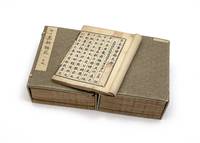
11212Collected & edited by Jiang Shaoyu 江少虞. Complete in 78 parts plus table of contents bound in 15 vols. full collation supplied in the Hyde catalogue. Large 8vo 286 x 215 mm. early paper wrappers new stitching. Japan: chokuban privately published by the Emperor Go-Mizunoo’s order 1621.<br /> <BR> <BR> First edition and a fine complete set of one of the very few surviving “imperial editions†printed with movable type kokatsujiban 夿´»å—版. There is considerable modern debate with no definitive conclusion whether this book was printed with metal or wooden type see below. It is of very great rarity and we find no printed copy in WorldCat.<br /> <BR> <BR> This enormous publication is by far the largest of the eight surviving chokuban imperial printings and the only surviving Gen’na chokuban 元和勅版 — imperial printing during the reign 1611-29 of Emperor Go-Mizunoo 後水尾天皇 1596-1680. The production of this large work was a very complex and difficult project employing the recently imported technology of movable type from Korea.<br /> <BR> <BR> The Song dynasty editor Jiang Shaoyu active 12th century compiled the substantial encyclopedia Huang Song shi shi lei yuan 皇宋事實類苑 of the writings of Chinese courtly scholars completed in 1145. Encouraging the preservation of Chinese traditions long valued by aristocrats Emperor Go-Mizunoo continued the project initiated by his father Emperor Go-YÅzei of printing imperially commissioned volumes of Chinese literary classics with the present work a collection of Confucian texts that were considered both an ethical and a literary legacy of the court. Some of the many topics include music medicine painting calligraphy supernatural events safeguarding the border and controlling the unruly.<br /> <BR> <BR> “The earliest surviving books printed in Korea with movable type date from the late fourteenth century…During the invasion of the Korean peninsula undertaken by Toyotomi Hideyoshi in the closing years of the sixteenth century…large numbers of printed books were looted and printing type was removed from the Printing Office and taken to Japan…It appears that Korean type was immediately put to use to print the text of the…Kobun kokyo Classic of Filial Piety in 1593 although no copies of this appear to have survived. In 1597 in the postface to another work printed in Japan with movable type a monk who was present at Hideyoshi’s headquarters acknowledged that typography in Japan had come from Korea. It was not clear whether any Korean printing artisans came to Japan as well as a result of the invasion but in any event the impact on Japan of Korean typography both technologically and intellectually was far greater than that of the Jesuit Mission Press principally because the imported Korean typography was much closer to the centres of power in Japan than the increasingly precarious Jesuit missions.â€â€“Kornicki The Book in Japan p. 129.<br /> <BR> <BR> Emperor Go-YÅzei who nominally ruled Japan from 1586 to 1611 “displayed great enthusiasm for the new process and not content with the original type brought back from Korea ordered a new set of wooden type to be made. This was engraved between 1597 and 1602 and the books printed from this new type are generically known as choku-han or ‘imperial printings.’ Indeed ‘imperial’ is a fitting description of these works for they are among the finest unillustrated books ever produced in Japan. Not only was the typeface larger but the best-quality paper and the finest ink were used to achieve effect. Very few choku-han works were actually printed between 1597 and 1603 actually 1621 and if we exclude the 1593 edition of Kobun kokyÅ almost all the titles were copies of Chinese philosophical classics…<br /> <BR> <BR> “One other choku-han is known to have been printed by order of Emperor Go-Mino-o Emperor Go-YÅzei’s son and successor in 1621 and that is the Horuien the present work although one or two other titles were printed and have been lost. All these works are considerable examples of the printer’s art and show how quickly the Japanese were able to make full and aesthetic use of movable type.â€â€“Chibbett The History of Japanese Printing and Book Illustration p. 69.<br /> <BR> <BR> At the time of the writing of the Hyde sale catalogue it was believed that the present work was printed with copper type; the latest research has suggested that wooden type was used. No final conclusion has been reached. See Kornicki Printing Technologies and Book Production in Seventeenth-Century Japan Cambridge: 2025 p. 26 for a discussion.<br /> <BR> <BR> Very fine and fresh set. Minor worming carefully repaired. Final volume with some dampstaining. Preserved in two chitsu.<br /> <BR> <BR> From the RokuÅ-in 鹿王院 temple in Kyoto and the library of Donald and Mary Hyde their sale Christie’s NY 7 October 1988 lot 87. With the provenance seal å¼˜æ–‡è˜ â€œKÅbunshņthe trade name of Sorimachi Shigeo å町茂雄 1901-91 the “H.P. Kraus of Japan.â€. unknown
Folio (302 x 220 mm). 68 ff. Gothic letter, two columns, 65 lines plus headline. With 5- and 13-line white-on-black woodcut initials, numerous woodcut illustrations of surgical equipment, and woodcut printer's device beneath colophon. Contemporary vellum over carta rustica, lettered in manuscript on upper cover together with the name of the owner, Hieronymus Tattus. Stored in modern black cloth solander case with spine label. The earliest printing of the Surgery of Abu al-Qasim al-Zahrawi, a section of his great "Al-Tasrif": the "first rational, complete and illustrated treatise on surgery and surgical instruments. During the Middle Ages it was the leading textbook on surgery until superseded by Saliceto" (Garrison/M. 5550). This publication pre-dates by nearly two decades the first independent printing. It includes nearly 200 woodcut illustrations of surgical instruments, including a forceps for extracting a dead fetus - a device of the author's own invention, still in use in modified form. - Abu al-Qasim, hailed as the "father of modern surgery", specialized in curing disease by cauterization and designed several surgical devices. He described how to ligature blood vessels almost 600 years before Ambroise Paré and was also the first to describe a surgical procedure for ligating the temporal artery for migraine. His use of catgut for internal stitching is still practised in modern surgery. - Al-Qasim's treatise, by far the longest of the four contained in this volume, is accompanied by two ophthalmological works, the first by the tenth-century oculist 'Ali Ibn Isa of Baghdad, known as Haly Jesus in the Western tradition. In his principal work, "Kitab Tadhkirat al-kahhalin" (GAL S I, 884), which long remained the classical training manual for ophthalmologists, Ibn Isa describes 130 eye diseases and discusses 141 treatments. The Latin translation, available to Western medicine since the 13th century, continued in use by medical schools as late as the early 18th century. - The other work "De oculis", ascribed to Canamusali, is in fact a compilation by David Armenicus (Sack). Prefixed to these is the surgery treatise of Guy de Chauliac (Guido de Cauliaco), physician to several popes in Avignon in the 14th century and "the most eminent surgeon of his time" (Garrison/M. 5556). Locatellus had previously issued the text of Chauliac's treatise in 1498, after this highly important work had first been printed at Lyon in 1478. - A few small wormholes in gutter. Binding soiled and scraped at foot of upper cover, vellum covering shrunk and lacking two pairs of ties. - Provenance: owned by the 16th-century Milanese physician Girolamo Tattus, "vir ... in medicina facienda clarissimi nominis" (Della Torre di Rezzonico, Disquisitiones Plinianae II [Parma, 1767], p. 224), with his inscription on the title-page and upper cover, as well as several autograph annotations to the text. The son of Francesco Tatti, a member of the College of the Physicians of Milan, Girolamo flourished around 1570. His writings have remained unpublished (cf. Argelati, Bibliotheca Scriptorum Mediolanensium [Milan, 1745], col. 1821). He is known to have owned and annotated an illuminated manuscript of Pliny's "Naturalis Historiae", written by Hieronymus Baliocus of Novara in 1479 for Gian Matteo Bottigella of Pavia and his wife Bianca Visconti, later owned by Matteo Luigi Canonici (1727-1805) and acquired in 1817 by the Bodleian Library, Oxford (now Canon. Class. Lat. 295). - Extremely rare: this is the only copy ever to have appeared in the trade, sold at Sotheby's in 1988. Hain 4810 (I). Copinger 1550. Goff G-564. GW 11707. Klebs 497.1. Essling 1247. Ohly-Sack 1330. Oates 2005. Bod-Inc. G-275. Sheppard 4244, 4245, 4246. Proctor 5100. BMC V, 453. BSB-Ink. G-430. Döring-Fuchs G-173. Wellcome 3017. Cf. DSB XIV, 585. GAL I, 239 (276), 24, no. 1.
4to (148 x 208 mm). 40 ff. 34 lines, Gothic type. Title-page with full-page woodcut of an anatomical scene. Modern full calf, bound to style with covers stamped in black. Housed in a custom-made cloth solander case with morocco spine label. First illustrated edition of the first dedicated anatomy book. "The first modern book devoted solely to anatomy [...] Mundinus re-introduced human dissection, which had been neglected for 1500 years before him; he was the most noted dissector of his period. The medieval anatomical vocabulary, well set forth by Mundinus, was derived mainly from Arabic" (Garrison/M.). Mondino de' Luzzi, professor at Bologna, is considered the founder of anatomy in the Middle Ages. His treatise remained popular until the beginning of the 16th century and appeared in multiple editions. - "The subject of anatomy was not taught either by lectures or by dissection in the universities at the middle of the 15th century. An occasional 'anatomy' was held, but the neglect of the subject is well illustrated by the absence of anatomical books. There is only one in the list, that of Mundinus [...]. Mundinus was a professor at Bologna from 1306 to 1326, and was the first to teach anatomy from the subject, usually the corpse of a condemned criminal; but there is the record of a procedure in 1319 against four medical students for body-snatching. His 'Anatomia', written in 1316, was for two hundred years the popular text book" (Osler). - The work "met a need universally felt just at that time and commended itself for its brevity, conciseness, and completeness, as well as for the fact that it taught for each separate organ the necessary anatomic technique" (Choulant, p, 88). The title woodcut shows a man on a chair, "with coat and high cap, in his left hand an open book, on the left side of the picture a rock and six linden trees, below, on a table, a dissected cadaver, beside its left foot lies a curved knife, to the right of the cadaver stands a young man in a short garment, bare-headed and with long curls, grasping the intestines of the cadaver with both hands" (p. 93). - Inner margin of title-page neatly reinforced; illegible old library stamp to lower margin and old handwritten number "6" to upper corner. Tiny repair to blank outer margin of final leaf. Scattered light browning, mostly marginal. Very rare: a single copy in auction records since 1979). From the library of the noted Russian-American photographer and biologist Roman Vishniac (1897-1990). H 11633. Goff M-874. GW M-25670. Bod-inc M-330. Sheppard 2122. Proctor 2994. Wellcome I, 4484. Poynter 392. Klebs 688.6. Choulant, History and Bibliography of Anatomic Illustration, p. 93, no. 4. Cf. Garrison/M. 361; Osler, Incunabula Medica 156 (for the 1478 edition).
4to (140 x 195 mm). (96) ff., numbered in an early hand (omitting f. 77). Elaborate woodcut border on title-page, featuring elephant and cherubim, and with several large woodcut initials in text. Bound in early limp vellum with manuscript title on spine; edges stained red. 17th century portrait of Vives added to inner cover. Lengthy, exegetical early annotations to the first book 'De Instituenda Virgine' along with readership markings. A very good copy from the Harrach Library (Austria/Madrid), with 19th century stamp on title. Very rare first edition of "the first systematic study to address explicitly and exclusively the universal education of women", commissioned by Henry VIII's wife, Catherine of Aragon, who was at the time rearing her own daughter, Mary Tudor. Translated and adapted by numerous followers, Vives' treatise would go on to be read in almost every European vernacular, often by women themselves. The first edition, however, is rare in census and in commerce - and contains passages, particularly on chastity and intellectual capacity, which were entirely re-written in later incarnations. A fundamental document for the role of women in Early Modern society - and particularly in Early Modern England - this copy is especially remarkable for its state of preservation. An early reader of Vives has here added his own comments to the chapters on the seclusion of maidens and examples of feminine virtue. - "De Institutione Foeminae Christianae" consists of 3 books, one for each stage of woman's life: maidenhood, marriage, and widowhood. In his preface to Queen Catherine, Vives quotes Aristotle to the effect that states which do not provide for the education of women deprive themselves of a great source of their prosperity; yet as Charles Fantazzi points out, Vives is in fact here caught in a delicate double bind, "insistent on a subordinate, submissive role for women, the text must take care to expound its message not only without alienating the queen but rather, indeed, with the goal of winning her favour." Despite its dedication and although Vives specifically adapts his prose style for a female readership, the treatise is hardly pro-woman: "the 'Education' is determined to be both a reference book for men on how to control their women, as well as an edifying treatise for women to absorb as a source of proper behaviour" (Kolsky). Nevertheless, Vives' praise of women's intellectual capacity and his advocation of some form of universal learning for females are viewed as landmarks for modern historians of women and gender. - According to Fantazzi, "'De Institutione' enjoyed an enormous popularity and was generally regarded as the most authoritative statement on this subject throughout the sixteenth century, especially in England, where it found favor with Catholics and Protestants alike. There can be no denying that merely by attaching such importance to the education of women, Vives laid the groundwork for the Elizabethan age of the cultured woman." It was rapidly translated into English, enjoying some nine editions in that language during the 16th century alone (cf. Higginbotham, p. 69). According to Pollie Bromilow, the dozens of vernacular translations were partly aimed at women themselves, who had no knowledge of Latin; and thus a large segment of its readership during the 16th century was in fact female. Appearing in an undated edition as early as 1528 or 1529, the English translation is rather an adaptation of Vives' text begun by Thomas More but completed by his household tutor, William Hyrde, who must have used the present edition in its preparation. - In 1538 Vives brought out a revised Latin edition reflecting many changes to the original text. This is the edition most commonly cited by scholars, probably thanks to its greater availability. The sections on maidens and the preservation of maidenhood (in all its meanings), however, were substantially re-written - notably, treating many of the same subjects which interested the annotator of the present copy! Chapter 6, on virginity, for example, "was subjected to a complete revision, so that it bears little resemblance to the first published version. It is obvious that Vives struggled over the proper approach to this topic. In the original version, he suddenly abandons his more discursive style for a rather personal and, one might add, paternalistic tête-á-tête with a young woman" (Fantazzi, p. 18). Vives' views on women's intellectual capacities also develop between the two editions. - At the outbreak of the Reformation Vives was a close friend of Erasmus, who had commissioned him to write a commentary on Augustine's "City of God" in 1521. Perhaps seeking refuge from the political and religious turmoil of Europe, Vives turned his attention to England from this point onward. He dedicated his edition of "De Civitate Dei" to Henry VIII in 1522, and already in May of 1523 was able to present a manuscript of his "De Institutione Foeminae Christianae" to Queen Catherine in person. At Henry's court he grew close to the circle of Thomas More and produced a further educational treatise, "De Ratione Studii Puerilis". Thanks to his growing opposition to Henry VIII's divorce proceedings, however, Vives was placed under house arrest by Cardinal Wolsley from February to April 1528, and upon his release sensibly fled the country - only to return briefly later that year in the role of Catherine's legal adviser. - Provenance: later stamp of the Harrach Library on title-page. The collection originated as the personal library of Graf Ferdinand Bonaventura von Harrach, Austrian envoy to Spain (1637-1707), and explains the characteristically Spanish binding on the present example. Ferdinand's son Aloys followed in his father's footsteps; but after his death in 1742 the collection was transferred back to the remaining Harrach family in Vienna. Finally, the collection wound up in the family castle 'Schloss Bruck an der Leitha', in Lower Austria. We have handled numerous other Harrach copies, which seem to have formed a cohesive 'personal reference library' of 16th and 17th century works for this seventeenth century statesman. - A very good copy. OCLC shows just four copies in American institutions: Harvard, the Massachusetts Center for Renaissance Studies, Yale, and the Huntington. Nijhoff/Kronenberg 2167. Adams V 951. Brunet V, 1333. Estelrich 136. Cf. also Fantazzi's introduction to a modern translation, The Education of a Christian Woman: A Sixteenth-Century Manual (U Chicago, 2007). Kolsky, Making Examples of Women: Juan Luis Vives' The Education of a Christian Woman. Higginbotham, The Girlhood of Shakespeare's Sisters: Gender, Transgression, Adolescence (U Edinburgh, 2013). Bromilow, "An Emerging Female Readership of Print in Sixteenth-Century France?", French Studies (2013) Vol. 67, pp. 155-169.
Folio (210 x 315 mm). 87 (instead of 90) ff., including one (of two) blanks [#4-1, a10-1,b–e10, f8, g10, h8, i10-1]. Gothic type. 39 lines. Rubricated and with lombardic initials in red and blue throughout. Contemporary richly blind-stamped calf binding over wooden boards on three raised double bands; finely tooled brass fittings and brass remnants of two clasps. One of the earliest medical books in the vernacular and the first printed German pharmacopoeia. First dated edition: an undated edition was published at Augsburg in the same year, followed by four more printed editions before 1500. Of the utmost rarity, no copy of the present first edition traceable at auction or in the trade since 1950. Only Lathrop C. Harper offered a copy of the Augsburg edition in 1953, then described as "one of the earliest and rarest medical books of the fifteenth century". - Drawing strongly on the Arabic physicians who dominated the medieval medical school, Ortolff's work contains not only countless references to Avicenna, al-Razi, Mansur and Ibn Rushd (especially in the part on the preservation of health from fol. 44 onwards) but even some of the earliest complete renderings of their tracts into a modern language, here printed for the first time: "leaves 7 to 13 contain 'Meyster Isaacs Buch', which is nothing less than Isaac Judaeus' book on Uroscopy, by far the most elaborate medieval treatise on the subject" (Sarton). The final part of Ortolff's work is dedicated to the prescriptions for remedies used in professional medicine, making his Arzneibuch the "first German pharmacist handbook" (Schelenz) ever. - Modern spine professionally supplied, preserving the original covers with fine gothic blindstamps (not recorded in Schunke, Schwenke-Sammlung). Inner hinges and gutters of the first and last few leaves reinforced with Japanese paper; a few professional remarginings, but tightly sewn. First leaf of the registrum and text of last leaf (with one printed paragraph of 7 lines only) both supplied in 19th century manuscript. Textually complete with the dated imprint on the last leaf of the registrum present. Complete copies are nearly unobtainable: even the reference copy stored at the BSB in Munich lacks seven leaves. - Provenance: contemporary marginalia and foliation. 17th or early 18th century manuscript ownership of Ottobeuren Abbey ("monasterii ottenburani") in Bavaria at the head of the first text leaf; later in a Württembergian private collection. H 12112*. Goff O-110. GW M28462. Proctor 1977. Stillwell 466. Osler 123. Sudhoff 22. ISTC io00110000. Schelenz 336 ("Das erste deutsche Apothekerbuch"). - For the content cf. VL2 7, col. 80, and G. Keil, Ortolfs Arzneibuch, in: Sudhoffs Archiv 53 (1969), p. 124f. and Sarton III/2, pp. 1206/7.
Folio (265 x 388 mm). 2 parts in one volume. 427, (21); 187, (1) pp. Titles within elaborate allegorical woodcut border signed by Jost Amman. Woodcut headpieces, initials and Feyerabend publisher's mark signed by Tobias Stimmer at end part I. Contemporary full vellum, remnants of four alum-tawed leather ties, spine with four raised bands, headbands in grey, white, and yellow. Stored in custom-made half morocco box. First edition of this collection of the leading histories of the Low Countries, edited by Feyerabend. Fore-edge painting by Cesare Vecellio, depicting a scholar seated at a desk overlooking a landscape with the title "ANNA/LES" below; top and tail edges decorated with abstract line designs. - A rare item from the celebrated library of Dr. Odorico Pillone and his father. Late in the 16th century, Odorico invited Vecellio (first cousin once removed of the master painter Titian, under whom he trained) to decorate a number of books in his library with fore-edge paintings, thereby establishing the earliest known private collection of such paintings. As was Vecellio's preferred style, the painting here is of a scholar, brightly dressed in red and a black hat, centered on the fore-edge and additionally visible on the closed edge. - The histories contained are by Jacques Meyer (Part I, Flanders), Adrian Baarland (II, Brabant), G. Geldenhouwer (II, Holland), Jacques Marchand (II, Flanders), and L. Guicciardini (II, in Latin); also, shorter texts by Philip Galle and G. Candidus on the then-current situation. - Corners insignificantly bumped and rubbed, some worming to edges and spine, hinges and endpapers (with chipping to head of spine). Binding shows some dampstaining and soiling. A few tears to flyleaves. Internally generally clean with occasional insignificant foxing and some dampstaining, chiefly confined to margins, as well as minor text block edgewear. Overall a very good example with the fore-edge painting a little worn but still bright. - Provenance: Odorico Pillone (1503-93); Casteldardo estate (ca. 17th-19th centuries); Bayolle of Venice (early 19th century); Paolo Maresio Bazolle (1874); Sir Thomas Brooke (1830-1908; his bookplate to front pastedown); Humphrey Brooke (early 20th century); Pierre Berès (ca. 1947; his bookplate to front pastedown); Jeff Weber Rare Books; Randall J. Moskovitz, MD, Memphis, Tennessee (1990); acquired from the sale of his estate. VD 16, F 897. Berès, Bibliothèque Pillone, no. 133. Berès, Un groupe de livres Pillone, no. 1. Brooke, A Catalogue by Thomas Brooke, p. 666, no. 5. BNHCat A 394. Cf. Hobson, Pillone Library, The Book Collector (Spring 1958), pp. 28-37; Weber, Annotated Dictionary, pp. 221-227.
Chancery folio (205 x 285 mm). 2 parts in one volume. 122 ff. (A-O8, P10); 66 ff. (a-f8, g10, h8), complete with A1 and a1 blanks. 2 columns, 48 lines. Large illuminated initial and floral border on A2r, an illuminated coat of arms with additional floral border in the lower margin. Illuminated initials on leaves L2r and O8r, initials, paragraph marks and capital strokes in red and blue, borders ruled in pencil. Blind-tooled dark calf over heavy wooden boards with remains of clasps. Editio princeps and sole incunabular edition of this two-part medical treatise, drawing strongly on the Arabic physicians who dominated the medieval medical schools of France and Northern Italy. It includes the author's treatise on fevers, based on Avicenna, who is variously quoted and is also referenced in the handwritten annotations. Some of the surprisingly modern ailments discussed include tinnitus, diabetes, and manic depression. - "Concoreggio, born in Milan around 1380, was made professor in Bologna in 1404 before teaching at the Universities of Pavia, Florence and (in 1439) Milan. His works are composed after the model of the Arabs, without much personal observation, and were published as a collection after his death in Pavia around the year 1440" (cf. Hirsch). - A beautiful copy with a large illuminated initial and floral border, as well as an illuminated coat of arms with additional floral border in the lower margin on A2r. - A2 and final leaf show small marginal repairs, quires M and P faintly browned, otherwise mostly fresh, clean and wide-margined with just A2 trimmed at foot into illumination and marginalia trimmed on D6. Remboitage of blind-ruled calf over massive boards, formerly enclosing a Bible, rebacked, covers rubbed and scored, lacking brass fittings and clasps. - Provenance: ink marginalia in an early, probably contemporary, hand. Late 16th or early 17th century ink ownership inscription of Francesco Portidi, physician, on A1r. Evidence of a stamp removed from margin of A2. - Very rare on the market, with only one complete copy selling at auction in the past 50 years (this copy). HC *5615. Goff C-803. GW 7291. BMC VII, 997. BSB-Ink C-505. Bod-Inc C-415. ISTC ic00803000.
Folio (220 x 315 mm). 128 ff. (a-b8, c-d6, e4, f6, g4, h-p6, q4, r-x6, y4; page count: [t.p.], iii, v, iiii, v-ix, v, xiii, xii, [2 ff.], xiiii, xvi-xliii, xlvii, xlv-cvii, cix-cxxviii), complete thus. With half-page title woodcut, full-page woodcut on verso, large woodcut initial, and printer's device at the end (all with contemporary touches of red ink), as well as numerous fleuronee and lombardic initials in red and green, including five figurated initials. Rubricated throughout. Contemp. blindstamped gothic binding: dark brown calf over wooden boards, remains of engraved brass clasps. First edition of this polemic against the Bohemian Brethren, written by the author of the notorious "Malleus Maleficarum": a "Bulwark of Faith of the Holy Roman Church Against the Heresy of the Waldensians and Picards". Extremely rare: the present copy represents the hitherto unknown first impression of the first edition, still bearing a slightly different title; all other known copies printed that same year (three via OCLC, one in the Scientific Library of Olomouc, one in the Bavarian State Library), as well as the 1502 second edition, are entitled "Sancte Romane ecclesie fidei defensionis clippeum adversus waldensium seu pickardorum heresim, certas Germanie Bohemieque nationes in odium cleri ac enervatioe ecclesiatice potestatis virulenta contagione sparsim inficientes" (changing the - misspelled - "bulwark" into a "shield"). Quire signatures and pagination depart from those stated by OCLC in several details. In particular, the head-over-heels "u" in "virulenta" (here printed as "virnlenta", corrected in other editions), identifies the present variant as the earliest one. - In the year 1500, 15 years after he first published his "Malleus Maleficarum", Institoris had been installed by Pope Alexander VI as inquisitor to Bohemia and Moravia, where he was to take action agains heretics, sorcerers, and witches (cf. Tschacher). In the present work, his last to see publication, "he once more invokes his 'Malleus' and his earlier sermons against witchery and its doubters. The Bohemian Waldenses, he argues, had not only perpetrated numerous heresies, but also questioned the legitimacy of the witch trials. It is telling that Kramer, in his final polemic, would interpret the heresies of the Waldenses and witches as conjoined harbingers of the approaching apocalypse" (ibid.). The inquisitor who prided himself on having sent no fewer than 200 witches to the stake discusses other heresies as well: fol. 86ff. contains an entire chapter "De origine legis machometice". - One of the most extensive and technically ambitious works to leave the press of the itinerant German printer Konrad Baumgarten, active in Danzig, Olomouc, Breslau, and Frankfurt/Oder between 1498 and 1509. The page count is exceedingly confused, as in all copies. Indeed, only a single leaf in the entire "a" gathering bears a signature: the second, counted as "a iii" in error; thus agreeing with all copies available for comparison. The count of the first four leaves in our copy has therefore been corrected to "a i-iv" in red ink by a contemporary hand. - From the library of the disputatious Bohemian Franciscan friar John Aquensis, who in 1502 was to publish his own polemic against the "Picards", with his marginalia and his autograph ownership on the title page. "Although Johannes Aquensis, Jan Vodnansky in Czech, was one of the most active Catholic writers at the turn of the Middle Ages to the Age of Reformation, he has been largely ignored by scholarship so far. Born in Vodhany (some 30 kilometers to the north-west of Budweis and considered Utraquist) around 1460, he attended the school of St. Henry's in Prague since 1473, later studying Divinity at the University there. After obtaining his Bachelor's degree in 1480, he joined the Observant Franciscans and soon became one of the most vocal antagonists of the Utraquists, Begards, Waldensians, Bohemian Brethren, and other heretics. He disappears after 1534 [...] Most of his works, almost entirely ignored by scholarship but apparently marked by a curious mixture of erudition, bellicose dialectics, vivid imagination, and credulity, are known in manuscripts only; a very few were printed, and some must be presumed lost or awaiting discovery" (cf. Dietrich Kurze, Märkische Waldenser und Böhmische Brüder. Zur brandenburgischen Ketzergeschichte und ihrer Nachwirkung im 15. und 16. Jh., in: H. Beumann [ed.], Festschrift für Walter Schlesinger II [Cologne 1974], p. 456-502, at: 480). Some staining to first and last leaf; occasional insignificant waterstaining, otherwise very clean, showing very little browning. Altogether an excellent copy in its contemporary, original binding. The individual blindstamps could not be traced in the Kyriss or Schunke collections; the clasp hitches are engraved with an invocation of the Virgin ("MARIA AVE"). Text carefully rubricated throughout; the inhabited initials depict dragons and other mythical creatures, as well as the bearded head of an old man. - Of the utmost rarity: this present first edition is not listed in German or international auction records. The last copy of any edition in the trade was that formerly in the Broxbourne collection (1502 second ed.: Sotheby's, 8 May 1978, lot 408, to Breslauer). Not in VD 16 or ISTC. Cf. Panzer VII, 486, 1. Cf. OCLC 22369397. Zibrt III, 5181. Isaac 14475. Werner Tschacher, "Kramer, Heinrich (Henricus Institoris)", in: Lex. zur Geschichte der Hexenverfolgung, ed. G. Gersmann, K. Moeller & J.-M. Schmidt, s.v.
4to (193 x 134 mm). (52) ff., with large woodcut on title-page of a physician in his study, surrounded by books and jars, repeated on verso, as well as 66 half-page woodcuts of plants. Gothic type, 33 lines per page. An exceptionally large, broad-margined copy, with frequent contemporary Latin annotations (often untrimmed). Bound in brown morocco ca. 1900, all edges gilt. Ex-libris Fairfax Murray (his numbered label on pastedown, this copy described as #669 in his Catalogue). Light spotting throughout; lower blank corner of title-page discreetly repaired. With a handwritten letter enclosed from a curator at the Cambridge University Library, addressed to "Dr. Fleming" and dated 7th March [19]49, discussing this copy. The Fairfax Murray copy of a landmark botanical incunable, being the first or second illustrated edition of "one of the earliest Western documents showing a revival of interest in botany" (Hunt I, p. 4). Following unillustrated Italian printings in 1477 and 1482, the Genevan Jean Belot (printer of the 1495 "Fasciculus temporum", the 'Fardelet du temps') issued two variants of the present work, each employing 66 woodcuts illustrating the herbs of medieval medicine followed by an appendix of 12 (unillustrated) chapters on the medical qualities of various spices. Fairfax Murray cites this as the earliest edition in his collection, based on the state of the woodcuts. - Belot's two printings were imitated in a series of four further editions by his fellow Genevan printer Louis Cruse, also undated but easily distinguishable from the present ones due to their use of fewer woodcuts. Lökkös attributes the first edition to ca. 1495 and the present edition to ca. 1496, and claims that they must have been printed in quick succession: "L'erreur de numérotation des chapitres (xxix pour xxvi) n'est pas corrigée dans la deuxième edition. Ce fait semble confirmer l'hypothèse d'une sortie très rapprochée de la première. L'erreur 'cognoscre' du colophon se retrouve également dans l'exemplaire de la British Library" (Lökkös, p. 163). - Describing the medicinal properties of 77 herbs and spices, the work is written in 2,269 verses of Latin hexametre, a poetic form probably employed as a mnemonic device for physicians or apothecaries. In the 15th century, these verses were confused with a lost poem "De herbis" by the Augustan poet Aemilius Macer ['Floridus'], hence the attribution on the title-page. - "The text titled 'De Viribus Herbarum' (On Properties of Plants) has been traditionally attributed to Odo de Meung (Odo Magdunensis), who is believed to have lived during the first half of the 11th century and was from Meung on the Loire [...] The text was further expanded, including new data from the translation of Arabic texts into Latin in Salerno from the end of the 11th century onward. If this is the case, this text is good evidence of the continuity of scientific activity in the Middle Ages: its most ancient parts come from a period when there was a revival of interest in botany and a recovery of the classical tradition, while the most recent additions integrate the contribution of the Arabic world" (Hunt Botanical Library, online exhibition "Order from Chaos: The Birth of Modern Botany", 2009). - Having belonged to the celebrated collector, art dealer, and Pre-Raphaelite painter Charles Fairfax Murray (1849-1919), the present copy is in a magnificent state of preservation. Relative to the British Library copy, the present copy is much larger (193 x 134 mm vs 183 x 130 mm). It is unwashed, and most of the annotations by a contemporary pharmacist have been preserved almost in their entirety. The Fairfax Murray catalogue describes the binding as "brown morocco extra, gilt edges in rough"; the present copy is cited in most bibliographical studies of "De Viribus Herbarum" including that of Lökkös. Hain, Reichling, and the BMC fail to record the present variant with the error "cognoscre" on the penultimate line of the final leaf. Fairfax Murray #669 (this copy). On the chronology of the Genevan editions of Macer Floridus cf. Delarue in Genava 2 (1924), pp.177-86, and Lökkös, Catalogue des incunables imprimés à Genève, #86 (citing this copy); ISTC im00003000, showing 22 copies (of which 7 defective), including just 3 complete copies in US libraries; cf. also Hunt, I, p. 4; Goff M-3; Klebs 637.2; Hain/C. 10418; BMC VIII 371 (none of which notes the variant "cognoscre").
Folio (210 x 325 mm). 328 pp. Set in roman type. Titles within a ornamental woodcut border, with 8 full-page woodcuts by Hans Wechtlin and numerous woodcuts in the text. Rebound in the 19th century by Ludwig Eichhorn in half roan, brown paper spine label with manuscript title, drawn circle on the back board with the (faded) title within it, manuscript title on the bottom edge, new pastedowns and endpapers. Two esteemed 16th century medical works, originally written in the 4th and 11th century, here issued together in an early printed edition. Especially the second work in this early printed book is important: it is the only exclusively surgical work left by an Arab source. This treatise was written by Albucasis (Abu al-Qasim al-Zahwari) and was translated into Latin at Toledo by Gerard of Cremona (ca. 1114-87). Albucasis, a native of Cordoba in Moorish Spain, was an Arab physician of the 11th century who is sometimes described as "the father of surgery". The present work, which is the 30th and most popular volume of his 30-volume medical encylopedia entitled "Kitab al-Tasrif", can without doubt be regarded as the principal work of Albucasis, which established his authority. It is the first illustrated surgical guide ever written. - Albucasis' treatise is divided into three books, each treating a different surgical topic: the first, cauterization (a procedure recommended by the Prophet, the medical practice of burning a part of the body to remove or close off a part of it), the second on cutting and bloodletting, and the third on luxations of the limbs. It contains numerous small woodcuts of surgical instruments within the text. The author describes these instruments and how and when to use them. Added to the text of Albucasis are eight rather gruesome full-page woodcuts of specific operations, made by the German renaissance artist Hans Wechtlin (active between at least 1502 and 1526), probably his only surviving work. They show (1) a man wounded by many instruments, (2) a cauterization, (3) an amputation, (4) the extraction of an arrow, (5) bloodletting, (6) a full-page skeleton, and (7 & 8) trepanning operations. These woodcuts were not made specifically for this work, but were re-used by Schott after they had appeared in a manual printed by the German surgeon Hans von Gersdorff in 1517, entitled "Feldtbuch der Wundartzney". - Albucasis' surgical treatise was first printed (in Latin) in 1497. His guide remained a famous pharmacopoeia as late as the mid-16th century. The contents and descriptions contributed to many technological innovations in medicine, especially concerning the tools required for specific operations. - The work of Albucasis is preceded by the "Rerum medicarum libri quator", a therapeutic compendium written by the 4th century Greek physician Theodorus Priscianus, also known under his pseudonym Octavianus Horatianus. It here appears in print for the first time, in a Latin translation, though originally written in Greek, and edited by Hermann von Neuenahr (ca. 1492-1530), a German humanist with particular interest in medicine and pharmacy besides history and theology. The work is better known as the "Euporista" (Easily Obtained Remedies). - Priscianus' work consists of four books, treating several diseases and their remedies: the first two books treat external and internal diseases, the third gynecology, and the last physiology. - Both works together are printed by the German printer Johann Schott (1477-1548), the son of the printer Martin Schott and the grandson of the pioneering printer Johann Mentelin in Strasbourg. - Contemporary inscription in ink on last blank page in the same hand as the manuscript title written on the bottom edge. Binding a little worn and showing some stains, with two holes in the front board and two in the back board, probably from (now lost) clasps. A few tiny holes in the first two pages. The first four leaves browned, some minor foxing to the title-page. Paper slightly browned overall. Title in ink on the lower edge. A small tear in the first two full-page woodcuts, printed on both sides of the same leaf, not affecting the illustrations. Some stains in the margins throughout, not affecting the text or plates, otherwise in very good condition. VD 16, T 84. Adams P 2119. Choulant, Handb. 217. Durling 3764. Stillwell, Awakening III, 532. Wellcome I, 5256.
Folio (ca. 26 x 39 cm). 5 vols. bound in 3. - I: De quadrupedibus viviparis. Ed. secunda. Frankfurt, Cambier, 1602. 20 ff., 967 pp. with 125 woodcuts. - II: De quadrupedibus oviparis. Ed. secunda. Frankfurt, Wechel for Cambier, 1586. 4 ff., 119 pp. with 19 woodcuts. - III: De avium natura. Nunc denuo recognitus. Frankfurt, Wechel for Cambier, 1585. 6 ff., 806 pp. with 222 woodcuts, 13 ff. - IV: De piscium & aquatilium animantium natura. Ed. secunda. Frankfurt, Cambier, 1604. 20 ff., 1052, 30 pp. with 616 woodcuts, final blank leaf. - V: De serpentium natura. Zurich, Froschauer, 1587. 6 ff., 85 pp., 1 blank leaf, 11 numbered ff. with 30 woodcuts. - With a total of 4 title vignettes and more than 1000 woodcuts (some page-sized). Contemporary brown full calf with floral and ornamental cover borders stamped in black between rules; all volumes rebacked. The fundamental zoological work of the Renaissance, "an encyclopedia of contemporary knowledge, intended to replace not only medieval compilations but even Aristotle's work of the same title" (PMM). For nearly two centuries it survived as the standard reference book; "even Georges Cuvier later delighted in recognizing its enduring interest" (DSB) - a success story also attributable to the fact that the newer, systematic publications of John Ray (1693) and Linné (1735) were not illustrated. "Like contemporary herbals, and some earlier works on zoology, Gesner's encyclopaedia was enriched by crude but often lively woodcuts. Most were prepared specially for this work; others - like the rhinoceros after Dürer - were borrowed. They are realistic enough to act as a valuable supplement to the text" (PMM). - First (lib. V) and second edition (lib. I-IV. the first of the Frankfurt editions). Occasional light browning; almost no staining; a few slight creasemarks. Pages 41f. in lib. 1 have small tears to upper edge; ff. 1-4 in lib. III and pp. 961 f. in lib. IV show edge tears in the margins. Quire d (pp. 31-38) misbound before c in the appendix to lib. IV. A few edge defects to the final leaves of lib. V. The appealing bindings show a few small cuts and chafe marks, all professionally restored, as are the spines and the upper corner of the lower cover to vol. 3. Altogether a very fine copy. Provenance: flyleaves of vols. 1 & 2 recto have ownership "A. Van Burch 27 M[arch] 1612". Flyleaves of all three volumes bear the same seven-line inscription on the verso: "Anno 1723 die 10 maert heb ick dese drie boeken in folio, handelende van Beeste & vogelen & vischen door Conradus Gesnerus beschrevig aende pastorij van t' over Eyndt van Zutphaes verëert en de selve dy 14 d.o an de Eerw. H. pastoor Servatius Verhofstadt over gelanckt. G. F. Vander Burch van Wynesteyn". Pastedown of lib. III has handwritten ownership "Jannigje Bogaart" (18th c.); all pastedowns bear the bookplate of the Amsterdam physician and bibliophile Bob Luza (1893-1980), whose library was sold by Van Gendt & Co. in 1981. Last at Hartung & Hartung's sale 94 (1999), lot 342. PMM 77. Wellisch A 23.2 (dated "1603", as Nissen), 24.2, 25.2, 26.2 & 27.1 = A 28.2 (entire work, bound chronologically). DSB V, 379. Nissen, ZBI 1549 (I), 1550 (II), 1553 (IV), 1556 (V); IVB 349 (III). VD 16, G 1725 (II), 1731 (III), 1744 (V). Adams G 534 (II), 536 (III), 539 (V). BM-STC G 532 (I), 538 (IV). Rudolphi 827; Vischer C 1093 (V).
Folio (ca. 315 x 465 mm). 4 vols. 252, (1 blank) ff. 321 ff. 462, (1 blank) ff. (1 blank), 336, (1 blank) ff. With 7 large penwork initials. Contemporary blindstamped full brown calf bindings over wooden boards with brass corner and edge fittings and 2 clasps. Edges sprinkled. The complete four-volume set of this very early and rare edition of a principal work, usually encountered only in separate volumes. This encompassing account of moral philosophy by the Florentine archbishop Antoninus (1389-1459, canonized in 1523) exerted a powerful influence over later studies; it is regarded as "probably the first - and certainly the most comprehensive - treatment from a practical point of view of Christian ethics, asceticism, and sociology in the Middle Ages" (NCE, I, 647). - Koberger's edition was preceded merely by that printed almost simultaneously in Venice (1477-80), and for the first (17 Oct. 1478) and fourth volume (29 April 1479) his is in fact the first: volume 2 (10 Oct. 1477) had already appeared in Venice separately in 1474 and 1477, and again in Speyer in 1477; vol. 3 (26 Jan. 1478) had appeared in Venice in 1477. - Volumes 1, 3, and 4 each boast two large penwork initials in red and blue, volume 2 has a large penwork initial in red, blue, and purple that incorporates a long marginal decoration. Entirely complete save for the blank first leaf not present in vols. 1-3, a wide-margined copy printed on strong, light-coloured paper, rubricated throughout and with Lombardic initials drawn alternately in red and blue. First and last leaved insignificantly soiled with minute worming. Occasional marginalia by an early hand. The uniform bindings show a central compartment composed of a blossom role not identified by Kyriss or Schunke on the covers; the spines were not decorated. - Bindings professionally restored. Some damage to several of the brass edge and corner fittings with some loss; clasps and endpapers repaired, using early material. - Provenance: all volumes bear the lithographic bookplate of the German historian and bibliophile Johann Georg Kloss (1787-1854), whose extensive collection of incunabula and early printing was sold by Sotheby's in 1935 in a sale notorious for the auctioneer spuriously claiming many items to have been owned by Melanchthon (Catalogue of the Library of Dr Kloss, of Franckfort a. M., Professor, lot 231). Hain/C. 1242. Goff A 871. GW 2186. BMC II, 415. Proctor 1981, 1983, 1988 & 1992. BSB-Ink A 594. IGI 689. Pell. 877. Polain 265. Voull., Bln. 1649, 1652, 1657 & 1659. Hase 23, 25, 31 & 35. ISTC ia00871000. Not in Oates.
4to. (4), LIV pp. With title woodcut and several woodcut initials. - (Bound after) II: Ryff, Walther Hermann. Ein wolgegründet, nutzlich und heilsam handtbüchlin, gmeyner Practick der gantzen leib artzney [...]. (Strasbourg, Balthasar Beck), 1541. 4 parts. (224) ff. (last blank), (140), XC, (12) ff. (last blank). With 21 woodcuts in the text. Contemporary full pigskin over wooden boards with bevelled edges, blindstamped with evangelists' roll. 2 clasps. I: Very rare first edition of this book on the equipping and the managing of pharmacies. A single copy in auction records (2011, Reiss, sale 142: 40,000 Euros, also bound in a medical sammelband). The pretty woodcut on the title page shows the interior of a pharmacy, with one apothecary taking over a client's recipe, another fetching a can from a shelf, and a third at work with mortar and pestle. - The humanist, physician and theologian Brunfels (1490-1534), "first in time and importance among the German botanists of the 16th century" (Garrison/Morton 279), turned to Lutheranism in 1521, after which he had to flee; Ulrich von Hutten found him a parish near Frankfurt. Later, Brunfels turned to Basel, where he earned an M.D. degree, and Strasbourg, where he published several works on pharmacy and paediatrics. - Slight brownstaining and waterstaining; a few occasional edge flaws. The lower margin of fol. 30 contains an extensive, roughly contemporary note on camphor: "Der recht natürlich campher wirdt also probiert: Nimm ein new backen brot als bald es auß dem ofen kommen ist, schneids mitten entzwei, leg den campher darein: so er wässerecht wirdt, ist er rechtschaffen, so er aber dierr und trucken bleibt ist er gemacht, sol wol bewart werden verschwinden liederlich, man soll in behalten in aine marmelsteinen oder Alabastunen geschirr, darzu gethan leinsamen [...]". - II: First edition of this copious medical manual. The woodcuts show babies in the womb, two Phlebotomy Men, the blood vessels of the head (used twice), and two different diagrams of the eye (one a cross-section such as it would be used three decades later in Alhazen's "Opticae Thesaurus"). Leonhard Fuchs would challenge the publication as an adaptation of his own "De medendis singularum humani corporis partium libri IV". - Old handwritten ownership on title page deleted; some browning and waterstaining. Slight worming to front endpapers; endpapers at rear have additional recipes in a contemporary hand. The pretty binding shows slight worming, otherwise well preserved. I: VD 16, B 8567. Durling 730. IA 125.663. Muller 394, 6. Adlung/Urdang 83f. - II: VD 16, R 4007-4008. Benzing 115. Muller II, 312, 94. Ritter (Rép.) 2035. Waller 8350. Not in Bird, Durling, Lesky, Osler, Ritter (Cat.), STC, Wellcome etc.
Folio (308 x 430 mm). (408) ff. (first and last leaf blank), bound without Baldus de Ubaldis's "Repertorium super Innocentio" and the following leaf containing table of contents. Gothic letter in double columns, large initials at the beginning of each book supplied in red and blue with penwork flourishing, smaller initials supplied alternately in red and blue, headline supplied in red and blue. Three coats of arms finely painted at foot of first page by a contemporary hand. Contemporary pigskin-backed wooden boards (clasps and catches missing), title in handsome gothic lettering along lower edge. First edition of the commentary of Innocent IV on the Decretals of Gregory IX (known as the Liber Extra), one of the most important collections of medieval canon law. A handsome copy in a contemporary binding. Innocent's commentary was completed ca. 1251 and was never superseded. Beautifully printed by Heinrich Eggestein of Strasbourg; "le plus beau livre que cet imprimeur ait produit" (fin-de-siècle catalogue note pasted to first blank). Like a handful of other copies, the present copy contains the Apparatus only and was bound without Baldus de Ubaldis's "Repertorium super Innocentio" (an index to Innocent's work) which, although a separate work, seems to have been intended to form part of the edition. - Several contemporary annotations, manicules and other markings; summary of contents supplied in upper outer corners of recto of each leaf in a contemporary hand. Binding insignificantly rubbed; professional remarginings to first blank leaf. Occasional light browning, some light dampstaining, a few small wormholes at beginning and end of volume, occasionally affecting a letter or two. Generally a very fresh, wide-margined and crisp copy (hailed in the catalogue note as "superbe exemplaire dans toutes ses marges, parfaitement propre et d'une fraîcheur étonnante, sans le moindre défaut"). - Provenance: 1) painted at the foot of the first page by an accomplished contemporary (German?) artist are the arms of Pope Innocent VIII (1484-92), flanked by two coats of arms, one resembling a printer's device, possibly signifying an intended gift by an unidentified German scholar to the Pope in the 1480s or early 1490s. 2) Late 16th century ownership of Konrad Fuchs von Ebenhofen zu Saldenburg, a Tyrolean nobleman who acquired the Bavarian demesne of Saldenburg in 1587 and died on 14 January 1614 (his inscription "Conradt Fuchs" under the arms and "Fuchs zu Saldenburg" on front pastedown). 3) Owned by the Marquis de Villoutreys in the later 19th century (bookplate of the Bibliothèque Du Plessis-Villoutreys on pastedown). The Villoutreys family occupied the castle of Bas-Plessis in Chaudron-en-Mauges (Maine-et-Loire) from 1666. The castle was largely destroyed by fire in 1794 during the French Revolution; the central neoclassical section was erected in 1845, and a wing added in 1875 to house the Marquis’s library. When restoration began in 1982, the castle’s library was transferred to the Université Catholique de l'Ouest, and then to the Bibliothéque des Archives Départementales du Maine-et-Loire. The present incunable left the Villoutreys' library for an unidentified private collection at some time prior to this transfer. 4) British private collection. HC *9191. Goff I-95. GW M12156. BMC I, 69 ("the contents of each leaf are shortly noted at the top"). Sheppard 205. Proctor 267. Bod-inc I-013. BSB I-176.
Folio (197 x 280 mm). (179) ff. [instead of 180, lacking first blank]. 2 columns, 50 lines. Rubricated throughout in red and blue. With a large "O" initial (15 lines high) and a 10-line "Q" initial, both beautifully illuminated in blue, orange, green, purple, and gold; decoration extending along the inner margin. Contemporary vellum with handwritten title to flat spine; remains of two ties. First edition of this important commentary on Aristotle's "Posterior Analytics" by the leading logician of the Middle Ages, Paul of Venice (1368-1428), an Augustinian hermit from Udine and the period's foremost authority on Aristotle. His commentary is the first dated work from the press of Reynaldus de Novimagio (Rainald von Nimwegen), probably in collaboration with Theodor von Raynsburch. It is here edited by Francesco Benzoni e Mariotto da Pistoia. - This copy has a large armorial illumination (a bull Or on a shield Vert, annotated "R.D. ... da Bagno") in the lower margin of the first leaf (slightly trimmed at the bottom). Wants the first blank leaf, otherwise entirely complete. A small wormhole in the blank margin of the first leaves. A beautifully illuminated copy, annotated throughout in several early hands. HC 12511*. Goff P-212. GW M30316. BMC V, 253. BSB-Ink P-93. Proctor 4427.
Large folio (280 x 360 mm). Including Menardus monachus. (1), CCCCLXI, (6) ff., with two coloured historiated initials. 16th century blindstamped pigskin binding over wooden boards, wants clasps. Koberger's third Latin Bible, printed with the same types as the second: in the splendid Gothic typeface which Koberger used exclusively for his Bibles; at the same time, the earliest type he is known to have used (cf. Klemm, Bibliogr. Mus., 722). The initial on fol. i shows the evangelist Mark with the lion; the tendril decoration reaches from the upper edge (slightly trimmed) to the lower one, ending in a coat of arms bearing the monogram "S-A-B". The second historiated initial on fol. iiii shows the Fall from Grace (Adam and Eve in paradise, with the apple tree and the serpent in the centre); here, the tendrils reach as far as the lower third of the page and also end in a coat of arms. Very exactingly rubricated throughout; signed at the end: "91 Jo fec". Several handwritten ownerships to fol. A1r, some contemporary, others as late as 1876: the name and printed bookplate of "C. R. Earley, Ridgway, Pa." (1823-98). Several manuscript marginalia. Some slight browning to the gutter of the first few leaves, staining to upper edge of fol. i. Insignificant waterstaining to upper edge of several leaves; occasional foxing or tiny smudged inkstains. Handwritten marginalia trimmed in places, but altogether a crisp, wide-margined copy. Some staining to the hefty binding; edges as well as a crack to the upper cover have been unobtrusively repaired. Hain 3068. Goff B-556. GW 4232. BMC II, 415. Polain 648. Pellechet 2296. Oates 988. Hase 27.
4to. 48 unnumbered pages. With the Guidonian hand woodcut in red and black, 4 woodcut initials, woodcut device at end, several xylographic tables and music examples. Modern white boards with title lettered on spine. Rare first edition, of which just a few copies survive: the author's presentation copy, a partly erased inscription at the end reading "Munus Autoris [...] An 11, 7 martii [...]". Quercu was choirmaster to Duke Ludovico Sforza of Milan and accompanied his two sons as a tutor to the court of Vienna. The present treatise, a famous and highly original book on musical theory for young scholars, was probably used in the musical education of the duke's sons. "The first part, 'Musica plana', deals with the modes, intervals, note names, solmization and solmization syllables, and mutation. The second part, 'Musica mensuralis', deals with note lengths, rests, ligatures, mensuration signs, alteration, imperfection and mensural proportions. The third part, 'Contrapunctus', considers consonances, dissonances and polyphonic writing. His teaching is illustrated with many music examples" (New Grove). The finely printed book includes on p. (4) the Guidonian hand, named after Guido of Arezzo (992?-1050), who introduced into music theory this mnemonic device to help teach singers learn to sight-read. Each portion of the hand represents a specific note in the hexachord system; during instruction, a teacher would indicate the series of notes by pointing to them on their hand to have the students sing them. - Light washing traces. Inscription recording "A gift from the author, 7 March [15]11", on the final page. German dealer’s catalogue clipping bound in before title. A monogram stamp on the lower pastedown identifies the collection of Otto Schäfer in Schweinfurt (purchased in 1958). No auction record for this edition (and only one for the second edition; cf. ABPC/RBH). USTC lists 5 copies only held in libraries including this copy. VD 16, Q 39. Denis p. 22. Panzer IX, p. 3, no. 13. New Grove XV, 504. MGG X, 1811. USTC 679907.
Folio (208 x 307 mm). (16), 244, 299, (1) pp. 18th century full calf with double gilt rules to covers, giltstamped label and date to richly gilt floral spine. Leading edges gilt. Marbled endpapers. All edges gilt. Very rare first edition. "One of the earliest collections of alchemical writers, containing 53 texts [...] A very important item" (Duveen). Among the authors of these treatises highly sought after by 16th century disciples of the hermetic sciences are Geber (Jabir ibn Hayyan), Avicenna, Roger Bacon, Arnaldus de Villanova, Albertus Magnus, Ramon Llull, Johannes de Rupescissa, Richardus Anglicus, Robertus Tauladanus, Giovanni Battista da Monte, Aristotle, Giovanni Braccesco, and Giovanni Aurelio Augurelli, as well as the editor himself. Grataroli (1510-68), a native of Bergamo, studied philosophy and medicine at Padua and lectured on Avicenna from 1537 to 1539. After his conversion to Calvinism he had to flee the Inquisition. He arrived in Basel in 1552, where he practiced and taught medicine and wrote and edited works on medicine and alchemy, of which this is his most famous effort. He also briefly held the chair of medicine at Marburg. - A substantial part of the first section is devoted to the works of the great Arab alchemist Abu Musa Jabir ibn Hayyan, known as Geber in the Latin tradition. Jabir, who was active at the court of Caliph Harun al-Rashid, was inspired to study alchemy by his master Ja'far al-Sadiq, one of the greatest authorities on the esoteric sciences. One of Jabir's most famous works is the "Kitab al-Zuhra" ("Book of Venus", or the Noble Art of Alchemy) written for Harun al-Rashid. His works are commented on by Braccesco, like Grataroli a Lombard, in his "Dialogus ... cui titulus est Lignum vitae", and by the French alchemist Tauladanus in his "In eundem Braceschum Gebri interpretem, animadversio", presented here in their only edition. - The second part contains four texts attributed to Arnaud de Villeneuve, whose "Practica ad quendam Papam" is published here for the first time. This is followed by several apocryphal treatises attributed to Albert the Great, to Raymond Llull, to Avicenna and to Aristotle. Of these, the most notable are the first edition of one of the most important texts of early alchemy, the "De perfecto magisterio" of Pseudo-Aristotle, and the first edition of Johannes de Rupescissa's "Liber lucis", as well as several medieval texts attributed to the monk Ferrarius or Efferarius, most importantly his "Thesaurus philosophiae". - Near-contemporary faded ownership inscription "... ex dono D. D. Flanet R.P." on the title-page, with some 18th century bibliographical notes in more distinct ink. A few minute wormholes in the blank lower margin (some professionally repaired), otherwise an uncommonly fine copy, sumptuously bound in the 18th century, probably in France. VD 16, G 2915. BNHCat G 379. BM-STC German 366. Adams A 575 (s. v. Alchemy). Wellcome I, 2920. Duveen 268. Ferguson I, 341. Neu 1747. Dorbon 1976. Rosenthal 403. Thorndike V, 545ff. & 600ff. Bolton I, 989. Caillet 4746 (Biogr.). Brüning 333. Manly P. Hall coll. 79 (first part only). Soltesz G 379. USTC 602851. Not in Machiels.
Folio (ca. 225 x 322 mm). (6), 159 ff. Title-page printed in red and black; with woodcut title vignette. - (Bound after) II: Paulus of Aegina. Opus de re medica. Cologne, Johann Soter, 1534. (52), 507, (1) pp. With woodcut title-vignette and printer's device. - (And) III: The same. De chirurgia liber [...]. Basel, [Johann Bebel], 1533. (2), 29, (5) ff. With woodcut printer's device. Original blindstamped full pigskin (dated 1562) with 4 raised bands, 8 brass bosses, and 2 brass clasps. Giltstamped cover-title (oxydized) and handwritten spine title. First Latin edition of the first two books, namely the medical and therapeutic section, of "al-Tasrif", a 30-volume Arabic encyclopaedia on medicine and surgery written ca. 1000 CE by the Arab physician Abulcasis, edited by the physician Paul Ricius, and containing "what is probably the earliest description of haemophilia" (Garrison/M.). Abu al-Qasim, hailed as the "father of modern surgery", specialized in curing diseases by cauterization. He designed several devices used during surgery for purposes such as inspection of the interior of the urethra, applying and removing foreign bodies from the throat, inspection of the ear, etc. In his "Tasrif" he described how to ligature blood vessels almost 600 years before Ambroise Paré. Al-Qasim was also the first to describe a surgical procedure for ligating the temporal artery for migraine. His use of catgut for internal stitching is still practised in modern surgery. - II: Second Latin edition of the "Medical Compendium" by the 7th century Byzantine physician Paul of Aegina, translated by the humanist and physician Johann Winter from Andernach, first published in Paris in 1532. The "Medical Compendium" in seven books remained a standard text throughout the Arabic world for more than eight centuries. The most complete encyclopedia of medical knowledge of its time, it covers 1) hygiene and dietetics; 2) fevers; 3) topical illnesses from head to toe; 4) skin diseases and ailments of the intestines; 5) toxicology; 6) surgery; 7) the composition of medicines. The sixth book on surgery in particular was referenced in Europe and the Arab world throughout the Middle Ages, and is of special interest for surgical history. Indeed, Paul's reputation was particularly great in the Islamic world: the Arabic translation of his works by Hunayn ibn Ishaq was widely received, and it is said that he was especially consulted by midwives, whence he received the name of "al-Qawabeli", or "the Accoucheur". "Paulus Aegineta was the most important physician of his day and a skilful surgeon. He gave original descriptions of lithotomy, trephining, tonsillectomy, paracentesis and amputation of the breast; the first clear description of the effects of lead poisoning also comes from him" (Garrison/M., p. 7). - III: Rare first Latin edition of book six of Paul of Aegina's "Compendium", the celebrated book on surgery, edited by the physician Johannes Bernardus Felicianus. - Some near-contemporary handwritten marginalia in red and black ink. Bookplate of the French neurologist Maurice Villarett (1877-1946), remembered for his studies and experiments involving precision localization of vascular lesions of the brain, to front pastedown. Binding bears blindstamped initials "BF"; the ornaments include floral and tendril motifs as well as heads and vases. Covers somewhat wormed, slightly rubbed. Interior somewhat wormed throughout, wormholes in the first 21 ff. repaired with Japanese paper. Occasionally brownstained; paper slightly wavy. A good copy of two groundbreaking works in the history of medicine. I: VD 16, A 63. Durling 21. Waller 175. Proctor 10896. Wellcome 11. Garrison/M. 3048. Choulant 374, 1. Not in Schnurrer. - II: VD 16, P 1030. Adams II, 494. Wellcome 4866. Durling 3552. Choulant 142, II. Cf. Garrison/M. 36, note (1532 ed.). - III: VD 16, P 1029. Adams II, 492. Choulant 143, III, 3. BNHCat P 166. Cf. Durling 3550 (1532 ed.). Not in Wellcome.
Folio (215 x 316 mm). (4), 125 ff., final blank f. Title-page printed in red and black. With woodcut title border and numerous initials. - (Bound after) II: Hyginus, C[aius] Julius. Fabularum liber [...]. Basel, Johann Herwagen, March 1535. (24), 246, (2) pp. With 2 different printer's devices, 48 woodcuts in the text and numerous initials. - (Bound after) III: Alexander Trallianus. De singularum corporis partium, ab hominis coronide ad imum usque calcaneum, vitiis, aegritudinibus, & injuriis [...]. Basel, Heinrich Petri, (March 1533). (18) ff. (last blank), 342, (6) pp. With repeated woodcut printer's device and numerous initials. Contemporary wooden covers with blindstamped leather spine on four double bands. 2 clasps. The principal work of Rhazes, hailed as the "Arabic Galen", frequently reissued with a wealth of commentaries as late as the Renaissance. Dedicated to Prince Almansor of Chorasan, this edition contains the commentary of the physician Galeazzo da Santa Sofia (d. 1427), a native of Padua who served in Vienna as the personal physician to Duke Albrecht IV - likely the only edition of this commentary. The volume was edited by the physician Georg Kraut, who contributed a "Libellus introductorius in artem parvam Galeni de principiis universalibus totius medicinae". - II: Bound before this is the first edition of this variously reprinted collection of Hyginus's mythographical works, "an indispensable aid for the knowledge of the subject matter of Greek tragedy" (Tusc. Lex. Lit.). This is the first appearance in print of the "Fabularum liber", edited by Jacob Micyllus; the finely illustrated "Poeticon astronomicon" had first appeared in 1482. - III: Also bound within the same volume is the second Latin edition of the works of Alexander from Tralles in Lydia (525-ca. 605), the third great physician of the Byzantine epoch, edited by the learned Swiss physician Alban Thorer (Albanus Torinus, 1489-1516). - Traces of a removed title label on the upper cover of the well-preserved binding. Finely penned annotations to Rhazes; the other works contain marginalia in a different hand. An old ownership appears to have been removed from the upper blank margin of Hyginus. Wants the first free endpaper. Some dampstaining to upper margins throughout; other margins show only occasional staining; otherwise largely clean with insignificant browning. I. VD 16, M 6766. Adams R 225. BM-STC German 634. Benzing 115, 5. Bird 2030. Burg 187. Durling 1747. Haeser I, 705. Panzer VII, 111, 362. Wellcome I, 5748. Not in Lesky, Osler or Waller, not in Wolfenbüttel. - II: VD 16, H 6479. Honeyman 1738. Houzeau/L. 762. Panzer VI, 306, 1013. BM-STC German 427. Schweiger II.1, 464. Zinner 1592. Not in Adams. - III. VD 16, ZV 394. BM-STC German 20. Adams A 701 (incomplete). Choulant, Ält. Med. 136. Durling 147. Wellcome I, 206 (incomplete). Cf. Puschmann I, p. 99.
8vo (16.5 x 11 cm). (12), 86, (1 blank), (1) ff. With a finely executed woodcut on the title-page showing a female figure holding a cornucopia and with flowers and wheat growing at her feet (Flora? perhaps influenced by Fortuna and Demeter) repeated on the verso of the otherwise blank last leaf, about 20 woodcut initials with pictorial decoration (2 series, the smaller with a nearly complete alphabet and with more than one block for at least the E) plus about 20 repeats and a vine-leaf ornament (Vervliet 9). Set in an Aldine-style italic with preliminaries in Venetian-style roman and a few words of Greek. With: (2) Valla, Giorgio. De simplicium natura liber unus. Strasbourg, Heinrich Sybold, (August 1528). (104) ff. With the title in a woodcut architectural frame with a shield at the head bearing the (publisher's?) monogram (a cross with S, K and possibly H) and a woman playing a lute in the foot, and a vine-leaf ornament (Vervliet 7). Set in a Venetian-style roman type with frequent Greek printed in the fore-edge margins. (3) Odo of Meung (misattributed to Aemilius Macer). De herbarum virtutibus, cum Joannis Atrociani co[m]mentariis ... Ad haec. Strabi Galli [= Walafrid Strabo] Poetae et theologi clarissimi, hortulus vernantissimus. Freiburg im Breisgau, (Johann Faber, 1530). (4), 108 ff. With a space left for a manuscript initial at the opening of the main text, with a printed guide letter (not filled in). Set in an Aldine-style italic type with incidental Venetian-style roman and a few words of Greek. (4) Marbod of Anjou (with notes and additions by Georg Pictorius). De lapidibus pretiosis encheridion, cum scholiis Pictorii Villingensis. Eiusdem Pictorii De lapide molari carmen. [Freiburg im Breisgau, Johan Faber] 1531. 55, (1) ff. With a woodcut initial with pictorial decoration. Set in an Aldine-style italic. - 4 editions containing 6 works, in 1 volume. Blind-tooled pigskin (Freiburg or vicinity?, ca. 1570?) over tapered wooden boards, sewn on 3 double supports, laced into the boards, each board with fields edged by multiple fillets, the outer field containing a frame made from a large roll with allegorical female figures representing the four theological virtues (204 x 16 mm: "Fides", "Ivsticia", "Caritas", "Spes"), central field containing 3 fleurs-de-lis, the 2 fields to its left and right each containing 2 rosettes and a vine leaf and those above and below each containing 1 vine leaf (these 4 fields separated by diagonals at the corners). On the lower board each of the 2 remaining fields (between these last 2 and the outer frame) contains a rosette and 2 vine leaves, while on the front board the lower one is blank and the upper one contains the owner's initials "AW". The 4 spine compartments have what appear to be larger fleurs-de-lis and perhaps also larger rosettes, but they are difficult to make out. With 2 engraved brass fastenings (catch-plate, clasp on a short pigskin strap and anchor-plate). 19th-century paper spine label. Four editions printed and published in Freiburg and nearby Strasbourg from 1528 to 1531, containing six works of medical and pharmacological interest, all in the original Latin: the first edition of two Byzantine pharmacological works; the first edition of a Renaissance pharmacological work; an 11th-century verse description of nearly a hundred herbal medicines, here in the second edition to include the additions and commentaries of 1527; and the third and best edition of the first lapidary, written around 1100, discussing precious stones, especially the magical and therapeutic properties of gems. - (1): First edition of two pharmacological works by the Byzantine physician Paulus of Aegina (ca. 625-ca. 690). The first, Pharmaca simplicia, prepared for publication by the great German pioneer of scientific botany Otto Brunfels (1488?-1534), provides brief accounts of the properties and uses of about 750 pharmacological simples, the basic ingredients for preparing medicines, listed mostly in alphabetical order. The second, De ratione victus, prepared by Wilhelm Kopp (ca. 1461-1532) from Basel, who moved to Paris in 1512 and became personal physician to King Louis XII, describes about 100 medicines, including mushrooms. - (2): First edition of a posthumous pharmacological encyclopaedia by the humanist professor Giorgio Valla (1447-1500) at Venice. It contains brief instructions on the use of hundreds of herbal and other medicines, arranged alphabetically. - (3): A didactic poem in Latin hexameters explaining the therapeutic value of (originally) 77 kinds of herbs, now usually attributed to the French medieval physician, Odo of Meung in the last quarter of the 11th century, but formerly to Aemilius Macer (70-16 BC) and therefore sometimes called the Macer Floridus. It was a major influence on the Salerno Regimen sanitatis and through it on the Nicolai Antidotarium, making it a central work in the evolution of European medicine. Although first published at Naples in 1477, the present publisher's 1527 Basel edition first combined it with the shorter and more botanical and horticultural poem by Walafrid Strabo (ca. 808-849), first published under the title Hortulus at Vienna in 1510, both with important new commentaries and additions by Johannes Atrocianus (ca. 1495?-ca. 1543?), giving nearly a hundred kinds of medicinal herbs. The present edition is the second to include this additional material. Strabo's poem discusses his own garden and his tending of it, describing the herbs he grows and their medicinal uses. - (4): Third and best edition (the second separate edition) of the first lapidary, written in verse around 1100 by Marbod of Anjou, Bishop of Rennes. It gives a detailed account of a wide variety of precious stones, especially the magical powers and therapeutic properties of gems. It was first published at Vienna in 1511 and was included in a collection of the author's works, Liber Marbodi, at Rennes in 1524, but the present edition was carefully edited and annotated by Georg Pictorius, who also added a few verses of his own, including (perhaps intended as a moral lesson but also no doubt with a sense of humour) one devoted to a millstone. The present edition and the better known one published by Wechel at Paris in the same year, are very similar in text, collation and layout, but since both include Pictorius's dedication to Udalrico Wirtner in Freiburg im Breisgau, Wechel seems likely to have copied the Freiburg edition rather than the other way round. Although the edition gives no place of publication or publisher's name, the main text appears to be set in the same italic as the De herbarum virtutibus bound with it, supporting VD16's attribution to Johannes Faber in Freiburg im Breisgau. Sinkankas gives two entries for what appear to be the same edition, one erroneously giving the place of publication as "Freiburg im Bremen" and inexplicably naming an unidentified "P. Willig" as publisher. - The virtues roll on the binding matches the description of Haebler, Rollen- und Plattenstempel, Landesbibliothek Dresden 123 (on a Venice book dated 1566, not yet digitized), and the paper used for the endpapers and the blank leaves between the editions shows a Prague coat of arms watermark close to Briquet 2335 (recorded at Dresden 1564 but also at Eisenbach in 1571. Freiburg im Breisgau, in southwest Germany near the French and Swiss borders, where ads 3 and 4 were published is only about 30 km from Eisenbach and about 65 km from Strasbourg, where ads 1 and 2 were published, so the book seems most likely to have been bound in the region. - With a Hebrew owner's(?) name in red ink at the foot of the title-pages of ads 1 and 3, and a later owner's inscription at the head of the first title-page, partly erased. With several contemporary and later manuscript notes. With the first title-page slightly dirty, a faint water stain in the second, and minor marginal defects in 3 leaves of ad 3 (not affecting the text), but otherwise in very good condition. The impression of the tooling on the spine is no longer clear and there are a couple small holes and minor wear, but the binding remains in good condition, with most of the tooling on the boards sharp, so that the roll and stamps are very clear. Four rare Latin works from 1528 to 1531 on pharmacology, herbal medicine and the magical and therapeutic properties of gems, bound in blind-tooled pigskin (ca. 1570). (1): Adams P 496. USTC 683278. VD 16, ZV 12239. - (2): USTC 659360. VD 16, V 195. Not in Adams. - (3): Adams O 62. Durling 2892. L. Elaut, "Para-historisch kommentaar op ... de Macer Floridus, in: Scientiarum historia I (1959), pp. 149-159, at p. 153. USTC 609421. VD 16, O 270. - (4): Sinkankas 4170 & 4172. USTC 674861. VD 16, M 931 & P 2691. Ward/Corozzi 1495. Cf. Adams M 519 (1539 Cologne ed.). Wellcome 4039 (1531 Wechel ed.).