7 772 résultats
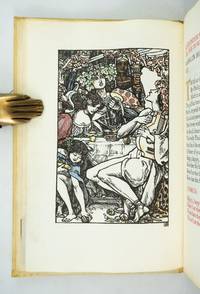
1904ST20796London: Essex House Press 1904. No. 1 OF 140 COPIES all on vellum. 195 x 131 mm. 7 3/4 x 5 1/8". 1 p.l. frontispiece 3-11 2 pp. <br/> Original stiff vellum over thin boards front cover with embossed rose design. In custom-made linen clamshell box with red morocco label on spine. Hand-colored woodcut frontispiece and final tailpiece both by Reginald Savage hand-painted initials in burnished gold red blue or green. Printed in black and red. Front pastedown with red morocco bookplate of William Andrews Clark Jr.; front endleaves with evidence of bookplate and inscription removal. Tomkinson p. 76; Ransom p. 268; Franklin p. 200. A VERY FINE COPY clean bright and free of the splaying that very frequently afflicts the boards of this work.<br/> <br/> This is a most appealing example of the luxurious hand-crafted volumes produced under the auspices of the Essex House Press with our copy coming from the library of a noted Dryden collector. The book is the 11th from the Essex House series of 14 "Great Poems in the English Language" a group of lovely little works all printed on vellum and with delightful colored illustrations and historiated initials. Generally considered to be the best example in English of the choric hymn the present work is set at a feast given by Alexander the Great who finds himself entranced by the poet and lyrist Timotheus. The great leader is lost in reveries of exploits and victory he sighs and cries over battles lost and warriors slain and he finds inspiration for new conquests. Our printer C. R. Ashbee founded the Essex House Press in 1898 by purchasing the presses and other production equipment though not the type formerly owned by the Kelmscott Press which had shut down at the death of William Morris. Ashbee printed books for 12 years with vellum ink and paper identical to that used by Kelmscott in an effort to carry on the tradition Morris had established. But the Essex House Press because it was conceived of and continued as part of a larger enterprise involving various artisans at work in a group of workshops at Ashbee's Guild of Handicrafts located at Essex House in London's Mile End Road always had its own special identity a fact which Cave reflects when he calls it the "Arts and Crafts press 'par excellence.'" The illustrator here Reginald Savage fl. 1886-1904 is deemed by Houfe "a talented and imaginative designer and woodcut artist" and Houfe notes that he was also commended by his fellow illustrator Walter Crane 1845-1915 for his "weird designs." Former owner William Andrews Clark Jr. 1877-1934 put together one of the most distinguished collections of English and French literature of his day. He had strong holdings in many areas but especially in Shakespeare and the other Elizabethans in Dryden in Oscar Wilde and in the French drama. After a fire in his home in 1923 Clark constructed a separate fireproof building to house his collection; in 1926 this library building with its distinguished collection was deeded to the University of California and now serves as a prominent center for literary research. Essex House Press unknown
19116954EBMünchen, Georg Müller, o.J. [1911]. 4°. 26 cm. 82 (6) Seiten, 82 Tafeln. Original-Halbpergamentband. Grüner Farbschnitt. [3 Warenabbildungen]
19113606FBMünchen, Georg Müller Verlag, [1911]. 4°. 26 x 20,5 cm. 82, (6) Seiten. 82 Tafeln im Anhang. Original-Halbpergamentband mit grüngeprägtem Rückentitel, Deckel mit floralem Buntpapierbezug und Rundum-Grünschnitt. [4 Warenabbildungen]
pp. viii; 126. 8vo. Original blue cloth binding. First Edition. Lists all material, in book or periodical form, of substantial biographical, interpretative, or critical value. **PRICE JUST REDUCED! REF2
pp. (vi), 243. Large 4to. Worn early full leather binding. Signs of prtevious ownerships removed. Very clean and wide margined text. Printed by one of the great firms to work in England in the wake of Baskerville. FIRST EDITION. Henry James Pye (1745-1813), poetaster and poet laureate. He was educated at home until 1762, when he entered Magdalen College, Oxford, as a gentleman-commoner. From an early age Pye cultivated literary tastes, and his main object in life was to obtain recognition as a poet. In 1790 Pye was appointed poet laureate, in succession to Thomas Warton, and he held the office for twenty-three years. He doubtless owed his good fortune to the support he had given the prime minister, Pitt, while he sat in the House of Commons. Pye was the intimate friend of Governor John Penn (1729-1795). This work has been described as his magnum opus, and was dedicated to Addington. W139 ON HOLD
chromo1t6Dimension extérieur : 23,4 x 55,5 cm. Numéro 505. Légèrement corné sur l'ensemble (a pris la forme d'un tube), redéposée entièrement sur papier Japon. Dans un état général bon.
Small format book. 4"w x 5 1/4"h. 186 pages. Black and white illustrations. An Easy to Read, Graphically Illustrated Guidebook, Designed Especially for the Beginning Stamp Collector.
2080202105600244Not Available N.A. Soft Cover. Fine. The book is in fine condition. Not Available paperback
1 c.; 41x55 cm; Due sonetti (”Allo Sposo” e “Alla Sposa”) in graziosa cornice incisa al rame.
51681aafBern, Selbstverlag, 1942, in-8vo, 444 S. mit zahlr. Fig., Halbleder gebunden mit goldgepr. Rückentitel.
8vo. (8), 359, (1) pp. With engraved title vignette. Modern half cloth with silver-stamped spine title. First edition. - A compact reference work for the principal terms of building and architecture, explaining the vocabulary used by engineers, builders, bricklayers, stonecutters, carpenters, locksmiths and other craftsmen, while also covering frequent terms of hydraulic engineering, shipbuilding and military construction. The final page provides a list of other works by the same author, prices added by hand. Modern ownership "Gass" to flyleaf. - Title vignette not properly aligned. Paper variously browned and brownstained. From the library of the Viennese collector Werner Habel, with his signed and stamped ownerships, dated 1984, to the flyleaf and pastedown. VD 18, 1136128X. Zischka 120. Kayser VI, 88. Engelmann, Bibl. mech.-tech. 414.
First Edition, 2 vols., 4to, [ii], vi, 152; [ii], vi, 88, 40, [148], [4]pp., engraved frontispieces, 8 engraved plates, 27 folding tables, wide-margin copy, some light worming to inner margins (not effecting text), orig. marbled paper wrappers, unopened, uncut, a very nice set. "Arranged as a dictionary, defining printing terms and containing much practical matter. A collection of diagrams and folding sheets shows presses and tools, type-founding utensils and moulds, type-specimens, case-lay, and imposition. Several poems in praise of printing precede a form of ceremony for reception of a new member of a printers' guild."?A List of Printers' Manuals to 1850. JPHS, No. 4, 1968. Without the third volume which was published four years later in 1809. Bigmore & Wyman, III, p.2.
1956KOS047800066Dai Nippon printing 1956 Soft Cover Fine
1959KOS047800016Dai Nippon printing 1959 Soft Cover Fine
1960KOS047800061Dai Nippon printing 1960 Soft Cover Fine
1831000015Paris Louis Janet 1831
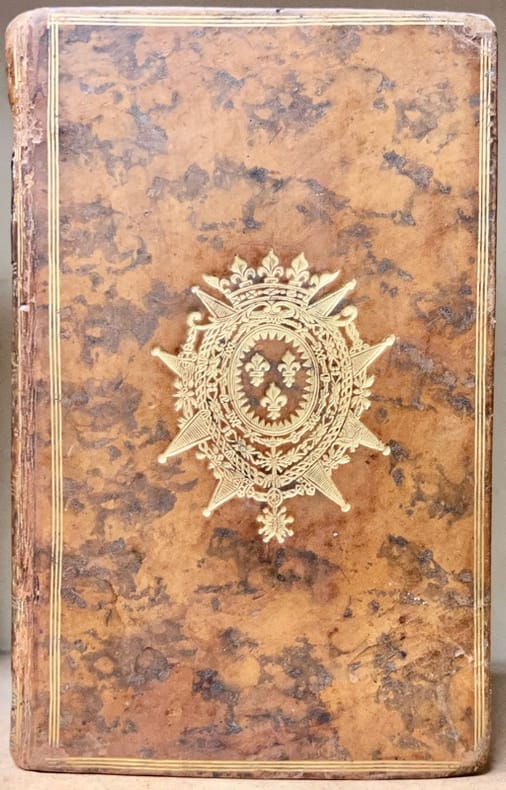
178216064A Paris, de l'Imprimerie de Monsieur, 1782. In-8 de 232 pp., veau marbré, dos lisse orné, pièce de titre en maroquin rouge, armes et triple filet doré d'encadrement sur les plats, tranches dorées (reliure de l'époque).
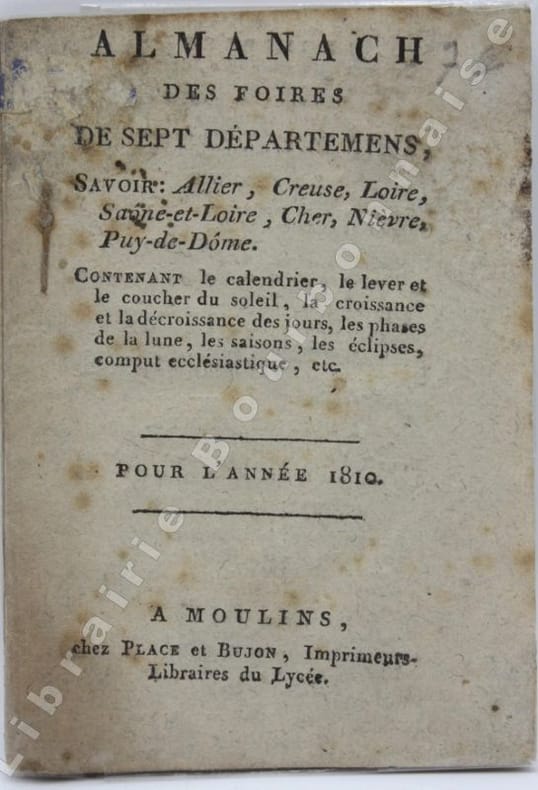
14483Moulins, Place et Bujon, 1810 ; in-32 (12,5 x 9 cm), broché. 48 pp. Tel que paru sans couverture, premier et dernier feuillets un peu tachés.
181221623Genève, J.J. Paschoud et Paris, 1812-1813 ; 80 ; 104, 16 pp. (Catalogue des Livres Nouveaux).Relié à la suite : Bibliothèque Universelle de Genève Nouvelle série. Tome dix-neuvième ; Genève Glaser, Paris Anselin (Imprimerie Ferd. Ramboz), 1839 ; 215 pp., 1 pl. lithographiée eet aquarellée sur la Vaccine du Dr Lombard.Soit 3 tomes reliés en un volume in-8, demi-veau glacé, dos lisse à faux-nerfs décoratifs, titre doré (reliure de l’époque).
10736Basle et Besançon, Chez les Libraires associés, 1812. In-4 de 30 ff. de papier gris, 3 bois à pleine page et une planche dépliante représentant la naissance du roi de Rome le 20 mars 1811. Doublage en papier de Chine du bas de la couverture imprimée; Bradel demi-chagrin rouge sombre moderne.
B9781168098986New. unknown
1160780277.Gpaperback. Good. Access codes and supplements are not guaranteed with used items. May be an ex-library book. paperback
116809898X.Gpaperback. Good. Access codes and supplements are not guaranteed with used items. May be an ex-library book. paperback
200034237ABWien, New York, Springer, 2000. 4°. 349 (1) Seiten, 1 Blatt. Original-Pappband. Original-Schutzumschlag.
New English Paperback. 4to. (28 x 23 cm). In English and Turkish. 300 p., color ills. and b/w photos. The alphabet reform which came into effect in Turkey on November 1st, 1928, made reading and writing in Turkish easier compared to the system based on the Arabic script, and it also constituted the new face of Early Republic modernization, which defined its political rhetoric through a break from its Ottoman past. The National Schools (Millet Mektepleri) played a vital role in the campaign for teaching reading and writing with the new alphabet, while the press regime structured in 1934 under the direction of the General Directorate of the Press (Matbuat Umum Müdürlügü) played a key role in the formation of a culture of national press in the country. Just like its counterparts pursued in the 1930s in Europe, in the United States, and in the Soviet Union, the press regime that was in effect in Turkey during the Early Republic period was an efficient cultural management policy, because it utilized centralized policies to shape official and private publishing that was under the control of political powers and because it got masses to adopt the ideology of modernization through publishing that reached rural areas. In the 1930s, the common goal of the press regimes of socialist, fascist, or liberal government systems, which played an active role in mass communication and education policies was the transformation of the official ideology of modernization into social culture.