Imprenta CervantesBiblio.com

7 773 résultats
1104025264.Gpaperback. Good. Access codes and supplements are not guaranteed with used items. May be an ex-library book. paperback
1165315009.Gpaperback. Good. Access codes and supplements are not guaranteed with used items. May be an ex-library book. paperback
2009DADAX1104025264Kessinger Publishing 2009-01-26. paperback. New. 7.50x1.05x9.25. Buy with confidence. Excellent Customer Service & Return policy. Kessinger Publishing paperback
1120511801.Gpaperback. Good. Access codes and supplements are not guaranteed with used items. May be an ex-library book. paperback
1120505844.Gpaperback. Good. Access codes and supplements are not guaranteed with used items. May be an ex-library book. paperback
A9781166790431New. unknown
A9781166796389New. unknown
B9781166796389New. unknown
B9781166790431New. unknown
1166796388.Gpaperback. Good. Access codes and supplements are not guaranteed with used items. May be an ex-library book. paperback
1166790436.Gpaperback. Good. Access codes and supplements are not guaranteed with used items. May be an ex-library book. paperback
4to (148 x 208 mm). 40 ff. 34 lines, Gothic type. Title-page with full-page woodcut of an anatomical scene. Modern full calf, bound to style with covers stamped in black. Housed in a custom-made cloth solander case with morocco spine label. First illustrated edition of the first dedicated anatomy book. "The first modern book devoted solely to anatomy [...] Mundinus re-introduced human dissection, which had been neglected for 1500 years before him; he was the most noted dissector of his period. The medieval anatomical vocabulary, well set forth by Mundinus, was derived mainly from Arabic" (Garrison/M.). Mondino de' Luzzi, professor at Bologna, is considered the founder of anatomy in the Middle Ages. His treatise remained popular until the beginning of the 16th century and appeared in multiple editions. - "The subject of anatomy was not taught either by lectures or by dissection in the universities at the middle of the 15th century. An occasional 'anatomy' was held, but the neglect of the subject is well illustrated by the absence of anatomical books. There is only one in the list, that of Mundinus [...]. Mundinus was a professor at Bologna from 1306 to 1326, and was the first to teach anatomy from the subject, usually the corpse of a condemned criminal; but there is the record of a procedure in 1319 against four medical students for body-snatching. His 'Anatomia', written in 1316, was for two hundred years the popular text book" (Osler). - The work "met a need universally felt just at that time and commended itself for its brevity, conciseness, and completeness, as well as for the fact that it taught for each separate organ the necessary anatomic technique" (Choulant, p, 88). The title woodcut shows a man on a chair, "with coat and high cap, in his left hand an open book, on the left side of the picture a rock and six linden trees, below, on a table, a dissected cadaver, beside its left foot lies a curved knife, to the right of the cadaver stands a young man in a short garment, bare-headed and with long curls, grasping the intestines of the cadaver with both hands" (p. 93). - Inner margin of title-page neatly reinforced; illegible old library stamp to lower margin and old handwritten number "6" to upper corner. Tiny repair to blank outer margin of final leaf. Scattered light browning, mostly marginal. Very rare: a single copy in auction records since 1979). From the library of the noted Russian-American photographer and biologist Roman Vishniac (1897-1990). H 11633. Goff M-874. GW M-25670. Bod-inc M-330. Sheppard 2122. Proctor 2994. Wellcome I, 4484. Poynter 392. Klebs 688.6. Choulant, History and Bibliography of Anatomic Illustration, p. 93, no. 4. Cf. Garrison/M. 361; Osler, Incunabula Medica 156 (for the 1478 edition).
Folio (208 x 290 mm). (17), 154 ff. With engr. title page and 42 full-page engravings in the text. Contemp. vellum in later slipcase. First Italian edition, second printing with the year on the title page changed from 1559 to 1560. Valverde's famous anatomy boasts beautiful engravings, mainly based on Vesalius, but with many improvements. "Setting of type unchanged, but many of the plates have been re-engraved (and reversed)" (Cushing). - Binding rubbed and wormed. Several carefully restored tears to t. p.; several leaves professionally restored (plate on leaf 96 covered with paper slip), some brownstaining. Cushing, Vesalius VI.D.-36. Durling 4532. Haller I, 215. Hirsch/Hübotter I, 123. Mortimer 513. Waller 9800.
1917458591917. A Geneve par Jules Guillaume Fick, imprimeur, 1863. Format 28x46 cm, broche sous couverture d'attente, 20 planches hors-texte, tire a 75 exemplaires. La couverture est degradee, mais l'ouvrage est intact sans tache. . Bon etat.
19923132503Philadelphia: Trinity Press International / London SCM Press 1992. XXXII, 448 Seiten. Gr. 8° (22,5-25 cm). Orig.-Broschur. [Softcover / Paperback].
First edition, 8vo, 36pp., 2 plans, disbound. JISC locating the University of Leeds copy only.
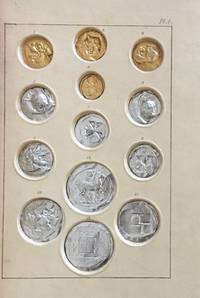
185058074London: Grant and Griffith Corner of St. Paul’s Churchyard 1850. Thick 4to. 6.75 x 9.25 x 2 in. 4 iv 208 pp. plus 2 pp. publisher’s ads decorated colophon leaf in red & black inserted errata leaf at rear. Title printed in red & black. With 10 plates featuring 114 embossed relief facsimile coins featuring gold silver copper & bronze leaf applied mimicking the originals all preserving their original printed cover leafs and some text woodcut engraved illustrations. Original embossed padded green publisher’s calf ornamental design borders & lettering in relievo marbled endpapers black linen tape reinforcement at gutter margin sunning & chipping to spine wear offsetting to text leaves minor wear & chipping to fore-edges of covers embossed raised letter spine label present still a VG bright original copy. First edition of this rare and inventive numismatic sample book on ancient Greek & Roman coins by the influential British illustrator and noted numismatist. He proclaims in his introduction how he has invented a new process to recreate actual facsimile coins in their original metals as he had found no other printing or reprographic process properly conveyed either the weight or appearance of the coins quite separate from the chromolithograph colour printing process for his very successful Coins of England. The coin specimens appear as they would have in a Victorian cabinet specimen trayHenry Noel Humphreys 1810-1879 was also fascinated with illuminated Medieval manuscripts and began producing beautiful books with painted ornaments by using the beautiful chromolithography process of Owen Jones 1809-1874. However he also had a keen interest in the natural world writing on aquariums butterflies entomology biology and more. See: Twyman A History of Chromolithography pp. 153-156; Alexander Del Mar A History of Money in Ancient Countries from the Earliest Times to the Present p. xv; Leitzmann Supplement to Lipsius Bibliotheca Numaria 60. Grant and Griffith, Corner of St. Paul’s Churchyard, unknown
2008160963Peabody, Mass.: Hendrickson Publishers 2008. XXXVI, 539 Seiten. Gr. 8° (22,5-25 cm). Orig.-Pappband mit goldgeprägtem Rückentitel sowie mit Orig.-Schutzumschlag. [Hardcover / fest gebunden].
A9781168158833New. unknown
2010DADAX1160785996Kessinger Publishing 2010-03-19. paperback. New. 6.00x1.30x9.00. Buy with confidence. Excellent Customer Service & Return policy. Kessinger Publishing paperback
B9781168158833New. unknown
1160785996.Gpaperback. Good. Access codes and supplements are not guaranteed with used items. May be an ex-library book. paperback
1168158834.Gpaperback. Good. Access codes and supplements are not guaranteed with used items. May be an ex-library book. paperback
19909923Olympia WA: The Archetype Press 1990. First edition number 19 of 40 copies. Portfolio 15x11" various typefaces printed on 12 leaves of cream and blue Magnani Incisioni Paper and with 3 linocuts by Rogers each signed. Leaves laid in gray paper folder with printed cover label. Some bumping to corners folder with toning and wear. <br /> <br /> Beautiful and rare example of Northwest fine printing and design. The portfolio features quotes from Swedenborg Theodora Ward Wallace Stevens Rainer Maria Rilke Fra Giovanni and Dante on the relationship between humans and angels. The text is presented in various typefaces and sizes alongside stark and beautifully executed linocuts by Rogers an artist and printmaker in Olympia who operated the Sammerb Press. Rogers is featured in the 1995 letterpress anthology The Ladies Printing Bee: An Anthology of Thirty-Nine Letterpress Printers Addressing the Subject of Women's Work which was printed in Sedro-Woolley WA. The design of Angelos is by Bernardo PeBenito who was active in Seattle sharing a studio with Art Chantry. <br /> <br /> We find no mention of this portfolio in OCLC nor elsewhere. The Archetype Press unknown
1951626262Berlin, de Gruyter, 1951. M. zahlr. Schriftbeisp. 2 Bl., 313 S. OLwd.