6 391 résultats
pp. xi, 115. Title page printed in red and black. Uncut. Tall 32mo. Original printed paper wraps, lettered and decorated in red. Small loss at edges. Stamped number ownership on rear cover. Nice copy. Includes an unusual plea for illumination by gas lamps. PRESS/W39
25p. + Etched portrait frontis of Stevenson. Printed only on recto throughout. Tall thin 8vo. Original cloth backed patterned binding. "Braid Scots" R.L.S. on gold lettered spine. Hardbound. Printed in small edition by Charles J. Swayer, London. Nice copy. PRESS/W32 x 2c
pp. (xvii), 113 (1). Small folio. Designed, printed, and bound by Ward Ritchie. Set in Intertype Waverly; on Linweave Paper, deckle edged. Bound in paper boards decorated by the artist, backed in brown cloth. Slipcase covered in rice paper, slightly soiled. Number 769 of an edition limited to only 1500 copies, signed by the artist. A fine example. From Wiki: The story is told in the first person by John Wiltshire, a British copra trader on the fictional South Sea island of Falesá. Upon arriving on the island, he meets a rival trader named Case, who (in an apparently friendly gesture) arranges for him to be "married" to a local girl named Uma in a ceremony designed to impress the natives but to be completely non-binding in the view of Europeans. Wiltshire soon discovers that Uma has a taboo attached to her which causes all the other natives to refuse to do business with him, to Case's profit. He also hears rumors of Case having been involved in the suspicious deaths of his previous competitors. Although realising that he has been tricked, Wiltshire has genuinely fallen in love with Uma, and has their marriage legalised by a passing missionary. Wiltshire gradually learns that Case's influence over the villagers stems from their belief that he has demonic powers, as a result of his simple conjuring tricks as well as strange noises and visions they have experienced at a "temple" he has built in the forest. Upon investigating, Wiltshire finds that these experiences are also tricks produced by imported technologies such as luminous paint and Aeolian harps. Wiltshire sets out that night to destroy the temple with gunpowder. Case confronts him and the two men fight, resulting in Case's death. The story concludes with Wiltshire several years later living on another island, still happily married to Uma, worrying about what will happen to his mixed-race children. Stevenson saw "The Beach of Falesá" as the ground-breaking work in his turn away from romanticism to realism. Stevenson wrote to his friend Sidney Colvin: 'It is the first realistic South Seas story; I mean with real South Sea character and details of life. Everybody else that has tried, that I have seen, got carried away by the romance, and ended in a kind of sugar candy sham epic, and the whole effect was lost - there was not etching, no human grin, consequently no conviction. Now I have got the smell and look of the thing a good deal. You will know more about the South Seas after you have read my little tale than if you had read a library.' In an unusual change for Stevenson, but in-line with realism, the plot of the story is less important, rather the realistic portrayal of the manners of various social classes in island society is foregrounded; it is essentially a novel of manners. As Stevenson says to Colvin in a letter, "The Beach of Falesá" is "well fed with facts" and "true to the manners' of the society it depicts." Other than the island itself which is fictional, it contains the names of real people, real ships and real buildings which Stevenson was familiar with from his personal travels in the South Seas. W42 L
pp. xiv, 93. Title page printed in red and black. Deckle edges. Top edge gold. Penciled notation. Ownership number stamped on rear end paper. Tall 32mo. Original limp leather binding, decorated and lettered in gold. Loss at edges and spine. PRESS/W39
1981053468Boulder, Shambala, 1981. 4°, Brosch., 205 S. - sehr gutes Exemplar
20102676Thames & Hudso 2010 Format carré - Broché - Couverture illustrée éditeur rempiée - 189 pages Bon état 1 020 g
ART898MNon daté / 132 pages. Broché. Editions Chronicle Books.
pp. vii, 136. Illustrated with full page etchings by Denis Tegetmeier; designed by Eric Gill; printed and bound by Hague & Gill; hand-set in Bunyan type, designed by Gill, and first used in this book; full tan buckram, stamped in blue, red and gold. 4to. 9 1/8 x 11 1/2 inches. Top edge gold. Binding curiously stained at bottom front corner and rear top corner. From the original slip case? Paper slip case paper label has slight chipping. Number 413 of an edition limited to only 1500 copies, signed by Denis Tegetmeier and Eric Gill. The books published by the Limited Editions Club are justly treasured for the quality of the texts, the beauty and artistry of the illustrations, the creativity of design, and the overall excellence of the paper, presswork, and binding. Each book would make a wonderful gift for any occasion. W42
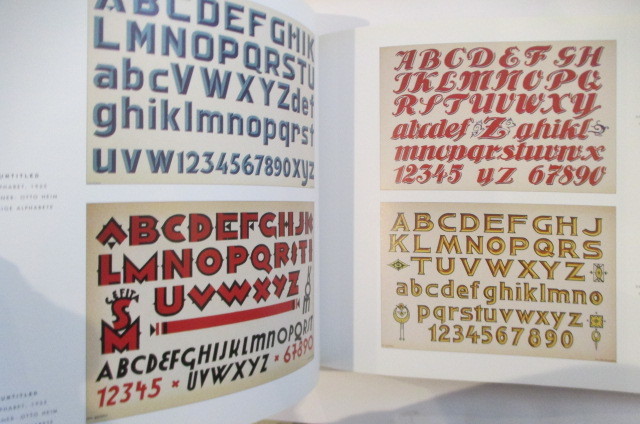
Thick 8vo, 24pp., followed by [212] leaves (mostly printed on one side only), a couple of samples excised from to leaves, orig. decorated cloth, gilt, a very good copy. This specimen book presents a fine and extensive example of the period. Provenance: From the library of Ruari McLean with his signature to front-endpaper.
79 S. Original Halbleinwand mit verziertem Deckeltitel (Jugendstil). Einband etwas berieben und bestoßen. Innen sauberer, ordentlicher Zustand.
183053161ABFrankfurt a/M. bey P.H. Guilhaumann. 1830. 8°. Lithographiertes Titelblatt, 4 n.n. S., 58 Tafeln, 30 S. Schlichter Halbleinwandband mit goldgeprägtem Rückentiel.
183053161ABFrankfurt a/M., bey P.H. Guilhaumann., 1830. 8°. Lithographiertes Titelblatt, 4 n.n. S., 58 Tafeln, 30 S. Schlichter Halbleinwandband mit goldgeprägtem Rückentiel. [3 Warenabbildungen]
20069394Bad Homburg, Linotype/ Mergenthaler, 2006, 2. Aufl. Leineneinband, Schutzumschlag, Lex-8°, 605 S.; -Umschlag minimal berieben, ordentliches, gutes Exemplar.
2006703462Bad Homburg, Mergenthaler, 2006. 4°. 605 Seiten. Orig.-Leinen mit Orig.-Umschlag. Tadelsfrei.
199585103ABLondon, Thames and Hudson, 1995. 4°. IX, 229 S. Mit vielen farb. Abb. OPp. mit OU.
12578Munchen, Prestel 1958, 185x115mm, 471Seiten, illustriert, mit zusammenfaltbaren alten Seitenreproduktionen verlegereinband mit Umschlag.
[2],449-468pp., 1 plate, orig. printed wrappers.
1948DEMO016029INo place: The Banyan Press 1948. First Limited. Hardcover. Fine/very good. Octavo 79pp. clothbacked marbled boards; glassine dj; scuffed blue publisher's slipcase <br/><br/>No. 415 of 626 numbered copies. Stein's version of a mystery novel. Foreword by Donald Gallup. Wilson A47 The Banyan Press hardcover
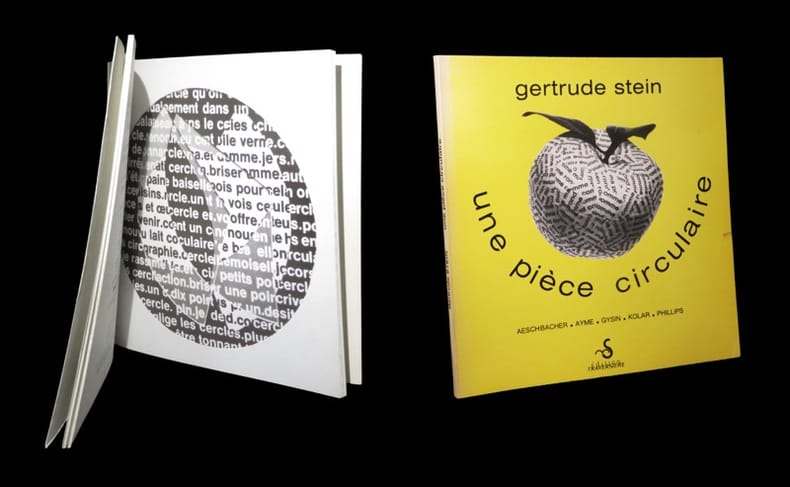
198532280S.l., Editions Traversière, (1985). Un vol. au format pt in-4 carré (223 x 212 mm) de 50 pp., broché.
35004Bern, Schweizerischen Gutenbergmuseums 1955, 235x160mm, 31Seiten, Verlegereinband. Sehr schönes Exemplar.
200618729Mainz, Verlag Hermann Schmidt, 2006. 4°. 311,(1) S., mit zahlreichen Abbildungen. Orig.-Pappband mit Transparentumschlag.
This is a very good softcover copy with just light wear. Completely clean inside and out. Folded illustrated wrapper with loose sheets. Text in English and Dutch. Essay by Sonja Herst. 11" high X 8" wide.
In 8°, pp. 13. Brossura.
1987104156Hannover, Stadtbibliothek Hannover 1987. 1987. 244 S. mit einigen s/w Abbildungen und 120 S., Orig.-Broschurbände.
4to., with a folding frontispiece and numerous illustrations and type samples in the text; original printed wrappers, sewed as issued, a very good, clean copy. Scarce. The advisory panel includes Francis Meynell, Stanley Morison and Mortimer Wheeler.