Louis, Chevalier de SADEBiblio.com

1 911 résultats
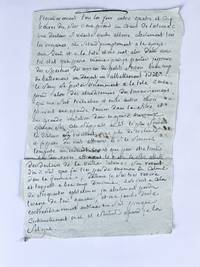
179167693s. l. Londres London Paris Toulon. 1791. Fine. s. l. Londres London Paris Toulon. 1791-1832 12 000 feuillets de divers formats en feuilles Unpublished political scientific and historical archives The complete manuscript unpublished papers of Louis Chevalier de Sade 1753-1832 author of the Lexicon politique and cousin of the famous Marquis. The important geopolitical historical and scientific archives of a learned aristocrat a privileged witness of the end of the Ancien Régime the French Revolution the Consulate Empire and Restoration. A unique fund of research on the implementation of a constitutional monarchy. Exceptional collection of the Chevalier Louis de Sade's personal archives the cousin of the Marquis de Sade representing 12000 handwritten pages including several thousand unpublished and written by his hand. The Chevalier shows a thought system that he describes as «holistic» including historical political and scientific reflections. Louis Chevalier de SADE If we take the French Revolution as the birth of an experiment both secular and political the Chevalier de Sade was without doubt one of its early critics. Not only of the Revolution which had many other detractors but of its political ideology which would go on profoundly to impact the two hundred years that followed. What he calls «positive politics» is «based on reasoning and experience». «The theory did have some attractions for me; I studied it with care I savored its principles. Now I see their value only in terms of the impact of their implementation what we've seen them produce in the peoples of which history has given me knowledge. This is my method; I know that it is all in all the opposite of the methods utilized by the men who have governed us and written our constitutions to this very day without deviation. This continuous divergence between what has been done and what should never have been done increased my confidence in the path to be followed and at the same time fortified my determination to keep to the views I had adopted of judging laws by the historic consequences they entail rather than by the lyrical supposedly conclusive metaphysical arguments with which these innovators continually and still to this day assault us.» The Chevalier de Sade who saw the world in terms of his own time and place could be nothing other than a Royalist. There were practically no examples of democracy in the history known to the Chevalier apart from the Classical democracies of Greece and Rome which had been experiments only in very elitist forms of democracy. These were very well known to this political scientist whose papers contain 7000 pages dedicated to the history of the Classical world. The republic ushered in by the Revolution was more than just a political system it was the realization of a philosophical political ideal. And while most of those opposed to the new regime saw in it above all a threat to their personal situations their religious beliefs or even more simply their habits the writings of the Chevalier de Sade show no such dogmatic influence; or at least he never uses dogma to justify his arguments. Louis de Sade a gentleman without a fortune and without significant ties was conservative through philosophical and historical conviction and not out of interest. It is with this perfect intellectual honesty that he studies the essays memoirs and political or theoretical works of his contemporaries. Running counter to Enlightenment thought the Chevalier's view of society owed very little to philosophy. Though he puts together a serious theoretical history of the development of Man from the condition of «savages» to the forging of various societies he does not posit Man's ideal nature as some of his contemporaries did. Rather the Chevalier examines the gap between nature and the civilized being without passing moral or philosophical judgment as was the fashion at the time. «The political error that damned Europe in the 18th unknown
179167693s. l. (Londres, Paris, Toulon...) 1791-1832 | 12000 feuillets de divers formats | en feuilles
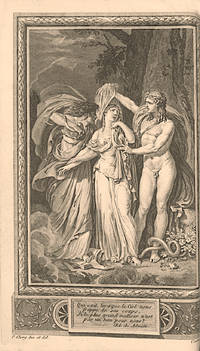
1791LCS-A103<p><strong>Original edition of <em>Justine</em> Sade's first work printed in 1791<br />"whose copies could be counted on the fingers of one hand." Pierre Berès</strong></p><p><strong>Pierre Berès described a copy of this 1791 original edition bound around 1890 by Lortic frères<br />"with large margins" height 190 mm priced at 375000 FF about 57500 33 years ago<br />Cat. 79 year 1989 no. 129.</strong></p><p><strong>Fine copy height 194 mm.</strong></p><p>2 volumes in 1 8vo. 1 frontispiece 283 pp. 2 ll. 191 pp.</p><p>Aubergine jansenist morocco spine with raised bands gilt filleted edges wide inner gilt roll gilt edges. <em>Binding signed by Petit around 1850.</em></p><p>194 x 122 mm.</p><p>"Original edition of the first work of Sade whose copies could be counted on the fingers of one hand." Pierre Berès.</p><p>The touching printed dedication of the book "A ma bonne amie" is addressed to the writer's faithful companion in misery Marie-Constance Quesnet; in this important apology for his writings Sade justifies his undertaking and asserts that his aim is to arrive at <em>one of the most sublime moral lessons ever given to man even if by a path little traveled until then.</em></p><p>A novel of adventure in the "dark genre" pushed to its paroxysm the book immediately met with considerable success. It appeared at the moment when the Constituent Assembly restored Sade's liberty after twelve years of captivity brought on by numerous clashes with his family and with society. Aristocrat allied with the Bourbons philosopher and libertine Sade grew fervent for the Revolution which disdained his services; kept in captivity after the fall of the Bastille from whose walls he incited passersby in early July 1789 the writer escaped the guillotine only thanks to the fall of Robespierre.</p><p>The frontispiece Neo-classical in style drawn and engraved by P. Chery under the direction of Antoine Carrée represents Virtue assailed by Lust.</p><p>"<em>It is under multiple aspects that one must consider the history of </em><em>Justine ou les Malheurs de la vertu</em><em>. The philosophy of the marquis de Sade is entirely summarized in the final tirade where Juliette exclaims in a triumphant voice: ' I admit it I love crime with fury; it alone inflames my senses and I will profess its maxims until the last moment of my life. Free from all religious fears knowing how to place myself above the laws by my discretion and by my wealth what power divine or human could therefore constrain my desires The past encourages me the present electrifies me I fear little for the future . Nature created men only so that they might amuse themselves with everything on earth; this is the dearest law it will always be that of my heart. Too bad for the victimsthere must be victims; everything in the universe would be destroyed without the profound laws of equilibrium; it is only through crimes that nature maintains itself and regains the rights that virtue takes from her. We obey her then by giving ourselves over to evil; our resistance is the only crime she should never forgive us. Oh! My friends let us convince ourselves of these principles; in their exercise are found all the sources of man's happiness.</em>'"</p><p>The Surrealists embraced this subversion considering the marquis de Sade as one of their most important forerunners. "A man who long remained famous only for having attached his name to a depravity a man whose conclusions in every domain are verified each day even outside his premises whose influence continues to grow and whom Baudelaire and Apollinaire did not hesitate to place in a class by himself the marquis de Sade appears as the first incarnation of the revolutionary spirit that the 19th century failed to stifle." <em>Louis Aragon and André Breton letter to Jacques Doucet</em> February 1922.</p><p>The original edition of 1791 and the new 1797 version are both equally rare and have essentially the same value.</p><p>Pierre Berès described a copy of the 1791 original bound around 1890 by Lortic frères "<em>with large margins</em>" height 190 mm priced at 375000 FF about 57500 33 years ago Cat. 79 year 1989 no. 129.<br />A copy of the 1797 edition incomplete by two engravings was sold for 160000 19 years ago in Belgium.<br />In June 2007 15 years ago Librairie P. Sourget catalogued a copy of this 1791 edition but bound in the 20th century by Tridullier priced at 75000.</p><p>Fine copy height 194 mm.</p><p>From the library of Edith Piaf's lyricist <em>René Rouzaud</em> with ex-libris "La Goualante."</p><p>Pia <em>Les Livres de l'Enfer</em> 388. Delon <em>Sade un athée en amour</em> Bibliothèque Bodmer 2014 no. 100. Bibliothèque de l'Arsenal <em>Les Choix de Pierre Leroy</em> 2016 no. 45.</p><p>FRANCAIS</p><p><strong>Edition originale de <em>Justine</em> le premier ouvrage de Sade imprimé en 1791</strong></p><p><strong>" <em>dont les exemplaires pourraient se compter sur les doigts</em>. " Pierre Berès.</strong></p><p><strong>Pierre Berès décrivait un exemplaire de cette originale de 1791 relié vers 1890 par Lortic frères</strong></p><p><strong>" <em>à belles marges</em> " hauteur 190 mm au prix de 375 000 FF environ 57 500 il y a 33 ans</strong></p><p><strong>Cat. 79 année 1989 n° 129.</strong></p><p><strong>Bel exemplaire hauteur 194 mm.</strong></p><p>2 tomes en un volume in-8. 1 frontispice 283 pp. 2 ff. 191 pp.</p><p>Maroquin aubergine janséniste dos à nerfs coupes filetées or large roulette intérieure tranches dorées. <em>Reliure signée de Petit vers 1850.</em></p><p>194 x 122 mm.</p><p>" Edition originale du premier ouvrage de Sade dont les exemplaires pourraient se compter sur les doigts. " Pierre Berès.</p><p>La touchante dédicace imprimée du livre " <em>A ma bonne amie "</em> s'adresse à la fidèle compagne de misère de l'écrivain Marie-Constance Quesnet ; dans cette importante apologie de ses écrits Sade justifie son entreprise et affirme que son dessein est d'aboutir à <em>l'une des plus sublimes leçons de morale que l'homme ait encore reçues fût-ce par une route peu frayée jusqu'à présent</em>.</p><p>Roman d'aventures du " genre noir " poussé à son paroxysme le livre eut immédiatement un succès considérable. Il paraissait au moment où la Constituante rendait à Sade sa liberté au terme de douze années de captivité que lui avaient valu des heurts nombreux avec sa famille et la société. Aristocrate allié aux Bourbons philosophe et libertin Sade s'enflamma pour la Révolution qui dédaigna son concours ; maintenu en captivité après la prise de la Bastille d'où il ameutait les passants au début du mois de juillet 1789 l'écrivain n'échappa à la guillotine que grâce à la chute de Robespierre.</p><p>Le frontispice de style néo-classique dessiné et gravé par P. Chery sous la direction d'Antoine Carrée représente la Vertu assaillie par la Luxure.</p><p>" <em>C'est sous de multiples aspects qu'il convient d'envisager l'histoire de " Justine ou les Malheurs de la vertu</em> ". <em>La philosophie du marquis de Sade y est tout entière résumée dans la tirade finale où Juliette s'écrie d'une voix triomphante : " . Je l'avoue j'aime le crime avec fureur lui seul irrite mes sens et je professerai ses maximes jusqu'au dernier moment de ma vie. Exempte de toutes craintes religieuses sachant me mettre au-dessus des lois par ma discrétion et par mes richesses quelle puissance divine ou humaine pourrait donc contraindre mes désirs Le passé m'encourage le présent m'électrise je crains peu l'avenir . La nature n'a créé les hommes que pour qu'ils s'amusent de tout sur la terre ; c'est la plus chère loi ce sera toujours celle de mon cur. Tant pis pour les victimes il en faut ; tout se détruirait dans l'univers sans les lois profondes de l'équilibre ; ce n'est que par des forfaits que la nature se maintient et reconquiert les droits que lui enlève la vertu. Nous lui obéissons donc en nous livrant au mal ; notre résistance est le seul crime qu'elle ne doive jamais nous pardonner. Oh ! Mes amis convainquons-nous de ces principes ; dans leur exercice se trouvent toutes les sources du bonheur de l'homme.</em> "</p><p>Les Surréalistes revendiquèrent cette subversion considérant le marquis de Sade comme l'un de leurs plus importants devanciers. " Un homme qui n'est resté longtemps célèbre que pour avoir attaché son nom à une dépravation un homme dont les conclusions dans tous les domaines se vérifient chaque jour en dehors même de ses prémisses dont l'influence va grandissant et que n'ont pas craint de mettre hors pair Baudelaire et Apollinaire le marquis de Sade apparaît comme la première incarnation de l'esprit révolutionnaire que le XIXè siècle n'est pas parvenu à étouffer <em>Louis Aragon et André Breton lettre à Jacques Doucet</em> février 1922.</p><p>L'édition originale de 1791 et la nouvelle rédaction de 1797 sont aussi rares l'une que l'autre et ont sensiblement la même valeur.</p><p>Pierre Berès décrivait un exemplaire de l'originale de 1791 relié vers 1890 par Lortic frères " <em>à belles marges</em> " hauteur 190 mm au prix de 375 000 FF environ 57 500 il y a 33 ans Cat. 79 année 1989 n° 129.</p><p>Un exemplaire de l'édition de 1797 incomplet de deux gravures fut adjugé 160 000 il y a 19 ans en Belgique.</p><p>En juin 2007 il y a 15 ans la Librairie P. Sourget cataloguait un exemplaire de cette édition de 1791 mais relié au XXè siècle par Tridullier au prix de 75 000 .</p><p>Bel exemplaire hauteur 194 mm.</p><p>De la bibliothèque du parolier d'Edith Piaf <em>René Rouzaud</em> avec ex-libris " La Goualante ".</p><p>Pia <em>Les Livres de l'Enfer</em> 388. Delon <em>Sade un athée en amour</em> Bibliothèque Bodmer 2014 n°100. Bibliothèque de l'Arsenal <em>Les Choix de Pierre Leroy</em> 2016 n°45.</p> chez les Libraires Associés (Paris Girouard).
180858602Charenton asylum: S. n. 1808. Fine. S. n. Charenton asylum août 1808 17.50 x 21.50 cm broché sous chemise et étui The complete original manuscript of one of Sade's first works ruled in pencil throughout comprising 40 leaves written recto and verso. This manuscript like the other extant items from the Marquis was dictated to a scribe and corrected by Sade himself. Contemporary green paper wrappers with a small lack to middle of spine. Ink title partly erased to upper cover: 9/ Net et corrigé en août 1808 bon brouillon. Les Antiquaires. Comédie en prose en 1 acte Copied and corrected August 1808 a good draft. The Antiquaries. A prose comedy in 1 Act. This title is repeated on the verso of the upper cover. Numerous manuscript corrections annotations and deletions in Sade's hand principally adding blocking and rich in both stage and acting directions. Written in 1776 and re-copied at Charenton in 1808 and most likely augmented at the time with various topical references notably including an allusion to Napoleon of whom he was hoping in vain to receive permission to leave the asylum at Charenton as a free man p.94 Les Antiquaires is one of the first theatrical pieces written by the Marquis and therefore one of his first literary works overall written eight years before the Dialogue entre un prêtre et un moribond Dialogue Between a Priest and a Dying Man. Though the precise dating of these pieces is made difficult due to the lack of the original manuscripts several clues have allowed bibliographers to date the initial composition of this piece to 1776 possibly with a corrected version during the Revolution and a few final changes at the time of this last edit which is today the only extant manuscript of this play. These clues include the status of the Jewish and English characters the style of the dialogues and Sade's correspondence with theatres; the strongest clue being biographical in nature. Les Antiquaires can essentially be considered the true theatrical version of Sade's Voyage en Italie with which it shows a sustained intertextuality. The play is about an antiquary in the 18th century sense of the term which is to say a learned devotee of Classical culture who wants to marry off his daughter to a friend with the same passion who nonetheless finds a way of convincing him to let her marry her young lover. Whether it be in the learned dialogues of the antiquaries or in their eccentric parody by the young lover imitating them Sade draws upon his own experience and observations from his travels which he expands or twists according to the viewpoint of his various characters. Hence the description of Mount Etna by the lover Delcour is a parody of Sade's detailed description of the Pietra Malla volcano and the made-up subterranean tunnel linking Etna to America is directly inspired by the tunnel of the Crypta Neapolitana described by Sade in his Voyage. The Marquis would reach back to this same experience of volcanoes in one of the most famous scenes in his Histoire de Juliette. Barely returned from his latest grand tour and almost at the same time as writing his passionate and detailed account of the experience Sade was thus also writing a satirical version of his own work until his problems with the military authorities. The work is at the same time a social critique of pointless erudition and a self-mockery of his own passion for history and of his zeal to see everything his insatiable curiosity cf. Maurice Lever preface to Voyage en Italie. This virulent satire is paradoxically twinned with a very erudite display of the author's knowledge of the latest architectural discoveries and the major contemporary questions in the field. This was in fact the element criticized by the two heads of theatres to whom Sade sent the play for consideration most likely during 1791 or 1792: The work is well-written. It shows the author's spirit and depth of knowledge but it's too serious too scientific S. n. unknown
180858602S. n. | [Asile de Charenton ] août 1808 | 17.50 x 21.50 cm | broché sous chemise et étui
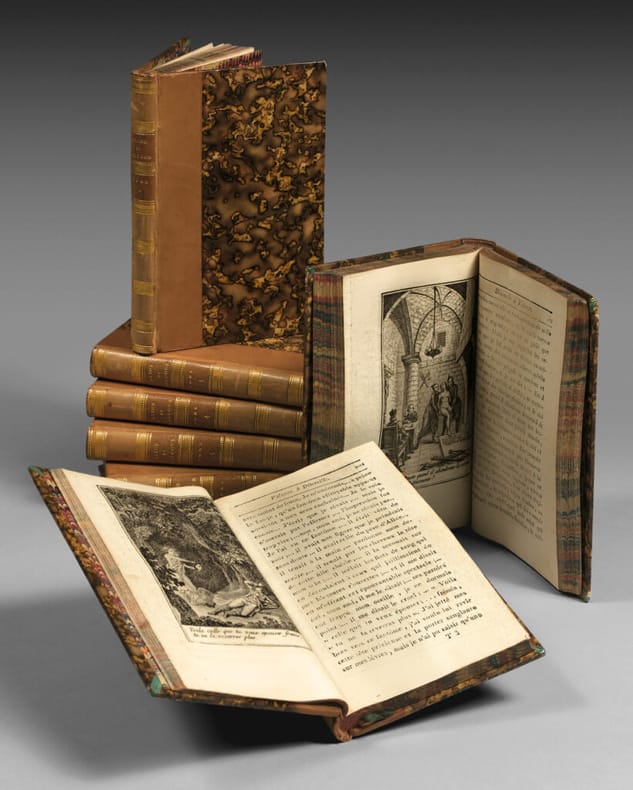
LCS-18043« Sade entend faire d’’Aline et Valcour’ son chef-d’œuvre ». (Gilbert Lely). Paris, chez la Veuve Girouard, 1795. 4 tomes en 8 volumes in-12 de : I/ (1) f.bl., xiv pp., 150 pp., 2 gravures hors-texte ; II/ (2) ff., pp. 151 à 315, 2 gravures hors-texte ; III/ (2) ff., 234 pp., (1) f. d’errata, 3 gravures hors-texte ; IV/ (2) ff., pp. 261 à 503 (saut de pages sans manque de la p. 234 à 261), (1) f. d’errata, 1 gravure hors-texte, 8 ff. brunis ; V/ (2) ff., pp. 5 à 267, 1 gravure hors texte, pte. restauration à l’angle inf. de la p. 141, pt. trou p. 219 ; VI/ (2) ff., pp. 269 à 575, 2 gravures, pte. brûlure p. 291, défaut d’impression à la p. 563 ; VII/ (2) ff., 204 pp., 2 gravures hors-texte, défaut de papier p. 143 ; VIII/ (2) ff., pp. 206 à 374, 2 gravures hors-texte. Qq. rares rousseurs pâles ou brunissures. Soit un total de 15 gravures sur 16 (comme dans la plupart des exemplaires la planche libre du tome 3 fait défaut). Demi-veau blond, dos lisses ornés de filets dorés, tranches peigne. Petite galerie de vers aux mors des vol. 1, 4 et 5. Reliure du XIXe siècle signée de Raparlier. 123 x 77 mm.
394218 parties reliées en 8 volumes in-12 (127 x 79 mm), demi-veau marbré à petits coins, dos lisses ornés de compartiments cloisonnés et fleuronnés, palette en pied, pièce de titre de maroquin rouge et de tomaison de maroquin vert (reliure de lépoque), 15 planches gravées hors-texte. A Paris, Girouard [et veuve Girouard], 1793-1795.
1790Sade1<p><strong>SADE </strong><strong>Donatien-Alphonse-François marquis de 1740-1814</strong></p><p>Autograph letter signed "de Sade" to his aunt Gabrielle-Eléonore de Sade N.p 22nd April 1790 3 pp. in-8vo</p><p><strong>Long and powerful letter from the Marquis de Sade just after his release from the hospice of Charenton. He shouts with rage the injustice done to him by his in-laws these "<em>monsters</em>" and mourns the loss of his precious manuscripts – including <em>The 120 Days of Sodom</em> – during the storming of the Bastille the previous year.</strong></p><p><strong><em>"</em></strong><em>M</em><strong><em>y room was searched and I lost everything. precious works the fruit of fifteen years' work I have saved nothing. and all this through the fault of those wretched rascals whom I hope God will one day avenge me"</em></strong></p><p><em>" Je manquerais au plus cher et au plus sacré de mes devoirs ma chère tante si je ne vous informais pas que <strong>je viens d'obtenir enfin ma liberté </strong>; il ne manquerait à mon bonheur que la satisfaction de pouvoir vous embrasser tout de suite et j'y volerai sans doute si des affaires majeures ne me retenaient encore quelque temps ici.</em><em><br />Ce n'est que dans votre sein ma chère et aimable tante que je puis déposer les chagrins violents que je reçois à toutes minutes de ma famille de Montreuil ; ils se seraient alliés au fils d'un charretier qu'ils n'auraient pas pour lui de procédés plus atroces et plus humiliants. J'ai des torts avec eux soit mais <strong>dix-sept</strong></em> ans <strong><em>de malheur dont treize ans consécutifs dans les deux plus horribles prisons du royaume… dans des prisons où l'on m'a fait souffrir tous les tourments qui peuvent s'imaginer</em></strong><em> <strong>cet assemblage dis-je de supplices et de revers n'a-t-il pas dû expier ses torts…</strong> <strong>qui dans le fait leur appartenaient plus qu'à moi</strong>. <strong>Ces gens-là sont des monstres</strong> je vous l'assure ma chère tante et le plus grand malheur de ma vie est de m'y être allié ; j'ai acquis en les épousant beaucoup de cousins banqueroutiers quelques marchands du Pont Neuf un couple de pendus et pas une protection pas un ami pas un individu honnête ; <strong>les scélérats travaillent à me ruiner maintenant qu'ils ne peuvent plus m'enfermer</strong>. Ils veulent me séparer d'avec ma femme et comme dans les commencements de mon mariage ils me facilitaient exprès des déplacements sur la dot il faut maintenant que mon bien réponde de ces déplacements et cela me ruine. Il va me rester à peine de quoi vivre et moi qui ne m'étais marié que pour trouver une société dans ma maison quand je vieillirais me voilà délaissé abandonné isolé et réduit au triste destin dans lequel mon malheureux père a fini ses jours de toutes les positions de la vieillesse celle que je redoutais le plus dans le monde.</em><em><br />Par un de ces plats coquins là excepté mes enfants dont je n'ai qu'à me louer pas un dis-je ne m'a seulement tendu la main quand je suis sorti de prison. <strong>Je me suis trouvé au milieu de Paris avec un louis dans ma poche sans savoir où aller manger et dormir</strong> sans savoir qui me donnerait un écu quand mon louis serait fini et ne recevant que des vilaines gens que j'implorais que des rebuffades et de mauvais compliments ; <strong>porte fermée chez tous et principalement chez ma femme ce qui est le comble de l'horreur </strong>; non non ma chère tante jamais on n'a vu de procédés pareils je vous le répète ou n'en imagina jamais de semblables.</em><strong><em><br />J'avais quelques meubles un peu de linge beaucoup de livres et plus de quinze volumes d'ouvrages manuscrits de ma composition fruits des travaux de ma solitude ; par une négligence ou plutôt une incompréhensible méchanceté ces vilaines gens m'ont laissé prendre tout cela au siège de la Bastille. Ils venaient de peur que je n'eusse ma liberté à cette époque de m'en faire sortir pour aller dans une autre prison. Ils n'ont jamais voulu que je prisse mes effets avec moi ; ils ont fait mettre le scellé sur la porte huit jours après est venu le siège ma chambre a été enfoncée et j'ai tout perdu… des ouvrages précieux le fruit du travail de quinze ans je n'ai rien sauvé… et tout cela par la faute de ces misérables coquins dont j'espère que Dieu me vengera un jour.</em></strong><em><br />Pardon ma chère et bonne tante vous que j'ai toujours adorée mille et mille pardons de vous ennuyer si longuement de moi mais j'ai tant de chagrin dans le cœur qu'il m'est impossible de ne pas le confier à une aussi bonne et si chère amie que vous. Je vous supplie de m'écrire de me parler de votre santé de me dire si vous m'aimez encore un peu et d'être bien persuadée que vous n'avez au monde personne qui vous soit plus tendrement et plus respectueusement attachée que moi.</em><em><br />Je vous prie de me rappeler dans le souvenir de celle de mes tantes et de mes cousines que j'ai le bonheur de conserver encor sans oublier Madame de Raousset avec laquelle je vous prie de me raccommoder s'il lui restait encore quelque chose sur le cœur contre moi. </em><em><br />Je vous assure ma chère tante de mon profond respect de Sade. "</em></p><p>Written from 1782 on the manuscript of<em>The 120 Days of Sodom</em> was entirely assembled by Sade in his cell at the Bastille. Every evening between 22 October and 28 November 1785; he copied his drafts on thirty-five pieces of paper eleven centimeters wide which glued end-to-end formed a roll twelve meters long and written on each side. Protected by a leather case the manuscript was hidden between two stones of his cell. On July 2 1789 twelve days before the storming of the Bastille Sade revolted:</p><p>"<em>He sat at his window yesterday at noon and shouted with all his rage and was heard from the whole neighborhood and passers-by that the prisoners of the Bastille were being slaughtered that the prisoners of the Bastille would be murdered and that they had to come to their rescue"</em> reports the Marquis de Launay governor of the Bastille. He obtained the immediate transfer of Sade to the asylum in Charenton. Sade was released the following year on 2 April 1790.</p>
178159108s. l. Vincennes 1781. Fine. s. l. Vincennes s. d. circa 1781 15.70 x 20.10 cm une feuille SADE Donatien Alphonse François Marquis de Autograph letter to his wife. Hommages à la Présidente: Faire noyer vive l'exécrable coquine qui depuis neuf ans . suce mon sang. N. p. Vincennes Castle n. d. circa 1781 157 x 201 mm 6 3/16 x 7 15/16 single leaf The more I think about it however the more I think you have to have quite a nerve to dare write to a poor suffering unfortunate. Autograph letter unsigned from the Marquis de Sade to his wife. One page closely written in ink on 31 lines. This letter was written during Sade's imprisonment at Vincennes probably in April 1781 if one is to believe the occasional indicators of date referenced by the writer. Sade mentions the end of his exile from Marseilles referring to the decision of the court in Aix-en-Provence to overturn his conviction for debauchery and libertinage on the 14 July 1778 but which nonetheless banned him from living in or visiting Marseilles for three years. Sade also mentions one of the defining episodes of his life his flight to Italy between January and November 1776: they may as well have killed me straight off as left me in that foreign country where I was. Sade also mentions the amazing favor that befell him of moving house which is to say his potential transfer to the fort at Montélimar. In April 1781 Madame de Sade through the good offices of her friend Madame de Sorans got authorization from the King for her husband to be transferred to the prison there. Sade explains in the letter: I think you have to have quite a nerve to dare write to a poor suffering unfortunate who has been beset these nine years.telling him to thank ever so humbly the woman who obtained for him the amazing favor of moving house. Sade is here no doubt referring to the famous Madame de Sorans a lady of Louis XVI's sister's bedchamber and a friend of his wife's who out of a spirit of adventure accepted the task of petitioning the King in his favor. It was to Commissioner Le Noir referenced in this letter that Renée-Pélagie left the task of breaking the news to the prisoner: Ah I see now what this nice little visit by M. Lenoir means I'm used to seeing him in the middle of my incarcerations. Despite the fact that as Pauvert points out in Sade vivant this change of house occupied the Marquis' thoughts to a large extent he was never actually moved preferring to stay in the gaols of the keep at Vincennes. At this point Sade had been imprisoned for several years and this letter full of movement reveals his thirst for freedom. This letter was written when Madame de Sade withdrew to the convent at Sainte-Aure. If she saw this act as a liberation from the yoke of her marriage the Marquis for his part was obsessed by the idea of his own liberation and mentions a potential date: October 1783. His long incarceration which began in 1777 would last till April 1790 when lettres de cachet were abolished. Madame de Sade's visits were not reauthorized by the prison authorities until 13 July 1781 after four years and five months of separation. Several important themes in Sade's correspondence already appear in this letter from his first years in prison. First of all his hatred for his mother-in-law the Présidente de Montreuil an execrable wretch who drinks my blood.disgraces her children who has not yet done scattering her horrific deeds and platitudes and whom he would like to drown alive. The Marquis also complains of his poor physical health: my head spins and in my condition I hardly need any more misery using very Sadean epithets to express his despair. A poor suffering unfortunate who has been beset these nine years; what have I done what have I done dear Lord to suffer for twelve years. Provenance: family archives. unknown
178059110s. l.: S. n. 1780. Fine. S. n. s. l. 17 août 1780 10 x 16 cm 2 pages sur un feuillet Handwritten letter to his wife. Sufferance and philosophy: Punish as much as you like but do not kill me: I did not deserve it . Ah! If you could read to the bottom of my heart see everything that happens there I think you would give up using it!August 17 1780 10 x 16 cm loose leaves Handwritten letter from the Marquis de Sade addressed to his wife. One recto-verso leaf written in fine tight writing. It has the partial date at the top ce jeudi 17 this Thursday 17th. Two slight signs of folding. The end of the letter was mutilated at the time probably by the prison administration which destroyed the Marquis' licentious correspondence. So several months later in March 1781 his wife wrote to him: My dear you really must change your style so that your letters can reach me whole. If you give the truth it offends turns against you. If you give any untruths they say: this is an incorrigible man always with the same head that ferments ungrateful false etc. In any case your style can only harm you. So change it. The letter was found as it was when in 1948 the Marquis' trunk that had been sealed by the family since 1814 was open and it was published in this reduced form in the correspondence of the Marquis de Sade. Provenance: family archives. This letter was written on 17 August 1780 during the Marquis' incarceration in Vincennes Prison. Following the umpteenth altercation with the prison guard the right to go for a walk was taken away from him on 27 June and was not reinstated until 9 March the following year. The Marquis' physical and mental health is strongly affected by not being able to go out and he constantly begs Renée-Pélagie for the right to be quickly reinstated: I urge you to let me get some fresh air: I absolutely cannot take it any longer. The suffering caused by these deprivations is a pretext for setting up a mechanism of guilt and blackmail with his wife: There three days that I have felt an awful dizziness with blood rushing to my head so much so that I do not know how I have not fainted. One of these days they will find me dead and you will be responsible after having warned you as I do and having asked you for the help which I need to avoid it. Here the Marquis is intentionally pulling on Renée-Pélagie's heartstrings really putting her Christian values to the test and giving her the role of grand inquisitor: You can grant me what I ask for whilst keeping on your signal the same strength. We note as in Tancrède's letter a new appearance of signal which masks completely different semantics. An essential component of the Marquis' prison mindset this encoded language like the fantasised interpretations of his correspondents' letters feeds the theories of researchers philosophers mathematicians. and poet biographers. As such Gilbert Lely estimates that far from being symptomatic of psychosis the return to signals is his psyche's defence reaction a subconscious struggle against despair where without the help of such a distraction his motivation could have declined. Missing from his correspondence during his eleven years of freedom these enigmatic semantic depths a real challenge to semiological judgement Lever p.637 reappear in his Charenton diary. This letter is also an opportunity for the Marquis to deploy his rhetorical panel confronting the sadistic antonyms in the same sentence. Pleasure is synonymous with abominable revolting cemeteryand garden are superimposed I suffer is conjugated as I enjoy and softness stands alongside darkness. The mastered practice of this eloquence exercise is united with the depths of Sadian thought: sufferance and pleasure are closely mixed simultaneously endured inflicted and desired. Through these associations we glimpse the sensitive Manicheism of the Marquis's philosophical thought which reaches its climax at the S. n. unknown
178159108s. l. [Vincennes] s. d. [circa 1781] | 15.70 x 20.10 cm | une feuille
178059110S. n. | s. l. 17 août 1780 | 10 x 16 cm | 2 pages sur un feuillet
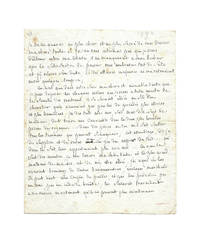
1793733941793. Fine. 1er avril 1793 15.60 x 20 cm une page sur un feuillet Unpublished autograph letter signed and dated written in black ink and addressed to a notary. On the verso probably in the hand of a secretary the inscription ""Sade du 1er avril 1793""; below this inscription a short sentence in the Marquis's hand: ""so that I may write to Gaufridy to send him money"". Some transverse folds from the original folding for posting. Lengthy letter addressed to a notary while the Marquis freed on April 2 1790 by the abolition of royal warrants is at liberty and attempting to put his affairs in order. After the Revolution his sons emigrated and he did not follow them. His name nevertheless appears on the list of persons who left France due to the revolutionary troubles: ""I hope that with all this I will manage to have my name erased from that fatal list of émigrés."" Anxious not to be considered a ci-devant Marquis in this period preceding the Terror he insists on the persecution of which he claims to be a victim despite his good will: ""It is an unparalleled atrocity that such a trick should have been played on me who have not left Paris since the revolution and who since that time have not ceased to give the most unequivocal proofs of my patriotism"". In this letter Sade also denounces the complexity of the workings of the French administration after the Revolution: ""I have just sent M. Lions the appropriate certificate of residence and I have attached a petition to the district which he tells me is . essential."" Impecunious he begs his lawyer ""to excite the zeal of those who owe him and to urge them to pay as much money as they collect immediately to M. Gauffridi sic"" and does not hesitate to show himself obliging in order to achieve his ends: ""spare no effort then I beseech you . always preserve for me your care and your friendship . I embrace and greet you with all my heart."" Sade's efforts would prove futile; in December 1793 he was imprisoned at the Madelonnettes before being admitted through the good offices of his friend Mme Quenet to the Coignard de Picpus establishment a nursing home sheltering wealthy suspects. Interesting unpublished letter showing the unfortunate Marquis at bay during one of his rare moments of freedom. unknown
1793733941er avril 1793 | 15.60 x 20 cm | une page sur un feuillet
179168333Marquis de Sade's First Published Book. Greatly Expanded from the Original Novella SADE Marquis de. Justine Ou Les Malheurs De La Vertu. En Hollande Paris: Chez les Libraires Associes 1791. Second edition published the same year as the first and considered equally or even more rare. Two twelvemo volume in one 6 1/2 x 3 3/4 inches; 165 x 95 mm. 2 5-339 1 blank; 4 228 pp. Both Volume I and II are in twelve and both title-pages have the pyramid-shape vignette engraving. With the half-title for volume II only which is identical to the volume I half-title. Our copy is lacking the engraved frontispiece in volume I as well as the 3 leaves which are commonly lacking in volume I the half-title for volume I the "LÃavis de lÃÈditeur" Notice from the Editor and "LÃexplication de lÃestampe." Explanation of Frontispiece. These two leaves are almost alway lacking and in fact are only known of in one or two copies. Volume is textually complete and with the half-title. Volume II is lacking the twelve engraved plates as usual. Title-pages of both volumes are bound in on stubs. Full 19th-Century maroon sheep. Boards triple-ruled in gilt. Spine stamped and lettered in gilt. Floral gilt dentelles. All edges gilt. Marbled endpapers. In volume I leaf F5 with a one-inch closed tear barely affecting text. Leaf S3 with corner renewed not affecting text. In volume II half-title with a closed tear professionally repaired. A small marginal hole to leaf C5 not affecting text and leaf T5 with marginal repair not affecting text. Some light staining and toning throughout. Otherwise a very good copy. This second edition printed the same year as the first edition is the first published work by Marquis de Sade. The original story entitled "Les Infortunes de la Vertu" was composed while he was imprisoned in the Bastille in 1787-1788 but was never published until 1930. Upon his release from imprisonment he much expanded and reworked the story articulating "the voice of a first-person female narration and not only recounts JustineÃs point of view but her vocal stutters and juvenile logorrhea as well." Kristi L. Krumnow Utah State University. "Justine his most famous and influential work a greatly-expanded version of a novella he wrote while in the Bastille is the harrowing story of a 14-year old orphan of uncompromising virtue who over the course of ten years is captured and abused by a succession of amoral libertines. The work reads like a symposium in moral philosophy whose interlocutors all of whom have the same learned voice whether male or female young or old take time out from their discourse for increasingly extravagant and brutal sex scenes presented in the allusive and metaphoric language of the period. Structurally based on Candide in the interminable suffering of the innocent heroine in a world of corruption it argues that those who hold virtue as an ideal are doomed to poverty and abuse while those who acquiesce in vice become rich and successful. The work was so popular that it appeared in seven further editions in the course of ten years. The first edition was not illustrated save for the frontispiece. The second edition which appeared the same year in reduced format but without alteration of the text save for a few lines added to the end of the ìavis de lÃÈditeurî was adorned with twelve engraved illustrations lacking as usual in the present copy." Sotheby's 14 December 2012 Cohen-de Ricci 920. HBS 68333. $10000 Chez les Libraires Associes hardcover books
196163797Ohne Ort (Paris), ohne Verlag bzw. Drucker, 1961. Fol. Mit 10 jeweils in Doppelblatt eingelegte sign. Orig.-Radierungen u. 2 Doppelblättern Text (Titel u. Druckvermerk), lose in OUmschlag, OSeidendecke u. OSeidenschuber.
180185841Charenton 1801. Fine. ""I experience spasms a sort of shivering a lot of yawning disgust total despondency the blood rushes violently to my head then I feel dizzy spinning which makes me stumble and a thousand other things proving a great tension in the body and a great irritation in the nervous system."" Charenton 1801 15 x 22.80 cm un feuillet composé deux papiers encollés Original autograph letter by the Marquis de Sade consists of 27 lines of relatively tight handwriting. Most likely written to his wife as evidenced by the letter's origin from Sade's family. The letter is physically composed of two glued pieces of paper. On the verso the Marquis wrote 19 lines and scrupulously crossed them out - a few words and letters are still quite visible. Cited in Maurice Lever's biography 'Donatien Alphonse François marquis de Sade' Paris Fayard 1991 p. 631. On March 7 1801 Armand de Sade the Marquis's son received a letter from the Minister of Police Joseph Fouché notifying him that his father had been arrested yesterday and that handwritten pages from the novel 'La nouvelle Justine' Justine or the Misfortunes of Virtue had been found on his person: Nevertheless sensitive to your request for leniency and concerned to preserve the honor of your name I have decided to have your father transferred to the Charenton nursing home.. It should be noted that for Fouché Charenton an insane asylum was nothing more than a nursing home a prison. It should not be forgotten that a large proportion of the population of these asylums did not fit into the social and moral field and psychiatry has long had no other aim than to normalize to make them fit for social life. Contrary to what has been said Sade fits in perfectly. However as soon as he entered Charenton Sade's attitude led to his expulsion to Bicêtre the Bastille of scoundrels but his family succeeded in getting him back into the Charenton asylum. Charenton was not only the Marquis de Sade's last incarceration but also the last place he lived in where he died in 1814. The 19 lines scrupulously crossed out on the back of the leaf reveal a few words or letters; in this respect we can conjecture that it's a coded message which Sade was quite fond of for if censorship had been behind these erasures absolutely everything would have been yet the message clearly shows that almost everything has been conscientiously crossed out apart from a few words or letters. We can still make out a few of them: 'Nécessaire' 'à tous' 'ger' 'ue' 'quel' 'je trouve' 'de'. As for the letter itself it is remarkable for the homogeneity of its message. It is a lengthy complaint describing the physical ailments Sade has suffered. It is an account of the sum total of the symptoms that overwhelm the writer. In a hyperbolic style using among other figures of speech adverbs of intensity si tel très. Sade methodically spells out the violent pains his body is suffering with the whole of this violence constituting a system a structure in which all the parts are linked. In the writer's correspondence it can be said that each time he found himself incarcerated his letters mention uncontrollable physical attacks although we know of no other letter so uniform and systematic.The pain originates in the pit of the stomach radiating out to the periphery: head eyes legs all converging on vertigo loss of balance. .because that's what it's all about: Sade isn't suffering from any illness he's besieged by anguish whose ultimate meaning is vertigo the wavering of a reality from which his freedom to live as he pleases his freedom of movement and his name have been taken away. The loss of these fundamental elements of his existence sends Sade in turmoil. In addition and as regards the formation of these particular symtoms if we consider that the fulfillment of a certain sexual sadism is necessary to him the deprivation of this satisfaction turns this sadistic driv unknown
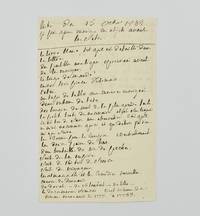
178321208931783. Vincennes fortress. 15 October 1783. Single leaf c. 155 x 100 mm pp. 2 comprising 38 lines written in dark brown ink; a few small stains to verso but generally very good.An apparently unpublished autograph note by the Marquis de Sade 1740-1814 addressed to his wife listing items he requested from prison primarily books.On 26 August 1778 Donatien Alphonse Francois Marquis de Sade was arrested at his chateau in La Coste Provence on charges of sexual violence and libertine excesses and subsequently imprisoned in the fortress of Vincennes. From his cell he remained prolific maintaining an extensive correspondence - primarily with his wife Renee-Pelagie de Montreuil 1763-1813 - and continuing work on Voyage d'Italie and several plays. In the summer of 1782 he wrote Dialogue entre un pretre et un moribund and began Les 120 Journees de Sodome ou l'ecole du libertinage. When Vincennes closed in February 1784 he was transferred to the Bastille where he produced a fair copy of Sodom the so-called ""rouleau de la Bastille"" now regarded as his first major work.An insatiable reader Sade regularly consulted the catalogue of the bookseller Merigot le Jeune whose shop stood at the corner of Quai des Augustins now Quai des Grands-Augustins and Rue Pavee now Rue Seguier. He selected works on history science philosophy and travel which he ordered through his wife. In this note to her he requested essential items for prison life including writing and reading materials: a ""blank book"" a ""table mat"" and the ""night candles of the largest size"". Among his reading requests were works by Francois-Thomas-Marie de Baculard d'Arnaud 1718-1805 Jacques Delille 1738-1813 Claude Joseph Dorat 1734-1780 and Jean Francois de Saint-Lambert 1716-1803 as well as Le Decameron francais by Louis d'Ussieux 1744-1804. Of these authors Dorat stands out for his affinity with libertine themes having gained renown for his erotic poetry plays and novels including the epistolary seduction novel Les Malheurs de l'inconstance 1772.The text of the note runs as follows:liste du 15 octobre 1783.je prie qu'on envoie les objets avantles fetes.Le livre blanc tel quil est detaille dans le lettresdes pastilles arabiques eprouvees avantde les envoyer.Le linge demandeencore trois pieces d'estomac.L'etui.Un tapis de table aux mesures envoyees.Deux rubans de tete.Des bougies de nuit de la plus grande taille.La petite boite du necessaire objet sur lequelil est bon de faire une observation c'est quil ne m'est necessaire quici et que dehors je n'en ai que faire.Le coussin pour le croupion essentiellement.Les douze paires de bas.Deux bouteilles de vin de peche.Suite du bon empiresuite de l'histoire de francesuite du voiyageur.Les almanachs et les Comedies nouvelles.OEuvres de darnaudde dorat. - de st lambert - de lille -le decameron francois vingt volumes de roman nouveaux de 1777 a 17783 sic.verso:envoyez de ces livres les au moinsvingt ou trente volumes parce que j'en manque tres absolument et tres au pied de la lettre. Je ne vous demande point de quinzaine expres afin que vous m'envoyiez a la place des livres don't je ne peux plus absolument me passer 8 jours surtout ceux de seconde - lecture don't j'ai encore pour la semaine et pas davantage Je vous embrasse de tout mon coeurList of 15 October 1783I pray that the items be sent before the holidays.The blank book as detailed in the letters.The Arabic pastilles tested before being sent.The requested linen.Three more stomach pieces.The case.A table man to the measurements sent.Two head ribbons.Night candles of the largest size.The small necessity box an item on which it is worth making an observation: it is only necessary for me here and outside I have no use for it.The cushion for the rump essential.Twelve pairs of stockings.Two bottles of peach wine.Continuation of the Bon empireContinuation of the History of France.Continuation of the Voyageur.The almanacs and the new comedies.Works of d'Arnaud.Of Dorat - of Saint-Lambert - of Delille.The Decameron francais.Twenty volumes of new novels from 1777 to 1783.verso:Send at least twenty or thirty volumes of these books for I am in absolute need of them and that in the strictest sense. I do not request fortnightly shipment on purpose so that instead you may send books without which I absolutely cannot do for even eight days - especially those for second reading of which I have enough for the week and no more.I kiss you with all my heart. unknown
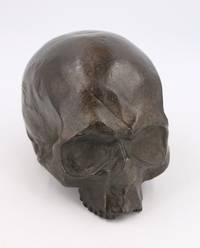
201291763s. l.: S. n. 2012. Fine. S. n. s. l. 2012 20 x 13.50 cm autre Bronze cast of the Marquis de Sades skull by the master founder Avangini. One of a unique numbered edition of 99 bearing a reproduction of Sades signature this one No. 30. Also included is a certificate of authenticity signed by the Comtesse de Sade with the familys wax seal. Provenance: family archives. On Friday 2nd December 1814 Donatien Alphonse François Marquis de Sade died at the Charenton asylum at the age of 74. Despite his final wishes the Marquis had a religious burial in the cemetery at Charenton. In an ironic twist of fate Sade would not stay in the bosom of the Church for long even after death for a few years later his tomb was profaned in the name of science by the asylums doctor Dr. L. J. Ramon. Having studied the enigmatic Marquis skull he passed it on to his German colleague Johann Spurzheim a student of the famous Franz Joseph Gall the founder of phrenology very new and very popular at the time. Spurzheim made a cast today in the Anthropological Lab of the Musée de lHomme in Paris of the precious skull and exhibited the original during his European conferences. He then lost it apparently in Germany or America. What greater freedom could someone who had spent the best years of his life behind bars have hoped for The museum also preserves the notes from the very partial phrenological analysis of the Marquis de Sades cerebral structure carried out by Spurzheims assistant which was nothing less than a new posthumous trial culminating in another guilty verdict this time without appeal: Born from the most shameful passions and marked by feelings of opprobrium and ignominy a world-view so monstrous if it were not the brainchild of a lunatic would render its creator unworthy of being called a man and would blacken his reputation for good. We however prefer the more honest description provided by Dr Ramon in his Notes on M. de Sade: Sades skull nonetheless had not been in my possession many days before I examined it from the phrenological point of view something I was very taken with at the time as well as magnetism. What did this examination show me A well-developed crown Theosophy goodwill; marked projection behind and underneath the ears a conflict point similarly developed organs in the skull of du Guesclin; mid-sized cerebellum an elongated distance between one mastoid part of the temporal bone and another indicating excesses in physical love. In a word just as I was unable to discover in Sade as he walked along seriously and I would even say almost in a patrician way the author of Justine and Juliette my inspection of his head would have made me absolve him altogether of the charge of producing such works: his skull was in all respects comparable to that of a Church Father. A tangible testimony to the impenetrable secret of the Marquis and his intolerable freedom. This bronze skull the only replica of the occiput that so mysteriously disappeared seems to respond to the Shakespearean question with a sarcastic reformulation: To be free or not to be! S. n. unknown
180385841Charenton [1803-1808] | 15 x 22.80 cm | un feuillet composé deux papiers encollés
201291763S. n. | s. l. 2012 | 20 x 13.50 cm | autre
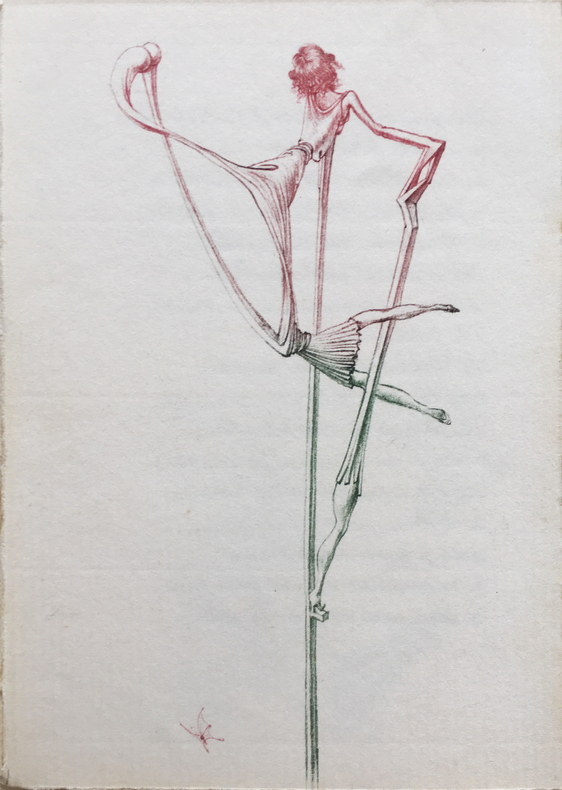
19391789Paris, Éditions Jeanne Bucher, 1939. Petit in-12 broché, couverture de papier rose orné d'une dentelle de papier blanc contrecollée. Édition originale de cet ouvrage "précieux et inquiétant" (F. Chapon, Le Peintre et le livre, 1987, p. 309). Les poèmes calligraphiés par Georges Hugnet et les 25 COMPOSITIONS EN COULEURS DE HANS BELLMER, dont une en frontispice et 6 à pleine page, sont fidèlement reproduits par héliogravure, avec des rehauts de couleurs à la main. Un des 200 exemplaires sur vélin de Rives, numéroté au crayon noir (n° 187) et signé à l'encre par Georges Hugnet. English : Book with 25 illustrations (hand-colored heliogravures) by Hans Bellmer and texts by Georges Hugnet. Edited by Jeanne Bucher, Paris 1939. This copy is numbered 187 from the edition of 200 on Rives paper. Signed in ink by G. Hugnet. Pink soft cover covered with white wrapping paper lace. Dimensions: 13 x 9,5 cm. The book is in excellent condition. Rare work by the artists Hans Bellmer and Georges Hugnet.
19040037320Paris: Club des Bibliophiles 1904. First Edition. Hardcover Hardcover. Near Fine Condition. 26cm x 18cm. viii 544 pages. Half leather marbled papered boards gilt lettering top edge gilt marbled endpapers. Text is in French. The first printed edition and editio princeps of the text based on the notorious manuscript written by Donatien Alphonse François Marquis de Sade in the Bastille in 1785. The manuscript composed in minute script on a continuous paper roll was long presumed lost following the storming of the Bastille before resurfacing in the late nineteenth century and coming into the hands of the Berlin physician and pioneering sexologist Iwan Bloch. Bloch prepared the first edition editing and annotating the text under the pseudonym Eugene Duhren and issued it via the Berlin bookseller Max Harrwitz using a fictive Paris imprint to mitigate censorship concerns. In his introduction Bloch framed the work as a document of scientific and anthropological interest intended for specialists in sexual pathology jurisprudence and cultural history. The text as here presented is incomplete and editorially imperfect deficiencies later addressed in Maurice Heine's critical edition of 1931-35 prepared from direct examination of the autograph manuscript yet this remains the foundational printed appearance. One of 200 numbered copies this being one of 160 printed on laid paper. Together with the rare original subscription prospectus by Max Harrwitz three leaves 29cm x 11.cm folded vertically and complete with original cord. Text is in French. Minor rubbing to board and leather edges. Very minor general wear and foxing to interior. Category: Sexuality; Foreign Language::French; Sexuality::Fetish & SM; French Language; Literature & Fiction. Inventory No: 0037320. BZDB407 Sexuality; Foreign Language::French; Sexuality::Fetish & SM; French Language; Literature & Fiction. Unbranded Marquis de Sade; Eugene Duhren Iwan Bloch Les 120 Journees de Sodome ou l'Ecole du Libertinage par le Marquis de Sade Club des Bibliophiles hardcover
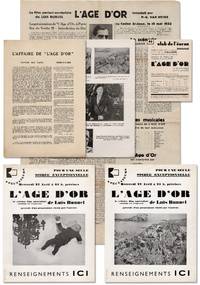
1932169144N.p.: N.p. 1932. A small archive of five vintage French pamphlets flyers and broadsides announcing 1931 and 1932 screenings of the banned 1930 surrealist film. All items are housed loose in a custom bound volume with a "L'Affaire de L'Age d'Or" label on the spine with each item laid in on separate leaves overlaid with heavy protective tissue housed in a custom slipcase. Rare.<br /> <br /> The archive includes:<br /> <br /> "L'Affaire de 'L'Age d'Or'" bi-fold pamphlet printed on rectos and versos with a satin-finish photo illustrated insert also printed on the recto and verso published by Nancy Cunard on the occasion of her January 1931 private screening of the film in London. The bi-fold includes the essay "Exposé des Faits" "Statement of Facts" describing the film's initial riotous reception "Extraits du Programme" "Excerpts from the Program" a "Questionnaire" regarding political and legal actions taken in response to the film and an extensive "Extraits de la Presse" "Excerpts from the Press" followed the names of signatories Maxime Alexandre Aragon André Breton René Char René Crevel Salvador Dali Paul Eluard Georges Malkine Benjamin Péret Man Ray Georges Sadoul Yves Tanguy André Thirion Tristan Tzara Pierre Unik and Albert Valentin.<br /> <br /> Two satin-finish variants of a flyer printed on rectos only for a screening of the film on April 27 1932 by Les Spectateurs de l'Avant-Garde at La Bellevilloise a workers' cooperative theatre with each flyer featuring a different image from the film. A second screening was later added on April 30 not noted on the flyers. The screenings were decidedly low-key private events with Buñuel insisting "No protests." French director Jean Vigo was reportedly among the participants of the screenings.<br /> <br /> And two items relating to a screening presented by Le Club de L'Ecran at Cine-Casino in Belgium on May 10 1932:<br /> <br /> A 4 x 5.5 inch announcement for the screening printed on the recto only noting the film as being presented by P.G. van Hecke Paul-Gustave Van Hecke followed by seating and ticket prices purchase locations and Club de L'Ecran membership prices.<br /> <br /> A large newsprint broadside printed on the recto and the verso for Le Club de L'Ecran announcing the May 10th screening with articles on the recto regarding the film club's activities and an excerpt from the Surrealist manifesto published upon the film's premiere with the verso dedicated entirely to numerous texts and articles on "L'Age d'Or" featuring two images from the film and a portrait of Buñuel.<br /> <br /> A key and archetypal work of Surrealist cinema alongside "Un Chien Andalou" 1929 also written by Buñuel and Dali and directed by Buñuel featuring a series of absurdist vignettes scathingly and sardonically rebuking the sexual hypocrisy of bourgeois society the Catholic Church and 20th century European society in general.<br /> <br /> The violence the uproar "L'Age d'Or" created remains as shocking as the film itself: days into the first screenings at Studio 28 on December 3 1930 the theatre was stormed by fascist youths enraged at the film's perceived anti-patriotic and anti-Christian message. Demonstrators threw ink at the screen shouted anti-Semitic death threats smashed the theatre windows and completely destroyed an exhibition of surrealist books and art in the foyer. In response the Board of Censors re-reviewed the film and on December 10 the film was banned from further public showings in France. The film's producers subsequently withdrew "L'Age d'or" from commercial distribution and public exhibition for more than 40 years although three years later in 1933 the film was privately exhibited at the Museum of Modern Art in New York.<br /> <br /> "L'Affaire de 'L'Age d'Or':" Bi-fold 7.5 x 10.5 inches. About Near Fine with a Very Good plus 7.5 x 10 inch insert with both items previously folded horizontally.<br /> <br /> Two Les Spectateurs April 27 Flyers: 8.25 x 10.5 inches. One Near Fine. One Very Good plus with light creasing faint toning and a .25 inch closed tear to the top edge.<br /> <br /> Le Club de L'Ecran Announcement: 4 x 5.5 inches. Near Fine.<br /> <br /> Le Club de L'Ecran Broadside: 14.25 x 21.75 inches folded as issued. About Near Fine with an additional lightly toned horizontal fold.<br /> <br /> Housed in a 9.25 x 12 inch custom bound Near Fine volume with a 9.5 x 12.25 inch Near Fine slipcase.<br /> <br /> BFI. Rosenbaum 1000. Vogel Film as a Subversive Art. N.p. unknown
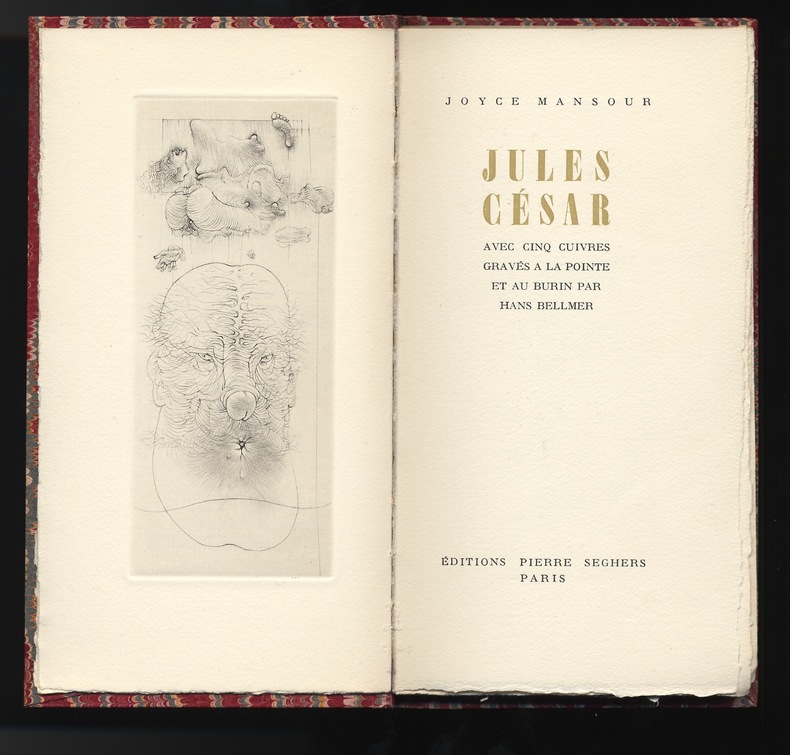
19552213Pierre Seghers, Paris 1955. Un volume in-8 (21,3 x 11,3) broché sous cartonnage de papier marbré de l’éditeur, 70 pages, étiquette de papier bleu, portant le titre, contrecollée au dos, étui éditeur. Édition originale. 1/99 ex. num. sur vélin de Rives, le n° 5. - 5 SUPERBES GRAVURES SUR CUIVRE DE HANS BELLMER à la pointe-sèche et au burin. - Tirage total à 106 : 1 ex. unique, 6 Japon, 99 vélin de Rives + 7 H.C. L'exemplaire porte UN TRÈS BEL ENVOI À L'ENCRE DE JOYCE MANSOUR sur un feuillet liminaire. Référence : Mandiargues, Hans Bellmer, Œuvre gravé, 31-33, reproduit. -- ENGLISH DESCRIPTION: Hans BELLMER - MANSOUR, Joyce : JULES CÉSAR. With 5 etchings by Hans Bellmer (1955). Pierre Seghers, Paris 1955. A volume 8° (21.3 x 11.3) in the publisher's marbled paperboard cover, 70 pages, blue paper label, bearing the title, laminated on the back, in the publisher's slipcase. First edition, first printing. 5 SUPERB ORIGINAL ETCHINGS BY HANS BELLMER with drypoint and chisel. Edition: 1/99 ex. number on Rives vellum (n°5) (total print run of 106: 1 unique, 6 Japan, 99 Rives vellum + 7 H.C.). L'un des ouvrages illustrés par Hans Bellmer parmi mes préférés ! Cet exemplaire avec une belle dédicace manuscrite de Joyce Mansour. One of my favorites… and more and more, so since meeting him is rare… With a dedicace in ink by Joyce Mansour. Reference: Mandiargues, Hans Bellmer, engraved works, 31-33, reproduced.