225 résultats
182319127Antoine Boucher Imprimeur 1823 1 volume In Folio Premier semestre seul , quotidien de la restauration, Royaliste, on donne chaque jour le cours des effets publics, compte-rendus des débats de la Chambre des Pairs, programmes des spectacles, etc; 4 pp par numéro.
18583388609Leipzig, Kramer, 1858. Zusammen ca. 200 S. Originalbroschur.
18263303395Rostock, Behm, (1826). 2 gefaltete Bogen, zusammen 16 S.
186435376Charleston: A. S. Willington & Co 1864. First Edition. Newspaper. Good. Newspaper. Approximately 23" x 16.5". Single sheet two pages. Folded. Light vertical crease. Stitching removed on the extreme left edge. A few tiny pin holes to the paper. <br /> <br /> Contents include the latest Civil War news reporting including General Lee's battle success; General Johnston's army victory at Kennesaw Mountain; the Siege of Charleston Three Hundred and Forty-Ninth Day and several more news items. On the back page is the publisher information advertisements and a printed act of authority to levy taxes for support the war effort. A. S. Willington & Co unknown
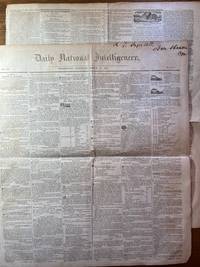
183236785Washington DC: Gales & Seaton 1832. Newspaper. Good. Newspaper. Approx. 21" x 18." 4 pages. Two folds. Sheets are detached. Newspaper has light toning. Name of R. J. Ingersoll New Haven Con" written top of issue. Possibly the same Ingersoll that served 4 terms in Congress from 1825-1833. <br /> <br /> Entire contents of page 2 concern "The Cherokee Case. Opinion of the Supreme Court delivered by Mr. Chief Justice Marshall January Term 1832. Samuel A. Worcester vs. The State of Georgia." The case is also printed on the first column of page 3. Supreme Court case of Samuel Worcester. From the Brittannica website: <br /> <br /> Worcester v. Georgia involved a group of white Christian missionaries including Samuel A. Worcester who were living in Cherokee territory in Georgia. In addition to their missionary work the men were advising the Cherokee about resisting Georgia's attempts to impose state laws on the Cherokee Nation a self-governing nation whose independence and right to its land had been guaranteed in treaties with the United States government. In an effort to stop the missionaries the state in 1830 passed an act that forbade "white persons" from living on Cherokee lands unless they obtained a license from the governor of Georgia and swore an oath of loyalty to the state. Worcester and the other missionaries had been invited by the Cherokee and were serving as missionaries under the authority of the U.S. federal government. They did not however have a license from Georgia nor did they swear a loyalty oath to that state. Georgia state authorities arrested Worcester and several other missionaries. After they were convicted at trial in 1831 and sentenced to four years of hard labour in prison Worcester appealed to the U.S. Supreme Court.<br /> <br /> Worcester argued that Georgia had no right to extend its laws to Cherokee territory. He contended that the act under which he had been convicted violated the U.S. Constitution which gives to the U.S. Congress the authority to regulate commerce with Native Americans. The Constitution also bars the states from passing laws that alter the obligations of contracts-in this case treaties. Several treaties between the Cherokee and the U.S. government recognized the independence and sovereignty of the Cherokee Nation. Furthermore Worcester argued that the Georgia laws violated an 1802 act of Congress that regulated trade and relations between the United States and the Indian tribes.<br /> <br /> The Supreme Court agreed with Worcester ruling 5 to 1 on March 3 1832 that all the Georgia laws regarding the Cherokee Nation were unconstitutional and thus void. Writing for the court Chief Justice John Marshall held that "the Indian nations had always been considered as distinct independent political communities retaining their original natural rights as the undisputed possessors of the soil." Even though Native Americans were now under the protection of the United States he wrote that "protection does not imply the destruction of the protected." Marshall concluded:<br /> The Cherokee Nation then is a distinct community occupying its own territory.in which the laws of Georgia can have no force and which the citizens of Georgia have no right to enter but with the assent of the Cherokees themselves or in conformity with treaties and with the acts of Congress. The whole intercourse between the United States and this Nation is by our Constitution and laws vested in the Government of the United States.<br /> <br /> Georgia however ignored the decision keeping Worcester and the other missionaries in prison. Eventually they were granted a pardon and were released in 1833. Pres. Andrew Jackson declined to enforce the Supreme Court's decision thus allowing states to enact further legislation damaging to the tribes. The U.S. government began forcing the Cherokee off their land in 1838. In what became known as the Trail of Tears some 15000 Cherokee were driven from their land and were marched westward on a grueling journey that caused the deaths of some 4000 of their people.<br /> <br /> The Supreme Court agreed with Worcester ruling 5 to 1 on March 3 1832 that all the Georgia laws regarding the Cherokee Nation were unconstitutional and thus void. Writing for the court Chief Justice John Marshall held that "the Indian nations had always been considered as distinct independent political communities retaining their original natural rights as the undisputed possessors of the soil." Even though Native Americans were now under the protection of the United States he wrote that "protection does not imply the destruction of the protected." Marshall concluded:<br /> The Cherokee Nation then is a distinct community occupying its own territory.in which the laws of Georgia can have no force and which the citizens of Georgia have no right to enter but with the assent of the Cherokees themselves or in conformity with treaties and with the acts of Congress. The whole intercourse between the United States and this Nation is by our Constitution and laws vested in the Government of the United States.<br /> <br /> Georgia however ignored the decision keeping Worcester and the other missionaries in prison. Eventually they were granted a pardon and were released in 1833. Pres. Andrew Jackson declined to enforce the Supreme Court's decision thus allowing states to enact further legislation damaging to the tribes. The U.S. government began forcing the Cherokee off their land in 1838. In what became known as the Trail of Tears some 15000 Cherokee were driven from their land and were marched westward on a grueling journey that caused the deaths of some 4000 of their people. Gales & Seaton unknown
1853131053Boston MA: Boston Daily Advertiser 1853. 2nd Printing. Hardcover. Good. 8vo 7.75 - 9.75'' tall. Hardcover. Book Condition: Good. Boston Daily Advertiser Boston MA 1853. 2nd Printing. 677 pages. Brown-Black cloth.Moderate general wear. Extreme wear at spine/board borders spine top and extremities. Size: 8vo 7.75 - 9.75'' tall. Law/True Crime::Law History::U.S.A.::Pre-Civil War New England::History 6168 6168 Boston Daily Advertiser hardcover
183642381Madrid: Imprenta a cargo de D. Ignacio Boix 1836.- 4 h. 117V p. 1 h.; 8º mayor 198 x 133 cm.; Sin tonsurar conservando Ãntegros sus margenes y todas sus barbas; Enc. en Media Piel. POLÃTICA ESPAÑOLA DESDE 1833 A 1936 Libro en español Imprenta a cargo de D. Ignacio Boix hardcover
18711248211871 Paris, E. Dentu, Librairie-Editeur - 1871 - In-12, reliure demi-percaline rouge, dos lisse avec pièce de titre - 311 pages
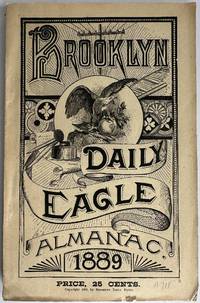
188913989Brooklyn Daily Eagle 1889. Paperback. Very Good. 1889 paperback almanac published by The Brooklyn Daily Eagle is toned lower right corner is chipped subsequent corners are bent spine is chipped head/tail. 250 pages black and white. Chock full of Brooklyn history trivia of all sorts and interesting ads. All orders packed with care most dust jackets protected by Brodart sleeve independent bookseller since 2011 Brooklyn Daily Eagle paperback
19006369<p>12 full size 11" x 14" b&w photos. Photos separate from previous page by tissue paper.Text unmarked. Set shows usuage. a popular series Text unmarked. rear volume 12 shows crease from bottom to middle of rear cover</p> Charles T Daily & Co paperback
185535883Chicago: Scripps Bross & Spears.Democratic Press 1855. Original printed wrappers stitched 76pp. Text printed in double columns. Light dusting. Narcissistic and repetitive name-scribbling on wrappers and endpapers else Very Good. <br/><br/> "Following wrapper title is advertisement of Rees and Kerfoot real estate agents and stockholders. Text ends on p.32; remaining pages given over to index and advertising. The first 32 pages consist of 'Annual Review of the Commerce of Chicago for 1854.'" Byrd. Over 70 Chicago merchants advertised and there is an Index to the advertisers. Tanner's modifications to some of Byrd's commentary are informative. <br/>FIRST EDITION. Byrd 2259 3. Not in Ante-Fire Imprints Decker Eberstadt. Scripps, Bross & Spears...Democratic Press unknown books
1855JC14472Cincinnati 1855. Paperback. Good. Vol. V for December 15 1855 No. 12 pp. 309-332. The Moral Influence of Firmness Marriage and Scrofula Nervauric Treatment of Disease The Wool and Hair Question Scientific Progress Interesting Phenomena The Dregs of Persecution The Madstone Oppressed Italy The Spirit World. Some foxing. Disbound. Uncommon. <br /> <br /> <br/><br/> paperback
1855JC14472Cincinnati 1855. Paperback. Good. Vol. V for December 15 1855 No. 12 pp. 309-332. The Moral Influence of Firmness Marriage and Scrofula Nervauric Treatment of Disease The Wool and Hair Question Scientific Progress Interesting Phenomena The Dregs of Persecution The Madstone Oppressed Italy The Spirit World. Some foxing. Disbound. Uncommon. <br/><br/> paperback books
185123643Paris "LE CHARIVARI" 1851 -in-folio demi-basane un fort volume, reliure demi basane bleu-marine in-folio (37 x 26 cm), dos long (spine without raised bands), titre et tomaison frappés "or", filet large à froid en place des nerfs avec un double filet "or" de part et d'autre, roulette chainette "or" en tête et en pied, papier bleu-marine granité imitation percale aux plats, toutes tranches lisses, gardes glacées jaunes, timbre fiscal de la seine en noir en haut à droite en 1ère page sur tous les 173 journaux, Le JOURNAL SATIRIQUE ILLUSTRE : "LE CHARIVARI" est un quotidien satirique de 4 pages dont une page de dessin par jour lithographié en noir . le 1er semestre 1851 comprend un ensemble de 173 numéros se décomposant comme suit : du N° 1 au N°180 (Manque les Nos 55-74-107-111-120-125-126) : l'ensemble comprend 51 lithographies hors-texte en noir d'Honoré DAUMIER, 44 lithographies hors-texte en noir de Charles VERNIER, 50 lithographies hors-texte en noir de CHAM, 25 lithographies hors-texte en noir d' E. DE BEAUMONT et 3 lithographies hors-texte en noir d'artistes inconnus non-signés, 20ème Année du N°1 du 1er Janvier 1851 au N°180 du Dimanche 29 Juin 1851 Paris "LE CHARIVARI" Editeur,
184923659Paris "LE CHARIVARI" 1849 -in-folio demi-basane un volume, reliure demi basane violet foncé in-folio à coins (37 x 26 cm), dos long (spine without raised bands), titre, année et tomaison frappés "or", double filets "or" en place des nerfs et en tête et en pied, papier peigné crème, marron et violet aux plats, toutes tranches lisses, Le JOURNAL : "LE CHARIVARI" est un quotidien satirique de 4 pages dont une page de dessin par jour lithographié en noir . le 4ème trimestre 1849 comprend un ensemble de 91 numéros se décomposant comme suit : du N° 274 au N°365 : l'ensemble comprend 30 lithographies hors-texte en noir d'Honoré DAUMIER, 11 lithographies hors-texte en noir de Charles VERNIER, 36 lithographies hors-texte en noir de CHAM, 14 lithographies hors-texte en noir d' E. DE BEAUMONT , 18ème Année du N°274 du 1er octobre 1849 au N°365 du lundi 31 décembre 1849 Paris "LE CHARIVARI" Editeur,
187123662Paris "LE CHARIVARI" 1871 -in-4 demi-basane un volume, reliure demi-basane marron in-folio (43,6 x 31 cm), dos long (spine without raised bands), Titre + Année et tomaison frappés "or"avec un filet "or", un filet large et un filet fin à froid de part et d'autre, dos trés légèrement épidermé, papier couleur "chocolat" aux plats, toutes tranches lisses, Le JOURNAL : "LE CHARIVARI" est un quotidien satirique de 4 pages dont une 1/2 page de dessin par jour lithographié en noir, l'Année 1871 (du 6 Mars 1871 au 31 Décembre 1871) comprend un ensemble de numéros tous illustrés d'une lithographie in-texte en noir par de trés nombreux illustrateurs dont : Honoré DAUMIER 42 Lithos), CHAM (112 lithos), GREVIN (17 lithos), HADOL (11 lithos), DRANER (24 lithos), NARCY (1 litho), STOP (18 lithos), gG. LAFOSSE (1 litho) et MORLAND (1 litho), Année 1871 Paris "LE CHARIVARI" Editeur,
184825758Paris "LE CHARIVARI" 1848 -in-folio demi-basane un volume, reliure demi basane violet foncé in-folio à coins (37 x 26 cm), dos long (spine without raised bands), titre, année et tomaison frappés "or", double filets "or" en place des nerfs et en tête et en pied, papier peigné crème, marron et violet aux plats, toutes tranches lisses, Le JOURNAL : "LE CHARIVARI" est un quotidien satirique de 4 pages dont une page de dessin par jour lithographié en noir . le 3ème trimestre 1848 comprend un ensemble de 91 numéros se décomposant comme suit : du N° 183 au N°274 : l'ensemble comprend 14 lithographies hors-texte en noir d'Honoré DAUMIER, 14 lithographies hors-texte en noir de Charles VERNIER, 32 lithographies hors-texte en noir de CHAM, 28 lithographies hors-texte en noir d' E. DE BEAUMONT + 2 Lithographies hors-texte en noir de BOUCHOT , 17ème Année du N°183 du 1er Juillet 1848 au N°274 du 30 septembre 1848, Paris "LE CHARIVARI" Editeur,
184925759Paris "LE CHARIVARI" 1849 -in-folio demi-basane un volume, reliure demi basane violet foncé in-folio à coins (37 x 26 cm), dos long (spine without raised bands), titre, année et tomaison frappés "or", double filets "or" en place des nerfs et en tête et en pied, papier peigné crème, marron et violet aux plats, toutes tranches lisses, Le JOURNAL : "LE CHARIVARI" est un quotidien satirique de 4 pages dont une page de dessin par jour lithographié en noir . le 2ème trimestre 1849 comprend un ensemble de 90 numéros se décomposant comme suit : du N° 91 au N°181 : l'ensemble comprend 40 lithographies hors-texte en noir d'Honoré DAUMIER, 13 lithographies hors-texte en noir de Charles VERNIER, 34 lithographies hors-texte en noir de CHAM + 2 Lithographies hors-texte en noir de BOUCHOT , 18ème Année du N°91 du 1er Avril 1849 au N°181 du 30 Juin 1849, Paris "LE CHARIVARI" Editeur,
184925760Paris "LE CHARIVARI" 1849 -in-folio demi-basane un volume, reliure demi basane violet foncé in-folio à coins (37 x 26 cm), dos long (spine without raised bands), titre, année et tomaison frappés "or", double filets "or" en place des nerfs et en tête et en pied, papier peigné crème, marron et violet aux plats, toutes tranches lisses, Le JOURNAL : "LE CHARIVARI" est un quotidien satirique de 4 pages dont une page de dessin par jour lithographié en noir . le 2ème trimestre 1849 comprend un ensemble de 91 numéros se décomposant comme suit : du N° 182 au N°273 : l'ensemble comprend 30 lithographies hors-texte en noir d'Honoré DAUMIER, 14 lithographies hors-texte en noir de Charles VERNIER, 36 lithographies hors-texte en noir de CHAM + 8 lithographies hors-texte en noir d'E. DE BEAUMONT + 4 Lithographies hors-texte en noir de BOUCHOT, 18ème Année du N°182 du 1er Juillet 1849 au N°273 du 30 Septembre 1849, Paris "LE CHARIVARI" Editeur,
185415847Indianapolis 1854. Light spotting. 20pp. Disbound. Good. unknown books
189957593London:: Privately Printed for F. Corman 1899. First edition. publisher's cloth with printed paper label rubbed to illegibility. Cloth lightly rubbed; endsheets tanned; contents fine. 8vo. Illustrated throughout with some hand-coloring and some hand-lettering. Privately Printed for F. Corman, hardcover
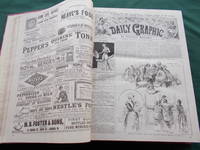
1897013788London 1897. From Saturday October 1st to Saturday December 31st 1892issue 859 to 937 each issue circa 15pp illustrated. Bound in period cloth with gilt lettering. Cloth rubbed worn some staining. Internally front endpaper joint split contents becoming loose but still holding. Internally text in very good clean condition. A good clean newspaper in a period worn binding . Cloth. Near Very Good. Folio. Hardcover
1897013787London 1897. From Friday January 1st to Wednesday March 31st 1897 issue 2190 to 2286 each issue circa 15pp illustrated. Bound in period cloth with gilt lettering. Cloth rubbed worn some staining. Internally front endpaper joint split contents becoming loose but still holding. Internally text in very good clean condition. A good clean newspaper in a period worn binding . Cloth. Near Very Good. Folio. Hardcover
1897BOOKS056679IAugusta ME: Daily Kennebec Journal 1897. HC. good tan cloth hardcover. B&W illustrations. Hardcover edition of the August Centennial Supplement to the Kennebec Journal issued on June 9th for the Centennial Celebration with "carefully prepared articles to bring back the past of our city and by numerous illustrations to show the city as it is at the present time." 63pp. Daily Kennebec Journal unknown
19009720London c. 1900. Second Anglo-Boer War souvenir handkerchief 45 x 45 cm printed in blue ink on fine linen a couple of trivial spots blank verso. Set in the borders of a map showing the contested regions of South Africa chiefly Orange Free State and Transvaal is the text of Rudyard Kipling's poem 'The Absent-Minded Beggar' with the music of Arthur Sullivan. The map is further adorned with portraits of Queen Victoria and Field Marshal Lord Roberts who was commander of British forces in the field between December 1899 and December 1900. It was published by the Daily Mail then a relatively new but highly successful British newspaper: established in 1896 its circulation had soared to over a million - the largest in the world - by the war's end in 1902. Kipling presented his poem to the Mail which established a charitable fund soon known as the Absent Minded Beggar Fund to provide comforts for British troops on campaign and support for their families at home. Sullivan was prevailed upon to set it to music and it was first sung in public in November 1899. It caught the public mood and was reproduced in many forms. The handkerchiefs were in circulation by March 1900. Local newspapers carry advertisements from wholesalers and retailers around the country all promising to donate a portion of the profits to the fund. Advertising in the Bradford Daily Telegraph 8 March 1900 one vendor described them as the latest novelty a work of art further suggesting that they could make a useful present everybody pleased with them. An Exeter draper excitedly advertised another delivery in the March 28 issue of the Western Echo. They seem to have sold for between twopence and threepence each. Map unknown