Jean Le Rond d' Alembert, Pierre Mouchon, Denis Diderot; Voltaire, Rousseau, Montesquieu, MarmontelBiblio.com
457 résultats
17512605210193Chez Briasson David Le Breton Durand A Paris; Amsterdam 1751 - 1777 1751. First Edition. Hardcover. Very Good. 0x0x0. The Organization of Enlightenment Thought: The Revolution in Ideas. A first edition of this foundational encyclopedia of 18th century knowledge. A massive thirty-five volume set. Large folios volumes 39.5 x 25 cm. Bound in 18th-century French calf. Spines gilt with raised bands. One volume non-uniformly bound in light calf. <br> The set includes: Encyclopedie Paris: 1751-57 & Neuchatel 1765. 17 volumes; Recueil de planches. Paris: 1762-72. 11 volumes 1 2 part I 2 Part II 3 5 6 7 8 9 10 11; Supplement a l'Encyclopedie. Paris & Amsterdam: 1776-77. 5 volumes including the Suite de recueil de planches; Table Analytique. Paris: 1780. <br> Profusely illustrated with engraved plates. <br> Diderot's famous Encyclopedie was initially a modest translation of Chambers's Cyclopaedia. It grew as a project into a massive project which attempted to collect human knowledge from a rationalistic perspective instead of by nature or theology. In organizing knowledge from a position where human reason was paramount the supremacy of the Church was imperiled. As a result the Encyclopedie was widely controversial and placed on the Index Librorum Prohibitorum by the Catholic Church. In discussing fundamental philosophical issues such as on political authority and natural rights articles in the Encyclopedie shifted the basis of governmental authority from the divine right of Kings to radical concepts popular consent was the basis of legitimacy and the ideals of a social contract. The work was banned by the King of France. It spread the foundational ideas of the French Revolution and enlightenment thinkers. "No encyclopaedia perhaps has been of such political importance or has occupied so conspicuous a place in the civil and literary history of its century. It sought not only to give information but to guide opinion." "It was a war machine; as it progressed its attacks on both the church and still more on despotic government as well as Christianity itself became bolder and more undistinguished and it was met with persecution and opposition unparalleled in the the history of encyclopedias." - Encyclopedia Britannica 11th ed p. 1483. "A monument in the history of European thought; the acme of the age of reason; a prime motive force in undermining the ancien regime and in heralding the French Revolution" Printing in the Mind of Man 200. Refs: Grolier/Horblit 25b; Norman 637; PMM 200. <br> Includes: 17 v. : ill. ; 41 cm. supplement 4 volumes plates 11 volumes plates supplement 1 volume. Table Analytique 1 volume. This is an oversized or heavy book which requires additional postage for international delivery outside the US. Chez Briasson, David, Le Breton, Durand, A Paris; Amsterdam (1751 - 1777) hardcover
176216111762, chez Briasson, David, Le Breton, Durand, in-folio plein cuir de 6+18 pages + 269 planches noir et blanc, dos à 6 nerfs, titrage doré, pages de garde marbrées. Première livraison, avec leurs explications : agriculture et économie rustique (83 planches), aiguillier (2 planches), aiguillier-bonnetier (1 planche), amidonnier (1 planche), anatomie (33 planches), antiquités (12 planches), architecture et parties qui en dépendent (81 planches), maçonnerie (13 planches), argenteur (2 planches), armurier (2 planches), arquebusier (7 planches), art militaire (38 planches), artificier (7 planches) planches doubles comptant pour deux. | Etat : Etat général moyen, rousseurs, coins, coiffes et mors écorchés, accrocs sur les plats, grosse tache sur le 1er plat, champs usés, le tiers inférieur de la planche XVIII d'Anatomie est déchiré entièrement (sans manque), complet de ses planches. (Ref.: MA14)
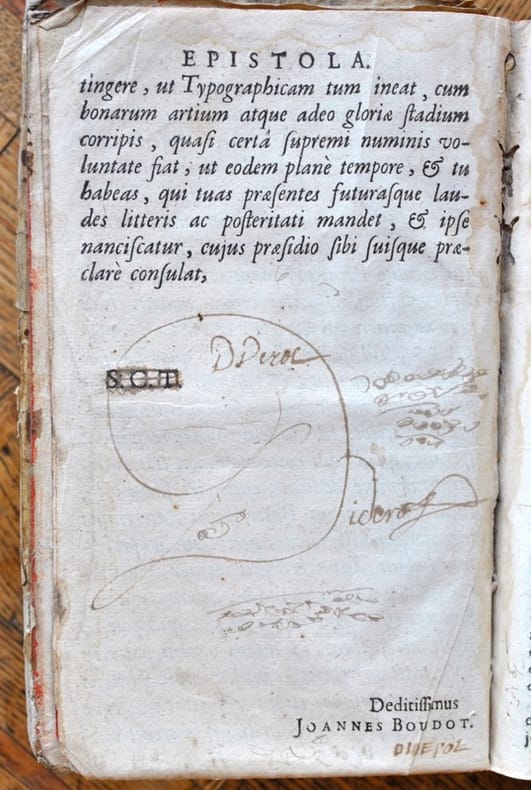
171510700Paris, Jean Boudot, 1715. In-8 de (6)-956 pp., vestiges de cartonnage de l'époque, sous étui moderne.
1777103648Genève, chez Pellet, Imprimeur Libraire , Rue des Belles Filles, 1777-1779, , 39 volumes in-4 dont 36 volumes de texte et 3 volumes de planches, Demi-basane havane à coins de l'époque, dos à faux-nerfs, pièces de titre rouges, tomaisons dorées, plats couverts de papier à la cuve, tranches rouges, Troisième édition de cette monumentale entreprise, la première au format in-quarto et la plus aisée à consulter. Dans cette édition le tome 30 a été imprimé à Neufchatel, Chez la Société typographique, en 1779. Exemplaire qui comporte 447 planches gravées sur cuivre, 128 sont dépliantes dont 10 cartes, 31 planches sont à double page, 2 frontispices représentent les portraits en médaillon de Diderot et d'Alembert (dessinés par Cochin et gravés par Cathelin) sont reliés au premier volume de texte, 1 frontispice annonce la section Chirurgie au T. 2 du volume de planches. T. I : 140 pl. T. 2 : 169 pl. T. 3 : 135 pl. et 52 pages de tables géométriques. Le T. 3 correspond aux suppléments des 2 premiers tomes de planches. Ensemble en bon état en reliure uniforme d'époque, les coins sont usés, et les dos frottés par endroits, quelques mors fendus et certaines coiffes étêtées, néanmoins bel exemplaire aux planches, pour la plupart, bien encrées. Sans les six volumes de table qui manquent très souvent. Brunet, 700-701. Couverture rigide
176227797A Paris: Chez Braisson David Le Breton Durand M. DCC. LXII. 1762 .- TOMO I Premiere Livraison: 2 h. 6 p. 18 p. 2 p. 21 p. 1 p. 19 p. 1 h. 1 h. 3 p. 7 p. 2 p. todas de texto 269 artÃsticas planchas magistralmente grabadas al cobre; en Gran Folio 405 x 17 cm; magnÃfica impresión sobre gran papel verjurado; Encuadernación en Media Piel época de color verde lomera de 6 nervios con tÃtulo y hierros dorados cortes pintados en color granate tapas o planos en papel de aguas.- CONTIENE los siguientes oficios y profesiones: AGRICULTURE ET ECONOMIE RUSTIQUE: Labourage 5 planches Semoir 3 pl. Conservation des grains 2 pl. Moulins à vent et à l'eau pou lé blé 9 pl. Moulins à exprimer l'huile des fruits et des graines 4 pl. Fabrique de tabac 6 pl. Culture et travail du chanvre 2 pl. Culture et travail deu coton 5 pl. Culture de la vigne 2 pl. Pressoirs 4 pl. Pressoir à cidre 3 pl. Sucrerie et affinage 7 pl. Travail des sabots et des échalats 1 pl. Charbon de bois 4 pl. Jardinage 7 pl. Jardin potager 6 pl. Fontainier 4 pl. Mouches à miel 1 pl. Vers à foie 1 pl. Basse cour 1 pl. Laiterie de la meute 1 pl. Art de Faire èclóre les poulets 3 pl. AIGUILLIER: Le coupeur le perceur et Le empointeur 2 pl. AIGULLIER BONNETIER 1 pl. AMIDONNIER 1 pl. ANATOMIE 33 pl. ANTIQUITES 12 pl. ARCHITECTURE 86 pl. Moulin à scier les pierres 4 pl. MAÇONNERIE 14 pl. Tuilerie 3 pl. Couvreur et carreleur 3 pl. ARGENTEUR 2 pl. ARMURIER 2 pl. ARQUEBUSIER 7 pl. ART MILITAIRE 38 pl. ARTIFICIER 7 pl. EL INTERIOR EN PERFECTO ESTADO TANTO PARA EL TEXTO COMO PARA LAS LAMINAS GRABADAS. Encuadernación de la época con el lomo de piel algo rozado pero en muy buen estado general. Tapas restauradas de pequeñas faltas en las esquinas. Papel de aguas con diversas rozaduras. SOLO OFRECEMOS ESTE PRIMER VOLUMEN de "Recueil des Planches sur les Sciences les Arts.". La obra completa consta de 11 volúmenes los 17 volúmenes de "La Enciclopédie" a la que seguÃan. La estructura de la Encyclopedie tanto en su diagramación formato y por supuesto contenido ideológico dio respuesta al complejo entramado de variables que supuso ese proceso disparador de nuevas ideas inteviniendo intelectuales como Voltaire Buffon Montesquieu D'Alembert Quesnay Turgot d'Holbach Rousseau de Jacourt y por supuesto Diderot; proceso también rompedor de los secretos tecnológicos del cerrado universo de las corporaciones gremiales del modo feudal de producción. En este sentido la obra presenta dos núcleos entrelazados: el Diccionario y las Planchas. Sin embargo hay que reconocer que la potente originalidad está concentrada en "Recueil des Planches sur les sciences les arts liberaux et les arts mechaniques avec leur explication" en que se despliega a través de descripciones gráficas y de textos aclaratorios una impresionante cascada de datos sobre la situación fundamentos y perspectivas de las técnicas oficios y talleres. EN DEFINITIVA OFRECEMOS EL PRIMER VOLUMEN DE "RECUEIL DES PLANCHES." SIN DUDA LA MAS GRANDE Y AMBICIOSA PRODUCCIÓN EDITORIAL DE LA FRANCIA DE LA ILUSTRACION. EN CONJUNTO CONTIENE 296 IMPRESIONANTES PLANCHAS GRABADAS AL COBRE POR LOS MEJORES ARTISTAS DEL MOMENTO ALGUNAS A DOBLE PAGINA. TODAS ELLAS CONSERVADAS PERFECTAMENTE. "TodavÃa no se ha hecho ni durante mucho tiempo se hará una colección tan considerable y tan hermosa de máquinas" Diderot. FILOSOFÃA E HISTORIA DE LA CULTURA Livre en français Chez, Braisson, David, Le Breton, Durand hardcover
1798K8FG3X3S7BMNParis 1798. 8vo. Desray Deterville back of half-title vol. I: printed by Charles Crapelet Contemporary uniform half sprinkled calf sewn on recessed supports richly gold-tooled spines each with 2 morocco labels red and green in the 2nd and 5th of 6 fields green ribbon markers. With a frontispiece portrait of the author engraved by Charles Étienne Gaucher after a 1766 drawing by Jean-Baptiste Greuze 16 engraved plates numbered 1-7 1-9 a folding letterpress hierarchical table of all kinds of human knowledge for the Encyclopédie 52 x 37.5 cm and letterpress music three 5-line staves with G C and F clefs. 15 volumes. in total about 7500 pp. First edition of the works of Denis Diderot 1713-1784 published fourteen years after his death. Diderot one of the widest ranging and most creative minds of the Enlightenment is best known as the motive force behind and author of many articles in his 28-volume Encyclopédie 1764-1772 which occupied him for more than twenty years but he published works on a wide range of subjects before and after the Encyclopédie. The present 15 volumes published from Diderot's manuscripts including correspondence and totalling about 7500 pages therefore covers plays novels and poetry as well as essays on philosophy mathematics including music literature art and religion and includes correspondence with numerous men and women including Voltaire. Although his Encyclopédie articles are not included many were based on or carried further in publications included here and 220 pages of vol. III are devoted to the Encyclopédia. Diderot's Encyclopédie though enormously influential left him in financial straits. The French government banned it and the French establishment shunned him as a radical but from 1773 to his death he worked under the patronage of Catharine the Great of Russia who bought his library and paid him to oversee it in Paris giving him the freedom to pursue his literary and scholarly interests.In very good condition with only some minor foxing an occasional quire very slightly browned and an occasional minor marginal defect. With a small hole in the spine of one volume but the bindings are otherwise also very good.l Adams Bibliographie des oeuvres de Denis Diderot A6 pp. 98-109; CCfr 3 copies; Diderot Contes 1963 item 12 p. 206; Johansson Études de Denis Diderot 1927 p. 197 cf. p. 30. unknown
1770a300110204Yverdon, 1770 - 1780. 57 (von 58) Bänden, der letzte reguläre Textband (Tome XLII/ 42) fehlt. 41 (von 42) Textbänden; 6 Supplemente (Text) jeweils mit meist mehr als 600 Seiten und 10 Tafelbände mit 1408 (von 1410) Kupfertafeln. Noch recht dekorative Halblederbände der Zeit mit etwas Rückenvergoldung und je einem roten und einem grünen Rückenschild, Schmuckpapierdeckelbezüge und Lederecken. Alters- und Gebrauchsspuren, Kapitale oft leicht beschädigt, Ecken und Kanten bestoßen, die Deckel berieben. Innen meist frisch, es kommen jedoch auch einzelne Lagen anderer Büttenqualität vor, die dann stärker gebräunt sind. Einige Büttenblätter in den breiten Rändern mit Produktionsfehlern. Anfangs und am Ende der Blöcke oft Abklatsch der noch feuchten Druckfarbe auf die gegenüberliegenden Seiten, dem Zeitdruck bei der Produktion geschuldet. (26,2 x 21 cm) 4°. [12 Warenabbildungen]
176347776A Paris: Chez Braisson David Le Breton Durand M. DCC. LXIII 1763.- TOMO II Seconde Livraison Premiere Partie: 2 h. 10 p. 1 h. 2 p. 3 p. 1 p. 1 p. 26 p. 1 p. 1 p. 1 p. 1 p. 1 p. 3 p. 1 p. 2 p. 1 p. 1 p. 1 p. 3 p. 17 p. 16 p. 1 p. 5 p. 1 p. 1 p. 1 p. 2 p. 1 p. 1 p. 11 p. todas de texto 233 artÃsticas planchas magistralmente grabadas al cobre; en Gran Folio 405 x 17 cm; magnÃfica impresión sobre gran papel verjurado; Encuadernación en Media Piel época de color verde lomera de 6 nervios con tÃtulo y hierros dorados cortes pintados en color granate tapas o planos en papel de aguas.- CONTIENE los siguientes oficios y profesiones: Balancier 5 planches Faiseur de bas au mètier & Faiseur de metier à bas 19 pl. Batteur d'or 3 pl. Blanchissage des toiles 2 pl. Blason ou art heraldique 29 pl. Boisselier 2 pl. Bonnetier de la Foule 2 pl. Boucher 2 pl. Bouchonnier 1 pl. Boulanger 1 pl. Bourrelier & bourrelier-batier 7 pl. Boursier 3 pl. Boutonnier 6 pl. Boyaudier 1 pl. Brasserie 5 pl. Brodeur 2 pl. Fonderie en carácteres 8 pl. Carácteres et alfabets de langues mortes et vivantes 25 pl. Carácteres ou écriture françoise 16 pl. Cardier 1 pl. Cartier 6 pl. Cartonnier et gaufreur en carton 2 pl. Ceinturier 2 pl. Chainetier 3 pl. Chamoiseur & mègissier 5 pl. Chandelier 2 pl. Chapelier 3 pl. Charpente 70 pl. EL INTERIOR EN PERFECTO ESTADO TANTO PARA EL TEXTO COMO PARA LAS LAMINAS GRABADAS. Encuadernación de la época con el lomo de piel algo rozado pero en muy buen estado general. Tapas restauradas de pequeñas faltas en las esquinas aunque a la posterior le falta el ángulo inferior externo. Papel de aguas con diversas rozaduras. SOLO OFRECEMOS ESTE SEGUNDO VOLUMEN de "Recueil des Planches sur les Sciences les Arts.". La obra completa consta de 11 volúmenes los 17 volúmenes de "La Enciclopédie" a la que seguÃan. La estructura de la Encyclopedie tanto en su diagramación formato y por supuesto contenido ideológico dio respuesta al complejo entramado de variables que supuso ese proceso disparador de nuevas ideas inteviniendo intelectuales como Voltaire Buffon Montesquieu D'Alembert Quesnay Turgot d'Holbach Rousseau de Jacourt y por supuesto Diderot; proceso también rompedor de los secretos tecnológicos del cerrado universo de las corporaciones gremiales del modo feudal de producción. En este sentido la obra presenta dos núcleos entrelazados: el Diccionario y las Planchas. Sin embargo hay que reconocer que la potente originalidad está concentrada en "Recueil des Planches sur les sciences les arts liberaux et les arts mechaniques avec leur explication" en que se despliega a través de descripciones gráficas y de textos aclaratorios una impresionante cascada de datos sobre la situación fundamentos y perspectivas de las técnicas oficios y talleres. EN DEFINITIVA OFRECEMOS EL SEGUNDO VOLUMEN DE "RECUEIL DES PLANCHES." SIN DUDA LA MAS GRANDE Y AMBICIOSA PRODUCCIÓN EDITORIAL DE LA FRANCIA DE LA ILUSTRACION. EN CONJUNTO CONTIENE 233 IMPRESIONANTES PLANCHAS GRABADAS AL COBRE POR LOS MEJORES ARTISTAS DEL MOMENTO ALGUNAS A DOBLE PAGINA. TODAS ELLAS CONSERVADAS PERFECTAMENTE. "TodavÃa no se ha hecho ni durante mucho tiempo se hará una colección tan considerable y tan hermosa de máquinas" Diderot. FILOSOFÃA E HISTORIA DE LA CULTURA Livre en français Chez, Braisson, David, Le Breton, Durand hardcover
17772308270001Geneva: Pellet 1777-79; Neuchatel: La Societe Typographique 1777. troisieme. Hardcover. Very Good. The Organization of Enlightenment Thought: The Revolution in Ideas 41 of 45 volumes. Quartos 25 x 19.5 cm. Bound in handsome catspaw calf. All edges red. Good bindings and covers. Clean unmarked pages. Includes Vol. 1-36 of the Encyclopedie important note: lacks 3 text volumes 23 30 31; Vol. 37-38: Recueil de planches pour la nouvelle edition du dictionnaire raisonne des sciences des arts et des metiers; lacks the final plate volume v.39 Vol. 40-45 Table Analytique Et Raisonnee Des Matieres. <br> Diderot's famous Encyclopedie was initially a modest translation of Chambers's Cyclopaedia. It grew as a project into a massive project which attempted to collect human knowledge from a rationalistic perspective instead of by nature or theology. In organizing knowledge from a position where human reason was paramount the supremacy of the Church was imperiled. As a result the Encyclopedie was widely controversial and placed on the Index Librorum Prohibitorum by the Catholic Church. In discussing fundamental philosophical issues such as on political authority and natural rights articles in the Encyclopedie shifted the basis of governmental authority from the divine right of Kings to radical concepts popular consent was the basis of legitimacy and the ideals of a social contract. The work was banned by the King of France. It spread the foundational ideas of the French Revolution and enlightenment thinkers. "No encyclopaedia perhaps has been of such political importance or has occupied so conspicuous a place in the civil and literary history of its century. It sought not only to give information but to guide opinion." "It was a war machine; as it progressed its attacks on both the church and still more on despotic government as well as Christianity itself became bolder and more undistinguished and it was met with persecution and opposition unparalleled in the the history of encyclopedias." - Encyclopedia Britannica 11th ed p. 1483. Geneva: Pellet, 1777-79; Neuchatel: La Societe Typographique hardcover
179652668Paris, Buisson, (1796/97) - An Cinquième De La République. 8vo. Very nice contemporary half calf with gilt spine. Minor, barely noticeable repair to upper capital and slight bumping to corners. A very nice and clean copy, with only very minor brownspotting. Printed on good paper. With the half-title (bearing the ""Décret concernant les Contrefacteurs"" on verso). Book plate of Guy de Portuales to inside of front board. (4), 411, (1) pp.
179652668Paris Buisson 1796/97 - An Cinquième De La République. 8vo. Very nice contemporary half calf with gilt spine. Minor barely noticeable repair to upper capital and slight bumping to corners. A very nice and clean copy with only very minor brownspotting. Printed on good paper. With the half-title bearing the "Décret concernant les Contrefacteurs" on verso. Book plate of Guy de Portuales to inside of front board. 4 411 1 pp. <br/><br/><em>The very rare first edition of Diderot's famous novel "The Nun" which was actually begun as an elaborate practical joke but which ended up as one of the most famous novels of the period. A great succes-de-scandale "The Nun" has both fascinated and unsettled the vast reading public since its first appearance. It started out as a series of letters from a fictitious character the nun Suzanne to one of Diderot's friends the Marquis de Crosmare who Diderot was trying to lure back to Paris describing her intolerable life in the convent and imploring him to help regain her freedom and her renounce her vows. The fictitious letters were later revised and written in to the novel that we know today. The work was completed in ab. 1780 and was published posthumously in 1796/97 attracting enormous attention and bringing to light a number of issues that had not previously been publically addressed. It focuses on the then-current practice of forcing young women into convents in order to get them out of the way on the unnatural life of the convents and on the corruption in religious institutions and among the clergy. As such it caused an outrage when it appeared and and became an instant succes-de-scandale. "A novel mingling mysticism madness sadistic cruelty and nascent sexuality it gives a scathing insight into the effects of forced vocations and the unnatural life of the convent. A succes de scandale at the end of the eighteenth century it has attracted and unsettled readers ever since. For Diderot's novel is not simply a story of a young girl with a bad habit; it is also a powerfully emblematic fable about oppression and intolerance. This new translation includes Diderot's all-important prefatory material which he placed disconcertingly at the end of the novel and which turns what otherwise seems like an exercise in realism into what is now regarded as a masterpiece of proto-modernist fiction." From the Oxford University Press edition 2005. Tchemerzine IV:471 </em> unknown
176347777A Paris: Chez Braisson David Le Breton Durand M. DCC. LXIII 1763.- TOMO II Seconde Livraison Seconde Partie 3º de la obra: 2 h. 2 p. 31 p. 2 p. 4 p. 4 p. 1 h. 1 p. 2 p. 1 p. 1 p. 1 p. 1 p. 1 p. 3 p. 2 p. 1 p. 1 p. 1 p. 1 p. 1 p. 12 p. 1 p. 1 p. 2 p. 2 p. todas de texto 201 artÃsticas planchas magistralmente grabadas al cobre; en Gran Folio 405 x 17 cm; magnÃfica impresión sobre gran papel verjurado; Encuadernación en Media Piel época de color verde lomera de 6 nervios con tÃtulo y hierros dorados cortes pintados en color granate tapas o planos en papel de aguas.- CONTIENE los siguientes oficios y profesiones: Charron 8 planches Chasses 23 pl. Chauderonniers grossier Planeur et Faiseur d'instrumens de Musique 4 pl. Chimie 25 pl. Chirurgie 39 pl. Choregraphie 2 pl. Blanchissage de cires 3 pl. Cirier 4 pl. Fabrique de la cire à cacheter 2 Ciseleur & Damasquineur 2 pl. Cloutier grossier 2 pl. Cloutier d'épingle 2 pl. Coffretier-Malletier-Bahutier 3 pl. Confiseur 5 pl. Corderie 6 pl. Cordonnier et Cordonnier-Botier 2 pl. Corroyeur 2 pl. Coutelier 2 pl. Découpeur et Gaufreur d'étoffes 3 pl. Dentelle et façon du point 3 pl. Dessein 39 pl. Diamantaire 3 pl. Distillateur d'eau-de-vie 1 pl. Doreurs sur meteaux cuir et bois 4 pl. Draperie 13 pl. EL INTERIOR EN PERFECTO ESTADO TANTO PARA EL TEXTO COMO PARA LAS LAMINAS GRABADAS. Encuadernación de la época con el lomo de piel algo rozado pero en muy buen estado general. Tapas restauradas de pequeñas faltas en las esquinas. Papel de aguas con diversas rozaduras. SOLO OFRECEMOS ESTE TERCER VOLUMEN de "Recueil des Planches sur les Sciences les Arts.". La obra completa consta de 11 volúmenes los 17 volúmenes de "La Enciclopédie" a la que seguÃan. La estructura de la Encyclopedie tanto en su diagramación formato y por supuesto contenido ideológico dio respuesta al complejo entramado de variables que supuso ese proceso disparador de nuevas ideas inteviniendo intelectuales como Voltaire Buffon Montesquieu D'Alembert Quesnay Turgot d'Holbach Rousseau de Jacourt y por supuesto Diderot; proceso también rompedor de los secretos tecnológicos del cerrado universo de las corporaciones gremiales del modo feudal de producción. En este sentido la obra presenta dos núcleos entrelazados: el Diccionario y las Planchas. Sin embargo hay que reconocer que la potente originalidad está concentrada en "Recueil des Planches sur les sciences les arts liberaux et les arts mechaniques avec leur explication" en que se despliega a través de descripciones gráficas y de textos aclaratorios una impresionante cascada de datos sobre la situación fundamentos y perspectivas de las técnicas oficios y talleres. EN DEFINITIVA OFRECEMOS EL TERCER VOLUMEN DE "RECUEIL DES PLANCHES." SIN DUDA LA MAS GRANDE Y AMBICIOSA PRODUCCIÓN EDITORIAL DE LA FRANCIA DE LA ILUSTRACION. EN CONJUNTO CONTIENE 202 IMPRESIONANTES PLANCHAS GRABADAS AL COBRE POR LOS MEJORES ARTISTAS DEL MOMENTO ALGUNAS A DOBLE PAGINA. TODAS ELLAS CONSERVADAS PERFECTAMENTE. "TodavÃa no se ha hecho ni durante mucho tiempo se hará una colección tan considerable y tan hermosa de máquinas" Diderot. FILOSOFÃA E HISTORIA DE LA CULTURA Livre en français Chez, Braisson, David, Le Breton, Durand hardcover
1800CLL-390Paris, Deterville, 1800 15 volumes in-12, veau moucheté, dos lisses ornés de cadres de roulettes dorées avec fleurons aux angles et motif central doré, pièces de titre et de tomaison de maroquin vert, coupes décorées, tranches rouges (reliures de l'époque).
174915025Paris, chez David l'aîné, 1749. In-4 de XXXVIII-[2]-184 pages et 4 planches dépliantes. Demi-basane brune, dos lisse orné de filets et fleurons dorés, non rogné (reliure XXe). Quelques rares rousseurs.
174566927Principes de la philosophie moral DIDEROT Denis. Principes de la philosophie morale ou essai de M. S.sur le mÈrite et la vertu. Avec rÈflexions. Amsterdam: chez Zacherie Chatelain 1745. First edition. xxx 297 1 blank 10 tables des matiËres errata pp. With title-vignette two engraved frontispieces one for each part and two head-pieces by Fessard after Durand. Citron morocco gilt back with raised bands gilt triple-rule border on sides with gilt stamped floral ornament in corners inner gilt-dentelles all edges gilt. Lower cover slightly discolored otherwise a beautiful copy. Housed in a custom brown cloth clamshell. "Rather a paraphrase than a translation of Lord Shaftesbury's An Inquiry Concerning Virtue and Merit. Yet it is a very important work indeed for the growth and development of his thought. It was Diderot who furnished the RÈflexions in a preliminary discours and lengthy footnotes to which students of Diderot now turn for precious indications of the unfolding of his ideas.It will be noticed that the French version is anonymous neither Shaftesbury's name nor that of the translator was mentioned. The reason was that there was some danger involved in presenting to the French public a work that declared so boldly for the existence of a natural morality independant of any particular religion or church" Arthur M. Wilson Diderot p. 50. Tchemerzine-Scheler II p. 916. Thomas A checklist of major French authors in Oxford libraries 1526-1800 p. 47. HBS 66927. $5000 chez Zacherie Chatelain hardcover books
174566927Amsterdam: chez Zacherie Chatelain 1745. First edition. xxx 297 1 blank 10 tables des matières errata pp. With title-vignette two engraved frontispieces one for each part and two head-pieces by Fessard after Durand.<br> <br> Citron morocco gilt back with raised bands gilt triple-rule border on sides with gilt stamped floral ornament in corners inner gilt-dentelles all edges gilt. Lower cover slightly discolored otherwise a beautiful copy. Housed in a custom brown cloth clamshell.<br> <br> "Rather a paraphrase than a translation of Lord Shaftesbury's An Inquiry Concerning Virtue and Merit. Yet it is a very important work indeed for the growth and development of his thought. It was Diderot who furnished the Réflexions in a preliminary discours and lengthy footnotes to which students of Diderot now turn for precious indications of the unfolding of his ideas.It will be noticed that the French version is anonymous neither Shaftesbury's name nor that of the translator was mentioned. The reason was that there was some danger involved in presenting to the French public a work that declared so boldly for the existence of a natural morality independant of any particular religion or church" Arthur M. Wilson Diderot p. 50.<br> <br> Tchemerzine-Scheler II p. 916. Thomas A checklist of major French authors in Oxford libraries 1526-1800 p. 47.<br> <br> HBS 66927.<br> <br> $5000. chez Zacherie Chatelain unknown
179675946à Paris: Chez Buisson 1796. Fine. Chez Buisson à Paris An Cinquième de la République 1796 12 x 20.70 cm relié First edition posthumous printed on Holland paper. Contemporary full marbled brown calf binding spine in compartments richly decorated red morocco title label black morocco volume label a small loss to the lower joint at the foot rubbing marks surface abrasions to the upper cover with a small loss of leather one corner bumped marginal loss to the right corner on pages 247 and 257.Paper generally fresh. This copy has been bound as a single volume following the 1772 edition of Diderots Works in 6 volumes Volume VI II.A good copy. The introductory text à la mémoire de Diderot is by Jakob-Heinrich Meister a friend of Necker and successor to Frédéric Melchior Grimm at the Correspondance littéraire. The novel conceived from 1765 onwards was first issued in instalments in this journal between 1778 and 1780. The published version however is not definitive as Diderot continued to expand it until his death: the work which comprised 125 pages in 1771 reached 200 pages in 1778 208 in 1780 and 287 in 1783. Yet the work was already known in Germany prior to its French publication thanks to Schillers translation published in 1787 in his journal Thalia. Following this version Doray de Longrais produced a French version of the same narrative. In 1792 Germany discovered the complete text through a new translation by Mylius. Finally in 1796 the original text was published in France based on a copy likely supplied by Grimm or Goethe. An unclassifiable work breaking free from all the conventions of the novel it draws on the picaresque tradition and inherits the freedom of a book that deeply influenced Diderot: Vie et opinions de Tristram Shandy by Sterne. Chez Buisson hardcover
176730188Paris 1767. The following plates come from a defective copy of Volume 5 and are generally in excellent condition with full margins: The 37 plates includes two sections : first section numbered 1 -11 plates are drawings describing the Pipe Organ with minute details. Plate 11 is an index to a tuning scale. Second section plates numbered 1- 22 describes foreign ancients modern instruments & percussion plus different sorts of beautifully made instruments. Plate 10 on this section is doubled and on which described all tools needed in the making of the wind instruments. Plate 13 is damaged with a missing corner affecting text and border but not drawings. Plate 22 is double page. Four descriptive text sheets. <br/><br/> unknown books
176730188Paris 1767. The following plates come from a defective copy of Volume 5 and are generally in excellent condition with full margins: The 37 plates includes two sections : first section numbered 1 -11 plates are drawings describing the Pipe Organ with minute details. Plate 11 is an index to a tuning scale. Second section plates numbered 1- 22 describes foreign ancients modern instruments & percussion plus different sorts of beautifully made instruments. Plate 10 on this section is doubled and on which described all tools needed in the making of the wind instruments.<br /> Plate 13 is damaged with a missing corner affecting text and border but not drawings. Plate 22 is double page. Four descriptive text sheets. unknown
179675946Chez Buisson | à Paris An Cinquième de la République [1796] | 12 x 20.70 cm | relié
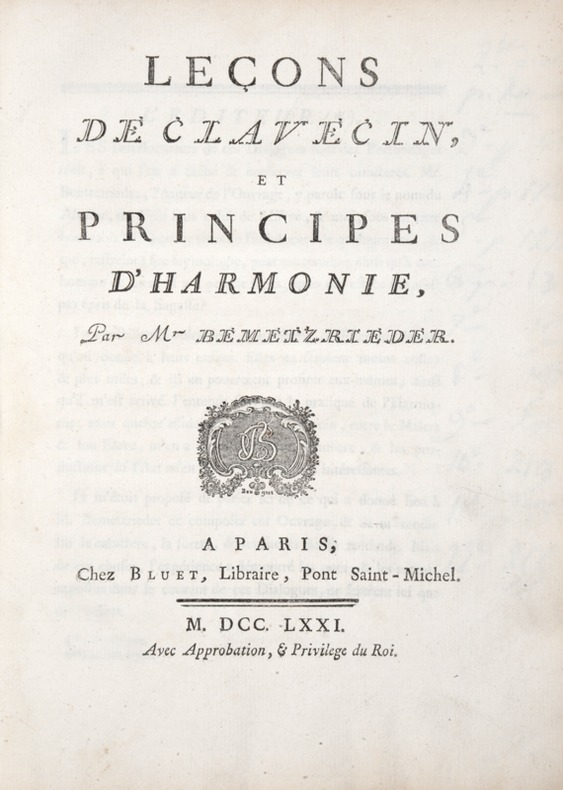
177140271A Paris, chez Bluet, 1771. In-4 de VIII-362-(2) pp., vélin dur, dos orné, pièce de titre en maroquin brun (reliure de l'époque).
1775AMO-3759A Genève, chez les libraires associés, 1775 3 volume in-4 (26 x 20 cm) de (4)-IV-III-VIII-719, (4)-VIII-662 et (4)-VIII-658 pages. Portrait de l'auteur en frontispice du premier volume (dessiné par Cochin et gravé par L. Le Grand). Au tome I : 1 gravure hors-texte (livre I) + 1 grande carte repliée + 1 bandeau à l'eau-forte par Marillier + 1 gravure hors-texte (livre IV). Au tome II : 1 gravure hors-texte (livre VII) + 2 cartes repliées + 1 bandeau à l'eau-forte par Marillier + 1 gravure hors-texte (livre X). Au tome III : 1 gravure hors-texte (livre XIV) + 1 carte repliée + 1 bandeau à l'eau-forte par Marillier + 1 gravure hors-texte (livre XV) + 1 gravure hors-texte (livre XVIII). Soit 1 portrait, 7 gravures hors-texte (avant la lettre), 3 bandeaux et 4 cartes. Collationné complet. Reliure de l'époque plein veau caramel, dos à nerfs orné aux petits fers, pièce de titre de maroquin rouge, pièce de tomaison de maroquin olive. Reliures très décoratives et solides. Usures de surface sur les plats du premier et deuxième volume (épidermures stoppées), petits manques de cuir et petite galerie sans gravité, petites piqûres de vers en queue du dos du premier volume. Malgré ces quelques défauts l'ensemble reste très décoratif et parfaitement solide. Intérieur très frais. A noter une mouillure en marge intérieure des trois premiers feuillets du premier volume et les derniers feuillets du même volume avec mouillure marginale saine (à quelques feuillets seulement). Exemplaire relié à l'époque aux armes (en queue) d'un membre de la famille de Damas (?) ou d'Aubusson (?). Première édition au format in-quarto. Cette édition est bien complète en 3 volumes in-quarto (il n'y a pas d'atlas pour cette édition). Elle reprend le corpus de l'édition en 7 volumes in-8, avec les passages supprimés réintégrés ici au bas des pages sous forme de variantes. La première édition de ce magistral ouvrage a paru pour la première fois en 1770. "Véritable encyclopédie de l’anticolonialisme au XVIIIe siècle" ce texte entre dans la catégorie des "Voyages philosophiques" et représente un prétexte à des réflexions sur la "loi naturelle" et dénonce tout à la fois despotisme, cléricalisme, esclavage et colonialisme. L'ouvrage est toujours décrit par les commentateurs comme une « machine de guerre » contre le pouvoir en place. Pour la rédaction de cette encyclopédie Raynal eut recours à la collaboration de nombreux informateurs et collaborateurs écrivains tels que le Baron d'Holbach ou Diderot, à qui on attribue une part importante des textes. Interdite en 1772, l’Histoire des deux Indes sera à nouveau publiée par l’abbé Raynal dans une nouvelle édition en 1774 qui est immédiatement mise à l’Index par le clergé. C’est en 1780 qu’il publie sa troisième édition de l'Histoire des deux Indes, encore plus virulente que les deux précédentes et qu’il avoue implicitement comme étant de lui en y faisant graver son portrait en frontispice. Condamné par le Parlement de Paris, l’ouvrage est brûlé par le bourreau en place publique, ce qui lui assure un succès considérable. L’Histoire des deux Indes a également été l’occasion de la Lettre apologétique de l’abbé Raynal à Monsieur Grimm (1781) de Diderot (qui aurait écrit au moins un tiers de l'ouvrage, selon Grimm). Dans cette lettre Diderot écrit : « Raynal est un historien comme il n'y en a point encore eu, et tant mieux pour lui, et tant pis pour l'histoire. Si l'histoire avait, dès les premiers temps, saisi et traîné par les cheveux les tyrans civils et les tyrans religieux, je ne crois pas qu'il en fussent devenus meilleurs; mais ils en auraient été plus détestés, et leurs malheureux sujets en seraient peut-être devenus moins patients... Le livre que j'aime et que les rois et leurs courtisans détestent, c'est le livre qui fait naître des Brutus... » Dans notre exemplaire une note manuscrite de l'époque révolutionnaire indique : "Le Parlement de Paris proscrivit, le 25 mai 1781, l'Histoire philosophique de l'abbé Raynal, et ordonna que cet ouvrage fût brûlé. Il décréta même l'auteur de prise de corps. L'abbé Raynal se vit donc forcé de s'enfuir précipitamment de France. Le 15 août 1790, l'Assemblée nationale, sur la rédaction proposée par les députés Voidel et Maloüet, annula, comme contraire aux droits naturels et imprescriptibles de l'homme, le décret lancé par le Parlement de Paris contre l'abbé Raynal et son Histoire philosophique (v. Oeuvres d'André Chénier, 2e vol., p. 119)." (note manuscrite ancienne sur le faux-titre du premier volume). "It became a key text of the American Revolution, and Raynal became a correspondent of Franklin, Jefferson, and Adams." "Un des ouvrages clefs de la crise de l'Ancien Régime" (Michel Delon, in En Français dans le texte) "Celui qui abdique lâchement sa liberté, se voue au remords et à la plus grande misère qu’un être pensant et sensible puisse éprouver. S’il n’y a, sous le ciel, aucune puissance qui puisse changer mon organisation et m’abrutir, il n’y en a aucune qui puisse disposer de ma liberté. [...] L'esclavage est l'état d'un homme qui, par la force ou des conventions, a perdu la propriété de sa personne, et dont un maître peut disposer comme de la chose. [...] La liberté est la propriété de soi; on distingue trois sortes de libertés: la liberté naturelle, la liberté civile, la liberté politique; c'est-à-dire la liberté de l'homme, celle du citoyen et celle d'un peuple. [...] L'homme est aux prises avec la nature; sans cesse il la modifie, et sans cesse il est modifié. [...]." (extraits). Provenance : A. Leclerc, 1885 (étiquette). Armes dorées en queue des dos (mariage - non identifiées - non reconnu par O.H.R. qui les cite pourtant sous la planche n°888, figure n°3). Armoiries peut-être d'une ancienne famille de Bourgogne ? (provenance bourguignonne pour les volumes concernés). Par ailleurs O.H.R. les mentionne sur une Histoire de Bourgogne), peut-être les armes d'une branche de la famille de Damas (à la croix ancrée) ou d'Aubusson. Les présents volumes de Raynal ont été acquis également en Bourgogne ce qui laisserait supposer l'hypothèse "de Damas" plus pertinente. Références : A. Feugère, Bibliographie critique de l'abbé Raynal, 40 ; En français dans le texte, 166 ; Bel exemplaire relié aux armes à l'époque de cet ouvrage très important du Siècle des Lumières, dans son format le plus majestueux.
174843792Au Monomotapa [Paris], sans date, , [1748]. 2 vol. in-12 de (8)-370 pp. et (4)-420 pp., veau glacé, dos lisses ornés, pièces de titre et de tomaisons vieux-rouge, triple filet doré d'encadrement sur les plats, tranches dorées (reliure de l'époque).
1746393311746 2 ouvrages reliés en un volume in-12 (147 x 87 mm), veau marbré de lépoque, dos à 5 nerfs orné de compartiments fleuronnés et cloisonnés, plats encadrés de filets à froid, tranches rouges.
174861041Au Monomatapa (Paris, 1748) 8vo. Uniformly bound in two contemporary Cambridge-style mirror bindings with four raised bands and richly gilt spine. Small paper-label pasted on to top of spines. Wear to spines, some of gilting worn off. Internally nice and clean. (8), 370 pp. + 5 plates (4), 420 pp. + 2 plates (complete).