National Vaudeville ArtistsBiblio.com
113 résultats
0260670804.Ghardcover. Good. Access codes and supplements are not guaranteed with used items. May be an ex-library book. hardcover
1928244319New York: National Vaudeville Artists Fund. Poor with no dust jacket. 1928. Hardcover. Spine is mostly detached along the edges some chipping to the upper end. Book is now in a clear plastic cover which protects and holds the spine. Covers have heavy edge and corner wear and moderate rubbing. The binding is cracked and basically the book is in 2 halves. . National Vaudeville Artists Fund hardcover
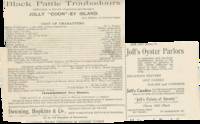
1899List2923Portland Oregon 1899. Two double-sided clippings measuring approximately 7 ½ x 4 ¾ inches both put together with tape. Slightly wrinkled and toned; excellent. Matilda Sissieretta Jones 1869–1933 was an African-American opera singer from Portsmouth Virginia. She studied at the Providence Academy of Music and the New England Conservatory in Boston. At the start of her career Jones sang solo or in small groups touring North and South America the Caribbean and Europe. Jones’ talent was renowned; she was the first Black artist to sing at Carnegie Hall and she performed for multiple US presidents and the English royal family among many other accomplishments.1 In 1896 she formed Black Patti’s Troubadours—Jones was given the nickname “Black Patti†by a critic after famed Spanish opera singer Adelina Patti. The Troubadours would perform comical vaudeville and minstrel skits without Jones followed by Jones performing her “operatic kaleidoscope†of musical excerpts.<br /> <br /> Offered here are two magazine clippings—based on the advertisements these were printed in Portland Oregon—promoting two Black Patti’s shows: “A Rag Time Frolic at Ras-Bury Park†and “Jolly ‘Coon’-ey Islandâ€. The latter was written by Ernest Hogan a musician widely credited with creating the ragtime genre; he would become the first African-American performer to produce and star in a Broadway show 1907’s The Oyster Man. Jones’ kaleidoscope pieces include excerpts from Faust Pirates of Penzance and others; both shows also feature an audience-judged cakewalk. Of interest to scholars of M. Sissieretta Jones and African-American entertainers at the turn of the century.<br /> <br /> 1 “Jones M. Sissieretta ‘Black Patti’†in Africana: The Encyclopedia of the African and African American Experience ed. Anthony Appiah and Henry Louis Gates Basic Civitas Books 1999 1064. unknown
1334863334.Gpaperback. Good. Access codes and supplements are not guaranteed with used items. May be an ex-library book. paperback
0259458120.Gpaperback. Good. Access codes and supplements are not guaranteed with used items. May be an ex-library book. paperback
0267050593.Ghardcover. Good. Access codes and supplements are not guaranteed with used items. May be an ex-library book. hardcover
68931908-1928. Two vols hf-lea one 4to the other 8vo title "Newspaper Cuttings on front of one "Cuttings" on spine of the other boards bumped and bent but mainly good condition 112pp. and 160pp vast majority of items some substantial and folded laid down and with a neat statement of the newspaper source and the date. The Names "Milner & Storey" and "Dulcie Milner & George Storey" are written attractively at the beginning of the volumes. The record charting the theatrical careers of the partnership in great detail was obviously a labour of love self-love. They start with a provincial tour in England Seacombe to Bolton to London 1908-1911 but soon launch into an exhaustive tour of South Africa starting with a faded newspaper photo of "Milner & Storey in costume opening at the Orpheum" in Johannesburg. Their South African tour moved on to Kimberley and East London1911-1912 then back to the British Provinces inc. Scotland and London to 1914 back to South Africa inc. Durbanto 1915 then to Australia and New Zealand 1916-1922 - an extensive tour of usually major cities. End of Volume One. Volume Two: They continue the Antipodean tour till 1928 the end of the volume and the final loose newspaper cutting tells the tale of a contract being terminated because of a voluntary liquidation entailing "serious hardship" to the artists. An unusual and comprehensive record. 1908-1928. hardcover
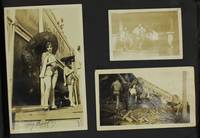
19285820Various locations 1928. Good. 28 leaves illustrated with seventy-five photographs and numerous ephemeral items. Oblong quarto. Contemporary black paper-covered boards string tied. Some chipping scuffing and soiling to boards. Contents worn and shaken with some leaves detached or trimmed some images detached. Still a lively collection. A unique vernacular photograph album and scrapbook documenting a couple of years of Strout's Military Hussar Band a notable sideshow act that toured the country in the early part of the 20th century. A newspaper clipping one of about thirty in the album describes the group: "one of the finest bands in the country is furnishing music at the fair and has already made a big hit with the visitors. In the bright red uniform of the Hussars the band makes an excellent appearance." Another clipping states that "This attraction a singing band of some 16 members is said to be one of the most pretentious organizations of its sort on tour this year." The photographs within are mostly portraits of the band members the majority of which have been shape-cut out of larger photographs. There are also group photographs of other circus performers and sideshow acts as well as some images capturing the after-effects of a train crash; the side of the train reads "D.D. Murphy Shows" a well-known promoter during this period with whom the Hussar Band apparently traveled. One of the more interesting group photographs is pasted on the inside front cover and shows seven large individuals next to a manuscript caption reading "World's Fattest Family."<br /> <br /> The ephemeral items peppered throughout the album include tickets to fairs in Beaumont Texas; Little Rock Arkansas; Fargo Minot and Devil's Lake North Dakota; Memphis Tennessee; and Sedalia Missouri. Other ephemeral items include a business card for the solo clarinet and saxophonist of Strout's Hussar Band Benne Kenner; other business and calling cards newspaper clippings and other clippings probably from magazines. unknown
0428665462.Ghardcover. Good. Access codes and supplements are not guaranteed with used items. May be an ex-library book. hardcover
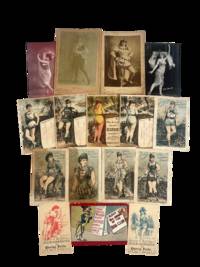
1880222891880. Photographs and printed ephemera of female stage performers dating from the 1880s through the 1910s document the emergence of women as visible figures within vaudeville and burlesque entertainment at a time when theatrical labor offered one of the few public professions available to working women. The archive identifies named performers including Gracie Wilson Jennie Joyce and Mlle. Marcia and records their presentation within commercial and studio imagery that circulated widely in mass print culture. These materials support research into women's history performance studies and the development of popular entertainment industries particularly the ways female performers navigated public visibility economic opportunity and gender norms in the late nineteenth and early twentieth centuries.<br /> <br /> Archive consists of sixteen pieces including two sepia cabinet cards mounted on cardstock chromolithographic advertising trade cards hand colored and monochrome postcards and real photo postcards measuring approximately 3.5 x 5.5 inches to 4.25 x 6.5 inches. The cabinet cards issued by Newsboy of New York include studio portraits of Jennie Joyce dressed in breeches and jacket and Gracie Wilson in a militarized costume with exposed legs both demonstrating the use of theatrical costume to construct stage identity. Additional items include postcards and trade cards depicting British and American burlesque performers in staged poses often accompanied by advertising text for commercial products such as barbershops and hair dressing parlors. Several pieces from series such as "British Burlesque Artists" present lithographed and photographic images of performers in theatrical settings including classical backdrops and studio interiors emphasizing pose costume and visual composition associated with stage publicity.<br /> <br /> These materials were produced during a period when mass printing technologies expanded the circulation of performer imagery allowing actresses and dancers to reach audiences beyond the theater through postcards and advertising media. The inclusion of cross gender costume stylized poses and commercial branding reflects the intersection of entertainment gender presentation and consumer culture in this period. Female performers used such imagery to establish recognizable personas while operating within a commercial system that marketed their appearance and performance. Light edge wear creasing and surface wear to some items with foxing present on certain advertising cards; overall very good condition. This archive provides concentrated visual and material evidence of women's participation in early popular entertainment and the commercial frameworks that shaped their public image. unknown
0260624535.Ghardcover. Good. Access codes and supplements are not guaranteed with used items. May be an ex-library book. hardcover
0265020867.Gpaperback. Good. Access codes and supplements are not guaranteed with used items. May be an ex-library book. paperback
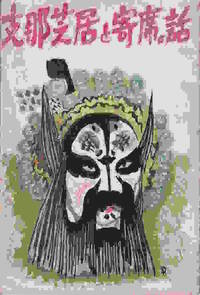
1419219549奉天. Mukden.: 滿鐵鐵道總局營業局旅客課. Mantetsutetsudōsōkyokueigyōkyokuryokakuka Hōten. Showa 14 1939. Black and white photographic illustrations 18.7 x 12.7cm 33pp original wrappers upper cover pictorial. Minor wear and light browning. Good copy. This charming tourist booklet with its delightful pictorial cover offers a comprehensive introduction to Peking Opera and Chinese vaudeville. It outlines the rules governing movement and costume in opera and describes the range of story types and productions a visitor might expect to see. The vaudeville section explains the various forms of oral entertainment performed for audiences together with the customs and rules observed in the theatre. Published in Mukden the booklet provides an accessible and informative overview of the region’s popular entertainments. . 滿鐵鐵道總局營業局旅客課. [Mantetsutetsudōsō unknown