Pierre-Augustin Caron de BEAUMARCHAISBiblio.com
378 résultats
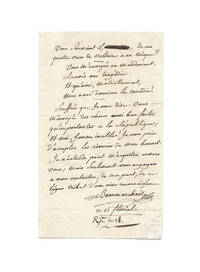
1797Beaumarchais3<p><strong>BEAUMARCHAIS de Pierre-Augustin Caron 1732-1799</strong></p><p>Autograph letter signed " Beaumarchais " to Citizen Pierre-Charles-Louis Baudin<br />N.p " ce 15 floréal " 4th May 1797 1 p. small in-8°<br />Apostille " Répondu le 18 floréal " from the hand of Pierre-Charles-Louis Baudin<br />One word "Monsieur" crossed off by Beaumarchais</p><p><strong>Quoting Voltaire Beaumarchais sent his correspondent <em>La Mère coupable</em> the third part of his <em>Figaro Trilogy</em></strong></p><p><em>" Vous Souvient il Monsieur de ces quatre vers de Voltaire à un Evèque <br />–<br /><strong>Vous m'envoyés un mandement.<br />Recevés une tragédie.<br />Et qu'ainsi mutuellement<br />Nous nous donnions la comédie !<br /></strong>–<br />Souffrés que je vous dise : Vous m'envoyés des choses aussi bien faites qu'importantes à la République ; <strong>Et moi homme inutile ! Je vous prie d'accepter les rèveries de mon bonnet.<br /></strong>Je n'entends point m'acquiter auvers vous ; mais seulement vous engager a vous contenter de ma part de ce léger tribut d'une vive reconnaissance.<br />Beaumarchais<br />ce 15 floréal "</em><br /><em>" Rep. Le 18 "</em></p><p>This letter is part of a sequence of epistolary exchanges between Beaumarchais and Pierre-Charles-Louis Baudin. We know Baudin's reply to the "18 floréal" as indicated by him in the lower margin: "My political abortions cannot become the equivalent of your dramatic work. As I read it with avidity I perfectly felt how necessary Susanne's bottle was. Your Irishman suffocates me … however observed that on the one hand political fanaticism as well as religious fanaticism explains many facts which seem to exceed the known measure of human wickedness; that on the other hand what we have seen that is most atrocious most revolting and above all most disgusting had a character of brutal frankness whereas in your Tartuffe it is a question of a refinement of hipocrite blackness so managed spun with so much art … ". <em>Beaumarchais et le Courrier de l'Europe</em>. Ed. Gunnar & Mavis von Proschwitz. <em>Studies on Voltaire and the Eighteenth Century</em>. Oxford : The Voltaire Foundation 1990 ; p. 1173-1174 n°628.</p><p>When Baudin evokes the characters "Irish" Bégearss "Suzanne" Figaro's wife and more broadly the praise he makes of the theatrical drama of his correspondent we understand that the text sent by Beaumarchais is the third part of his <em>Spanish</em> Figaro <em>trilogy</em>: <em>The</em> <em>Guilty Mother</em>.<br />The play performed on 26 June 1792 at the Théâtre du Marais was a failure. The revival at the Théâtre de la rue Feydeau on 16 Floréal of the year V 5 May 1797 that is to say the day after this letter was this time crowned with great success. The play represents the third part of the Figaro trilogy after<em> The Barber of Seville</em> 1775 and <em>The Marriage of Figaro</em> 1778. Beaumarchais himself wrote a notice to comment on this third and final act: "After having laughed at the Barber of Seville at the turbulent youth of Count Almaviva after having gaily considered in the Mad Day <em>The Marriage of Figaro</em> the faults of his virile age come and convince yourself by the picture of his old age that every man who is not born a dreadful villain always ends up being good. "</p><p>Although no letter between Voltaire and Beaumarchais has come down to us today we nevertheless know the esteem in which they were held. In his book<em> Voltaire's Kehl Edition</em>. <em>L'édition Kehl de Voltaire. Une aventure éditoriale et littéraire au tournant des Lumières</em> Linda Gil explains that "Their relationship is built on mutual admiration. Beaumarchais read Voltaire and admired his works. His own writing is often influenced by the style of the philosopher. As for Voltaire "he cites Beaumarchais as an example to D'Alembert he compares himself to him. A good part of his correspondence from the first months of 1774 is occupied with it."</p><p><u>Provenance:</u><br />Vente Cornuau 25-26 mai 1934<br />A. Guichard Collection</p><p><u>Bibliography:</u><br />" Chroniques " <em>Revue d'histoire littéraire de la France</em> 42e année n°1 1935 p. 148 transcription partielle – Linda Gil<em> L'édition Kehl de Voltaire</em>.<em> Une aventure éditoriale et littéraire au tournant des Lumières</em> Honoré Champion Paris 2018 t. 1 p. 573-576 – <em>Inventaire numérique de la correspondance de Beaumarchais</em> Linda Gil dir. Humanum/IRCL IDC24</p>
17335282Amsterdam: Zacharias Chatelain 1733. Contemporary gold-tooled calf by the Three Acorn Bindery sewn on 7 supports with the corresponding raised bands on the spine a red morocco title label on the spine lettered in gold both boards are richly gold-tooled in a panel design with a central ornament mottled and sprinkled panels of varying density separated by vegetal borders. Further with gold-tooled board edges and blue mottled page edges. Large folio. With an engraved frontispiece an engraved vignette on the title page the title printed in red and black a large armorial head-piece for the dedication and 60 full-page engraved plates by Bernard Picart. Large-paper copy of the first Dutch edition of a beautifully illustrated explanation of the classical fables sumptuously bound by the Three Acorn Bindery in Amsterdam fl. ca. 1756-1780/1806. Each chapter is dedicated to a single fable. It contains a Latin quotation from the original source primarily from Ovid but also Seneca Martial Lucan and Horace followed by a Dutch prose account of the fable an explanation of its meaning and scholarly notes. The 60 fine plates were designed and engraved by Bernard Picart 1673-1733 and his pupils. These engravings framed by elaborate rococo borders populated with scrollwork and mythological creatures not only represent Picarts final works but also his finest.The inspiration for the collection comes from Michel de Marolles' Tableaux du Temple des Muses 1655 but the texts were newly written for the present edition by Antoine de la Barre de Beaumarchais. The plates include a brief caption in French Dutch English and German likely so that they could be reused as Chatelain published editions in all four languages simultaneously. The French and German translations were published a second time in 1749 and 1754 respectively.The binding shows minor traces of use. The text leaves are somewhat browned and foxed but the plates are clean. Otherwise a fine large-paper copy in good condition.l Cat. Rijksmuseum Amst. I p. 170; STCN 182996409; cf. Cohen-De Ricci col. 531 French ed.; Storm van Leeuwen Dutch decorated bookbindings vol. I pp. 599-612 for the bindery and vol. III L358 for this binding. Zacharias Chatelain, hardcover
178486383Kehl Baden: Imprimerie de la Société Littéraire-Typographique 1784. Leather Bound. Very Good. L 8vo 7.75 - 9.75'' tall. Leather Bound. Condition: Very Good. Imprimerie de la Société Littéraire-Typographique Kehl Baden 1784. In French. Famous first posthumous collected edition of Voltaire's 1694-1778 works known as the 'Kehl Voltaire' produced by Beaumarchais who created a print foundry at Kehl to carry out this great work. Set contains 69 of the 70 Volume 8vo edition smaller 12mo 90 volume edition was also produced. Volume 23 Histoire de Charles XII missing. Volumes 10 and 27 printed 1784 summary volume 70 printed 1789 all other volumes printed 1785. Uniform 18th century calf full brown leather. Spines decorated in gold floral designs titles volume numbers within 6 boxed compartments. Boards have a natural brown mottled leather finish slanted gold lines on the narrow board edges. All page ends stained a very light yellow finely bespeckled with green. Green silk reading ribbons. Moderate wear of leather at spine tops light stress wear along exterior leather hinges some boards show minor leather loss at edges. All interior hinges firm untorn. Volume 20 upper rear board tip charred. Otherwise no volume damaged or repaired uniform light general wear. Only endpapers show browned bands along margins from pasted endpaper glue chemistry. Volumes 1 to 69 containing all the works and massive correspondences of Voltaire. Volume 70 contains Condorcet's Life of Voltaire and Condorcet's 'Memoires' of Voltaire index and 'Additions et Corrections' to the 70 volumes. Volume 1 frontispiece engraving of Voltaire by Moreau.; Volume 10 frontispiece engraving of Henry IV; Volume 16 frontispiece portrait of Voltaire; Volume 24 frontispiece engraving military map camp plan; Volume 31 14 engraved plates of scientific diagrams. Provenance: Each volume has the small ink stamp 'William H. Floyd Collection No.' on the rear of the title page. Floyd was a late 19th century American antiquarian collector. The numbering sequence 5098-5166 shows that volume 23 was missing even when cataloged by Floyd. Size: L 8vo 7.75 - 9.75'' tall. A major cultural event of the last decade of the ancien regime a beautiful monument to Voltaire the greatest man that literature had produced. Pierre-Augustin Caron de Beaumarchais led a controversial life. Playwright The Marriage of Figaro politician publisher entrepreneur spy supplier of munitions for the American Revolution and an early champion of the rights of artists and intellectual property. Shortly after the death of Voltaire in 1778 Beaumarchais set out to publish Voltaire's complete works many of which were banned in France and vehemently condemned by the Church. Royal letters would be censored by Frederick II of Germany Catharine II of Russia and others. He bought the rights to most of Voltaire's many manuscripts from publisher Charles-Joseph Panckoucke in 1779. To evade censorship printing presses were set up in the small neutral independant state of Baden at Kehl. Beaumarchais bought with exclusivity the complete foundry of the famous English type designer John Baskerville for the Societe Litteraire Typographique an organization he established to produce editions in which he was interested. Three paper mills were purchased. Seventy volumes were published between 1783 to 1790. While the venture proved a financial failure Beaumarchais was instrumental in preserving many of Voltaire's later works which otherwise might have been lost. The Kehl edition was banned on French territory until 1789. Baskerville font was revived by Americans in the 20th century. Voltaire Kehl Condorcet Pierre Beaumarchais Charles-Joseph Panckoucke RBR4 RBR4 Imprimerie de la Société Littéraire-Typographique hardcover
