123 résultats
18632110502150903444Not Available 1863. Soft Cover. Fine. Number of books: 4 Not Available paperback
18632110502150901905Not Available 1863. Soft Cover. Fine. Number of books: 5 Not Available paperback
18242110502150902459Not Available 1824. Soft Cover. Fine. Number of books: 2 Not Available paperback
18782080202105101567Yamamoto Kichitaro 1878. Soft Cover. Fine. Volume: 1 Yamamoto Kichitaro paperback
187111233New York: Hurd and Houghton 1871. Hardcover. Very Good. 12mo 7" - 7" tall. Reprint. Mild wear to the boards; previous owner's inscription on front fly leaf. Clean and tight. Andersen was an enthusiastic traveler who brought his own personal style notably the incorporation of folk and fairy tales to the genre of the travel narrative. Hurd and Houghton hardcover books
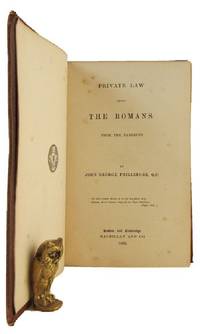
1863182419London: Macmillan and Co 1863. Pp. iiadvertisementsxxxiv424last blank text books consulted index; tall demy 8vo; brown textured cloth lettered in gilt and ruled in black edges of boards lightly worn fore-corners slightly bruised the lower joint starting and slightly frayed at head; book label of David Levine Sydney on upper pastedown earlier owner's name stamp on verso of upper free endpaper binder's ticket Burn & Kirby on lower pastedown the upper hinge cracking and lower hinge starting inked annotation at head of preface occasional minor marginalia some mainly light foxing and occasional slight soiling; Macmillan and Co. London 1863. First edition. John George Phillimore 1808-1865 was an English barrister and Liberal Party politician. The Pandects was a sixth century compilation of passages from the writings of early Roman jurists. Macmillan and Co unknown
18702090202122800298Shokodo 1870. Soft Cover. Fine. Volume: 1 Shokodo paperback
18702090202122800287Shokodo 1870. Soft Cover. Fine. Volume: 1 Shokodo paperback
1880mon0000013551Philadelphia : Edward Stern 1880-01-01. Paperback. Good. . Hardcover. Some cover wear. Clean unmarked text. Tight binding. Philadelphia : Edward Stern paperback
180950198Paris, Mad. Ve Barnard, 1809. Contemp. hcalf. Spine gilt. Wear to top of spine. A few scratches to binding. Small stamps on verso of titlepage.In: ""Annales de Chimie, ou Recueil de Mémoires concernant la Chemie"" Tome 70. 336 pp. (Entire volume offered). Davy's paper: pp. 189-254.
183244145Paris, Crochard, 1832. Contemp. hcalf., gilt spine, light wear along edges. In: ""Annales de Chimie et de Physique, Par MM. Gay-Lussac et Arago."", tome 50, Series 2. (Entire volume offered). 448 pp. 2 folded engraved plates. Faraday's papers: pp. 5-67 a. pp. 113-162.
183248987Paris, Crochard, 1832. Contemp. hcloth, gilt lettering to spine. In: ""Annales de Chimie et de Physique, Par MM. Gay-Lussac et Arago."", tome 50, Series 2. (Entire volume offered). 448 pp. 2 folded engraved plates. Faraday's papers: pp. 5-67 a. pp. 113-162. Some scattered brownspots.
186344144Paris, Victor Masson et Fils, 1863 a. 1864. Boundin 2 contemp. hcalf. Gilt spines, raised bands, light wear along edges. In: ""Annales de Chimie et de Physique"", 3e Series - Tome 68 a. 4e Series, tome 1. 512 pp. a. 5 large folded engraved plates. + 512 pp. a. 3 large folded engraved plates. Kirchhoff's papers: pp. 5-45 a. pp. 396-411. 5 plates belongs to K's papers, 4 showing spectra and 1 plate (double page) depicts the famous spectroscope invented by K. and used by K. and Bunsen in their importent analysis of the spectra of the elements.
180950198Paris Mad. Ve Barnard 1809. Contemp. hcalf. Spine gilt. Wear to top of spine. A few scratches to binding. Small stamps on verso of titlepage.In: "Annales de Chimie ou Recueil de Mémoires concernant la Chemie" Tome 70. 336 pp. Entire volume offered. Davy's paper: pp. 189-254. <br/><br/><em>First edition in French the first English 1808 of this importent historical paper in chemistry in which Davy shows that electricity is capable of decomposing some alkalies isolating two new substances and discovering potassium and sodium. Neville in his Historical Chemical Library vol. I p.340 writes about this paper "ONE OF THE GREAT CLASSIC RESEARCHES IN CHEMISTRY in which Davy announced in this his second Bakterian lecture the isloation of metallic potassium and sodium by the electrolytic decomposition of their fused oxides.""He Davy began his own electrical experiments.The results were spectacular. On October 6 1807 the current passing through molten potash liberated a metal which Davy called potassium. The little globules of shining metal tore the water molecule apart as it eagerly recombined with oxygen and the liberated hydrogen burst into lavender flame. Davy danced about in a delirium of joy. A week later he isolated sodium from soda."Asimow. The paper offered here describes these discoveries."Humphry Davy was one of the most brilliant chemists of the early nineteenth century. His early study of nitrous oxide brought him his first reputation but his later and most importent investigations were devoted to electrochemistry. Following Galvani's experiments and the discovery of the voltaic pile interest in galvanic electricity had become widespread. The first electrolysis by means of the pile was carried out in 1800 by Nicholson and Carisle who obtained oxygen and hydrogen from water. Davy began to examine the chemical effects of electricity in 1800 and his numerous discoveries were presented in his Bakerian lecture to the Royal Society on November 20 1806. A Source Book in Chemistry p. 243. </em> unknown
183244145Paris Crochard 1832. Contemp. hcalf. gilt spine light wear along edges. In: "Annales de Chimie et de Physique Par MM. Gay-Lussac et Arago." tome 50 Series 2. Entire volume offered. 448 pp. 2 folded engraved plates. Faraday's papers: pp. 5-67 a. pp. 113-162. <br/><br/><em>First French editions of the 2 first memoirs of Faradays groundbreaking researches on electricity constituting the first 2 papers of his "Experimental Researches in Electricity" and containing his fundamental discovery of electromagnetic induction THE FOUNDATION OF NEARLY ALL THE ELECTRICITY IN USE TODAY. In 1820 Oersted had generated magnetism from electricity Faraday here finds the opposite effect generating electricity by magnetism. He also described the first electrical generator second paper. THESE PAPERS ARE SOME OF THE GREAT CLASSICS OF CHEMISTRY AND PHYSICS."Faraday demonstrated this theory involving the lines of force.by inserting a magnet into a coil of wire attached to a galvanometer. While the magnet was being inserted or removd current flowed through the wire. If the magnet was held stationary and the coil moved over it one way or the other there was current in the wire. In either case the magnetic lines of force about the magnet were cut by the wire.If the magnet and coil were both held motionless whether the magnet was within the coil or not there was no current.Faraday hd thus discovered electricalinduction.It was to lead to great things but this was not apparent."Asimov."Although his discovery of the electric motor and the dynamo was almost entirely identical to his theoretical discoveries it laid the foundation of the modern electrical industry - electric light and power teælephony wireless telegraphy televison etc. - by providing for the production of continous mechanical motion from an electrical source and vice versa." PMM 308.Horblit 29 - Milestones 62. - Dibner 64. - PMM 308. </em> unknown
183248987Paris Crochard 1832. Contemp. hcloth gilt lettering to spine. In: "Annales de Chimie et de Physique Par MM. Gay-Lussac et Arago." tome 50 Series 2. Entire volume offered. 448 pp. 2 folded engraved plates. Faraday's papers: pp. 5-67 a. pp. 113-162. Some scattered brownspots. <br/><br/><em>First French editions of the 2 first memoirs of Faradays groundbreaking researches on electricity constituting the first 2 papers of his "Experimental Researches in Electricity" and containing his fundamental discovery of electromagnetic induction THE FOUNDATION OF NEARLY ALL THE ELECTRICITY IN USE TODAY. In 1820 Oersted had generated magnetism from electricity Faraday here finds the opposite effect generating electricity by magnetism. He also described the first electrical generator second paper. THESE PAPERS ARE SOME OF THE GREAT CLASSICS OF CHEMISTRY AND PHYSICS."Faraday demonstrated this theory involving the lines of force.by inserting a magnet into a coil of wire attached to a galvanometer. While the magnet was being inserted or removd current flowed through the wire. If the magnet was held stationary and the coil moved over it one way or the other there was current in the wire. In either case the magnetic lines of force about the magnet were cut by the wire.If the magnet and coil were both held motionless whether the magnet was within the coil or not there was no current.Faraday hd thus discovered electricalinduction.It was to lead to great things but this was not apparent."Asimov."Although his discovery of the electric motor and the dynamo was almost entirely identical to his theoretical discoveries it laid the foundation of the modern electrical industry - electric light and power teælephony wireless telegraphy televison etc. - by providing for the production of continous mechanical motion from an electrical source and vice versa." PMM 308.Horblit 29 - Milestones 62. - Dibner 64. - PMM 308.The volume contains further notable papers. Elie de Beaumont "Zweiter geologischer Brief.an A.v. Humboldt über die relative Alter der Gebirgszüge" pp. 1-58 a. 2 plates one handcoloured papers by Döbereiner E. Lenz Moser Mitscherlich de Saussure J. Dumas F.E. Neumann Gay-Lussac Johannes Müller "Beobachtungen zur Analyse der Lymphe des Bluts und des Chylus" pp. 513-590. </em> hardcover
186344144Paris Victor Masson et Fils 1863 a. 1864. Boundin 2 contemp. hcalf. Gilt spines raised bands light wear along edges. In: "Annales de Chimie et de Physique" 3e Series - Tome 68 a. 4e Series tome 1. 512 pp. a. 5 large folded engraved plates. 512 pp. a. 3 large folded engraved plates. Kirchhoff's papers: pp. 5-45 a. pp. 396-411. 5 plates belongs to K's papers 4 showing spectra and 1 plate double page depicts the famous spectroscope invented by K. and used by K. and Bunsen in their importent analysis of the spectra of the elements. <br/><br/><em>First edition in French of Kirchhoff's milestone papers on the interpretation of the dark D lines - noticed by Fraunhofer in 1814 - in the spectrum of the sun the papers that inspired Max Planck to his theory of quanta 1900. The papers are the French translations of his papers published in Abhandl. d. königl. Akad. d. Wissenscchaften in Berlin in 1861 and 1862.In the course of his preparatory work in the autumn of 1859 Kirchhoff made an unexpected observation. It had long been known that the dark D lines noticed in the solar spectrum by Fraunhofer 1814 coincided with the yellow lines emitted by flames containing sodium.Kirchhoff's unexpected discovery was that if the intensity of the solar spectrum increased above a certain limit the dark D lines were made much darker by the interrposition of the sodium flame. He instantly felt that he had got hold of "something fundamental" even though he was at a loss to suggest an explanation. On the day following the surprising observation Kirchhoff found the the correct interpretation which wass soon confirmed by new experiments: a substance capable of emittiing a certain spectral line has a strong absorptive power for the same line.The dark D lines in the solar spectrum could accordingly be ascribed to absorption by a solar atmosphere containing sodium. Immense prospects thus opened up of ascertaining the chemical composition of the sun and other stars from the study of their optical spectra. A few more weeks sufficed for Kirchhoff to elaborate a quantitative theory of the relationship between emissive and absorptive poweer."DSB VII pp. 381-82.PMM 278 b. - Barchas 1169-70 - Sparrow 117 - Horbli 59 - Dibner 153 the note. </em> hardcover
18502080302106802665Not Available 1850. Soft Cover. Fine. Number of books: 1 Not Available paperback
1898mon0000060159Philadelphia : John D. Wattles 1898-01-01. Paperback. Acceptable. in x in x in. Hardcover. Philadelphia : John D. Wattles paperback
18842082402113505190Not Available 1884. Soft Cover. Fine. Volume: 1 Not Available paperback
189425175E. Dentu, éditeur, 1894 (Petite Collection Guillaume). Petit in-16 relié 13,5 x 8 cm, reliure demi-maroquin brun, tête dorée, 104 pages, illustré de dessins par Marold et Mittis.-140g.L. - Intérieur bien frais, charmant reliure en très bon état.
1897191899Portland ME: Thomas B. Mosher. 1897. good. Hardcover. 4th ed. on Van Gelder laid paper consists of 925 copies; 7" tall x 3.75"; 126pp including bibliography; off-white buckram is soiled; paper overhangs boards on fore edges; uncut fore edge; prev. owner's name dated 1897 on first page . Thomas B. Mosher hardcover
18782111902160200229Chugaido Yanagawa Umejiro 1878. Soft Cover. Fine. Volume: 1 Chugaido Yanagawa Umejiro paperback
183449065Leipzig, Barth, 1834. Contemp. hcalf., raised bands, spine gilt. Spine with light wear. in. ""Annalen der Physik und Chemie. J.C. Poggendorff"", Zweite reine, 3. bd.VIII,558,(4) pp. and 5 plates. (Entire volume offerd). Faradays papers: pp. 149-189 (Sixth series) + pp. 301-331 a. 481-520 (Seventh series). Internally clean and fine, printed on good paper.
183449065Leipzig Barth 1834. Contemp. hcalf. raised bands spine gilt. Spine with light wear. in. "Annalen der Physik und Chemie. J.C. Poggendorff" Zweite reine 3. bd.VIII5584 pp. and 5 plates. Entire volume offerd. Faradays papers: pp. 149-189 Sixth series pp. 301-331 a. 481-520 Seventh series. Internally clean and fine printed on good paper. <br/><br/><em>First appearance in German - prepared by Faraday himself for publication in Annalen - of 2 historical papers in chemistry and physiscs in which Faraday in the first detects a new recombination-effect in electrolysis and in the second we have the MILESTONE PAPER in which Faraday announces the discoveries of further laws of electrochemistry stating the general relations of electricity to chemistry and introducing new terms with precise meanings. The first part of the paper introduces his new terminology giving the words a limited and precise meaning. These words devised with the assistance of William Whewell are now familiar to all chemists electrode anode cathode ion anion and cation. He also introduces the "Volta-electrometer" and arrives at the "Law of electro-chemical equivalents". The paper offered is one of Farday's most famous papers."Another section of the paper is devoted to a closer examination of the law of constant electrochemical action with respect to water and to the development of a gas electrometer to measure quantities of electricity. Faraday's "Volta-electrometer" provided the first practical means for the quantitative measurement of electricity." Source Book in Chemistry p. 280-81.The Sixth series: "In the course of his experimental investigations of a general and importent law of electro-chemical action which required the accurate measurement of thegases evolved during the decomposition of water and other substances the author was lead to the detection of a curious effect which had never been previously noticed and of which the knowledge had he before possessed it would have prevented many of the errors and inconsistencies occurring in the conclusions he at first deduced from his earlier experiments. The phenomena observed was the gradual recombination of elements which had been previously separated from each other by voltaic action. This happened when after water had been decomposed by voltaic electricity the mixed gases resulting from such decomposition were left in contact with the platina wires or plates which had acted as poles; for under these circumstances they gradually diminished in vo.umes water was reprioduced and at lust the whole of the gases disappeared."Abstract - Faraday explains the causes of this recombination. </em> hardcover