PETRUS DELPHINUS DelfinMareMagnum

7 641 résultats
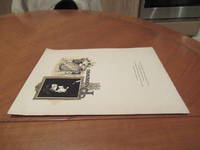
In-folio; ff. (392), in caratteri romani; il titolo, tranne le prime due righe, è in caratteri gotici; pelle marrone ottocentesca firmata Bedford, con decorazione dorata ai piatti entro doppia cornice, titolo in oro al dorso, fregi, nervature, tagli dorati. Ex libris John Fairfax Crowder. Al frontespizio sotto al titolo una xilografia raffigura "Petrus Delphinus Generalis" inginocchiato di fronte a A. Romualdo; la pagina è inquadrata in una cornice a grottesche su legno che reca il monogramma "I C", che era stata impiegata nel 1521 per Sallustio, e poi per l'edizione delle Vite de SS. Padri del 1532. Raro epistolario del generale dei camaldolesi, fonte ricchissima per la vita storica e artistica fiorentina del XV secolo. PIETRO DELFIN, (Venezia 1444-1525), venne eletto generale dei camaldolesi nel 1480, e coltivò costantemente le lettere e la teologia, tenendosi in relazione con gli uomini più illustri del suo tempo, soprattutto con gli umanisti. Irriducibile avversario del Savonarola, nel suo Dialogus in Ieronymum Ferrariensem arrivò a chiedere la condanna al rogo del frate. Prima edizione del suo epistolario, una ricchissima fonte per la dottrina teologica ma anche per i dettagli storici di cui le sue lettere sono corredate. L'argomento principale che è al centro degli scritti di Delfin è certamente la disputa teologica o comunque religiosa, oggetto di fitti scambi epistolari con i rappresentanti del clero e gli umanisti di tutta Italia; tra gli altri argomenti vi rientra anche una disquisizione piuttosto lunga (l. II ep.LXXVII) circa l'azione corruttrice delle rappresentazioni teatrali, in particolare delle commedie, con un richiamo ai ludi scaenici degli antichi romani. Ma dati i rapporti con gli umanisti del tempo, la raccolta contiene anche scambi epistolari con questi ultimi: Ugolino Verino, Ermolao Barbaro, Francesco Guicciardini ecc. Ad esempio proprio in una di queste missive si esprime l'augurio che si ponga mano ad una edizione completa delle opere di Leon Battista Alberti. In folio; ff. (392), in Roman characters; the title, except for the first two lines, is in gothic characters; 19th century brown calf binding signed Bedford, with gilt decoration on the plates within a double frame, gilt title on the spine, friezes, bands, gilt edges. Ex libris John Fairfax Crowder. On the title page, under the title, a wood plate depicts "Petrus Delphinus Generalis" kneeling in front of A. Romualdo; the page is framed in a grotesque frame on wood bearing the monogram "I C", which had been used in 1521 for Sallustio, and then for the edition of the Vite dei SS. Padri 1532. Rare epistolary of the general of the Camaldolese order, a very rich source for the historical and artistic life of Florence in the 15th century. PIETRO DELFIN, (Venice 1444-1525), was elected general of the Camaldolese order in 1480, and constantly cultivated literature and theology, keeping in touch with the most illustrious men of his time, above all with the humanists. Irreducible opponent of Savonarola, in his Dialogus in Ieronymum Ferrariensem he came to ask for the friar to be condemned to the stake. First edition of his epistolary, a very rich source for theological doctrine but also for the historical details with which his letters are accompanied. The main topic that is at the center of Delfin's writings is certainly the theological or religious dispute, the subject of dense exchanges of letters with representatives of the clergy and humanists from all over Italy; among the other topics there is also a rather long disquisition (l. II ep.LXXVII) about the corrupting action of theatrical representations, in particular of comedies, with a reference to the ludi scaenici of the ancient Romans. Given the relationships with the humanists of the time, the collection also contains correspondence with the latter: Ugolino Verino, Ermolao Barbaro, Francesco Guicciardini etc. For example, precisely in one of these letters the wish is expressed that a complete edition of the works of Leon Battista Alberti be put to work.
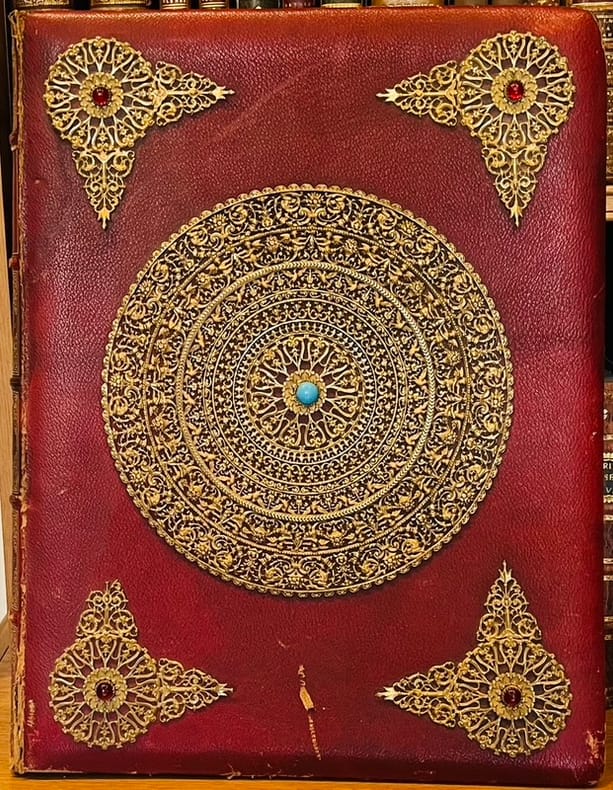
188044443, , (Vers 1870-1880). Grand in-folio manuscrit (54 x 41 cm) de 52, 50 ff. enluminés sur peau de vélin à l'encre et aquarelle rouge, vert, bleu et or, chagrin rouge, dos orné à nerfs, décor sur le plat supérieur d'écoinçons et d'une grande plaque circulaire ajourés en laiton avec incrustations de cabochons de pierres, sur le second plat quatre plaques d'angles circulaires ajourés en laiton avec incrustations de cabochons de pierres, dentelle intérieure, gardes de papier dominoté (reliure de l'époque).
1891STLE0119Wien, Druck von Carl Steinhardt 1891. 8°. 118(2) S. Mit 2 Bühnenskizzen. Halbleinenband der Zeit m. Deckelbezügen aus Achatmarmorpapier u. Rü.präg (?Theater 33.?). Buchdeckel mit Kratzspuren, Rü. geblichen, Deckelkanten abgerieben, papierbedingt gebräunt. - Auf Titelblatt mit eh. Widmung 'Herrn Hofschauspieler Max Devrient hochachtungsvoll. ArtSch'. Kosch 15, 660; vgl. WG² 2 (hier die erste Buchausgabe von 1894). Als ?Manuskript? gedruckte erste Ausgabe von Schnitzlers frühem Bühnenstück ?Das Märchen?. Drei Jahre vor der ersten Buchausgabe 1894 (bei Pierson in Dresden) erschienen und zwei Jahre vor ?Anatol? (1893). Schnitzler begann 1890 mit der Arbeit zu ?Das Märchen?, in dem der Schriftsteller Fedor Denner die Schauspielerin Fanny Theren liebt, doch es gelingt ihm nicht zu vergessen, daß er für sie nicht ?der erste? Liebhaber ist. ?S. schreibt sein erstes großes Bühnenstück in drei Akten, das auch ein Versuch ist, sich von der besessenen Eifersucht auf die Vergangenheit [] zu befreien. ?Begann das ?Mährchen? zu schreiben. ?Das Mährchen von der Gefallenen?. Befreie mich. ? Psychologisches aus meinem Verhältnis mit Mz. [d.i. Marie (Mizi) Glümer].? Notiert er im November 1890 in sein Tagebuch und am 26. Februar 1891: ?[?Das Mährchen?] Endet schlecht. ? Wie wird?s in Wirklichkeit enden??. (vgl. Farese, Arthur Schnitzler. Ein Leben in Wien. S.40ff.). Das Stück wurde am 1. Dezember 1893 am Wiener Volkstheater uraufgeführt. Es fällt durch und wird nur mehr ein einziges Mal gezeigt, dann verschwindet es vom Spielplan. ? Mit Widmung an den deutschen Schauspieler Maximilian Paul Devrient (1857-1929), der als einer der herausragendsten deutschsprachigen Schauspieler des ausgehenden 19. Jahrhunderts galt. Bereits 1882 wurde er an das Burgtheater in Wien engagiert, das zum Mittelpunkt seines künstlerischen Schaffens als Schauspieler wie auch als Regisseur wurde. 1911 spielte er in der Besetzung der Uraufführung von Schnitzlers ?Das weite Land? mit. ? Der Sammelband enthält außerdem: Fitger, A[rthur]. Die Hexe. 1885. / L?Arronge, Adolph. Hasemann?s Töchter. o.J. / Fortis, Leone. Kunst und Liebe. 1896. / Lope de Vega, König und Bauer. Bearbeitung v. August Förster. 1887. / Edler, Karl Erdm. Theodora. 1881. - DIESES OBJEKT UNTERLIEGT DER DIFFERENZBESTEUERUNG.
1984005516NY: GROVE PRESS. ONE OF THE RAREST OF MODERN DAY PLAYS. STATED FIRST EDITION WITH NUMERICAL SEQUENCE 54321 17.50DJ. CLEAN UNMARKED COPY! . Fine. Hardcover. First Edition. 1984. GROVE PRESS hardcover
194930698London: John Lehmann 1949. First UK edition. Cloth. Very Good/very good. First British edition of Williams' classic. Published two years after the American debut. Very good indeed in green cloth binding with bright spine label. Price intact dustwrapper shows minor wear to edges. Also very good. This copy boldly SIGNED by Williams on the front endpaper and quite scarce thus. John Lehmann unknown books
1923016029NY Doubleday 1923 1923. First Edition stated 1st Printing. Orange Cloth. Very Good /No Jacket. Photographs of Stage Production. X 187 Pp. Orange Cloth Stamped In Black. First Am. Edition First Printing 1923 Date On Title And Copyright Pages Copyright Page Does State "First Edition". Frontispiece Photograph And Three Other Photographs Of The Stage Production. Vg Very Slight Fading To Spine. Front Hinge Broken But Holding Can Be Repaired. Ownership Signature Of Mental Hygienist Clare Moore De Gruchy See: Biography Of Alice B Toklas By Simon. An Early Play About Self-Aware Mechanico-Electric Humanoids Contributing The Word "Robot" To Twentieth Century Consciousness Before Mankind Became Aware Of How Dehumanized Humans Were Than Humanized Robots So Far. <br/> <br/> NY Doubleday 1923 hardcover
1903107297Montreal: The Renaissance Press 1903. Deluxe Limited Edition. Hardcover. Very Good/No Dj. Larger 4to. Signed by Artist. pp 5 Phamplet and 17 illustrations. This is number 6 of 100 from the edition De luxe signed by R G Mathews on limitation page. The list of plates are as follows Mrs Patrick Campbell Marie Celeste Marie Celeste Clara Lipman Jan Kubelik Mrs James Brown-Potter Jean Gerardy George Grossmith Lillian Nordica Mrs Patrick Campbell… The Renaissance Press hardcover
19341169Moscow: Izd. Vseros. teatral nogo obshchestva 1934. First Edition. 4to 12 1/8 x 8 7/8 inches / 307 x 220 mm xlvii 11-195 plates 3 199-211 appendix 1 pages in publisher's original brown cloth lacking the rare dust jacket. A celebration of Alexander Tairov's pathbreaking Kamerny Theatre in Moscow featuring set and costume designs as well as scenes from the theatre's first 20 years. Text entirely in Russian Profusely illustrated in both color and black and white the book showcases each production of the Kamerny founded by Alexander Tairov 1885-1950 and his wife the actress Alisa Koonen 1889-1974. Tairov brought many non-Russian productions to the Kamerny including works by Shakespeare Bertolt Brecht Eugene O'Neill George Bernard Shaw and Oscar Wilde. Tairov's productions were known for their magnificent set and costume designs and he collaborated with some of the most acclaimed avant-garde artists of the day including Alexandra Exter and Natalia Goncharova. Indeed it's possible to see the evolution of 20th-century Russian art through the set and costume designs which reflected Cubist Constructivist Rayonist and even Art Deco influences. It was an exciting time in Soviet theatre; this era featured some of the greatest directors of the 20th century such as Stanislavsky Meyerhold and Vakhtangov. The Kamerny was the scene of one of the most significant plays of the Soviet theatre according to Nick Worrall in his authoritative study "Modernism to Realism on the Soviet Stage" Cambridge University Press 1989. Vsevolod Vishnevsky's Russian civil-war play Optimistic Tragedy opened at the Kamerny on December 18 1933. "It concerns particular historical events associated with the civil war in the Soviet Union but more generally it is an article of faith -- in the triumph of Life over Death of the Collective over the Individual of faith in the necessary tragedy of revolution of the necessary destruction of those who oppose revolution of hostility to the spirit of anarchism and faith in the leadership of the party." Indeed the play which is featured in this book marked an important milestone in the development of "socialist realism." The Soviet government closed the Kamerny Theatre in 1949 and Tairov died a year later. The Kamerny's home at 23 Tverskoy Boulevard is now occupied by the Moscow Pushkin Drama Theatre. A stunning look at the first 20 years of the Kamerny Theatre one of the most innovative theatres at an important moment in Soviet theatre history. SCARCE. <br/><br/>CONDITION: Both boards rubbed small scrape to rear paste down. Tissue guards separating each play page 36 unpublished according to list of illustrations in the appendix plate 41 loose some small closed tears in a few pages plate 175 improperly trimmed not affecting the illustration. Overall Very Good or better. Izd. Vseros. teatral nogo obshchestva hardcover books
19341169<p>Quarto 12 1/8 x 8 7/8 inches; 307 x 220 mm pp. 8 ix-xlvii 1 introduction 195 plates 3 199-211 1 appendix in publisher's original brown cloth lacking the rare dust jacket. </p><p>A celebration of Alexander Tairov's pathbreaking Kamerny Theatre in Moscow featuring set and costume designs as well as scenes from the theatre's first 20 years. Text entirely in Russian. Profusely illustrated in both color and black and white the book showcases each production of the Kamerny founded by Alexander Tairov 1885-1950 and his wife the actress Alisa Koonen 1889-1974.<br /></p><p>Tairov brought many non-Russian productions to the Kamerny including works by Shakespeare Bertolt Brecht Eugene O'Neill George Bernard Shaw and Oscar Wilde. Tairov's productions were known for their magnificent set and costume designs and he collaborated with some of the most acclaimed avant-garde artists of the day including Alexandra Exter and Natalia Goncharova. Indeed it's possible to see the evolution of 20th-century Russian art through the set and costume designs which reflected Cubist Constructivist Rayonist and even Art Deco influences. It was an exciting time in Soviet theatre; this era featured some of the greatest directors of the 20th century such as Stanislavsky Meyerhold Vakhtangov and of course Tairov.<br /></p><p>The Kamerny was the scene of one of the most significant plays of the Soviet theatre according to Nick Worrall in his authoritative study "Modernism to Realism on the Soviet Stage" Cambridge University Press 1989. Vsevolod Vishnevsky's Russian civil-war play Optimistic Tragedy opened at the Kamerny on December 18 1933. "It concerns particular historical events associated with the civil war in the Soviet Union but more generally it is an article of faith -- in the triumph of Life over Death of the Collective over the Individual of faith in the necessary tragedy of revolution of the necessary destruction of those who oppose revolution of hostility to the spirit of anarchism and faith in the leadership of the party." Indeed the play which is featured in this book marked an important milestone in the development of "socialist realism."<br /></p><p><br /></p><p>The Soviet government closed the Kamerny Theatre in 1949 and Tairov died a year later. The Kamerny's home at 23 Tverskoy Boulevard is now occupied by the Moscow Pushkin Drama Theatre.</p><p>A stunning look at the first 20 years of the Kamerny Theatre one of the most innovative theatres at an important moment in Soviet theatre history. <b>SCARCE</b>.<br /></p><p>CONDITION: Both boards rubbed small scrape to rear paste down a few scattered stains. Tissue guards separating each play plate 36 not present but apparently never published according to list of illustrations in the appendix plate 41 detached but present some small closed tears to a few pages plate 175 improperly trimmed not affecting the illustration. Overall Very Good or better.<br /></p><p><br /></p> Izd. Vseros. teatral nogo obshchestva hardcover
19112289Moscow: A.A. Gorozhankin and K.A. Fisher 1911-12. <br /><br />Twenty-six postcards each 5 1/2 x 3 3/8 inches 138 x 84 mm featuring black-and-white photos of scenes from Anton Chekhov's The Cherry Orchard and text descriptions in Russian. <br /><br />The Cherry Orchard opened at the Moscow Art Theatre on January 17 1904 in a production directed by Konstantin Stanislavsky just six months before the death of Chekhov. In the play a family is forced to sell their estate at auction to pay their debts. The buyer Lopakhin plans to cut down the family's beloved cherry orchard so he can build cottages on the estate. <br /><br />These postcards feature cast members from early productions: Olga Knipper as Madame Ranevskaya the estate owner Maria Lilina as Anya her daughter Margarita Savitskaya as Varya foster daughter Stanislavsky himself as Gaev Ranevskaya's brother Leonid Leonidov as Lopakhin Vladimir Gribunin as Simeonov-Pishchik a landowner Elena Muratova as Charoltta Ivanovna a governess Alexander Artyom as Firs an elderly valet Vasily Kachalov as Trofimov a student and Ivan Moskvin as Yephikhov a bookkeeper. <br /><br />Olga Knipper was the wife of Chekhov Maria Lilina was the wife of Stanislavsky and Ivan Moskvin became director of the Moscow Art Theatre in 1943. All three were among the 39 original members of the troupe when Stanislavsky founded it in 1898 with Vladimir Nemirovich-Danchenko. <br /><br />Chekhov conceived The Cherry Orchard as a comedy but Stanislavsky turned it into a tragedy angering Chekhov. "My play opened yesterday so my mood is none too good" Chekhov wrote in a letter to author and dramatist Ivan Leontyev known as Shcheglov quoted in Laurence Senelick Anton Chekhov's Selected Plays. New York: W.W. Norton 2005 page 456. And in late March 1904 writing from Yalta Chekhov declared in a letter to his wife Olga Knipper the star of the play: "One thing I can say: Stanislavsky has butchered the play for me." Senelick page 457. <br /><br />While Chekhov may not have liked the play the public certainly did. Indeed in a note on the verso of one card an anonymous writer says translating: "we have just got back from the Art Theatre where we saw The Cherry Orchard. There are no words to tell how wonderful it was." The note appears on a card showing Stanislavsky and his wife Maria Lilina. <br /><br />A.A. Gorozhankin published two of the cards in 1911. The famous Moscow photographer Karl Fisher issued all the others. Two of them not identified as the Moscow Art Theatre production are dated 1912. <br /><br />A fascinating set of postcards depicting scenes from one of the theatre world's most acclaimed plays. <br /><br />CONDITION: Inscription in ink to the verso of one card stains or soiling to many cards lower corner of one card of Olga Knipper damaged with slight loss of text; old bookseller's stamp to the verso of half a dozen cards; all a bit rubbed or edge-worn. About Good overall. <br /><br /> A.A. Gorozhankin and K.A. Fisher books
34893LUGANO OFFICINA BODONI 1924. A PRESENTATION COPY FROM HANS MARDERSTEIG FOUNDER OF THE OFFICINA BODONI TO W J BURCH. LIMITED TO 224 COPIES PRINTED ON HAND-MADE PAPER BOUND IN GREEN VELLUM WITH THE ORIGINAL TYPES OF GIAMBATTISTA BODONI. A NEAR FINE COPY IN THE ORIGINAL SLIPCASE WHICH IS WORN AND DAMAGED BUT HAS DONE ITS JOB IN PROTECTING THE BOOK. LUGANO, OFFICINA BODONI, 1924 hardcover
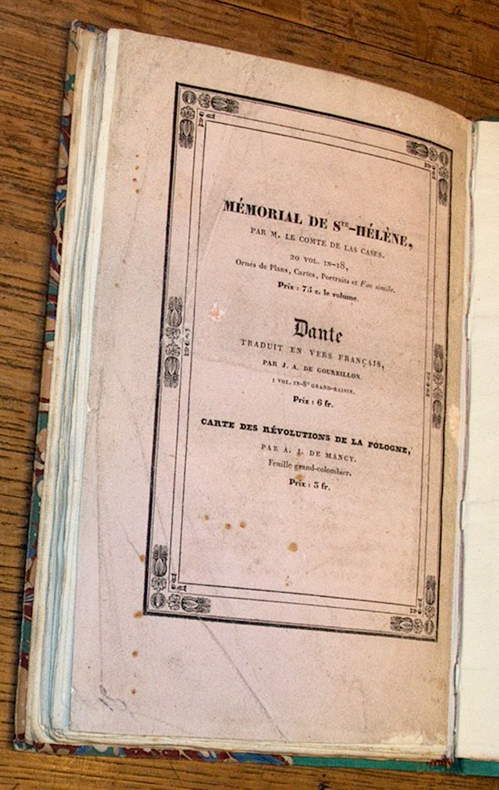
1831002014Paris Auguste Auffray 1831
19112289Moscow: A.A. Gorozhankin and K.A. Fisher 1911-12. <br /><br />Twenty-six postcards each 5 1/2 x 3 3/8 inches 138 x 84 mm featuring black-and-white photos of scenes from Anton Chekhov's The Cherry Orchard and text descriptions in Russian. <br /><br />The Cherry Orchard opened at the Moscow Art Theatre on January 17 1904 in a production directed by Konstantin Stanislavsky just six months before the death of Chekhov. In the play a family is forced to sell their estate at auction to pay their debts. The buyer Lopakhin plans to cut down the family's beloved cherry orchard so he can build cottages on the estate. <br /><br />These postcards feature cast members from early productions: Olga Knipper as Madame Ranevskaya the estate owner Maria Lilina as Anya her daughter Margarita Savitskaya as Varya foster daughter Stanislavsky himself as Gaev Ranevskaya's brother Leonid Leonidov as Lopakhin Vladimir Gribunin as Simeonov-Pishchik a landowner Elena Muratova as Charoltta Ivanovna a governess Alexander Artyom as Firs an elderly valet Vasily Kachalov as Trofimov a student and Ivan Moskvin as Yephikhov a bookkeeper. <br /><br />Olga Knipper was the wife of Chekhov Maria Lilina was the wife of Stanislavsky and Ivan Moskvin became director of the Moscow Art Theatre in 1943. All three were among the 39 original members of the troupe when Stanislavsky founded it in 1898 with Vladimir Nemirovich-Danchenko. <br /><br />Chekhov conceived The Cherry Orchard as a comedy but Stanislavsky turned it into a tragedy angering Chekhov. "My play opened yesterday so my mood is none too good" Chekhov wrote in a letter to author and dramatist Ivan Leontyev known as Shcheglov quoted in Laurence Senelick Anton Chekhov's Selected Plays. New York: W.W. Norton 2005 page 456. And in late March 1904 writing from Yalta Chekhov declared in a letter to his wife Olga Knipper the star of the play: "One thing I can say: Stanislavsky has butchered the play for me." Senelick page 457. <br /><br />While Chekhov may not have liked the play the public certainly did. Indeed in a note on the verso of one card an anonymous writer says translating: "we have just got back from the Art Theatre where we saw The Cherry Orchard. There are no words to tell how wonderful it was." The note appears on a card showing Stanislavsky and his wife Maria Lilina. <br /><br />A.A. Gorozhankin published two of the cards in 1911. The famous Moscow photographer Karl Fisher issued all the others. Two of them not identified as the Moscow Art Theatre production are dated 1912. <br /><br />A fascinating set of postcards depicting scenes from one of the theatre world's most acclaimed plays. <br /><br />CONDITION: Inscription in ink to the verso of one card stains or soiling to many cards lower corner of one card of Olga Knipper damaged with slight loss of text; old bookseller's stamp to the verso of half a dozen cards; all a bit rubbed or edge-worn. About Good overall. <br /> A.A. Gorozhankin and K.A. Fisher
Very Good Turkish, Ottoman (1500-1928) In modern, handsome full brown morocco. Foolscap 8vo. (18 x 12.5 cm). In Ottoman script (Old Turkish with Arabic letters). 159 p. Extremely rare first Turkish translation of Macbeth, printed in Ottoman Cairo. Macbeth reflected Abdullah Cevdet's reaction against Hamidian despotism and his love and advocacy of liberty. One must also remember him as one of the founding members of the Party of Union and Progress - a secret organization that conspired to overthrow Abdülhamid's absolutist regime. The argument that Abdullah Cevdet's translation of Hamlet, Julius Caesar and Macbeth reflected his opposition to Abdülhamid II's absolute monarchy could be justified with the fact that the themes of the translated plays were perceived by the political authorities as threatening since they were about the murder of kings and heads of state. In Abdullah Cevdet's view, Macbeth is famous as a drama of "ambition for status" (hirs-i cah). Abdullah Cevdet was an Ottoman-born Turkish intellectual and physician of Kurdish ethnic descent, and one of the founders of the Committee of Union and Progress (CUP). In 1908, he joined the Democratic Party that later on merged with the Freedom and Accord Party in 1911. He was also a translator, radical free-thinker, and ideologist of the Young Turks until 1908. The son of a physician, and himself a graduate from the Military College in Constantinople as an ophthalmologist, Cevdet, initially a pious Muslim, was influenced by Western materialistic philosophies and came to oppose institutionalized religion but thought that "although the Muslim God was of no use in the modern era, the Islamic society must preserve Islamic principles." He published the periodical Içtihat from 1904 to 1932, of which articles he used to promote his modernist thoughts. He was arrested and expelled from his country several times due to his political activities and lived in European cities including Vienna, Geneva and Paris. His poetry was linked with the Symbolist movement in France and he received accolades from leading French authors like Gustave Kahn. (Source: DR. ABDULLAH CEVDET'S TRANSLATIONS (1908-1910): THE MAKING OF A WESTERNIST AND MATERIALIST "CULTURE REPERTOIRE" IN A "RESISTANT" OTTOMAN CONTEXT; Ayluçtarhan, Sevda). "Between 1908 and 1910, Abdullah Cevdet produced a large oeuvre of translations, including four translations of Shakespeare's tragedies: The translations of Hamlet and Julius Caesar (translated by Cevdet as Jül Sezar) were published in 1908, the same year as the declaration of the Second Constitution. Macbeth, translated by Cevdet as Makbes, was published in the following year. [.] Nonetheless, Abdülhamid II seemed to be even less tolerant of the dissemination of Hamlet, Macbeth, and Julius Caesar, since they were all about unjust rulers who were executed in the end. It is not surprising that the performances of these plays became subject to strict censorship in the Ottoman lands and banned (Paker 1986: 91). This could be shown as a reason why Abdullah Cevdet was able to publish the translations of these plays only after 1908, though he had finished translating Hamlet in 1902, Julius Caesar and Macbeth in 1904, and Romeo and Juliet in 1905 (Süssheim 1987). As Abdullah Cevdet was a planner of culture, his literary translations cannot merely be judged on an "aesthetic" level. It will be discussed in this chapter that Abdullah Cevdet's translations of Hamlet, Julius Caesar and Macbeth could be read as critical texts directed against Abdülhamid II's absolutist regime. [.] Due to the fact that the selection of source language and culture is an important factor in accounting for any kind of "translation policy", Abdullah Cevdet's selection of both these instruments needs to be taken into account (Toury 2000: 202). Özege 12009. Only one copy in OCLC: 949612474 (Bogaziçi University Library of Turkey).
30743LONDON 1684 AND 1692. TWO WORKS BY DRYDEN BOUND IN MODERN 1934 FULL BROWN LEATHER. THE STATE OF INNOCENCE AND THE FALL OF MAN AN OPERA. PRINTED BY H.H. FOR HENRY HERRINGMAN 1684. DEDICATION 4pp POEM OF PARADISE 2pp AUTHOR'S APOLOGY 6pp STATE OF INNOCENCE 26pp. BOUND WITH OEDIPUS; A TRAGEDY BY DRYDEN AND MR. LEE FOURTH EDITION PRINTED FOR RICHARD BENTLEY COVENT GARDEN 1692. PREFACE 2pp DRAMATIS PERSONAE 1pp PROLOGUE 1pp OEDIPUS 71pp EPILOGUE 1pp. NEW ENDPAPERS BOOKPLATE TO FRONT PASTEDOWN. BROWNING OF PAGES COMMENSURATE WITH THE AGE. NOTE THAT THE AGE OF INNOCENCE IS INCOMPLETE ENDING AT ACT V SCENE 1 PARADISE PARAGRAPH 11.'EVE - PLEASE THEN YOUR SELF WITH ME.'. FINE BINDING WITH A FEW MARKS TO THE LEATHER. VERY SCARCE. LONDON, 1684 AND 1692 hardcover
30744LONDON H PLAYFORD 1694. THE SECOND EDITION 58 PAGES. .AS IS ACTED AT THE THEATRE ROYAL BY HIS MAJESTY'S SERVANTS. VERY NICELY BOUND IN MODERN 1934 FULL BROWN LEATHER. NEW ENDPAPERS BOOKPLATE TO FRONT PASTEDOWN. BROWNING OF PAGES COMENSURATE WITH THE AGE. FINE BINDING WITH A FEW MARKS TO THE LEATHER. VERY SCARCE. LONDON, H PLAYFORD, 1694 hardcover
38808LONDON HURST ROBINSON AND CO. 1824. NEW EDITION 20 VOLUMES. SMALL OCTAVO HALF LEATHER OVER MARBLED BOARDS RAISED BANDS. WITH A FINE ENGRAVING AT THE FRONT OF EACH PLAY FOXED TEXT VERY CLEAN. IN VERY GOOD CONDITION. WITH BIOGRAPHICAL AND CRITICAL REMARKS. A HANDSOME SET. LONDON, HURST, ROBINSON AND CO., 1824 hardcover
38900LONDON THOMAS TEGG 1812. 12 VOLUMES COMPLETE. BOUND IN FULL LEATHER RAISED BANDS A.E.G. WITH 12 FINELY ENGRAVED TITLE PAGES AND 38 OTHER PLATES. ARMORIAL BOOKPLATE REMOVED FROM EACH FRONT PASTEDOWN. SOME FOXING TO THE PRELIMS. ONLY THEN CLEAN AND TIGHTLY BOUND. CRACKED JOINT TO VOLUME 12. A VERY GOOD SET OF A SCARCE WORK. LONDON, THOMAS TEGG, 1812 hardcover
17764<p>Includes the following: Philips Ambrose The Distrest Mother. A Tragedy London: T. Caslong et al. 59 pp. frontispiece; Banks John The Happy Favourite; or the Earl of Essex. A Tragedy. printed for I. Hawes 70 2 pp.; Shakespeare William Hamlet Prince of Denmark printed for Woodfall 1868 72 ppl.' Shakespeare William The History of King Lear printed for Noble 1771 71 pp.; Congreve William The Mourning Bride Printed for S. Bladon 1768 71 pp.;; Shakespeare William Macbeth printed for Woodfall 1768 68 4 pp.; All of these are later editions but the compilation is a fascinating picture of what plays were popular in London in the 1760s and 1770s. . The six plays bound together in contemporary calf rebacked. Corners rubbed. Some offsetting from plates. Contemporary armorial bookplate John Beale. Also bookplate of anthropologist Frances Emma Watkins plus another ownership signature: "L. Watkins Denver Colo. 1873." A very good copy with interesting provenance. Details about library holdings of individual titles available upon request. Frances Emma Watkins 1899 – 1987 was born in Colorado and attended the University of Denver. After graduating with specializations in archaeology and anthropology in 1929 Watkins joined Isabel Kelly and Eva Horner in New Mexico on what was possibly the first excavation directed by an all-female team. Later Watkins worked as a curator at the Southwest Museum in Los Angeles where she managed the museum's archives.</p> Includes the following: Philips, Ambrose, The Distrest Mother. A Tragedy, London: T. Caslong [et al.[, 59 pp., frontispiece; Ban
1973021308London: Secker & Warburg 1973 First printing of the first U.K. edition. Publisher's black cloth and dust jacket with £2.50 price Octavo 163pp.Douglas Fairbanks Jr.'s copy Who wrote the forward with his armorial bookplate on front-free-endpaper also loosely laid-in is an auction card for The Estate of Douglass Fairbanks Jr.Signed and inscribed by Harold French to Douglas Fairbanks Jr. who wrote the Foreword. Light bump to upper board edge else book in fine condition; dust jacket with mild edge wear light tanning to spine and a bit of age-toning to top edge of flaps else dust jacket in fine condition. Unique signed-association copy scarce thus. Secker & Warburg hardcover
18640008949London: Chapman And Hall 1864. Revised edition. Hardcover. Fine. 8vos 3/4 brown morocco extra-gilt spines marbled boards and edges. Ex libris Cyrus K. Hale. <br/><br/>The title-page states "In Eight Volumes". Some versions of this had nine. Dyce is considered to have been a scrupulous editor: "Its textual criticism is of the highest value and the brief annotations are always useful and to the point. The glossary is full and meets most of the difficulties. A vast number of.Shakespearean students regard it as the most readable and satisfactory of all the editions of the dramatist - DNB." Frontispiece portraits. Jaggard SHAKESPEARE BIBLIOGRAPHY p. 538 . Chapman And Hall hardcover
1910042638New York: The Macmillan Company 1910. 1st Edition 1st Printing. Hardcover. Very Good. Xii 272 Pp. White Cloth Spine Stamped In Black With "The Macmillan Company" At Base Of Spine Maroon Ribbed Cloth Boards Stamped In White On The Front Cover Top Edge Gilt. One Of 900 Copies Only Of The First Printing With Broken Type On Pp 47 And 65. Sisson & Martens Identify A Primary Binding With "The Macmillan Company" At Base Of Spine And Top Edge Gilt Like This One Others In Olive Cloth Without Gilt. Spine Dusty Would Be Near Fine Slight Rubbing No Marks Or Bookplates But Front Endpaper Entirely Removed And Part Of White Stamping On Front Cover Has Flaked Away Although Lettering Still Readable. <br/> <br/> The Macmillan Company hardcover
20192081502111907074Shanghai People's Publishing 2019. Soft Cover. Fine. The book is in fine condition. Shanghai People's Publishing paperback
18260005340Chiswick: Charles Whittingham 1826. First edition. Hardcover. Near Fine. 60 wood engravings by John Thompson from drawings by Stothard Corbould Harvey and others. 16mos full dark cherry calf raised bands extra glt spines inner dentelles a.e.g. bound by Zaehnsdorf Bindery for Lauriat's of Boston some rubbed spots at tips of some spines. <br/><br/>Singer was a member of the Society of Antiquaries and a former bookseller when he and Charles Whittingham printed this handsome popular illustrated edition of the Bard of Avon. "Singer was responsible for a careful collation of the text and many useful notes. . He unostentatiously did much to advance the study of Elizabethan literature - DNB." John Thompson trained by Robert Branston and Thomas Bewick was considered unexcelled as a wood engraver in the two decades surrounding this set. 60 wood engravings by John Thompson from drawings by Stothard Corbould Harvey and others. This was the first edition to possess Singer's Notes - Jaggard SHAKESPEARE BIBLIOGRAPHY p. 517 . Charles Whittingham hardcover
In-8°, 2 voll, contengono 1. Le curieux impertinent; L'ingrat; L'irrésolu. 2. Le médisant; Le triple mariage; L'obstacle imprévu. Le opere hanno ciascuno un frontespizio proprio datato tra il 1712 e il 1718. Legatura in piena pelle con tassello, titolo e fregi in oro al dorso.