Terentii, PBiblio.com
7 632 résultats
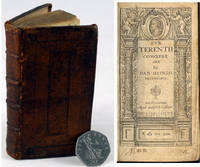
92881622. Full calf binding raised banding to spine blind stamped decoration to front and back boards rectangular centrepiece excentuated by line detail thistles to corners 4.25 x 2.00 inches approx. small sepia inscription to front endpaper and a single set of faded initials in ink 249 pages text in latin contents mostly very good some background staining and a few corners a very good and sound copy of this work. . 1622 hardcover
Minor browning to wraps. Scholar's bookplate to inner cover (G. P. Goold). Small tears to spine ends. Light wear to corners. ; Proceedings of the African Classical Associations Supplement Number 2; 160 pages
Small tears to first 3 pages. Pages tanned. Corners a little edgeworn. Spine ends are a little frayed and chipped. ; Latin text with English introduction and notes. ; P. Terenti Afri Comoediae; 340 pages
Light rubbing to boards. Very minor shelfwear. ; English Introduction and Commentary with Latin Text. ; 128 pages
Light pencilling to a couple of pages. Scholar's name to ffep (Robert Brown). Minor shelfwear to book. DJ has chipping, rubbing and 1 open tear near head of spine. ; 398 pages
Crease to spine. Small chip to foreedge of front wrap. Minor shelfwear. ; 398 pages
Former owners name to titlepage. Book has been rebound in 1/4 green cloth spine (spine a bit sunned) with cream colored boards. Some chipping to edges of a few pages. Some foxing. Else VG and attractive copy; Latin text with English introduction and notes and commentary. Xxiii, 554 pp; 554 pages
Fraying and small tears to joints and ends of spine. Some ink marginalia to about 30 pages. Scholar's name to ffep (G. V. Sumner) with other name deleted (J. W. Clarke). Corners have some edgewear. ; Latin Text with English Commentary and Introduction. ; Pitt Press Series; 200 pages
A few ink notes to Latin text. Spine a bit sunned. Endpapers tanned. Minor rubbing to boards. Else VG. ; English Commentary and Introduction with Latin Text and index at back. Lxxxi, 186 pp ; Allyn and Bacon`s College Latin Series; 186 pages
Some pencil notes to Latin text. Rubbing to boards. Front hinge starting to crack. Former owner's name to ffep. ; English Commentary and Introduction with Latin Text and index at back. Lxxxi, 186 pp ; Allyn and Bacon`s College Latin Series; 186 pages
Minor shelfwear to boards. DJ is price-clipped. DJ spine is browned. DJ has a few small tears. ; 212 pages; Latin text with extensive English commentary and introduction.
Small sticker stain to front wrap. Browning to edges of wraps. Minor pencil writing to a few pages. ; English translation. ; The Library of Liberal Arts; 61 pages
Small sticker stain to front wrap. Former owner's bookplate to half-title. Browning to edges of wraps. Crease to lower corner of pages. ; English translation. ; The Library of Liberal Arts; 61 pages
Foxing to top of textblock. Scholar's bookplate to inner cover (G. P. Goold). ; This unique book features a reproduction of the Phormio of the Bembinus Manuscript, with each of the 50 pages faced with a description to enable the students to experience the novelty and pleasure of reading a fourth-century manuscript. The text contains an edited version of the play, notes, and vocabulary. ; 4to 11" - 13" tall; 150 pages
Ex-university private library, no exterior markings. 1/2 vellum, boards. Spine chipped with a bit of loss to base, binding edgeworn at extremities with some flecking. Fading and browning to boards. Minor moisture stain to rear endpaper and rear inner cover. Former owner's name to titlepage (from 1772) Still Attractive. A beautiful and very large book. ; 252pp, wonderfully illustrated. Contains Adelphi, Phormio, Hecyra. ; Elephant Folio - over 15" - 23" tall; 252 pages
Full Title: P. TERENTIA AFRI POET LEPIDISSIMI COMOEDIAE: Andria, Eunuchus, Heavtontimorvmenos, Adelphi, Hecyra, Phormio, ex emendatissimis ac fide dignissimis codicibus summa diligentia castigat, metris in suum ordinem recte restitutis, ac uarijs lectionibus in margine appositis ex collatione prostremarum editionum Aldini & Gryphiani exemplaris. Elenchum interpretum, qui in had comoedias docte simul & erudite scripserunt, proxima subinde pagina demonstrabit. Eorum qu in his interpretum commentarijs annotata sunt, index amplissimus. pp. [22], 154 [i.e. 308], 117 [i.e. 234, [8]. Lacks two leaves of front matter (*2 & *3). Various errors in pagination as recorded in other examples. Folio. 320 mm. Old full vellum binding. Double and triple column Latin text in Italic and Roman. Great many bold woodcut illustrations of the scenes appear throughout the volume, and add to its charm. The various early paper 'repairs' to the title probably cover up old ownerships. Written some time after these repairs is an ink manuscript notation: Della Libreria de S(an) Vincenzo (in Tuscany). CEdit Iniquos - which seems to identify the text and/or editing as unjust, evil, and/or wicked. not too unusual for pagan works. On the front flyleaf is the 18th or 19th century autograph ownership of A. Wallis (unidentified). Publius Terentius Afer (195/185-159 BC), better known in English as Terence, was a playwright of the Roman Republic, of North African descent. His comedies were performed for the first time around 170-160 BC. Terentius Lucanus, a Roman senator, brought Terence to Rome as a slave, educated him and later on, impressed by his abilities, freed him. Terence apparently died young, probably in Greece or on his way back to Rome. He only wrote six plays. All survived, and are printed here. In this famous 1545 edition of Terence, Scoto, provided three summaries for the action of each scene by different humanist scholars of note. The innovation was immediately popular. The basic layout problem in the case of Terence was that the text consists of short scenes with much back-and-forth badinage while the apparatus was typically very lengthy. Early printers of these texts arranged the commentary for each scene all around the base text, creating a window or windows for the words of Terence. The resulting window-and-frame layouts are visually very lively, with each spread slightly different from the last, depending on the length of the commentary with respect to the text. As the sixteenth century progressed, however, it became more usual to employ a simple two-column format that placed the base text of each scene first and the commentary afterwards, alternating but running continuously from column to column. The four columns on a spread owned variety and visual interest because the text of Terence was set in larger type and more generously leaded than the commentary, but the result was rarely as handsome as the older layouts. This two-column format took over because it was much easier to set, correct, revise, and reprint than a window-and-frame. Similarly, fewer and fewer options were exercised in ornamenting and illustrating the folio text as the century wore on. Virtually the only ambitious editions from this point of view are this 1545 Scoto and the 1553 Cesano. These books preserve something of the grace of earlier folios, with scene-by-scene illustrations that characterized some folio editions in the fourteen nineties. Illustrations of individual scenes disappeared entirely after the 1555. The wonderful woodcuts are valued mainly for what they tell us of the Italian stage in the 15th and 16th century. BM STC Italian p. 664. ADD1 Safe
Scholar's name to ffep (Robert Brown). Else book is fine. ; Focus Classical Library; 100 pages
Light edgewear to boards. Some pencil notes to greek text with a bit of inking. Endpapers tanned. ; Extensive English introduction and notes with latin text. ; Clarendon Press Series; 128 pages
Minor Shelfwear. Minor creasing to spine. ; Penguin Classics; 7.0 X 4.3 X 0.9 inches; 400 pages
pp. (4), 308. The edition without the cancellans at G2. 12mo. [176 x 105 mm.] Foxed. It is very unusual to find in a Baskerville that some leaves (in two gatherings of this copy) were smudged during printing, and permitted to pass. Contemporary full sprinkled calf binding. Gilt tulip roll on the boards. Spine ornamented with gold crossed arrows. Joints tender. Printed ExLibris of John Rayner. Gaskell 47. Terence (Ca. 190-159 B.C.), the great Latin comic poet, was born in Carthage. He came to Rome as the slave of a senator, Terentius Lucanus. In the house of Lucanus he was educated like a free man and soon emancipated. His successful first play, 'Andria' introduced him to Roman society, and the circle of Scipio, Philus, and Laelius. His surviving six comedies are drawn from Athenian sources, especially from lost plays by Menander. Terence has been read for over two thousand years, and his influence on European literature cannot be overestimated. He imparted to Latin the sense of artistic elegance, consistency and moderation which made it a model for all literary epochs. In him we find a meeting-point for three great civilizations - the decaying Greece; Carthage, soon to pass away into oblivion; and nascent Italy, poised to absorb the world. John Baskerville (1706-1775) was the greatest printer of his era. Born in Wolverley, Hereford - Worcester, England, he became a writing master in Birmingham. He also carried on a successful japanning (varnishing) business there. In about 1750 he began to make experiments in letter founding, and produced the wonderful series of types now named after him. His first book, the Virgil of 1757, was also the first to be printed upon wove paper (manufactured by a process that he invented). In 1758 he be came printer to Cambridge University. All of his books bear show fine craftsmanship and a refined sense of design. In the last few years before his death, Baskerville published a few Latin classics in quarto and duodecimo. "All these bear the marks of unabated genius even in his declining days: and suffice, had he printed nothing else, to distinguish him as the first typographer of his time" - T. B. Reed, in 'Old English Letter Foundries' "Quot homines tot sentensiae; suo quoiqu e mos " So many men, so many opinions; a law of his own to each -- Terence. ** PRICE JUST REDUCED!! W154
364p. Uncut and unopened. Foxed. 4to. [304 x 235 mm.] Contemporary binding of paper boards backed in morocco tooled in gold gilt. John Baskerville (1706-1775) was the greatest printer of his era. Born in Wolverley, Hereford - Worcester, England, he became a writing master in Birmingham. He also carried on a successful japanning (varnishing) business there. In about 1750 he began to make experiments in letter founding, and produced the wonderful series of types now named after him. His first book, the Virgil of 1757, was also the first to be printed upon wove paper (manufactured by a process that he invented). In 1758 he became printer to Cambridge University. All of his books show fine craftsmanship and a refined sense of design. In the last few years before his death, Baskerville published a few Latin classics in quarto and duodecimo. "All these bear the marks of unabated genius even in his declining days: and suffice, had he printed nothing else, to distinguish him as the first typographer of his time" - T. B. Reed, in 'Old English Letter Foundries' It is worth emphasising how remarkable it is to find an uncut and unopened Baskerville quarto. Gaskell 46; Brunet V:718. EXTREMELY RARE AND UNUSUAL. **PRICE JUST REDUCED! W113
364p. Slight foxing. 4to. [304 x 235 mm.] Contemporary straight grained plum morocco leather binding. Boards tooled in gold with a wide Greek key design, and in blind with an archway roll. Engraved bookplate showing a shield (Arms Barry of six Supporters); two unicorns; ermine Coronet of an Earl ; and the Motto A MA PUISSANCE. This is likely the plate of Charles Grey, 2nd Earl Grey (1764-1845) Whig Prime Minister of Great Britain (1830-1834). There is also a manuscript inscription: "With B. Drury's Best Wishes, Eton, March 20 , 1820." John Baskerville (1706-1775) was the greatest printer of his era. Born in Wolverley, Hereford - Worcester, England, he became a writing master in Birmingham. He also carried on a successful japanning (varnishing) business there. In about 1750 he began to make experiments in letter founding, and produced the wonderful series of types now named after him. His first book, the Virgil of 1757, was also the first to be printed upon wove paper (manufactured by a process that he invented). In 1758 he be came printer to Cambridge University. All of his books bear show fine craftsmanship and a refined sense of design. In the last few years before his death, Baskerville published a few Latin classics in quarto and duodecimo. "All these bear the marks of unabated genius even in his declining days: and suffice, had he printed nothing else, to distinguish him as the first typographer of his time" - T. B. Reed, in 'Old English Letter Foundries'. Gaskell 46; Brunet V:71 8. A really handsomely bound copy of a beautifully printed book. **PRICE JUST REDUCED! W113
Well preserved in the original publisher's cloth. Virtually uncut. Curiously, this copy was apparently issued without the engraved title an d frontis. Pickering was the first in England to use cloth in publisher's bindings. SMALL BOX 2
187018596Hamburg Hermann Grüning, 1870. 45 S. 12° Duodez Ln.
OTTIME CONDIZIONI

