5 143 résultats
197251869Paris: Les Editions de Minuit 1972. Fine. Les Editions de Minuit Paris 1972 14.50 x 19.50 cm broché First edition of the author's French translation one of 50 numbered copies on vélin d'Arches paper an hors commerce copy the only large paper copies with 292 other vélin d'Arches paper. Precious copy inscribed and dated December 1972 by Samuel Beckett to his friend the painter Geer Van Velde and his wife Lise. Spine and back cover slightly discolored. What to say of the sliding planes the shimmering contours the cut-out figures in the fog the balance that any little thing can break breaking and re-forming themselves under our very eyes How to talk about the colors that breathe and pant Of the swarming stasis Of this world without weight without force without shadow Here everything moves swims fells comes back falls apart re-forms. Everything stops non-stop. One would say it's the revolt of the internal molecules of a stone a split second before its disintegration. That is literature The van Veldes' Art or the World and the Trousers in Cahiers d'Art n° 11-12 Paris 1945. Beckett here is not talking despite how it may appear about his literary oeuvre but about the paintings of Geer Van Velde going on to add a few lines later Bram Van Velde paints distance. Geer Van Velde paints succession. This elegy published on the occasion of the double exhibition of the Van Veldes Geer at Maeght's and Bram at the Galerie Mai is the first important text on these painters more or less unknown to the public at the time: We've only just started spouting nonsense about the Van Velde brothers and I'm the first. It's an honor. This is also the first critical text written directly in French by a young Irish writer who had not as yet published anything in France. Thus the first and most important of Beckett's writings on art composed at the dawn of his literary career establishes right from the start a fundamental relationship between his developing work and his friends' art: Thus this text has often been read in a hollow or in the mirror as one of the rare designations of Beckett's poetry to come by the man himself a sort of anamorphic program of writing Un pantalon cousu de fil blanc : Beckett et l'épreuve critique by Pierre Vilar. A real statement of dramaturgical intent this fundamental text whose introspective value Beckett lays out from the introduction on one does nothing but tell stories with words ushers in the writer's most fruitful creative period. In essence like Apollinaire and Cendrars Beckett draws from the artistic problems of his contemporaries the catalyst of his own future writing through the deepest questioning of narrative figurative or poetical presuppositions Pascale Casanova in Beckett l'Abstracteur. The major influence of modern painting on the narrative structure or destructuring of Beckett's drama and novels would be pointed out and examined by a number of thinkers among them Gilles Deleuze Julia Kristeva and Maurice Blanchot. It was in fact with the art of the Van Veldes first Geer then Bram that Beckett began to formalize this desire to translate the pictorial question into dramaturgical terms. Thus it was that he rejected Nicolas de Staël's set design for Godot since: the set must come out of the text without adding anything to it. As for the visual comfort of the audience you can imagine how much I care. Do you really think you can listen with the backdrop of Bram's set or see anything other than him Letter to Georges Duthuit 1952. When he met Geer in 1937 Beckett was going through a major existential crisis and had just been reworking his first novel Murphy which had been rejected by a great many publishers. He was lost in alcohol leaving Ireland and moving once and for all to Paris Le Pictural dans l'uvre de Beckett Lassaad Jamoussi. He returned from a long artistic journey in Germany where he was marked by classical works as well as contemporary ar Les Editions de Minuit unknown
196851865Paris: Les Editions de Minuit 1968. Fine. Les Editions de Minuit Paris 1968 14.50 x 19.50 cm broché First edition one of 100 hors commerce advance copies on B.F.K. de Rives the only deluxe copies with 662 other B.F.K. de Rives. Precious autograph inscription dated Février 1968 and signed from Samuel Beckett to his friend the painter Geer Van Velde and his wife Lise. Samll stains to upper cover marginally and slightly sunned. What to say of the sliding planes the shimmering contours the cut-out figures in the fog the balance that any little thing can break breaking and re-forming themselves under our very eyes How to talk about the colors that breathe and pant Of the swarming stasis Of this world without weight without force without shadow Here everything moves swims fells comes back falls apart re-forms. Everything stops non-stop. One would say it's the revolt of the internal molecules of a stone a split second before its disintegration. That is literature The van Veldes' Art or the World and the Trousers in Cahiers d'Art n°11-12 Paris 1945. Beckett here is not talking despite how it may appear about his literary oeuvre but about the paintings of Geer Van Velde going on to add a few lines later Bram Van Velde paints distance. Geer Van Velde paints succession. This elegy published on the occasion of the double exhibition of the Van Veldes Geer at Maeght's and Bram at the Galerie Mai is the first important text on these painters more or less unknown to the public at the time: We've only just started spouting nonsense about the Van Velde brothers and I'm the first. It's an honor. This is also the first critical text written directly in French by a young Irish writer who had not as yet published anything in France. Thus the first and most important of Beckett's writings on art composed at the dawn of his literary career establishes right from the start a fundamental relationship between his developing work and his friends' art: Thus this text has often been read in a hollow or in the mirror as one of the rare designations of Beckett's poetry to come by the man himself a sort of anamorphic program of writing Un pantalon cousu de fil blanc : Beckett et l'épreuve critique by Pierre Vilar. A real statement of dramaturgical intent this fundamental text whose introspective value Beckett lays out from the introduction on one does nothing but tell stories with words ushers in the writer's most fruitful creative period. In essence like Apollinaire and Cendrars Beckett draws from the artistic problems of his contemporaries the catalyst of his own future writing through the deepest questioning of narrative figurative or poetical presuppositions Pascale Casanova in Beckett l'abstracteur. The major influence of modern painting on the narrative structure or destructuring of Beckett's drama and novels would be pointed out and examined by a number of thinkers among them Gilles Deleuze Julia Kristeva and Maurice Blanchot. It was in fact with the art of the Van Veldes first Geer then Bram that Beckett began to formalize this desire to translate the pictorial question into dramaturgical terms. Thus it was that he rejected Nicolas de Staël's set design for Godot since: the set must come out of the text without adding anything to it. As for the visual comfort of the audience you can imagine how much I care. Do you really think you can listen with the backdrop of Bram's set or see anything other than him Letter to Georges Duthuit 1952. When he met Geer in 1937 Beckett was going through a major existential crisis and had just been reworking his first novel Murphy which had been rejected by a great many publishers. He was lost in alcohol leaving Ireland and moving once and for all to Paris Le Pictural dans l'uvre de Beckett Lassaad Jamoussi. He returned from a long artistic journey in Germany where he was marked by classical works as well as contemporary art it was during th Les Editions de Minuit unknown
196951864Paris: Les Editions de Minuit 1969. Fine. Les Editions de Minuit Paris 1969 14.50 x 19.50 cm broché First edition one of 100 hors commerce advance copies on BFK de Rives paper the only deluxe copies with 642 other copies on BFK de Rives paper. Precious copy inscribed and dated January 1970 by Beckett to his friend the painter Geer Van Velde and his wife Lise. Nice copy. What to say of the sliding planes the shimmering contours the cut-out figures in the fog the balance that any little thing can break breaking and re-forming themselves under our very eyes How to talk about the colors that breathe and pant Of the swarming stasis Of this world without weight without force without shadow Here everything moves swims fells comes back falls apart re-forms. Everything stops non-stop. One would say it's the revolt of the internal molecules of a stone a split second before its disintegration. That is literature The van Veldes' Art or the World and the Trousers in Cahiers d'Art n°11-12 Paris 1945. Beckett here is not talking despite how it may appear about his literary oeuvre but about the paintings of Geer Van Velde going on to add a few lines later Bram Van Velde paints distance. Geer Van Velde paints succession. This elegy published on the occasion of the double exhibition of the Van Veldes Geer at Maeght's and Bram at the Galerie Mai is the first important text on these painters more or less unknown to the public at the time: We've only just started spouting nonsense about the Van Velde brothers and I'm the first. It's an honor. This is also the first critical text written directly in French by a young Irish writer who had not as yet published anything in France. Thus the first and most important of Beckett's writings on art composed at the dawn of his literary career establishes right from the start a fundamental relationship between his developing work and his friends' art: Thus this text has often been read in a hollow or in the mirror as one of the rare designations of Beckett's poetry to come by the man himself a sort of anamorphic program of writing Un pantalon cousu de fil blanc : Beckett et l'épreuve critique by Pierre Vilar. A real statement of dramaturgical intent this fundamental text whose introspective value Beckett lays out from the introduction on one does nothing but tell stories with words ushers in the writer's most fruitful creative period. In essence like Apollinaire and Cendrars Beckett draws from the artistic problems of his contemporaries the catalyst of his own future writing through the deepest questioning of narrative figurative or poetical presuppositions Pascale Casanova in Beckett l'abstracteur. The major influence of modern painting on the narrative structure or destructuring of Beckett's drama and novels would be pointed out and examined by a number of thinkers among them Gilles Deleuze Julia Kristeva and Maurice Blanchot. It was in fact with the art of the Van Veldes first Geer then Bram that Beckett began to formalize this desire to translate the pictorial question into dramaturgical terms. Thus it was that he rejected Nicolas de Staël's set design for Godot since: the set must come out of the text without adding anything to it. As for the visual comfort of the audience you can imagine how much I care. Do you really think you can listen with the backdrop of Bram's set or see anything other than him Letter to Georges Duthuit 1952. When he met Geer in 1937 Beckett was going through a major existential crisis and had just been reworking his first novel Murphy which had been rejected by a great many publishers. He was lost in alcohol leaving Ireland and moving once and for all to Paris Le Pictural dans l'uvre de Beckett Lassaad Jamoussi. He returned from a long artistic journey in Germany where he was marked by classical works as well as contemporary art it was during this journey that he discovered Caspar David Friedrich's Two Les Editions de Minuit unknown
1964188388London: John Calder 1964. From the unthinkable first to the no less unthinkable last First UK edition out of series from a limitation of 200 copies printed on handmade paper and signed by the author; this is one of 100 "Series A" copies bound in full vellum. Written without punctuation of any form this is widely considered Beckett's darkest and most difficult novel in which the solitary narrator worms their way through mud dwelling in recollections and reminiscences briefly forming a couple "with Pim" and finally returning to solitude this time motionless. Despite the limitation stating that the signed issues were printed in advance of the trade issue they were according to Federman & Fletcher issued shortly after. The work was first published in French as Comment c'est in 1961; Beckett's English translation first appeared in the US in early 1964. There were also 100 copies of this limitation issued bound in full morocco as"Series B". Octavo. Original vellum spine lettered and ruled in gilt top edge gilt others untrimmed several leaves unopened. With original glassine and white card slipcase. Contents fresh; glassine a little creased and chipped faint marks to slipcase: a fine copy. Federman & Fletcher 384.101. hardcover
19729536London: Enitharmon Press 1972. Folio wrappers; loose as issued in a paper folder cloth chemise and slipcase. Text printed by Will and Sebastian Carter at the Rampant Lions Press on paper made by J. Barcham Green. Of 137 copies 12 ad personam numbered in the press this is no. 24. Illustrated with three original etchings by Avigdor Arikha each signed in pencil by the artist. Book Enitharmon Press, hardcover
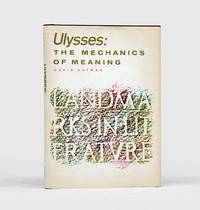
158487Englewood Cliffs NJ: Prentice-Hall Inc. 1970. The acclaimed commentary on Ulysses inscribed to Joyce's disciple and amanuensis First edition first impression inscribed by the author to Samuel Beckett who had been Joyce's amanuensis during the writing of Finnegans Wake on the front free endpaper "For Sam Beckett from whose first letter to me I quote: '.in Joyce the form of judgement more and more devoured its gist and the saying of all the saying of anything in a way more consistent with Bruno's identification of contraries than with the intellectualism of Mallarmé.' Is the present position mine more to your liking It is of course a blend. Warmly David Sept '70. P.S. I hope yr eyes permit you to read this". In a significant letter to James Knowlson Beckett wrote of the powerful "influence ab contrario" Joyce had on him as a writer: "I realized that Joyce had gone as far as one could in the direction of knowing more in control of one's material. He was always adding to it; you only have to look at his proofs to see that. I realised that my own way was impoverishment in lack of knowledge and in taking away subtracting rather than adding. When I first met Joyce I didn't intend to be a writer. That only came later when I found out that I was no good at all at teaching. When I found I simply couldn't teach. But I do remember speaking about Joyce's heroic achievement. I had a great admiration for him. That's what it was: epic heroic what he achieved. I realized that I couldn't go down that same road." David Hayman is a literary critic and professor at the University of Wisconsin-Madison who participated in the publication of Joyce's complete manuscripts and has also written a number of essays on Beckett's works. Octavo. Original black cloth titles to spine in silver. With dust jacket. An excellent copy in the lightly rubbed and toned jacket. hardcover
1931203616London: Chatto & Windus 1931. First Edition; First Printing. Hardcover. Very Good in a Good dust jacket in a custom slipcase. Chipping along spine panel edges. Light chipping at spine crown/heel. Chatto & Windus hardcover
184875463London: Published at the Punch Office 1848. First Edition. Wraps. Very good. Original twenty parts in nineteen published from July 1946 to February 1848. Octavo: xii 320; xii 304 p. Twenty colored steel-engravings after designs by John Leech plus 240 woodcuts in the text.<br /> <br /> The set collates near complete: lacking the pink slip advertising The Battle of Life and Dombey & Son at the front of Part VI. The back wrapper of Part XVIII supplied from a Part XI with "Elements of Botany" on the inside and "Mr. Dickens New Monthly Work" on the outside. The ads on the back wrapper of Part V match those called for by Tooley with "Opinions of the Press" on the inside and "Rowlands Macassar Oil" on the outside rather than Abbey with "First Vol. of the Music Book" on the inside and "Works by G. A'Beckett" on the outside.<br /> <br /> Original blue printed wrappers. The usual rebacking. A very clean and bright set. Housed in a full olive morocco folding case spine faded to brown.<br /> <br /> "Among the most popular and best of Leech's work" Tooley 296.<br /> <br /> From the library of revered English actor comedian musician and writer Eric Idle accompanied by a letter of provenance. Idle b.1943 is a founding member of the British comedy troupe Monty Python as well as the parody rock group The Rutles and is the writer of the music and lyrics for the hit Broadway musical Spamalot. Published at the Punch Office unknown
1958SB013London: Faber & Faber 1958 First Faber paperback edition first printing. Presentation copy; signed and inscribed by Beckett on the title page to Goucher professor and director of the fall 1965 production of Endgame: "For/ George B. Dowell/ with all good wishes from/ Samuel Beckett/ Paris March 1965." Original publisher's orange paper wraps lettered in black and white. A very good copy with some light wear and rubbing to the extremities first leaf starting else near fine. Scarce signed by Beckett. . Signed by Author. First Edition. Original Wraps. Near Fine. London: Faber & Faber paperback books
1970311756London: Calder & Boyars 1970. Number 90 of 100 copies specially bound and signed by the author. 204 pp. 8vo. Original vellum backed cloth-covered boards cloth slipcase. Spine a touch browned but fine. Number 90 of 100 copies specially bound and signed by the author. 204 pp. 8vo. One of 100 signed additionally inscribed. One of 100 copies signed by Beckett additionally inscribed "for Bill & Roslyn with all good wishes from Sam". William Targ 1907-1999 was head of Putnam's before founding his own imprint Targ Editions; he was also a noted bibliophile and Beckett collector; his wife Roslyn Targ 1925-2017 was Beckett's literary agent. <br/>Beckett's first collection of short prose which originally appeared in 1934 here reissued in a special edition. Calder & Boyars unknown books
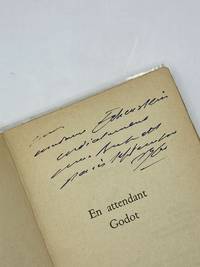
1952133383Les Editions de Minuit 1952. Later printing of first edition 16th thousand. Orignal wraps. Some wear creases and toning overall lower front hinge starting in plain custom clamshell case. Inscribed and initialed by Samuel Beckett on half title page. Les Editions de Minuit unknown
1961499421New York: Grove Press 1961. Softcover. Fine. First edition. Paperback original preceding both the French and British editions. Octavo. 64pp. Stiff glossy wrappers as issued not published in clothbound issue in the first edition. A near fine copy with faint bump and crease on rear wrap and last few leaves. Inscribed by Beckett: "for Dan Pope from Samuel Beckett 4.2.82". Scarce thus. Grove Press unknown
19646317London: John Calder 1964. First Edition. Hardcover. Fine. 8vo. Full vellum. One of only 100 copies Series A signed by Beckett this copy being unnumbered. Fine in publisher's flexible slipcase. <br/><br/> John Calder hardcover
499542Messina Italy: The Blue Guitar 1975. Softcover. Fine. First edition issued as an offprint from The Blue Guitar Vol. I No. 1. Octavo. 8pp. Printed wrappers. Fine. Inscribed by Beckett: "for Erwin Garzarolli-Thurnlackh with all best wishes Samuel Beckett. Paris October 1979". Samuel Beckett's adaptations of Chamfort's maxims. Publisher's note states: "Free rhymed adaptations of six Maximes by Sebastian Chamfort. All are unpublished except No. 6 which appeared in the Dublin University Review Hermathena CXV Summer 1973". A scarce offprint especially signed by Samuel Beckett. OCLC lists only seven holdings. The Blue Guitar unknown
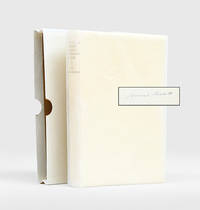
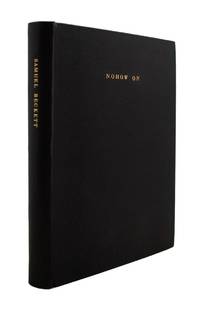
69338New York: Limited Editions Club 1989. RYMAN Robert; LIMITED EDITIONS CLUB. LIMITED EDITIONS CLUB. RYMAN Robert artist. Nohow On LEC. With Etchings by Robert Ryman New York: Limited Editions Club 1989.<br> <br> Full Description:<br> <br> BECKETT Samuel. LIMITED EDITIONS CLUB. RYMAN Robert artist. Nohow On LEC. With Etchings by Robert Ryman New York: Limited Editions Club 1989.<br> <br> Limited to 550 copies signed by Beckett and the artist Ryman on limitation page. This being number 37. Quarto 10 5/8 x 7 1/4 inches; 269 x 185 mm. With 6 aquatints by Ryman on Arches and handmade Japanese paper. Samuel Beckett designed a new typeface for the text.<br> <br> Publisher's original full black goatskin. Front board and spine lettered in gilt. Housed in a black cloth clamshell lined in gred ultrasuede. Box with morocco spine label lettered in gilt. A fine copy.<br> <br> "Beckett wrote this series of short intense novels in the late 1970's. Company is about old age about childhood young love and parental memories. Ultimately the narrator realizes that all the voices are his own invention created to keep him company. Ill Seen Ill Said concerns an old woman living in a ghostly cabin who can sometimes be seen sometimes not. The God of Genesis is very much involved. Worstword Ho is Beckett's modern equivalent of The Tempest. He literally becomes Prospero--or God-- bringing life into being. Nohow On-- the title for the trilogy- is paradoxical. "Nohow" is the situation all of us confront every day. "On" suggests hope. In any event we must go "on." Robert Ryman's six aquatints firmly anchored in Beckett's text invite the viewer to find something profound in seeming nothingness. By being able to discern anything even the most delicate "white space next" to another we are able to discover something." From the publisher.<br> <br> LEC Bibliography.<br> <br> HBS 69338.<br> <br> $2000. Limited Editions Club unknown
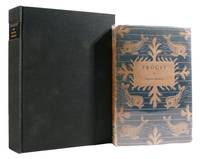
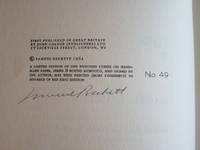
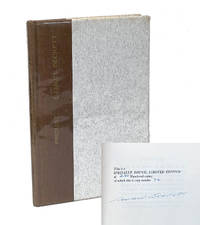
SB028New York: Grove Press 1957 originally published in 1931 1981 First American edition. One of 250 copies signed and numbered by Beckett on the limitation page this being number 76. Publisher's brown cloth-backed white patterned paper-covered boards with front board and spine lettered in gilt. Near fine with light toning to spine and upper edges of boards and just a hint of spotting to rear board. Overall a beautiful copy seemingly unread. From the personal library of American theater critic and friend of Beckett Mel Gussow. Proust Beckett's second published book is a dense study of the French author Marcel Proust which gives insight into Beckett's own burgeoning ideas on writing. Beckett wrote the essay in 1930 as a commission for Chatto & Windus' Dolphin Books series. In all fourteen titles were published in the series which only ran from 1930 to 1932. Beckett went on to write classic works like The Trilogy Molloy; Malone Dies; The Unnamable 1951-1953 Endgame 1957 and his most celebrated piece Waiting for Godot 1953. He received the Nobel Prize for Literature in 1969. . Signed by Author. First Edition. Hard Cover. Fine/Dust Jacket Included. New York: Grove Press, [1957] (originally published in 1931) hardcover
1957181972New York: Grove Press 1957. First edition and first printing. Hardcover. 72 pages. Number 96 from an edition of 250 specially bound copies. An essay on Proust from the author of "Waiting for Godot." A close to near fine copy in paper covered boards with cloth spine but with some sunning to the cloth in an about very good acetate dust jacket that has some chips and tears. Signed by Beckett on the limitation page. Grove Press unknown
24335New York: Gotham Book Mart 1976. Decorative Boards. Fine. Edward Gorey. An all-but-immaculate copy of this 1976 Samuel Beckett/Edward Gorey signed/limited. #123 OF 200 COPIES SIGNED BY BOTH BECKETT AND GOREY at the limitation. Clean and Near Fine to Fine in its leather-backed pictorial chocolate boards. Thin quarto wonderfully illustrated along the margins by the maestro Gorey. Also includes a very sharp Near Fine example of the publisher's unprinted slipcase with just a touch of light rubbing to the bottom-edges. The maiden title in the "Gotham Book Mart Master Series" edited by the legendary Andreas Brown the owner of the Gotham Book Mart. Gotham Book Mart unknown
198265563AJFA. As New. 1982. Paperback. FREE UPGRADE to Courier/Priority Shipping Upon Request IN STOCK AND IMMEDIATELY AVAILABLE FOR SHIPMENT - AS NEW THE TEXT BLOCK IS PRISTINE CLEAN UNMARKED AND IN EXCELLENT CONDITION - - 120 pp. With 81 ills. 5 col. . 24 x 18 cm. -- with a bonus offer-- . AJFA paperback
199167090Universe Publishing NY / Phaidon. New. 1991. Paperback. 0714824348 . FREE UPGRADE to Courier/Priority Shipping Upon Request IN STOCK AND IMMEDIATELY AVAILABLE FOR SHIPMENT - Flawless copy brand new pristine never opened --176 pp. With 227 ills. 41 col. . 29 x 22 cm. -- with a bonus offer--; 0.39 x 8.27 x 5.91 Inches . Universe Publishing (NY) / Phaidon paperback
195191218Routledge. As New. 1951. Hardcover. FREE UPGRADE to Courier/Priority Shipping Upon Request - IN STOCK AND IMMEDIATELY AVAILABLE FOR SHIPMENT - AS NEW THE TEXT BLOCK IS PRISTINE CLEAN UNMARKED AND IN EXCELLENT CONDITION - - 70 pages; many black and white illustrations. Catalogue Raisonne Catalog Raisonné Complete Works Life and Work Raisonnee Routledge hardcover
198874687The Gallery. New. 1988. Paperback. 0920095704 . FREE UPGRADE to Courier/Priority Shipping Upon Request - IN STOCK AND IMMEDIATELY AVAILABLE FOR SHIPMENT - Flawless copy brand new pristine never opened -- Text in English. 80 pp. With 149 ills. 16 col. . 24 x 17 cm. -- with a bonus offer-- . The Gallery paperback
200694365Museum Publications. New. 2006. Hardcover. 0892368438 . FREE UPGRADE to Courier/Priority Shipping Upon Request - IN STOCK AND IMMEDIATELY AVAILABLE FOR SHIPMENT - Flawless copy brand new pristine never opened -- 60 pages; 40 color illustrations. Description: "Sister Wendy Beckett is one of the best-known art historians in the world today. In Joy Lasts she explores her reactions to a painting that she finds uniquely compelling: the haunting Christ on the Cross by El Greco. As she candidly admits "I have always had a difficulty in talking about religious art." This surprising admission leads her to examine the very nature of religious and spiritual art which Sister Wendy argues are not at all the same things. In the course of her discussion she takes a careful look at fourteen works by artists ranging from anonymous medieval masters to Paul Cézanne in whose still lifes she finds the expression of a deep spirituality. The art of Correggio Rubens Millet and others helps Sister Wendy arrive at a new understanding of just why it is that this particular El Greco painting speaks to her so profoundly." -- with a bonus offer-- . Museum Publications hardcover
197157484Bantam Books. As New. 1971. Paperback. FREE UPGRADE to Courier/Priority Shipping Upon Request IN STOCK AND IMMEDIATELY AVAILABLE FOR SHIPMENT - TEXT PRISTINE & UNMARKED CRISP TIGHT TO THE SPINE - 122 pages. -- with a bonus offer-- . Bantam Books paperback
1955BECKETTS019350Les �ditions de Minuit Paris. 1955. First combined edition. One of fifty numbered hors commerce copies on V�lin out of a total limited issue of 1185 copies. Octavo. 221 pages. Wrappers.Presentation copy from the author to the French art historian Patrick Waldberg inscribed on the half-title page: ''pour Patrick et Lin avec son amiti� - Sam Beckett - Paris 1955''. Waldberg was a member of the Surrealist Movement and author of several books on the subject.Spine and cover edges tanned. Yapp covers chipped at bottom edges. Protruding edges of two pages nicked. Good. Les �ditions de Minuit, Paris. unknown