Beckett, SamuelBiblio.com

5 143 résultats
338457London: Turret Books 1971. First edition limited issue limited to 100 numbered copies signed by Samuel Beckett. Illustrated. 123 pp. 4to. Black cloth. A fine copy issued without printed dust jacket. First edition limited issue limited to 100 numbered copies signed by Samuel Beckett. Illustrated. 123 pp. 4to. Reproduces a few pages of Beckett manuscripts in holograph facsimile prints portraits of Beckett describes unpublished texts etc. Turret Books unknown
1956354957London: Faber and Faber 1956. Hardcover. Very Good/Very Good. First English edition. Toning on the endpapers and the boards a little bowed about very good in a near very good dust jacket with some rubbing and modest tears. From the library of Pulitzer Prize-winning author Peter Taylor and his wife the National Book Award-nominated poet Eleanor Ross Taylor with Peter Taylor's ownership signature on the front fly. Faber and Faber hardcover
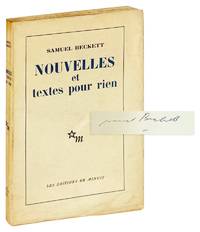
195544780Paris: Les Editions de Minuit 1955. Very Good. Paris: Les Éditions de Minuit 1955. First Trade Edition Limited to 1110 copies of which this is no. 1059. Small octavo 18.5cm; publisher's white wrappers printed in blue and black; 220pp. Moderate shelf wear and dust-soil to wrappers else a Very Good internally clean and sound unopened copy. Signed by Beckett on title page.<br /> <br /> Compilation of thirteen short stories and prose pieces including many of Beckett's earliest forays into writing in French. Beckett began these works as early as 1946 writing to the poet George Reavey "I hope to have a book of short stories ready by the spring in French. I do not think I shall write very much in English in the future" No Symbols p. 81. Nine years passed before the book in question was published. <br /> <br /> References:<br /> <br /> No Symbols Where None Intended: A Catalogue of Books Manuscripts and Other Material Relating to Samuel Beckett in the Collections of the Humanities Research Center pp. 81-9<br /> <br /> Federman and Fletcher 263. Les Editions de Minuit unknown
196142924London: John Calder 1961. Near Fine/Very Good. London: John Calder 1961. First Trade Edition. Slim octavo 21cm; publisher's cloth in blue-grey price-clipped printed dust jacket; 53pp. Very light shelf wear jacket a bit toned along margins and spine panel uneven offsetting to endpapers else a Very Good and sound example. Signed by Beckett on title page.<br /> <br /> Beckett's collected poetry was originally published in 1959 in Wiesbaden Germany under the title Gedichte. A limited edition 100 copies of this first English language was issued by Calder simultaneously in 1961.<br /> <br /> References: <br /> <br /> No Symbols Where None Intended: A Catalogue of Books Manuscripts and Other Material Relating to Samuel Beckett in the Collections of the Humanities Research Center pp. 111-4<br /> <br /> Federman & Fletcher 40. John Calder unknown
GOR006611593Hardback. Very Good. hardcover
563842Paris 1980. Unbound. Near Fine. Gelatin silver photograph. Image measuring 9½" x 6½" on 10" x 8" paper. Four small pieces of tape residue on the verso moderate creasing very good or better. Captioned on the back presumably in the photographer's hand: "Samuel Beckett December 1980 / Photo by Herbert Mitgang" followed by a New York City address. Mitgang was a columnist and book critic for The New York Times. On January 25 1981 Mitgang published a piece in The New York Times Book Review titled "Beckett in Paris"; the piece ends thusly: "As we walked outside I suggested to Beckett that his photographs always made him appear too somber and asked if he would allow me to take a few pictures. Relaxed he stood in front of a street sign that read: 'SORTIE de SECOUR - ne pas encombrer' Emergency Exit - do not block. Beckett weighed the words aloud. 'That's appropriate' he said with a smile." A heavily cropped version of the portrait showing only six letters of the sign appears in the article making this print all the more interesting. unknown
939Paris: Les Editions De Minuit. 1st Edition. Soft cover. Fine/Fine. First French edition SIGNED BY BECKETT on title page; one of only 112 copies printed on "bouffant select marques" and reserved for the publishers. A collection of six short plays translated from English by Beckett. Includes: Comédie Va et vient Cascando Paroles et musique Dis Joe Acte sans paroles II. Paris: Les Editions de Minuit 1966. Octavo original printed wrappers; glassine. Unopened. A FINE COPY. Les Editions De Minuit paperback books
1981D11056Paris: Les Editions de Minuit 1981. First Edition. Paperback. Near Fine/Very Good. Wraps in glassine dust jacket. Number 55 from a limited edition of 99 copies. Inscribed by Beckett on the half-title page. Covers just a little rubbed along the edges otherwise book is fine. Dust jacket lightly wrinkled and chipped along the edges. <br/><br/> Les Editions de Minuit paperback books
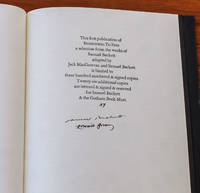
0023<p>Very fine copy like new: this is number 57 of 300 numbered copies signed by Samuel Beckett and Edward Gorey an additional 26 lettered copies were signed & reserved for Beckett himself at Gotham Book Mart; illustrated with a skull motif on its cloth cover and throughout by Gorey.</p><p>I purchased this copy directly from the Gotham Book Mart in 1989 and it has been kept in an archival bag in a glass-enclosed book case ever since so there is no hint of shelf wear or even of dust.</p><p>This collaborative adaptation of Beckett's work by the author and the actor Jack MacGowran is the text of MacGowran's iconic one-man stage performance of the same title which you can watch on Youtube: https://www.youtube.com/watchv=bi0F01dNxLE</p> The Gotham Book Mart hardcover
2604002The Gotham Book Mart 1988. signed limited. hardcover. fine. SIGNED LIMITED edition number 164 of 300 copies. Signed by Beckett and Gorey drawings by Gorey. Book fine. The Gotham Book Mart unknown
499352New York: Grove Press Inc 1980. Hardcover. Fine/Fine. First American edition clothbound issue. Octavo. Fine copy in fine dust jacket. Signed by Samuel Beckett on the title page. Grove Press, Inc hardcover
939Paris: Les Editions De Minuit. 1st Edition. Soft cover. Fine/Fine. First French edition SIGNED BY BECKETT on title page; one of only 112 copies printed on "bouffant select marques" and reserved for the publishers. A collection of six short plays translated from English by Beckett. Includes: Comédie Va et vient Cascando Paroles et musique Dis Joe Acte sans paroles II. Paris: Les Editions de Minuit 1966. Octavo original printed wrappers; glassine. Unopened. A FINE COPY. Les Editions De Minuit paperback
1964311066London: calder 1964. First. hardcover. near fine. Translated from the French by the author. Full tan morocco binding series B spine lettered in gilt with a hint of fading and lightly rubbed at the top edge; top edge gilt other edges uncut. London: John Calder 1964. Limited First Edition.<br/> <br/> One of 100 copies signed by Beckett. Near fine in slipcase.<br/> <br/> calder unknown
198212393Northridge CA: Lord John Press 1982. Limited Edition. Hardcover. Fine. Limited Edition. Hardcover. "This late work from Samuel Beckett is the haunting picture of an old woman alone in a cabin who watches the evening and the morning star and ventures out chiefly to visit a grave. In prose of great poetic beauty which the author translated from his original French text Mal vu mal dit in 1982 Beckett returns to the imagery of the Old and New Testaments to speculate on the great questions of human existence. " Tight bright and unmarred; fine. Original half navy morocco fore-edge binding by David Bourbeau with blue paste paper covered boards two vertical dotted gilt rolls to each of the covers and spine lettered in gilt. The present volume was designed and printed by Henry Morris. The text was set in Bembo type with paragraph openings printed in blue on Bugrabutten moulded paper. viii 9-45 i colophon pp. Letter DK of 26 specially-bound copies from a total edition of 325 copies. Signed by binder. Lord John Press hardcover
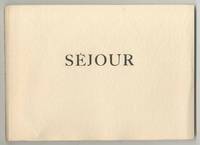
499535Paris: G. R. / Les Editions de Minuit 1970. Softcover. Fine. First edition "sur grand velin de Rives" issue limited to 150 numbered copies on "grand velin de Rives" paper. Illustrated by Jean Deyrolle. Large oblong octavo. 25pp. Text in French. Loose folded sheets in stiff folded wrappers as issued. Illustrated with five full-page original etchings printed by Louis Maccard after drawings by Jean Deyrolle. Fine with etchings fresh and clean in about fine publisher's clamshell box. One of 150 numbered copies Signed by Samuel Beckett and with facsimile of Jean Deyrolle's signature as issued as he had died prior to publication. $1500.00. G. R. / (Les Editions de Minuit) unknown
1964014525London John Calder 1964 In-8 Reliure de l'éditeur
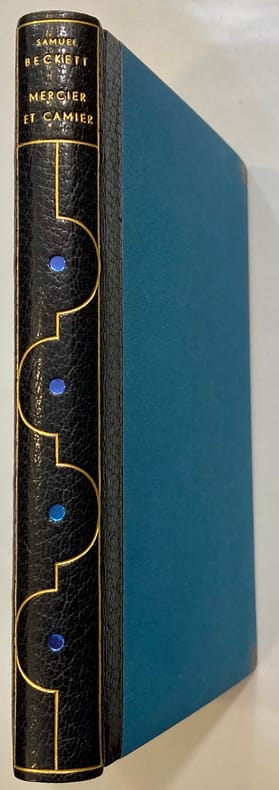
1970422611970 Paris. Editions de Minuit. 1970. 1 volume in-12, demi-maroquin bleu nuit à petits coins, dos lisse orné d’un décor géométrique de filets dorés serti de 4 strass bleu, tête dorée, couvertures et dos conservés, étui. Reliure signée P - L. Martin.
1947003187Paris Bordas 1947 In-8 Broché Edition originale
196318517Envoi signé Paris, Éditions de Minuit, (23 février) 1963. 1 vol. (100 x 185 mm) de 89 p. et 1 f. Broché, boîte signée de Julie Nadot. Edition originale. Envoi signé : « pour Robert Carlier, avec la fidèle amitié de son toujours reconnaissant Samuel Beckett ».
19169London, John Calder, 1961, in-8, reliure de l’éditeur, sous jaquette transparente, 43 p. Première édition collective. Whoroscope, Echo’s bones, Two poems, Quatre poèmes (bilingue). 1/100 ex. num. sur Hand Made paper (vergé pur fil), justifié et signé par Beckett (seul grand papier). Le nôtre, n° 5, est enrichi en outre d’un bel envoi a.s. page de titre à Alain Trutat.
18517Paris Éditions de Minuit 23 février 1963. 1 vol. 100 x 185 mm de 89 p. et 1 f. Broché boîte signée de Julie Nadot. . EÌdition originale. Envoi signé : « pour Robert Carlier avec la fidèle amitié de son toujours reconnaissant Samuel Beckett ». . Cette pièce en deux actes écrite par Samuel Beckett est jouée pour la première fois en 1961. Bien accueillie par la critique elle a été citée par The Independent comme l'une des 40 meilleures pièces de théâtre de tous les temps. Winnie enterrée jusqu'à la taille suit cette absurde routine quotidienne et bavarde avec son mari Willie taciturne. Son refrain favori est « Oh les beaux jours » : même enterrée jusqu'au cou elle continue de parler et de se souvenir de ces jours heureux comme si de rien n'était… Bel exemplaire dédicacé à Robert Carlier : directeur littéraire du Club français du livre il travailla également avec Pascal Pia au Cercle du livre précieux avant de devenir le directeur de la collection « Poésie / Gallimard » à partir de 1961. Paris, Éditions de Minuit, (23 février) 1963. 1 vol. (100 x 185 mm) de 89 p. et 1 f. Broché, boîte signée de Julie Nadot. unknown
196646805Les Editions de Minuit | Paris 1966 | - | broché
199869320S. n. [ Jean-Jacques Sergent] | s. l. s. d. [1998] | 17 x 25.50 cm | broché
198075477Université de Paris Sorbonne | Paris 1980 | 21 x 29.50 cm | broché
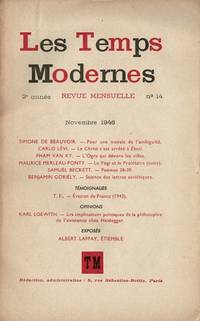
194631665AB1946. Paris Les Temp Modernes Gallimard 1945-1948 / Julliard 1949-1965 1946 -1956. Octavo. Original Softcover / Broche Originale. Some of the issues with condition-problems but in general in good to very good condition with some of the issues having frayed and detached wrappers. Only one frontwrapper with titles missing. A very rare run of 88 issues of this rare periodical. 88 Issues with interruptions in between. See here below an example of the structure of each Volume: 2e année - No.14 - Novembre 1946 Novembre 1946 Reviews of works by: Simone de Beauvoir - "Pour une morale de l'ambiguite" / Carlo Levi - "Le Christ s'est arrete a Eboli" / Pham van Ky - "L'Ogre qui devore les villes" / Maurice Merleau-Ponty - Le Yogi et le Proletaire suite / Samuel Beckett - "Poemes 38-39" / Benjamin Goriely - Science des lettres sovietiques / Temoignages: T.F. - "Evasion de France 1943 Opinions: Karl Loewith - Les implications politiques de la philosophie de l'existence chez Heidegger Exposes: Albert Laffay - "Etiemble" History of the Review: Les Temps Modernes lit. 'Modern Times' was a French journal founded by Simone de Beauvoir Jean-Paul Sartre and Maurice Merleau-Ponty. Its first issue was published in October 1945. It was named after the 1936 film by Charlie Chaplin. Les Temps Modernes filled the void left by the disappearance of the most important pre-war literary magazine La Nouvelle Revue Française The New French Review considered to be André Gide's magazine which was shut down by the authorities after the liberation of France because of its collaboration with the occupation. Les Temps Modernes was first published by Gallimard and was last published by Gallimard. In between the magazine changed hands three times: Julliard January 1949 to September 1965 Presses d'aujourd'hui October 1964 to March 1985 Gallimard from April 1985. Les Temps Modernes ceased publication in 2019 after 74 years. The first editorial board consisted of Sartre director Raymond Aron Simone de Beauvoir Michel Leiris Maurice Merleau-Ponty Albert Ollivier and Jean Paulhan. All published many articles for the magazine. Sartre's contributions included "La nationalisation de la littérature" "The Nationalisation of Literature" "Matérialisme et révolution" "Materialism and Revolution" and "Qu'est-ce-que la littérature" "What is Literature". Simone de Beauvoir first published Le Deuxième Sexe "The Second Sex" in Les Temps Modernes. In the preface to the first edition Sartre stated the review's purpose: to publish littérature engagée. This philosophy of literature expresses a basic creed of existentialismthat an individual is responsible for making conscious decisions to commit socially useful acts. Thus literature in the magazine would have a utilitarian component; it would not be just culturally valuable "art for art's sake". Other intellectuals such as André Gide André Breton and Louis Aragon disapproved of this orientation. Sartre's response: "Le monde peut fort bien se passer de la littérature. Mais il peut se passer de l'homme encore mieux." "The world can easily get along without literature. But it can get along even more easily without man." The works of many writers appeared in Les Temps Modernes. They include Richard Wright Jean Genet Nathalie Sarraute Boris Vian and Samuel Beckett. Political divisions between board members soon surfaced. Raymond Aron quit in 1945 because of the magazine's Communist sympathies becoming an editor at Le Figaro. At the time of the Korean War of 19501953 Merleau-Ponty resigned. Originally more supportive of Communism than Sartre he moved progressively to the right as Sartre moved to the left. At the time Sartre still endorsed Communism in his writings but in private expressed his reservations. Sartre disapproved of Camus for seeing both sides in the Algerians' rebellion against their French colonial masters The Algerian War195462. In his bitterness against Camus Sartre selected Francis Jeanson who did not like the works of Camus to review the Camus essay L'Homme Révolté The Rebel. When Camus responded to the review with hurt feelings Sartre put the final blow to a friendship that had lasted for years. He said "Vous êtes devenu la proie d'une morne démesure qui masque vos difficultés intérieures. . Tôt ou tard quelqu'un vous l'eût dit autant que ce soit moi." "You have become the victim of an excessive sullenness that masks your internal problems. . Sooner or later someone would have told you so it might as well be me." Les Temps Modernes enjoyed its greatest influence in the 1960s. At this time it had more than 20000 subscribers. During the Algerian War 19541962 it strongly supported the National Liberation Front the primary group in the ultimately successful battle against the French. It fiercely denounced the extensive use of torture by French forces opposed Charles de Gaulle's government and supported desertion and resistance to conscription. The journal printed testimonies by French soldiers denouncing the war and torture from 1958 to 1962. For this it was censured and its premises seized. From its inception the review has published many special issues. These include Sartre's 1946 description of the United States an attempt to discredit the myths that many of the French held about this country. In 1955 Claude Lanzmann described Sartre's Marxist philosophy in an issue called "La Gauche" "The Left". An issue on "La révolte hongroise" "The Hungarian Rebellion" 195657 denounced Soviet repression. In 1967 at the time of the Six-Day War an issue "Le conflit israélo-arabe" "The Israeli-Arab conflict" contained articles by both Israelis and Arabs. In 1977 North African writers led by Abdelkebir Khatibi published the edition Du Maghreb.10 In 2001 a special edition was devoted to Serge Doubrovsky. Wikipedia paperback