65 résultats
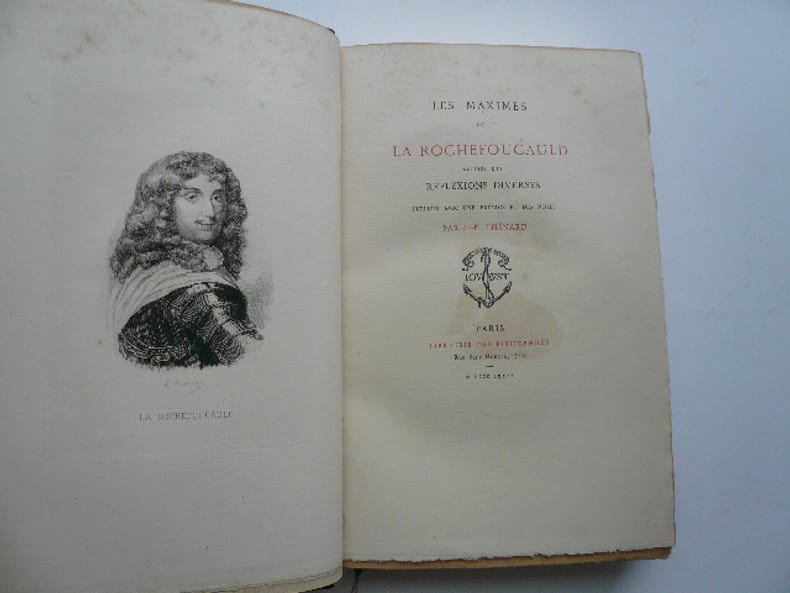
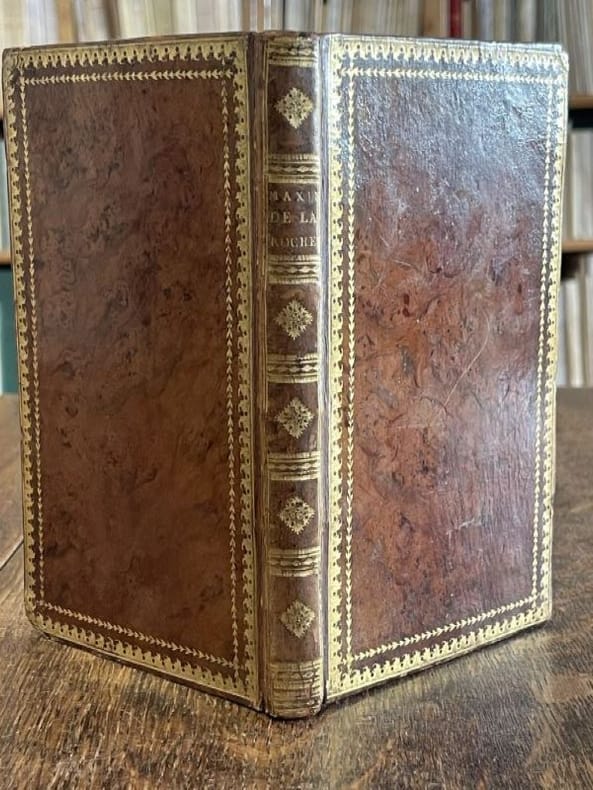
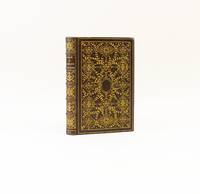
1892ST17001Paris: Imprimé par D. Jouaust Librairie Des Bibliophiles E. Flammarion Successeur 1892. 188 x 104 pp. 6 3/4 x 4 1/4". XL 290 pp. 1 leaf.Preface and notes by J.-F. Thénard. With the autobiographical essay "Self-Portrait by Himself" from the 1665 first edition the introductions to the 1665 and the 1678 fifth editions maxims removed from earlier editions and the posthumously published essays "Reflections." <br/> EXQUISITE DARK BROWN MOROCCO EXUBERANTLY GILT IN THE FANFARE STYLE BY ZAEHNSDORF stamp-signed in gilt on front turn-in blind Exhibition stamp on rear doublure covers with fillet border enclosing a panel with central oval strapwork medallion surrounded by rows of geometric ornaments with sprays of leafy fronds connecting them and filling the space between raised bands spine compartments with central geometric ornament with leafy cornerpieces gilt lettering turn-ins with gilt fillets accented with leaf sprigs crimson silk doublures and free endleaves all edges gilt. Printer's device on title page. Front flyleaf with quote in French from the text "It is more necessary to study men than to study books" and "Christmas 1895" written in ink; recto of rear free endleaf with Taplow Court library label of William Grenfell Baron Desborough. ◆Minor soiling to flyleaves very faint browning to edges of leaves otherwise very fine the text clean and fresh and in a virtually unworn binding bright with gilt.<br/> <br/> This comprehensive edition of the French moralist's famed collection of epigrams is offered here in a binding done in the fanfare style popular when this work was first printed. After a turbulent youth of court intrigue and aristocratic rebellions against King Louis XIII François Duc de La Rochefoucauld 1613-80 settled into a quiet life in the Parisian salons of Madame de Sablé Madame de Sévigné and Madame de La Fayette. It was among this intellectual witty society that he honed the pithy epigrams that would have such an influence on French literature and culture. As the Oxford Companion notes "The high degree of polish in the phrasing of the 'Maximes' which excel in conciseness precision and appropriateness of expression is to some extent due to discussions among his friends . . . . The work is a collection of some 500 gnomic sentences in which the author analyses the motives of human conduct with merciless penetration. While he recognizes in rare cases the existence of pure virtue and disinterested sentiments he finds them tainted almost universally with some element of self-love or interested motive." Voltaire drew on La Rochefoucauld's views when writing "Candide" and the "Maximes" impacted the works of French writers from Stendhal to André Gide as well as philosopher Friedrich Nietzsche and English novelist Thomas Hardy. The duke's worldview would have resonated with former owner William Grenfell Baron Desborough 1855-1945 a sportsman and indefatigable public servant who was one of the founding members of The Souls fl. 1886-1900 an elite group of friends whose social gatherings for intellectual discussions were perhaps Victorian London's closest approximation of a Parisian salon. Although other members included prominent and accomplished men and women it was the parties given by Grenfell's wife and fellow Soul Ettie that attracted guests like Vita Sackville-West H. G. Wells Edith Wharton Oscar Wilde Edward VII when Prince of Wales and Winston Churchill. One can easily imagine one of the Souls presenting this volume to the Grenfells for Christmas in 1895.<br /> <br /> By one of the great London workshops the binding here is a modified example of the fanfare style of decoration popular in France from the late 16th to mid-17th century. The main features of this style in Glaister's words "are interlacing ribbons" that form "compartments of various shapes with emphasis given to a central compartment." Ornaments made with small hand tools "fill all the compartments except the central one and almost completely cover the sides." The fanfare style is perhaps most frequently associated with the work of Nicolas and Clovis Eve court binders and booksellers to successive kings of France from about 1578 to 1634. It is generally believed that the term "fanfare" actually took its name from an early 17th century music book the title of which begins with the word "fanfare" acquired by the bibliophile Charles Nodier in 1829. The book was bound for Nodier by the famous Parisian binder Joseph Thouvenin using an appropriately retrospective design in imitation of the Eves' style which from that point forward came to be known as "fanfare." The Zaehnsdorf bindery produced a number of bindings in this genre with their usual expertise. Hungarian-born Joseph Zaehnsdorf 1816-86 served his apprenticeship in Stuttgart worked at a number of European locations as a journeyman and then settled in London where he was hired first by Westley and then by Mackenzie before opening his own workshop in 1842. His son and namesake took over the business at 33 when the senior Joseph died and the firm flourished under the son's leadership becoming a leading West End bindery. Over the years Zaehnsdorf employed a considerable number of distinguished binders including the Frenchman Louis Genth who was chief finisher from 1859-84 and trained a number of others including Roger de Coverly and Sarah Prideaux. A family-run business until 1947 the Zaehnsdorf bindery continued to produce consistently attractive tasteful and innovative designs executed with unfailing skill. It is generally understood that the Zaehnsdorf firm reserved the use of its oval stamp showing a binder at work for their finest bindings including those entered in exhibitions. [Imprimé par D. Jouaust] Librairie Des Bibliophiles, E. Flammarion, Successeur unknown
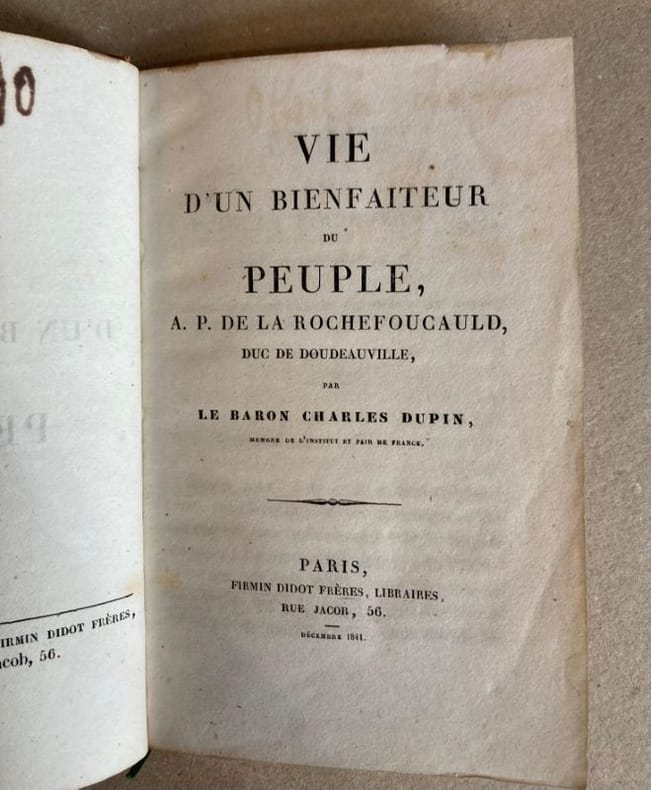
184114170Paris FIRMIN DIDOT 1841 1 A. P. de la Rochefoucauld, duc de Doudeauville, par le baron Charles Dupin, membre de l'Institut et Pair de France. Paris, Firmin Didot, décembre 1841, petit in-12, demi-basane fauve, dos lisse, titre estampé doré, 84 pages, (Simier Relieur).
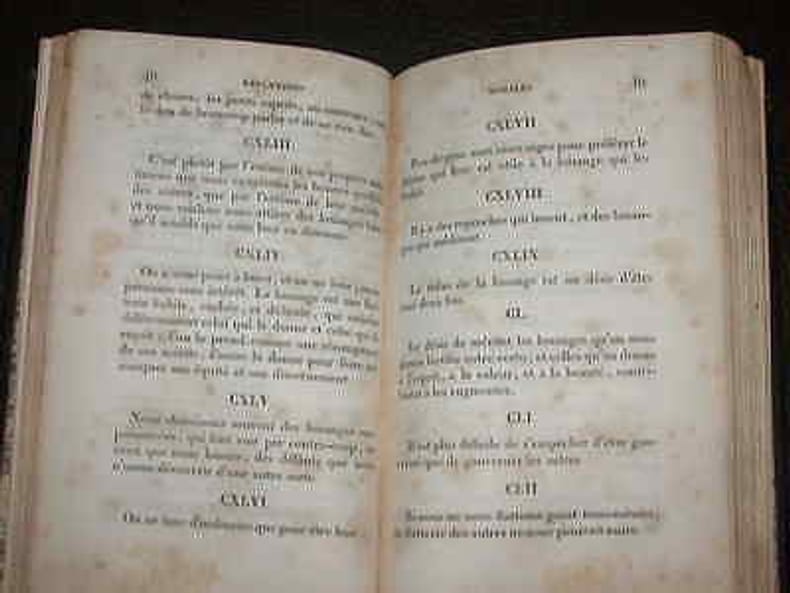
1827A2477Paris, chez Lefevre, 1827 ; in-8, 1 frontispice + 248 pp., broché d'époque. La Rochefoucauld appartenait à l’une des plus anciennes et illustres familles de France et mena une vie des plus intenses. Comme ses ennemis puissants (Richelieu, Mazarin…) il fut embastillé de nombreuses fois, obligé aussi de désavouer ses mémoires pour cause de scandale. Il fut blessé de nombreuses fois. Voici deux maximes que j'apprécie tout spécialement: «Il est plus difficile de dissimuler les sentiments que l'on a que de feindre ceux que l'on n'a pas», «Il n'est pas si dangereux de faire du mal à la plupart des hommes que de leur faire trop de bien». Bon état.
1870LTH20-B-17London: John Camden Hotten c1870. Leather. Very Good. 6" by 4.5". None. A collection of four critical works bound as one volume. With portrait frontispieces of the authors to the first two works. All four of the works are undated dated from Copac. Diversions of The Echo Club is subtitled as a companion to the Autocrat of the Breakfast Table by Oliver Wendell Holmes. It is an imitation and parody of various poets. La Rochefoucauld's Reflections and Moral Maxims are an incredibly famous collection of thoughts and feelings. They were originally published anonymously but soon established his position among men of letters. There are a total of 504 maxims which reflect on various subjects such as the conduct and motives of mankind. The Book of Clerical Anecdotes is subtitled as 'a gathering from many sources of the antiquities humours and eccentricities of 'the cloth.'' The collection of anecdotes are sourced from several places including biographies history works newspapers and periodicals. The final work to this volume The Relations between America and England is subtitled as 'a reply to the late speech of Mr Sumner'. It is written by Goldwin Smith a British historian and journalist of the late nineteenth century. In a half calf binding with paper covered boards. Externally generally smart with slight rubbing to the head and tail of spine joints and extremities. Small patches of rubbing to the rear paper covered board. Internally firmly bound. Pages are age toned particularly to edges with scattered spots to endpapers. The odd spot throughout. Very Good John Camden Hotten hardcover
1829RO40243292Au Bureau des Editeurs, Paris. 1829. In-18. Relié demi-cuir. Bon état, Couv. convenable, Dos satisfaisant, Quelques rousseurs. 232 + 179 pages. 2 ouvrages en 1 volume. Auteurs et titres dorés sur le dos. Plats des ouvrages brochés conservés. Etiquette de code sur la couverture. Quelques tampons et annotations de bibliothèque. Dos légèrement insolé.. . . . Classification Dewey : 840.05-XVIII ème siècle
1896183258Paris, Lecene, Oudin et Cie. 1896. M. Portr. 238 S. Hlwd. M. kl. Rgoldpräg. Kanten kaum berieben.
1878119025Paris Berche et Trlin Paris Berche et Trlin 1878, In-8 relié demi chagrin rouge, plats de percaline rouge, dos à nerfs trés orné. Fer du Lycée de Limoges au 1° plat. 314 pages. Bon état.
1866241014Bibliothèque nationale 1866 192 pages in16. 1866. Broché. 192 pages.
1869182041869 un volume, reliure plein maroquin rouge in-douze oblong (full morocco in-12 oblong), (19,2 x 11 cm), Reliure d'Epoque signée "Capé Masson-Debonnelle", dos à nerfs (spine with raised bands), décoration or (gilt decoration) à filets et roulettes or (gilt lines and fillets), titre frappé or dans un encadrement d'un filet or, entre-nerfs à fleuron à la "Du Seuil" au fer plein (between the raised bands floweret with full blocking stamp) avec rinceaux aux angles, filet perlé "or" en place des nerfs, rinceaux en tête et en pied (top and at the foot of spine with foliages carried out with the curved line), plats décorés "or" d'un encadrement d'un triple filet or et dentelle sur les chasses (lace-like decoration on the turn-ins), toutes tranches dorées (gilt edges), Tirage limité à 333 Exemplaires comme suit : 3 exemplaires sur parchemin, 15 exemplaires sur Chine, 15 exemplaires sur Whatman et 300 exemplaires sur papier Vergé (Ici Exemplaire N°26 sur Whatman), EX-LIBRIS manuscrit à la mine de plomb en haut de la première page de garde : " Baron G. (gaëtan) de Wismes Nantes ", sans illustrations (no illustration) excepté une vignette "marque de l'Editeur" en bas de la page de titre gravée sur bois en noir + Bandeaux, lettrines et cul-de-lampe gravés sur bois en noir, plats trés légèrement décolorés, XII-140 pages, 1869 Paris : D. Jouaust Editeur,
186985101869 br. (débroché). in-12, XII-139pp;, P. Jouaust 1869,
1853RO80258632Furne et Cie. 1853. In-8. Relié. Etat d'usage, Coins frottés, Dos satisfaisant, Quelques rousseurs. XV + 438 pages. Titre doré au dos. Frontispice illustré en noir et blanc sous serpente. Deux photos disponibles.. . . . Classification Dewey : 840.04-XVII ème siècle
188174009Paris, Librairie des Bibliophiles. Imprimé par D. Jouaust., 1881, in-8, Demi-chagrin marron à coins, dos à cinq nerfs, tête dorée, signet., XL, 290pp pages. Bel exemplaire. Pâles rousseurs uniquement sur la page de titre sinon exemplaire de toute fraîcheur dans une reliure en parfait état de conservation.
1829ROD0045419AU BUREAU DES EDITEURS. 1829. In-18. Broché. Bon état, Couv. convenable, Dos satisfaisant, Intérieur bon état. 179 pages non coupées.. . . . Classification Dewey : 840-Littératures des langues romanes. Littérature française
1855RO80046919FIRMIN DIDOT FRERES. 1855. In-12. Relié demi-cuir. Bon état, Couv. convenable, Dos satisfaisant, Quelques rousseurs. 345 pages. Titre, fleurons dorés sur le dos cuir rouge.. . . . Classification Dewey : 840.08-XIX ème siècle
1878RO40144183Librairie de Firmin Didot et Cie. 1878. In-12. Broché. Etat d'usage, Plats abîmés, Dos abîmé, Rousseurs. 345 pages. Papier et étiquette de code collés sur le dos. Tampons sur le 1er plat et en page de titre. 1er plat se détachant.. . . . Classification Dewey : 840.05-XVIII ème siècle
1883RO20046129DAMASCENE. 1883. In-8. Broché. Etat d'usage, Couv. défraîchie, Coiffe en tête abîmée, Rousseurs. 129 pages. Bandeaux, culs-de-lampes et lettrines illustrés en noir et blanc. Plats légèrement abîmés sur les bords. Quelques pages non coupées.. . . . Classification Dewey : 840.04-XVII ème siècle
1858R260124368LIBRAIRIE DE FIRMIN-DIDOT FRERES, FILS ET Cie. 1858. In-12. Broché. A relier, Couv. légèrement passée, Dos abîmé, Quelques rousseurs. 342 pages. Manques au dos, coupé en deux parties. Pages non coupées.. . . . Classification Dewey : 840-Littératures des langues romanes. Littérature française
180297731Paris Pierre Didot l'aîné et Firmin Didot 1802 1 vol. relié in-12, plein veau marbré, dos lisse orné de filets et fleurons dorés, double frise dorée en encadrement des plats, guirlande intérieure dorée, guirlande dorée sur les coupes, coiffes guillochées, tranches dorées, 120 pp. Belle édition stéréotype sur vélin d'après le procédé de Firmin Didot dans une fine reliure de l'époque.
180297731Paris Pierre Didot l'aîné et Firmin Didot 1802 1 vol. relié in-12, plein veau marbré, dos lisse orné de filets et fleurons dorés, double frise dorée en encadrement des plats, guirlande intérieure dorée, guirlande dorée sur les coupes, coiffes guillochées, tranches dorées, 120 pp. Belle édition stéréotype sur vélin d'après le procédé de Firmin Didot dans une fine reliure de l'époque.
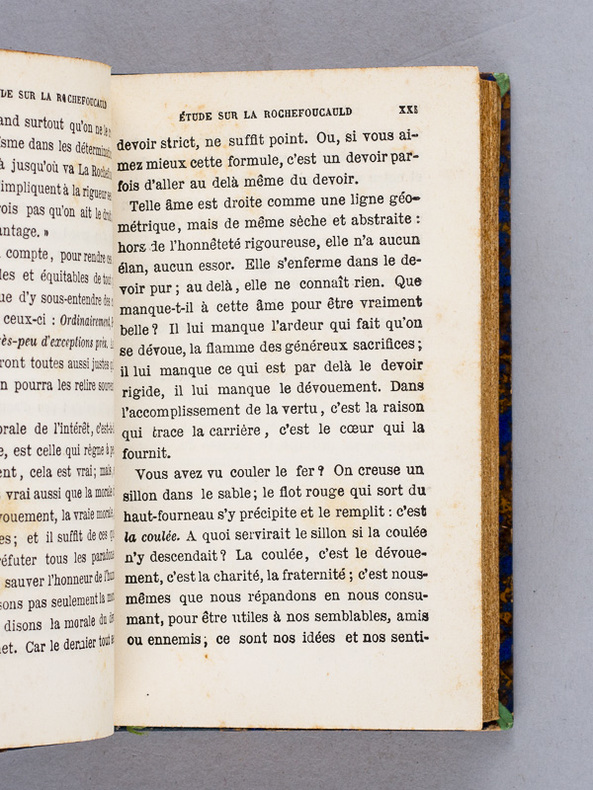
188649807Maximes et Réflexions Morales précédées d'une étude par Emile Deschanel, 1 vol. in-18 reliure demi-maroquin bleu, dos à 4 nerfs dorés orné, Bibliothèque Nationale, collection des Meilleurs Auteurs anciens et modernes, Librairie de la Bibliothèque Nationale, Paris, 1886, 192-192 pp.
18294866Paris Au bureau des éditeurs 1829 179 pages in-12. 1829. relié. 179 pages. - 2ème édition. In-12 (144x92 mm) 179 pages. Livre relié Plein cuir Dos lisse orné de motifs dorés Plats de la couverture conservés. Suivies des réflexions et maximes choisies de Vauvenargues.Reliure en bon état général. Intérieur avec rousseurs laissant une lecture satisfaisante. Poids : 190 gr
181733362Paris Ant. Aug. Renouard 1817 In-12 illustré, 2 parties reliées en 1 volume : xv et 98p.; x, 329p. et 4f. (catalogue de l'éditeur).
1883RO40127597Garnier Frères. 1883. In-8. Broché. Etat d'usage, Plats abîmés, Dos abîmé, Quelques rousseurs. 469 pages. Gravure en noir et blanc (portrait) en frontispice. 1er plat taché et se détachant.. . . . Classification Dewey : 840.04-XVII ème siècle
1883RO40202737Librairie Hachette et Cie, Paris. 1883. In-8. Broché. A relier, Plats abîmés, Dos abîmé, Non coupé. 158 pages. Dos très abîmé, avec manques. Cahiers se détachant. Manques sur les bords des plats. Fortes mouillures et quelques rousseurs dans le texte.. . . . Classification Dewey : 840.08-XIX ème siècle
1868RO40237988Librairie Hachette et Cie, Paris. 1868. In-8. Relié demi-cuir. Etat d'usage, Couv. convenable, Dos très frotté, Rousseurs. 118 + 492 + 158 pages. Titre dorés sur le dos. Etiquette de code sur le dos. Tampons de bibliothèque en page de titre. Epidermures sur le dos.. . . . Classification Dewey : 840.08-XIX ème siècle